Writer, Critic, Poet, Educator, Artist — Reflecting on the William H. Gass Centenary

I was invited to deliver this paper at the Louisville Conference on Literature and Culture, Feb. 2025, but unfortunately a bout of influenza prevented my attending. I had written the paper ahead of time, so I post it here, as an undelivered address. I did not finely tune as I normally would (given my weakened condition).
This past year, 2024, marked the centenary of William H. Gass (1924-2017), who is perhaps best known as the author of the postmodern mega-novel The Tunnel, both revered and reviled by reviewers when it landed in 1995. Via conferences here in Louisville and the American Literature Association Conference in Chicago, a day-long program at Washington University in St. Louis, and the forthcoming collection William H. Gass at 100: Essays, the many aspects of Gass’s literary contributions to both American and international letters were emphasized and examined. This paper will survey some of the most vital takeaways regarding Gass’s work, especially in areas not typically addressed, like Gass the poet, Gass the teacher, Gass the mentor, and Gass the photographer. The centenary made clear that William Gass has admirers around the world, and this paper offers a plethora of little-explored avenues for continued Gass scholarship. What is more, translations of various Gass texts are underway, and this paper will speak to some of that work as well (especially the project of translating Cartesian Sonata and Other Novellas into the Greek language, detailing some of the specific issues raised by the translator).

Before talking about 2024 and beyond, I would like to go backward … to 2020, which marked the 25th anniversary of the publication of The Tunnel. That year was the abyss of the Covid pandemic, and nearly everyone was hunkered down in their homes. It occurred to me that the 25th anniversary should be noted, and it could be done online as well as during an in-person event; thus, I conceived of thetunnelat25.com, a website that would publish various contributions by Gass scholars, aficionados and fans regarding the 650-page, postmodern behemoth. Working with Mary Henderson Gass and Catherine Gass (the author’s widow and daughter), I assembled a list of “Gass people” and reached out via email. Responses were enthusiastic, although not everyone felt that they could contribute. Nevertheless, the project took shape. I was actually supposed to deliver a paper on The Tunnel at 25 project at this conference in 2022, but a conflict prevented my attendance. Let me take you on a quick tour of thetunnelat25.com, and highlight some material that is appropriate to our topic today. (You’ll have to tour on your own.)
One of the pieces I contributed to the project was “Stripping the Master of Kohler’s Rags,” and here is an excerpt:
[Begin excerpt]
“People, in my view, are many people. It’s not that we fall apart all the time into separate personalities, but under certain circumstances we display different values and feelings and modes of thinking” (Ziegler, “WHG in Germany” 115). Thus said William H. Gass when asked about the department colleagues of William Kohler, the narrator of The Tunnel. That is, Kohler’s fellow historians (Culp, Governali, Herschel and Planmantee) “each represents a theory of history, and each gets his own little story.” Like so much else in The Tunnel, it is not clear whether Kohler is describing actual colleagues, or, rather, projections of his own multifaceted personality. “I wanted to leave the ontological status of these characters in doubt,” said Gass. “Either these are real people in his world […] or they are simply aspects of his own personality mildly at war with one another” (115).
Given that one of the consistent complaints about The Tunnel when it appeared in 1995 was that its protagonist, Kohler, seemed uncomfortably similar to the author himself, the idea of multidimensional personalities is well worth exploring in a symposium that hopes to re-introduce the reading public to Gass’s magnum opus. There was the name, of course: the given name of William paired with a family name of German ancestry. There was the occupation: a professor at a Midwestern university, one quite like Purdue, where Gass was teaching when he began writing the novel. There was the affinity for many of the same writers: most notably the German poet Marie Rainer Rilke, perhaps Gass’s greatest influence. Over time, another similarity became the length of time Kohler took to write his magnum opus, Guilt and Innocence in Hitler’s Germany: thirty years, four more than the number Gass required to complete a book he imagined finishing in just a fraction of that time. These are only some of the correspondences between the author and his narrative creation, William Frederick Kohler.
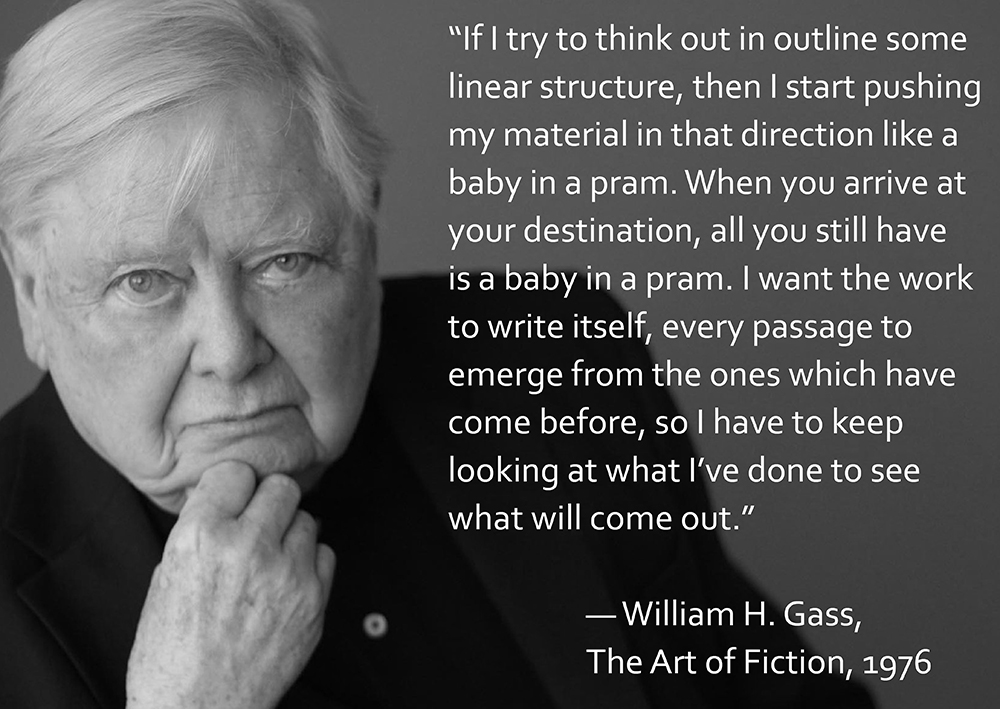
The similarities became troubling for readers and reviewers because Kohler is, well, not nice. In fact, he’s something of a monster. He is mean-spirited toward essentially everyone who has the misfortune of inhabiting his sphere, and he’s downright hateful to his wife, Martha, whom he thinks of as a “guard” that is confining him within the prison of his unhappiness. She has become essentially a non-person to him: “Martha’s face fades as her torso solidifies, her Aryan blood surfacing like lard. I work on her features, but I’ve forgotten what they are[.…] Without a mouth she’ll still talk back, from her crack like as not” (150-51). Worst of all, Kohler’s scholarly work on the Nazis appears more sympathetic toward them than many would like, including the administrators at his university (“those shit-resembling administrators,” he calls them) who overlook him for promotion because they consider him a “Nazi-nuzzler” (133). If Kohler seems to have a soft spot for Nazis and refers flippantly to the Holocaust, he must therefore be anti-Semitic; and if Kohler is an avatar for Gass himself, then the author, too, must be … so went the logic.
Gass anticipated readers who didn’t know how to read well would conflate the persona of the protagonist with the person of the author: “The resemblances between myself and my narrator are wholly trivial, I think, but I did emphasize them in order to test the reader’s sophistication (a test many reviewers failed). […] Unfriendly reviewers delight in the opportunity to clothe me in Kohler’s rags.” Against such charges, Gass pushed back, saying, “[T]he record will show, I believe, that I do not belong in Kohler’s camp” (Ziegler, “WHG in Germany” 116). (You will find the Works Cited at project site.)
The distinction between the author and his creation is a vital one to make as we attempt to read The Tunnel afresh in 2020, on its twenty-fifth anniversary.
[End excerpt]
As you will see in today’s talk, The Tunnel remains a special focus of Gass scholarship and appreciation. In light of that I will also call your attention to another of my contributions to the website: “The Tunnel: A Chronology & Bibliography,” (link) which documents Gass’s progress from its conception in 1966 to its publication in 1995 and beyond. The novel has a complicated publishing history, and my hope is that I will save scholars time and trouble tracking when attempting to piece together and track down the scattered excerpts of The Tunnel. As a writer myself, I always found it interesting that Gass seemed to have concept of how long the writing of the novel would take; so I’ve included quotes from Gass over time as he continued to reassess where he was in the process. Even from the start, completion of the novel always seemed to him a few years away. A complimentary piece at the website is Joel Minor’s “The Tunnel: A Survey of Published Excerpts,” [link] which takes a more scholarly, strictly bibliographic approach to the same sort of information I provide in my “Chronology & Bibliography.”
Let me return to 2024 … or rather December 2023, which is when I posted my first “William H. Gass at 100: A Reading Journal,” [link] in which I describe how I first encountered Gass via his novella (or long story) “In the Heart of the Heart of the Country.” I begin by saying, “As a Gass scholar and devotee (disciple isn’t too strong of a word), I have various projects in the works to mark the Master’s 100th year — all part of my ‘preaching the Gass-pel,’ an evangelism I embarked on more than a decade ago. No doubt I will use this forum to talk about some of those Gass Centenary projects, which tend to be formal and scholarly. It occurred to me that I also wanted to do something less formal, and more personal. It is not an overstatement to say that William H. Gass changed my life. His writing, his theories, his example as torchbearer in the cause of literature: everything has impacted me in ways that I can name and, doubtless, in ways that I cannot.”

My intention was to post a new reading journal, including a new video, periodically throughout 2024. It didn’t quite workout that way (as I feared). I included my various contributions to the Gass Centenary as journal entries, although that isn’t what I had in mind back in December 2023. One such contribution was my paper delivered here a year ago: “William H. Gass at 100: Looking Forward, Looking Backward” [link], which focuses mainly on the backward part as I provide a biography of Gass and his most notable works for the majority of the paper. Sadly, I’ve discovered that Gass is not especially well known, even in literary circles, so describing his career and achievements is necessary.
After the Louisville Conference paper, the next significant event was a panel at the American Literature Association Conference in Chicago in May 2024. In the panel, Joel Minor presented his Tunnel bibliography from thetunnelat25.com project; Ali Chetwynd (American University of Iraq, Sulaimani) presented “Literary Theory Teaching: Founded on William Gass”; and I presented “Let Us Now Praise William Gass’s Greatest Work – And It’s Not the One You Think” [link]. While I am, of course, a fan of The Tunnel, and I’ve presented several papers and published a few on Gass’s magnum opus, I don’t believe it was the most masterful of the master’s work. Rather, artistically, I feel that Cartesian Sonata and Other Novellas represents the pinnacle of his literary achievements. I’ll share the final paragraphs of that paper:
[Begin excerpt]
Though my catalog is incomplete, I’ll end where I began, with The (large, loose, baggie) Tunnel. Gass’s ambitions for the novel were epic, and it took him far longer—far longer—to write than he anticipated. He imagined, maybe, three years or so … let’s say, then, a publication date around 1970. But time marched on and the Master aged along with his aim for the book. He had about 600 manuscript pages in hand when, in 1991 (age 67), he went for an extended stay at The Getty Center in Santa Monica to devote himself fully to finishing the legendary book. Working into 1992, he doubled the size of the novel, completing it at about 1,200 manuscript pages. Begun in the sunny summer of literary postmodernism, the first half of the book displays many of the tropes and tricks that interested Gass in the 1960s and 70s—it resembles in many ways Gass’s wildly experimental novella Willie Masters’ Lonesome Wife (1968)—an experiment that Gass himself deemed a failure in retrospect.5 Though The Tunnel doesn’t quite conform to the chronology of its composition, the latter half doesn’t display the same fondness for postmodern play as the beginning sections do. Released at last in 1995, it was as if the postmodern novel had arrived at the party after practically all the guests had collected their coats and gone home to sleep it off.
Perhaps Gass wittily but unwittingly anticipated the fate of The Tunnel when he wrote the preface to In the Heart of the Heart of the Country (revised 1981):
“I write down these dates, now, and gaze across these temporal gaps with a kind of dumb wonder … hodge against podge, like those cathedrals which have Baroque porches, Gothic naves, and Romanesque crypts; time passed, then passed again, bishops and princes lost interest; funds ran out; men died; … and because they were put in service while they were still being built, the pavement was gone, the pillars in a state of lurch, by the time the dome was ready for its gilt or the tower for its tolling bell …” (xxxii).
We still ought to attend service in William Gass’s great cathedral, but our warmest words of worship should be reserved for Cartesian Sonata and Other Novellas.
[End excerpt]
Gass was born in Fargo, North Dakota, though he moved from there to Warren, Ohio, when still a baby. Nevertheless connections to North Dakota remained, and I attempted to organize some sort of event or conference in Fargo or nearby in the summer of 2024, ideally around Gass’s birthday, July 30. Unfortunately no one locally seemed to have the time or money or interest. Perhaps one day I’ll resume my efforts. Therefore, the next significant event was at Washington University in St. Louis October 3, “William H. Gass Centenary Celebration” [link]. The main event was a panel discussion that I had the honor of moderating. It included Patrick Davis (Unbound Press), Michelle Komie (Princeton University Press), and Gerhild Williams (Washington University German Department, retired). Much of the informal discussion focused on Gass’s founding and directing of the International Writers Center (1990-2000).
One of the more intriguing revelations from the panel discussion was that Patrick Davis, of Unbound Press, plans to republish The Tunnel in the form that Gass always had in mind: a loose collection of about 1,200 manuscript pages, and stuffed with things like paper bags, business cards, and crossword puzzles. Its publication may coincide with the novel’s 35th anniversary. I hope that it comes to pass.
Interest in Gass’s work persists, if not as robustly as enthusiasts like me would prefer. Last year I was contacted by Apostolis Pritsas, who was translating Cartesian Sonata and Other Novellas into Greek, and he requested my informal consultation. I was happy to do it, and we exchanged a few emails over the summer and fall. The two novellas that generated the most questions were “Cartesian Sonata” and “Emma Enters a Sentence of Elizabeth Bishop’s”—both highly experimental works in terms of structure and narrative chronology. The Greek edition is slated for an early March release. Meanwhile, a Spanish-language edition of Cartesian Sonata appeared [link], which changes the order of the novellas, totally undercutting Gass’s concept of the collection.
Finally, I plan to edit, contribute to, and publish William H. Gass at 100: Essays later this year. Contributions include the following: “‘Inward Toward the Other’: The Dancing Minds of William H. Gass and Toni Morrison” by Jose Miguel Alvarado Mendoza; “In Search of William Gass” by Zachary Fine; “William Gass and the Power of Baroque Fictionality” by Yonina Hoffman; “The Meta-Novel as a Container of Self-Consciousness: Linguistic Order and Fascism of the Heart in William H. Gass’s The Tunnel” by Abbie Saunders; “Broken Windows and Dirty Mirrors: Metaphor and Mind in The Tunnel” by Jonathan Moreland; “Defying Form” by Nathan King; “To Create or Capture Consciousness: Reconsidering William H. Gass as ‘The Father of Metafiction’” by Alex Lanz; and “Medium-Specific Foundations: Teaching Literary Theory Across the Gass-Axis” by Ali Chetwynd.
I will draw from several of my Gass conference papers to put together a constellation of pieces, and I also will include a selection of Gass’s photographs. He was a serious photographer, but that aspect of his artistic life has received little attention.

 12 Winters Blog
leave a comment