Digital Resources that Facilitate the Study of English through Its Various Stages
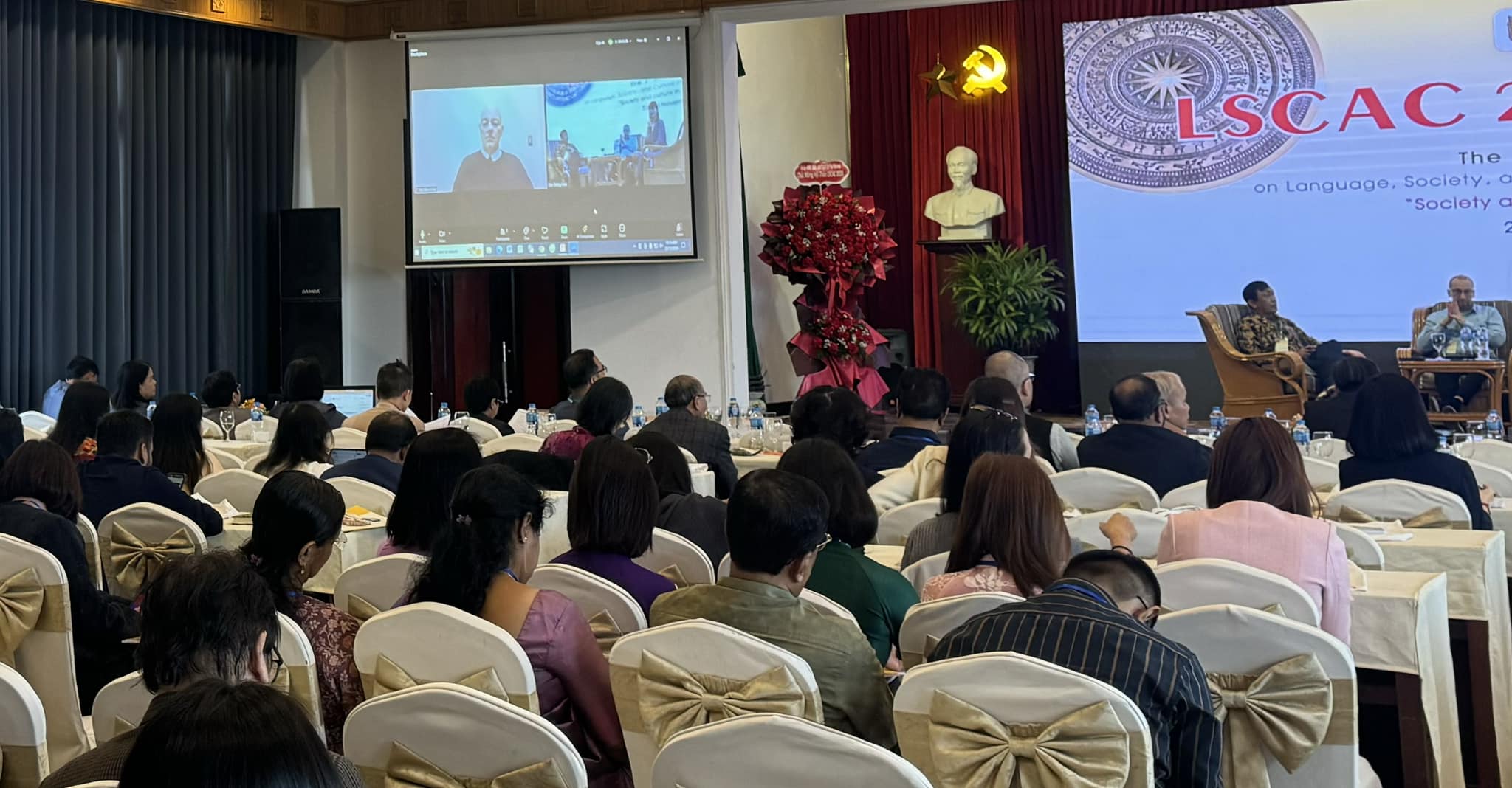
This text—“Digital Resources that Facilitate the Study of English Through Its Various Stages: Old, Middle and Modern”—was a keynote address at the 7th International Conference on Language, Society and Culture in Asian Contexts, organized by The Institute of Cultural Anthropology, held in Hue, Vietnam, November 22-24, 2024. It was delivered remotely concurrently with a translation into Vietnamese.

This paper has a few modest goals. Principally, I want to identify various digital resources that facilitate the study of the English language, from its earliest form to the present. In particular I will focus on the poem known as Beowulf, which was composed in the earliest form of recognizable English, called either “Anglo-Saxon” or “Old English.” I also want to suggest reasons why students in Asia may find such study both useful and engaging. What is more, a program in Old English and related subjects at Nanjing University in China provides a precedent of success for such study.

First, some background information regarding the evolution of English through its three phases as an identifiable language: commonly known as Old English, Middle English, and Modern English. It is convenient to begin a discussion of English with the retreat of the Romans, who colonized and occupied the island of Britain for approximately 350 years, until A.D. 410. Under Roman rule, Latin was the dominant language. However, in the sudden absence of Roman control, a language emerged that was greatly influenced by native tribes in (current-day) England and Scotland, as well as Germanic and Scandinavian groups arriving from mainland Europe. Though dialects varied widely, this language has become known as “Old English.” It’s worth noting that a synonym for Old English used by many is “Anglo-Saxon,” but it’s a term that has fallen further and further out of favor in recent years for a variety of reasons. Nevertheless, when searching for information about Old English, one definitely would want to include the phrase Anglo-Saxon and recognize that they are referring to the same language and literature.
The language we call Old English was the dominant language throughout Britain until the dramatic events of 1066, when the French-Norman King William (also known as “William the Conqueror”) defeated the Anglo-Saxon King Harold at the Battle of Hastings, in southeast England. The quickly ensuing “Norman Conquest” of England led to the evolution of Old English into the language we term “Middle English,” a hybrid of the native language and the French-Norman language (also known as “Old French”), which was spoken by William, his army, and the thousands of his subjects who flooded into England over the next two decades. Middle English, then, is derived from both the Germanic branch of languages and the Latin branch (so-called Romance languages). It is a gross oversimplification, but essentially Old English words were largely retained, but the mechanics associated with syntax and conjugation were adopted from Old French (that is, French-Norman).

Middle English was the dominant vernacular from, roughly, 1100 to 1430, when, mainly due to bureaucratic necessity, a standard language was adopted by law. This government-sanctioned language was the beginning of what we call “Modern English.” It is worth noting that the adoption of this standard form of English was more or less concurrent with the invention and development of the printing press in the West—a fact which has led to the difficulties of spelling modern English. With the advent of mass printing, when English was still using phonetically spelled Middle English vocabulary, those spellings were in essence frozen in time. Meanwhile, spoken English continued to evolve, which was primarily a process of simplification. For example, many two-syllable words (like bake, cake and take) became pronounced as one-syllable words; yet English retained their Middle-English two-syllable spellings. Now we say such words have a “silent e.” We have many silent letters and letter combinations in modern English because words continue to be spelled in their Middle-English forms but spoken in simplified and streamlined modern English.
For different reasons, we have relatively little literature from either the Old English period or the Middle English period. We have a dearth of Old English texts because of their agedness and also because of deliberate destruction by King Henry VIII during his feud with the Catholic Church (monasteries—repositories of such texts—were burned to the ground). We have very few Middle English texts because they were written prior to the printing press and only exist in rare hand-copied illuminated manuscripts, and most writers during this period were composing in French (not in the common vernacular of Middle English). Therefore, the texts we have from these two language periods are treasured examples of England’s national literature. From the Old English period, the crown jewel is clearly the poem Beowulf (approximately A.D. 725). From the Middle English period, Geoffrey Chaucer’s The Canterbury Tales (circa 1380) stands apart.
The text of Beowulf exists in a single volume, copied by hand on vellum, dating from about the year 1000. The poem is one of four texts gathered into what is known as The Nowell Codex, housed in the British Library. The Codex is in poor condition, due to its antiquity, rough handling, and a famous fire in 1731 that could have destroyed it completely if not for a librarian’s quick action. Consequently, there are passages in the poem of 3,182 lines that are essentially unreadable and passages that have disappeared off the page entirely—which has led to a great deal of scholarly speculation. Old English is so far removed from modern English that contemporary readers must rely on the work of translators (to date there have been more than 350 modern-English translations of Beowulf).
Given the fragile condition of the Beowulf manuscript, it is extremely difficult to gain access to its crumbling pages. Luckily, there are many digital resources that can substitute for access to the original. Here I will identify only a small sample of such resources.
To examine the original Beowulf manuscript itself, the most useful resource is Electronic Beowulf: Index & Guide (https://ebeowulf.uky.edu/), made available by University of Kentucky and edited by the esteemed Beowulf scholar Kevin Kiernan. The site features high-resolution digital images of the Beowulf manuscript, page by page, searchable via a variety of options, including line number and word entry. There is a wealth of other information available at the site; I only provide the briefest sketch here.
Another especially valuable site is Fordham University’s Internet History Sourcebooks Project, edited by Paul Halsall. Again, it is a treasure trove of information, divided into three general categories: Ancient, Medieval, and Modern. Moreover, it is not limited to English texts (geographically). Given my focus here, I will underscore that it provides reliable texts of Beowulf in both Old English (https://origin.web.fordham.edu/halsall/basis/beowulf-oe.asp) and in translation, by Francis Gummere (https://origin.web.fordham.edu/halsall/basis/beowulf.asp).
There are numerous side-by-side translations available. That is, on one side of the screen is Beowulf in Old English and opposite is the modern-English translation. One such site is based on Seamus Heaney’s widely read translation (https://www.hieronymus.us.com/latinweb/Mediaevum/Beowulf.htm). Another especially ambitious bilingual site is Beowulf in Steorarume, edited by Benjamin Slade, who provides detailed hypertextual notes along with the side-by-side translation (https://heorot.dk/beowulf-rede-text.html). Perhaps the simplest and most straightforward bilingual edition available online is provided by Massachusetts Institute of Technology as Bilingual Beowulf in a downloadable PDF format (https://www.mit.edu/~jrising/webres/beowulf.pdf).

As I say, these are only a few of the countless online resources that provide the poem in Old English, in translation, or both. I believe them to be especially reliable. For assistance with Old English itself I recommend the “Old English dictionary” provided by Lexilogos: Words and Wonders of the World (https://www.lexilogos.com/english/english_old.htm); and I am especially fond of the site’s link to “Old English Translator” (https://www.oldenglishtranslator.co.uk/), a handy online tool for translating Old English words to modern English, or vice versa. For simplicity and thoroughness, I also like the Old English “Glossary” (http://www.oereader.ca/glos.htm) that can be quickly searched using the “find” function on one’s computer.
In addition to teaching the poem Beowulf for decades, I have been working on my own modern-English translation. All of the sources discussed above have been invaluable in my work as both a teacher and a translator. Of course, there are myriad printed texts that are of great importance, but they may not be readily available in all locations. Online resources tend to be.
In the interest of brevity, I will not go into as much detail regarding resources associated with Middle English, but they are just as copious as those dedicated to Old English and are easily found online. Here are three especially useful and well-vetted sources: Rider University Library’s “English Language History and Linguistics” (https://guides.rider.edu/c.php?g=420552&p=2872234); University of Michigan Library’s “Middle English Compendium” (https://quod.lib.umich.edu/m/middle-english-dictionary); and Harvard University’s “METRO Resources” (https://chaucer.fas.harvard.edu/metro-resources-0).
This topic was largely inspired by a program of study at Nanjing University in China. Professor Leonard Neidorf, a leading medieval scholar, teaches courses in Old English, Middle English, and Old Norse, as well as literatures composed in those languages. Chinese students complete both M.A. and Ph.D. degrees under Dr. Neidorf’s supervison, and they are widely published in English in the field of medieval studies. See Dr. Neidorf’s supervision page online (https://leonardneidorf.com/supervision). I have interacted with the students via Zoom; their erudition and enthusiasm are both obvious and impressive.

Beyond the inherent value of serious study, scholarship and publication, engaging with works like Beowulf can provide a bridge between cultures. Researchers in psychology, for example, have long been aware of myths, folktales and themes that appear ubiquitously across cultures. Claude Lèvi-Strauss developed his concept of “mythemes” as a way of identifying the structures that build similar narratives across cultures and languages. As just one small but obvious example, I will point to the dragon that appears in the final sections of Beowulf. Dragons, or dragon-like creatures, appear in stories on practically every continent, in untold numbers of cultures and languages, including, of course, the origin tales of Vietnam in the form of Lạc Long Quân. So, even in the stories of medieval England, in a language as remote as Old English (which was practically a dead language even among native English speakers for several centuries), students everywhere can find common elements that engage them both intellectually and emotionally.
Indeed, I believe that students who approach a poem like Beowulf from a cultural perspective that is definitively non-Western can detect aspects of the work previously unexplored through scholarship. In spite of intense academic study for more than 200 years, there remain an infinite number of new things to discover and to say about the old poem and its literary kin. My hope is that this brief presentation will spark interest in medieval studies, and that I have provided a few useful resources to begin to explore that interest.

 12 Winters Blog
leave a comment