Popular Fiction – An Historical Perspective
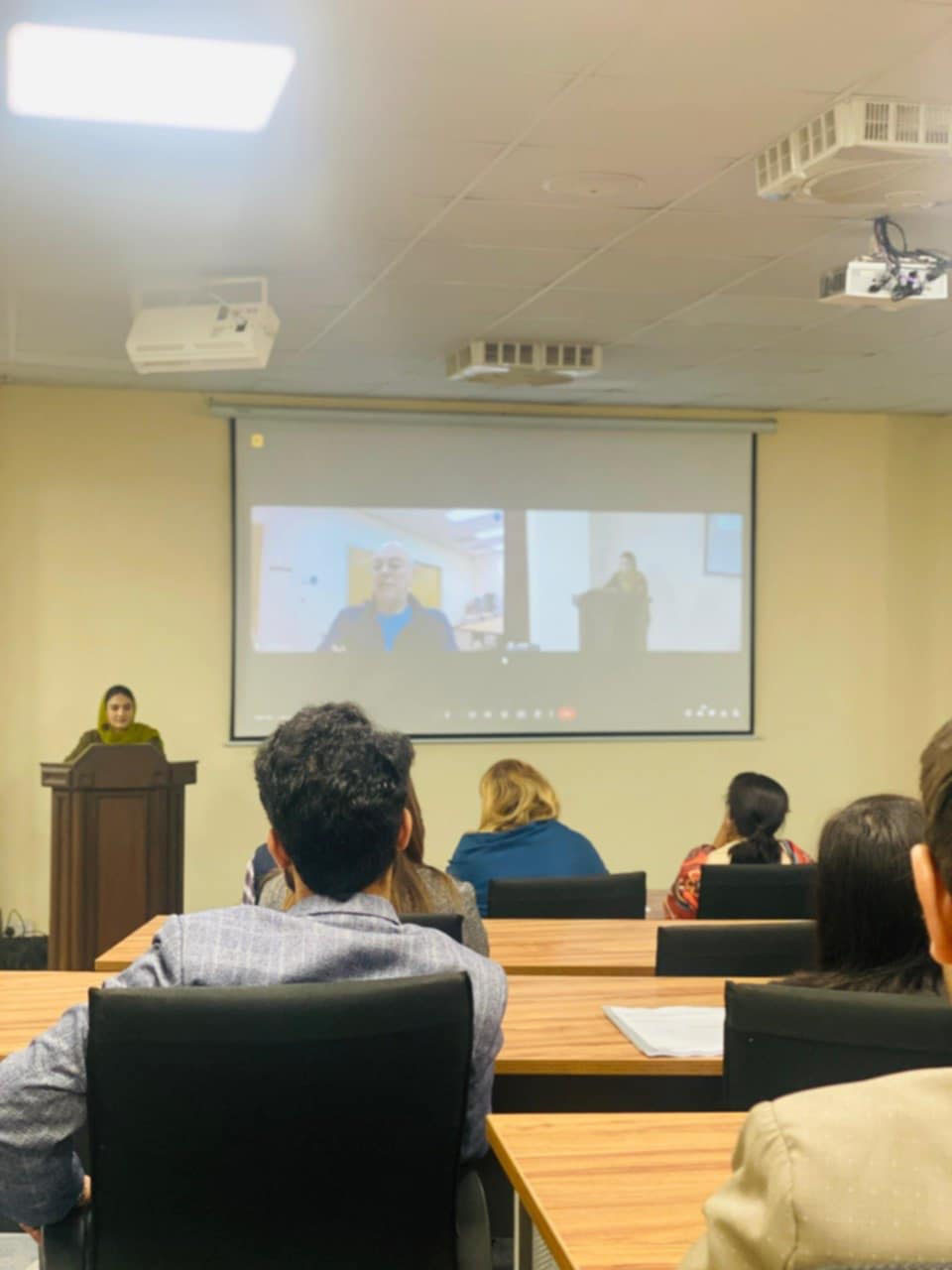
(The following lecture was presented remotely to students and faculty at the National University of Modern Languages, Islamabad, Pakistan, on February 12, 2025. It was at the invitation of and organized by Ms. Ambrina Qayyum, Dr. Amina Ghazanfar, and Ms. Farihatulaen Rizvi; with student organizers Moazzam Ali and Minha Iman.)

I begin with a quotation:
“Persons attempting to find a motive in this narrative will be prosecuted; persons attempting to find a moral in it will be banished; persons attempting to find a plot in it will be shot.” – the “Notice” that appears on the title page of Adventures of Huckleberry Finn, by Mark Twain (1884), considered by many the quintessential American novel. As you may know, Adventures of Huckleberry Finn is a picaresque novel narrated by the title character, Huck, who is about 13 years old. Huck and the escaped slave Jim travel down the Mississippi River on a raft, having a series of adventures along the way. I feel like beginning with this quotation is appropriate to our purposes here because the Notice seems to be the author’s warning to the reader not to take the book too seriously. Its purpose is entertainment, and thinking about loftier things, like the novel’s meaning, will not be tolerated. Mark Twain, whose real name was Samuel Clemens, was a master storyteller and satirist. So how serious was Clemens in his Notice? Did he truly not want readers to search for motive, moral, and plot in his book? If there was some sincerity to his Notice, it may have been because he anticipated that Huckleberry Finn would be a highly controversial book.
Sincere or not, his Notice was disregarded, and Adventures of Huckleberry Finn has been one of the most studied and discussed novels in American (and world) literature. And in spite of the seriousness that readers have found in the text, it became a fabulously popular novel and contributed to Mark Twain (aka, Samuel Clemens) becoming the most popular author in the U.S. by the end of the nineteenth century.
Let me leave Samuel Clemens and Huckleberry Finn for now.
I’ve been asked to speak on “popular fiction,” and I agreed even though at the time I realized the term was malleable in my mind. That is, I wasn’t completely sure what the term even meant. In the last month or so I’ve been looking into the topic – browsing the internet, reading articles, giving it some quasi-serious thought – and I can say with confidence that I’m still not sure what it means. I have, however, stumbled across a lot of interesting ideas associated with the concept of “popular fiction,” so I’ll share them with you (in the hope that you’ll find them interesting too). What is more, largely due to my roles as a writer and publisher, but also as a teacher of writing, I’ve been interested in the history of the publishing industry (in the West, and in particular the United States), and I’ve presented some conference papers on the topic. I will draw from these as well.

Let me begin with some assumptions and/or questions that first came to mind when considering this topic:
What do we mean by popular?
What is the measuring stick for determining popularity?
That is, how popular does a novel have to be to be considered “popular fiction”?
Can a novel be “popular fiction” without actually being popular?
Is popular code, or a kind of euphemism, for bad?
Is the previous question elitist?
How do we determine good versus bad fiction?
For that matter, who determines it?
If popular does mean bad fiction, what is the term for good fiction?
Again, how do we judge?
Again, who judges?
And if the fiction is so darn good, why isn’t it popular?
When did the idea of a book being a “bestseller” begin?
How is bestselling determined?
Ok, I’ll stop there for now. Let’s begin to consider these questions.
From one perspective, popular fiction is fiction (probably in the form of novels) that is read by a lot of people in a given culture. A book gains the label “popular fiction” by attracting a significant number of readers. From this perspective, books are not published as “popular fiction,” but they may become popular over time. Nowadays we call such books “bestsellers,” but that itself is a nebulous term. Quite honestly, until I started researching for this talk I didn’t know much about how a book (or an author) earns the epithet “bestselling.” For the last quarter century I’ve also worked as a librarian, and every week we add new titles to our shelves that are said to be bestsellers or by bestselling authors—books and authors, oftentimes, I’ve never heard of, which suggests that the standard for determining bestselling is fairly low. Low, of course, is relative, but my research has determined that the standard is both nonstandard and mysterious. What I mean by nonstandard is that different organizations will disseminate “bestseller” lists, and each will use its own criteria. In the U.S., we tend to think of The New York Times newspaper and its The New York Times Book Review as the arbiter of bestseller status, but, really, there are many bestsellers lists: Publishers Weekly, USA Today and Indiebound are among the more common publications that provide lists of bestsellers. Moreover, booksellers, like Amazon and Barnes and Noble, will put out their own lists of bestsellers. Complicating things further is the fact that each will put out multiple lists, based on categories of books and types of book (hardback versus paperback versus ebook).
Each entity and each list generated will have its own criteria for determining bestseller status. They’re all based on sales, kind of, but on data that comes from a wide variety of sources. I say “kind of” because the sales data can be rather fluid and open to interpretation, so that, in some lists more than others, the accolade of “bestseller” may be as much subjective impression as empirical conclusion. (Indiebound, for example, tends to rely more on booksellers’ hunches than actual hard sales figures.) Another nonstandard element is sales period. One list may be based on a week’s worth of sales, Monday to Sunday, say, (reported from here versus there), while another list considers data drawn from a different period of time, longer or shorter, or simply a different bracketing of time.
Even though numbers have nebulous meanings, for a frame of reference let’s look at The New York Times bestseller list. To make the list in a given week, a novel must sell between 1,000 and 10,000 copies. However, such sales do not guarantee inclusion on the list because it also depends on other factors, like the total number of books that achieve those sales figures for a single week. Earlier I said the standards were both nonstandard and mysterious; here is where the mystery comes in. The New York Times won’t reveal precisely how they determine the bestseller lists. Sales are an important factor, but there are others that are closely held secrets. Allegedly even the editors of The NYT Book Review aren’t privy to the exact methodology. Their secrecy, they say, is partly in an effort to prevent people from manipulating the system. Nevertheless, people (like authors, agents and publishers) do try to manipulate the system, and if the NYT suspects such manipulation they’ll mark a title on the list as suspicious, printing a dagger symbol next to it.
Another aspect of popularity is the number of weeks that a book remains on the bestseller list. About a quarter of novels make the NYT list for a single week. Incidentally, it seems the idea of a bestsellers list, as we think of it, began in 1895 with the New York-based journal The Bookman. The New York Times began publishing its list in 1936 (based only on New York City sales). The list, resembling its current form, became established by the 1950s.
I said that people will try to manipulate the bestseller lists, and the reason for that is that appearing on a bestseller list can be a major boon for sales, especially for “new” and little-known authors. So, appearing on a bestseller list reflects some level of popularity, and it further promotes popularity. Said differently, bestsellers sales are self-perpetuating. [In addition to Wikipedia entries, information for these last few paragraphs was taken from “The Convoluted World of Best-Seller Lists, Explained” by Constance Grady.]
In recent years another route to popularity has emerged, namely social media. I would like to speak to this phenomenon, but I find such a discussion will have to wait for another occasion.
For now, let’s shift our perspective on the term “popular fiction,” away from a status based (obliquely) on sales, to a term we use to describe a kind of fiction. One can find many definitions of popular fiction as a kind of writing. I like Britannica.com’s definition:
“[S]ome common attributes of popular literature have been defined. First, it is crafted primarily to entertain the reader, as entertainment is a quality that attracts and appeals to a wide audience. To promote a pleasurable reading experience, works of popular fiction are usually written in a simple and straightforward style. They are largely plot-driven, rather than character-driven, and adhere to conventional narrative structures. As such, they are intended less to provoke deep reflection or aesthetic appreciation than to be read casually and quickly. Books that are successful at this aim, especially through their employment of techniques that stimulate readers’ interest and compel them to continue reading, are praised as ‘page-turners.’”
Popular fiction tends toward escapism rather than self-reflection. That is, readers of popular fiction often want to be distracted from their cares and concerns, not prompted to think deeply about them. As a consequence, popular fiction frequently falls into various genre categories: romance, Western, science fiction, mysteries, so-called “chic lit.” All in all, popular fiction is written to be accessible to the average reader. Literary fiction, meanwhile, (sometimes just called “literature” among other synonyms) tends to require more of the reader: more careful attention, more time, more cognitive effort, a broader working vocabulary.
Nowadays, we tend to think of a wide schism between popular fiction and literary fiction. Writers must be either fish or fowl. Indeed, many earlier texts—let’s say, pre-twentieth century—are studied today because of their seriousness; that is, their author’s attention to significant issues, and the book’s facilitation of meaningful analysis and discourse. Whether it’s Mary Shelley’s meditations on society and the individual, Jane Austen’s examination of unequal inheritance laws, Charles Dickens’s depiction of the mechanisms of poverty, Charlotte Brontë’s proto-feminism, or Joseph Conrad’s indictment of colonialism—the writers and their works were unquestionably popular. That is, they sold well, were widely reviewed, and frequently discussed across social strata.
These writers, of course, benefited from the popularity of reading in general. Authors competed with playwrights (who often adapted authors’ works to the stage, without necessarily paying for the privilege), but reading for pleasure was a major pastime for both men and women, across socioeconomic lines. Periodicals were hugely popular. These were newspapers and magazines that printed stories and excerpts from novels and sold them quite inexpensively. It was common practice for a novel to appear in a periodical serially, and then later be brought together for book publication. Serialization didn’t seem to negatively impact eventual book sales. One can find examples of authors or publishers shying away from periodical publication to begin with for fear of it diminishing the sales potential of the book version. Nevertheless, serialization was an effective way for the reading public to become familiar with an author and their work.
Charles Dickens’s The Pickwick Papers (1836) is often cited as the work that popularized the approach of serialization, first, followed by the book publication. Throughout the nineteenth century and well into the twentieth, magazine publication (either of serial installments of a longer work, or stand-alone stories) was the vehicle that brought mass popularity to authors. Popularity gained through magazine publication was not limited to England, where authors like Wilkie Collins, Elizabeth Gaskell, William Thackeray, Anthony Trollope, and Arthur Conan Doyle thrived. In France, a notable example is Alexander Dumas, whose The Three Muskateers (1844) and The Count of Monte Cristo (1844-1846) were widely read serials. Another would be Gustave Flaubert and his serial publication of Madame Bovary (1856). In Russia, both Leo Tolstoy and Fyodor Dostoevsky found readers via the serialization of Anna Karenina (1875-1877), and The Brothers Karamazov (1879-1880), respectively. In the U.S., publishers were quick to follow Dickens’s example, and many writers found popularity via magazine publication and serialization, among them Harriet Beecher Stowe, Henry James, and Herman Melville. Across Europe and into Asia and Australia, having their work appear in magazines was vital for authors achieving popularity.

Obviously not everything published in this time period combined popularity with serious literary merit. For that matter, it’s difficult to know how serious authors were when writing the books that became popular. Their literary quality—and their ability to generate in-depth study and discourse—may be in part due to our projections. That is, we recognize the significance of their work when they, perhaps, did not. They were merely trying to tell an entertaining tale, but because of the milieu in which they were writing, and their own inherent insightfulness, they wove into the telling significant issues. I think, for example, of a writer like Jane Austen and her series of drawing-room romances, like Sense and Sensibility (1811), and Pride and Prejudice (1813), where the plots mainly center on the marriageability of young women without financial means. They are in some ways extensions of Samuel Richardson’s rather vapid Pamela (1740) and Clarissa (1748). Yet Austen also examines the unequal roles of men and women in marriage, the unfairness of English law when it came to inheritance and gender, the hypocrisy of the Church, and myriad other significant issues, including family dynamics and the interrelationships of siblings.
From almost precisely the same period, an antithetical example would be Mary Shelley’s Frankenstein (1818). On the one hand, it is a fantastical Gothic tale about a creature who has been constructed from body parts, both human and animal, brought to life, then left to fend for himself in a harsh and unsympathetic world. From the start of its composition, however, the teenage author saw the potential for her novel to be so much more than a sensational page-turner. Throughout she alludes to numerous books—which she had thoroughly digested, often in their original language and not in translation—regarding science, history, geography, philosophy, religion, and ethics. Like all authors I suppose, Mary Shelley hoped that her book would be popular, but she did not expect it. She and her husband, Percy Shelley, and their children left for the Continent before Frankenstein was published, and Mary was quite surprised several months later when she heard, while in Italy, that her strange book was the talk of London. It has never been out of print.
What all of these pre-twentieth-century books—the merely popular and the popular while also being serious—have in common is accessibility. That is, they are highly readable regardless of one’s educational background. Frankenstein, for all the complex issues that it raises, remains a novel that can be read and understood by practically anyone who is functionally literate. Whether they recognize the complex issues in the book and whether they consider them deeply, those are other matters.
It is worth noting that there were authors in the nineteenth century who became canonized in academic circles, but they were not especially accessible in their day. Nor, then, were they popular. Two well-known examples are Nathaniel Hawthorne and his friend and neighbor Herman Melville. Both are considered giants of the nineteenth century, and for much of the twentieth century they were staples on high school and college syllabi in the U.S. Hawthorne—famous now for such novels as The Scarlet Letter and The House of the Seven Gables—was frustrated and perplexed by his slow book sales. Meanwhile, authors whom he considered inferior enjoyed wide popularity. He was especially annoyed by the status enjoyed by Henry Wadsworth Longfellow, someone he knew in their younger days as a fellow student at Bowdoin College. To compare, 10,000 copies of The Scarlet Letter were printed, and during Hawthorne’s lifetime only 7,800 copies were sold. Meanwhile, Longfellow’s poem The Song of Hiawatha sold 50,000 copies in its first year, 1857. It was just one of Longfellow’s highly popular publications. It’s estimated that during his lifetime, Longfellow wrote more than 20,000 letters in response to the fan mail that he received. (One close friend speculated that Longfellow’s dedication to responding to his fans led to exhaustion and a too-early grave.) [For this section, I relied on various Wikipedia entries as well as the article by Lauren Gatti “Seriously Popular: Rethinking 19th-Century American Literature through the Teaching of Popular Fiction,” published in The English Journal, vol. 100, no. 5, 2011, pp. 47–53, available via JSTOR.]

Hawthorne’s friend and neighbor, Melville, is another interesting case when discussing authorial popularity. Melville’s first novels were page-turning sea adventures, based on his real-life adventures as a seaman. However, he longed to write something more complex, more artistic, even though he knew such a book wouldn’t be popular. In a famous letter to Hawthorne (May 1851), Melville spelled out his dilemma: “Dollars damn me … What I feel most moved to write [Moby Dick], that is banned,—it will not pay. Yet, altogether, write the other way I cannot. So the product is a hash, and all my books are botches.” In other words, writing simple sea adventures was profitable but they bored him; instead, he wanted to write a book that was much more complex and artistically challenging, even though it likely wouldn’t sell. In the end, he chose artistic satisfaction over popularity. There were 3,000 copies of Moby Dick printed, and copies were left unsold forty years later at Melville’s death. Both Hawthorne and Melville had to support their families by taking low-paying government jobs.
In retrospect, we can see that writers like Hawthorne and (especially) Melville were ahead of their time. A novel like Moby Dick has much more in common with the modernist experimental books produced seventy years later by James Joyce, T.S. Eliot, Virginia Woolf, and D.H. Lawrence. In fact, Moby Dick was essentially rediscovered in the 1920s (thirty years after its author’s death), which led to its becoming a classic and a staple on college syllabi by the 1950s. Hawthorne and his works were also canonized in the twentieth century, while Longfellow and other popular writers of the nineteenth century became marginalized in the academy.
So, if depth of thought and the poetic quality of the language do not lead to popularity, what is the key? I’ve already used the word several times: accessibility. In essence, a book has to be easily comprehensible for it to be widely read and have the potential to become a bestseller. In other words, to become “popular fiction” a book must be written in the style of “popular fiction.” To cement this idea, let me repeat Britannica’s definition: “First, it is crafted primarily to entertain the reader, as entertainment is a quality that attracts and appeals to a wide audience. To promote a pleasurable reading experience, works of popular fiction are usually written in a simple and straightforward style. They are largely plot-driven, rather than character-driven, and adhere to conventional narrative structures. As such, they are intended less to provoke deep reflection or aesthetic appreciation than to be read casually and quickly. Books that are successful at this aim, especially through their employment of techniques that stimulate readers’ interest and compel them to continue reading, are praised as ‘page-turners.’”

I began this talk with a reference to Mark Twain and Adventures of Huckleberry Finn, published in 1884, a novel that has the patina of a simple tale of adventure, perhaps even one for younger readers, but in fact is packed with serious and controversial ideas, especially regarding the institution of slavery (which had been abolished two decades before, but its aftermath was still very much a part of American society … as, sadly, it is today). It is a gross overgeneralization, but we could think of Huckleberry Finn as a kind of temporal marker: a delineation between a time when authors could be both serious and popular, and a time when authors had to choose between the two. Herman Melville’s conundrum of the 1850s (to write Moby Dick and forfeit his growing popularity, or not) foreshadowed the dilemma that increasing numbers of writers would face in the twentieth century and beyond: To be either a writer of popular fiction (read by the masses) or to be a writer of serious fiction (read mainly in academic circles)?
The so-called modernist writers who began publishing after the First World War—Pound, Eliot, Stein, Woolf, Joyce, Forster, Lawrence, et al.—were rejecting accessibility for deeper (especially psychological) meaning. They were grappling with the horrors of the War and developing styles of narration and poetics that responded to both personal and cultural trauma. While the modernists may not have been bestselling authors, they were known and therefore influential. Some of their less challenging work (especially stories and individual poems) appeared in popular magazines (while their more challenging work came out in literary journals, including via serialization—all three of James Joyce’s high-modernist novels, A Portrait of the Artist as a Young Man, Ulysses, and Finnegans Wake, were first published serially). But even if people weren’t reading Joyce, Stein, Woolf, etc., they knew who they were and what kind of writing they were doing because the popular press closely covered the modernist movement. As an example, when Gertrude Stein, one of the least comprehensible modernists, returned to the United States after a self-imposed thirty-year exile in France, she was met by a group of reporters at the New York City docks, and lights in Times Square announced “Gertrude Stein Has Arrived.” Next to no one in the U.S. had actually read Stein’s highly experimental work (and even fewer understood it), yet she had gained celebrity status among the general public. Stein was, in a word, popular. I must acknowledge that the previous year, 1933, Stein had published The Autobiography of Alice B. Toklas, which was by far her most readable book, and its accessibility and popularity contributed to her surprisingly warm welcome home.
During this period, while writers like Stein, Joyce and Eliot prided themselves on the difficulty of their texts, there were many writers who sought both kinds of attention. They thought of themselves as serious literary artists, but they also wanted to be widely read (and well paid). There could be many examples, of course, but two that come to mind are Ernest Hemingway and F. Scott Fitzgerald. Though they had very different personalities, they took similar approaches to achieving both popularity and respect from the high-literary establishment. Again, I oversimplify, but Hemingway saw his short fiction and his novels as products of his highest literary aspirations; while his nonfiction, especially his journalism and newspaper reporting, helped to fund his adventurous lifestyle. Similarly, Fitzgerald devoted great time and energy to his novels, wanting them to be as complex and as literary as possible, but at the same time he churned out one lackluster short story after another to sell to magazines and support his dizzyingly wild lifestyle (his and his wife Zelda’s).
Writers like Hemingway and Fitzgerald were able to aim for both kinds of writing—popular and serious—because the periodical industry was still thriving in the U.S. and elsewhere. Allow me to share a quote from Theodore Peterson’s Magazines in the Twentieth Century (University of Illinois Press, 1956):
“Despite pessimistic forecasts from time to time … magazines had a tremendous growth between 1900 and 1955. The number of magazine readers increased remarkably. When Frank Munsey brought out his Mimsey’s Magazine in 1893, he later estimated, there were about 250,000 magazine purchasers in the United States. By 1899, the ten-cent magazine, he further estimated, had increased the number to 750,000. In 1947, in its nationwide audience study, the Magazine Advertising Bureau found 32,300,000 magazine reading families—those in which members could identify specific items from recent issues. The number of individual magazines also increased; there were well over a thousand more magazines in the United States in 1955 than in 1900. The aggregate circulation of all magazines in the United States mounted steadily, and the sales of individual publications soared from thousands to millions. In 1900 there seems to have been no magazine with a circulation of a million; in 1955 there were at least forty-six general and farm magazines with circulations of one million or more, and one of them had a circulation of more than ten million for its domestic edition alone.”
While not all of these magazines published short fiction, I will risk saying that the majority did. Many, in fact, specialized in publishing fiction in the form of short stories and serialized novels. Moreover, they paid writers well. Let me quote from my introduction to Delta of Cassiopeia (which is available online at Twelve Winters Miscellany):
“There had been a Golden Age of magazine publication for much of the twentieth century, when fiction writers could make a good living selling stories to magazines. In the 1920s, F. Scott Fitzgerald and Zelda lived their legendary high life almost solely from Fitz’s short stories, which could fetch as much as $4,000 each (nearly $60,000 in 2023 money). It’s estimated that during the 1920s and 30s Fitzgerald made almost a quarter of a million dollars from 164 magazine stories (more than $3.25 million today). A generation later, in the 1950s, Kurt Vonnegut Jr. sold four stories to magazines in the course of about eighteen months, allowing him to quit his job in the marketing department at General Electric and devote himself fully to writing. At the time, Vonnegut was supporting a wife [who didn’t work] and six children.”
I continue from my introduction:
“By the 1960s, however, television had begun turning the Golden Age into lead. And by the time I started to write effectively enough to publish, the Golden Age was a rapidly receding memory. In sum, television had superseded book reading as a popular pastime, and nationally distributed magazines had either severely cut back or eliminated space for short stories altogether, thus closing a crucial avenue for new writers to build an audience—let alone make a living.”
From then on it’s been a succession of inventions and developments that have made reading books a lower and lower priority for mass culture: the microcomputer (1980s); the internet and World Wide Web (1990s-2000s); social media and streaming services (2000s-present). Concurrent with these technological arrivals, the publishing industry was consolidated into a handful of multinational entertainment conglomerates. Here I’ll draw from my paper “The Loss of the Literary Voice and Its Consequences” (available at tedmorrissey.blog):

“[T]he corporate takeover of the publishing industry … was largely undocumented when André Schiffrin wrote The Business of Books (2000). ‘In Europe and in America,’ writes Schiffrin, ‘publishing has a long tradition as an intellectually and politically engaged profession. Publishers have always prided themselves on their ability to balance the imperative of making money with that of issuing worthwhile books.’ However, in the turbulent sixties, large conglomerates began acquiring publishing houses. Schiffrin continues, ‘It is now increasingly the case that the owner’s only interest is in making money and as much as possible’ (emphasis in original). Schiffrin’s study is wide-ranging and thorough, but he focuses particular attention on the demise of Pantheon, where he’d been managing director for a number of years when it was acquired by Random House, which in turn was purchased by media mogul S. I. Newhouse, who inevitably insisted on changes to try to increase profits, unreasonably and unrealistically so, according to Schiffrin: ‘As one publishing house after another has been taken over by conglomerates, the owners insist that their new book arm bring in the kind of revenue their newspapers, cable television networks, and films do. … New targets have therefore been set in the range of 12-15 percent, three to four times what publishing houses have made in the past.’”
The only way for these remaining commercial publishers to achieve the sort of profits that are expected by their parent companies (and the companies’ shareholders) is to only publish fiction that has the potential to become popular. In other words, it must be easily accessible to the small percentage of the public that continues to read fiction. The internet is full of statistics that highlight the rapid decline of reading (and therefore in people’s ability to read well). One reliable source in the U.S. is the National Endowment for the Arts. NEA’s report from October 2024 said that in its most-recent surveyed year, 2022, just over a third of American adults reported reading a novel or a short story in the previous year. Let me emphasize: a novel or a short story, singular. And practically every survey from practically every organization confirms a downward trend over several decades. Test Prep Insight published a less thorough but even more recent report (January 2025) that confirms this same kind of decline in reading. The report cites several factors:
- The fast pace of the modern world: With the demands of work, family, and social obligations, many people feel they simply don’t have time to read.
- The rise of digital media: In our constantly connected world, it’s easy to get your news and entertainment from sources other than books.
- The cost of books: Books can be expensive, especially if you’re buying them new. Used books are a cheaper option, but many people simply don’t have the time to hunt for them.
- The declining popularity of reading: As fewer people read, it becomes less socially acceptable to do so. This can create a vicious cycle that leads to even fewer people reading.

So what does all this mean in terms of our topic, “popular fiction”? For one thing, in the West at least, there are fewer and fewer authors who can achieve popularity. Also, for those writers who desire mass appeal, they must make sure their books are easily accessible (that is, as easy to read and comprehend as possible).
There are many interesting issues associated with the idea of fiction’s popularity, like the following:
How has social media, especially TikTok, impacted popular fiction?
How do contemporary authors navigate writing for popularity versus writing for artistic satisfaction?
Why, in the U.S., are we seeing an explosion in creative writing programs at universities (and an explosion in the number of creative writers) during the same period that we see a steady decrease in the number of readers?
How do factors like the age and gender of readers affect what books are being published by the few remaining commercial publishers?
I will have to leave these and other questions unanswered for now.

 12 Winters Blog
1 comment