The Two Root Causes of America’s Education Crisis
Spoiler Alert: School Boards and School Administrators
The following is excerpted from my forthcoming book, tentatively titled Aspects of Expressive Writing: The International Lectures, and specifically from the new commentary I am writing for each of the eight lectures. This excerpt is from Lecture 4, “Psychoanalytic Criticism and the Creative Writer,” delivered remotely as the principal seminar lecture to the National University of Modern Languages in Islamabad, Pakistan, in 2024, hosted by the Department of English and arranged by Dr. Amina Ghazanfar.
This excerpt is being published simultaneously at Twelve Winters Miscellany.
▪ ▪ ▪
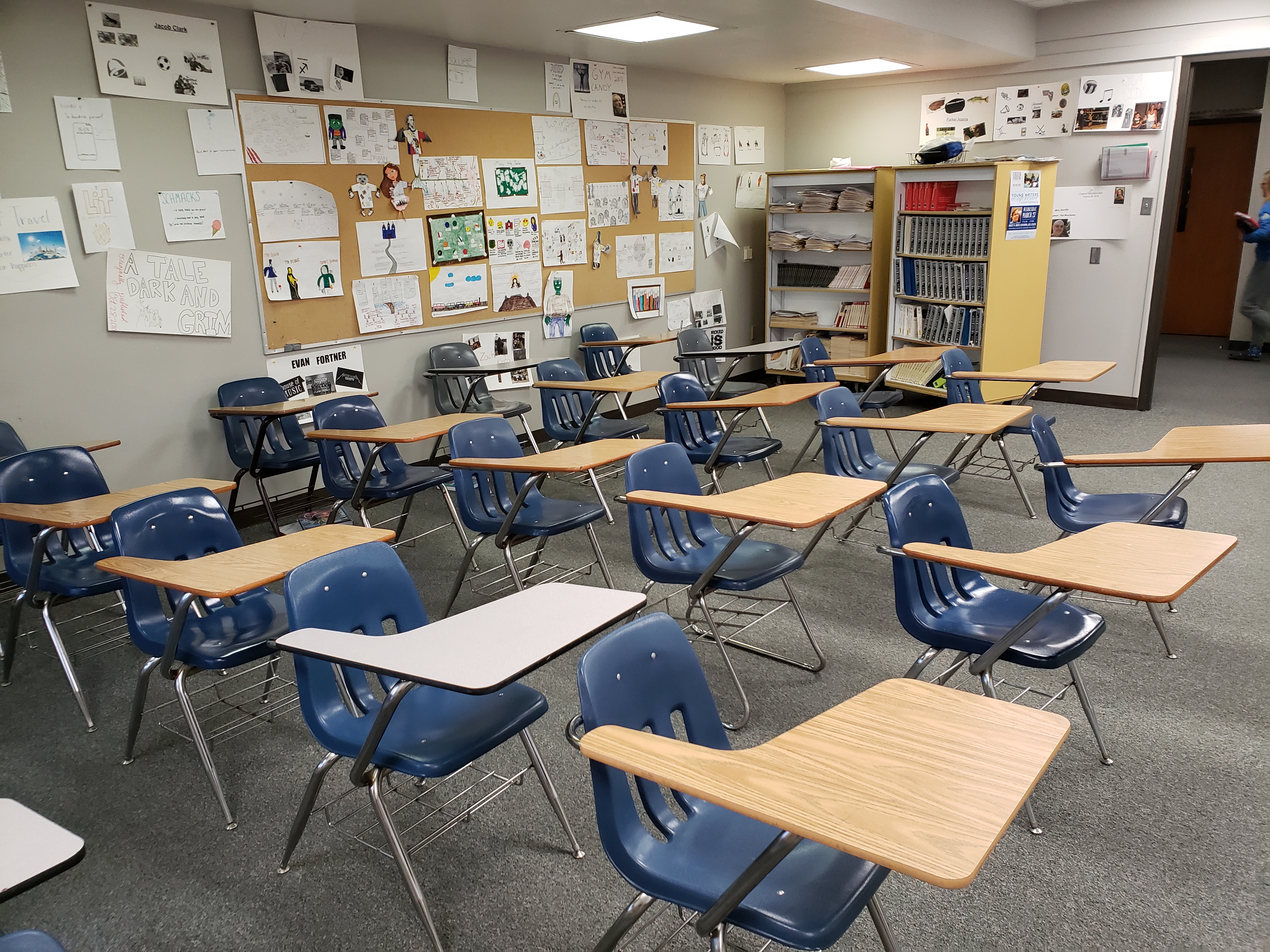
I retired from full-time teaching (high school) in 2021, and an unstated consensus remained that technology, in all its forms, made schools better, made students smarter—minus any evidence, and really for decades minus any serious effort to determine if it’s true. The tech industry sold this snake oil to society, and society gulped it down. I have already drifted far afield from the lecture’s topic, psychoanalytic criticism, but while I’m here I must drift a bit further. The sad state of affairs in the U.S. (with Trump and the GOP taking a wrecking-ball to the Constitution as well as common decency, meanwhile promoting the rise of every kind of vile hate one can imagine) leads many to point a finger at our education system. How could it have produced a citizenry that would be so easily duped by Fox News and nitwits like Joe Rogan and Tucker Carlson? How could it embrace a well-documented liar, conman, sexual predator, and all-around sleazebag like Donald Trump?
What can we do as a nation to improve our schools and prevent such miscarriages of democracy in the future?
Well, here’s something: Put teaching in the hands of teachers. No improvements in the effectiveness of education are going to take place unless some fundamental and systemic changes take place. The two biggest problems in education are school boards and administrators. Public schools are run omnipotently by a group of non-educators elected from the community. Sometimes they may be retired educators or educators not connected to the school, but almost always they are people who have no training and no experience in teaching. They may be well meaning, but oftentimes people run for school boards with specific agendas and axes to grind. To be clear, I’m not suggesting that all members of school boards have nefarious intentions. I am saying that it is ridiculous to put a group of people elected from the community in charge of schools when they have no qualifications whatsoever to make educationally sound decisions.
Educating children—especially nowadays—is one of the most complex and challenging professions someone can undertake. Yet well-trained and experienced educators have practically no agency when it comes to making decisions within their school. The board of untrained and inexperienced community members (car salesmen, bank managers, farmers, insurance agents, bar owners, handymen, homemakers, bakers, tinkers, tailors, and candlestick makers) have total control over every decision: whom to hire, whom to fire; what curriculum to approve, which textbooks to buy; what technology to purchase, how it should be implemented; how each penny should be allocated, which contractors should be hired for this or that project. Every decision ends up in the hands of these untrained school board members.
Well o.k., you say, but they’re not operating in the dark. They’re making decisions based on recommendations that are provided to them by the administration, i.e., the superintendent (perhaps assistant superintendents, of curriculum, of transportation, of facilities) and the building administrators (principal, vice principal, vocational director, athletic director, possibly special education director, et al.). True enough, but one might assume that the cream rises to the top, and the best-of-the-best teachers become administrators; therefore, the most qualified, most experienced educators assume the mantle of administration. Sometimes, of course, really gifted teachers become administrators, but based on my nearly four decades of experience this metamorphosis is the exception. For one thing, really gifted teachers are gifted with a love of teaching. They truly enjoy being with their students and facilitating and nurturing their skills and intellect. They have no desire to leave the classroom and with it the thrill of exercising a skillset they have mastered—a mastery that requires melding science and art and empathy. Just as Yoyo Ma has no desire to give up the cello, nor Spielberg filmmaking. A teacher who flourishes in the classroom will unlikely flourish in the role of administrator, a job of pandering to pushy parents, of milling paperwork (budgets, formal requests, mandated reports, assessment criteria, legislative updates), of disciplining unruly students, of kowtowing to higherups (especially those untrained school board members).
It’s true that sometimes, sometimes really talented teachers are lured from the classroom to the administrative office, mainly because the discrepancy in pay is so profound. Figures vary widely from state to state, and even within a state, like my home state of Illinois, the numbers can vary significantly, between, say, a well-heeled Chicago suburb and a small town in the sparsely populated southern part of the state. According to recent data, however, the average teacher salary is about $76,000 annually, while the average principal’s is at least double that, ranging from around $145,000 to $165,000. For assistant principal (usually a school’s chief disciplinarian) the average is around $127,000. Meanwhile, the top dog, the superintendent, pulls in between $142,000 and $250,000 (according to the Illinois Report Card, 2024-25).
Granted, school administrators are generally on an 11-month or full-year contract, whereas classroom teacher pay is based on a 9-month (180-day) contract. Yet the statement “Teachers have the summer off” is a fiction on its face. Teachers aren’t getting paid, but they’re still developing curriculum, taking courses, advancing in their degrees, increasing their content knowledge through reading and travel, making materials for their classrooms, attending conferences and professional assemblies, and myriad other teaching-related activities. They’re not getting paid, but they’re still being teachers, even in the allegedly lazy days of summer.
So, if really talented teachers, by and large, aren’t becoming administrators, who is? In the upper grades the clear majority is men, and often these men are former coaches. Hard data is difficult to come by, but it seems to be a universal phenomenon, the tendency for school administrators to come up through the coaching ranks, which also means they tend to hail from nonacademic fields of education—physical education of course, drivers education, vocational ed., perhaps business and accounting. There are several factors that likely contribute to the phenomenon. For one, the lower rungs of the administrative ladder are tailormade for coaching types. In larger school districts, “athletic director” is an administrative post; in really large districts one may have an “assistant superintendent of athletics” (alongside an assistant superintendent of finance, an assistant superintendent of transportation, an assistant superintendent of facilities, etc.).
In more modest-size school districts, the A.D. position is commonly combined with the job of a high school’s vice or assistant principal, who is the school’s chief disciplinarian (the dude who is supposed to intimidate unruly students back into line and physically break up fights when necessary). It makes sense, then, that you would hire a coach, who understands the intricacies of an athletic program (hiring coaches, ordering uniforms and equipment, organizing schedules, arranging transportation, building budgets, and so on—the responsibilities are many and intricate). Moreover, it makes sense that you would want your chief disciplinarian (the person scaring kids straight and breaking up fights) to be a big guy, maybe a former football or basketball player, turned football or basketball coach. Thus, a lot of coaches are ushered into the administrative ranks because they have the background and the physical presence for these lower-order positions.
But these athletic directors and vice principals almost always have their sights set on grander things, like becoming building principals and perhaps even, one day, superintendents. When there are openings, internally or at other school districts, these large men (hired mainly for their girth and their ability to move a blocking-sled several yards) now have experience as administrators, and so their applications move to the head of the line, placed before those other teachers with administrative credentials but no administrative experience (perhaps too small or too athletically inexperienced to have been hired as vice principals and A.D.s). Before long, many of those ex-coaches do become principals; meanwhile, they acquire their superintendency endorsement, and, lo and behold!, superintendent jobs become available, and the applicants with experience as building principals are those ex-coaches.
To be fair, these coach-types who achieve the upper echelons as school administrators may possess qualities that make them effective leaders. They have a tendency to exude confidence, which can be motivating for a staff of teachers. They may have top-flight organizational skills, and they may be very good with budgets and the many mundanities that are part and parcel of running a school or a whole district. Unfortunately their responsibilities encompass other things, in fact, essentially every other thing: curriculum development and delivery, purchasing priorities, teacher trainings, teacher hirings and firings, teacher evaluations, teacher contracts, as well as dealing with the public and with those seven noneducators who are, ultimately, in charge of everything, the school board, a.k.a. the board of education.
The common-coach-to-administrator path results in administrations that are quite adept at organizing and nurturing athletic programs but largely clueless when it comes to nurturing the academic side of the school equation. My experience has been that these ex-coaches aren’t especially critically minded when it comes to decision-making. Thus, they tend to take at face value much of the snake oil pitches lobbed their way, which leads to their forcing into the curriculum and the classroom methods and materials that are ineffective or actually counterproductive. And one can imagine how frustrating it is for the experts in charge of delivering instruction when they can see so clearly and so obviously why this or that method or material is wrongheaded in so many ways. Yet they are forced to employ them with their students. They are forced, in essence, to commit pedagogical malpractice, again and again and again.
There has been a well-documented mass exodus of teachers from the classroom. Learning Policy Institute published a report March 17, 2026, that said 7% to 8% of teachers in the U.S. leave the profession annually (i.e., approximately 600,000 teachers); and as many as half of new teachers quit within five years. There are myraid reasons why teachers—new, mid-career, and veteran—may walk out of the classroom never to return. People will cite low pay, which is true; people will cite exponentially mounting responsibilities, which is true; people will cite increasingly unmanageable children and parents, which is true; and people will cite lack of respect, which is true—and it is this last one that I believe is the main reason dedicated teachers give up on teaching. But it’s not society’s general disrespect, per se, a kind of external disrespect. Rather, it’s the internal disrespect, the disrespect within each teacher’s specific educational environment. No matter how much classroom experience a teacher acquires, no matter how much advanced education in their field and degrees they obtain, no matter how professionally they conduct themselves and their careers, their agency within the school system remains the impotent agency of a first-year teacher; that is, practically nil. They forever have to answer to those ex-coach administrators and those untrained school board members. They forever have to follow their asinine directives, enforce their dipshit policies, and embrace their farcical educational philosophies. Time and again, they are mandated to do things that run counter to their knowledge and experience—then, time and again, they are blamed for the failings of their students, for the failings of their school . . . and ultimately for the failings of their society.
Schoolteachers are routinely faced with the outright aggressive behavior of parents and students (and administrators at times), but almost daily their lack of professional agency is illustrated. Decisions are made and actions are taken by “superiors” who are not qualified to teach their subject matter, and who, eventually, have a fraction of their experience in the classroom (most administrators exit the classroom after only a few years of teaching). Here is one concrete illustration, from one of my last years of teaching high school. It was not part of my normal teaching schedule, but I was assigned a low-ability sophomore English class. Several of the students had Individualized Education Programs (I.E.P.s). I don’t recall the exact assignment (something based on one of our readings), but it was a writing assignment. The school was really into Chromebook labs, these rolling racks of laptops that could be moved from room to room, and they were connected to the school’s network for internet access, etc. My students spent a class period writing a draft of their paper on the Chromebooks; at the end I instructed them to print their drafts so that we could work on editing and revising them. Alas, the Chromebooks were not connected to the printer in the old-fangled stationary lab across the hall (a lab that was designated for use by others, which is why I had to request a mobile lab in the first place). A minor hiccup. I put in a tech request with our I.T. guys to work their magic and connect the Chromebook lab to the printer via the network, the sort of thing they did all the time, connecting this tech to that tech along the ever-expanding yet invisible tentacles of the network.
I would have my students print their drafts the next day. No problem. Writers and teachers of writing know that people are able to edit text more effectively when it’s on paper, much more effectively in fact. Study after study has demonstrated it. Reading on paper leads to deeper comprehension, while reading on the screen is more superficial, rendering errors and other issues more easily missed. And these were students who had some cognitive processing issues. I was trying to facilitate their success with this specific assignment, but I was also hoping to establish a pattern whereby they would always print their drafts for editing and revising.
Well, the building principal (a former business teacher and athletic coach) had to approve all tech requests (something I didn’t know), and he wouldn’t approve mine. He wouldn’t let the I.T. guys connect the Chromebook lab to the printer across the hall because “it was going backward” (they told me). So, this administrator, who wasn’t a writer, beyond writing emails and filling out bureaucratic forms, believed that editing a draft on paper was passé, and that all editing and revising should be done on the screen, even for struggling students. He didn’t even bother to consult with me before rejecting the request.
These are the kinds of microaggressions that schoolteachers have to deal with day in and day out. They spend years accumulating knowledge and experience, earning advanced degrees in their subject matter, and yet their expertise is ignored by the untrained, unqualified, inexperienced few at the top of the pedagogical pyramid.
The evaluation system for teachers is especially emblematic of this lack of agency and respect. In most school districts, teachers are evaluated throughout their careers as if they were nontenured newbies, and the process includes observations of the teacher in the act of teaching their students. Setting aside the artificiality of the whole enterprise due to the Hawthorne effect (i.e., the observer effect)—the artificiality and the likely inaccuracy—teachers eventually reach a point where the person doing the observing and assessing and judgment-passing is inappropriately unqualified to do so. Depending on the hierarchy of the school, which depends on its size and administrative complexity, various people will be involved in the evaluating and observing of classroom teachers. For simplicity’s sake, let’s think of the building principal as the evaluator (which is common). It’s reasonable that they observe, offer advice, and assign some level of proficiency to newer, less experienced teachers (generally nontenured teachers). Meanwhile, though, if the teacher continues in the profession, they accumulate more and more experience, and more and more expertise in their field (by taking subject-matter courses, acquiring advanced degrees, attending conferences, presenting at conferences, perhaps writing and publishing in their field . . . not to mention the expertise that comes with having taught a subject for a number of years).
All of which leads to the situation where a principal is responsible for evaluating someone who is more experienced and more qualified than they are. In a junior high or high school setting the subject areas are quite diverse (English, math, biology, chemistry, history, business, health, et al.), and yet the principal was probably only certified to teach in one of those areas (health, let’s say); and because they became an administrator early in their career (became an athletic director or vice principal), they had only a few years as a classroom teacher. Therefore, a former health teacher, with less than a decade of classroom experience, is in the elevated position of observing, assessing and passing judgment on a teacher with twenty or thirty years of classroom experience and a master’s or even a Ph.D. in their subject area (English or calculus or chemistry).
Clear-headed administrators will realize they have nothing of value to offer the highly qualified classroom teacher, so the process becomes a rubber-stamping formality that must be ritualistically performed every other year. Unfortunately there are wrongheaded, egotistical and axe-grinding administrators who freely offer advice on the teaching of a subject they themselves are neither qualified nor certified to teach. They will nitpick for any rationale to give a lower-order evaluation to a teacher they don’t like on a personal level, or just because they don’t want to be seen as a pushover who gives “excellent” marks to everyone. Some people (educational consultants, school board members) believe that there should be a spread of evaluation marks, statistically. That is, not all teachers can be excellent; some, surely, must be satisfactory, and some, surely, must be unsatisfactory.
Yes, of course, some educators excel more so than others, but they may all be excellent in their field.
Let me use a sports metaphor; golf, say. Yes, one golfer wins the Masters, others get second place or third place, top 10, top 25, etc.; and yes, some golfers miss the cut after 36 holes and leave Augusta National early. But every golfer who qualified to play in the Masters in the first place is excellent at golf. You wouldn’t say the players who finished in the top 10 are excellent, and the rest of the field who made the cut are satisfactory at golf, and the half of the field that missed the cut are unsatisfactory at golf. Therefore, it’s more than reasonable—it’s expected—that every teacher who accumulates years of classroom experience and works at advancing in their subject expertise is excellent at teaching. Some may win the Masters, some may miss the cut after 36 holes—but they’re all excellent at teaching. Why, then, would you give them less-than-excellent ratings just to satisfy some unqualified person’s misguided notions about the evaluation process and the way data ought to align on a graph?
I’ve gone much further afield here than intended, but I so frequently here experts weigh in regarding the education crisis and the exodus of teachers from the classroom, and not once have I heard one even mention the root cause of both issues: the wrong people are in charge of the system. Majority-elected noneducators wield all the power, based on the advice of the least-experienced, least-qualified “educators” who wear the mantle of “administrator” and reside at the top of the hierarchy. To fix education—and produce a citizenry that can tell valid information from villainous propaganda—schoolteachers must be put in charge of schools; and the most-qualified, highest-achieving among them should ascend to positions of authority in each school setting. A system that does that—lets the best and brightest rise to the top (instead of the largest and loudest)—could assume any number of forms, but it’s vital that the administrative educators (who perform the equivalent functions of “principal,” “vice principal,” and so on) must continue to teach part of the time. The world changes so rapidly, technology changes so rapidly, kids change so rapidly—educators who leave the classroom rapidly become out-of-touch with the types of students they’re tasked with teaching.
As things stand now, an administrator who hasn’t taught in a decade may as well have taught Depression-era tykes who walked to school after milking Bessie and giving a ladle of unpasteurized milk to each of their little brothers and sisters, raggedly dressed in homespun hand-me-downs. In 2026, the students of 2016 were a different breed of cat altogether. Imagine how clueless the principal or superintendent is who hasn’t taught in twenty or thirty years. Yet they are the ones making the recommendations to the board of the even-more-clueless whose yea or nay controls everything. Madness.
It’s no wonder that nearly a quarter of the U.S. population is functionally illiterate, and half read below a sixth-grade level— making them easy prey for propagandists and unprincipled politicians. And making the rest of us the victims of their ignorance and barely-breathing critical-thinking skills.
▪ ▪ ▪
Ted Morrissey is the publisher of Twelve Winters Press and its various entities, including Twelve Winters Journal, Twelve Winters Miscellany, and the podcast A Lesson before Writing, which he co-hosts with Brady Harrison and Grant Tracey. His most recent book is Aspiring Child: A Biography of Mary W. Shelley in Sonnets. He is on Instagram, Bluesky, TikTok, YouTube, and elsewhere.
Fatal flaws of the Danielson Framework
The Danielson Group’s “Framework for Teaching Evaluation Instrument” has been sweeping the nation, including my home state of Illinois, in spite of the fact that the problems with the Group, the Framework, the Instrument, and even Ms. Danielson herself are as obvious as a Cardinals fan in the Wrigley Field bleachers. There have already been some thorough critiques of the Danielson Group, its figurehead, the Framework, and how it’s being used destructively rather than constructively. For example, Alan Singer’s article at the Huffington Post details some of the most glaring problems. I encourage you to read the article, but here are some of the highlights:
[N]obody … [has] demonstrated any positive correlation between teacher assessments based on the Danielson rubrics, good teaching, and the implementation of new higher academic standards for students under Common Core. A case demonstrating the relationship could have been made, if it actually exists.
[I]n a pretty comprehensive search on the Internet, I have had difficulty discovering who Charlotte Danielson really is and what her qualifications are for developing a teacher evaluation system … I can find no formal academic resume online … I am still not convinced she really exists as more than a front for the Danielson Group that is selling its teacher evaluation product. [In an article archived at the Danielson Group site, it describes the “crooked road” of her career, and I have little doubt that she’d be an interesting person with whom to have lunch — but in terms of practical classroom experience as a teacher, her CV, like most educational reformers’, is scant of information.]
The group’s services come at a cost, which is not a surprise, although you have to apply for their services to get an actual price quote. [Prices appear to range from $599 per person to attend a three-day workshop, $1,809 per person to participate in a companion four-week online class. For a Danielson Group consultant, the fee appears to be $4,000 per consultant/per day when three or more days are scheduled, and $4,500 per consultant/per day for one- to two-day consultations (plus travel, food and lodging costs). There are fees for keynote addresses, and several books are available for purchase.]
As I’ve stated, you should read Mr. Singer’s article in its entirety, and look into the Danielson Group and Charlotte Danielson yourself. The snake-oil core of their lucrative operation quickly becomes apparent. One of the chief purposes of the Danielson Framework, which allegedly works in conjunction with Common Core State Standards, is to turn students into critical readers who are able to dissect text, comprehending both its explicit and implicit meanings. What follows is my own dissection of the “Framework for Teaching Evaluation Instrument” (2013 edition). For now, I’m limiting my analysis to the not quite four-page Introduction, which, sadly, is the least problematic part of the Framework. The difficulties only increase as one reads farther and farther into the four Domains. (My citations refer to the PDF that is available at DanielsonGroup.org.)
First of all, the wrongheadedness of teacher evaluation
Before beginning my dissection in earnest, I should say that, rubrics aside, the basic idea of teacher evaluation is ludicrous — that sporadic observations, very often by superiors who aren’t themselves qualified to teach your subject, result in nothing especially accurate nor useful. As I’ve blogged before, other professionals — physicians, attorneys, business professionals, and so on — would never allow themselves to be assessed as teachers are. For one thing, and this is a good lead-in to my analysis, there are as many styles of teaching as there are of learning. There is no “best way” to teach, just as there is no “best way” to learn. Teachers have individual styles, just as tennis players do, and effective ones know how to adjust their style depending on their students’ needs.
But let us not sell learners short: adjusting to a teacher’s method of delivery is a human attribute — the one that allowed us to do things like wander away from the Savanna, learn to catch and eat meat, and survive the advance of glaciers — and it is well worth fine tuning before graduating from high school. I didn’t attend any college classes nor hold any jobs where the professor or the employer adjusted to fit me, at least not in any significant ways. Being successful in life (no matter how one chooses to define success) depends almost always on one’s ability to adjust to changing circumstances.
In essence, forcing teachers to adopt a very particular method of teaching tends to inhibit their natural pedagogical talents, and it’s also biased toward students who do, in fact, like the Danielsonesque approach, which places much of the responsibility for learning in the students’ lap. Worse than that, however, a homogenous approach — of any sort — gives students a very skewed sense of the world in which they’re expected to excel beyond graduation.
In fairness, “The Framework for Teaching Evaluation Instrument” begins with a quiet little disclaimer, saying in the second sentence, “While the Framework is not the only possible description of practice, these responsibilities seek to define what teachers should know and be able to do in the exercise of their profession” (3). That is, there are other ways to skin the pedagogical cat. It’s also worth noting that the Danielson Group is seek[ing] to define — it doesn’t claim to have found The Way, at least not explicitly. Nevertheless, that is how untold numbers of legislators, reformers, consultants and administrators have chosen to interpret the Framework. As the Introduction goes on to say, “The Framework quickly found wide acceptance by teachers, administrators, policymakers, and academics as a comprehensive description of good teaching …” (3).
Teachers, well, maybe … though I know very, very few who didn’t recognize it as bologna from the start. Administrators, well, maybe a few more of these, but I didn’t hear any that were loudly singing its praises once it appeared on the Prairie’s horizon. Academics … that’s pretty hard to imagine, too. I’ve been teaching high-school English for 31 years, and I’ve been an adjunct at both private and public universities for 18 years — and I can’t think of very many college folk who would embrace the Danielson Framework tactics. Policymakers (and the privateer consultants and the techno-industrialists who follow remora-like in their wake) … yes, the Framework fits snugly into their worldview.
Thus, the Group doesn’t claim the Framework is comprehensive, but they seem to be all right with others’ deluding themselves into believing it is.
The Framework in the beginning
The Introduction begins by explaining each incarnation of the Framework, starting with its 1996 inception as “an observation-based evaluation of first-year teachers used for the purpose of licensing” (3). The original 1996 edition, based on research compiled by Educational Testing Service (ETS), coined the performance-level labels of “unsatisfactory,” “basic,” “proficient,” and “distinguished” — labels which have clung tenaciously to the Framework through successive editions and adoptions by numerous state legislatures. In Illinois, the Danielson Group Framework of Teaching is the default evaluation instrument if school districts don’t modify it. Mine has … a little. The state mandates a four-part labeling structure, and evaluators have been trained (brainwashed?) to believe that “distinguished” teachers are as rare as four-leaf clovers … that have been hand-plucked and delivered to your doorstep by leprechauns.
In my school, it is virtually (if not literally) impossible to receive a “distinguished” rating, which leads to comments from evaluators like “I think you’re one of the best teachers in the state, but according to the rubric I can only give you a ‘proficient.'” It is the equivalent of teachers telling their students that they’re using the standard A-B-C-D scale, and they want them to do A-quality work and to strive for an A in the course, but, alas, virtually none of them are going to be found worthy and will have to settle for the B (“proficient”): Better luck next time, kids. Given the original purpose of the Framework — to evaluate first-year teachers — it made perfect sense to cast the top level of “distinguished” as all but unattainable, but it makes no sense to place that level beyond reach for high-performing, experienced educators. Quite honestly, it’s demeaning and demoralizing — it erodes morale as well as respect for the legitimacy of both the evaluator and the evaluation process.
Then came (some) differentiation
The 2007 edition of the Framework, according to the Introduction, was improved by providing modified evaluation instruments for “non-classroom specialist positions, such as school librarians, nurses, and counselors,” that is, people who “have very different responsibilities from those of classroom teachers”; and, as such, “they need their own frameworks, tailored to the details of their work” (3). There is no question that the differentiation is important. However, the problem is that it implies “classroom teacher” is a monolithic position, and nothing could be further from the truth. Thus, having one instrument that is to be used across grade levels, ability levels, not to mention for vocational, academic and fine arts courses is, simply, wrongheaded.
As any experienced teacher will tell you, each class (each gathering of students) has a personality of its own. On paper, you may have three sections of a given course, all with the same sort of students as far as age and ability; yet, in reality, each group is unique, and the lesson that works wonderfully for your 8 a.m. group may be doomed to fail with your 11 a.m. class, right before lunch, or your 1 p.m. after-lunch bunch — and on and on and on. So the Danielson-style approach, which is heavily student directed, may be quite workable for your early group, whereas something more teacher directed may be necessary at 11:00.
Therefore, according to the Danielson Group, I may be “distinguished” in the morning, but merely “proficient” by the middle of the day (and let us not speak of the last period). The evaluator can easily become like the blindman feeling the elephant: Depending on which piece he experiences, he can have very different impressions about what sort of thing, what sort of teacher, he has before him. Throw into the mix that evaluators, due to their training, have taken “distinguished” off the table from the start, and we have a very wobbly Framework indeed.
Enter Bill and Melinda Gates
The 2011 edition reflected revisions based on the Group’s 2009 encounter with the Bill and Melinda Gates Foundation and its Measures of Effective Teaching (MET) research project, which attempted “to determine which aspects of a teacher’s practice were most highly correlated with high levels of student progress” (4). Accordingly, the Danielson Group added more “[p]ossible examples for each level of performance for each component.” They make it clear, though, that “they should be regarded for what they are: possible examples. They are not intended to describe all the possible ways in which a certain level of performance might be demonstrated in the classroom.” Indeed, the “examples simply serve to illustrate what practice might look like in a range of settings” (4).
I would applaud this caveat if not for the fact that it’s embedded within an instrument whose overarching purpose is to make evaluation of a teacher appear easy. Regarding the 2011 revisions, the Group writes, “Practitioners found that the enhancements not only made it easier to determine the level of performance reflected in a classroom … but also contributed to judgments that are more accurate and more worthy of confidence” (4-5). Moreover, the Group says that changes in the rubric’s language helped to simplify the process: “While providing less detail, the component-level rubrics capture all the essential information from those at the element level and are far easier to use in evaluation than are those at the element level” (4).
I suspect it’s this ease-of-use selling point that has made the Framework so popular among policymakers, who are clueless as to the complexities of teaching and who want a nice, tidy way to assess teachers (especially one designed to find fault with educators and rate them as average to slightly above average). But it is disingenuous, on the part of Charlotte Danielson and the Group, to maintain that a highly complex and difficult activity can be easily evaluated and quantified. In a 2012 interview, Ms. Danielson said that her assessment techniques are “not like rocket science,” whereas “[t]eaching is rocket science. Teaching is really hard work. But doing that [describing what teaching “looks like in words”] isn’t that big a deal. Honestly, it’s not. But nobody had done it.”
It’s downright naive — or patently deceptive — to say that a highly complex process (and highly complex is a gross understatement) can be easily and simply evaluated — well, it can be done, but not with any accuracy or legitimacy.
Classic fallacy of begging the question
I want to touch on one other inherent flaw (or facet of deception) in the Danielson Framework and that is its bias toward “active, rather than passive, learning by students” (5). Speaking of the Framework’s alignment with the Common Core, the Group writes, “In all areas, they [CCSS] place a premium on deep conceptual understanding, thinking and reasoning, and the skill of argumentation (students taking a position and supporting it with logic and evidence).” On the one hand, I concur that these are worthy goals — ones I’ve had as an educator for more than three decades — but I don’t concur that they can be observed by someone popping into your classroom every so often, perhaps skimming through some bits of documentary evidence (so-called artifacts), and I certainly don’t concur that it can be done easily.
The Group’s reference to active learning, if one goes by the Domains themselves, seems to be the equivalent of students simply being active in an observable way (via small-group work, for example, or leading a class discussion), but learning happens in the brain and signs of it are rarely visible. Not to get too far afield here, but the Framework is intersecting at this point with introverted versus extroverted learning behaviors. Evaluators, perhaps reflecting a cultural bias, prefer extroverted learners because they can see them doing things, whereas introverted learners may very well be engaged in far deeper thinking, far deeper comprehension and analysis — which is, in fact, facilitated by their physical inactivity.
And speaking of “evidence,” the Introduction refers to “empirical research and theoretical research” (3), “analyses” and “stud[ies]” (4) and to “educational research” that “was fully described” in the appendix of the 2007 edition (3), but beyond this vague allusion (to data which must be getting close to a decade old) there are no citations whatsoever, so, in other words, the Danielson Group is making all sorts of fantastic claims void of any evidence, which I find the very definition of “unsatisfactory.” This tactic, of saying practices and policies are based on research (“Research shows …”), is common in education; yet citations, even vague ones, rarely follow — and when they do, the sources and/or methodologies are dubious, to put it politely.
I plan to look at the Danielson Framework Domains in subsequent posts, and I’m also planning a book about what’s really wrong in education, from a classroom teacher’s perspective.

 12 Winters Blog
leave a comment