Let Us Now Praise William Gass’s Greatest Work

This paper was presented at the American Literature Association Conference in Chicago, May 2024, as part of the “William H. Gass at 100” panel. Other papers were “Surveying The Tunnel“ by Joel Minor (Washington University in St. Louis) and “Literary Theory Teaching: Founded on William Gass” by Ali Chetwynd (American University of Iraq, Sulaimani). The panel was chaired by Benjamin Seigle (University of Illinois, Chicago).
“I should like to return to my real love, the novella. I think that is what I should have been doing all along, writing storyless stories,” thus spake William H. Gass in 1995 in response to the question, in essence, what would he be working on now that his novel The Tunnel was out in the world, all 650 pages of it, after a legendary gestation of 26 years? Over those nearly three decades of its composition, Gass, as a writer of fiction, became identified with the project as excerpts of it appeared more than 30 times, between 1969 (New American Review, No. 6) and 1995 (Esquire, March), including as reprints in anthologies of award-winners, limited-edition books by boutique presses, and even as a stage play. When finally released in 1995, The Tunnel proved controversial, provoking as much condemnation as praise (as well as a sizable percentage of ambivalence). Nevertheless, its brilliance was recognized with the American Book Award and a nomination for the Pen-Faulkner Prize, both in 1996.
Gass seemed to take the mixed reviews in stride, content that “the past ha[d] been laid to rest,” as he expressed it to Heide Ziegler (119). He was free at last to focus on his real love.
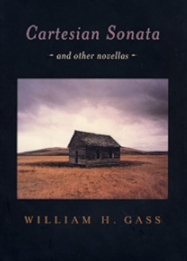
Because of the infamy of The Tunnel—its seemingly never-ending composition, its accolade-earning surface-breaches, its much-anticipated publication, and its ire-inspired critiques—those who know William Gass as a fiction writer almost always connect him to his infamous magnum opus. My purpose here is to posit that of all Gass’s works of fiction—three novels, one stand-alone novella, and three collections—he ought to be known for, and lauded for, the book that came out in the shadow of The Tunnel, while the behemoth’s radioactive dust was still settling: Cartesian Sonata and Other Novellas (1998). Gass, who wore like epaulets the epithets stylist and experimentalist, was always in pursuit of the perfect book, the perfect work of literary art. I believe that Gass achieved that perfection, according to his own standards, in the four novellas brought together as Cartesian Sonata, a work that has not received nearly the attention of Gass’s first four books.1 By the end of the twentieth century, postmodernism had run its course, and there wasn’t a lot of critical attention being paid to its master practitioners (though Gass resisted the label postmodernist).
Fortunately for us, Gass also wrote copious amounts of nonfiction, much of which is devoted to narrative theory, either directly or indirectly. By indirectly, I mean that he was a masterful critic in how own right and wrote illuminatingly about numerous authors, like Henry James, Gertrude Stein, Malcom Lowery, William Gaddis—and of course Gass’s literary idol, Rainier Maria Rilke. He was also a generous granter of interviews, the subjects of which often turned to his thoughts and theories regarding fiction. So, between his essays, his analyses of other authors, and his interview responses, we have a significant body of material regarding his aspirations for a work of fiction.
First, though, some background on the Cartesian Sonata collection. It consists of the title novella (divided into three distinct parts), plus “Bed and Breakfast,” “Emma Enters a Sentence of Elizabeth Bishop’s” and “The Master of Secret Revenges.” As Gass explained in 1998, “Cartesian Sonata” “was written a long time ago in rough draft” and “The Master of Secret Revenges” had been “an idea maybe 35-40 years ago,” while the remaining novellas “were much more recent and don’t appear to have had any lengthy sort of time in my unconscious” (Abowitz 143). Pieces of “Cartesian Sonata” appeared here and there beginning as early as 1964 (Location No. 2). In other words, the beginning and concluding pieces of the novella collection had been on Gass’s mind (and partly on paper) during the same years that he worked in fits and starts on The Tunnel (as well as many other writing projects). However, the middle two novellas were written after The Tunnel was completed. “Emma Enters a Sentence of Elizabeth Bishop’s” first appeared in 1994 (Iowa Review 24.2)—before the publication of The Tunnel, but after its completed composition, in 1992. (For a bibliography and chronology of The Tunnel’s composition see this link.) I want to underscore, then, that when Gass was at last able to return to his first love, the fruits of that impassioned homecoming were the reworking of “Cartesian Sonata” and the writing of the other three novellas—all within the context of a clearly envisioned theme and tightly imagined structure.
No guesswork is needed when it comes to understanding Gass’s agenda for the collection. He spelled it out in a conversation with Michael Silverblatt for the Lannan Foundation reading on November 5, 1998 (happily available via video).2 Gass explains that “the conception was to take the Cartesian problem of the three substances—the uncreated substance, God, which has always existed, and then the created substances, mind and matter [and explore] the problem of Descartes metaphysics: How do you get mind and matter to interact, because they have nothing to do with one another . . . [Silverblatt interjects, ‘So it’s a failure of God …’] Yes.” The title novella is divided into three sections corresponding to the three substances. “Then,” continues Gass, “I decided to write three other novellas. Each would be parallel to that initial sonata. So this [first novella] is a sonata played this way [Gass gestures], then a sonata played that way [opposing gesture], as each one of these others lines up behind one of the sections” (starts around the 13:00 mark).
Like this:
“Cartesian Sonata”
—‘The Writing on the Wall’ [God]
—‘The Clairvoyant’ [Mind]
—‘I Wish You Wouldn’t’ [Matter]
“Bed and Breakfast” [Matter]
“Emma Enters a Sentence of Elizabeth Bishop’s” [Mind]
“The Master of Secret Revenges” [God’s opposite, “a tinhorn Lucifer,” says Gass]
Gass, for whom nothing was sacred,3 presents, as he explains, not “God the great and glorious” and not “God the dead and gone,” but “God the incompetent—the real God, in my opinion.” Taking a familiar self-deprecating posture, ‘The Writing on the Wall’ begins in a (familiar) metafictional mode with Gass, as narrator, speaking directly to the reader about the creation of the main character, Ella Bend Hess, who was a briefly mentioned character in Gass’s earlier novella, Willie Masters’ Lonesome Wife (earlier, though contemporary with the original writing of this story). Gass writes, “Is it right or honest? After all—Ellla Bend—where is she? Isn’t she as much in all those scraps I threw away as in the scraps I saved? Threw away, mind you, when they held her name. Where else did she have her life?” Gass then goes about discussing Ella’s original description and how he is rewriting (recreating) her for this story: “I’d given her a long nose, I remember—no good reason why. Now her nose is middling” (4). So this incompetent God is the author: Gass, the creator of the text, the rearranger of matter from all those scraps.
The section continues in a metafictional mode as we are introduced to other characters in the story. Ella is the focus of the second section, ‘The Clairvoyant.’ Through the gift (or curse) of her clairvoyance Ella lives in a world of spiritual essence, seeing the dead, sensing the lingering presence of the past, and hearing the voices trapped inside inanimate objects: “She possessed an abnormal number of sensitive receivers. She was almost totally attention and antennae” (37). The final section, ‘I Wish You Wouldn’t,’ shifts the focus to Ella’s husband, Edgar Hess, who sees her as sick due to the clairvoyance he doesn’t understand. He becomes abusive, believing “[i]t helped her to hit her” (53), and “he solemnly prayed for his wife’s demise” (45). H. L. Hix describes the problem of Descartes metaphysics as represented in the novella this way: “His wish for her death arises between the disparity between their modes of being. She is almost pure spirit, and he almost pure body. . . . Her gift meant that he was far too material for her, and she was not material enough for him” (143).
In brief, the next novella, “Bed and Breakfast”(representing matter), is about an itinerant accountant, Walt Riff, who specializes in helping business owners cheat on their taxes by creating fraudulent records for them (an act of fiction not terribly far removed from the role of storyteller). However, Walt begins to see the error of his ways when he stays in a bed and breakfast and becomes enchanted by the innumerable homey objects therein. Put simply, Walt begins to see the value of real things, as opposed to the value of imaginary things, like the figures he writes in clients’ ledgers. In “Emma Enters a Sentence of Elizabeth Bishop’s” (representing mind), the main character, Emma Bishop, attempts to escape her abusive and neglectful parents by not eating (thus making her material self disappear little by little) and by immersing herself in books of poetry, by Elizabeth Bishop, Marianne Moore, Edith Sitwell, Emily Dickinson and others (feeding her mind while denying her body). Finally, “The Master of Secret Revenges” returns to the subject of God, but through the twisted theology of Luther Penner, who devises a philosophy and then a religion based on the fulfillment of retribution.
Though I have only provided the sketchiest of sketches here, I submit that in its form Cartesian Sonata and Other Novellas is perfect (or as close to perfection as any work of art can achieve). It has a mathematical symmetry that is apropos to Descartes’ philosophy, which is based in mathematics. And form represented the pinnacle of artistic achievement for Gass: “The form. That is what the long search is for; because form, as Aristotle instructed us, is the soul itself, the life in any thing, and of any immortal thing the whole” (Preface xliv; italics in original). Earlier in his career, Gass expressed another guiding principle of his art to an editor who wanted him to consider revisions to a piece that would eventually become part of Gass’s first novel, Omensetter’s Luck. In essence, the editor’s notes were designed to make the narrative more readable, more traditional. Gass wrote, “[T]he writer [has no] responsibility to the reader. . . . He has a responsibility to the thing he is making. . . . [T]here is no story. There remain but words—the continuous exploration of concepts” (Saltzman 66-67). So even then, in 1958, Gass had decided what his chief objective would be as a writer of fiction: the continuous exploration of concepts, which is perhaps the best way to describe the four novellas that comprise Cartesian Sonata.
However, I hold up Cartesian Sonata and Other Novellas as Gass’s greatest work not just because of its ideal form and its sustained exploration of Decartes’ metaphysics. The four novellas are woven together via the intricate repetition of images, ideas and language. A thorough examination would be the stuff of a doctoral dissertation, but perhaps I can give some sense of these kinds of connections here. For example, the corresponding Cartesian representations are reinforced by the names of the characters. The two narratives that explore the concept of mind feature the main characters Ella and Emma, both abused by men (Ella’s husband and Emma’s father). Early in ‘The Writing on the Wall,’ when we are introduced to Ella Bend, the narrator-writer becomes fixated on the letter m: “I wonder if you understand about that m. The other day I idly scribbled twelve of them in the margin of a canceled page: mmmmmmmmmmmm. . . . Look at them again: mmmmmmmmmmmm. Hear them hum. Isn’t that the purply dove? the witches’ mist? It’s Ella Bend in receipt of her gift” (5). But it also foreshadows the subtle shift in the alphabet from Ella to Emma, who will further explore the concept of mind later in the collection. Gass is similarly playful when it comes to the opening and closing novellas that delve into the two sides of the divine coin. The godlike author-narrator of “Cartesian Sonata” is set alongside tinpot Lucifer Luther Penner, who spreads his gospel of revenge via the written word, “The Moral Self Wears a White Shirt” and “An Immodest Proposal”—“his only public and published document[s]” (244).
Perhaps it goes without saying, but throughout the novellas Gass gives us his trademarks: stunningly superb sentences, magisterial metaphors, and similes whose smiles are as smooth as brie.4
To close, I find myself in the uncomfortable position of stating why Cartesian Sonata outshines, by a fraction, Gass’s other works fiction. Regarding the other collections, In the Heart of the Heart of the Country and Other Stories (1968) offers five fabulous stories in an impressive variety of styles, which means that as a whole they do not proffer the cohesion, the continuous exploration of a concept that we find in Cartesian Sonata; and Eyes: Novellas & Stories (2016) is once again a fabulous gathering of fiction, but it is even more of a potpourri than the first collection. Gass had in mind a collection of three novellas that may have rivaled Cartesian Sonata in terms of artistic concept and execution, but one of the novellas grew beyond his expectation and was published as his third novel, Middle C (2013)—an incredible book and winner of the William Dean Howells Medal. However, its creation almost by accident seems to disqualify it as a masterwork from conception to completion.
Though my catalog is incomplete, I’ll end where I began, with The (large, loose, baggie) Tunnel. Gass’s ambitions for the novel were epic, and it took him far longer—far longer—to write than he anticipated. He imagined, maybe, three years or so … let’s say, then, a publication date around 1970. But time marched on and the Master aged along with his aim for the book. He had about 600 manuscript pages in hand when, in 1991 (age 67), he went for an extended stay at The Getty Center in Santa Monica to devote himself fully to finishing the legendary book. Working into 1992, he doubled the size of the novel, completing it at about 1,200 manuscript pages. Begun in the sunny summer of literary postmodernism, the first half of the book displays many of the tropes and tricks that interested Gass in the 1960s and 70s—it resembles in many ways Gass’s wildly experimental novella Willie Masters’ Lonesome Wife (1968)—an experiment that Gass himself deemed a failure in retrospect.5 Though The Tunnel doesn’t quite conform to the chronology of its composition, the latter half doesn’t display the same fondness for postmodern play as the beginning sections do. Released at last in 1995, it was as if the postmodern novel had arrived at the party after practically all the guests had collected their coats and gone home to sleep it off.
Perhaps Gass wittily but unwittingly anticipated the fate of The Tunnel when he wrote the preface to In the Heart of the Heart of the Country (revised 1981):
“I write down these dates, now, and gaze across these temporal gaps with a kind of dumb wonder … hodge against podge, like those cathedrals which have Baroque porches, Gothic naves, and Romanesque crypts; time passed, then passed again, bishops and princes lost interest; funds ran out; men died; … and because they were put in service while they were still being built, the pavement was gone, the pillars in a state of lurch, by the time the dome was ready for its gilt or the tower for its tolling bell …” (xxxii).
We still ought to attend service in William Gass’s great cathedral, but our warmest words of worship should be reserved for Cartesian Sonata and Other Novellas.
Notes
- Chapter 7 of H.L. Hix’s Understanding William H. Gass focuses on Cartesian Sonata as a whole, but it is a relatively brief chapter. Hix’s emphases are on comparing the novellas to previous Gass fiction, and on the Christian elements found throughout the collection. Otherwise, there are noteworthy discussions of individual novellas (or their genitive pieces). In The Metafictional Muse (U of Pittsburgh P, 1982) Larry McCaffery includes early versions of “Cartesian Sonata” in his analysis of Gass’s work. Another interesting article is “About Reading” by Sally Ball, who makes the case that William Gass is more like Emma Bishop (of “Emma Enters a Sentence of Elizabeth Bishop’s”) than William Kohler (of The Tunnel). See The Review of Contemporary Fiction 24.3 (Fall 2001), pp. 40-45. This note is not intended as an exhaustive list of sources.
- For the Lannon Foundation reading, Gass primarily drew from the The Tunnel. He did, however, also read an excerpt from “Emma Enters a Sentence of Elizabeth Bishop’s.” This part begins at about the 4:30 mark. Of the four novellas in the collection, Gass seemed to think most highly of “Emma.” It was published in Conjunctions No. 30 accompanied by photos by Michael Eastman; and it is the only novella from Cartesian Sonata that Gass included in The William H. Gass Reader (Knopf, 2018).
- In the interview with Richard Abowitz, speaking of hostile reactions to The Tunnel, Gass said, “I don’t think anything is sacred and therefore I am prepared to extol or make fun of anything” (144).
- Due to the necessity of brevity, I am not discussing in detail Gass’s literary techniques in the collection. It must be noted, however, that it is not just the book’s form and continuous exploration of concepts that elevate its status to the most masterful of the Master’s works. Throughout the four novellas, Gass’s virtuosity with the written word is on full display: the metaphors, the similes, the catalogs, the playfulness with typography, and what Gass described as “jingling”—a poetic use of language that emphasizes alliteration, rhyming, repetition and other aural techniques that are not usually so enthusiastically employed in works of prose.
- See Gass’s interview with Thomas LeClair in Conversations, in which he said about Willie Masters’, “I was trying out some things. Didn’t work. Most of them didn’t work…. Too many of my ideas turned out to be only ideas—situations where the reader says: ‘Oh yeah, I get the idea,’ but that’s all there is to get, the idea. I don’t give a shit for ideas—which in fiction represent inadequately embodied projects—I care only for affective effects” (22).
Works Cited
Abowitz, Richard. “Still Digging: A William Gass Interview.” Conversations with William H. Gass, edited by Theodore G. Ammon, UP of Mississippi, 2003, pp. 142-148.
Gass, William H. Cartesian Sonata and Other Novellas. 1998. Dalkey Archive, 2009.
—. “A Revised & Expanded Preface.” In the Heart of the Heart of the Country and Other Stories. 1968. Godine, 2007, pp. xiii-xlvi.
Hix, H. L. Understanding William H. Gass, U of South Carolina P, 2002.
Saltzman, Arthur M. “William H. Gass: Selected Correspondence.” Review of Contemporary Fiction, vol. 11, no. 3, fall 1991, pp. 65-70.
“William Gass with Michael Silverblatt: Readings and Conversations.” Lannan Foundation, 5 Nov. 1998, https://lannan.org/media/william-gass-with-michael-silverblatt.
Ziegler, Heide. “William H. Gass in Germany.” Conversations with William H. Gass, edited by Theodore G. Ammon, UP of Mississippi, 2003, pp. 111-19.

 12 Winters Blog
leave a comment