Digital Resources that Facilitate the Study of English through Its Various Stages
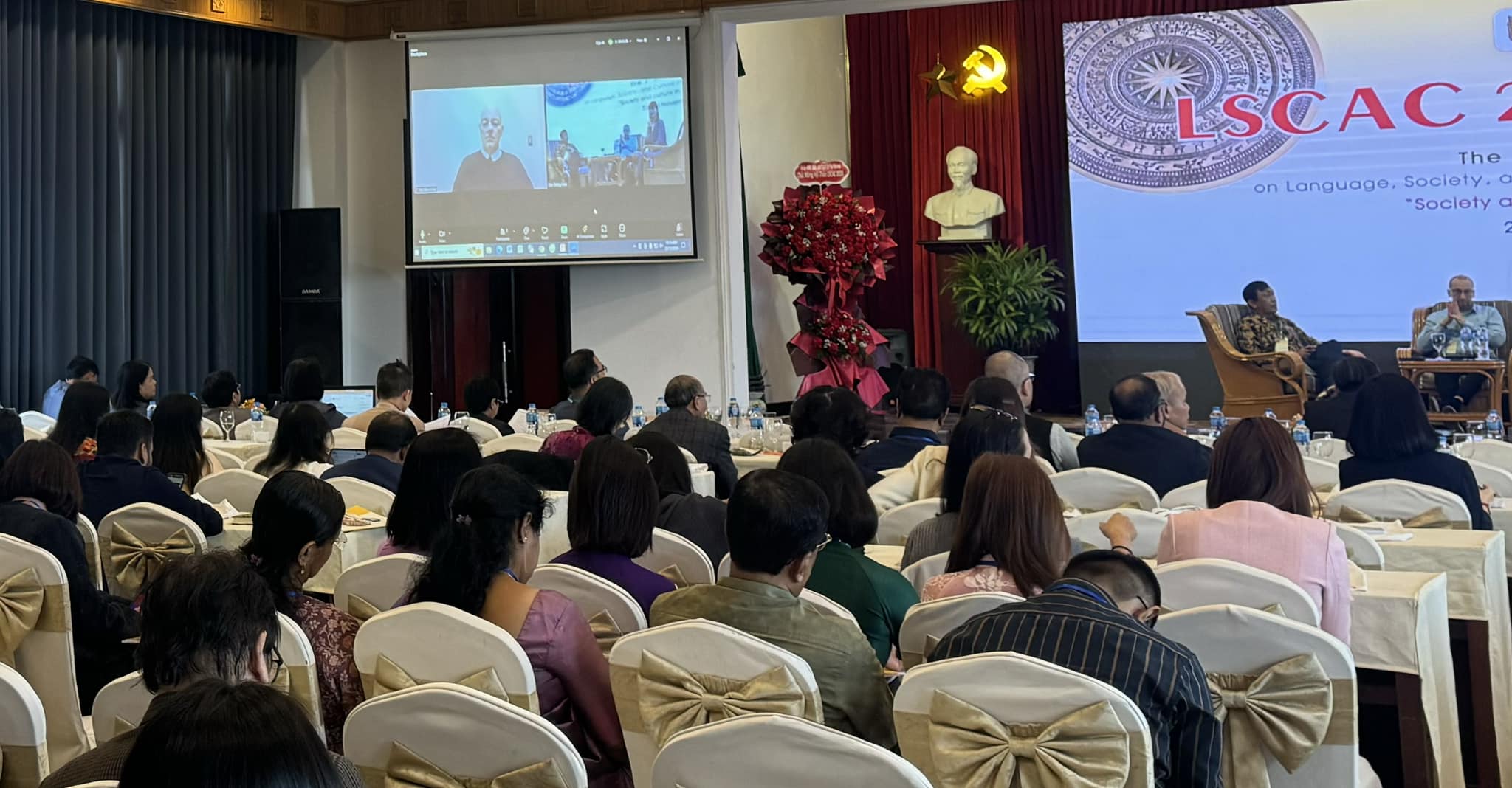
This text—“Digital Resources that Facilitate the Study of English Through Its Various Stages: Old, Middle and Modern”—was a keynote address at the 7th International Conference on Language, Society and Culture in Asian Contexts, organized by The Institute of Cultural Anthropology, held in Hue, Vietnam, November 22-24, 2024. It was delivered remotely concurrently with a translation into Vietnamese.

This paper has a few modest goals. Principally, I want to identify various digital resources that facilitate the study of the English language, from its earliest form to the present. In particular I will focus on the poem known as Beowulf, which was composed in the earliest form of recognizable English, called either “Anglo-Saxon” or “Old English.” I also want to suggest reasons why students in Asia may find such study both useful and engaging. What is more, a program in Old English and related subjects at Nanjing University in China provides a precedent of success for such study.

First, some background information regarding the evolution of English through its three phases as an identifiable language: commonly known as Old English, Middle English, and Modern English. It is convenient to begin a discussion of English with the retreat of the Romans, who colonized and occupied the island of Britain for approximately 350 years, until A.D. 410. Under Roman rule, Latin was the dominant language. However, in the sudden absence of Roman control, a language emerged that was greatly influenced by native tribes in (current-day) England and Scotland, as well as Germanic and Scandinavian groups arriving from mainland Europe. Though dialects varied widely, this language has become known as “Old English.” It’s worth noting that a synonym for Old English used by many is “Anglo-Saxon,” but it’s a term that has fallen further and further out of favor in recent years for a variety of reasons. Nevertheless, when searching for information about Old English, one definitely would want to include the phrase Anglo-Saxon and recognize that they are referring to the same language and literature.
The language we call Old English was the dominant language throughout Britain until the dramatic events of 1066, when the French-Norman King William (also known as “William the Conqueror”) defeated the Anglo-Saxon King Harold at the Battle of Hastings, in southeast England. The quickly ensuing “Norman Conquest” of England led to the evolution of Old English into the language we term “Middle English,” a hybrid of the native language and the French-Norman language (also known as “Old French”), which was spoken by William, his army, and the thousands of his subjects who flooded into England over the next two decades. Middle English, then, is derived from both the Germanic branch of languages and the Latin branch (so-called Romance languages). It is a gross oversimplification, but essentially Old English words were largely retained, but the mechanics associated with syntax and conjugation were adopted from Old French (that is, French-Norman).

Middle English was the dominant vernacular from, roughly, 1100 to 1430, when, mainly due to bureaucratic necessity, a standard language was adopted by law. This government-sanctioned language was the beginning of what we call “Modern English.” It is worth noting that the adoption of this standard form of English was more or less concurrent with the invention and development of the printing press in the West—a fact which has led to the difficulties of spelling modern English. With the advent of mass printing, when English was still using phonetically spelled Middle English vocabulary, those spellings were in essence frozen in time. Meanwhile, spoken English continued to evolve, which was primarily a process of simplification. For example, many two-syllable words (like bake, cake and take) became pronounced as one-syllable words; yet English retained their Middle-English two-syllable spellings. Now we say such words have a “silent e.” We have many silent letters and letter combinations in modern English because words continue to be spelled in their Middle-English forms but spoken in simplified and streamlined modern English.
For different reasons, we have relatively little literature from either the Old English period or the Middle English period. We have a dearth of Old English texts because of their agedness and also because of deliberate destruction by King Henry VIII during his feud with the Catholic Church (monasteries—repositories of such texts—were burned to the ground). We have very few Middle English texts because they were written prior to the printing press and only exist in rare hand-copied illuminated manuscripts, and most writers during this period were composing in French (not in the common vernacular of Middle English). Therefore, the texts we have from these two language periods are treasured examples of England’s national literature. From the Old English period, the crown jewel is clearly the poem Beowulf (approximately A.D. 725). From the Middle English period, Geoffrey Chaucer’s The Canterbury Tales (circa 1380) stands apart.
The text of Beowulf exists in a single volume, copied by hand on vellum, dating from about the year 1000. The poem is one of four texts gathered into what is known as The Nowell Codex, housed in the British Library. The Codex is in poor condition, due to its antiquity, rough handling, and a famous fire in 1731 that could have destroyed it completely if not for a librarian’s quick action. Consequently, there are passages in the poem of 3,182 lines that are essentially unreadable and passages that have disappeared off the page entirely—which has led to a great deal of scholarly speculation. Old English is so far removed from modern English that contemporary readers must rely on the work of translators (to date there have been more than 350 modern-English translations of Beowulf).
Given the fragile condition of the Beowulf manuscript, it is extremely difficult to gain access to its crumbling pages. Luckily, there are many digital resources that can substitute for access to the original. Here I will identify only a small sample of such resources.
To examine the original Beowulf manuscript itself, the most useful resource is Electronic Beowulf: Index & Guide (https://ebeowulf.uky.edu/), made available by University of Kentucky and edited by the esteemed Beowulf scholar Kevin Kiernan. The site features high-resolution digital images of the Beowulf manuscript, page by page, searchable via a variety of options, including line number and word entry. There is a wealth of other information available at the site; I only provide the briefest sketch here.
Another especially valuable site is Fordham University’s Internet History Sourcebooks Project, edited by Paul Halsall. Again, it is a treasure trove of information, divided into three general categories: Ancient, Medieval, and Modern. Moreover, it is not limited to English texts (geographically). Given my focus here, I will underscore that it provides reliable texts of Beowulf in both Old English (https://origin.web.fordham.edu/halsall/basis/beowulf-oe.asp) and in translation, by Francis Gummere (https://origin.web.fordham.edu/halsall/basis/beowulf.asp).
There are numerous side-by-side translations available. That is, on one side of the screen is Beowulf in Old English and opposite is the modern-English translation. One such site is based on Seamus Heaney’s widely read translation (https://www.hieronymus.us.com/latinweb/Mediaevum/Beowulf.htm). Another especially ambitious bilingual site is Beowulf in Steorarume, edited by Benjamin Slade, who provides detailed hypertextual notes along with the side-by-side translation (https://heorot.dk/beowulf-rede-text.html). Perhaps the simplest and most straightforward bilingual edition available online is provided by Massachusetts Institute of Technology as Bilingual Beowulf in a downloadable PDF format (https://www.mit.edu/~jrising/webres/beowulf.pdf).

As I say, these are only a few of the countless online resources that provide the poem in Old English, in translation, or both. I believe them to be especially reliable. For assistance with Old English itself I recommend the “Old English dictionary” provided by Lexilogos: Words and Wonders of the World (https://www.lexilogos.com/english/english_old.htm); and I am especially fond of the site’s link to “Old English Translator” (https://www.oldenglishtranslator.co.uk/), a handy online tool for translating Old English words to modern English, or vice versa. For simplicity and thoroughness, I also like the Old English “Glossary” (http://www.oereader.ca/glos.htm) that can be quickly searched using the “find” function on one’s computer.
In addition to teaching the poem Beowulf for decades, I have been working on my own modern-English translation. All of the sources discussed above have been invaluable in my work as both a teacher and a translator. Of course, there are myriad printed texts that are of great importance, but they may not be readily available in all locations. Online resources tend to be.
In the interest of brevity, I will not go into as much detail regarding resources associated with Middle English, but they are just as copious as those dedicated to Old English and are easily found online. Here are three especially useful and well-vetted sources: Rider University Library’s “English Language History and Linguistics” (https://guides.rider.edu/c.php?g=420552&p=2872234); University of Michigan Library’s “Middle English Compendium” (https://quod.lib.umich.edu/m/middle-english-dictionary); and Harvard University’s “METRO Resources” (https://chaucer.fas.harvard.edu/metro-resources-0).
This topic was largely inspired by a program of study at Nanjing University in China. Professor Leonard Neidorf, a leading medieval scholar, teaches courses in Old English, Middle English, and Old Norse, as well as literatures composed in those languages. Chinese students complete both M.A. and Ph.D. degrees under Dr. Neidorf’s supervison, and they are widely published in English in the field of medieval studies. See Dr. Neidorf’s supervision page online (https://leonardneidorf.com/supervision). I have interacted with the students via Zoom; their erudition and enthusiasm are both obvious and impressive.

Beyond the inherent value of serious study, scholarship and publication, engaging with works like Beowulf can provide a bridge between cultures. Researchers in psychology, for example, have long been aware of myths, folktales and themes that appear ubiquitously across cultures. Claude Lèvi-Strauss developed his concept of “mythemes” as a way of identifying the structures that build similar narratives across cultures and languages. As just one small but obvious example, I will point to the dragon that appears in the final sections of Beowulf. Dragons, or dragon-like creatures, appear in stories on practically every continent, in untold numbers of cultures and languages, including, of course, the origin tales of Vietnam in the form of Lạc Long Quân. So, even in the stories of medieval England, in a language as remote as Old English (which was practically a dead language even among native English speakers for several centuries), students everywhere can find common elements that engage them both intellectually and emotionally.
Indeed, I believe that students who approach a poem like Beowulf from a cultural perspective that is definitively non-Western can detect aspects of the work previously unexplored through scholarship. In spite of intense academic study for more than 200 years, there remain an infinite number of new things to discover and to say about the old poem and its literary kin. My hope is that this brief presentation will spark interest in medieval studies, and that I have provided a few useful resources to begin to explore that interest.
Beauty Must Come First: The Short Story as Art Made of Language

[This paper was presented at the 16th International Conference on the Short Story in English, held June 20-24, Singapore. It was part of the panel “The Short Story and the Aesthetics of Narration.” Other papers were “A Lot Like Joy: Fractured fragments represented within a composite narrative” by Sarah Giles, and “‘Writing back’—The Sideways Progress of Ideasthetic Imagining” by Julia Prendergast.]
“A second rate writer has no reason to exist unless he is on his way to being a first rate writer, and there is no point at all in doing pleasant easy things, or altering one’s conception of how a story ought to be to get it into print” (Saltzman, “Selected Correspondence” 66).
William H. Gass wrote this statement in a letter, in 1958, to an editor who was considering publishing his fiction, which would have been its first appearance in print. The editor was balking at Gass’s elaborate prose style. Gass, age 34 at the time, preferred to remain unpublished than have his words changed. It was an attitude he maintained – that to be edited was to be rejected – throughout what became a long and illustrious career that claimed numerous awards and distinctions, including Pushcart Prizes, Best American Stories, an O. Henry, the PEN/Nabokov Award, the American Book Award, and the William Dean Howells Medal. Gass – novelist, novella-ist, story-writer, critic, translator, and teacher – passed away in 2017 at the age of 93, working on his final project until he no longer had the energy to continue.
This paper is about Gass’s aesthetic theories when it came to producing narrative, and specifically fiction. Luckily, Gass was a generous granter of interviews, so we have a substantial amount of material in which he discusses his ideas about plot, character, setting, theme, symbolism … all of the elements we associate with storytelling (we have printed material, plus video and audio recordings that are available online). He also wrote numerous “craft” essays in which he goes into detail about his writing, as well as the writing techniques of others (among them Henry James, James Joyce, and Gertrude Stein). Such essays were included in his nine nonfiction collections, beginning with Fiction and the Figures of Life (1970) and concluding, for now, with Life Sentences (2012). And we have copious letters, which are carefully archived at Washington University in St. Louis.
To be clear, Gass’s theories are not designed to make one popular, that is, to make one a bestselling author. On the contrary, Gass never achieved that brand of success. In fact, he said (in another letter to the same editor, Charles Shattuck): “[S]uccess is merely failure at another level” (Saltzman 65), by which he meant that a writer must compromise their artistic principles in order to gain the public attention and financial rewards we (in the United States at least) usually associate with literary success. Gass’s primary goal was to create a work of literary art that he himself was satisfied with; if he had secondary goals they were to earn the respect of writers he admired, and to be read beyond his own lifetime. “I don’t write for a public,” Gass said. “[. . .] It’s the good book that all of us are after. I’ve been fortunate in that I think I have the respect of the writers whom I admire” (Saltzman, “Language and Conscience” 24). He did indeed as his work was praised by authors such as John Barth, Susan Sontag, John Gardner, Stanley Elkin, Joy Williams, and William Gaddis, who called Gass “our foremost writer, a magician with language” (Gaddis 629).
Regarding the goal of having his work read beyond his lifetime, it’s been my mission to make that a reality for more than a decade, during which time I’ve been “preaching the Gass-pel” (an expression coined by one of my students that I immediately filched). I’ve presented dozens of conference paper (all available at my blog, and some elsewhere); I’ve included readings of Gass’s work in my book Trauma Theory as an Approach to Analyzing Literary Texts (2021 edition); and I organized the website thetunnelat25.com, an online symposium devoted to Gass’s magnum opus. In my teaching I regularly place Gass’s books on my syllabi, and I share pearls of his writing wisdom with my students regularly (they may say obsessively). Many of these pearls I also share via social media in the form of memes that I’ve created. Like this one:
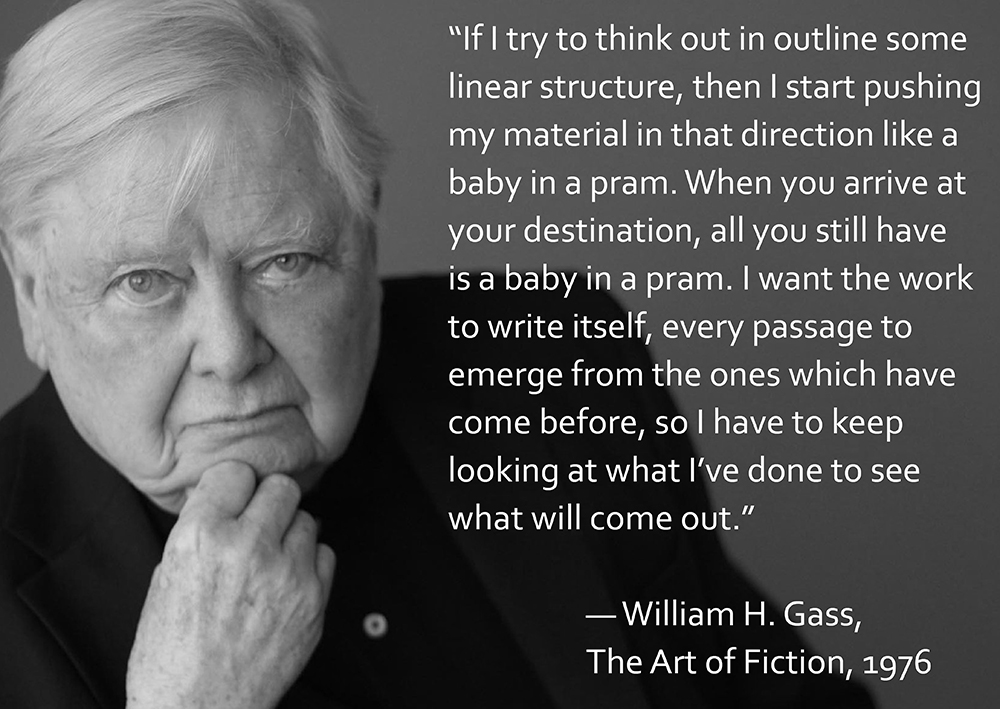
[This meme has to do with a topic I’ve recently written about: “To Plan or Not to Plan,” available here.]
And this:
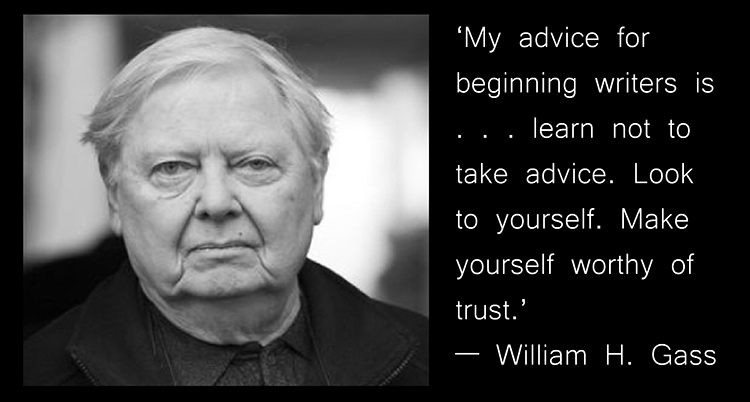
[During the presentation I talked briefly about the inherent problem of writing workshops or writing groups: No matter how well-intentioned, peers’ critiques are oftentimes wrongheaded, and an offhanded criticism can send the unwary writer down a frustrating and fruitless rabbit hole. Instead, writers must accept the unavoidable subjectivity of reader response and stay true to their artistic vision.]
And this:

[I felt this was an especially apropos sentiment to share since the conference was comprised of writers from across the globe — but mainly Asia, Australia and Europe — who compose in English, even though for many it’s not their first language.]
I want to touch on some specific ideas Gass had about writing narrative, but before we get there I’m inclined to discuss the cornerstone of his aesthetic philosophy – as well as my primary focus here: Throughout his long writing career, Gass’s main interest was language, and he sought to use it as a painter uses paint, a sculptor uses marble or metal, a composer uses musical notes, or a photographer uses light and shadow. He stated, in a 1976 interview, “As a writer I only have one responsibility, and that’s to the language I’m using and to the thing I’m trying to make” (Duncan 53). He elaborated elsewhere, “Old romantic that I am, I would like to add objects to the world worthy of love. . . . My particular aim is that it be loved because it is so beautiful in itself, something that exists simply to be experienced. So the beauty has to come first” (LeClair 48).
Allow me to restate Gass’s central tenet: The beauty of the language must come first. By extension, then, everything else – all the other elements associated with fictional narrative, plot, characterization, setting, etc. – are subordinate to the quality of the language, to the beauty of the language. Gass’s devotion to beautiful language took many forms. For example, he regularly employed literary devices we normally associate with poetry: alliteration, assonance, rhyming, repetition. As such, Gass considered himself a stylist, meaning that his main interest was the writing itself. “I’ve always been interested in writing as writing. My interest in the various forms is dominated by an interest in style as such” (Duncan 64). Though Gass considered himself an abysmal poet, his use of poetic language was, he said, “compulsive” and “turns up in almost every line of prose, in sound patterns that get pushy, even domineering” (“Retrospection” 43-44).
Gass’s drive to create art made of language led him away from using narrative elements in traditional ways. Mind you, not ways that are utterly unique – I’m a supporter of Adorno’s assertion that when it comes to art, there is nothing new under the sun, yet the true artist must strive for the new nevertheless – but ways that are certainly unusual in modern American fiction, especially popular fiction. For instance, we normally think of characters in fiction as people, or possibly animals or machines (generally, though, personified animals or machines). However, for Gass a character was “any linguistic location of a book toward which a great part of the rest of the text stands as a modifier” (LeClair 53). Gass’s ideas about characters and characterization were complex, and he wrote and spoke frequently about those ideas (I direct you, especially, to his essay “The Concept of Character in Fiction”), but I will try to communicate the essence of his thinking.
Drawing from the essay above: He wrote, “[T]here are some points in a narrative which remain relatively fixed; we may depart from them, but soon we return, as music returns to its theme. Characters are those primary substances to which everything else is attached . . . anything, indeed, which serves as a fixed point, like a stone in a stream or that soap in Bloom’s pocket, functions as a character” (49-50). As such, physical objects can be characters (everything from Lowry’s volcano to Gogol’s overcoat); symbols can be characters; ideas; concepts; situations. All can function a characters.
If we think of plot as what happens to a narrative’s central character (its protagonist), commonly how the character changes during the course of the narrative, we must be prepared to modify our sense of conflict, resolution and denouement when other things besides people operate as protagonists (and antagonists). A volcano or an overcoat or a crucifix or a bombing or fascism cannot have epiphanies (as Joyce would have phrased it). They do not change as, we hope, people change. No matter how many ghosts visit a volcano on Christmas Eve, it’s still a volcano on Christmas morning, with all the capricious and explosive qualities its kind is known to have.
To be clear, nearly all of Gass’s fiction is populated with human characters as their ostensible narrative focus (two exceptions are the brief stories “Don’t Even Try, Sam” and “Soliloquy for a Chair” in which the protagonist of the former is the legendary piano in the film Casablanca, while it is a folding chair in a barbershop that soliloquizes in the latter – both are collected in Eyes [2013]). However, the human characters’ primary function is to provide a scaffolding on which Gass can develop his thematic interests, and, perhaps chiefly, play with language. “For me,” he said, “a character is really a voice and a source of language. . . . Words are going to come out from that source either as direct speech or as a means of dictating the language you use in the third person to describe scenes or that individual from outside” (Saltzman 85). So, functionally speaking, human characters are providing the means (structurally and linguistically) by which Gass can explore other characters in the narrative: a concept, an attitude, a place, an object.
One may ask at this point: If in Gass’s fiction he was disinclined to maneuver his characters toward epiphanies, toward traditional, Aristotelean kinds of resolutions, how did he develop his narratives? What was their aim? In one sense, Gass developed a piece of fiction as one might develop an expository essay, with the objective being to more fully realize a particular subject. Ultimately, though, and overarchingly, Gass’s interest was to create a beautiful piece of writing: a work of art made of language. Perhaps he expressed his philosophy most clearly and most forcefully in a series of debates with fellow writer (and friend) John Gardner in the 1970s (audio recordings of one such debate session can be accessed here). Gardner believed that fiction should have a moral component, that it should teach the reader something important about how to behave in the world. Gass vehemently disagreed: “John wants a message, some kind of communication to the world. I want to plant some object in the world. . . . I want to add something to the world which the world can ponder the same way it ponders the world” (LeClair 48). Elsewhere Gass bluntly asserted that “literature in not a form of communication” (Duncan 49).
Since we are a gathering of writers, I want to end on what Gass believed to be a kind of side benefit of using artful language, a utilitarian additional advantage. He said, “Shakespeare succeed[s] mainly because the rhetoric succeeds. Psychological shifts, changes of heart, all sorts of things happen which are inexplicable, except that if the speech is good enough, it works. The same is true in the way I go at things” (Saltzman 83-4). To put it plainly, certain weaknesses in a narrative can be bolstered by using language beautifully. Readers can be distracted from fissures in the foundation if the architecture is elaborate and enchanting. May we all build such mesmerizing abodes with our material of choice: the English language.
Works Cited
Duncan, Jeffrey L. “A Conversation with Stanley Elkin and William H. Gass.” The Iowa Review, vol. 7, no. 1, 1976, pp. 48-77.
Gaddis, William. The Letters of William Gaddis, edited by Steven Moore, New York Review Books, 2023.
Gass, William H. Fiction and the Figures of Life. Knopf, 1970.
LeClair, Thomas. “William Gass and John Gardner: A Debate in Fiction.” Conversations with William H. Gass, edited by Theodore G. Ammon, UP of Mississippi, 2003, pp. 46-55.
Saltzman, Arthur M. “An Interview with William H. Gass.” Conversations with William H. Gass, edited by Theodore G. Ammon, UP of Mississippi, 2003, pp. 81-95.
—. “William H. Gass: Selected Correspondence.” Review of Contemporary Fiction,
vol. 11, no. 3, 1991, pp. 65-70.
—. “Language and Conscience: An Interview with William H. Gass.” Review of Contemporary Fiction, vol. 11, no. 3, 1991, pp. 15-28.

 12 Winters Blog
leave a comment