A Concise Summary and Analysis of The Mueller Report
In March 2024 Amazon removed my book A Concise Summary and Analysis of The Mueller Report, which had been published via KDP in 2019, because it was deemed “a companion guide.” Of late, I’ve been contacted by people who would like to read my book, which is perhaps of interest again because of Donald Trump himself, who has been attempting to rewrite history by saying that the investigation into his 2016 campaign was a “hoax” perpetrated by Democrats and specifically President Obama. In fact, the investigation into whether or not the Trump campaign colluded with Russia, and also whether or not Trump obstructed justice during the investigation, was initiated and carried out by Trump’s own Justice Department. Moreover, Trump continues to keep the names of his political enemies in the news by calling for their investigation and prosecution.
Given the renewed interest in the Trump-Russia investigation, I decided to publish the entirety of my Summary and Analysis via my blog. I do have some print copies available, and I would be delighted to mail copies to anyone who’s interested. What follows is the text used to create the Kindle edition of the book.
Originally published by Twelve Winters Press / twelvewinters.com in 2019
Dedicated to journalists everywhere—but especially American journalists
Contents:
Introduction
Chapter 1 – Trump Team’s Contacts with Russia
Chapter 2 – Cyber Warfare
Chapter 3 – Obstruction of Justice
Chapter 4 – Legal Analysis
—
Introduction
–
Let me begin where Robert S. Mueller III ends: No person—not even the President of the United States—is above the law. This is the point on which Mueller chose to end his Office’s “Report on the Investigation into Russian Interference in the 2016 Presidential Election,” more familiarly known as The Mueller Report, submitted to William P. Barr, the recently confirmed Attorney General, on March 22, 2019. After nearly two years of extraordinarily tightlipped investigation (by a Special Counsel’s Office which consisted at its peak of forty personnel working alongside and in coordination with forty FBI agents and other Bureau staff), Mueller filed a two-volume report of nearly 450 pages—one volume discussing Russia’s contacts with members of the Trump team and the Russians’ efforts to sway the election in Trump’s favor; and the other volume discussing the President’s efforts to obstruct the investigations and the legal issues related to matters uncovered by the Special Counsel.
From the moment it was submitted, Attorney General Barr, Deputy Attorney General Rod Rosenstein, Republicans in Congress, and conservative media (especially Fox News) began the process of misrepresenting the contents of The Mueller Report. Rather than immediately releasing The Report, to Congress and the American people, Bill Barr, on March 24, gave to Congress a four-page summary of what he represented as Mueller’s conclusions: Mueller was not able to find evidence that Trump or members of his campaign conspired with Russia; and on the issue of obstruction of justice, while Mueller did not exonerate the President, Barr and Rosenstein decided there was not sufficient evidence to accuse Trump of committing a crime. When submitting his summary to Congress, Barr also made a public statement in which he communicated these same ideas.

Barr’s letter and his public statement gave Trump and his allies license (as if they needed any) to claim The Mueller Report was a total exoneration of the President and that the investigation had been—as he said repeatedly—a “witch hunt” and a “hoax.” The President also called for an investigation into the investigators, whom he had long characterized as members of a “deep state” liberal conspiracy intent on removing him from office, insinuating, too, that Hillary Clinton and the Democrats were at the root of the plot, still angry over Clinton’s embarrassing loss in the 2016 election. The President accused the FBI of “spying” on his campaign. (As of this writing [in 2019], Attorney General Barr has, in fact, initiated an investigation into the origins of the Russia probe and has, at times, supported Trump’s characterization of the FBI investigation as “spying.”)
Barr delayed submitting The Mueller Report to Congress because he was doing necessary redactions (blacking out information which could not be made public). The redacted report was released to Congress and the public April 18, nearly a full month after Barr submitted his misleading summary—which gave Trump and his allies a significant amount of time to reinforce the idea that The Report cleared the President of wrongdoing, and also to reinforce the narrative that Trump was the victim of an illegal, unwarranted and unfair investigation conducted by conflicted and just plain bad people in the FBI and Justice Department. The President and his allies used Twitter and (mainly) Fox News to blast these messages to tens of millions of people every day, perhaps hundreds of millions, perhaps nearly every hour of every day.

We learned later that just three days after Barr submitted his summary letter to Congress and made his public remarks about The Report, Robert Mueller sent a letter to Barr and spoke to him by telephone to express his dissatisfaction with Barr’s characterizations. For one thing, Mueller and his team had written Executive Summaries of both Volume I and II of their report with the intention, in part, that they could be released immediately to the public (they made certain there was nothing in the Executive Summaries that would need to be redacted). But instead of releasing Mueller’s summaries, Barr had written his own four-page summary that, according to the Special Counsel, had misrepresented his Office’s findings.
When The Mueller Report was finally released, it was eye-opening as well as jaw-dropping on several levels: the numbers of contacts between Trump’s campaign and Russians and Ukrainians, Russia’s wide-ranging and sophisticated efforts to help Trump win the election, and Trump’s efforts to derail or at least curtail the investigation—to most readers of The Report it was all rather shocking. But therein lay a problem: It was shocking to readers of The Report, and very few people were reading it, or even likely to read it.
As a teacher, writer, librarian and publisher I am more aware than most (in fact I am reminded of it almost daily) that the United States has become a country predominantly of non-readers. It is a challenge to get Americans to read a news article of more than a few paragraphs, leave be a document like The Mueller Report, which presents challenges to even avid readers. It is long, nearly 450 single-spaced pages. It has frequent redactions, interrupting sentences and even disappearing entire paragraphs and whole pages. It is heavily footnoted (2,375 footnotes to be exact). The majority of the footnotes are purely documentary, supplying a citation for a given source, but many of the footnotes are several sentences in length and provide important, eyebrow-raising information themselves. While much of The Report is narrative and tells an intriguing story (oftentimes reading like a Robert Ludlum spy novel), overall it is not organized chronologically. Finally, there is a vast cast of characters to keep in mind as one reads, and many of those characters are Russians or Ukrainians with names that American readers do not easily process and retain.
The Mueller Report was first available to the public via an online PDF version. I read bits and pieces of the document, and realized that an easier-to-read summary would be quite useful. My sense was that there were people interested in knowing what The Report said, but the idea of wading through it in its entirety would be daunting and, ultimately, discouraging. The vast majority of the country was learning of The Report’s contents via commentators on cable news and social media—and many, many of those commentators and social-media users are determined to misrepresent Mueller’s findings, to propagate propaganda in fact.
To date, very few Americans have read The Mueller Report. Even members of Congress, especially Republicans, have not read Mueller’s findings. That is the opinion, for example, of Justin Amash, a Republican Representative from Michigan, who has been the only Republican calling for Trump’s impeachment and openly criticizing Attorney General Barr for his misrepresentations of The Report and for assisting Trump in blocking congressional investigations (even refusing to respond to congressional subpoenas). Amash said that he supported Trump’s impeachment because he actually read The Mueller Report, unlike the majority of his colleagues. Amash conducted a town hall in his hometown of Grand Rapids, Michigan, on May 28, 2019, and was met with standing ovations for his stance on protecting the Constitution over protecting the President. In a video clip that was widely aired a woman who identified as a Trump supporter was interviewed after Amash’s town hall, and she acknowledged that Amash’s descriptions of Trump’s behavior were truly surprising; she said she did not know there was anything negative about Trump in Mueller’s report.
It is anecdotal of course, but the woman may well represent the majority of Americans who get their news from right-wing outlets like Fox.
My hope in writing A Concise Summary and Analysis of The Mueller Report is that more people will become informed about the true contents of Robert Mueller’s report and the findings of the Special Counsel’s two-year investigation. In his only public statement so far, Bob Mueller emphasized that if his Office had found that President Trump had not committed any crimes, they would say so—and they are not saying so. Also, Russia attacked the United States and continues to attack the United States, and that should be alarming to every American. Finally, Mueller stressed the integrity and the professionalism of the men and women of the FBI and the Justice Department, a direct refutation of Trump’s attacks on his and the other investigators’ integrity in performing their duty to conduct the investigation into Russia’s interference in the 2016 election and related matters.
Here are some prefatory remarks regarding The Mueller Report and my summary and analysis of it. From the outset, Mueller was not attempting to build a case to prosecute Donald Trump. Mueller was operating under the Department of Justice policy that a sitting President cannot be indicted. I discuss this DOJ policy in my summary. Also, it seems to me Mueller is implying at the end of The Report that the policy is wrongheaded. In any event, Mueller never intended to recommend Trump should be indicted, for obstruction or anything else, because the policy forbade it. Rather, he was trying to determine exactly what went on in regard to the 2016 election and to collect evidence when it was available and witnesses’ recollections were still relatively fresh. He points out that while a sitting President cannot be indicted, according to the DOJ guidelines, there is nothing that prohibits a former President from being indicted and prosecuted.
“[I]f we had confidence … that the President clearly did not commit obstruction of justice, we would so state. Based on the facts and applicable legal standards, however, we are unable to reach that judgment.”
Because Mueller could not recommend indicting Trump, he also believed it was unfair to accuse him of crimes in The Report, since Trump would not have the opportunity to defend himself in court. Mueller’s “concerns about the fairness of such a determination” are discussed at the beginning of Volume II of The Report. Conversely, though, Mueller makes clear that if his investigation uncovered that Trump did not commit a crime, like obstruction, The Report would say so. It does not say so: “[I]f we had confidence after a thorough investigation of the facts that the President clearly did not commit obstruction of justice, we would so state. Based on the facts and applicable legal standards, however, we are unable to reach that judgment” (II-1-2).
Moreover, Trump and his allies, like Attorney General Barr, have been emphasizing that there was “no collusion” between his campaign and the Russians who were trying to help Trump win the election. That is not what The Mueller Report says. Mueller says that they were not able to prove it happened, which, of course, is not the same as saying it did not happen: “The investigation did not always yield admissible information or testimony, or a complete picture of the activities undertaken by subjects of the investigation” (I-10). Mueller cites several reasons for the lack of a complete picture. Some witnesses invoked their Fifth Amendment right against self-incrimination. Others, like Paul Manafort, lied to or misdirected investigators. Many documents were destroyed, or encrypted communication devices were used that did not allow data to be extracted by investigators. Perhaps most significantly when it came to connecting the dots between the Trump campaign and Russia, half the dots, so to speak, are in Russia, and Mueller’s investigators had no access to them.
The Report states, “Accordingly, while this report embodies factual and legal determinations that the Office believes to be accurate and complete to the greatest extent possible, given these identified gaps, the Office cannot rule out the possibility that the unavailable information would shed additional light on (or cast in a new light) the events described in the report” (I-10). This possibility, of course, is why Democrats in Congress have begun investigations, and a growing number have called for actual so-named impeachment inquiries—including the lone Republican to date, Representative Amash.
Volume II of Mueller’s report has received more attention than Volume I. Volume II speaks to the issue of possible obstruction by President Trump, and identifies as many as ten obstructive acts by the President, including attempting to fire Robert Mueller, attempting to enter a fraudulent document into the official record, and attempting to influence witnesses. Legal experts disagree somewhat on the number of acts, but it should be noted that an open letter published at medium.com states that the undersigned former federal prosecutors, both Republican and Democrat, believe that the President would be charged with obstruction if he were not the President (that is, if he were not shielded by the Department of Justice policy prohibiting indictment); and as of this date 1,006 former prosecutors have added their name to the letter.
Regarding my summary and analysis, I have tried to limit myself to the contents of Robert Mueller’s report, and not add a lot of contextual material and updated information that has arisen in the weeks since The Report’s publication. My primary goal was to produce an accurate but attractively readable text, so it would have been counterproductive to write a 300-page summary of Mueller’s 450-page report. In other words, I tried to keep it short while also including the most pertinent information. Nevertheless, from time to time I did find it helpful to include some background information, or to add clarity based on more recent events. I think in each case it is clear that I am adding to The Report, and not drawing from it, in these rare instances.
Throughout I have cited the page numbers from The Mueller Report where I am getting the quoted material or specific paraphrase. It should be an easy task to verify my summary and to read further from The Report itself. In Volume II the page numbering starts over; that is, each volume is paginated separately. Therefore (as you may have noticed in this Introduction), I cite both the volume number and the page number in parentheses, like (I-10), or (II-115-116). My citing of The Mueller Report is done with care; however, when it comes to the material I am referencing outside the contents of The Report, I have opted for a less formal approach and am treating, for example, information from news reports, as “common knowledge”—not “common” in that most people are already familiar with the information, but “common” in that readers can easily locate the information by typing a few key words into an Internet search engine, like Google or Yahoo! Just as I did not want to make my summary too long (and therefore too like The Report itself), I did not want to impede readers with copious citations and endnotes, thus mirroring one of the difficulties of the original.
Also, I have organized the summary a bit differently than Mueller organized his report because it seems to me that each volume has two distinct subject matters. Volume I deals with both contacts between members of the Trump campaign and Russians or Ukrainians, and Russia’s efforts to influence the 2016 election, so I have separated these into Chapters 1 and 2 of my summary. Similarly, Volume II discusses Trump’s possible obstruction of justice, and the legal issues surrounding the President’s actions, so Chapters 3 and 4 cover these topics, respectively. The Mueller Report includes four appendixes—the letter appointing Robert Mueller Special Counsel, a glossary of referenced persons, the written questions and responses between Mueller’s team and President Trump, and the Special Counsel’s transferred, referred and completed cases—which I do not summarize here.
Finally, my original notion was to write a distinct summary followed by a brief analysis (my own take on the events and the issues at hand), but I decided a more effective approach was to provide small doses of analysis along the way. Again, as with the contextual additions, I believe my analytical insertions stand apart from the text of the summary itself. For one thing, if an analysis is Mueller’s, and not my own, it is clearly cited.
—
Chapter 1
—
Trump Team’s Contacts with Russia
–
Volume I of The Mueller Report concerns the Special Counsel’s mandate to investigate Russian interference in the 2016 election and possible coordination between the Trump campaign and Russia (generally but inaccurately, in a legal sense, called “collusion” in the media). According to Mueller, the interference was “sweeping and systematic” (I-1). This chapter will look at the innumerable contacts between members of the Trump campaign and Russians and Ukrainians, while the next chapter will focus on Russia’s cyber-attacks, its vast social media campaign, and on-the-ground efforts to support Donald Trump in his bid for the White House. It is worth noting that Russia’s efforts to influence elections and destabilize countries has not been limited to the United States. Vladimir Putin and the Russian government have worked to disrupt the political processes of several countries, especially in Europe. Russia’s efforts to influence the United States’ election process began long before 2016, and connections between Trump, members of his campaign, and Russia go back to at least the early 2000s. For example, Paul Manafort, chair of the campaign in the summer of 2016, began working as a political consultant with a Russian oligarch, Oleg Deripaska, as early as 2005 (I-131).
Trump Tower Moscow project
As will be discussed further in Chapter 2, Russia’s efforts actually began at least two years prior to the 2016 election. In 2015, however, communications ensued between members of the Trump team and Russia in the form of discussions regarding the real-estate project which became known as “Trump Tower Moscow,” and Trump signed a letter-of-intent regarding the project in November of that year, approximately five months after having declared himself a candidate for the presidency (I-5). The Trump Tower Moscow project would become a major focal point of the Special Counsel’s investigation, in large part because Trump, his family, and his associates (particularly Trump’s longtime lawyer Michael Cohen) told numerous lies about the project, especially regarding how long discussions with Russia lasted. The lies were told to investigators, to Congress, and to the American people.
The “party line” or “message” or “script,” as Cohen and others called it, was to insist that negotiations concerning Trump Tower Moscow ended in January 2016 (before Trump became the Republican nominee), but in fact talks between Cohen, Russian real-estate developers and Kremlin representatives lasted until May or June, and a decision to “close out” the deal officially was made only after Trump won the election in November. It was on a “to do” list as the Inauguration neared in January 2017 (II-138). After agreeing to cooperate with the investigation, Cohen told the Special Counsel’s Office that he “thought it was important to say the deal was done in January 2016, rather than acknowledge that talks continued in May and June 2016, because it limited the period when candidate Trump could be alleged to have a relationship with Russia to an early point in the campaign, before Trump had become the party’s presumptive nominee” (II-139).
“[A]t no time … did Trump tell [Cohen] not to pursue the project or that the project should be abandoned.”
Meanwhile, on the campaign trail, Trump insisted again and again that he had no Russian connections whatsoever: “Trump denied having any personal, financial, or business connection to Russia . . .” (II-138). In reality, Cohen kept Trump, Donald Trump Jr. and others in the Trump Organization apprised of the status of the Trump Tower Moscow project throughout the many months of the campaign, and “at no time … did Trump tell [Cohen] not to pursue the project or that the project should be abandoned” (II-138). Trump was even willing to travel to Russia to secure the deal, or to have Cohen go to Moscow—but details were slow to come together, and by June 2016 Cohen suspected the project would not happen at all. However, he did not share his opinion with Trump because he did not “want Trump to complain that the deal was on-again-off-again if it were revived” (II-137).
The contacts between Cohen and Russia regarding the Moscow project were varied and numerous. They usually took the form of emails and text messages, but also telephone conversations. For much of the time, the contacts were coordinated by Russian-born New York real estate developer Felix Sater, who had worked with Trump previously on licensing deals abroad. In particular, Sater put Cohen in contact with the office of Dmitry Peskov, Vladimir Putin’s deputy chief of staff and press secretary. As a result, Cohen had a telephone conversation with Peskov’s assistant Elena Poliakova (in January 2016). Cohen thought the talk had gone well and at that point was optimistic the project would go forward. Throughout this period Cohen says that he spoke about the Moscow Tower project regularly with Sater, Trump and Don Jr. (II-136-137).
Cohen’s optimism was bolstered by the fact that Peskov seemed to be interested in either Trump or Cohen coming to speak at the St. Petersburg Economic Forum, a gathering of powerful Russian businessmen (or oligarchs) in mid-June. Sater was working on an official invitation from Peskov and hoped that if Trump or Cohen made the trip a meeting with either Putin or Russian Prime Minister Dmitry Medvedev could be arranged. However, an official invitation never materialized and Cohen decided an appearance at the Forum was unwarranted (II-137).
Reasons for pursuing Moscow project
Trump and his team’s interests in the Trump Tower Moscow project were at least twofold. First and probably foremost, the Trump Organization stood to make hundreds of millions of dollars should the billion-dollar deal come to fruition. Even before breaking ground, the Trump Organization wanted to receive $4 million as an “up-front fee.” With the other terms and conditions Cohen was negotiating on behalf of the Organization it “stood to earn substantial sums over the lifetime of the project, without assuming significant liabilities or financing commitments” (I-71). From the start of his campaign it seems that Trump was mainly interested in a bid for the presidency as an elaborate advertising campaign to increase the value of his name: “Cohen recalled conversations with Trump in which the candidate suggested that his campaign would be a significant ‘infomercial’ for Trump-branded properties” (I-72).
Others, however, viewed the Moscow deal as a potential vehicle for Trump’s winning the election. In November 2015, the day following Trump’s signing the letter-of-intent for the project, Felix Sater emailed Cohen “suggesting that the Trump Moscow project could be used to increase candidate Trump’s chances at being elected.” Sater wrote, “Buddy our boy can become President of the USA and we can engineer it. I will get all of Putins [sic] team to buy in on this, I will manage this process” (I-71). At this early stage of the campaign, when Trump was thinking of his run as a public-relations stunt, Cohen claims that neither he nor the candidate viewed the Moscow project as politically advantageous (I-72), but later, when it became clear Trump would be the Republican nominee, the Organization’s business dealings with Russia were understood to be detrimental to the campaign.
Again, while campaigning, “candidate Trump publicly claimed that he had nothing to do with Russia and then shortly afterwards privately checked with Cohen about the status of the Trump Tower Moscow project” (II-137). In January 2017, journalists began inquiring about Trump Tower Moscow and in particular questioning the timing of the project as it related to statements made by Trump about not having any business interests in Russia. In early May 2017, congressional committees began contacting Cohen about testifying in connection with Russia’s interference in the election. Shortly, Cohen entered into a joint defense agreement with now-President Trump and others associated with the Special Counsel’s investigations. By August Cohen was drafting a fraudulent statement to submit to Congress, and “[t]he final version of the statement contained several false statements about the project” (II-140). Besides lying about the duration of contacts regarding the project (indicating that they ended in January 2016, rather than May or June), the statement also misrepresented the Trump Organization’s seriousness about the deal (Cohen said he never discussed Trump’s going to Russia with him). Moreover, the statement claimed that discussions with Trump about the project were few and superficial, and that there was no direct communication with anyone linked to the Kremlin (in spite of his phone call to Dmitry Peskov’s assistant which lasted several minutes and seemed to be most valuable) (II-140-141).
Cohen had shared a draft of the statement with President Trump’s counsel (as well as others who were part of the joint defense agreement), and was surprised to find that it was edited to omit a sentence regarding Cohen’s “contacts with Russian government officials.” Cohen told the President’s counsel that he would accept the revision (II-141). Furthermore, President Trump’s personal counsel (probably Jay Sekulow) recommended that Cohen not share with Congress discussions he and Trump had about possible visits to Russia, which included the potential for meeting with Putin: “[H]e and the President’s personal counsel talked about keeping Trump out of the narrative, and the President’s personal counsel told Cohen the story was not relevant and should not be included in his statement to Congress.” In the ten-day period between Cohen’s first draft of his statement and its being submitted to Congress on August 28, 2017, Cohen spoke with the President’s counsel nearly every day, according to phone records (II-142).
Extensive Russian contacts
While the Trump Tower Moscow project—and its various ramifications, including Michael Cohen’s going to prison, in part, for his false statements to Congress—was a significant focus of the Special Counsel’s investigation, it represented only a tiny fraction of the contacts between members of the Trump campaign and Russians (or those representing Russian interests). In fact, as extensively detailed as those contacts are in The Mueller Report, they still only represent a portion of the links between the campaign and Russia, which the Special Counsel makes clear from the outset. When Robert Mueller III was appointed Special Counsel on May 17, 2017, the FBI had already been looking into Russia’s interference into the 2016 election for almost ten months, and they had identified more contacts between Trump team members and Russians than could be reasonably investigated by Mueller and his office, which “exercised its judgment regarding what to investigate and did not, for instance, investigate every public report of a contact between the Trump Campaign and Russian-affiliated individuals and entities” (I-12).

Similarly, the Special Counsel emphasizes that The Report contains only part of the information his office uncovered during their approximate two years of investigations. For example, the Special Counsel’s Office shared information with the FBI regarding “foreign intelligence and counterintelligence … relevant to the FBI’s broader national security mission … not all of which is contained in this Volume.” As such, The Mueller Report, even at nearly 450 single-spaced pages, is itself a “summary” (I-13). (It should be noted that the conflict between Congress and the Attorney General’s Office which followed the release of the redacted version of The Report was only partly about Congress’s wanting an un-redacted version, but also about wanting all the underlying evidence that Robert Mueller’s team collected, which, presumably, would tell a fuller tale than the summary constituted by The Report. By way of comparison, when Independent Counsel Ken Starr completed his 445-page report of his four-year investigation of President Bill Clinton, it was submitted in full to Congress on September 9, 1998, including all of the underlying evidence, and the full report, dubbed The Starr Report, was released to the public two days later. Ten days after that, 3,200 pages of grand jury testimony was made public.)
Returning to the focus of Volume I of The Report and specifically to contacts between members of the Trump campaign and Russian entities, the details surrounding Michael Cohen, Donald Trump and the Trump Tower Moscow project were the proverbial tip of the iceberg. The Report states, “The Russian contacts consisted of business connections [in the manner of Cohen], offers of assistance to the Campaign, invitations for candidate Trump and Putin to meet in person, invitations for Campaign officials and representatives of the Russian government to meet, and policy positions seeking improved U.S.-Russian relations” (I-5). Meanwhile, Russia launched a two-pronged cyber-attack on the U.S., via a social media campaign and targeted computer hacking of people associated with the Clinton Campaign (I-1). The attack will be discussed further in the next chapter.
George Papadopoulos
Beginning in the spring of 2016, George Papadopoulos, a foreign policy adviser for the Campaign, was informed that Russians possessed incriminating information about Trump’s presumed political opponent Hillary Clinton “in the form of thousands of emails” (I-5). This offer of Russian assistance to the campaign came from Joseph Mifsud, a Moscow-connected professor who lived in London. Papadopoulos originally worked for one of Trump’s primary opponents, Ben Carson, but when his aspirations fizzled in the spring of 2016, Papadopoulos accepted a position at the London Centre of International Law Practice (I-81-82). Papadopoulos, at about the same time, reached out to the Trump campaign, which, as it happened, needed to flesh out its list of foreign policy experts due to increasing criticism in the media (I-82).

When the campaign contacted him, in early March 2016, “Papadopoulos recalled that Russia was mentioned as a topic, and he understood from the conversation that Russia would be an important aspect of the Campaign’s foreign policy” (I-82). Papadopoulos’s previous connection with the conservative think tank Hudson Institute caught the attention of Sam Clovis, national co-chairman for the campaign. A few days after joining the campaign, Papadopoulos traveled to Italy on behalf of the London Centre, and it was then that he met Joseph Mifsud, whom Papadopoulos saw as a possible conduit to the Russian government.
Papadopoulos told Mueller’s team “that Mifsud’s claim of substantial connections with Russian government officials … could increase his importance as a policy advisor to the Trump Campaign” (I-83). Back in London a few days later, Mifsud introduced Papadopoulos to Olga Polonskaya, a woman “who had connections to Vladimir Putin.” Papadopoulos believed a meeting with the Russian ambassador in London was being arranged—a meeting which never took place (I-84). Perhaps trying to impress his new colleagues on the Trump Campaign, Papadopoulos emailed the foreign policy team that “the [Russian] leadership, including Putin, is ready to meet with us and Mr. Trump should there be interest” (I-84).
Papadopoulos’s email arrived at a time when the Campaign may have been altering its posture toward Russia “from one of engaging with Russia through the NATO framework,” but Clovis’s reaction to Papadopoulos’s news did not seem in keeping with a change in posture as he advised caution, writing, “We need to reassure our allies [in NATO] that we are not going to advance anything with Russia until we have everyone on the same page” (I-85). Nevertheless, Clovis praised the young policy adviser for his “[g]reat work.”
“Papadopoulos told the group that he had learned through his contacts in London that Putin wanted to meet with candidate Trump and that these connections could help arrange that meeting.”
On March 31, 2016, there was a meeting of the Campaign’s foreign policy team in Washington, D.C., which included Senator Jeff Sessions (eventually a member of the President’s transition team and his first attorney general, which ended in his being fired), and the candidate himself. Papadopoulos flew to Washington for the meeting, which was held at the Trump International Hotel. There is a widely circulated photograph of the team’s meeting which Trump posted to his Instagram account. During the meeting, “Papadopoulos told the group that he had learned through his contacts in London that Putin wanted to meet with candidate Trump and that these connections could help arrange that meeting” (I-86).
According to Papadopoulos, and corroborated by the campaign’s J. D. Gordon, “Trump was interested in and receptive to the idea of a meeting with Putin.” Sessions, however, cautioned against such a meeting—although there was disagreement among witnesses regarding just how vigorously Sessions objected. In any event, Papadopoulos left the meeting believing that the campaign wanted him to pursue a Trump-Putin meeting (I-86-87). A number of communications ensued wherein Papadopoulos urged both Mifsud and Polonskaya to move forward with their efforts to set up a meeting. Mifsud traveled to Moscow in mid-April. Via email, Mifsud introduced Papadopoulos to Ivan Timofeev, a member of the Russian International Affairs Council; and for the next several weeks Papadopoulos and Timofeev had numerous conversations, some via Skype, associated with a “potential meeting between the Campaign and Russian government officials” (I-88).
“Dirt” on Hillary Clinton
Mifsud returned to London on April 25 and promptly met with Papadopoulos the next day. It was then that he broached the subject of Russian “dirt” on Hillary Clinton, reporting that the Russians had “thousands of [Clinton’s] emails.” About ten days later, “Papadopoulos suggested to a representative of a foreign government [Britain’s Alexander Downer] that the Trump Campaign had received indications from the Russian government that it could assist the Campaign through the anonymous release of information that would be damaging to Hillary Clinton” (I-88-89).
Throughout May, Papadopoulos had frequent contacts “about Putin wanting to host [Trump] and the team when the time is right” (I-89). On May 21, 2016, Paul Manafort, poised to become chairman of the Campaign, weighed in regarding a meeting with the advice that it “should be someone low level in the Campaign so as not to send any signal” (I-90). Papadopoulos was eager to be that low-level representative who would travel to Moscow on behalf of the Campaign. However, Papadopoulos never made the trip, and was fired from the Campaign in October 2016 due to the negative publicity he generated in an interview with Interfax, the Russian news agency.
The Special Counsel’s Office was not able to ascertain whether Papadopoulos discussed the possibility of obtaining Clinton’s emails via Russia with any members of the Trump Campaign. Papadopoulos thought he may have told Clovis, but he was not certain. The Report states, “The Campaign officials who interacted or corresponded with Papadopoulos have similarly stated, with varying degrees of certainty, that he did not tell them.” Clovis, for example, said “he did not recall anyone … having given him non-public information that a foreign government might be in possession of material damaging to Hillary Clinton” (I-93).
Michael Flynn
Another subject of the Special Counsel’s investigation was Michael Flynn, a member of the campaign and transition team, and President Trump’s first National Security Advisor. Flynn’s actions, especially as they related to Russian ambassador Sergey Kislyak, raised red flags for the FBI and other intelligence agencies. Specifically, Flynn “had two phone calls with the Russian Ambassador to the United States about the Russian response to U.S. sanctions imposed because of Russia’s election interference” (II-24). Trump named Flynn his National Security Advisor just after winning the election, so for approximately two months Flynn had a major role in the transition “coordinating policy positions and communicating with foreign government officials,” including Kislyak (II-24).

A key event occurred on December 29, 2016, when the outgoing Obama Administration made public its plans to impose sanctions and other punitive acts on various Russians and Russian-controlled entities in response to their cyber-attacks on the United States in order to influence the election. Members of Trump’s transition team sent numerous messages back and forth regarding the situation, and Flynn indicated to K. T. McFarland (who had been named Flynn’s deputy at National Security) that he was going to speak with Ambassador Kislyak about Russia retaliating only in kind to Obama’s actions, and not intensifying the situation. Interviews with transition team members, like Reince Priebus, Trump’s first chief of staff, indicated that “the President-Elect viewed the sanctions as an attempt by the Obama Administration to embarrass him by delegitimizing his election” (II-25).
That evening, Flynn called Kislyak, and afterward he indicated to McFarland “that the Russian response to the sanctions was not going to be escalatory because Russia wanted a good relationship with the Trump Administration.” Sure enough, the next day Putin “announced that Russia would not take retaliatory measures,” but would rather take “steps to restore Russian-US relations based on the policies of the Trump Administration” (II-25-26). On December 31, Kislyak contacted Flynn to say that the mild Russian response was due specifically to Flynn’s request, “which had been received at the highest levels” (II-26). In addition to McFarland, others involved in the transition were aware of Flynn’s contact with the Russian ambassador. For example, Steven Bannon “appeared to know about Flynn’s conversation with Kislyak, and he and Bannon agreed that they had ‘stopped the train on Russia’s response.’” On January 3, 2017, Flynn spoke with President-Elect Trump in person and believed they discussed the Russian response, but Flynn “did not have a specific recollection of telling [Trump] about the substance of his calls with Kislyak” (II-26).
Meanwhile, Putin’s temperate response raised eyebrows in the intelligence community because “the FBI had opened an investigation of Flynn based on his relationship with the Russian government,” and “Flynn’s contacts with Kislyak became a key component of that investigation” (II-26). Prior to his Inauguration, Trump and incoming administration officials received an intelligence briefing on Russia’s interference in the 2016 election. Afterward, FBI Director James Comey had a private meeting with Trump to discuss the “unverified, personally sensitive allegations” compiled in the so-called “Steele Dossier.” According to Comey, Trump spoke warmly to him and encouraged him to continue as FBI Director, but he also “seemed defensive” regarding the specific allegations in the dossier. Because of the President-Elect’s defensiveness, “Comey decided to assure him that the FBI was not investigating him personally” (II-27-28). (The “Steele Dossier,” sometimes called the “Trump-Russia Dossier,” refers to a collection of seventeen memos assembled by Christopher Steele and Fusion GPS, a private information-gathering firm. The dossier, which, controversially, was made public by BuzzFeed in January 2017 and is widely available online, contains information that could be embarrassing to Donald Trump if verified to be true—to date, the most scandalous allegations have not been verified, while others have proven legitimate—Trump and his Republican supporters have claimed that the “fake” dossier initiated the FBI’s investigation into his campaign, but FBI officials deny that claim.)
Congressional investigations
Over the next few weeks, three congressional committees launched inquiries into Russia’s interference in the election and possible ties between the Trump campaign and Russia. On January 12, 2017, The Washington Post reported that Flynn and Kislyak spoke on the day the Russian sanctions were announced by the Obama Administration. Trump was “angry about the reporting of Flynn’s conversations with Kislyak,” and he wanted Flynn to “kill the story.” Flynn directed McFarland to contact the Post and officially deny the story, which she did even though “she knew she was providing false information” (II-29). As January wore on, Trump officials—including Mike Pence, Reince Priebus and Sean Spicer—did numerous media interviews in which they denied Flynn had talked to Kislyak about Russia’s response to the sanctions (II-29-30). It seemed they were basing their denials on Flynn’s assurances regarding the nature of his conversations with the Russian ambassador.
The public denials were worrying to Department of Justice officials because they knew the statements were false. The Report states, “Those officials were concerned that Flynn had lied to his colleagues—who in turn had unwittingly misled the American public—creating a compromise situation for Flynn because the [DOJ] assessed that the Russian government could prove Flynn lied.” Moreover, FBI investigators were concerned that Flynn’s contacts with Russia were in violation of the Logan Act, which makes it illegal for unauthorized citizens to engage in negotiations with foreign governments regarding U.S. policy. On January 23, Press Secretary Spicer gave his first public briefing and insisted that Flynn’s call to Kislyak had nothing to do with Russian sanctions, which gave the DOJ further pause that “Russia had leverage over Flynn based on his lies and could use that derogatory information to compromise him” (II-30).
On January 24, Flynn volunteered to be interviewed by FBI agents, and he made two false statements—that he had not encouraged the Russian government to moderate their response to sanctions, and he did not recall a conversation in which Kislyak indicated Flynn’s request had been honored by Putin (II-30). Among those publicly repeating Flynn’s lie about his contacts with Kislyak was Vice President Mike Pence. Two days after Flynn’s interview with the FBI, Acting Attorney General Sally Yates reached out to White House Counsel Donald McGahn about the Flynn situation, including Flynn’s lying to the Vice President, and that afternoon McGahn spoke to President Trump regarding laws Flynn may have broken (II-31). The President was “angry with Flynn,” according to then-Chief of Staff Priebus (II-32).
“[T]he President hugged Flynn, shook his hand, and said, ‘We’ll give you a good recommendation. You’re a good guy. We’ll take care of you’.”
On the evening of January 27, 2017, Trump had a private dinner with FBI Director Comey during which he expressed his need for Comey’s “loyalty” and the fact that Flynn had “serious judgment issues” (II-34; quotes based on Comey’s recollections). (Note that there is much more to follow regarding the meetings and conversations between President Trump and James Comey, when Volume II of The Report is summarized in Chapter 3.) On February 12, Trump spoke with Flynn about whether he had lied to Vice President Pence regarding his conversations with Kislyak, and Flynn indicated “he may have forgotten details of his calls, but he did not think he lied,” to which Trump said, “Okay. That’s fine. I got it” (II-37). However, the next day the President directed Chief of Staff Priebus to request Flynn’s resignation—not due to Flynn’s possible violations of the law, but rather because of “a trust issue.” Flynn proffered his resignation in the Oval Office, and “Priebus recalled that the President hugged Flynn, shook his hand, and said, ‘We’ll give you a good recommendation. You’re a good guy. We’ll take care of you’” (II-37).
Paul Manafort
Another key figure in the Special Counsel’s investigation into ties between the Trump campaign and Russia was Paul Manafort, who joined the campaign in March 2016, and served as chairman and chief strategist from May to August. Manafort, whose position with the campaign was unpaid, had multiple connections to Russia and Ukraine. As described in The Report, “Manafort had connections to Russia through his prior work for Russian oligarch Oleg Deripaska and later through his work for a pro-Russian regime in Ukraine.” While working for the campaign, Manafort maintained these connections via Konstantin Kilimnik, who had worked for Manafort for a number of years by running Manafort’s Kiev office (I-129). Manafort insisted to the Special Counsel that Kilimnik was not a “spy” working for the Russian government, but the FBI “assesses that Kilimnik has ties to Russian intelligence” (I-133).

The Mueller Report says that as soon as Manafort signed onto the campaign, he directed his long-time deputy Rick Gates to write memoranda for a host of Russians and Ukrainians, including Deripaska, Rinat Akhmetov, Serhiy Lyovochkin and Boris Kolesnikov. The memoranda, which Kilimnik arranged to translate, “described Manafort’s appointment to the Trump Campaign and indicated his willingness to consult on Ukrainian politics in the future” (I-135). It seems Manafort was willing to work for the campaign for free because he hoped to use his high-profile position as a business opportunity. For one thing, Manafort was owed approximately $2 million from political consulting he did in Ukraine, but it was tied up due to a lawsuit brought against him by Deripaska which was still in litigation. Manafort hoped that by doing favors for Deripaska, the Russian would drop the lawsuit and Manafort could collect the $2 million (I-135-136).
In his interviews with the Special Counsel’s Office, Gates said that “Deripaska wanted a visa to the United States, that Deripaska could believe that having Manafort in a position inside the campaign or administration might be helpful to Deripaska, and that Manafort’s relationship with Trump could help Deripaska in other ways as well.” But Gates was not clear on specifics regarding what Manafort may have offered Deripaska (I-136). One curious thing that Manafort did involved the campaign’s internal polling data. He hired pollster Tony Fabrizio, with whom Manafort had a long history, to work on behalf of the campaign. Then Manafort arranged for the polling data to be shared with Kilimnik (I-136). Gates said “he did not know why Manafort wanted him to send polling information, but Gates thought it was a way to showcase Manafort’s work, and Manafort wanted to open doors to jobs after the Trump Campaign ended.”
Polling data and the “peace plan”
The sharing of the data was done with considerable caution. Manafort directed Gates to send data to Kilimnik via WhatsApp, then “delete[ ] the communications on a daily basis.” Even after Manafort left the campaign in mid-August, due to reports about his connections to Russia and Ukraine, Gates continued to send polling data to Kilimnik. Polling data, of course, is used by campaigns to assess how a candidate may be doing in a particular part of the country, what issues are of interest to potential voters, and how messaging may be revised to appeal to voters—among many other uses. In addition to sharing the polling data electronically, Manafort met with Kilimnik in the United States twice during the campaign. The first meeting was on May 7, 2016, in New York. They talked about Ukrainian politics, and “Manafort briefed Kilimnik on the Trump Campaign, expecting Kilimnik to pass the information back to individuals in Ukraine” (I-138).
The second meeting occurred on August 2, at the Grand Havana Club in New York. Manafort and Kilmnik exchanged emails with coded language to arrange the meeting, according to The Report. Kilimnik had recently been in Moscow and Kiev, and he wanted about a two-hour meeting with Manafort to discuss three principal topics. First, they discussed options for resolving stubborn political issues in Ukraine. The best solution would be to support Viktor Yanukovych for Ukrainian President, which “constituted a ‘backdoor’ means for Russia to control eastern Ukraine” (I-139-140; internal quote is Manafort). For the plan to work, it would require the backing of both Russia and the United States. Manafort’s role in the effort would be “to convince Trump to come out in favor of the peace plan,” and “to use his connections in Europe and Ukraine” (II-140). Manafort claimed to the Special Counsel that he dismissed Kilmnik’s plan as “crazy” and ended the discussion.
The second topic raised in the August 2 meeting had to do with Trump’s possibilities for winning the election. Manafort, Gates and Kilimnik discussed “messaging and internal polling data.” Manafort, according to Gates, identified the key “battleground” states as Michigan, Wisconsin, Pennsylvania and Minnesota if Trump were going to win the Electoral College. (Trump’s victory came about in part because of razor-thin victories in Michigan, Pennsylvania and Wisconsin.) The Special Counsel’s Office was unable to ascertain what the polling data was used for, if anything, after it was given to Kilimnik. The Report states, “The Office did not identify evidence of a connection between Manafort’s sharing of polling data and Russia’s interference in the election, which had already been reported by U.S. media outlets at the time of the August 2 meeting. The investigation did not establish that Manafort otherwise coordinated with the Russian government on its election-interference efforts” (I-131).
Manafort and Deripaska
Even so, The Report includes in its background on Manafort that he worked with Deripaska, an oligarch closely linked to Putin, from about 2005 until 2009, during which time he “earned tens of millions of dollars” and was also “loaned millions of dollars by Deripaska” (I-131). According to Gates, “Deripaska used Manafort to install friendly political officials in countries where Deripaska had business interests.” The relationship between Manafort and Deripaska ended after the Russian suffered heavy financial losses when a Manafort-managed fund collapsed, and Deripaska sued Manafort over the loss. In the intervening years, Manafort and Gates tried to resolve the dispute and resurrect their business dealings with Deripaska. Manafort saw the 2016 campaign as an opportunity to mend his formerly lucrative relationship with Deripaska, according to Gates (I-132).
The third purpose of the August 2 meeting, in fact, was regarding “two sets of business disputes related to Manafort’s previous work in the region,” namely Deripaska’s lawsuit and money owed to Manafort by the Opposition Bloc for political consulting work (I-141). The media was dogging Manafort, as well as others associated with the campaign, so Manafort, Gates and Kilimnik left the Grand Havana Club via different exits to avoid reports that the meeting had taken place. Such efforts proved futile, however, and the media continued reporting about Manafort’s ties to Russia and Ukraine, so much so that the pressure forced Manafort to resign from the campaign in mid-August.
“Manafort continued to offer advice to various Campaign officials through the November election [including to Jared Kushner, Steve Bannon and candidate Trump].”
The resignation was largely symbolic, though, or more of a ruse perhaps, because “Manafort continued to offer advice to various Campaign officials through the November election,” including Jared Kushner, Steve Bannon and candidate Trump (I-141). One of the topics discussed in the days leading up to the November 8, 2016, election was the concern that the Clinton campaign would try to delegitimize a Trump victory with charges of “voter fraud and cyber-fraud, including the claim that the Russians have hacked into the voting machines and tampered with the results” (I-141; quoting a Manafort email to Kushner).
After Trump’s victory, Manafort said he was not interested in joining the Administration, but rather wanted to capitalize on his connections with the winning campaign “to generate business,” and in fact promptly visited the Middle East, Cuba, South Korea, Japan and China as a political consultant, “explain[ing] what a Trump presidency would entail” (I-141). More relevant to the Special Counsel investigation, Manafort also arranged meetings to discuss Ukraine and Russia, the first of which was held in Madrid, Spain, in early January 2017. He also met with Kilimnik and Ukrainian oligarch Serhiy Lyovochkin in Alexandria, Virginia, in mid-January (I-141-142).
Manafort’s lies and misdirection
Special Counsel investigators, as was the case throughout their dealings with Manafort, had difficulty nailing down precisely what the nature of these meetings were. Manafort lied during interviews, and then would only own up to certain facts when presented with concrete evidence contradicting earlier testimony—but even then would compound the confusion with further lies. For example, after having to acknowledge that these meetings took place, he initially said they only pertained to the Deripaska lawsuit and directly related matters, but the evidence said otherwise. In point of fact, the plan to assist Russia in controlling Ukraine (or bring peace to the region, as the euphemism went) was revisited by Kilimnik during the Alexandria meeting. In an email dated December 8, 2016, Kilimnik told Manafort, “All that is required to start the process is a very minor ‘wink’ (or slight push) from DT [Donald Trump] and a decision to authorize you to be a ‘special representative’ and manage this process,” adding that “DT could have peace in Ukraine basically within a few months after inauguration” (I-142-143).
Manafort stayed in regular communication with Kilimnik throughout 2017 and the first several months of 2018. In some instances, the exchanges were about the Special Counsel’s ongoing investigations into Manafort’s dealings with Russians and Ukrainians. In spite of this scrutiny, Manafort and Kilimnik moved forward with their peace plan for Ukraine, which included Manafort’s drafting a poll to be conducted in Ukraine regarding forthcoming regional and national elections. While these actions took place, essentially, behind the scenes, Kilimnik openly lobbied the new Administration to support the plan. How aware Trump was regarding these efforts, or for that matter, those around Trump, was unclear: “The Office has not uncovered evidence that Manafort brought the Ukraine peace plan to the attention of the Trump Campaign or the Trump Administration” (I-144). (It is always important to keep in mind that investigators’ inability to uncover evidence is not, itself, evidence that something did not take place, which The Report makes clear. As discussed in the Introduction, the investigation was impaired by witnesses’ invoking their Fifth Amendment rights or lying, erasing or destroying communications, and the lack of access to Russians and documents in Russia.)
June 9 Trump Tower meeting
To this point, the chapter has focused on Michael Cohen, George Papadopoulos, Michael Flynn and Paul Manafort. The review of Russian connections as discussed in The Mueller Report could continue for pages by looking separately and in detail at Donald Trump Jr., Jared Kushner, Jeff Sessions, Carter Page and others, but in the spirit of summarization let us turn our attention to the widely reported Trump Tower meeting of June 9, 2016, which was organized by Don Jr. As it is described in The Report, “senior representatives of the Trump Campaign met in Trump Tower with a Russian attorney [Natalia Veselnitskaya] expecting to receive derogatory information about Hillary Clinton from the Russian government.” This derogatory information, or “dirt,” on Clinton was to be provided by the “Crown prosecutor of Russia” in the form of “official documents and information” regarding Hillary’s “dealings with Russia” (I-110).
The specific connections between Trump, his people and the Russians pertaining to the June 9 meeting grew out of Trump’s involvement in the 2013 Miss Universe pageant in Moscow. Robert Goldstone, a talent agent of sorts, emailed Don Jr. at the urgings of Goldstone’s client Emin Agalarov (a singer who performed at the Moscow Miss Universe pageant, but also the son of Putin-linked oligarch and real-estate mogul Aras Agalarov). Goldstone’s offer of “incriminat[ing]” information on Hillary Clinton prompted Don Jr. to reply, “[I]f it’s what you say I love it” (I-110; quoting Goldstone and Don Jr., respectively). After a series of emails and phone calls, the meeting was set for June 9, 2016, at Trump Tower.
Don Jr. was open about the purpose of the meeting being to obtain “negative information about the Clinton Foundation” when discussing it with the top level of the campaign, according to Rick Gates, including Eric Trump, Manafort, Hope Hicks, Ivanka Trump, and Kushner. Michael Cohen told the Special Counsel’s Office that Don Jr. informed his father about the meeting “to obtain adverse information about Clinton,” but he had no recollection of Don Jr. saying to his father “that the meeting was connected to Russia” (I-115).
On June 9, the meeting consisted of Don Jr., Manafort and Kushner (representing the campaign) and Ike Kaveladze, Anatoli Samochornov, Rinat Akhmetshin, Goldstone and the attorney Veselnitskaya. The much-anticipated meeting lasted only about twenty minutes. The dirt that Veselnitskaya was offering was an unsubstantiated claim “that funds derived from illegal activities in Russia were provided to Hillary Clinton and other Democrats” (I-110). Absent any corroborating evidence, the Russian attorney changed the focus of the meeting to the Magnitsky Act, a 2012 statue which banned the adoption of Russian children by Americans. Don Jr., no doubt disappointed that the promise of useful information on candidate Clinton had not been fulfilled, cut off the discussion by saying the adoption issue could be revisited once his father won the election (I-110).
Manafort and Kushner were equally disappointed in the meeting. Afterward, Goldstone apologized to Don Jr. about how the interchange had turned out (I-120). About a year later, the Trump Tower meeting became the focus of Trump Organization attorneys who appeared to be doing damage control on Don Jr.’s behalf. In July the Trump Tower meeting became public knowledge thanks to news reporting, and by then the FBI was investigating it. Participants, like Goldstone and Emin Agalarov, were regretting their involvement and trying to draft cover stories (I-121-122). Ultimately, the Special Counsel’s Office was able to interview all the Trump Tower meeting participants except Veselnitskaya and Don Jr., who “declined to be voluntarily interviewed” (I-117). (It should be noted that Special Counsel Robert Mueller has drawn some criticism, especially from liberals, for not subpoenaing Donald Trump Jr., as well as other members of the Trump family and the President himself—whose legal team responded to a limited set of questions on his behalf, and frequently with the answer some form of “I don’t remember”—but reporting has asserted that the Special Counsel’s Office felt it was always on the brink of being dissolved by the President and his supporters, which included Rosenstein, so perhaps Mueller felt that if he pushed too hard the whole investigation would be scuttled and Russia’s attack on the United States was too important to abandon. Again, these assertions are largely uncorroborated, but it does answer what has been a nagging question among liberals.)
President Trump’s reaction to public knowledge of the Trump Tower meeting will be discussed in more detail in Chapter 3, on the investigation into Trump’s efforts to obstruct justice, but the most-publicized reaction was his personally revising a press statement regarding the meeting so that it “did not mention the offer of derogatory information about Clinton” (II-103). The statement was specifically for The New York Times, whose reporters, they had learned, were working on a story about the Trump Tower meeting. The back-and-forth regarding various drafts of the statement took place on Air Force One on July 8, 2017, while the President and his team were returning from the G20 summit in Hamburg, Germany. Members of Trump’s staff were dubious about putting out a false or at least misleading statement. Hope Hicks, who at the time served as Director of Strategic Communications, “urge[d Trump] that they should be fully transparent about the June 9 meeting, but he again said no, telling Hicks, ‘You’ve given a statement. We’re done’” (II-103).
Sessions, Kushner and the Center for National Interest
Another significant point of contact which takes up considerable space in The Mueller Report involves Dimitri Simes and the Center for the National Interest, a Washington-based think tank with expert knowledge of Russia and ties to the Russian government, and publisher of National Interest foreign policy magazine. Several members of Trump’s team had regular contact with Simes and other Russians within the context of events or projects undertaken by CNI. For example, Jeff Sessions, while still a senator, had some interaction with Russian Ambassador Kislyak at a CNI event (I-103). Jared Kushner had ongoing contact with Simes, both via electronic communications and in-person meetings (I-104).
“Simes raised the issue of Russian contacts with Kushner, advised that it was bad optics for the Campaign to develop hidden Russian contacts, and told Kushner both that the Campaign should not highlight Russia as an issue and should handle any contacts with Russians with care.”
Simes also interacted with Trump team members J. D. Gordon and Stephen Miller, specifically in attempting to establish a “new beginning with Russia” (I-104-105; quoting a Simes email to Gordon). As the media became more and more interested in contact between Team Trump and Russians and Ukrainians, Simes, among others, advised a less conspicuous relationship while the campaign was still in progress. In April 2016, “Simes raised the issue of Russian contacts with Kushner, advised that it was bad optics for the Campaign to develop hidden Russian contacts, and told Kushner both that the Campaign should not highlight Russia as an issue and should handle any contacts with Russians with care” (I-108). Ultimately, says The Report, “The investigation did not identify evidence that the Campaign passed or received any messages to or from the Russian government through CNI or Simes” (I-103).
Kushner, in general, seemed blind to how it looked for the Trump team and Russians to be working so closely together. In November 2016, after Trump won the election, Kushner and Flynn were in conversations with Russian Ambassador Kislyak about the in-coming Administration’s policy toward Syria, and “Kislyak floated the idea of having Russian generals brief the Transition Team on the topic using a secure communications line.” Flynn’s response was that they did not have access to a secure line. Kushner then suggested the possibility of “using secure facilities at the Russian Embassy. [But] Kislyak quickly rejected that idea” (I-160-161).
Kislyak’s rejection came in spite of the fact Vladimir Putin was quite interested in establishing a communication channel with Donald Trump and his in-coming administration. Putin directed one of Russia’s leading businessmen, Petr Aven, to spearhead what became known as Project A, “Aven’s effort to help establish a communication channel between Russia and the Trump team” (I-165). Putin regularly checked with Aven on his progress “to build relations with the Trump Administration.” Project A stalled, however, due to media as well as congressional scrutiny, and eventually the FBI subpoenaed Aven in connection with his efforts to establish a “back channel” between the Kremlin and the Trump White House (I-165).
It is worth remembering that as detailed as the contacts between Trump’s people and Russians are in The Report, it is still only a summary, and Mueller’s team had to disregard some contacts identified by the FBI as a matter of practicality. They simply did not have the resources to pursue every connection.
—
Chapter 2
—
Cyber Warfare
–
Much of Volume I of The Mueller Report deals with Russia’s cyber-attacks and other interference to influence the 2016 election. At the outset, The Report states unequivocally, “The Russian government interfered in the 2016 presidential election in sweeping and systematic fashion” (I-1). Mueller further says the interference occurred mainly in two ways: “First, a Russian entity carried out a social media campaign that favored presidential candidate Donald J. Trump and disparaged … Hillary Clinton. Second, a Russian intelligence service conducted computer-intrusion operations [i.e. hacking] against entities, employees, and volunteers working on the Clinton Campaign and then released stolen documents” (I-1). While irrefutable evidence that the Trump campaign coordinated with Russia in their efforts to influence the election was not uncovered, The Report is quite clear that “the Russian government perceived it would benefit from a Trump presidency … and that the Campaign expected it would benefit electorally from information stolen and released through Russian efforts” (I-1-2).
Russia’s efforts to influence the United States’ election process began in 2014 when employees of the Internet Research Agency, LLC (IRA) visited the U.S. to gather information and to take photos for future use in Russia’s elaborate social media campaign. At first, Russians knew only that they wanted to interfere with the election to their own benefit, but they had not chosen a candidate to support. Soon after Donald Trump declared his run for the presidency on June 16, 2015, Russia decided to throw its surreptitious weight behind the Trump campaign. The IRA was funded by Russian Yevgeniy Viktorovich Prigozhin. One of the IRA’s “active measures” was to establish social media accounts and group pages under the names of fictitious American personas. The accounts and pages were made to look genuine, in part, through the use of the photographs taken by IRA employees in 2014 (I-14).
Social media campaign
The Report says, “By the end of the 2016 U.S. election, the IRA had the ability to reach millions of U.S. persons through their social media accounts” (I-14). All together, various IRA-generated Facebook and Instagram accounts had attracted hundreds of thousands of U.S. users. IRA Twitter accounts had tens of thousands of followers, which included “multiple U.S. political figures who retweeted IRA-created content” (I-14-15). Reported estimates were that the IRA reached about 126 million Facebook users (not counting those reached via Instagram) and 1.4 million Twitter users “may have been in contact with an IRA-controlled account” (I-15). In addition to Facebook, Instagram and Twitter, Russian “specialists” also managed YouTube and Tumblr accounts (I-22).
“[T]he IRA [Internet Research Agency] began to create larger social media group or public social media pages that claimed (falsely) to be affiliated with U.S. political and grassroots organizations.”
At first, IRA specialists only created accounts that appeared to be individuals, but in 2015 “the IRA began to create larger social media group or public social media pages that claimed (falsely) to be affiliated with U.S. political and grassroots organizations.” One Twitter account, for example, purported to be associated with the Tennessee Republican Party. Meanwhile, fraudulent grassroots organizations stoked anger over immigration and minority rights (I-22). By 2016, the IRA’s documented strategy was to “criticize Hillary [Clinton] and the rest (except Sanders and Trump—we support them)” (I-23; quoting an internal IRA document). In order to sow as much discord as possible the IRA, through Facebook accounts, “covered a wide range of political issues and included purported conservative groups (with names such as ‘Being Patriotic,’ ‘Stop All Immigrants,’ ‘Secured Borders,’ and ‘Tea Party News’), purported Black social justice groups (‘Black Matters,’ and ‘Don’t Shoot Us’), LGBTQ groups (‘LGBT United’), and religious groups (‘United Muslims of America’)” (I-24-25).
The IRA also purchased advertising on Facebook—over 3,500 ads, according to Facebook, spending about $100,000. Anytime Hillary Clinton was mentioned in an advertisement it was to disparage her and her campaign “with very few exceptions” (I-25).
Besides the regular social media sharing and retweeting, some of which was done by political figures, the news media also helped spread Russia’s propaganda by “quot[ing] tweets from IRA-controlled accounts and attribut[ing] them to the reactions of real U.S. persons” (I-27). However, the spreading of Russian propaganda was especially active via the influence of high-profile conservatives like Roger Stone, Sean Hannity and Michael Flynn Jr., and “[m]ultiple individuals affiliated with the Trump Campaign” (I-27-28).
Political rallies
In addition to its social media campaign, the IRA held political rallies in the U.S., reaching out to actual U.S. persons to coordinate and host the event. Then afterward, the IRA used its social media presence to spread videos and photographs of the rallies. The Special Counsel’s Office “identified dozens of U.S. rallies organized by the IRA,” some of which drew hundreds of attendees (I-29). The Report states, “From June 2016 until the end of the presidential campaign, almost all of the U.S. rallies organized by the IRA focused on the U.S. election, often promoting the Trump Campaign and opposing the Clinton Campaign. Pro-Trump rallies included three in New York; a series of pro-Trump rallies in Florida in August 2016; and a series of pro-Trump rallies in October 2016 in Pennsylvania” (I-31). The Trump campaign promoted the Miami rally via its Facebook page.
As far as connections between members of Trump’s team and the IRA, the Special Counsel found two different types of connections. First, oftentimes team members and surrogates promoted via their own social media accounts pro-Trump or anti-Clinton content generated by the IRA and its accounts. Second, on occasion IRA employees contacted people on the Trump campaign directly “in an effort to seek assistance and coordination” (I-33). In some instances, individuals did lend the requested support, but “the investigation has not identified evidence that any Trump Campaign official understood the requests were coming from foreign nationals” (I-35).
Computer hacking
In addition to the IRA’s extensive social media campaign to disrupt and influence the 2016 election, “[t]wo military units of the GRU carried out the computer intrusions into the Clinton Campaign, DNC, and DCCC [Democratic Congressional Campaign Committee]” (I-36). Starting in mid-March 2016, the GRU, in essence the Russian military, launched a spearphishing operation which “enabled it to gain access to numerous email accounts of Clinton Campaign employees and volunteers, including campaign chairman John Podesta, junior volunteers assigned to the Clinton Campaign’s advance team, informal Clinton Campaign advisors, and a DNC employee.” The spearphishing operation was successful in stealing tens of thousands of emails (I-37). The GRU used credentials stolen from the emails to gain access to computer networks used by the Democratic Party: “By stealing network access credentials along the way (including those of IT administrators with unrestricted access to the system), the GRU compromised approximately 29 different computers on the DCCC network” (I-38).
“[The s]tolen documents included internal strategy documents, fundraising data, opposition research, and emails from the work inboxes of DNC employees.”
The GRU cyber-warfare units also infected DCCC and DNC networks with malware that allowed them “to exfiltrate stolen data from the victim computers” (I-38). The “[s]tolen documents included internal strategy documents, fundraising data, opposition research, and emails from the work inboxes of DNC employees” (I-40). Beyond just stealing the information, the GRU strategically released the material that they determined would be damaging to Hillary Clinton and her campaign. The Report states, “The GRU carried out the anonymous release through two fictitious online personas that it created—DCLeaks and Guccifer 2.0—and later through the organization WikiLeaks” (I-41). The GRU began planning to release stolen documents in April 2016 and followed through with its first release via dcleaks.com in June 2016 (I-41).
WikiLeaks and release of stolen material
Considerable thought went into what material to release, when, and where: “Released documents included opposition research performed by the DNC … , analyses of specific congressional races, and fundraising documents. Releases were organized around thematic issues, such as specific states (e.g., Florida and Pennsylvania) that were perceived as competitive in the 2016 U.S. presidential election” (I-43).
Wikileaks was seen by Russia as another viable outlet for stolen material because its founder, Julian Assange, was outspokenly opposed to Hillary Clinton and her campaign. In a November 2015 communication to associates, Assange expressed support for the Republican candidate in 2016 and described Clinton as “a bright, well connected, sadistic sociopath” (I-44). A key strategy adopted by Assange and WikiLeaks was to fuel unrest between Hillary Clinton supporters and Bernie Sanders supporters. On July 6, 2016, WikiLeaks communicated to Guccifer 2.0, “we think trump has only a 25% chance of winning against Hillary … so conflict between bernie and hillary is interesting” (I-45; ellipsis in original).
The Special Counsel’s Office was especially interested in how Assange and WikiLeaks came to possess the stolen computer material, but the process remained unclear. Public statements by Assange were “apparently designed to obscure the source of the material.” The Special Counsel was able to rule out several of Assange’s assertions, but were not able to positively identify the method of file transfer (I-48).
A similarly perplexing puzzle occurred on July 27, 2016, when candidate Trump made his now-famous press conference request for Russia’s and WikiLeak’s continued assistance: “Russia, if you’re listening, I hope you’re able to find the 30,000 [Hillary Clinton] emails that are missing. I think you will probably be rewarded mightily by our press,” Trump said. The “30,000 emails” reference had to do with emails that were allegedly missing from a personal computer used by Clinton when she was Secretary of State. Only hours after Trump’s public request, GRU officers tried to hack Hillary Clinton’s personal office for the first time, “but it is unclear how the GRU was able to identify these email accounts, which were not public” (I-49).
Hillary Clinton’s missing emails
The quest to acquire candidate Clinton’s elusive emails became a focal point for the Trump campaign after Trump’s public request directed at Russia. Michael Flynn “recalled that Trump made this request repeatedly, and Flynn subsequently contacted multiple people in an effort to obtain the emails” (I-62). Among Republicans who were eager to assist in obtaining the emails were Barbara Ledeen (Senate staffer) and Peter Smith (an investment adviser affiliated with Republican politics). Ledeen had been working on finding the emails since at least December 2015. After Flynn expressed Trump’s level of interest in the project, Ledeen and Smith developed a 25-page proposal based on the assumption that the “Clinton email server was, in all likelihood, breached long ago” (I-62; quoting a Ledeen email).
The proposal included working, perhaps via liaisons, with the Chinese, Russian, and/or Iranian intelligence agencies to acquire some or all of the presumed 30,000 emails. They believed if they could ascertain that even just one State Department email had been intercepted by a foreign service “it would be catastrophic to the Clinton campaign” (I-62; quoting a Ledeen email). Smith, meanwhile, spearheaded a different approach for locating the emails: “He created a company, raised tens of thousands of dollars, and recruited security experts and business associates.… [He claimed] he was in contact with hackers with ‘ties and affiliations to Russia’ who had access to the emails, and that his efforts were coordinated with the Trump Campaign” (I-63).
“It is clear that the Clinton’s [sic] home-based, unprotected server was hacked with ease by both State-related players, and private mercenaries. Parties with varying interests, are circling to release ahead of the election.”
On August 28, 2016, Smith sent an encrypted email regarding the project to several individuals, including Sam Clovis, co-chairman of the Trump campaign. In the email Smith said that for two days he had been involved in “sensitive meetings” in Washington “to poke and probe” in connection to candidate Clinton’s missing emails. Smith wrote, “It is clear that the Clinton’s [sic] home-based, unprotected server was hacked with ease by both State-related players, and private mercenaries. Parties with varying interests, are circling to release ahead of the election” (I-63).
WikiLeaks’ release of GRU-stolen emails from Democratic Party and Clinton Campaign computers, and whether or not there was any coordination with the Trump campaign are among the most mysterious aspects of the 2016 election—both because Mueller’s team did not fully establish the connections between Russia and WikiLeaks, and because some of the most heavily redacted portions of The Mueller Report are the pages dealing with these issues. (The redactions are most often there because of “Harm to Ongoing Matter,” that is, another case being investigated or prosecuted, which, in this section of The Report, likely references Roger Stone, a longtime Trump associate who may have been the go-between for the campaign and Julian Assange. Stone’s trial was scheduled for the fall of 2019, so information pertaining to that investigation would have been redacted. This is all surmise based on media reporting.)
‘Access Hollywood’ video
About a month prior to the election, The Washington Post published the now-famous Access Hollywood video from 2005 that featured Donald Trump bragging about the liberties he takes with women due to his fame, and he uses crude terminology. It was the sort of thing that would have been campaign-ending in previous elections. Within an hour of the video’s release, WikiLeaks did its first publication of GRU-stolen emails from Clinton campaign chairman John Podesta, which served the purpose of largely distracting the media from Trump’s comments in the video. The timing of the Wikileaks dump suggested that it was coordinated with someone in the campaign. The timing may have been due to Jerome Corsi, an author and sometime journalist who supports conservative causes and writes from a conservative perspective. Corsi was also an associate of Roger Stone.
Corsi told the Special Counsel’s Office that he had heard about the Access Hollywood tape and knew the media would release it before the election. He thought that one way to undercut the tape’s impact would be to have Assange publish material from his cache of stolen Clinton emails. He believed his remark, made during a conference call with his publisher WND Books, somehow reached Assange. The Report says, “Corsi stated that he was convinced that his efforts had caused WikiLeaks to release the emails when they did” (I-59). Mueller’s investigators, however, were unable to corroborate Corsi’s claim.
Don Jr. and WikiLeaks
While Corsi’s and Stone’s links to WikiLeaks remain unclear (at least as described in The Report), Donald Trump Jr.’s communications with WikiLeaks are well established during the months leading up to the election. In September 2016 WikiLeaks contacted Don Jr. via a direct message on Twitter to alert the campaign about an anti-Trump political action committee which was about to release damaging allegations regarding Trump’s ties to Putin. About three weeks later, on October 3, WikiLeaks direct-messaged Don Jr. “to help disseminate a link alleging candidate Clinton had advocated using a drone to target Julian Assange” (I-60). Just nine days later WikiLeaks wrote to express their appreciation for Don Jr. and his father “talking about our publications.” In that message they also sent a link that would assist the Campaign in sorting through the leaked emails. Two days later Don Jr. tweeted the link sent to him by WikiLeaks (I-60).
Mueller summed up the hacking operation by writing, “[T]he investigation established that the GRU [Russian military] hacked into email accounts of persons affiliated with the Clinton Campaign, as well as the computers of the DNC and DCCC. The GRU then exfiltrated data related to the 2016 election from these accounts and computers, and disseminated that data through fictitious online personas … and later through WikiLeaks. The investigation also established that the Trump Campaign displayed interest in the WikiLeaks releases . . .” (I-65).
—
Chapter 3
—
Obstruction of Justice
–
Volume II of The Mueller Report deals with the issue of whether or not President Trump attempted to obstruct justice, the issue which has attracted the most attention and generated the most commentary since the document’s release. Volume II also discusses the Special Counsel’s decisions regarding prosecutorial issues, and Mueller summarizes case law, Supreme Court decisions, and Congressional interpretations that relate to issues in his investigation. These legal issues will be discussed in Chapter 4 of A Concise Summary and Analysis of The Mueller Report.
In Mueller’s Executive Summary of Volume II he lays out the “key issues and events” regarding possible obstruction of justice and they include the following: how the campaign responded to assertions that Russia helped Trump to win the election, Trump’s behavior in regards to FBI Director James Comey and Michael Flynn (including Comey’s termination), Trump’s behavior as it pertained to the ongoing Russia probe, Mueller’s appointment as Special Counsel and Trump’s efforts to have him fired or to at least limit the scope of Mueller’s investigation, efforts to hide evidence, and efforts to influence witnesses (especially Cohen and Manafort) (II-3-6).
Unusual elements
The Report discusses some of the unusual aspects of the situation, not the least of which was the fact the President of the United States was the principal subject. Therefore, the investigation “involved facially lawful acts within [the President’s] Article II authority”—for instance, the hiring and firing of agency directors, like the Director of the FBI. Also, obstruction cases normally involve the cover-up of a crime, and “the evidence [Mueller’s Office] obtained did not establish that the President was involved in an underlying crime related to Russian election interference” (II-7). Mueller makes clear that the absence of an underlying crime did not eliminate the possibility that obstruction took place, but it did add other elements to the investigation. In other words, there may have been “other possible motives for [Trump’s] conduct” (II-7).
“[N]o principle of law excludes public acts from the reach of the obstruction laws. If the likely effect of public acts is to influence witnesses or alter their testimony, the harm to the justice system’s integrity is the same.”
Another unusual element was the fact that much of Trump’s potentially obstructive behavior occurred in plain sight, either via public statements, on-the-record interviews, or tweets. Mueller states, “That circumstance is unusual, but no principle of law excludes public acts from the reach of the obstruction laws. If the likely effect of public acts is to influence witnesses or alter their testimony, the harm to the justice system’s integrity is the same” (II-7). During their investigation, Mueller’s Office came to see Trump’s acts in “two phases,” with the first being from the President’s initial conversations with FBI Director Comey until Comey’s firing. After that point Trump came to understand that he was under scrutiny for possible obstruction of justice, and he began attacking the investigation through public statements, taking actions to halt or limit the investigation, and initiating the manipulation of potential witnesses (II-7).
Trump’s denials of Russian connections
As discussed earlier, one of the first ways that Trump responded to reports that he and/or members of his campaign may have cooperated with Russians in their efforts to sway the election was to deny any business interests in Russia and any direct contacts with Russians. The Report states, “In addition to denying any connections with Russia, the Trump Campaign reacted to reports of Russian election interference in aid of the Campaign by seeking to distance itself from Russian contacts” (II-20). Two days after Trump won the election on November 8, 2016, officials of the Russian government informed the press that they had “maintained contacts” with Trump and his closest associates throughout the campaign. However, Hope Hicks, speaking for the campaign, said, “We are not aware of any campaign representatives that were in touch with any foreign entities before yesterday, when Mr. Trump spoke with many world leaders.” More bluntly, Hicks said, “It never happened. There was no communication between the campaign and any foreign entity during the campaign” (II-21).
In the coming weeks intelligence officials released more and more information pertaining to Russia’s cyber-attacks on the U.S. to influence the election, but Trump refused to accept their conclusions. Mueller’s team says, “Several advisors recalled that the President-Elect viewed stories about his Russian connections, the Russia investigations, and the intelligence community assessment of Russian interference as a threat to the legitimacy of his electoral victory” (II-23).
The Michael Flynn situation
As discussed in Chapter 1, one of the first issues raised by the Justice Department was concern regarding National Security Advisor Michael Flynn and his contacts with Russians and Ukrainians, and specifically about Flynn’s discussions with Russian Ambassador Kislyak regarding sanctions. On January 27, 2017, Trump invited FBI Director James Comey to a private dinner “in which he asked for Comey’s loyalty”; and the next day Trump initiated a one-on-one discussion with Comey to encourage him “to let[ ] Flynn go” (II-24). It was clear, however, that Comey did not plan to overlook Flynn’s behavior, and potentially other matters related to Russia and the 2016 election. Comey was so concerned about future inappropriate conversations with the President he “requested that [Attorney General Jeff] Sessions not leave [him] alone with the President again” (II-41).
After Flynn had been forced to resign, Trump directed his Chief of Staff, Reince Priebus, to have K.T. McFarland, Deputy National Security Advisor, write an email stating explicitly that President Trump did not tell Flynn to have a dialogue with the Russian ambassador regarding sanctions. Trump also wanted McFarland to resign her post as Deputy National Security Advisor, but suggested that she may be made ambassador to Singapore. However, “McFarland told Priebus she did not know whether the President had directed Flynn to talk to Kislyak about sanctions, and she declined to say yes or no to the request” (II-42-43).
McFarland sought the advice of John Eisenberg, an attorney in the White House Counsel’s Office. He advised her not to write the email. Also, the offer of an ambassadorship upon her being fired from National Security made the email statement look like a quid-pro-quo arrangement. Later the same day, Priebus instructed McFarland not to write the statement and “to forget he even mentioned it” (II-43).
When it was announced that Flynn was going to testify before investigators in exchange for immunity, Trump began tweeting his support and affection for Flynn, encouraging him to “stay strong” (II-44). However, in private Trump expressed his displeasure with Flynn: “[M]ultiple senior advisors, including Bannon, Priebus, and Hicks, said that the President had become unhappy with Flynn well before Flynn was forced to resign and that the President was frequently irritated with Flynn.” Priebus in particular believed that Trump’s “post-firing expressions of support for Flynn were motivated by the President’s desire to keep Flynn from saying negative things about him” (II-47).
Flynn, Comey, and Sessions’s recusal
In analyzing the Flynn-Comey episode, Mueller’s Office looked carefully at Trump’s behavior because “[t]he way” he conducted himself “is relevant to understanding [his] intent” (II-47). For example, when Trump found out about the investigation into Flynn, “he told McGahn, Bannon, and Priebus not to discuss the matter with anyone else in the White House,” and it was the following day that he had his private dinner with Comey in which he asked for Comey’s loyalty. Then later Trump lied about having the room cleared before asking Comey to overlook Flynn’s missteps. Mueller’s Report says, “[A] denial … would have been unnecessary if [Trump] believed his request was a proper exercise of prosecutorial discretion” (II-47).
Another issue that the Special Counsel looked into had to do with Attorney General Session’s recusal from the Russia investigation. In February 2017, the Justice Department began looking at the issue of whether Sessions ought to recuse himself from the investigation should his nomination to be Attorney General become confirmed by the Senate. When President Trump discovered Sessions was looking into recusal, he directed White House Counsel Don McGahn to discourage Sessions from recusing. McGahn made several efforts to avert Sessions’s recusal, but on March 2, 2017, Sessions announced that he had decided to recuse from “existing or future investigations of any matters related in any way to the campaign for President of the United States” (II- 48-49).
“[T]he President feared that the investigation could spin out of control and disrupt his ability to govern, which Sessions could have helped avert if he were still overseeing it.”
The day following Sessions’s recusal, Trump called McGahn to the Oval Office to express his displeasure with him, saying he did not “have a lawyer” and wishing McGahn was more like Roy Cohn, Trump’s personal attorney for years who won hopeless cases on his behalf and did “incredible things,” according to Priebus’s characterization of the President’s frequent descriptions (II-50). Within a few days Trump was trying to get Sessions to “unrecuse” and take over the Russia investigation. According to Sessions, “the President feared that the investigation could spin out of control and disrupt his ability to govern, which Sessions could have helped avert if he were still overseeing it” (II-51).
Comey before Congress
On March 9, 2017, FBI Director Comey informed Congress’s leadership about the Bureau’s investigation into Russia’s part in the election and he identified key subjects of the investigation. The Report says it was not clear if Trump had found out about the briefing, but according to Annie Donaldson, the White House Counsel’s chief of staff, Trump was “in panic/chaos” (II-52). On March 20, Comey testified before the House Permanent Select Intelligence Committee, specifically on the topic of Russia’s interference in the 2016 election, and Comey would not answer the direct question of whether or not the President was personally under investigation. He also would not say if the FBI was investigating the allegations in the “Steele Dossier” (II-52-53).
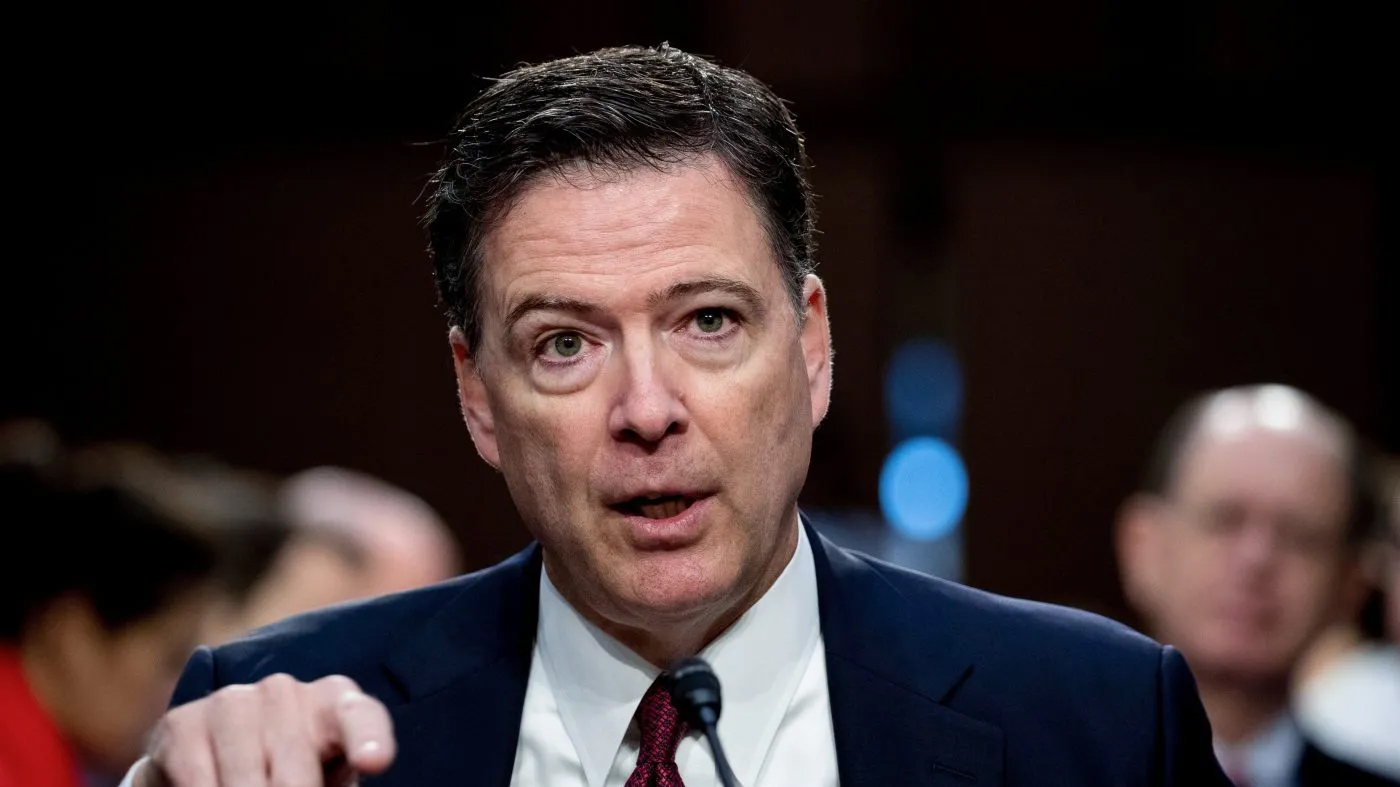
Comey’s responses “made matters worse” regarding Trump’s “frustration with Comey” (II-53). In the weeks following Comey’s statements, Trump pestered members of the intelligence community to make public statements saying that he had nothing to do with Russia’s efforts to sway the election. Trump was also hoping high-ranking intelligence officials, like Dan Coats, Director of National Intelligence, could use their influence to halt the FBI’s investigation. Coats’s recollections were not crystal clear on the matter, but others in the National Intelligence Office recalled Coats making several statements at the time regarding the President’s wanting him to help curtail the investigation, but “Coats told the President that the investigations were going to go on and the best thing to do was to let them run their course” (II-55-56).
Trump also broached the subject of stopping or limiting the investigation with Michael Pompeo (then-CIA Director) and Admiral Michael Rogers (NSA Director) (II-55). Admiral Rogers and his Deputy Director Richard Ledgett were so unsettled by the President’s suggestion that they immediately documented the conversation in a memorandum and placed it “in a safe” (II-56). Ledgett told investigators “it was the most unusual thing he had experienced in 40 years of government service.” In spite of the conversation’s strangeness, Rogers did not feel the President’s suggestion (and it was merely a suggestion, not a directive) was “illegal, immoral, unethical or inappropriate” (II-57).
In the meantime, Trump continued to pressure James Comey to make a public statement saying the President was not under investigation. Comey avoided the issue by indicating it was not in his purview, but rather the Department of Justice’s. On April 22, 2017, President Trump taped an interview in which he said he was considering asking Comey to resign, but “[w]e’ll see what happens,” seeming to imply that Comey’s job status hinged on there being a public statement clearing Trump of any wrongdoing in the Russia-interference matter (II-58-59). White House Counsel McGahn and senior DOJ officials did not want a statement issued because they knew they were getting close to triggering a Special Counsel investigation if it appeared Comey was forced to make a public statement (II-59-60).
The matter came to a head in early May when Comey testified before the Senate Judiciary Committee. According to McGhan, “the President said it would be the last straw if Comey did not take the opportunity to set the record straight by publicly announcing that the President was not under investigation.” During the oversight hearing, Comey was asked explicitly to comment on who may have been ruled out during the FBI’s investigations thus far, and if the President specifically had been cleared—but Comey would not answer any such questions until the investigation had run its course (II-62-63).
Terminating Comey
The President was furious, especially with Attorney General Jeff Sessions for his decision to recuse from overseeing the Russia investigation, saying, “I appointed you and you recused yourself. You left me on an island. I can’t do anything,” to which Sessions responded that he had no choice in the matter (II-63; according to testimony from Sessions’s chief of staff Jody Hunt). Trump became obsessed with the idea of firing Comey and discussed it with several advisers. Steve Bannon recalled telling the President firing Comey was pointless because “he could fire the FBI director but … not the FBI” (II-64).
On May 8, 2017, Trump informed his aids of his decision to fire Comey as Director. White House and Department of Justice officials were reluctant, and they wanted to slow the process and perhaps allow Comey to resign. Trump had made up his mind, however. Deputy Attorney General Rod Rosenstein expressed concerns about the way Comey had handled the Hillary Clinton email investigation. The President, with the help of Stephen Miller, had already drafted a termination letter, but Trump was persuaded to allow Rosenstein and Sessions to compose the letter firing Comey. Trump insisted the new letter include the fact “Comey had refused to confirm that the President was not personally under investigation.” Trump said, “Put the Russia stuff in the memo” (II-67).
Rosenstein did not want to reference the Russia investigation in the new draft because it was not behind his support for removing Comey. Ultimately Comey’s termination letter did not mention Russia, and McGahn was of the opinion that Trump’s original letter should never be read by anyone (II-68). There was immediate backlash in the media over Comey’s firing, and Trump wanted Rosenstein to say in public that the idea of the Director’s removal came from him, but “he would not participate in putting out a ‘false story’” (II-70). Nevertheless, Trump insisted that the narrative be that the decision to fire Comey did not originate with him. He directed Press Secretary Sean Spicer to tell reporters on May 9, 2017, “It was all [Rosenstein]. No one from the White House. It was a DOJ decision” (II-70).
“I just fired the head of the F.B.I. he was crazy, a real nut job. I faced great pressure because of Russia. That’s taken off. … I’m not under investigation.”
The following day, President Trump held an Oval Office meeting with Russian Foreign Minister Sergey Lavrov and Russian Ambassador Sergey Kislyak in which he told them about Comey’s removal. As reported by the media, Trump told the Russians, “I just fired the head of the F.B.I. he was crazy, a real nut job. I faced great pressure because of Russia. That’s taken off. … I’m not under investigation” (II-71; ellipsis in original). The President and the White House did not dispute the reporting of the remarks to the Russians, and the President confirmed them to McGahn when he inquired about them.
False narrative regarding Comey
In addition to trying to attribute Comey’s firing to Rosenstein, Trump also pushed the idea that Comey was an ineffective leader of the FBI and agents had lost confidence in him, and this had prompted him to accept Rosenstein’s recommendation for termination. Deputy Press Secretary Sarah Sanders gave a briefing to reporters in which she said, “Look, we’ve heard from countless members of the FBI that say things very different [than that they support Comey].” Sanders told the Special Counsel, however, that the claim and ones similar to it regarding agents’ lack of confidence in Comey were “not founded on anything” (II-72).
One of the most significant events involving Comey’s firing came on May 11, 2017, during an interview with NBC News’ Lester Holt. First, Trump contradicted his own version of events by acknowledging he had decided to fire Comey prior to meeting with Sessions and Rosenstein. Trump said, “I was going to fire regardless of recommendation.… [Rosenstein] made a recommendation. But regardless of the recommendation I was going to fire Comey knowing there was no good time to do it.” Then came the more eyebrow-raising statement: “And in fact, when I decided to just do it, I said to myself—I said, you know, this Russia thing with Trump and Russia is a made-up story. It’s an excuse by the Democrats for having lost an election that they should’ve won” (II-73).
So, in the moment, Trump abandoned or forgot the official story, that Comey had been fired chiefly for his mishandling of the Clinton email investigation (and particularly for his public statement about developments in it just prior to the election), compounded by FBI agents’ loss of faith in Comey. Later in the interview, Trump said he knew firing Comey would be “confus[ing]” and that it may “even lengthen out” the time frame of the Russia investigation (II-73).
The Special Counsel’s Office concluded that the evidence “indicate[s] that a thorough FBI investigation would uncover facts about the campaign and the President personally that the President could have understood to be crimes or that would give rise to personal and political concerns” (II-76). What is more, “The initial reliance on a pretextual justification [for terminating Comey] could support an inference that the President had concerns about providing the real reason for the firing [that is, the Russia investigation], although the evidence does not resolve whether those concerns were personal, political, or both” (II-77). In other words, Trump did not seem to want anyone to know the real reason for Comey’s termination (his refusal to say publicly that Trump was not under investigation), but Mueller was not able to determine if Trump was worried about personal liability (in other words, being charged with a crime) or political fallout, or both. If only political fallout, it would not support a charge of obstruction of justice.
Appointment of a Special Counsel
Less than a week after the Lester Holt interview, Acting Attorney General Rod Rosenstein authorized a Special Counsel investigation into Russian interference and related matters, and he appointed Robert Mueller to fill that post. A delegation of White House officials went to the Oval Office to inform Trump of the Special Counsel’s appointment, and, according to Jody Hunt, “the President slumped back in his chair and said, ‘Oh my God. This is terrible. This is the end of my Presidency. I’m fucked’” (II-78). Sessions had delivered the news. The President was furious with Sessions and blamed him for the situation since he had recused himself. “You were supposed to protect me,” said Trump, or something to the effect, as reported by Sessions (II-78).
At the end of the meeting Trump told Sessions that he should resign, and Sessions said he would submit his resignation as Attorney General. The next day the FBI notified Don McGhan that there was an investigation underway related to Comey’s firing and all related documents must be preserved. That was May 18, 2017, the same day that Sessions hand delivered his letter of resignation. Trump took the letter but asked Sessions several times if he wanted to continue serving as Attorney General. Sessions said that he did, and Trump acknowledged that he did not want Sessions to resign—but he kept his letter (II-79).
Priebus advised Sessions to retrieve his letter of resignation “because it would function as a kind of ‘shock collar’ that the President could use any time he wanted.” He also described the President as having the Department of Justice “by the throat” (II-79-80). Both Priebus and Bannon attempted to get Sessions’s letter back from Trump, but he was reluctant to return it. He would at times show it off to people, but then lie about not having it on hand when Priebus asked for it. Finally on May 30 the President returned the letter to Sessions with a notation that his resignation was not accepted.
Attempted removal of Mueller
Meanwhile, Trump was attempting to have Mueller removed as Special Counsel by claiming that he had conflicts of interest. In particular, Trump claimed that Mueller held a grudge over a membership fee dispute he and his wife had with a Trump-owned golf course in Virginia. Trump’s staff assured him such claims of conflict were groundless, and that the Department of Justice cleared Mueller of any potential conflicts before appointing him Special Counsel (II-80-81). McGahn also advised Trump that efforts to have Mueller removed “would be ‘[a]nother fact used to claim obst[ruction] of Just[ice]’” (II-81-82). Nevertheless, Trump continued considering the possibility of firing the Special Counsel, even though his closest advisers warned against it (II-82-83).
The first public reports of the Special Counsel’s investigating possible obstruction of justice surfaced June 14, 2017, in The Washington Post. The next day the President began tweeting hostile criticism regarding the investigation and the Special Counsel’s Office. On Saturday, June 17, Trump contacted McGahn at home and ordered him to fire Mueller. McGahn had no intention of carrying out Trump’s directive, telling him “the White House Counsel’s Office should not be involved in any effort to press the issue of conflicts” (II-85).
“McGahn recalled feeling trapped because he did not plan to follow the President’s directive but did not know what he would say the next time the President called. McGahn decided he had to resign.”
The President persisted, and called McGahn a second time to insist that he contact Rosenstein: “Call Rod, tell Rod that Mueller has conflicts and can’t be the Special Counsel,” Trump said (II-85-86). McGahn just wanted to end the phone call, so he told the President he would contact Rosenstein even though he had no intention of doing so. The Report says, “McGahn recalled feeling trapped because he did not plan to follow the President’s directive but did not know what he would say the next time the President called. McGahn decided he had to resign” (II-86). McGahn called his personal attorney and his chief of staff, Donaldson, regarding his decision; then he drove to his office to pack his things and submit his letter of resignation. Donaldson intended to resign also (II-86-87). Ultimately McGahn did not resign, however.
The Special Counsel summarizes Trump’s attempts to have him removed with the following statement: “Substantial evidence indicates that the President’s attempts to remove the Special Counsel were linked to the Special Counsel’s oversight of investigations that involved the President’s conduct—and, most immediately, to reports that the President was being investigated for potential obstruction of justice” (II-89).
Attempted limiting of Mueller’s scope
In addition to efforts to have Mueller removed as Special Counsel, Trump also attempted to limit the scope of the investigation. On June 19, 2017 (two days after asking McGahn to have Mueller removed), the President met with Corey Lewandowski, Trump’s former campaign manager, and asked him to take a message to Attorney General Sessions directing him to make a public statement about the Special Counsel’s investigation. For one, the statement was supposed to clear Trump of any wrongdoing when it came to Russia’s involvement in the 2016 election. Also, Sessions was to announce that he was limiting the Special Counsel’s investigation to foreign meddling in “future elections” (II-90-91).
Lewandowski was not sure of the best way to get the note to Sessions. Efforts to arrange a personal meeting away from the Justice Department, which seemed best to Lewandowski, proved difficult. Eventually Lewandowski passed the task to Rick Dearborn, a senior White House official, who agreed without knowing the contents of the message (II-92). When Dearborn finally read the note, it “definitely raised an eyebrow,” according to Dearborn’s testimony. Later, he lied to Lewandowski and said that he had delivered the message, when in fact he had not and had destroyed his only copy (II-93).
Harassment of Sessions for recusing
Meanwhile, Trump was lambasting Sessions in the media for recusing. He told The New York Times, “[H]e should have told me before he took the job, and I would have picked somebody else,” and he called Sessions’s recusal “very unfair to the president” (II-93). On July 22, Trump directed Priebus, his chief of staff, to demand Sessions’s resignation, but Preibus was certain the political fallout would be devastating, that “the Department of Justice and Congress would turn their backs on the President”—but the President was undeterred in wanting to replace Sessions, presumably with an Attorney General who would protect him (II-95). Priebus believed that his own job status depended on his securing Sessions’s resignation.
The President continued his public attacks on Sessions via Twitter. By the end of July, Sessions prepared another letter of resignation “and for the rest of the year carried it with him in his pocket every time he went to the White House” (II-96; quoting Jody Hunt, Sessions’s chief of staff). As The Report summarizes, “Substantial evidence indicates that the President’s effort to have Sessions limit the scope of the Special Counsel’s investigation to future election interference was intended to prevent further investigative scrutiny of the President’s and his campaign’s conduct” (II-97).
Suppressing emails
During this same time period, Trump became aware of emails pertaining to the June 9, 2016, Trump Tower meeting. In addition to the President’s involvement in drafting a misleading press report about the purpose of the meeting (discussed earlier), he wanted to suppress communications about the meeting as well. When stories were breaking in the media about the meeting, Hope Hicks and others advised the President that the best approach would be to release the incriminating emails to the media, rather than have them leaked. The Report says, “Hicks warned the President that the emails were ‘really bad’ and the story would be ‘massive’ when it broke, but the President was insistent that he did not want to talk about it and said he did not want details.” Moreover, Trump “directed the group not to be proactive in disclosing the emails because [he] believed they would not leak” (II-101).
According to the Special Counsel’s analysis, “The evidence establishes the President’s substantial involvement in the communications strategy related to information about his campaign’s connections to Russia and his desire to minimize public disclosures about those connections” (II-106). Regarding the suppression of emails related to the Trump Tower meeting, the Office concluded that Trump was trying to keep the information from the public; however, “the evidence does not establish that the President intended to prevent the Special Counsel’s Office or Congress from obtaining the emails” (II-107).
Continued pressure on Sessions
Trump’s pressure on Sessions to reverse his recusal continued for the remainder of 2017 and into 2018. Specifically, Trump wanted Sessions to “take control of the Special Counsel’s investigation, and order an investigation of Hillary Clinton” (II-107). In an Oval Office meeting, Trump told Sessions, “You’d be a hero. Not telling you to do anything”—but Sessions would find himself very much in Trump’s favor if he were to recuse and redirect the investigation toward Hillary Clinton.
The Special Counsel’s analysis states: “The duration of the President’s efforts—which spanned from March 2017 to August 2018—and the fact that the President repeatedly criticized Sessions in public and in private for failing to tell the President that he would have to recuse is relevant to assessing whether the President’s efforts to have Sessions unrecuse could qualify as an obstructive act.… A reasonable inference from [the President’s statements and actions] is that the President believed that an unrecused Attorney General would play a protective role and could shield the President from the ongoing Russia investigation” (II-112-113).
Influencing witnesses
Another critical element in the investigation into possible obstruction involves a letter that the President wanted his White House Counsel to draft. The New York Times published a story on January 25, 2018, about McGahn being directed to fire the Special Counsel. On January 26, the President’s personal counsel told Don McGahn that the President “wanted McGahn to put out a statement denying that he had been asked to fire the Special Counsel and that he had threatened to quit in protest” (II-114). McGahn refused to make such a statement because it was untrue. There was mounting media scrutiny based on the report over the next several days, and on February 5 Trump directed McGahn “to write a letter to the file ‘for our records’ … something beyond a press statement to demonstrate that the reporting was inaccurate” (II-115). The President believed McGahn was behind the leaks to the press, and he called him a “lying bastard” behind his back.
Trump threatened to fire McGhan, behind his back, if he refused to write the letter. The next day, Trump told McGhan directly to write a letter for the record, telling him, “This story doesn’t look good. You need to correct this. You’re the White House counsel” (II-116). McGhan would not comply, however, because the news story was essentially true. Ultimately, the Special Counsel concluded, “Substantial evidence indicates that in repeatedly urging McGahn to dispute that he was ordered to have the Special Counsel terminated, the President acted for the purpose of influencing McGahn’s account in order to deflect or prevent further scrutiny of the President’s conduct toward the investigation” (II-120).
Another substantial portion of Volume II looks at whether or not Trump attempted to influence the testimony and overall cooperation of persons being investigated by the Special Counsel in connection to either Russian interference or obstruction of justice—persons such as Michael Flynn, Paul Manafort and Michael Cohen. The attempts were made via personal contact with individuals, messages sent through Trump’s personal attorneys, and statements on Twitter.
Regarding Flynn, The Report states, “After Flynn withdrew from a joint defense agreement … and began cooperating with the government, the President’s personal counsel [John Dowd] left a message for Flynn’s attorneys reminding them of the President’s warm feelings towards Flynn.” Also, the message asked for a “heads up” if Flynn learned about anything regarding the investigation into the President. When Flynn’s counsel responded by reminding the President’s counsel that they could no longer share information, Trump’s attorney said “he would make sure that the President knew that Flynn’s actions reflected ‘hostility’ towards the President” (II-6). (The Report provides a fuller version of Dowd’s statement, and since then a full transcript has been released to the public as well as the recorded voicemail itself.)
“After Manafort was convicted, the President called Manafort ‘a brave man’ for refusing to ‘break’ and said that ‘flipping’ ‘almost ought to be outlawed’.”
Trump’s behavior toward Manafort was similar: “[T]he President praised Manafort in public, said that Manafort was being treated unfairly, and declined to rule out a pardon. After Manafort was convicted, the President called Manafort ‘a brave man’ for refusing to ‘break’ and said that ‘flipping’ ‘almost ought to be outlawed’” (II-6). “Flipping,” of course, refers to the subject of an investigation agreeing to cooperate with investigators in return for lesser charges or the prosecutor’s recommendation to the court for reduced or no incarceration. For a time, Manafort entered into an agreement with prosecutors, but in reality he was not forthcoming and violated other mandates of the agreement.
Attacks on Cohen
Michael Cohen, on the other hand, committed to cooperating with authorities. As The Report states, “On August 21, 2018, Cohen pleaded guilty … to eight felony charges, including two counts of campaign-finance violations based on the payments he made during the final weeks of the campaign to women who said they had affairs with the President.” What is more, “[d]uring the plea hearing, Cohen stated he had worked ‘at the direction of the candidate in making those payments,’” asserting that Trump was a co-conspirator in the campaign-finance violations. (Cohen ultimately corroborated the assertion by turning over a voice recording of him and Trump, and a canceled check signed by Trump to reimburse Cohen for the “hush money” payment to adult film star Stormy Daniels.)
The day following Cohen’s appearance in court, Trump made a point of comparing Cohen’s behavior with Manafort’s, tweeting, “I feel very badly for Paul Manafort and his wonderful family. ‘Justice’ took a 12 year old tax case, among other things, applied tremendous pressure on him and, unlike Michael Cohen, he refused to ‘break’—make up stories in order to get a ‘deal.’ Such respect for a brave man!” (II-149). In the following weeks, Trump kept up the public abuse of Cohen, “repeatedly impl[ying] that Cohen’s family members were guilty of crimes” (II-151). On December 3, 2018, for example, the President tried to influence Cohen’s sentencing via Twitter: “He lied for this outcome and should, in my opinion, serve a full and complete sentence.” In an especially widely reported tweet from December 12, Trump called Cohen a “rat”—and in the same tweet he said the investigation was an “illegal[ ] … Witch Hunt,” and suggested that instead the FBI should be investigating Hillary Clinton (II-151).
The President also used his close association with Fox News to keep applying pressure to Cohen, who was scheduled to testify before Congress. In a January 12, 2019, interview, Trump accused Cohen’s father-in-law of committing crimes (without any evidence) and said that authorities should be looking into his business dealings. On January 23, “Cohen postponed his congressional testimony, citing threats against his family” (II-152).
“The President’s efforts to influence the investigation were mostly unsuccessful, but that is largely because the persons who surrounded the President declined to carry out orders or accede to his requests.”
In summing up Trump’s behavior, The Report states, “Our investigation found multiple acts by the President that were capable of exerting undue influence over law enforcement investigations, including the Russian-interference and obstruction investigations.… The President’s efforts to influence the investigation were mostly unsuccessful, but that is largely because the persons who surrounded the President declined to carry out orders or accede to his requests” (II-157-158).
—
Chapter 4
—
Legal Analysis
–
The latter part of Volume II discusses case law, Supreme Court decisions, and congressional interpretations which have some bearing on the issues at hand, especially obstruction of justice. Unlike other parts of The Mueller Report which are primarily narrative (they tell the story of what happened), this final section is almost entirely analytical. One of the first issues Mueller discusses has to do with the uniqueness of the situation, that is, the investigation of a sitting President who was assisted in his electoral victory by a hostile foreign power and whose possible criminal acts took place mainly in public view (via Twitter, press conferences, public rallies, and media interviews). Accordingly, Mueller references congressional statutes which speak to “corrupt methods … limited only by the imagination of the criminally inclined” (ellipsis in original). The Report quotes the Senate in particular: “[T]he purpose of preventing an obstruction of or miscarriage of justice cannot be fully carried out by a simple enumeration of the commonly prosecuted obstruction offenses. There must also be protection against the rare type of conduct that is the product of the inventive criminal mind and which also thwarts justice” (II-165).
In other words, the fact that there may not be statutes specifically making illegal certain behaviors, it does not mean those behaviors are, therefore by default, legal. There must be some flexibility in the way laws are interpreted in order to adequately address criminal conduct. Then Mueller goes about discussing several statutes whose elements apply nearly, if not precisely, to Trump’s behavior.
Congress’s role
Absent the option to bring criminal charges against President Trump (due to Department of Justice policy), Mueller goes into depth regarding Congress’s checks-and-balances role in regard to the Executive branch of government (that is, the President). One of the issues that the Special Counsel seems to have anticipated is Trump’s stubbornness when it came to releasing documents and in general cooperating with congressional investigations (perhaps based on the President’s lack of cooperation in the Special Counsel investigation, like his refusal to sit for a face-to-face interview and his not allowing his tax returns to be examined). And, in fact, as of this date, the President has claimed a blanket “executive privilege” to shield documents and witnesses from congressional oversight. The Report discusses executive privilege, saying, “The Court has … upheld a law that provided for archival access to presidential records despite a claim of absolute presidential privilege over the records.… The analysis in those cases supports applying a balancing test to assess the constitutionality of applying obstruction-of-justice statutes to presidential exercises of executive power” (II-172). Simply stated, there is no such thing as blanket executive privilege; it can only be exerted in very specific instances.
Mueller also examined issues related to removal of personnel (like the Director of the FBI or the Special Counsel). Normally, presidents’ Article II powers give them tremendous latitude when it comes to hiring and firing positions within the Executive branch, while Congress’s Article I powers do not allow them discretion in such Executive branch personnel decisions. However, the Special Counsel points out that firings cannot take place in order to obstruct justice. The Report states, “[E]ven if a particular … position might be of such importance to the execution of the laws that the President must have at-will removal authority, the obstruction-of-justice statutes could still be constitutionally applied to forbid removal for a corrupt reason” (II-175).
DOJ policy
It seems significant that Mueller underscores the idea that a “corrupt-purpose prohibition … would not undermine the President’s ability to perform his Article II functions.… [Moreover] a restriction on removing an inferior officer [like FBI Director] for a corrupt reason—a reason grounded in achieving personal rather than official ends—does not seriously hinder the President’s performance of his duties” (II-175-176). The verbs undermine and hinder are of particular interest because of the Department of Justice policy prohibiting the indictment of a sitting President, which is known by the awkward title “Amenability of the President, Vice President, and other Civil Officers to Federal Criminal Prosecution while in Office.” In 1973, about a year before President Richard Nixon resigned in large part for obstructing the Watergate investigation, the Department of Justice’s Office of Legal Counsel concluded charging a President while in office “would interfere with the … unique official duties, most of which cannot be performed by anyone else.”
Specifically, the Special Counsel is speaking to the obstructive act of removing someone like FBI Director or Special Counsel and whether or not “Congress has a recognized authority to place certain limits on removal” (II-174); however, Mueller’s insistence that Congress’s interceding to prevent or correct a firing for obstructive purposes, which would naturally involve an investigation into the underlying circumstances, seems to be saying that such an investigation would not interfere, undermine, or hinder the President’s ability to perform his duties—which would, in turn, remove the rationale for the DOJ’s theory-based policy prohibiting the indictment of a sitting President. Later, The Report states in starker terms, “A general ban on corrupt action does not unduly intrude on the President’s responsibility to ‘take Care that the Laws be faithfully executed’ [Constitution, Article II].… To the contrary, the concept of ‘faithful execution’ connotes the use of power in the interest of the public, not in the office holder’s personal interests.… And immunizing the President from the generally applicable criminal prohibition against corrupt obstruction of official proceedings [like oversight and investigations] would seriously impair Congress’s power to enact laws” (II-177).
Furthermore, in Mueller’s final analysis, he writes, “[H]istory provides no reason to believe that any asserted chilling effect justifies exempting the President from the obstruction laws.” By chilling effect, Mueller means impeding the President from performing his constitutional duties. The Special Counsel emphasizes, “[T]he President’s conduct of office should not be chilled based on hypothetical concerns about the possible application of a corrupt-motive standard in this context” (II-180). It is worth noting based on hypothetical concerns—suggesting perhaps the theory that indicting a sitting President would interfere with (that is, chill, in a legal sense) his ability to perform his Article II responsibilities.
“And the protection of the criminal justice system from corrupt acts by any person—including the President—accords with the fundamental principle of our government that ‘[n]o [person] in this country is so high that he is above the law’.”
In the final paragraph of The Report, Mueller says again, “In our view, the application of the obstruction statutes would not impermissibly burden the President’s performance of his Article II function[s].… And the protection of the criminal justice system from corrupt acts by any person—including the President—accords with the fundamental principle of our government that ‘[n]o [person] in this country is so high that he is above the law’” (II-180-181). It is with this idea—that no one, even the President, is above the law—that Mueller concludes his nearly 450-page report, letting it literally be the last word.
Even if Mueller is not advocating for the overturning of accepted DOJ policy (“Amenability of the President . . .”), he makes clear that investigation of President Trump, especially on the allegations of obstruction of justice, are in order by Congress, even if not the Department of Justice.
The thread of bribery
There is a curious thread that runs through the final pages of The Mueller Report which, to my knowledge, has not received a lot of attention in the media to date, and that is the Special Counsel’s inclusion of cases involving bribery. He states, for instance, “[T]he Constitution confers no power in the President to receive bribes” (II-170). Then, at the end of his Report, Mueller writes, “[P]robing the President’s intent in a criminal matter is unquestionably constitutional in at least one context: the offense of bribery turns on the corrupt intent to receive a thing of value in return for being influenced in official action.… There can be no serious argument against the President’s potential criminal liability for bribery offenses” (II-180). Nowhere else in The Report does the Special Counsel discuss bribery except in these final pages.
Some legal experts have written about this twist at the end of The Report and have concluded that Mueller’s team was correlating obstruction with bribery because bribery statutes are more clear-cut than ones involving obstruction of justice, when it comes to applying them to sitting Presidents with Article II powers. Legal experts have claimed this correlation is weak and even erroneous. I think it is possible that Mueller was not correlating obstruction with bribery, but was, in fact, talking about bribery itself. It is not discussed by name elsewhere in The Report, but Mueller was not tasked with investigating allegations of bribery—coordination with Russia’s interference in the election, and obstruction of justice—so that is what he reported on. We know, though, that he uncovered other crimes by other subjects (Michael Cohen and Paul Manafort, as examples), and that he handed off cases to other DOJ offices, like the Southern District of New York.
When the Mueller probe came to a close in 2019, there were more than a dozen known investigations into Donald Trump and the Trump Organization, in addition to ongoing matters directly related to the Special Counsel’s Office. As of this date, Attorney General Barr will not release the unredacted Mueller Report to Congress, let alone the American people, and many of those redactions have to do with continuing investigations or grand jury testimony. Nor, of course, will Barr release the underlying evidence collected by Mueller’s team. With Barr’s assistance and nearly all of the Republicans in Congress, Trump has managed to stonewall the various House committees who are working to gather documents and hear from witnesses.
It is conceivable that Mueller uncovered evidence of actual bribery—after all, violations of the Constitution’s emoluments clause are among the allegations that have been leveled at Trump. The emoluments clause prohibits office holders from receiving gifts from foreign nationals and entities. It has been widely reported in the media that Trump’s properties, especially those in Washington, benefit from the business generated by foreign nationals, many of whom have come to Washington to lobby the Trump Administration regarding specific policies. What is more, bribery was the principal allegation against Vice President Spiro Agnew when he was forced to resign in 1973. The DOJ policy memo, “Amenability of the President, Vice President, and other Civil Officers to Federal Criminal Prosecution while in Office,” which has been used to claim a President cannot be indicted while in office, most definitely concluded that a Vice President can be.
Granted, there is much speculation in these last few paragraphs, but it would explain why Trump and his supporters, including Attorney General Barr, are willing to defy subpoenas and risk being held in contempt of Congress to keep the President’s financial documents out of the hands of investigators.
—
For more information about Twelve Winters Press, a literary publisher, and its imprints, visit twelvewinters.com.
Writer, Critic, Poet, Educator, Artist — Reflecting on the William H. Gass Centenary

I was invited to deliver this paper at the Louisville Conference on Literature and Culture, Feb. 2025, but unfortunately a bout of influenza prevented my attending. I had written the paper ahead of time, so I post it here, as an undelivered address. I did not finely tune as I normally would (given my weakened condition).
This past year, 2024, marked the centenary of William H. Gass (1924-2017), who is perhaps best known as the author of the postmodern mega-novel The Tunnel, both revered and reviled by reviewers when it landed in 1995. Via conferences here in Louisville and the American Literature Association Conference in Chicago, a day-long program at Washington University in St. Louis, and the forthcoming collection William H. Gass at 100: Essays, the many aspects of Gass’s literary contributions to both American and international letters were emphasized and examined. This paper will survey some of the most vital takeaways regarding Gass’s work, especially in areas not typically addressed, like Gass the poet, Gass the teacher, Gass the mentor, and Gass the photographer. The centenary made clear that William Gass has admirers around the world, and this paper offers a plethora of little-explored avenues for continued Gass scholarship. What is more, translations of various Gass texts are underway, and this paper will speak to some of that work as well (especially the project of translating Cartesian Sonata and Other Novellas into the Greek language, detailing some of the specific issues raised by the translator).

Before talking about 2024 and beyond, I would like to go backward … to 2020, which marked the 25th anniversary of the publication of The Tunnel. That year was the abyss of the Covid pandemic, and nearly everyone was hunkered down in their homes. It occurred to me that the 25th anniversary should be noted, and it could be done online as well as during an in-person event; thus, I conceived of thetunnelat25.com, a website that would publish various contributions by Gass scholars, aficionados and fans regarding the 650-page, postmodern behemoth. Working with Mary Henderson Gass and Catherine Gass (the author’s widow and daughter), I assembled a list of “Gass people” and reached out via email. Responses were enthusiastic, although not everyone felt that they could contribute. Nevertheless, the project took shape. I was actually supposed to deliver a paper on The Tunnel at 25 project at this conference in 2022, but a conflict prevented my attendance. Let me take you on a quick tour of thetunnelat25.com, and highlight some material that is appropriate to our topic today. (You’ll have to tour on your own.)
One of the pieces I contributed to the project was “Stripping the Master of Kohler’s Rags,” and here is an excerpt:
[Begin excerpt]
“People, in my view, are many people. It’s not that we fall apart all the time into separate personalities, but under certain circumstances we display different values and feelings and modes of thinking” (Ziegler, “WHG in Germany” 115). Thus said William H. Gass when asked about the department colleagues of William Kohler, the narrator of The Tunnel. That is, Kohler’s fellow historians (Culp, Governali, Herschel and Planmantee) “each represents a theory of history, and each gets his own little story.” Like so much else in The Tunnel, it is not clear whether Kohler is describing actual colleagues, or, rather, projections of his own multifaceted personality. “I wanted to leave the ontological status of these characters in doubt,” said Gass. “Either these are real people in his world […] or they are simply aspects of his own personality mildly at war with one another” (115).
Given that one of the consistent complaints about The Tunnel when it appeared in 1995 was that its protagonist, Kohler, seemed uncomfortably similar to the author himself, the idea of multidimensional personalities is well worth exploring in a symposium that hopes to re-introduce the reading public to Gass’s magnum opus. There was the name, of course: the given name of William paired with a family name of German ancestry. There was the occupation: a professor at a Midwestern university, one quite like Purdue, where Gass was teaching when he began writing the novel. There was the affinity for many of the same writers: most notably the German poet Marie Rainer Rilke, perhaps Gass’s greatest influence. Over time, another similarity became the length of time Kohler took to write his magnum opus, Guilt and Innocence in Hitler’s Germany: thirty years, four more than the number Gass required to complete a book he imagined finishing in just a fraction of that time. These are only some of the correspondences between the author and his narrative creation, William Frederick Kohler.
The similarities became troubling for readers and reviewers because Kohler is, well, not nice. In fact, he’s something of a monster. He is mean-spirited toward essentially everyone who has the misfortune of inhabiting his sphere, and he’s downright hateful to his wife, Martha, whom he thinks of as a “guard” that is confining him within the prison of his unhappiness. She has become essentially a non-person to him: “Martha’s face fades as her torso solidifies, her Aryan blood surfacing like lard. I work on her features, but I’ve forgotten what they are[.…] Without a mouth she’ll still talk back, from her crack like as not” (150-51). Worst of all, Kohler’s scholarly work on the Nazis appears more sympathetic toward them than many would like, including the administrators at his university (“those shit-resembling administrators,” he calls them) who overlook him for promotion because they consider him a “Nazi-nuzzler” (133). If Kohler seems to have a soft spot for Nazis and refers flippantly to the Holocaust, he must therefore be anti-Semitic; and if Kohler is an avatar for Gass himself, then the author, too, must be … so went the logic.
Gass anticipated readers who didn’t know how to read well would conflate the persona of the protagonist with the person of the author: “The resemblances between myself and my narrator are wholly trivial, I think, but I did emphasize them in order to test the reader’s sophistication (a test many reviewers failed). […] Unfriendly reviewers delight in the opportunity to clothe me in Kohler’s rags.” Against such charges, Gass pushed back, saying, “[T]he record will show, I believe, that I do not belong in Kohler’s camp” (Ziegler, “WHG in Germany” 116). (You will find the Works Cited at project site.)
The distinction between the author and his creation is a vital one to make as we attempt to read The Tunnel afresh in 2020, on its twenty-fifth anniversary.
[End excerpt]
As you will see in today’s talk, The Tunnel remains a special focus of Gass scholarship and appreciation. In light of that I will also call your attention to another of my contributions to the website: “The Tunnel: A Chronology & Bibliography,” (link) which documents Gass’s progress from its conception in 1966 to its publication in 1995 and beyond. The novel has a complicated publishing history, and my hope is that I will save scholars time and trouble tracking when attempting to piece together and track down the scattered excerpts of The Tunnel. As a writer myself, I always found it interesting that Gass seemed to have concept of how long the writing of the novel would take; so I’ve included quotes from Gass over time as he continued to reassess where he was in the process. Even from the start, completion of the novel always seemed to him a few years away. A complimentary piece at the website is Joel Minor’s “The Tunnel: A Survey of Published Excerpts,” [link] which takes a more scholarly, strictly bibliographic approach to the same sort of information I provide in my “Chronology & Bibliography.”
Let me return to 2024 … or rather December 2023, which is when I posted my first “William H. Gass at 100: A Reading Journal,” [link] in which I describe how I first encountered Gass via his novella (or long story) “In the Heart of the Heart of the Country.” I begin by saying, “As a Gass scholar and devotee (disciple isn’t too strong of a word), I have various projects in the works to mark the Master’s 100th year — all part of my ‘preaching the Gass-pel,’ an evangelism I embarked on more than a decade ago. No doubt I will use this forum to talk about some of those Gass Centenary projects, which tend to be formal and scholarly. It occurred to me that I also wanted to do something less formal, and more personal. It is not an overstatement to say that William H. Gass changed my life. His writing, his theories, his example as torchbearer in the cause of literature: everything has impacted me in ways that I can name and, doubtless, in ways that I cannot.”

My intention was to post a new reading journal, including a new video, periodically throughout 2024. It didn’t quite workout that way (as I feared). I included my various contributions to the Gass Centenary as journal entries, although that isn’t what I had in mind back in December 2023. One such contribution was my paper delivered here a year ago: “William H. Gass at 100: Looking Forward, Looking Backward” [link], which focuses mainly on the backward part as I provide a biography of Gass and his most notable works for the majority of the paper. Sadly, I’ve discovered that Gass is not especially well known, even in literary circles, so describing his career and achievements is necessary.
After the Louisville Conference paper, the next significant event was a panel at the American Literature Association Conference in Chicago in May 2024. In the panel, Joel Minor presented his Tunnel bibliography from thetunnelat25.com project; Ali Chetwynd (American University of Iraq, Sulaimani) presented “Literary Theory Teaching: Founded on William Gass”; and I presented “Let Us Now Praise William Gass’s Greatest Work – And It’s Not the One You Think” [link]. While I am, of course, a fan of The Tunnel, and I’ve presented several papers and published a few on Gass’s magnum opus, I don’t believe it was the most masterful of the master’s work. Rather, artistically, I feel that Cartesian Sonata and Other Novellas represents the pinnacle of his literary achievements. I’ll share the final paragraphs of that paper:
[Begin excerpt]
Though my catalog is incomplete, I’ll end where I began, with The (large, loose, baggie) Tunnel. Gass’s ambitions for the novel were epic, and it took him far longer—far longer—to write than he anticipated. He imagined, maybe, three years or so … let’s say, then, a publication date around 1970. But time marched on and the Master aged along with his aim for the book. He had about 600 manuscript pages in hand when, in 1991 (age 67), he went for an extended stay at The Getty Center in Santa Monica to devote himself fully to finishing the legendary book. Working into 1992, he doubled the size of the novel, completing it at about 1,200 manuscript pages. Begun in the sunny summer of literary postmodernism, the first half of the book displays many of the tropes and tricks that interested Gass in the 1960s and 70s—it resembles in many ways Gass’s wildly experimental novella Willie Masters’ Lonesome Wife (1968)—an experiment that Gass himself deemed a failure in retrospect.5 Though The Tunnel doesn’t quite conform to the chronology of its composition, the latter half doesn’t display the same fondness for postmodern play as the beginning sections do. Released at last in 1995, it was as if the postmodern novel had arrived at the party after practically all the guests had collected their coats and gone home to sleep it off.
Perhaps Gass wittily but unwittingly anticipated the fate of The Tunnel when he wrote the preface to In the Heart of the Heart of the Country (revised 1981):
“I write down these dates, now, and gaze across these temporal gaps with a kind of dumb wonder … hodge against podge, like those cathedrals which have Baroque porches, Gothic naves, and Romanesque crypts; time passed, then passed again, bishops and princes lost interest; funds ran out; men died; … and because they were put in service while they were still being built, the pavement was gone, the pillars in a state of lurch, by the time the dome was ready for its gilt or the tower for its tolling bell …” (xxxii).
We still ought to attend service in William Gass’s great cathedral, but our warmest words of worship should be reserved for Cartesian Sonata and Other Novellas.
[End excerpt]
Gass was born in Fargo, North Dakota, though he moved from there to Warren, Ohio, when still a baby. Nevertheless connections to North Dakota remained, and I attempted to organize some sort of event or conference in Fargo or nearby in the summer of 2024, ideally around Gass’s birthday, July 30. Unfortunately no one locally seemed to have the time or money or interest. Perhaps one day I’ll resume my efforts. Therefore, the next significant event was at Washington University in St. Louis October 3, “William H. Gass Centenary Celebration” [link]. The main event was a panel discussion that I had the honor of moderating. It included Patrick Davis (Unbound Press), Michelle Komie (Princeton University Press), and Gerhild Williams (Washington University German Department, retired). Much of the informal discussion focused on Gass’s founding and directing of the International Writers Center (1990-2000).
One of the more intriguing revelations from the panel discussion was that Patrick Davis, of Unbound Press, plans to republish The Tunnel in the form that Gass always had in mind: a loose collection of about 1,200 manuscript pages, and stuffed with things like paper bags, business cards, and crossword puzzles. Its publication may coincide with the novel’s 35th anniversary. I hope that it comes to pass.
Interest in Gass’s work persists, if not as robustly as enthusiasts like me would prefer. Last year I was contacted by Apostolis Pritsas, who was translating Cartesian Sonata and Other Novellas into Greek, and he requested my informal consultation. I was happy to do it, and we exchanged a few emails over the summer and fall. The two novellas that generated the most questions were “Cartesian Sonata” and “Emma Enters a Sentence of Elizabeth Bishop’s”—both highly experimental works in terms of structure and narrative chronology. The Greek edition is slated for an early March release. Meanwhile, a Spanish-language edition of Cartesian Sonata appeared [link], which changes the order of the novellas, totally undercutting Gass’s concept of the collection.
Finally, I plan to edit, contribute to, and publish William H. Gass at 100: Essays later this year. Contributions include the following: “‘Inward Toward the Other’: The Dancing Minds of William H. Gass and Toni Morrison” by Jose Miguel Alvarado Mendoza; “In Search of William Gass” by Zachary Fine; “William Gass and the Power of Baroque Fictionality” by Yonina Hoffman; “The Meta-Novel as a Container of Self-Consciousness: Linguistic Order and Fascism of the Heart in William H. Gass’s The Tunnel” by Abbie Saunders; “Broken Windows and Dirty Mirrors: Metaphor and Mind in The Tunnel” by Jonathan Moreland; “Defying Form” by Nathan King; “To Create or Capture Consciousness: Reconsidering William H. Gass as ‘The Father of Metafiction’” by Alex Lanz; and “Medium-Specific Foundations: Teaching Literary Theory Across the Gass-Axis” by Ali Chetwynd.
I will draw from several of my Gass conference papers to put together a constellation of pieces, and I also will include a selection of Gass’s photographs. He was a serious photographer, but that aspect of his artistic life has received little attention.
Popular Fiction – An Historical Perspective
(The following lecture was presented remotely to students and faculty at the National University of Modern Languages, Islamabad, Pakistan, on February 12, 2025. It was at the invitation of and organized by Ms. Ambrina Qayyum, Dr. Amina Ghazanfar, and Ms. Farihatulaen Rizvi; with student organizers Moazzam Ali and Minha Iman.)

I begin with a quotation:
“Persons attempting to find a motive in this narrative will be prosecuted; persons attempting to find a moral in it will be banished; persons attempting to find a plot in it will be shot.” – the “Notice” that appears on the title page of Adventures of Huckleberry Finn, by Mark Twain (1884), considered by many the quintessential American novel. As you may know, Adventures of Huckleberry Finn is a picaresque novel narrated by the title character, Huck, who is about 13 years old. Huck and the escaped slave Jim travel down the Mississippi River on a raft, having a series of adventures along the way. I feel like beginning with this quotation is appropriate to our purposes here because the Notice seems to be the author’s warning to the reader not to take the book too seriously. Its purpose is entertainment, and thinking about loftier things, like the novel’s meaning, will not be tolerated. Mark Twain, whose real name was Samuel Clemens, was a master storyteller and satirist. So how serious was Clemens in his Notice? Did he truly not want readers to search for motive, moral, and plot in his book? If there was some sincerity to his Notice, it may have been because he anticipated that Huckleberry Finn would be a highly controversial book.
Sincere or not, his Notice was disregarded, and Adventures of Huckleberry Finn has been one of the most studied and discussed novels in American (and world) literature. And in spite of the seriousness that readers have found in the text, it became a fabulously popular novel and contributed to Mark Twain (aka, Samuel Clemens) becoming the most popular author in the U.S. by the end of the nineteenth century.
Let me leave Samuel Clemens and Huckleberry Finn for now.
I’ve been asked to speak on “popular fiction,” and I agreed even though at the time I realized the term was malleable in my mind. That is, I wasn’t completely sure what the term even meant. In the last month or so I’ve been looking into the topic – browsing the internet, reading articles, giving it some quasi-serious thought – and I can say with confidence that I’m still not sure what it means. I have, however, stumbled across a lot of interesting ideas associated with the concept of “popular fiction,” so I’ll share them with you (in the hope that you’ll find them interesting too). What is more, largely due to my roles as a writer and publisher, but also as a teacher of writing, I’ve been interested in the history of the publishing industry (in the West, and in particular the United States), and I’ve presented some conference papers on the topic. I will draw from these as well.
Let me begin with some assumptions and/or questions that first came to mind when considering this topic:
What do we mean by popular?
What is the measuring stick for determining popularity?
That is, how popular does a novel have to be to be considered “popular fiction”?
Can a novel be “popular fiction” without actually being popular?
Is popular code, or a kind of euphemism, for bad?
Is the previous question elitist?
How do we determine good versus bad fiction?
For that matter, who determines it?
If popular does mean bad fiction, what is the term for good fiction?
Again, how do we judge?
Again, who judges?
And if the fiction is so darn good, why isn’t it popular?
When did the idea of a book being a “bestseller” begin?
How is bestselling determined?
Ok, I’ll stop there for now. Let’s begin to consider these questions.
From one perspective, popular fiction is fiction (probably in the form of novels) that is read by a lot of people in a given culture. A book gains the label “popular fiction” by attracting a significant number of readers. From this perspective, books are not published as “popular fiction,” but they may become popular over time. Nowadays we call such books “bestsellers,” but that itself is a nebulous term. Quite honestly, until I started researching for this talk I didn’t know much about how a book (or an author) earns the epithet “bestselling.” For the last quarter century I’ve also worked as a librarian, and every week we add new titles to our shelves that are said to be bestsellers or by bestselling authors—books and authors, oftentimes, I’ve never heard of, which suggests that the standard for determining bestselling is fairly low. Low, of course, is relative, but my research has determined that the standard is both nonstandard and mysterious. What I mean by nonstandard is that different organizations will disseminate “bestseller” lists, and each will use its own criteria. In the U.S., we tend to think of The New York Times newspaper and its The New York Times Book Review as the arbiter of bestseller status, but, really, there are many bestsellers lists: Publishers Weekly, USA Today and Indiebound are among the more common publications that provide lists of bestsellers. Moreover, booksellers, like Amazon and Barnes and Noble, will put out their own lists of bestsellers. Complicating things further is the fact that each will put out multiple lists, based on categories of books and types of book (hardback versus paperback versus ebook).
Each entity and each list generated will have its own criteria for determining bestseller status. They’re all based on sales, kind of, but on data that comes from a wide variety of sources. I say “kind of” because the sales data can be rather fluid and open to interpretation, so that, in some lists more than others, the accolade of “bestseller” may be as much subjective impression as empirical conclusion. (Indiebound, for example, tends to rely more on booksellers’ hunches than actual hard sales figures.) Another nonstandard element is sales period. One list may be based on a week’s worth of sales, Monday to Sunday, say, (reported from here versus there), while another list considers data drawn from a different period of time, longer or shorter, or simply a different bracketing of time.
Even though numbers have nebulous meanings, for a frame of reference let’s look at The New York Times bestseller list. To make the list in a given week, a novel must sell between 1,000 and 10,000 copies. However, such sales do not guarantee inclusion on the list because it also depends on other factors, like the total number of books that achieve those sales figures for a single week. Earlier I said the standards were both nonstandard and mysterious; here is where the mystery comes in. The New York Times won’t reveal precisely how they determine the bestseller lists. Sales are an important factor, but there are others that are closely held secrets. Allegedly even the editors of The NYT Book Review aren’t privy to the exact methodology. Their secrecy, they say, is partly in an effort to prevent people from manipulating the system. Nevertheless, people (like authors, agents and publishers) do try to manipulate the system, and if the NYT suspects such manipulation they’ll mark a title on the list as suspicious, printing a dagger symbol next to it.
Another aspect of popularity is the number of weeks that a book remains on the bestseller list. About a quarter of novels make the NYT list for a single week. Incidentally, it seems the idea of a bestsellers list, as we think of it, began in 1895 with the New York-based journal The Bookman. The New York Times began publishing its list in 1936 (based only on New York City sales). The list, resembling its current form, became established by the 1950s.
I said that people will try to manipulate the bestseller lists, and the reason for that is that appearing on a bestseller list can be a major boon for sales, especially for “new” and little-known authors. So, appearing on a bestseller list reflects some level of popularity, and it further promotes popularity. Said differently, bestsellers sales are self-perpetuating. [In addition to Wikipedia entries, information for these last few paragraphs was taken from “The Convoluted World of Best-Seller Lists, Explained” by Constance Grady.]
In recent years another route to popularity has emerged, namely social media. I would like to speak to this phenomenon, but I find such a discussion will have to wait for another occasion.
For now, let’s shift our perspective on the term “popular fiction,” away from a status based (obliquely) on sales, to a term we use to describe a kind of fiction. One can find many definitions of popular fiction as a kind of writing. I like Britannica.com’s definition:
“[S]ome common attributes of popular literature have been defined. First, it is crafted primarily to entertain the reader, as entertainment is a quality that attracts and appeals to a wide audience. To promote a pleasurable reading experience, works of popular fiction are usually written in a simple and straightforward style. They are largely plot-driven, rather than character-driven, and adhere to conventional narrative structures. As such, they are intended less to provoke deep reflection or aesthetic appreciation than to be read casually and quickly. Books that are successful at this aim, especially through their employment of techniques that stimulate readers’ interest and compel them to continue reading, are praised as ‘page-turners.’”
Popular fiction tends toward escapism rather than self-reflection. That is, readers of popular fiction often want to be distracted from their cares and concerns, not prompted to think deeply about them. As a consequence, popular fiction frequently falls into various genre categories: romance, Western, science fiction, mysteries, so-called “chic lit.” All in all, popular fiction is written to be accessible to the average reader. Literary fiction, meanwhile, (sometimes just called “literature” among other synonyms) tends to require more of the reader: more careful attention, more time, more cognitive effort, a broader working vocabulary.
Nowadays, we tend to think of a wide schism between popular fiction and literary fiction. Writers must be either fish or fowl. Indeed, many earlier texts—let’s say, pre-twentieth century—are studied today because of their seriousness; that is, their author’s attention to significant issues, and the book’s facilitation of meaningful analysis and discourse. Whether it’s Mary Shelley’s meditations on society and the individual, Jane Austen’s examination of unequal inheritance laws, Charles Dickens’s depiction of the mechanisms of poverty, Charlotte Brontë’s proto-feminism, or Joseph Conrad’s indictment of colonialism—the writers and their works were unquestionably popular. That is, they sold well, were widely reviewed, and frequently discussed across social strata.
These writers, of course, benefited from the popularity of reading in general. Authors competed with playwrights (who often adapted authors’ works to the stage, without necessarily paying for the privilege), but reading for pleasure was a major pastime for both men and women, across socioeconomic lines. Periodicals were hugely popular. These were newspapers and magazines that printed stories and excerpts from novels and sold them quite inexpensively. It was common practice for a novel to appear in a periodical serially, and then later be brought together for book publication. Serialization didn’t seem to negatively impact eventual book sales. One can find examples of authors or publishers shying away from periodical publication to begin with for fear of it diminishing the sales potential of the book version. Nevertheless, serialization was an effective way for the reading public to become familiar with an author and their work.
Charles Dickens’s The Pickwick Papers (1836) is often cited as the work that popularized the approach of serialization, first, followed by the book publication. Throughout the nineteenth century and well into the twentieth, magazine publication (either of serial installments of a longer work, or stand-alone stories) was the vehicle that brought mass popularity to authors. Popularity gained through magazine publication was not limited to England, where authors like Wilkie Collins, Elizabeth Gaskell, William Thackeray, Anthony Trollope, and Arthur Conan Doyle thrived. In France, a notable example is Alexander Dumas, whose The Three Muskateers (1844) and The Count of Monte Cristo (1844-1846) were widely read serials. Another would be Gustave Flaubert and his serial publication of Madame Bovary (1856). In Russia, both Leo Tolstoy and Fyodor Dostoevsky found readers via the serialization of Anna Karenina (1875-1877), and The Brothers Karamazov (1879-1880), respectively. In the U.S., publishers were quick to follow Dickens’s example, and many writers found popularity via magazine publication and serialization, among them Harriet Beecher Stowe, Henry James, and Herman Melville. Across Europe and into Asia and Australia, having their work appear in magazines was vital for authors achieving popularity.
Obviously not everything published in this time period combined popularity with serious literary merit. For that matter, it’s difficult to know how serious authors were when writing the books that became popular. Their literary quality—and their ability to generate in-depth study and discourse—may be in part due to our projections. That is, we recognize the significance of their work when they, perhaps, did not. They were merely trying to tell an entertaining tale, but because of the milieu in which they were writing, and their own inherent insightfulness, they wove into the telling significant issues. I think, for example, of a writer like Jane Austen and her series of drawing-room romances, like Sense and Sensibility (1811), and Pride and Prejudice (1813), where the plots mainly center on the marriageability of young women without financial means. They are in some ways extensions of Samuel Richardson’s rather vapid Pamela (1740) and Clarissa (1748). Yet Austen also examines the unequal roles of men and women in marriage, the unfairness of English law when it came to inheritance and gender, the hypocrisy of the Church, and myriad other significant issues, including family dynamics and the interrelationships of siblings.
From almost precisely the same period, an antithetical example would be Mary Shelley’s Frankenstein (1818). On the one hand, it is a fantastical Gothic tale about a creature who has been constructed from body parts, both human and animal, brought to life, then left to fend for himself in a harsh and unsympathetic world. From the start of its composition, however, the teenage author saw the potential for her novel to be so much more than a sensational page-turner. Throughout she alludes to numerous books—which she had thoroughly digested, often in their original language and not in translation—regarding science, history, geography, philosophy, religion, and ethics. Like all authors I suppose, Mary Shelley hoped that her book would be popular, but she did not expect it. She and her husband, Percy Shelley, and their children left for the Continent before Frankenstein was published, and Mary was quite surprised several months later when she heard, while in Italy, that her strange book was the talk of London. It has never been out of print.
What all of these pre-twentieth-century books—the merely popular and the popular while also being serious—have in common is accessibility. That is, they are highly readable regardless of one’s educational background. Frankenstein, for all the complex issues that it raises, remains a novel that can be read and understood by practically anyone who is functionally literate. Whether they recognize the complex issues in the book and whether they consider them deeply, those are other matters.
It is worth noting that there were authors in the nineteenth century who became canonized in academic circles, but they were not especially accessible in their day. Nor, then, were they popular. Two well-known examples are Nathaniel Hawthorne and his friend and neighbor Herman Melville. Both are considered giants of the nineteenth century, and for much of the twentieth century they were staples on high school and college syllabi in the U.S. Hawthorne—famous now for such novels as The Scarlet Letter and The House of the Seven Gables—was frustrated and perplexed by his slow book sales. Meanwhile, authors whom he considered inferior enjoyed wide popularity. He was especially annoyed by the status enjoyed by Henry Wadsworth Longfellow, someone he knew in their younger days as a fellow student at Bowdoin College. To compare, 10,000 copies of The Scarlet Letter were printed, and during Hawthorne’s lifetime only 7,800 copies were sold. Meanwhile, Longfellow’s poem The Song of Hiawatha sold 50,000 copies in its first year, 1857. It was just one of Longfellow’s highly popular publications. It’s estimated that during his lifetime, Longfellow wrote more than 20,000 letters in response to the fan mail that he received. (One close friend speculated that Longfellow’s dedication to responding to his fans led to exhaustion and a too-early grave.) [For this section, I relied on various Wikipedia entries as well as the article by Lauren Gatti “Seriously Popular: Rethinking 19th-Century American Literature through the Teaching of Popular Fiction,” published in The English Journal, vol. 100, no. 5, 2011, pp. 47–53, available via JSTOR.]

Hawthorne’s friend and neighbor, Melville, is another interesting case when discussing authorial popularity. Melville’s first novels were page-turning sea adventures, based on his real-life adventures as a seaman. However, he longed to write something more complex, more artistic, even though he knew such a book wouldn’t be popular. In a famous letter to Hawthorne (May 1851), Melville spelled out his dilemma: “Dollars damn me … What I feel most moved to write [Moby Dick], that is banned,—it will not pay. Yet, altogether, write the other way I cannot. So the product is a hash, and all my books are botches.” In other words, writing simple sea adventures was profitable but they bored him; instead, he wanted to write a book that was much more complex and artistically challenging, even though it likely wouldn’t sell. In the end, he chose artistic satisfaction over popularity. There were 3,000 copies of Moby Dick printed, and copies were left unsold forty years later at Melville’s death. Both Hawthorne and Melville had to support their families by taking low-paying government jobs.
In retrospect, we can see that writers like Hawthorne and (especially) Melville were ahead of their time. A novel like Moby Dick has much more in common with the modernist experimental books produced seventy years later by James Joyce, T.S. Eliot, Virginia Woolf, and D.H. Lawrence. In fact, Moby Dick was essentially rediscovered in the 1920s (thirty years after its author’s death), which led to its becoming a classic and a staple on college syllabi by the 1950s. Hawthorne and his works were also canonized in the twentieth century, while Longfellow and other popular writers of the nineteenth century became marginalized in the academy.
So, if depth of thought and the poetic quality of the language do not lead to popularity, what is the key? I’ve already used the word several times: accessibility. In essence, a book has to be easily comprehensible for it to be widely read and have the potential to become a bestseller. In other words, to become “popular fiction” a book must be written in the style of “popular fiction.” To cement this idea, let me repeat Britannica’s definition: “First, it is crafted primarily to entertain the reader, as entertainment is a quality that attracts and appeals to a wide audience. To promote a pleasurable reading experience, works of popular fiction are usually written in a simple and straightforward style. They are largely plot-driven, rather than character-driven, and adhere to conventional narrative structures. As such, they are intended less to provoke deep reflection or aesthetic appreciation than to be read casually and quickly. Books that are successful at this aim, especially through their employment of techniques that stimulate readers’ interest and compel them to continue reading, are praised as ‘page-turners.’”

I began this talk with a reference to Mark Twain and Adventures of Huckleberry Finn, published in 1884, a novel that has the patina of a simple tale of adventure, perhaps even one for younger readers, but in fact is packed with serious and controversial ideas, especially regarding the institution of slavery (which had been abolished two decades before, but its aftermath was still very much a part of American society … as, sadly, it is today). It is a gross overgeneralization, but we could think of Huckleberry Finn as a kind of temporal marker: a delineation between a time when authors could be both serious and popular, and a time when authors had to choose between the two. Herman Melville’s conundrum of the 1850s (to write Moby Dick and forfeit his growing popularity, or not) foreshadowed the dilemma that increasing numbers of writers would face in the twentieth century and beyond: To be either a writer of popular fiction (read by the masses) or to be a writer of serious fiction (read mainly in academic circles)?
The so-called modernist writers who began publishing after the First World War—Pound, Eliot, Stein, Woolf, Joyce, Forster, Lawrence, et al.—were rejecting accessibility for deeper (especially psychological) meaning. They were grappling with the horrors of the War and developing styles of narration and poetics that responded to both personal and cultural trauma. While the modernists may not have been bestselling authors, they were known and therefore influential. Some of their less challenging work (especially stories and individual poems) appeared in popular magazines (while their more challenging work came out in literary journals, including via serialization—all three of James Joyce’s high-modernist novels, A Portrait of the Artist as a Young Man, Ulysses, and Finnegans Wake, were first published serially). But even if people weren’t reading Joyce, Stein, Woolf, etc., they knew who they were and what kind of writing they were doing because the popular press closely covered the modernist movement. As an example, when Gertrude Stein, one of the least comprehensible modernists, returned to the United States after a self-imposed thirty-year exile in France, she was met by a group of reporters at the New York City docks, and lights in Times Square announced “Gertrude Stein Has Arrived.” Next to no one in the U.S. had actually read Stein’s highly experimental work (and even fewer understood it), yet she had gained celebrity status among the general public. Stein was, in a word, popular. I must acknowledge that the previous year, 1933, Stein had published The Autobiography of Alice B. Toklas, which was by far her most readable book, and its accessibility and popularity contributed to her surprisingly warm welcome home.
During this period, while writers like Stein, Joyce and Eliot prided themselves on the difficulty of their texts, there were many writers who sought both kinds of attention. They thought of themselves as serious literary artists, but they also wanted to be widely read (and well paid). There could be many examples, of course, but two that come to mind are Ernest Hemingway and F. Scott Fitzgerald. Though they had very different personalities, they took similar approaches to achieving both popularity and respect from the high-literary establishment. Again, I oversimplify, but Hemingway saw his short fiction and his novels as products of his highest literary aspirations; while his nonfiction, especially his journalism and newspaper reporting, helped to fund his adventurous lifestyle. Similarly, Fitzgerald devoted great time and energy to his novels, wanting them to be as complex and as literary as possible, but at the same time he churned out one lackluster short story after another to sell to magazines and support his dizzyingly wild lifestyle (his and his wife Zelda’s).
Writers like Hemingway and Fitzgerald were able to aim for both kinds of writing—popular and serious—because the periodical industry was still thriving in the U.S. and elsewhere. Allow me to share a quote from Theodore Peterson’s Magazines in the Twentieth Century (University of Illinois Press, 1956):
“Despite pessimistic forecasts from time to time … magazines had a tremendous growth between 1900 and 1955. The number of magazine readers increased remarkably. When Frank Munsey brought out his Mimsey’s Magazine in 1893, he later estimated, there were about 250,000 magazine purchasers in the United States. By 1899, the ten-cent magazine, he further estimated, had increased the number to 750,000. In 1947, in its nationwide audience study, the Magazine Advertising Bureau found 32,300,000 magazine reading families—those in which members could identify specific items from recent issues. The number of individual magazines also increased; there were well over a thousand more magazines in the United States in 1955 than in 1900. The aggregate circulation of all magazines in the United States mounted steadily, and the sales of individual publications soared from thousands to millions. In 1900 there seems to have been no magazine with a circulation of a million; in 1955 there were at least forty-six general and farm magazines with circulations of one million or more, and one of them had a circulation of more than ten million for its domestic edition alone.”
While not all of these magazines published short fiction, I will risk saying that the majority did. Many, in fact, specialized in publishing fiction in the form of short stories and serialized novels. Moreover, they paid writers well. Let me quote from my introduction to Delta of Cassiopeia (which is available online at Twelve Winters Miscellany):
“There had been a Golden Age of magazine publication for much of the twentieth century, when fiction writers could make a good living selling stories to magazines. In the 1920s, F. Scott Fitzgerald and Zelda lived their legendary high life almost solely from Fitz’s short stories, which could fetch as much as $4,000 each (nearly $60,000 in 2023 money). It’s estimated that during the 1920s and 30s Fitzgerald made almost a quarter of a million dollars from 164 magazine stories (more than $3.25 million today). A generation later, in the 1950s, Kurt Vonnegut Jr. sold four stories to magazines in the course of about eighteen months, allowing him to quit his job in the marketing department at General Electric and devote himself fully to writing. At the time, Vonnegut was supporting a wife [who didn’t work] and six children.”
I continue from my introduction:
“By the 1960s, however, television had begun turning the Golden Age into lead. And by the time I started to write effectively enough to publish, the Golden Age was a rapidly receding memory. In sum, television had superseded book reading as a popular pastime, and nationally distributed magazines had either severely cut back or eliminated space for short stories altogether, thus closing a crucial avenue for new writers to build an audience—let alone make a living.”
From then on it’s been a succession of inventions and developments that have made reading books a lower and lower priority for mass culture: the microcomputer (1980s); the internet and World Wide Web (1990s-2000s); social media and streaming services (2000s-present). Concurrent with these technological arrivals, the publishing industry was consolidated into a handful of multinational entertainment conglomerates. Here I’ll draw from my paper “The Loss of the Literary Voice and Its Consequences” (available at tedmorrissey.blog):

“[T]he corporate takeover of the publishing industry … was largely undocumented when André Schiffrin wrote The Business of Books (2000). ‘In Europe and in America,’ writes Schiffrin, ‘publishing has a long tradition as an intellectually and politically engaged profession. Publishers have always prided themselves on their ability to balance the imperative of making money with that of issuing worthwhile books.’ However, in the turbulent sixties, large conglomerates began acquiring publishing houses. Schiffrin continues, ‘It is now increasingly the case that the owner’s only interest is in making money and as much as possible’ (emphasis in original). Schiffrin’s study is wide-ranging and thorough, but he focuses particular attention on the demise of Pantheon, where he’d been managing director for a number of years when it was acquired by Random House, which in turn was purchased by media mogul S. I. Newhouse, who inevitably insisted on changes to try to increase profits, unreasonably and unrealistically so, according to Schiffrin: ‘As one publishing house after another has been taken over by conglomerates, the owners insist that their new book arm bring in the kind of revenue their newspapers, cable television networks, and films do. … New targets have therefore been set in the range of 12-15 percent, three to four times what publishing houses have made in the past.’”
The only way for these remaining commercial publishers to achieve the sort of profits that are expected by their parent companies (and the companies’ shareholders) is to only publish fiction that has the potential to become popular. In other words, it must be easily accessible to the small percentage of the public that continues to read fiction. The internet is full of statistics that highlight the rapid decline of reading (and therefore in people’s ability to read well). One reliable source in the U.S. is the National Endowment for the Arts. NEA’s report from October 2024 said that in its most-recent surveyed year, 2022, just over a third of American adults reported reading a novel or a short story in the previous year. Let me emphasize: a novel or a short story, singular. And practically every survey from practically every organization confirms a downward trend over several decades. Test Prep Insight published a less thorough but even more recent report (January 2025) that confirms this same kind of decline in reading. The report cites several factors:
- The fast pace of the modern world: With the demands of work, family, and social obligations, many people feel they simply don’t have time to read.
- The rise of digital media: In our constantly connected world, it’s easy to get your news and entertainment from sources other than books.
- The cost of books: Books can be expensive, especially if you’re buying them new. Used books are a cheaper option, but many people simply don’t have the time to hunt for them.
- The declining popularity of reading: As fewer people read, it becomes less socially acceptable to do so. This can create a vicious cycle that leads to even fewer people reading.

So what does all this mean in terms of our topic, “popular fiction”? For one thing, in the West at least, there are fewer and fewer authors who can achieve popularity. Also, for those writers who desire mass appeal, they must make sure their books are easily accessible (that is, as easy to read and comprehend as possible).
There are many interesting issues associated with the idea of fiction’s popularity, like the following:
How has social media, especially TikTok, impacted popular fiction?
How do contemporary authors navigate writing for popularity versus writing for artistic satisfaction?
Why, in the U.S., are we seeing an explosion in creative writing programs at universities (and an explosion in the number of creative writers) during the same period that we see a steady decrease in the number of readers?
How do factors like the age and gender of readers affect what books are being published by the few remaining commercial publishers?
I will have to leave these and other questions unanswered for now.
Trauma theory as an approach to analyzing literary texts
The following is the primary text of a presentation for academics in Kabul and Tehran, arranged by Dr. Nasir Arian, Assistant Professor of Persian Literature and Middle Eastern Studies at Penn State University. It was conducted via Zoom December 5, 2024. This text is excerpted and updated from a much longer article published by Eclectica Magazine, “Cultural Trauma and the Postmodern Voice” (April/May 2021), which was itself excerpted and updated from my book Trauma Theory as an Approach to Analyzing Literary Texts (2021).
In a writers’ symposium on postmodern literature at Brown University in 1989, Robert Coover, in his welcoming remarks, gave the impression the writing style that became known as postmodernism sprang up in the 1950s and ’60s almost by sheer coincidence. Among the symposium participants were Leslie Fiedler, John Hawkes, Stanley Elkin, William Gass, Donald Barthelme, and William Gaddis. Coover noted other writers who certainly would have fit in but were not in attendance, including John Barth, Thomas Pynchon, Angela Carter, Italo Calvino, and Gunter Grass. Coover said, “[T]his group sought out some form, some means by which to express what seemed to them new realities.” However, Coover went on to suggest a remarkably thin theory as to why so many writers, all working in relative isolation, began constructing narrative in uncannily similar styles:
We felt we were all alone. No one was reading us, nor was anyone writing remotely like the sort of writing we were doing until, in the little magazines, we began slowly to discover one another. Few of us knew one another at the time we began writing. There was a uniform feeling among writers at that time that something had to change, something had to break, some structure had to go. And that was, I think, what most united us.

Even though the panel was intended to be a debate, and not merely a discussion, not a single writer challenged Coover’s explanation for the emergence of postmodern style. At first this assessment may seem startling—that some of the keenest and best-educated minds who were at the forefront of producing and (many) critiquing literary postmodernism accepted the premise that postmodern narrative style more or less just happened; essentially individuals writing in isolation on various continents, including North and South America, and Europe, just all happened to begin writing in the same sorts of ways, all in a narrow time span, from about 1950 to 1965. According to Coover, writers with virtual simultaneity decided to abandon modernist realism for something fragmented, repetitive, largely unrealistic and illogical, and highly intertextual.
Joe David Bellamy, in his preface to The New Fiction (1974), expresses a similar notion as to the origins of postmodern narrative style. Bellamy cites an essay by Louis D. Rubin, Jr., who “described his sense that the most interesting writers (at that hour of the world [mid 1960s]) were in the process of struggling against a ‘whole way of using language . . . a whole way of giving order to experience,’ which had been imposed on the sensibility of the times by the great writers of the immediate past.” Again, Bellamy appears to support the idea that postmodern writers simply decided to rebel against modernist literary convention.
A more cogent explanation, I believe, rests with trauma theory. The trauma of the nuclear age, experienced by the entirety of Western culture, affected the psyches of these writers in a way that resulted in postmodern literary style—a style reflecting the traumatized voice. (More on this in a moment.) Historians Jay Lifton and Greg Mitchell, in Hiroshima in America (1995), make several assertions regarding the 20th-century’s zeitgeist as it suddenly evolved after the Second World War. One is the “[s]truggles with the Hiroshima narrative have to do with a sense of meaning in a nuclear age, with our vision of America and our sense of ourselves.” Another is Americans were deeply and immediately conflicted with the atomic bombings of Hiroshima and Nagasaki. They experienced the “contradictory emotions of approval and fear the bomb evoked, a combination that has continued to disturb and confuse Americans ever since.” A third assertion is “[or]dinary people [. . .] experienced their own post-Hiroshima entrapment—mixtures of nuclearism and nuclear terror, of weapons advocacy and fearful anticipation of death and extinction.” And all of this internal conflict, much of which resides in the unconscious, has contributed to a “sense of the world as deeply absurd and dangerous.” Similarly, literary critic Ihab Hassan sees a connection between the horrors of the Second World War and postmodernism: “Postmodernism may be a response, direct or oblique, to the Unimaginable that Modernism glimpsed only in its most prophetic moments. Certainly it is not the Dehumanization of the Arts that concerns us now [1987]; it is rather the Denaturalization of the Planet and the End of Man.”
It is quite possible Coover and the other postmodernists at the Brown University symposium experienced the same sort of repression and dissociation individual trauma victims frequently do. We know it is common for people suffering the symptomology of post-traumatic stress disorder (PTSD) to have no conscious recollection whatsoever of the traumatizing event, or to have a dissociated recollection, so that trauma can be simultaneously indelible and forgettable. While the symposium participants did not seem to recognize post-nuclear cultural trauma as the source of their collective postmodern style, they inadvertently came near the mark—so much so that reading their comments from here in the 21st century, with our growing understanding of trauma theory, one experiences a sort of dramatic irony. An example is this exchange between Fiedler and Elkin regarding the role of the unconscious in narrative production:
Fiedler: [. . . The writer’s] possessed with certain hallucinations that he would like other people to take as real and to weep over and laugh over and shiver over. [. . .] One of the marvelous things about being a writer is many of the things you do you don’t know you’re doing until you get somebody’s response to it.
Elkin: I don’t believe that.
Fiedler: You don’t believe anything’s out of control in a writer?
Elkin: There’s plenty out of control, yes. Absolutely. But I don’t think there’s any such thing as serendipitous meaning.
Fiedler: Well, there’s meaning that comes from writers who are gifted, especially in writers who please many and please long—and it comes from levels deep within their unconsciousness.
I would call attention to Fiedler’s use of the word “possessed,” as we know trauma tends to possess its victim, distorting reality in numerous ways; and “hallucinations” of course are among the symptomology of the traumatized. Also, while Fiedler and Elkin disagree on specific points, they concur fiction is harvested in large part from the writer’s unconscious mind. Moreover, William Gass cited Gertrude Stein’s theory of composition and applied it to Elkin’s earlier statement where he imagined William Faulkner peering over his shoulder as he composed: “[Stein] wrote, she said, finally, for the human mind, which was the same in some remote, abstract sense. When Stanley [Elkin] says he’s writing with Faulkner looking over his shoulder, that’s the superego who’s telling you that your paragraphs are lousy.” Stein’s assessment gets at the notion of a collective unconsciousness, where writers and their readers are able to connect because all are tapping into the same neuropsychic substructures. Coover, meanwhile, referenced the nuclear-age zeitgeist of the 1960s:
I also wanted to get involved in telling stories. But we were in that period of time in the 1960s when telling stories was no longer so simple. A lot of people were telling stories, and it was getting us into wars. It didn’t seem to stop the growth of nuclear armaments in the world. The stories seemed to be contributing in some way to all those activities.
Coover also discussed writing as “a kind of therapy.” He said, “There are things you have to work your way through. There are issues that have to be confronted[. . . .] So you work that out in fictional forms, and you do feel that Freudian answer, that kind of power over what would otherwise be your impotent life.” Hence Coover recognized the unsettling cultural climate of post-Hiroshima America and how it contributed to narrative style; also, his view of writing-as-therapy is consistent with trauma theorists who suggest postmodern techniques are akin to victims’ struggling to transform traumatic memory into narrative memory. Even the Rubin quote Bellamy cites in The New Fiction—about writers “struggling” to find a “way of giving order to experience”—sounds very much like the difficult transformation from traumatic into narrative memory.
Characteristics of the Traumatized Voice
Before going further, let me take a step back to discuss, in brief, the correspondences between the postmodern narrative voice and the struggles facing the traumatized when trying to articulate the events surrounding their traumatic experience. To avoid the trap of making “postmodernism” into such an enormous net that, when cast into literary history, it ensnares virtually everything, I turn to the work of contemporary trauma theorists and limit, quite definitively, what it means to say a text is postmodern. Cathy Caruth and others have looked to psychoanalysts such as Freud and Lacan to illustrate the close connections between trauma and literature. Caruth writes, “If PTSD must be understood as a pathological symptom, then it is not so much a symptom of the unconscious, as it is a symptom of history. The traumatized, we might say, carry an impossible history within them, or they become themselves the symptom of a history that they cannot entirely possess.”
I want to call particular attention to Caruth’s statement that the traumatized “become themselves the symptom of a history that they cannot entirely possess” as it implies a duality. The traumatized usually have a conscious awareness of the causal event, but it also colonizes their subconscious in a way beyond their control and quite possibly even their awareness (a common phenomenon, according to neuropsychologists). As a result of the trauma, points out Anne Whitehead, there are “[u]nsettling temporal structures and disturbing relations between the individual and the world.” That is, the victim of trauma is unable to perceive time and space normally. And, as psychologists Bessel A. van der Kolk and Onno van der Hart explain, the impediment to processing time and space perceptions normally are not limited to the traumatic event itself (if, indeed, there was a specific and singular event), but rather affect non-traumatic events as well (until such time that the PTSD can be effectively treated). Here, too, we must recall the group psyche operates much the same as the individual psyche. Whitehead reiterates, “[Traumatic] crisis extends beyond the individual to affect the ways in which historical experience can be accessed at a cultural level.” Ronald Granofsky is among critics who have studied the close ties between the traumatic events of the Second World War and the literature that emerged in its aftermath, with Granofsky coining the term “the trauma novel” to refer to the work of writers like Kurt Vonnegut, Jr., and Thomas Pynchon. Moreover, Laura Di Prete explains, “all of these writers tackle the issue of trauma by depicting imagined collective disasters that only indirectly relate to real historical or personal traumas.”
Indeed, the emergence of postmodernism seems a direct reflection of cultural PTSD. Writes Whitehead,
[Postmodernism’s] innovative forms and techniques critique the notion of history as grand narratives, and it calls attention to the complexity of memory. Trauma fiction emerges out of postmodernist fiction and shares its tendency to bring conventional narrative techniques to their limit. In testing formal boundaries, trauma fiction seeks to foreground the nature and limitations of narrative and to convey the damaging and distorting impact of the traumatic event.
Professionals working with victims of trauma in an attempt to help them articulate and come to terms with their traumatizing event(s)—to relocate their “traumatic memory” to “narrative memory”—note the traumatized voice mirrors narrative techniques of postmodern writers. “[T]raumatic knowledge cannot be fully communicated or retrieved without distortion,” says Whitehead, who has identified key features of postmodern texts reflecting aspects of the traumatized voice: “intertextuality, repetition and a dispersed or fragmented narrative voice.” Here, then, is the vehicle for limiting my examination of “postmodern” texts. Or, said differently, the intersection of trauma and postmodern literature is at these key points:
1) intertextuality, that is, the use of various “texts” to create meanings when contextualized together that are somehow different from the meanings of those same texts when read independently
2) repetition, that is, the compulsion to return to images and events, particularly ones that at first blush may seem relatively insignificant but that gain significance(s) with each return, with each echo
3) a dispersed or fragmented narrative voice, that is, a style of narration that employs multiple authorial voices/perspectives, and/or a decidedly nonlinear emplotment (or even a decidedly “non-plotted” emplotment)
Whitehead explicitly names these three aspects of postmodern technique that mirror the traumatized voice, but I would augment the list with a fourth (implied) aspect: a search for language—if you will, for powerful, indeed, almost magical words—that will uncouple the traumatized from the traumatizing event. One significant aspect of this language-power is the act of testimony; in fact, some trauma theorists have dubbed the end of the 20th century and the beginning of the 21st the Age of Testimony. Shoshana Felman writes, “It has been suggested that testimony is the literary—or discursive—mode par excellence of our times, and that our era can precisely be defined as the age of testimony.” She goes on to compare writing about trauma in a testimonial mode as akin to psychoanalysis, in which patients confide to their therapist.
Development of the Apocalyptic Temper
In his examination of the apocalyptic temper in the American novel, Joseph Dewey theorizes about the literary community’s response to Hiroshima and Nagasaki, which he describes as “slow in coming.” Citing the work of Paul Boyer, Dewey writes, “[T]he literary conscience of America did not seem ready in the 1940s and even in the 1950s to engage the menace of the mushroom cloud.” At first, writers, along with the rest of their culture, experienced a “psychic numbing [. . .] in the face of such catastrophe.” In the ’50s, notes Dewey, “the American literary community pondered the bomb only in tentative ways.” He references “a glut of forgettable speculative fiction” that appeared during the decade. In the early ’60s, however, “the American novel began to work with the implications of the nuclear age.” Dewey speculates the Cuban Missile Crisis—”the nuclear High Noon over Cuba”—may have acted as a catalyst for writers in general to “begin to think about the unthinkable.” Dewey does not approach his subject in this way, but he seems to be accounting for the dual starting point for American postmodern literary style, which some trace to the mid-1940s and others to the ’60s. Nor does Dewey tend to speak in psychological terms, but he seems to be suggesting American writers were by and large repressing the atomic blasts for nearly two decades, until nuclear Armageddon loomed in 1962, which caused the cultural literary psyche to begin to confront the source of its trauma, if only dissociatively. The scenario Dewey suggests corresponds with the way many individuals respond to a traumatic event. As Bessel A. van der Kolk and Alexander C. McFarlane explain,
[p]eople’s interpretations of the meaning of the trauma continue to evolve well after the trauma itself has ceased. This is well illustrated by a case of delayed PTSD reported by Kilpatrick et al. (1989): A woman who was raped did not develop PTSD symptoms until some months later, when she learned that her attacker had killed another rape victim. It was only when she received this information that she reinterpreted her rape as a life-threatening attack and developed full-blown PTSD.
Perhaps the fear of nuclear Apocalypse was part of the American psyche since 1945, but it seemed unreal until 1962’s standoff with Cuba and its ally the Soviet Union. It is also useful to recall that groups—entire nations even—can respond to trauma just as individuals do. In fact, Neil J. Smelser, in his work on cultural trauma in particular, notes societies can undergo a delayed response to trauma akin to the Freudian notion of a breakdown in repression, which “only succeeded in incubating, not obliterating the threat”—though he qualifies the analogy as not being perfect.
The Leading Voices of American Postmodernism
There is more to be said regarding “In the Heart of the Heart of the Country” and, indeed, the rest of Gass’s fiction, but in closing I would like to turn, more broadly, to other postmodern writers who emerged at about the same time as William Gass. As stated earlier, my choice to focus on the fiction of Gass is because of all the postmodernists I have studied, his work most readily and most consistently reveals the connective tissue between cultural trauma and postmodern narrative style. It is worth noting that among the leading voices of American postmodernism, narratives about the Second World War are plentiful. A short list includes Thomas Pynchon’s Gravity’s Rainbow (1973), Kurt Vonnegut, Jr.’s Slaughterhouse-Five (1969), and Joseph Heller’s Catch-22 (1961). Interestingly, bombs and bombing play pivotal parts in nearly all of these novels: Gravity’s Rainbow centers on the rockets Germany is aiming toward the West, and the title itself refers to the parabolic arc of a rocket; the central event of Slaughterhouse-Five is the firebombing of Dresden, Germany, the site of an American POW camp; and Catch-22 focuses on an American bomber squadron stationed in Italy, and the kernel of the narrative returned to again and again happens on a bomber during a mission. So it seems these postmodernists are not only concerned with the events of the Second World War, but they are especially interested in bombs. None of the narratives mentioned deals directly with the bombings of Japan, but it is provocative that in each case Americans are harmed or even killed by the bombs. This indirect engagement of nuclear threat could be a dissociative response. “Avoidance may take many different forms,” write van der Kolk and McFarlane, “such as keeping away from reminders [. . .] or utilizing dissociation to keep unpleasant experiences from conscious awareness.”
In addition to these novels, there appeared a second wave of significant postmodern novels dealing with United States nuclearism, Cold War anxiety, and/or profound government mistrust. On that list would be books like Robert Coover’s The Public Burning (1977), John Barth’s Sabbatical (1982), and Don DeLillo’s Libra (1988) and Underworld (1997). The Public Burning focuses on the Rosenberg espionage trial of 1951 in which Julius and Ethel Rosenburg were charged with selling nuclear secrets to the Soviet Union. Barth’s Sabbatical tells the tale of an ex-CIA analyst who has retired from the agency and written a book about government subterfuge, and who also suspects a cover-up of the murder of his brother and other former colleagues at the CIA. Libra, meanwhile, centers on Lee Harvey Oswald and his dealings with the Soviets and Cubans leading up to the assassination of John F. Kennedy; and Underworld involves a government nuclear testing facility and focuses in part on one of its employees.
Current Perspective
Sadly, 2024, on the brink of 2025, finds no shortage of trauma in the world, on both a personal level and a cultural level, which may explain the steady interest in my trauma-theory book. In addition to my academic work, I’m also a novelist, publisher, podcaster, librarian, and educator of new writers. As a consequence I’m very interested in and very aware of current trends in the writing and publishing world, as least in the U.S., where there are fewer and fewer readers of any sort, but especially the sort of writing that we may call “trauma texts.” Therefore, agents and commercial publishers are not interested in novels and story collections that may be written from a place of trauma. The writers and the books I have discussed here are mid- to late-twentieth-century authors. They had significant (even bestseller) readerships; they won literary awards; they gave readings and lectures; they taught young writers and offered workshops. All of which may have provided a kind of cultural catharsis, mass treatment of cultural posttraumatic stress.
As a writer and teacher of new writers, I know trauma texts are being produced, here in 2024; however, most such texts are not being published (unless they’re self-published), and they’re not finding a wide readership. Moreover, new writers who may be drawn to writing trauma-inspired texts could ignore those psychic impulses because of market pressures. The only writers who are being widely read now are producing simplistic, repetitive plots—escapist fiction composed with fast, shallow consumption in mind. If the writing and reading of trauma literature does act as a therapeutic response to posttraumatic stress, what will be the consequences to stifling the traumatized voice?
What is more, I wonder if future scholars will be able to gauge the amount of cultural trauma being experienced in the beginning decades of the twenty-first century if there is a dearth of trauma texts being published (and read, reviewed, critiqued, judged, promoted, etc.). Will scholars develop a skewed sense of our reality because of market pressures and readers’ tastes?
I also fully anticipate artificial intelligence taking over the production of popular fiction (which is already essentially the only kind of fiction being published by the five remaining major houses in the U.S.). How will AI-produced texts respond to our personal and cultural needs to voice and to process trauma?
Digital Resources that Facilitate the Study of English through Its Various Stages
This text—“Digital Resources that Facilitate the Study of English Through Its Various Stages: Old, Middle and Modern”—was a keynote address at the 7th International Conference on Language, Society and Culture in Asian Contexts, organized by The Institute of Cultural Anthropology, held in Hue, Vietnam, November 22-24, 2024. It was delivered remotely concurrently with a translation into Vietnamese.

This paper has a few modest goals. Principally, I want to identify various digital resources that facilitate the study of the English language, from its earliest form to the present. In particular I will focus on the poem known as Beowulf, which was composed in the earliest form of recognizable English, called either “Anglo-Saxon” or “Old English.” I also want to suggest reasons why students in Asia may find such study both useful and engaging. What is more, a program in Old English and related subjects at Nanjing University in China provides a precedent of success for such study.

First, some background information regarding the evolution of English through its three phases as an identifiable language: commonly known as Old English, Middle English, and Modern English. It is convenient to begin a discussion of English with the retreat of the Romans, who colonized and occupied the island of Britain for approximately 350 years, until A.D. 410. Under Roman rule, Latin was the dominant language. However, in the sudden absence of Roman control, a language emerged that was greatly influenced by native tribes in (current-day) England and Scotland, as well as Germanic and Scandinavian groups arriving from mainland Europe. Though dialects varied widely, this language has become known as “Old English.” It’s worth noting that a synonym for Old English used by many is “Anglo-Saxon,” but it’s a term that has fallen further and further out of favor in recent years for a variety of reasons. Nevertheless, when searching for information about Old English, one definitely would want to include the phrase Anglo-Saxon and recognize that they are referring to the same language and literature.
The language we call Old English was the dominant language throughout Britain until the dramatic events of 1066, when the French-Norman King William (also known as “William the Conqueror”) defeated the Anglo-Saxon King Harold at the Battle of Hastings, in southeast England. The quickly ensuing “Norman Conquest” of England led to the evolution of Old English into the language we term “Middle English,” a hybrid of the native language and the French-Norman language (also known as “Old French”), which was spoken by William, his army, and the thousands of his subjects who flooded into England over the next two decades. Middle English, then, is derived from both the Germanic branch of languages and the Latin branch (so-called Romance languages). It is a gross oversimplification, but essentially Old English words were largely retained, but the mechanics associated with syntax and conjugation were adopted from Old French (that is, French-Norman).

Middle English was the dominant vernacular from, roughly, 1100 to 1430, when, mainly due to bureaucratic necessity, a standard language was adopted by law. This government-sanctioned language was the beginning of what we call “Modern English.” It is worth noting that the adoption of this standard form of English was more or less concurrent with the invention and development of the printing press in the West—a fact which has led to the difficulties of spelling modern English. With the advent of mass printing, when English was still using phonetically spelled Middle English vocabulary, those spellings were in essence frozen in time. Meanwhile, spoken English continued to evolve, which was primarily a process of simplification. For example, many two-syllable words (like bake, cake and take) became pronounced as one-syllable words; yet English retained their Middle-English two-syllable spellings. Now we say such words have a “silent e.” We have many silent letters and letter combinations in modern English because words continue to be spelled in their Middle-English forms but spoken in simplified and streamlined modern English.
For different reasons, we have relatively little literature from either the Old English period or the Middle English period. We have a dearth of Old English texts because of their agedness and also because of deliberate destruction by King Henry VIII during his feud with the Catholic Church (monasteries—repositories of such texts—were burned to the ground). We have very few Middle English texts because they were written prior to the printing press and only exist in rare hand-copied illuminated manuscripts, and most writers during this period were composing in French (not in the common vernacular of Middle English). Therefore, the texts we have from these two language periods are treasured examples of England’s national literature. From the Old English period, the crown jewel is clearly the poem Beowulf (approximately A.D. 725). From the Middle English period, Geoffrey Chaucer’s The Canterbury Tales (circa 1380) stands apart.
The text of Beowulf exists in a single volume, copied by hand on vellum, dating from about the year 1000. The poem is one of four texts gathered into what is known as The Nowell Codex, housed in the British Library. The Codex is in poor condition, due to its antiquity, rough handling, and a famous fire in 1731 that could have destroyed it completely if not for a librarian’s quick action. Consequently, there are passages in the poem of 3,182 lines that are essentially unreadable and passages that have disappeared off the page entirely—which has led to a great deal of scholarly speculation. Old English is so far removed from modern English that contemporary readers must rely on the work of translators (to date there have been more than 350 modern-English translations of Beowulf).
Given the fragile condition of the Beowulf manuscript, it is extremely difficult to gain access to its crumbling pages. Luckily, there are many digital resources that can substitute for access to the original. Here I will identify only a small sample of such resources.
To examine the original Beowulf manuscript itself, the most useful resource is Electronic Beowulf: Index & Guide (https://ebeowulf.uky.edu/), made available by University of Kentucky and edited by the esteemed Beowulf scholar Kevin Kiernan. The site features high-resolution digital images of the Beowulf manuscript, page by page, searchable via a variety of options, including line number and word entry. There is a wealth of other information available at the site; I only provide the briefest sketch here.
Another especially valuable site is Fordham University’s Internet History Sourcebooks Project, edited by Paul Halsall. Again, it is a treasure trove of information, divided into three general categories: Ancient, Medieval, and Modern. Moreover, it is not limited to English texts (geographically). Given my focus here, I will underscore that it provides reliable texts of Beowulf in both Old English (https://origin.web.fordham.edu/halsall/basis/beowulf-oe.asp) and in translation, by Francis Gummere (https://origin.web.fordham.edu/halsall/basis/beowulf.asp).
There are numerous side-by-side translations available. That is, on one side of the screen is Beowulf in Old English and opposite is the modern-English translation. One such site is based on Seamus Heaney’s widely read translation (https://www.hieronymus.us.com/latinweb/Mediaevum/Beowulf.htm). Another especially ambitious bilingual site is Beowulf in Steorarume, edited by Benjamin Slade, who provides detailed hypertextual notes along with the side-by-side translation (https://heorot.dk/beowulf-rede-text.html). Perhaps the simplest and most straightforward bilingual edition available online is provided by Massachusetts Institute of Technology as Bilingual Beowulf in a downloadable PDF format (https://www.mit.edu/~jrising/webres/beowulf.pdf).
As I say, these are only a few of the countless online resources that provide the poem in Old English, in translation, or both. I believe them to be especially reliable. For assistance with Old English itself I recommend the “Old English dictionary” provided by Lexilogos: Words and Wonders of the World (https://www.lexilogos.com/english/english_old.htm); and I am especially fond of the site’s link to “Old English Translator” (https://www.oldenglishtranslator.co.uk/), a handy online tool for translating Old English words to modern English, or vice versa. For simplicity and thoroughness, I also like the Old English “Glossary” (http://www.oereader.ca/glos.htm) that can be quickly searched using the “find” function on one’s computer.
In addition to teaching the poem Beowulf for decades, I have been working on my own modern-English translation. All of the sources discussed above have been invaluable in my work as both a teacher and a translator. Of course, there are myriad printed texts that are of great importance, but they may not be readily available in all locations. Online resources tend to be.
In the interest of brevity, I will not go into as much detail regarding resources associated with Middle English, but they are just as copious as those dedicated to Old English and are easily found online. Here are three especially useful and well-vetted sources: Rider University Library’s “English Language History and Linguistics” (https://guides.rider.edu/c.php?g=420552&p=2872234); University of Michigan Library’s “Middle English Compendium” (https://quod.lib.umich.edu/m/middle-english-dictionary); and Harvard University’s “METRO Resources” (https://chaucer.fas.harvard.edu/metro-resources-0).
This topic was largely inspired by a program of study at Nanjing University in China. Professor Leonard Neidorf, a leading medieval scholar, teaches courses in Old English, Middle English, and Old Norse, as well as literatures composed in those languages. Chinese students complete both M.A. and Ph.D. degrees under Dr. Neidorf’s supervison, and they are widely published in English in the field of medieval studies. See Dr. Neidorf’s supervision page online (https://leonardneidorf.com/supervision). I have interacted with the students via Zoom; their erudition and enthusiasm are both obvious and impressive.
Beyond the inherent value of serious study, scholarship and publication, engaging with works like Beowulf can provide a bridge between cultures. Researchers in psychology, for example, have long been aware of myths, folktales and themes that appear ubiquitously across cultures. Claude Lèvi-Strauss developed his concept of “mythemes” as a way of identifying the structures that build similar narratives across cultures and languages. As just one small but obvious example, I will point to the dragon that appears in the final sections of Beowulf. Dragons, or dragon-like creatures, appear in stories on practically every continent, in untold numbers of cultures and languages, including, of course, the origin tales of Vietnam in the form of Lạc Long Quân. So, even in the stories of medieval England, in a language as remote as Old English (which was practically a dead language even among native English speakers for several centuries), students everywhere can find common elements that engage them both intellectually and emotionally.
Indeed, I believe that students who approach a poem like Beowulf from a cultural perspective that is definitively non-Western can detect aspects of the work previously unexplored through scholarship. In spite of intense academic study for more than 200 years, there remain an infinite number of new things to discover and to say about the old poem and its literary kin. My hope is that this brief presentation will spark interest in medieval studies, and that I have provided a few useful resources to begin to explore that interest.
Psychoanalytic Criticism and the Creative Writer
The following is the principal lecture of a seminar on psychoanalytic criticism delivered remotely to students at the National University of Modern Languages, Islamabad, Pakistan. It was hosted by the Department of English and arranged by Dr. Amina Ghazanfar. The seminar was held November 19, 2024.
My plan is to speak to you about psychoanalytic criticism along four axes: one set stretching from the past to the future; and the other set running from reader to writer. Even though these two sets exist on different planes of thought, their data points will no doubt cross paths and even bump into one another at times. Mixed in with all the theorizing, I hope to impart some actual useful information now and again. And let us start with that (just in case there is no more to be had).

When asked to discuss psychoanalytic criticism, the immediate response is to focus on the adjective, psychoanalytic, and to regard the noun as a given. But let’s not. Criticism and especially its related word critic tend to have bad connotations, especially in everyday English. One definition of criticism, in fact the most prominent one, means to offer an unfavorable opinion about someone or something. A fed-up spouse may say to their partner (or child to their parent, employee to their employer), “I’m tired of your constant criticism!” Or the person who finds themselves surrounded by people who feel free to judge them may say, “Sure, everyone’s a critic!”
These negative connotations associated with criticism and with the critic have drifted over to the words as they’re used in the arts, meaning to evaluate a work of art, and the one doing the evaluation. In fact, there seems to be a natural antagonistic, even adversarial, relationship between the artist and the critic, perhaps because so much of an artist’s reputation (and possibly, in turn, their livelihood) depends on the critic’s opinion. A good or bad review, in a prominent place, could make or break an artist’s standing.
In the academy, criticism has managed to avoid the most negative associations and survives more on par with the neutral critique, which is less about passing judgment and more about asking interesting questions and stimulating interesting discussion. Criticism is about opening up possibilities regarding a work of art; it’s about multiplying potential interpretations. It’s not about identifying truths regarding the art; it’s not about solving the art, as a mathematician may solve a complicated equation.
This may be the first important thing I’ve said: Budding critics must guard against the sense that they’ve said something definitive about the work under consideration. Everything is speculative, and they should manage their rhetoric to make that clear. When writing criticism, there should be a lot of hedging. Not “Shakespeare clearly had a troubled relationship with his mother”; rather, “Shakespeare may have had a troubled relationship with his mother.” In the sciences, they strive for declarative statements. In the humanities, we almost always avoid them. We happily traffic in ambiguity.
All of this brings me round (finally) to the adjective, psychoanalytic, which is an especially intriguing critical approach because it is a kind of hybrid school of criticism, marrying science with humanism (although it may be an unhappy or at least unequal marriage). The term of course means that we, psychoanalytic critics, are about analyzing (examining, testing, dissecting) the psyche. That seems straightforward enough. But since we love ambiguity, let’s ask “What do we mean by the psyche?” Are we examining the mind? The soul? The personality? The spirit? These are all synonyms for psyche. If this were a question on a multiple-choice exam, and we could only choose one answer, nearly all of us would probably choose A) The mind. But I think each of the choices is potentially correct, depending on factors like the work being critiqued and the working thesis of the critic. For example, my first monograph—The “Beowulf” Poet and His Real Monsters—was, yes, an examination of the poet’s mind, but also (equally) an examination of the poet’s culture and community, its zeitgeist, which comes closer to psyche as “spirit,” as geist is German for “ghost” or “spirit.” (Zeit, if you’re curious, means “time.”)
So, upon a closer look, psychoanalytic has a broader sense than just an examination of the mind. “Whose mind?” we of course need to ask—and we will.
Before going there, though, let’s spend some time on the origins of psychoanalysis itself. Note the plural: origins. Returning to that simplistic multiple-choice exam, if there were a question about the origin of psychoanalysis, being brilliant students, we would look for “Sigmund Freud.” But in truth it’s not that simple. I do want to talk about Freud—because he was a crucial theorist, a foundational theorist—but he wasn’t the first human being to notice that people have a lot of complicated things happening under the hood. Ancient storytellers had a sense of multi-faceted personalities, of “good” versus “evil,” of twins (Romulus and Remus, for example), of trios forged into a single entity (the Fates); in more contemporary times, of doppelgangers, of Jekyll-and-Hyde personas.
Freud’s masterstroke was to take the sense of an unconscious part of the mind to a much further point, theorizing that people’s behavior is chiefly due to their unconscious. They may believe, consciously, that their decisions and their subsequent actions are due to a, b and c. But in reality their actions are, unconsciously, due to x, y and z. Nearly all of the time, said Freud, people are unaware—oblivious even—to their own true motivations, their own true reasoning. Moreover, Freud said the dominance of the unconscious mind is completely natural. Finally, in his theorizing (and in his prolific publishing) Freud provided a vocabulary for discussing the workings of the unconscious mind: terms like Id, Ego and Superego, as well as processes drawn from literature like Oedipal complex, Electra complex, and narcissism.
In essence, Freud theorized that the unconscious drivers of human behavior are our unexpressed fears and our unacknowledged wishes. Our fears and wishes find expression in four ways: neurotic behaviors (like anger, anxiety, depression, paranoia); dreams and nightmares; accidental vocalization and diction (so-called “Freudian slips”); and the creative arts. It is of course this last kind of expression that is our main interest. In other words, when artists create (when writers write, painters paint, music composers compose, dance choreographers choreograph), they are accessing their hidden fears and wishes, usually unwittingly.
I don’t want to be overly technical, but Freud used the concepts of condensation and displacement to describe the processes by which the mind obfuscates its fears and wishes. With condensation, the writer, let’s say, brings together several ideas or personas into a single representation. With displacement, a fear or wish may be moved from its true origin to become associated with someone or something else. It must be underscored that the mind conceals its fears and wishes because it would be unbecoming or downright taboo to discuss them openly, that is, consciously.
Just as Freud did not develop his theories in isolation, other psychologists, psychiatrists and psychoanalysts either accepted them, modified them, or rejected them in favor of competing theories, during Freud’s lifetime (he died in 1939) and up to the present. It is a cast of thousands, and even the most significant are too numerous to mention even in the briefest summary. Nevertheless, I want to mention one psychoanalyst who, for our purposes, provided the most useful clarifications and extensions of Freud: Frenchman Jacques Lacan.
Like Freud, with whom he was somewhat of a contemporary (Lacan, 1901-1981), the Frenchman was a prolific writer and lecturer; therefore, his discussion of Freud’s theories takes up many volumes, and he was oftentimes at odds with Freud, tinkering, extending, or frequently outright disagreeing. From my perspective, there are two Lacanian concepts that are crucial to our effectiveness as psychoanalytic critics. First, while Freud certainly believed in the significance of language, Lacan took that belief further to the point of making careful attention to language paramount. In fact, he believed that psychoanalysts must work with language just as literary critics do, microscopically and all-encompassingly. No word-choice, no word-order-choice can be taken for granted. Each has significant bearing on interpretation. (I suppose one could go further and say that each word-omission and word-order-not-taken is worthy of attention, too.)
Second, a major criticism (there’s that word) of Freud had to do with causation. Lacan felt that Freud tended to oversimplify the relationship between cause and effect. What appears to be the cause is not the real cause at all. Or it may be more accurate to say that anything attributed to a single cause is misleading because for everything there are multiple causes, with some causes being more significant than others. The analyst—and by extension, the critic—who is satisfied with a one-to-one causal relationship is almost certainly overlooking important facets of cause.
These two Lacanian concepts are so crucial I want to repeat them. Let’s call them important points two and three: The psychoanalytic critic must consider every aspect of the text’s language as significant—diction, syntax, rhetorical posture, everything. Also, psychoanalytic critics must approach each effect as having multiple causes, and therefore they must be dissatisfied with analyses that suggest a facile, single cause, no matter how logical, no matter how well supported by the critique. Causes are always multiple and/or multilayered.
By stopping with Lacan I don’t want to imply that he represents the last word in psychoanalysis. Far from it. Advances in psychoanalysis, psychiatry, and perhaps especially neuropsychology have continued apace for the last half century. Consequently, literary critics inclined toward psychoanalytic interpretation should be aware of the latest advances in our study of the mind. I was recently asked to peer-review an article using trauma theory (a branch of psychoanalytic critique), and the writer only cited pioneers in the field, as if there has been no advancement in our understanding of the mind in decades. I recommended against publication without significant revision to include the work of contemporary (living and practicing) psychologists and psychological theorists. I was gratified to read a later draft that made good use of some of the names I suggested. I was happy to greenlight publication as a useful contribution to the field (and not just a well-written rehash of what has come before).
Let’s call that important point number four: Our understanding of the human psyche and how it relates to behavior is constantly evolving and improving. Psychoanalytic critics must make an effort to stay abreast of new knowledge, at least new knowledge that is directly relevant to the critique they have in mind.
It is also worth noting that we sometimes hear “psychoanalytic criticism” and “Freudian criticism” as synonymous terms, but it’s probably best to think of them as somewhat different. Psychoanalytic criticism is any critique that deals with the unconscious, whereas Freudian criticism makes use specifically of terms and concepts developed by Freud. By the same measure, we may employ Lacanian criticism or Jungian criticism, which are types of psychoanalytic criticism, but as one may imagine they make use of Lacan’s or Jung’s theories and terminologies.
So, then, what is the mission of psychoanalytic criticism? I want to suggest that psychoanalytic criticism has two broad agendas. Through careful examination the critic seeks to find at work the author’s unconscious fears and wishes as they are represented in a literary text. Or (and/or) the critic seeks to find at work a character’s unconscious fears and wishes. With some texts, we can do one or the other or both because we know the author; that is, we have access to their biographies and therefore, to a degree, their personalities. With other texts we are limited to the analysis of the fictional characters (or other literary elements) because we do not have access to the author’s personality. Either the author is unknown, or there is so little known about them that nothing of use can be definitively said. A third approach would be to critique a text psychoanalytically in an effort to reconstruct an unknown or little-known author’s persona. What fears and wishes may be operating in the text, and what may they tell us about the person who created the text? Referencing again my Beowulf monograph, my objective was this last one: I attempt to reconstruct the persona of the anonymous poet by psychoanalyzing the text of the poem.
What does it matter? Why bother to critique a text psychoanalytically, or any other way? T. S. Eliot, considered one of the most astute critics of the twentieth century, put it simply (I paraphrase): The ultimate goal of criticism is to understand a work of art better. We psychoanalytic critics may say our goal is to better understand the relationship between the artist and their art, and in so doing understand the work of art better. Is criticism, then, simply an academic pastime, using academic in both its meanings? Is criticism a behavior of the academy, something done by scholars as a function of their scholarship? And is criticism of no practical value?
Regarding the first meaning of academic, I would say yes, probably: It primarily happens in the academy. That is, it is primarily scholars who engage in criticism as we are thinking of it here, psychoanalytic and otherwise. Regarding the second meaning, I hope and believe the answer is no. Criticism does have practical value. Since art is a product of human beings, and a reflection of all that it means to be human, then I think we can modify Eliot’s assessment to say that the ultimate goal of criticism is to understand ourselves better: ourselves as a species, ourselves as a society, and our each individual selves. Important point number five. What could be of greater value? We hardly have time here for a meaningful discussion of whether or not the value is practical. Going back to Plato at least, we have debated the usefulness of knowledge—and if there is a difference between knowledge and understanding. In a contemporary, real-world sense of practicality, understanding human beings is essential to modifying human behavior, whether individually or en masse, including behaviors that are either constructive or destructive.
My literary idol William Gass believed that art (including literature) could impact consciousness, that it could assemble ethical paradigms that would lead individuals and societies to behave more humanely, more empathically. I would direct you in particular to his essay “The Artist and Society,” which I know is not easily available. There is an insightful discussion of the essay, with several block quotes, available online. (here) I am beginning to stray far afield, so I will end this line of thought by simply reiterating that if art has value, practical or ethereal, then criticism of that art is at least equally valuable.
Let me return to psychoanalytic criticism’s mission and restate how we may use it: Through careful examination the critic seeks to find at work the author’s unconscious fears and wishes as they are represented in a literary text. Or (and/or) the critic seeks to find at work a character’s unconscious fears and wishes. With some texts, we can do one or the other or both because we know the author; that is, we have access to their biographies and therefore, to a degree, their personalities. With other texts we are limited to analysis of the fictional characters (or other literary elements) because we do not have access to the author’s personality. Either the author is unknown, or there is so little known about them that nothing of use can be definitively said. A third approach would be to critique a text psychoanalytically in an effort to reconstruct an unknown or little-known author’s persona. What fears and wishes may be operating in the text, and what may they tell us about the person who created the text?
Of the first order would be a text like Henry James’s novella “The Turn of the Screw” (1898). In brief, it is the first-person account of an English governess who comes to believe that her two young charges, a brother and sister, are being harassed or even possessed by the ghosts of two adults who worked at the estate before their deaths. The employees, who were lovers, had an oddly close relationship with the children in life, and are perhaps continuing the relationships as ghosts. In fact, they may have had inappropriate relationships with the children. In the novella, Henry James is always highly suggestive and lightly clear. His vagueness has left a great deal to our imaginations, and to the ingenuity of critics. Via plot details, via characterization, and via a host of symbols (some rather heavy-handed), critics have penned copious readings over the past 125 years. Many of those critiques are based on our understanding of the author, who was a lifelong bachelor. It is believed that James was attracted to men at a time when that would have been an impossible situation in England: perhaps this is reflected in the same-sex relationships between the adults and the children in the story—the wholly inappropriate same-sex relationships. Some critics have speculated that James was a victim of sexual abuse as a child, and that fact has found its way into the novella. What is more, the vagueness of the novella, James’s seeming inability to state anything plainly and directly, may represent his inability to discuss his sexuality and (possibly) the abuse he experienced as a child. “The Turn of the Screw” (with the suggestive imagery of its title) is, above all, a story of psychological repression.
Another interesting example from the same time period is the work of Sir Arthur Conan Doyle and his Sherlock Holmes mysteries, of which he ultimately wrote four novels and sixty short stories. The apparently platonic relationship of Holmes and his sidekick Dr. Watson has of course been the subject of countless critiques. The fictional character Holmes, like the real Henry James, never marries. Perhaps of greater interest is the fact that the danger in the Holmes stories is always associated with British colonization. Conan Doyle was writing during an expansionary period of the Empire. Britain’s global influence was steadily increasing from about 1815 to 1915, adding 10 million square miles of territory and subjugating as many as 400 million people. Conan Doyle’s first Holmes story appeared in 1886, the last in 1927—all but the final twelve were published during the height of British colonial expansion prior to the First World War. Again, the antagonist or antagonistic element consistently comes from one of the colonies. In the first Sherlock Holmes story, A Study in Scarlet, the murders are connected to Mormonism, a religion that originated in the United States. In the second story, The Sign of Four, the murder is provoked by treasure brought back from India. In the third, “A Scandal in Bohemia,” again it is an American, an opera singer, who is at the root of an extortion plot. In the fourth, “The Red-Headed League,” an American millionaire is behind a robbery that is to unfold in the heart of London. Plot after plot hinges on someone or something that has returned to England from a colony or former colony: The U.S., Canada, South America, Asia, Africa. Critics have suggested that the guilt associated with the subjugation and exploitation of millions led Conan Doyle to enact revenge on British citizens at the hands of the colonized. The guilt, as well as the fear of retribution. Conan Doyle was staunchly and outspokenly pro-Queen Victoria, pro-King Edward VII, and pro-Empire, which contributed greatly to his being knighted in 1901.
At the most fundamental Freudian level, we can see that both Henry James and Arthur Conan Doyle were motivated, on some level, by fear and/or inappropriate wish fulfillment.
This time period—around 1900, which we also associate with the writings of Sigmund Freud—is important to our interests, but for now let me go back a bit further.
Of course all of Shakespeare’s plays have been fertile ground for a wide variety of critical analyses. In terms of psychological criticism, his most famous play, Hamlet, has lent itself to discussions of the Oedipal complex: young Hamlet fosters a desire to kill his uncle and stepfather, Claudius, upon marrying Gertrude after what may appear an inappropriately short period of mourning the death of King Hamlet. Young Hamlet had been in love with Ophelia, but he rejects her after developing his obsession to kill Claudius, who has usurped King Hamlet’s status.
William Shakespeare, as a person, is much more of a mystery than authors like Henry James and Arthur Conan Doyle, for whom we have extensive biographical accounts as well as diaries, letters, and other documents directly attached to their lives. It is difficult to say anything with certainty when it comes to the life of Shakespeare. There are no letters, no diaries, and scant official documentation. We have the texts of the plays and the poems, and we have a great deal of documentary evidence from the time period. We can’t say for certain what may have motivated Shakespeare based on his personal history, but we do know about the outbreaks of plague, the assassinations and attempted assassinations of monarchs, and we know about the fear of invasion by Spain, France and other European powers. Psychoanalytic critics can make educated guesses about how this cultural milieu may have impacted Shakespeare’s writing.

I have done similar guesswork when it comes to the Old English poem Beowulf and its anonymous poet, composed around AD 725. We know nothing of the poet himself (assuming a male poet), not even his name, but we know quite a lot about his time period. It isn’t nearly as well documented as Shakespeare’s day, almost a thousand years later, but there is a considerable record, including numerous firsthand, eyewitness accounts. Drawing from this material, I theorized in The “Beowulf” Poet and His Real Monsters that the three monsters in the poem may have represented specific sources of anxiety for the poet and his audience: continual armed violence, the dangers of reproduction, and illnesses that were caused by agents beyond people’s comprehension—manifested in Grendel, Grendel’s Mother, and the dragon.
I want to return to the year 1900. It has been noted that creative writers in the twentieth century and beyond have been more concerned with character motivation than writers in the past. Let’s take as one example a writer I’ve already alluded to—considered by many the greatest writer in the English language, Shakespeare. As great as Shakespeare was, his treatment of character motivation was consistently cursory. Why is Hamlet so quick to turn against his mother and his girlfriend, based on the urgings of a ghost? In The Winter’s Tale, why does Leontes turn against his wife, Hermione, based solely on the friendly hospitality she shows her husband’s oldest friend? How can Othello move so easily from adoring Desdemona to murdering her? The examples are abundant. We could explore any number of explanations, but the important point is that Shakespeare’s audience didn’t seem to care much about character motivation, a token effort is all they required of their playwrights. Said differently, the early modern audiences appeared to have little interest in the psychology of their fictional characters. Of course, Shakespeare was interested in his characters’ psychology. It was often the element he added to his revisions of previously existing plays: a focus on his characters’ tendency toward introspection. Yet it was still minimal compared to the psychological novels and plays (and films) as they developed in the twentieth century. One theory is that the wide dissemination of Freud’s theories—which began in the 1890s, but not until the 1920s were his works widely translated and read—made twentieth-century readers and theatergoers much more interested in the psychology (i.e. the motivation) of the fictional characters they were seeing on the page, the stage, and ultimately the screen. Important point number six.
It may be worth noting that in the United States the first college to establish a course in “psychology” was Harvard, in 1873, taught by Henry James’s older brother William, who eventually wrote the first psychology textbook, The Principles of Psychology, published in 1890. It was the primary college psychology textbook for decades, and greatly influenced thought in other disciplines as well.
I want to turn now from one side of the page to the other, from psychoanalytic critic to writer of fiction, which has been my chief interest since childhood. As a writer, I’m not mindful of my characters’ psychology—and certainly not of my own. It sounds like a simple goal, but when I put pen to paper I’m trying to tell an interesting story in an interesting way. I know there are elements at work beneath the surface of my awareness, but when I’m writing a story or a novel or a poem (my poetry tends to be strongly narrative), I’m not thinking about what those influential elements may be. Similarly, I’m not even thinking about what the text I’m writing may mean. Long ago I decided that meaning was the reader’s purview. In fact, when I let go of my concern for meaning in my stories, my stories became much, much better—more interesting and probably more meaningful.
William Gass said it well: “You hope that the amount of meaning you can pack into a book will always be more than you are capable of consciously understanding…. You have to trick your medium into doing far better than you, as a conscious and clearheaded person, might manage” (my italics).
That is, Gass understood that while he was writing consciously—making deliberate choices about plot, characterization, setting, word choice, and so on—his unconscious mind was at work as well, perhaps operating on a more symbolic level; and because of the influence of his unconscious thoughts, the work would turn out more complex, more engaging, and more interesting than it would if just his consciousness was directing the narrative.
When I write, I deliberately (i.e. consciously) put what I think of as “constellations of images” into the work: repeated words, phrases, ideas (much as we do in poetry, even when I’m writing prose), as well as allusions to the great, classical repositories of narrative. In the west, writers have tended to allude to four narrative sources: the Bible, classical mythology, history, and Shakespeare. I don’t limit myself to these sources for allusions, but I do draw from them copiously. These techniques are not done at random. I have intentions, but I also know that each reader is going to bring their own perspective, their own experiences to my text, and therefore read it and interpret it idiosyncratically. By using these “constellations of images” I’m feeding their imaginations as readers, giving them a lot of handholds for scaling their own personal understanding of the text (and perhaps their own personal understanding of me as the author of the text).
I have experienced two phenomena as a writer that I want to share because they relate directly to our interest in psychology and the unconscious mind. For more than thirty years my process has been to write in the morning, Monday through Friday. When I taught full-time, I would only manage about 30 minutes per morning writing session (now it’s somewhat more). Some mornings I sat down to write knowing precisely where I was in the narrative I was working on. That is, I’d left off the previous morning with a clear sense of what to write next (I’d just run out of time). On those mornings, the writing tended to produce a fine enough first draft. The writing session was satisfactory. Other mornings, I wasn’t sure where to take the narrative. I would sit with my coffee and a blank sheet of paper staring at me. Some writers, I knew, would say at that point “Well, I don’t have anything today. I’ll try again tomorrow.” I, on the other hand, had learned that if I just start writing—put pen to paper and begin producing text—the ideas would come. Not only that, the writing tended to be much, much better on those days that began so aimlessly. More interesting, more creative, more linguistically complex. I have a theory as to why.
On the mornings when I had a clear sense of what I wanted to write, the composing of text was directed primarily by my conscious mind, whereas on the mornings when I had a fuzzy sense or no sense at all, the composing of text was directed by my unconscious mind. And, lo and behold, it turns out my unconscious mind is a much better writer than my conscious mind. Said differently, my conscious mind operates in the real, and my unconscious mind operates in the surreal. And most of us would agree that surrealistic images are more engaging, more captivating than realistic ones.
The other phenomenon has to do with not writing. I’m dedicated to my creative writing, but I will have stretches when I’m not writing for several days—generally this happens when I’m traveling or on vacation. I have had a few occasions where a significant illness or injury has prevented me from writing for several days. I notice that I begin to get anxious, I have difficulty concentrating, I become impatient, and generally I just feel uneasy. These symptoms of my not-writing correspond precisely with sleep deprivation. Returning to Freud, he compared creative writing to daytime dreaming. He theorized that the mind of the creative writer is functioning in much the same way as the brain does when we’re sleeping and dreaming. I feel that my experience gives credence to Freud’s theory. By not writing for several days I’m depriving my mind of its process for analyzing and interpreting my world. I’ve often said that my writing is a kind of meditation. It keeps me centered. It may also be keeping me mentally healthy.
I will end on a note about a possible future for psychoanalytic criticism. As we know, a dominant topic in the academy is artificial intelligence: how is it reshaping society, how is it reshaping education, how is it reshaping us? It is a broad and constantly changing subject, so I want to focus on a very narrow sliver: AI’s production of narrative text. I have no doubt that commercial publishers in the U.S. and elsewhere will start marketing books written by artificial-intelligence “authors.” There will be no need for royalty payments, no authorial egos for editors to bruise (really, no need for editors), no missed deadlines by unpredictable human writers, who become sick, who become distracted, who become blocked.
If you follow developments in artificial intelligence, you’re probably familiar with the “black box problem.” AI is autodidactic, gathering data and “learning” from that data of its own mysterious volition. When AI begins doing things that its programmers didn’t program it to do, demonstrating processes and outcomes the programmers themselves don’t understand, the AI is operating in a so-called black box. AI that is composing narratives—telling stories, writing novels, etc.—is essentially drawing from its unconscious, its impenetrable black box. At that point, computer scientists are unable to untangle and understand the AI author’s complex programming, but perhaps psychoanalytic critics can employ their skill sets, analyzing the language of the narrative itself to perceive the artificial author’s unconscious mind. Such a process was predicted by science fiction writers. In Robert Heinlein’s novel The Moon Is a Harsh Mistress (1966), computer technicians are essentially psychoanalysts who diagnose and fix problems by talking to the computer, asking it questions, and analyzing its responses. Similarly, in Arthur C. Clarke’s 2001: A Space Odyssey (1968), the computer, HAL, has what amounts to a nervous breakdown when faced with an ethical dilemma.
As the new generation of critics, you may well be at the forefront of working with artificial intelligences, reading their output, analyzing their language, and assessing their unconscious programming. If so, I encourage you not to ignore the old, human-produced texts, for they are the gateway to comprehending the artificial authors of the very near future, and humanity will likely depend on that comprehension. Humanity will likely depend on you. Vitally important point number seven.
On the Whale Road (Beowulf)
Introduction to the translation-in-progress
I’ve been fascinated by the Old English poem Beowulf since I was a teenager. Even though my primary focus was American postmodernism and the work of William H. Gass, my doctoral dissertation (2010) included chapters concerned with Beowulf. For my dissertation, however, I relied on modern-English translations of the poem. In 2012, I wrote my monograph, The “Beowulf” Poet and His Real Monsters, and tried my hand at translating the Old English for the first time. It was difficult, to put it mildly, but also invigorating. My translating for the monograph was primarily literal. Being a novelist, I wanted to try a literary translation, and I finally got around to it in 2019, focusing on the central section of the poem, the Grendel’s mother episode. The editors at EKL Review published my translation. Then in 2022, upon retiring from teaching full-time, I returned to the poem, and began translating it from the beginning.

Rather than searching for publishers as I completed each section, I decided to use the Kindle Vella platform and put the poem-in-progress out into the world myself. I managed six installments before Kindle Direct Publishing announced the closing of their Vella platform as of February 2025. At that time I migrated my translation-in-progress to this blog. The translation here appears in two parts, as I’m in the process of joining the beginning sections with the central section that I translated in 2019.
You’ll notice that I’ve changed the title from the typical, simply, Beowulf. That title is one of custom. In the codex that contains the one and only manuscript of the poem, it is untitled. We have no idea what name the story may have carried in the, likely, eighth and ninth centuries when it was perhaps a standard tale in Anglo-Saxon halls. Since I want my translation to be unique (among the approximately 350 other modern-English translations currently on record), I decided to give it a unique title, On the Whale Road, which includes a homage to Jack Kerouac and the Beats.
My secondary title — “A New & True Translation of the Poem Known as ‘Beowulf'” — reflects that my objective is to create a prose poetry version of the poem that has fidelity with the original poet’s intentions. That is, my translation is rooted in the poem’s original language, but I always have an eye (and ear) on the story’s narrative energy. The poem would be performed for a hall filled with probably boozy listeners, likely heavily armed — not to mention the capricious king himself. The poet had a vested interest in keeping his audience on the edge of their benches. So at every turn of the translation, when there are choices to be made among equally enigmatic options of Anglo-Saxon, I always choose the most captivating, or as we would say today, the most page-turning.
+ + +
BOOK I: DENMARK
—
Prologue (ll. 1-52)
A Leader for the Leaderless
Halt! – And recall the spear-wielding Danes of old, whose kings gifted greatness to their people and whose princes played the role of hero time and again.
Scyld Scefing served fear to his many enemies in their very own halls, unseated the terror-struck lords and murdered their mercenary bands, even the dread Eruli. He was a foundling forlorn, though consolation would come his way as he flourished beneath the sky, rising in fame and forcing tribute from foes near at hand whose misfortune arrived via the whale road. That was a virtuous king!
After a time, a son came to court, God-sent and a tremendous comfort to the community. He sensed the distress the leaderless Danes had long endured. Thus the Lord of Life, Warden of the Wide World, granted him glory, and the renown of Scyld’s son, Beaw, burst across his father’s land. Thus a young leader, while still at his father’s hearth and privy to his wealth, would do well to lavish gifts upon his close companions so that when war erupts their loyalty can be counted on. It’s true everywhere that noble deeds enrich a man’s name.
When destiny declared Scyld’s departure, the old man, still imbued with youthful strength, was called into the Lord’s keeping. He’d commanded his companions to carry his cherished body to the surging sea, which lapped at a land he had long ruled.
A regal ring-prowed ship – ice-adorned and eager – waited impatiently at the water’s edge. The beloved leader, illustrious ring-giver, was laid by the main mast, the beating heart of the breathtaking bark. Fabulous treasures from far-away lands were brought forth. Never have I heard of a ship so fulsomely equipped with weapons of war: swords made of malice and finely crafted mail. On his breast they heaped many a marvelous treasure to travel with him far onto the frothing flood. Their great gifts – finery of a faithful flock – were no less fantastic than those given him in the beginning when he embarked upon the waves, a little child alone.
High above his head they erected a gold-bright banner and allowed the sea to guide him, giving him back to the gaping ocean. They watched with sunken spirits and heavy hearts. No one can say precisely – neither hall councilors nor noble men under heaven – who received that precious cargo.
I (ll. 53-114)
The Hell-Born Fiend
Beaw, beloved leader of his people, held the land firmly and famously for a long time after his noble father had reached another realm – then he himself fathered highborn Healfdene, who ruled the glory-greedy Scyldings, becoming ancient and battle-hardened by the end. In time, four children were born to that unrivaled ruler of troops – Heorogar, Hrothgar and Halga the Good. I’ve heard that the daughter (Yrse, I think) was Onela’s queen, or at least the War-Scylfing’s favored bed companion.
Then Hrothgar became known for his war-glory and battle-savvy so that his novice followers blossomed into a mighty warrior band. A plan came to mind: he would command that a wondrous hall be built, a marvel to outlive memory for mead-drinking and the division of war booty among young and old alike – everything God had bestowed, save for common ground and men’s lives. I’ve heard that work orders spread widely across the region summoning craftsmen of every skill to build the people’s beautiful hall. As such, it was completed in no time, this grandest of greathalls. He whose words were not questioned anywhere said the hall’s name was Hereot. True to his boasts, at banquet he gave gifts of rings, treasure galore. The hall towered tall, gabled with horns and beckoning the unholy flames of war-wrath. The day of the blade-hate had not yet been born between son- and father-in-law, sown by a long-buried hostility.
A darkness-dwelling demon, powerful with pain, had long endured the din of debauched merrymaking in the meadhall. The harpstrings sang stingingly, as did the song-shaping poet, who could keenly recount the creation of men from long ago. He declaimed how the Almighty made the earth, a lovely land ringed with water and a triumph of design when the sun and moon were set in motion there; and how He ornamented every corner with branches and leaves while animating myriad forms of life.
They lived prosperously, a chosen people, until the hell-born fiend burned with rage, became fixed on their ruin. Grendel, the grim outcast was called, infamous guardian of lonely haunts, fens and forsaken wastes. The mournful monster had dwelt for a time among his kind, all expelled by God, the marked kin of the murderer Cain. For the slaying of Abel, the Lord exacted revenge. Indeed, he extracted no joy from that evil act, only the Lord’s hostility and banishment from humankind. Thereafter were born all manner of monstrous things – ogres and evil-minded elves and ghouls who go among the dead, as well as the giants that waged war against God for ages (an outrage for which they were fully compensated).
II (ll. 115-188)
The Burning Embrace
At nightfall, the Ring-Danes’ foe fell upon the awe-inspiring house, after the beer-drinking was done. Inside he beheld the noble band abed amid their abandoned banquet – their sleep was carefree, with no thoughts of the misery men must sometimes endure. The unclean creature, cruel and ruthless, was ready at once for a savage assault and wrested thirty thanes from their rest. Proud of his plunder, he left for his lair, his hellish home, bearing on his shoulders the bloody slaughter.

In the predawn twilight, Grendel’s war prowess was revealed, and the night’s raucous feasting was replaced by woeful wailing. The famous king, long-known for his nobility, sat stunned by sorrow. The great one grieved for his taken thanes as they beheld the track of that hated haint, that soulless specter. The fight proved fierce, pernicious and persistent. The very next night he resumed his murderous rampage, dedicated as he was to death and devastation, to unmitigated malice, doling out not a morsel of remorse. Many were the men, then, who found sleeping quarters elsewhere, a room removed from the hall and its unwelcome guest, once the unmistakable signs of his savagery were made abundantly clear. To escape the fiend, the deft sought safety via distance. Thus did Grendel ravage right, ruling over all until the hallowed hall was hollow.
The Scyldings’ patriarch suffered the pain of misfortune, the misery of unimaginable woe, for an interminable time, twelve withering winters. Reports of Grendel’s crimes were recited far from the site of his unending war on Hrothgar, so that a generation of children grew up hearing of his wicked and wrathful ways. He sought no substitute for his feud with the Danes – no pact, no price could curtail this deadly curse. Hrothgar’s hall councilors needn’t hope for a radiant reprieve from the death-dealer’s claws. On the contrary, the monster – shadow-cloaked and death-draped – continued to hunt whomever he pleased, from battle-weary warriors to dewey youths, plotting and pouncing from the mist-covered wastes where he presided over a never-ending night. No one can say where hell’s messengers may meet them on their meandering path.
So, mankind’s menace, always alone, committed uncountable crimes, unending acts of evil that caused unbearable anguish. On lead-dark nights he would occupy Heorot’s lonely treasure-laden halls. Unworthy, he avoided the hallowed throne, which was to be occupied by men deemed godlike — and never would he know such adoration. The Scyldings’ heartbroken lord suffered a misery that was acute. Men granted authority debated strategems by which the courageous could defend against the sudden assaults. Desperate, they would seek out heathen shrines and make pledges to the stealer of souls, soliciting diabolical assistance in hopes of halting the nation’s destruction.
Such was the heathens’ habit of mind, their misguided hope: they imagined that turning toward hell would be their salvation. They knew nothing of God, the Maker of everything who would judge their deeds. Their ignorance didn’t allow them to ask for the Lord’s protection – He whose glory gilded the world. Woe to those who throw their souls into hatred’s burning embrace, a sacrifice that will effect nothing no matter how desperate their desire. Well, though, will it be for those who find the enfolding arms of the Lord. A protective father’s comfort and security will be theirs!
III (ll. 189-257)
Across the Waves
So Healfdene’s son suffered ceaselessly, his sorrow seething without end, the best of princes unable to move past the perpetual grief. Nothing could overturn the trouble that had been wrought, that pernicious night-evil. It clung to him, loathsome and cruel.
In his distant home, a great man among the Geats, Hygelac’s thane, heard of Grendel’s misdeeds. Among men, back then, his might was unmatched, so too his nobility and his strength of character. He commanded that a sturdy seaworthy ship be outfitted for a crossing upon the swan-road to the war-king, the worthy prince who was in need of equally worthy warriors. Clever-headed men declined to dissuade him, though he was dear to them. Rather, they hailed him a hero, confident in the signs they studied. The born-leader selected from among the Geats the best and boldest – fourteen seasoned soldiers – and led his troops to the heavy-timbered ship. The warrior knew the ways of the sea and marched them to the water’s edge.
The time had come, and the boat waited upon the water. Floating just beyond the high beachhead. The eager warriors, noisy in their excited chatter, leaped above the twisting tide onto the boat. Each bore a splendid array of war-gear, stowing it in the bosom of the stout-timbered ship. The glad warriors were launched, then, on their glorious journey.
Wind-driven across the waves, the ship flew like a foam-plumed bird for a full day – until the sea-voyagers sighted land. Before the curved prow rose glimmering cliffs, abrupt bluffs, and fanning forelands. Then their sea-crossing had come to an end. The Weder Geats hastened to the hard ground, tying tight their ship, shaking out their mail-shirts, and gathering their war-gear. The crossing was easy, and, pleased, they thanked God.
From the high seawall, a Scylding watchman, charged with guarding the coast, counted as gleaming shields were carried across the gangway, followed by other worthy war-gear. Worry threatened to wreck him: he must know the minds of these well-armed men. Heavy shaft in hand, Hrothgar’s man boldly rode down to the strand to interrogate this newly arrived band:
Halt and identify yourselves! You chain-mailed men who have steered your ship here along the sea-path, skillfully crossing the deep. Long has it been my duty to dwell at land’s end and monitor the sea for hostile mariners who mean harm to the Danes. No shieldbearing warriors have disembarked so boldly, not without displaying some sign that they’d been granted permission. I have never beheld a man in battle-gear of greater stature – nowhere on earth is there such a fearsome figure. Unless his physique and even his fine face deceive, he is no mere hall hanger-on propped up with battle panoply. Now, before you advance farther into the land of the Danes, I must know where you came from – I must be convinced you are not false-hearted spies. Don’t hesitate, seafaring foreigners, and take me seriously when I say I must know your place of origin.
IV (ll. 258-319)
The Shining Hall
Their leader, who was eldest and wisest, unlatched his lockbox of language and answered: We are from Geat-land, hearth-guardians of our lord, Hygelac. My father’s name, Edgtheow, was synonymous with nobility, and known by people of many nations for his bravery in battle. He outlasted many bitter winters, proving their better, before leaving his home deep into old age. His memory lives on among the wisest advisers everywhere. We seek your leader, Healfdane’s son, lord and protector of his people. Our intentions are noble. Provide us your wise advice. We are on an errand of great import to the legendary leader of the Danes; and have nothing to hide, I assure you.
You must confirm if what we have heard is true, that among the Scyldings dwells some sort of destroyer, an enigmatic enemy who reveals his rage in the terror he brings on dark-black nights, unspeakable acts resulting in shame and slaughter. I have advice for Hrothgar that comes from a kindred spirit, a way for he who is wise and good to vanquish this villain and cool his accumulated cares, a remedy that will bring sweet relief. Otherwise he will eternally endure this troubled time, this everlasting season of distress, dwelling there in that high hall, gleaming emblem of his greatness.
Before speaking, the coast-warden, stalwart servant upon his steed, considered that a shrewd shield-warrior must be able to distinguish between words and deeds. Said: My sense is that your war-band is here on behalf of the lord of the Scyldings. Go forth, then, bearing weapons and armor. I shall be your guide. What is more, I shall command my young men, on their honor, to keep safe your ship against any ne’er-do-wells – this freshly tarred vessel on the beach – so that the stout timbers of its curved keel can easily return you, esteemed sea-farers, over the deep currents to your home coast in Wederland. May your noble intentions buy you protection in battle so that each of you comes through unharmed.
They then proceeded. Their boat floated quietly. The broad-beamed ship was at anchor and firmly secured with ropes. Golden boar images gleamed above their cheek-guards. The fire-hardened ornament was an added protection, and the grim masks were a reflection of their war-ready hearts. The troop hurried as one and soon beheld the high, timbered hall, magnificently trimmed in gold. Earthbound men held that it was the best-known building under heaven. Home of a powerful king, its brilliance beamed across many lands. The brave-hearted guard pointed out the straightest way to the shining hall, pride of the people. Turning his horse, the singular watchman shared these words: The time has come for me to depart. May Father Almighty look upon you all with favor in times of strife and bring you through it whole. I return to the seaside to resume my duty guarding against hostile troops.
V (ll. 320-370)
Audience with the King
The road, paved in stone, showed the group the way. Their iron mail was hard, hand-linked, and that shining war-gear made an unmistakable statement. Outfitted as they were, in their terrifying gear, they went directly to the hall and straight away placed their shields, which were wide, circular and sturdy, against the outside wall of the building. Weary from the sea, they rested on benches, their armor loudly announcing the arrival of brave men. These men of the sea stood their ash-wood weapons together, gray tips pointing up. The troop was impressively armed.
A fellow, uncowed, inquired of their origin: From where have you carried these gilded shields, these gray shirts of mail and grim-looking helmets, an armory of battle-ready spears? I am Hrothgar’s herald and servant. Never have I seen a gathering of men, foreigners too, whose deportment was so daring. I trust your motives in seeking Hrothgar are honorable, an expression of courage – not because you are needy exiles. The clear leader of the Weders, he of noble bearing, speaking firmly from beneath his helmet, answered with these well-chosen words: We are Hygelac’s close companions, table-mates. Beowulf is my name. I desire to explain my errand to Healfdane’s famous son, your lord, if he would be gracious enough to grant the time and allow an audience. Wulfgar – a leader of the Wendals, well-known for his war-skills and wisdom – replied: I shall approach the friend of the Danes, the Scyldings’ chief and ring-giver, and communicate your quest, as you ask, then quickly bring back whatever response the best of men cares to give.
With that, he went confidently to the place where Hrothgar, haggard and gray-headed, sat among his most-trusted men. The stalwart messenger, shoulders squared, stood before the lord of the Danes. He knew the ways of these noble people. Wulfgar spoke to his lord as one does who is a reliable retainer: Standing just outside, come from across the wide sea, are men of the Geats. This warrior band calls Beowulf their leader. They seek, my lord, a conference. I encourage you to grant their request, gracious Hrothgar. By the worth of their war-gear they warrant consideration. Their chief, without question, is a warrior worthy of respect.
VI (ll. 371-455)
A Single Request
Hrothgar, defender of the Scyldings, declared: I last saw him when he was but a boy. His honored father was named Ecgtheow, and it was to him that the Geat Hrethel gave his only daughter. Now the son, grown strong, is calling on a dependable friend. Those who have traveled across the sea, delivering gifts to the Geats to demonstrate our goodwill, report his hand-grip to be that of thirty men, giving him great advantage in battle. My hope is that he has been sent to us, the West Danes, by the grace of God to contend with Grendel’s terror. This good man shall receive great rewards for his courageous spirit. Quickly now, bring them in to see the assembled kinsmen. Say to them also, the words meaning they are welcome among the Danes.
Wulfgar went to the hall door and issued this summons: I have been instructed by the leader of the East Danes, a victorious king, to say he knows your noble lineage, and, stout-hearted seafarers, you are welcome guests. You may now go – in battle-gear, face-plates raised – to see Hrothgar. Leave behind your war-shields and -shafts until the conversation is concluded.
The powerful one rose from among his many powerful men, a loyal band. Some were instructed by their savvy leader to stay and watch the weapons. Promptly they walked as one, guided under Heorot’s roof. The bold one, stone-faced beneath his helmet, went forward until he stood in the center of the room. Beowulf spoke – his chain-mail shone, a war-net artfully woven by a master smith:
Hail to you, Hrothgar. I am Hygelac’s kinsman and subject. I have performed many magnificent feats in my youth. In my fatherland this affair with Grendel became well known to me. Seafarers say that this hall, the finest of such strongholds, stands vacant and worthless to warriors after the light hides in the night sky. All of my people, from the noblest to the most common, said I must place my uncommon strength at your service, great Hrothgar. They witnessed my return wearing my enemies’ blood after capturing a clan of giants, five strong, and slaughtering them, as I had water-monsters in night-waves. The Weders’ strife was mine to remedy, whoever meant them harm. They deserved utter destruction. And now with Grendel, that fiercest of fighters, shall I alone settle the score with the ogre.
To you now, prince of the Bright-Danes, shelter of the Scyldings, I must make a single request – do not deny me, fortress of fighting-men, proud prince of the people, now that I have come so far, I be allowed alone to purge Heorot, beside my band of worthy warriors. Furthermore, it is my understanding that the fierce foe brazenly forsakes weapons. Thus, in the spirit of honorable Hygelac I shall bear into battle neither shining sword nor gleaming shield. Rather, I shall wrestle the hateful wraith, grip against grasp, a fight that will leave only one of us living. Then he who is taken in death must trust in the Lord’s judgment.
I suspect, should he succeed, he will eat us Geats with gusto, as he has so often done the bravest Danes. No, my head shall not require a shroud, should death seize me, for it will be covered in blood as he carries off my gory corpse, intending, I should think, to make a meal of me. The solitary swamp-walker will eat it heartily, fouling his fen-hollow with the feast. My body then will be beyond your care, and, too, your worry. Should I be taken in battle, send to Hygelac my war-shirt, a finely wrought garment that has faithfully guarded my breast. It was handed down from Hrethel, the legendary work of Weland. It shall go as fate intends.
VII (ll. 456-498)
A Gathering of Heroes
Hrothgar, guardian of the Scyldings, said: You have assumed this quest, Beowulf my friend, from a sense of obligation, as well as kindness. Your father provoked a pestilent feud when he murdered Heatholaf, guest of the Wylfings. Then, afraid of war, his Weder clan was wary of having him. So over the swelling waves he came, seeking the people of the South Danes, the honorable Scyldings. I was a new ruler of the Danes at that time – yet my youthful hand held a wide-ranging realm, a land rich with heroes. Heorogar, my elder brother, had died–Healfdene’s heir, my better, dead! I paid the price of ancient treasure to settle the feud. The sea’s back bore it to the Wylfings, and he pledged an oath to me as repayment.
It is dispiriting to acknowledge to anyone how my heart is weighted with humiliation, sunken with shame to think what devastation Grendel’s attacks have brought to Heorot, laced with his hatred and hostility. My hall-troop has been decimated, my personal guard diminished, their fate to be swept away by Grendel’s grasping hate. God could quickly quell this deadly enemy’s deeds.
Often, drunk and full of beer-boasts, warriors would declare over cups their intention to await combat in the hall, meeting the horror of Grendel with their own horrible blades. Come morning, daylight revealed the noble hall’s benches dripping with blood, wound-gore everywhere. Death dispatched my dearest companions, taken from me one by one, diminishing the courageous band. Rest now, feast – feed your spirit in the hall where noble warriors like you have celebrated great victories. At once space was made for the Geatish men, a bench all their own in the beerhall, and the bold band took their seats, preening their strength. Then a serving-thane performed his duty to bring forth a decorated cup brimming with bright drink. The court poet sang clearly in Heorot as the sizable company of heroes, Geats and Weders, enjoyed themselves.
VIII (ll. 499-558)
A Public Challenge
Ecglaf’s son spoke, Unferth, seated at the feet of the Scyldings’ king, words weighted with provocation. Beowulf’s courageous coming here from across the sea irritated him in the extreme because he desired that no other man in middle-earth should accrue more daring deeds under heaven than himself. Aren’t you the Beowulf that competed with Breca on the open sea, the two of you quick to settle your quarrel, pride placing you in the deep water and risking your lives? No one, confidante or crank, could convince you two of the recklessness of your plan to row upon the open sea. There you both would accept the assessment of the sea-path, drawing the water with your arms, slipping over the surface that stretched before you: chaotic tides enkindled with winter’s temper. For seven long nights you labored against the water’s powerful pull. He bested you, Breca did, demonstrated mightier drive on the sea. Then the morning’s tide cast him upon the shore of the Heathoræmes. From there, well-loved by his people, the Brondings, he set out for his cherished homeland, where he ruled in its handsome citadel, keeping safe its citizens and its resources. Beanstan’s son followed through on his boast to beat you. So I imagine you will get the worst of it – even though elsewhere you met with success the rush of oncoming battle, grim warfare – should you dare to wait through the long night for Grendel’s grim hour.
Beowulf, Ecgtheow’s son, replied: Gee, Unferth my friend, you’ve said a lot about Breca and his harrowing time – with your beer-bathed tongue. I maintain, as a matter of truth, that I possessed mightier sea-strength, overcame more adversity on the waves, than any other man. The two of us vowed, when we were just boys, brimming with youth, that we would wager our lives out on the open ocean – thus we did. As we rowed at sea, we had at hand hardened swords, thinking we would use them to ward off whales. He was unable to drift beyond me, to float faster on the wicked waves. And I wouldn’t abandon him. Five nights we managed to stay together, until the turbulent sea tore us apart, separated by the surging swells. We battled bone-chilling storms, deepening night and a vicious north wind – everything turned against us.
The waves were wrathful. Outrage riled the sea-fish. Against their hatred I had my handmade mail, hard-woven war-gear threaded with gold, spread protectively across my breast. An especially angry beast hooked me in its horrible grip, pulling me to the depths. Nevertheless it was granted me that my sword-point should pierce the vile fighter. By my hand, the mighty ocean menace was dispatched in the frothing melee.
IX (ll. 559-661)
A Passing of the Torch
Again and again the hateful haints set upon me savagely. I repaid them appropriately with my most-trusted sword. The devious demons were disappointed in their design to devour me ’round a banquet-table near the bottom of the sea. But by morning they lay upon the beach – blade wounds from my sword had them resting peacefully. Afterward mariners could cross the high sea unhindered by their harassment. Light, God’s bright beacon, came in the east. Then the sea calmed and the wind-whipped cliffs of a cape appeared. Fate will often favor the brave, as yet unmarked for death, if their courage doesn’t falter. Thus it befell me to slay with my sword nine sea-beasts. I know of no more bitter combat contested by night beneath heaven’s arching buttresses, nor of a man in more dire circumstances caught in the ocean’s current. Nonetheless, I slipped their treacherous grip, saving my life, but worn out from the struggle. Then the sea’s surging current carried me to the land of the Finns – its frothing flood.
There are no such tales of your clashing combat, not that I have heard. Nothing at all about your dread sword. Neither you nor Breca ever achieved impressive deeds in battleplay, with swords gory with glory. My boast is no exaggeration. You, on the other hand, became the killer of your brothers, your own close kin. Your punishment will be to suffer in hell, and no amount of cleverness will save you.
I speak the truth, son of Ecglaf, when I say that menacing monster, Grendel, would never have inflicted such misery on your chief, painted Heorot in the hue of humiliation, if your mind and your fighting-spirit were as grim in battle as you yourself proclaim. But he has discovered he need not greatly fear a feud – no storm of swords – from the Victory-Scyldings. He levies his toll on the Victory-Scyldings without a tittle of mercy for the Danish people; indeed he satisfies his appetite, putting them to sleep and sending them off with no fear of fight from spear-fierce Danes. But very soon now I shall reveal to him the Geats’ strength and valor in battle. Go then boldly, those who so desire, to drink mead, once morning light – a new day’s gold-draped sun – rises in the south to shine over the children of men.
The giver of riches was rewarded with happiness then. The grayhaired and battle-savvy ruler of the Bright-Danes, shepherd of his people, believed that help had finally arrived in Beowulf, whose boasts showed his resolve.
Among and around the warriors a pleasant din developed: music, laughter, convivial conversation. Wealtheow then came forth, Hrothgar’s queen, well known for her courtesy. Glittering in gold, she greeted the men in the hall, and the dutiful wife gave the drinking-cup first to her husband, guardian of the East-Danes’ homeland – and wished him happiness in his beer-drinking, loved as he was by his people. Delighted, the king who was famous for his conquests accepted the ceremonial cup and thus initiated the feast. The lady of the Helmings then went around serving old and young (warriors all), tipping the precious pitcher herself, until the treasure-attired queen, true of heart, carried the container of mirth to Beowulf. She greeted the Geats’ leader with well-chosen words, thanking God that her desperate plea had been answered: that some noble soul would bring comfort by defeating their tormentor.
The battlefield killer, keen for the fight, accepted the brimful cup from Wealtheow and made a declaration. Beowulf, born of Ecgtheow, said, My intention when I boarded the boat with my brothers-in-arms and we launched upon the sea was that I would at once render complete relief to your kingdom, or fall a bloodied corpse in the baneful clutches of my foe. I shall accomplish this feat, marked with courage, or meet my end in this meadhall. The Geat’s speech, his well-chosen words, well pleased the queen. Aglow in gold, the cherished wife went to sit at her husband’s side.
It was then as before in the hall – the happy noise of an again brave nation, again recounting proudly (and loudly) their countless victories – until Healfdene’s son suddenly needed to seek his evening rest. No longer able to see the sun’s light, he knew the monster meant to hit the exalted hall, now that day had surrendered to night’s all-encompassing darkness, allowing shadow-draped shapes to approach unmolested. The hall-troops rose all. Then one guardian to the next, Hrothgar to Beowulf, offered him as good omen the wish for safe stewardship of the stately winehall, uttering these words: Never before have I entrusted to any other man the security of the Danes’ great hall – since raising my own hand and shield – that is, until now to you. Now have and hold this good house. Be mindful of glory, demonstrate your might, be ready for the coming wrath. Reward beyond your most ardent desires is forthcoming should you come through this courageous undertaking alive.
To be continued
+ + +
XX (ll. 1321-1382)
Retribution
Hrothgar, helmet of the Scyldings, replied [to Beowulf]: Ask not after our happiness—for sorrow again lurks in our luckless land. Aeschere, Yrmenlaf’s elder brother, is lost, my keeper of secrets and wellspring of wisdom. We stood shoulder-to-shoulder striking as one when clashing footsoldiers tried to remove our boar-crested heads. However bathed in bravery a man should be, demonstrating a nobility from olden times, that was princely Aeshere. But now a wandering blood-thirsty wight has snatched him from Hereot hoping for a rich reward. The bold terror has fled somewhere, perhaps to devour her hapless victim, I cannot say. She has avenged the crushing grip by which you caught Grendel on his last night, payment for my people’s pernicious annihilation. Something terrible has now befallen Aeschere in this feud, his future likely forfeited, as a new threat, a vicious visitant, has come to continue the deadly quarrel after a death among her clan. Many a thane knows the weight of a heart’s bitter weeping following the loss of a beloved brother-in-arms, a generous bearer of gifts. Now that hand which would have given you—all of you!—your heart’s desire is hidden from us.
It has been reported by those who work the land, and confirmed by my councilors, that two powerful prowlers have been spotted among the marshes, queer characters who rule over the waste-lands. One, according to the most reliable reports, has a feminine form, while the other misshapen outcast seems male, but larger and more powerful than any other . . . man at least: Grendel, or so he was named by the workers of the earth in days long gone. No father for the pair is known, nor whether any other fearsome creatures came before them. They live in a place shrouded in secrecy, a treacherous track thick with wolves, where windy cliffs loom above the waste-land and dark waters cascade into a tumult that races toward the nether-world. Marked off in miles, it is not far, their hoarfrosted fen, where firmly rooted woods darken the wretched water. There, kinsmen claim, flames flicker ominously upon the flood, night after night. No man lives, no matter how old or how wise, who can surmise the mere’s malignant depths. The hard-horned hart, high-stepper of the heath, pushed there by hounds, would rather surrender to the savage pack than hide—it is such an unholy place. Black waves blast toward the heavens when hostile storms further disturb the surge, salting the air as if the sky were weeping. Now you alone can save us, even though you know not this perilous place. You may find her there, this sinister creature. Dare to seek her, and if you survive the fight, I shall again reward you with the worthiest treasure of wound gold.
XXI (ll. 1383-1472)
A Churning Sea
Beowulf, son of ecgtheow, replied: Your wisdom must inform you it is better to punish those who pile sorrow at our door than to be forlorn over a friend’s sad fate. We must all bear knowing our life in this world will end. Allow whoever is able to achieve their glory before death. For afterward, it will be their most enduring memorial. Take heart, wisest watchman of the realm—we shall swiftly take to the track of Grendel’s dam, and on this threat I will make good: She has no chance to lose herself, not in the earth’s embrace, not among the mountain’s forest, not on the sea’s sandy floor—flee where she will. Patience can be excruciating, but I know you will practice it today. The ancient one’s spirit was lifted by this bold speech, and he gave thanks to God, praised the All-Powerful.
Then Hrothgar’s mount was duly dressed, a haughty warhorse with a mane of intricate braids. The wise old king set off in a magnificent manner, leading a fine troop of linden-bearing footsoldiers. The tracks were easily seen where she had borne the best of thanes along the forest floor and directly to her dark domain. The lifeless captive had always helped Hrothgar watch over his home. The king and his company worked their way along the unwelcoming path, at times so narrow they were compelled to squeeze through one by one, then edge along a high seawall where myriad monsters made their home. He went first, with some seasoned soldiers, to spy out the land. Quickly they came to a forbidding forest where mountain trees angled above gray rock. Below, the water was grim with gore. Misery dealt a murderous blow to the Danes on that sea-cliff—to every last warrior, including the friends of the Scyldings—when they came upon Aeschere’s severed head. The bloody sea-surge boiled with gore, upon which all were drawn to gaze. Then battle-horns sounded, singing their readiness for war—and the waiting soldiers stole a moment’s rest.
The water churned with many strange creatures of the sea, while kindred monsters lay upon the rocks, the sorts of sea-serpents and wild beasts that menace mariners as they navigate early-morning channels. The creatures sank away, furious and fulminating, the second they heard the battle-horns’ sharp song. A Geat, their chief archer, used his bow to bury a war-hardened shaft in one such water-beast, cutting short its struggles. It swam slowly in the surf toward the realm of death. A barbed javelin designed for hunting boars hooked the desperate wave-roamer and hauled it onto the rocks. All gaped at the gruesome guest.
Beowulf dressed for battle, not in the least mindful of his mortality. The well-made mail, ample and artfully adorned, must safeguard his body as he searched the sea, shielding his breast when caught in the grip of war, in the malicious grasp of a murderous foe. A rare helmet—refulgent and complete with a curtain of rings covering the neck, created by a master smith of the olden days—would protect the hero’s head; and when the sandy seafloor was churned into a cloud of chaos, a boar-crest amulet would prove impenetrable to any war-sword or battleax. At this critical moment Hrothgar’s humbled advisor, Unferth, lent Beowulf a powerful aid: the specially hilted sword known as Hrunting, a nightmare of a weapon, highly treasured in times of strife. Its ferric edge was festooned with terrible tendrils, poison-laced thorns hard-varnished with the blood of the vanquished. It had proved worthy of every warrior who had wielded it in the stronghold of his enemies. Indeed, this was hardly the first time it would be relied upon to carry out an act of courage. It seemed certain that Unferth, son of Ecglaf, wanted to forget the drunken insults he had hurled at the superior swordsman, skilled in feats of strength, when he lent him the weapon. He would not dare risk his life beneath that turbulent tide—in his failure to seek fame he lost his good name forever. Not so for the other, the man wardrobed in war-gear.
XXII (ll. 1473-1556)
The Mere-Wolf
Beowulf, son of Ecgtheow, said: I am eager to set off, son of Healfdene, wisest of kings and gold-friend to your men. Bear in mind our arrangement, of which we spoke before, that should I fall in fulfilling my promise, you will embrace the role of my father. Likewise, grant your guardianship to my young comrades, closest of companions, if this battle carries me off. Furthermore, beloved Hrothgar, forward to Hygelac the spectacular gifts you have showered upon me. Thus the great leader of the Geats, Hrethel’s son, when he is struck by the magnificence of the treasure, will realize that I have made the most of my time here and was richly rewarded by a gracious ring-giver. And you, Unferth, man widely known, have this revered heirloom—this hard-edged sword with its perfect blade expertly patterned after the sea. I shall bear Hrunting in my hunt for fame, or be borne away by death.
After these bold words, the much-loved leader of the Weather-Geats rushed away without awaiting reply, and the swirling sea accepted the impetuous warrior. Then daylight helped him discover the dim bottom.

Soon the grim and greedy one who had ruled that watery realm with a ravenous ferocity for some fifty years sensed that a man from above was penetrating her unwelcoming place. She clutched the warrior in her wicked claws, hoping to pierce the woven rings of his shirt, but it saved his body and his life from her searching, sickening fingers. Coming to the bottom, the mere-wolf managed the ring-clad prince toward her warren, and, in spite of his resolve, he was restrained from freeing his weapon. All the while a bevy of mysterious sea-beasts beat at his battle-mail and tore at it with their tusks as they pursued the tangled pair. Then the hero discovered he had entered some kind of hostile hall, cut off from the water and the current’s cruel grip, due to the hall’s high roof. He saw the white light of a fire, its flames flickering brightly.
The valiant visitor also saw the sickening lake-wife, duchess of this lepers’ den. He swung the ring-embellished war-sword, saving nothing back, and its aria was a hideous battle-song against her head. But the guest found that the gleaming blade would not bite, let alone prove baneful, its edge failing the imperiled prince. That precious treasure had prevailed countless times in hand-to-hand conflict, cutting helmets, hewing harnesses, delivering enemies to their doom—this was its debut failure.
Recalling his fame and retaining his courage, the determination of Hyglac’s kinsman was intact. The enraged warrior tossed to the ground the artfully adorned sword, though rigid and razor-edged. He must trust in his own tireless grip. Such is required of a man if his reputation in battle is to become legendary. He must be willing to forfeit his life.
The War-Geats’ great prince grasped Grendel’s mother by her hair, harboring no remorse for the move. Many a hard battle helped him to keep his head, and he used his swelling rage to force his lethal lover to the floor. She instantly retaliated with the grasp of her terrible talons, clawing at him. The relentless onslaught wearied the strongest of warriors, the surest of foot, so that he stumbled and fell. She put her full weight upon the visitor to her hall and brandished a short sword, its blade broad and biting, meaning to avenge her only son, her sole offspring. Across his shoulder and breast lay the braided mail, and it protected his body from being pierced or hacked. The Geats’ guardian, Ecgtheow’s son, would have perished there, beneath the wide earth, if not for his battle-tested gear, true to its purpose in helping holy God determine the contest’s victor. The Ruler of the heavens easily foresaw the right result when Beowulf again was upright.
XXIII (ll. 1557-1590 )
Striking with Fury
Then he spotted among the scattered war-gear a blade imbued with countless victories in battle, an ancient sword, strong-edged and worthy of the finest fighters. It was a choice weapon but far more than most men could wield in combat—only the hardiest of heroes could harness its special might, manufactured, as it was, by giants. The Scyldings’ bold savior drew the ring-marked blade and struck with fury, breaking the bone-rings of her neck, the ancient blade slicing straight through, her body doomed. Lifeless, it crumpled to the floor. The sword-blade glinted with gore—the swordsman with satisfaction.
A light flared, illuminating the interior, as if heaven’s own candle had pierced the pall. He surveyed the chamber, quickly turning to the wall. Hygelac’s thane, still furiously focused, took up his weapon by its heavy hilt. The blade would prove its worth once more as the warrior wished to repay Grendel for the vicious work he performed on the West-Danes. Hrothgar’s hearth-friends, fifteen dozing Danes, were devoured during a recent attack, and as many carried off as a loathsome prize for later. The fierce champion had rewarded him for that, as was evident when he found Grendel, battle-worn, in his final resting-place. He lay dead, obviously drained of life, fatally injured as he was in Heorot. His shattered corpse split wide open, suffering a sort of second brutal death upon Beowulf’s merciless sword-stroke, severing completely his head.
To be continued
Note: All artwork by the author. All rights reserved.
Let Us Now Praise William Gass’s Greatest Work
This paper was presented at the American Literature Association Conference in Chicago, May 2024, as part of the “William H. Gass at 100” panel. Other papers were “Surveying The Tunnel“ by Joel Minor (Washington University in St. Louis) and “Literary Theory Teaching: Founded on William Gass” by Ali Chetwynd (American University of Iraq, Sulaimani). The panel was chaired by Benjamin Seigle (University of Illinois, Chicago).
“I should like to return to my real love, the novella. I think that is what I should have been doing all along, writing storyless stories,” thus spake William H. Gass in 1995 in response to the question, in essence, what would he be working on now that his novel The Tunnel was out in the world, all 650 pages of it, after a legendary gestation of 26 years? Over those nearly three decades of its composition, Gass, as a writer of fiction, became identified with the project as excerpts of it appeared more than 30 times, between 1969 (New American Review, No. 6) and 1995 (Esquire, March), including as reprints in anthologies of award-winners, limited-edition books by boutique presses, and even as a stage play. When finally released in 1995, The Tunnel proved controversial, provoking as much condemnation as praise (as well as a sizable percentage of ambivalence). Nevertheless, its brilliance was recognized with the American Book Award and a nomination for the Pen-Faulkner Prize, both in 1996.
Gass seemed to take the mixed reviews in stride, content that “the past ha[d] been laid to rest,” as he expressed it to Heide Ziegler (119). He was free at last to focus on his real love.

Because of the infamy of The Tunnel—its seemingly never-ending composition, its accolade-earning surface-breaches, its much-anticipated publication, and its ire-inspired critiques—those who know William Gass as a fiction writer almost always connect him to his infamous magnum opus. My purpose here is to posit that of all Gass’s works of fiction—three novels, one stand-alone novella, and three collections—he ought to be known for, and lauded for, the book that came out in the shadow of The Tunnel, while the behemoth’s radioactive dust was still settling: Cartesian Sonata and Other Novellas (1998). Gass, who wore like epaulets the epithets stylist and experimentalist, was always in pursuit of the perfect book, the perfect work of literary art. I believe that Gass achieved that perfection, according to his own standards, in the four novellas brought together as Cartesian Sonata, a work that has not received nearly the attention of Gass’s first four books.1 By the end of the twentieth century, postmodernism had run its course, and there wasn’t a lot of critical attention being paid to its master practitioners (though Gass resisted the label postmodernist).
Fortunately for us, Gass also wrote copious amounts of nonfiction, much of which is devoted to narrative theory, either directly or indirectly. By indirectly, I mean that he was a masterful critic in how own right and wrote illuminatingly about numerous authors, like Henry James, Gertrude Stein, Malcom Lowery, William Gaddis—and of course Gass’s literary idol, Rainier Maria Rilke. He was also a generous granter of interviews, the subjects of which often turned to his thoughts and theories regarding fiction. So, between his essays, his analyses of other authors, and his interview responses, we have a significant body of material regarding his aspirations for a work of fiction.
First, though, some background on the Cartesian Sonata collection. It consists of the title novella (divided into three distinct parts), plus “Bed and Breakfast,” “Emma Enters a Sentence of Elizabeth Bishop’s” and “The Master of Secret Revenges.” As Gass explained in 1998, “Cartesian Sonata” “was written a long time ago in rough draft” and “The Master of Secret Revenges” had been “an idea maybe 35-40 years ago,” while the remaining novellas “were much more recent and don’t appear to have had any lengthy sort of time in my unconscious” (Abowitz 143). Pieces of “Cartesian Sonata” appeared here and there beginning as early as 1964 (Location No. 2). In other words, the beginning and concluding pieces of the novella collection had been on Gass’s mind (and partly on paper) during the same years that he worked in fits and starts on The Tunnel (as well as many other writing projects). However, the middle two novellas were written after The Tunnel was completed. “Emma Enters a Sentence of Elizabeth Bishop’s” first appeared in 1994 (Iowa Review 24.2)—before the publication of The Tunnel, but after its completed composition, in 1992. (For a bibliography and chronology of The Tunnel’s composition see this link.) I want to underscore, then, that when Gass was at last able to return to his first love, the fruits of that impassioned homecoming were the reworking of “Cartesian Sonata” and the writing of the other three novellas—all within the context of a clearly envisioned theme and tightly imagined structure.
No guesswork is needed when it comes to understanding Gass’s agenda for the collection. He spelled it out in a conversation with Michael Silverblatt for the Lannan Foundation reading on November 5, 1998 (happily available via video).2 Gass explains that “the conception was to take the Cartesian problem of the three substances—the uncreated substance, God, which has always existed, and then the created substances, mind and matter [and explore] the problem of Descartes metaphysics: How do you get mind and matter to interact, because they have nothing to do with one another . . . [Silverblatt interjects, ‘So it’s a failure of God …’] Yes.” The title novella is divided into three sections corresponding to the three substances. “Then,” continues Gass, “I decided to write three other novellas. Each would be parallel to that initial sonata. So this [first novella] is a sonata played this way [Gass gestures], then a sonata played that way [opposing gesture], as each one of these others lines up behind one of the sections” (starts around the 13:00 mark).
Like this:
“Cartesian Sonata”
—‘The Writing on the Wall’ [God]
—‘The Clairvoyant’ [Mind]
—‘I Wish You Wouldn’t’ [Matter]
“Bed and Breakfast” [Matter]
“Emma Enters a Sentence of Elizabeth Bishop’s” [Mind]
“The Master of Secret Revenges” [God’s opposite, “a tinhorn Lucifer,” says Gass]
Gass, for whom nothing was sacred,3 presents, as he explains, not “God the great and glorious” and not “God the dead and gone,” but “God the incompetent—the real God, in my opinion.” Taking a familiar self-deprecating posture, ‘The Writing on the Wall’ begins in a (familiar) metafictional mode with Gass, as narrator, speaking directly to the reader about the creation of the main character, Ella Bend Hess, who was a briefly mentioned character in Gass’s earlier novella, Willie Masters’ Lonesome Wife (earlier, though contemporary with the original writing of this story). Gass writes, “Is it right or honest? After all—Ellla Bend—where is she? Isn’t she as much in all those scraps I threw away as in the scraps I saved? Threw away, mind you, when they held her name. Where else did she have her life?” Gass then goes about discussing Ella’s original description and how he is rewriting (recreating) her for this story: “I’d given her a long nose, I remember—no good reason why. Now her nose is middling” (4). So this incompetent God is the author: Gass, the creator of the text, the rearranger of matter from all those scraps.
The section continues in a metafictional mode as we are introduced to other characters in the story. Ella is the focus of the second section, ‘The Clairvoyant.’ Through the gift (or curse) of her clairvoyance Ella lives in a world of spiritual essence, seeing the dead, sensing the lingering presence of the past, and hearing the voices trapped inside inanimate objects: “She possessed an abnormal number of sensitive receivers. She was almost totally attention and antennae” (37). The final section, ‘I Wish You Wouldn’t,’ shifts the focus to Ella’s husband, Edgar Hess, who sees her as sick due to the clairvoyance he doesn’t understand. He becomes abusive, believing “[i]t helped her to hit her” (53), and “he solemnly prayed for his wife’s demise” (45). H. L. Hix describes the problem of Descartes metaphysics as represented in the novella this way: “His wish for her death arises between the disparity between their modes of being. She is almost pure spirit, and he almost pure body. . . . Her gift meant that he was far too material for her, and she was not material enough for him” (143).
In brief, the next novella, “Bed and Breakfast”(representing matter), is about an itinerant accountant, Walt Riff, who specializes in helping business owners cheat on their taxes by creating fraudulent records for them (an act of fiction not terribly far removed from the role of storyteller). However, Walt begins to see the error of his ways when he stays in a bed and breakfast and becomes enchanted by the innumerable homey objects therein. Put simply, Walt begins to see the value of real things, as opposed to the value of imaginary things, like the figures he writes in clients’ ledgers. In “Emma Enters a Sentence of Elizabeth Bishop’s” (representing mind), the main character, Emma Bishop, attempts to escape her abusive and neglectful parents by not eating (thus making her material self disappear little by little) and by immersing herself in books of poetry, by Elizabeth Bishop, Marianne Moore, Edith Sitwell, Emily Dickinson and others (feeding her mind while denying her body). Finally, “The Master of Secret Revenges” returns to the subject of God, but through the twisted theology of Luther Penner, who devises a philosophy and then a religion based on the fulfillment of retribution.
Though I have only provided the sketchiest of sketches here, I submit that in its form Cartesian Sonata and Other Novellas is perfect (or as close to perfection as any work of art can achieve). It has a mathematical symmetry that is apropos to Descartes’ philosophy, which is based in mathematics. And form represented the pinnacle of artistic achievement for Gass: “The form. That is what the long search is for; because form, as Aristotle instructed us, is the soul itself, the life in any thing, and of any immortal thing the whole” (Preface xliv; italics in original). Earlier in his career, Gass expressed another guiding principle of his art to an editor who wanted him to consider revisions to a piece that would eventually become part of Gass’s first novel, Omensetter’s Luck. In essence, the editor’s notes were designed to make the narrative more readable, more traditional. Gass wrote, “[T]he writer [has no] responsibility to the reader. . . . He has a responsibility to the thing he is making. . . . [T]here is no story. There remain but words—the continuous exploration of concepts” (Saltzman 66-67). So even then, in 1958, Gass had decided what his chief objective would be as a writer of fiction: the continuous exploration of concepts, which is perhaps the best way to describe the four novellas that comprise Cartesian Sonata.
However, I hold up Cartesian Sonata and Other Novellas as Gass’s greatest work not just because of its ideal form and its sustained exploration of Decartes’ metaphysics. The four novellas are woven together via the intricate repetition of images, ideas and language. A thorough examination would be the stuff of a doctoral dissertation, but perhaps I can give some sense of these kinds of connections here. For example, the corresponding Cartesian representations are reinforced by the names of the characters. The two narratives that explore the concept of mind feature the main characters Ella and Emma, both abused by men (Ella’s husband and Emma’s father). Early in ‘The Writing on the Wall,’ when we are introduced to Ella Bend, the narrator-writer becomes fixated on the letter m: “I wonder if you understand about that m. The other day I idly scribbled twelve of them in the margin of a canceled page: mmmmmmmmmmmm. . . . Look at them again: mmmmmmmmmmmm. Hear them hum. Isn’t that the purply dove? the witches’ mist? It’s Ella Bend in receipt of her gift” (5). But it also foreshadows the subtle shift in the alphabet from Ella to Emma, who will further explore the concept of mind later in the collection. Gass is similarly playful when it comes to the opening and closing novellas that delve into the two sides of the divine coin. The godlike author-narrator of “Cartesian Sonata” is set alongside tinpot Lucifer Luther Penner, who spreads his gospel of revenge via the written word, “The Moral Self Wears a White Shirt” and “An Immodest Proposal”—“his only public and published document[s]” (244).
Perhaps it goes without saying, but throughout the novellas Gass gives us his trademarks: stunningly superb sentences, magisterial metaphors, and similes whose smiles are as smooth as brie.4
To close, I find myself in the uncomfortable position of stating why Cartesian Sonata outshines, by a fraction, Gass’s other works fiction. Regarding the other collections, In the Heart of the Heart of the Country and Other Stories (1968) offers five fabulous stories in an impressive variety of styles, which means that as a whole they do not proffer the cohesion, the continuous exploration of a concept that we find in Cartesian Sonata; and Eyes: Novellas & Stories (2016) is once again a fabulous gathering of fiction, but it is even more of a potpourri than the first collection. Gass had in mind a collection of three novellas that may have rivaled Cartesian Sonata in terms of artistic concept and execution, but one of the novellas grew beyond his expectation and was published as his third novel, Middle C (2013)—an incredible book and winner of the William Dean Howells Medal. However, its creation almost by accident seems to disqualify it as a masterwork from conception to completion.
Though my catalog is incomplete, I’ll end where I began, with The (large, loose, baggie) Tunnel. Gass’s ambitions for the novel were epic, and it took him far longer—far longer—to write than he anticipated. He imagined, maybe, three years or so … let’s say, then, a publication date around 1970. But time marched on and the Master aged along with his aim for the book. He had about 600 manuscript pages in hand when, in 1991 (age 67), he went for an extended stay at The Getty Center in Santa Monica to devote himself fully to finishing the legendary book. Working into 1992, he doubled the size of the novel, completing it at about 1,200 manuscript pages. Begun in the sunny summer of literary postmodernism, the first half of the book displays many of the tropes and tricks that interested Gass in the 1960s and 70s—it resembles in many ways Gass’s wildly experimental novella Willie Masters’ Lonesome Wife (1968)—an experiment that Gass himself deemed a failure in retrospect.5 Though The Tunnel doesn’t quite conform to the chronology of its composition, the latter half doesn’t display the same fondness for postmodern play as the beginning sections do. Released at last in 1995, it was as if the postmodern novel had arrived at the party after practically all the guests had collected their coats and gone home to sleep it off.
Perhaps Gass wittily but unwittingly anticipated the fate of The Tunnel when he wrote the preface to In the Heart of the Heart of the Country (revised 1981):
“I write down these dates, now, and gaze across these temporal gaps with a kind of dumb wonder … hodge against podge, like those cathedrals which have Baroque porches, Gothic naves, and Romanesque crypts; time passed, then passed again, bishops and princes lost interest; funds ran out; men died; … and because they were put in service while they were still being built, the pavement was gone, the pillars in a state of lurch, by the time the dome was ready for its gilt or the tower for its tolling bell …” (xxxii).
We still ought to attend service in William Gass’s great cathedral, but our warmest words of worship should be reserved for Cartesian Sonata and Other Novellas.
Notes
- Chapter 7 of H.L. Hix’s Understanding William H. Gass focuses on Cartesian Sonata as a whole, but it is a relatively brief chapter. Hix’s emphases are on comparing the novellas to previous Gass fiction, and on the Christian elements found throughout the collection. Otherwise, there are noteworthy discussions of individual novellas (or their genitive pieces). In The Metafictional Muse (U of Pittsburgh P, 1982) Larry McCaffery includes early versions of “Cartesian Sonata” in his analysis of Gass’s work. Another interesting article is “About Reading” by Sally Ball, who makes the case that William Gass is more like Emma Bishop (of “Emma Enters a Sentence of Elizabeth Bishop’s”) than William Kohler (of The Tunnel). See The Review of Contemporary Fiction 24.3 (Fall 2001), pp. 40-45. This note is not intended as an exhaustive list of sources.
- For the Lannon Foundation reading, Gass primarily drew from the The Tunnel. He did, however, also read an excerpt from “Emma Enters a Sentence of Elizabeth Bishop’s.” This part begins at about the 4:30 mark. Of the four novellas in the collection, Gass seemed to think most highly of “Emma.” It was published in Conjunctions No. 30 accompanied by photos by Michael Eastman; and it is the only novella from Cartesian Sonata that Gass included in The William H. Gass Reader (Knopf, 2018).
- In the interview with Richard Abowitz, speaking of hostile reactions to The Tunnel, Gass said, “I don’t think anything is sacred and therefore I am prepared to extol or make fun of anything” (144).
- Due to the necessity of brevity, I am not discussing in detail Gass’s literary techniques in the collection. It must be noted, however, that it is not just the book’s form and continuous exploration of concepts that elevate its status to the most masterful of the Master’s works. Throughout the four novellas, Gass’s virtuosity with the written word is on full display: the metaphors, the similes, the catalogs, the playfulness with typography, and what Gass described as “jingling”—a poetic use of language that emphasizes alliteration, rhyming, repetition and other aural techniques that are not usually so enthusiastically employed in works of prose.
- See Gass’s interview with Thomas LeClair in Conversations, in which he said about Willie Masters’, “I was trying out some things. Didn’t work. Most of them didn’t work…. Too many of my ideas turned out to be only ideas—situations where the reader says: ‘Oh yeah, I get the idea,’ but that’s all there is to get, the idea. I don’t give a shit for ideas—which in fiction represent inadequately embodied projects—I care only for affective effects” (22).
Works Cited
Abowitz, Richard. “Still Digging: A William Gass Interview.” Conversations with William H. Gass, edited by Theodore G. Ammon, UP of Mississippi, 2003, pp. 142-148.
Gass, William H. Cartesian Sonata and Other Novellas. 1998. Dalkey Archive, 2009.
—. “A Revised & Expanded Preface.” In the Heart of the Heart of the Country and Other Stories. 1968. Godine, 2007, pp. xiii-xlvi.
Hix, H. L. Understanding William H. Gass, U of South Carolina P, 2002.
Saltzman, Arthur M. “William H. Gass: Selected Correspondence.” Review of Contemporary Fiction, vol. 11, no. 3, fall 1991, pp. 65-70.
“William Gass with Michael Silverblatt: Readings and Conversations.” Lannan Foundation, 5 Nov. 1998, https://lannan.org/media/william-gass-with-michael-silverblatt.
Ziegler, Heide. “William H. Gass in Germany.” Conversations with William H. Gass, edited by Theodore G. Ammon, UP of Mississippi, 2003, pp. 111-19.
In the Heart of the Heart of William Gass Country
For me 2024 marks a special year: the centenary of William H. Gass (1924-2017). As a Gass scholar and devotee (disciple isn’t too strong of a word), I have various projects in the works to mark the Master’s 100th year — all part of my “preaching the Gass-pel,” an evangelism I embarked on more than a decade ago. No doubt I will use this forum to talk about some of those Gass Centenary projects, which tend to be formal and scholarly. It occurred to me that I also wanted to do something less formal, and more personal. It is not an overstatement to say that William H. Gass changed my life. His writing, his theories, his example as torchbearer in the cause of literature: everything has impacted me in ways that I can name and, doubtless, in ways that I cannot.
Thus, “William H. Gass at 100: A Reading Journal.”
My intention is that throughout 2024 I will post to my blog impressions and musings regarding Gass’s works and words: his fiction, his essays, his reviews, his translations, his thankfully copious interviews. I probably won’t post as frequently as I would like (for one thing, those other Gass Centenary projects are going to be time-consuming and labor-intensive), but hopefully I will be able to share some of the wisdom and insights that have been so meaningful to me, and in the process reflect on how they have affected me: my writing certainly, my teaching definitely, and, most profoundly so therefore also most elusively, my thinking.
I don’t have a set agenda for these posts. The various foci will be organically chosen. Nevertheless, there are some topics that I feel deserve particular attention: Gass’s philosophy when it comes to composing narratives; his magnum opus The Tunnel, which took him more than a quarter century to write; the influence of the German poet Rilke on Gass’s work; his innovative prose techniques; his unflagging support of other writers; and the late work, which hasn’t received nearly the attention it deserves.
That’s a lot, and I will almost certainly fall short of my ambitions. If this reading journal has any success it will be measured in the number of readers who, because of it, have their curiosity piqued and as such will read the Master, perhaps for the first time.
For this journal, I will begin where William Gass began for me, with my almost accidental reading of his long story (some say novella) “In the Heart of the Heart of the Country.” I have told the tale elsewhere. The year was 2009, and I was in the process of amassing as many books as I could afford having to do with postmodernism. I was in the final stages of a Ph.D. in English studies at Illinois State University, rather late in life (46 at the time). Over the previous seven years, chipping away as a part-time student, I had completed my coursework, passed the comprehensive exams, and had my dissertation topic approved. I was looking at the psychological origins of postmodernism, and my plan all along had been to focus on the work of Thomas Pynchon and, especially, William Gaddis.
One of the many books I’d purchased was a (very) used copy of Norton’s Postmodern American Fiction. The well-worn book had recently arrived, and one afternoon, after a day of teaching high school, I decided to thumb through it, briefly. One piece in particular arrested my attention because it was heavily highlighted in yellow by a previous owner of the anthology. Upon further inspection, I saw that it had a strangely long and redundant title, and it was broken up into small sections, each with its own heading.
I began reading the opening, subtitled “A Place,” which starts more in the shape of a poem than a short story: “So I have sailed the seas and come . . . / to B . . . / a small town fastened to a field in Indiana.” I was instantly ensorcelled by the writer’s prose, and I think it was this early set of sentences that hooked me, and hooked me for life: “It’s true there are moments — foolish moments — ecstasy on a tree stump — when I’m all but gone, scattered I like to think like seed, for I’m the sort now in the fool’s position of having love left over which I’d like to lose; what good is it now to me, candy ungiven after Halloween?”
I quickly discerned that “In the Heart of the Heart of the Country” didn’t have a plot per se, at least not in a traditional sense, and it barely had a central character. If it did, it was an aging poet who has come alone to this small Midwestern town, a place that is described in poetic bursts: “Where sparrows sit like fists. Doves fly the steeple. In mist the wires change perspective, rise and twist. If they led to you, I would know what they were. Thoughts passing often, like the starlings who flock these fields at evening to sleep in the fields beyond . . .”
Like so many readers, I knew this place. I’d grown up in the Midwest, and when I encountered “In the Heart” I’d been teaching in a tiny town that reminded me in so many (unpleasant) ways of the fictional “B.” Moreover, I knew these feelings, especially of “having love left over.” I’d been surviving a miserable marriage for two decades, and the plan was to divorce as soon as I completed my doctorate (an agreement we’d reached to put off the inevitable).
As I said, my intention that fateful day was to only skim through the book to get a sense of its contents and what may be of use (I probably mainly bought the book for its introduction). But I couldn’t stop reading “In the Heart of the Heart of the Country.” In Gass I detected a kindred soul, and it was dawning on me that perhaps he would be a better focus for my dissertation than Pynchon and Gaddis. As good fortune would have it, within a week or two I attended the AWP Conference in Chicago. When I arrived at the hotel, late one frigid February night, I perused the conference program and discovered there would be a special program in honor of William H. Gass, a tribute, at which he would give a reading. What luck!
Again, this was 2009. Yet I recall the event and his reading with amazing vividness. It was in a ballroom that seemed suited for a thousand revelers, enormous chandeliers illuminated the room like a rugby pitch, revealing what appeared to be only a handful of audience members. I (im)patiently waited for three speakers to proclaim Gass’s greatness in frustrating detail. Finally the Master was allowed to speak. He had opted for an entomologically themed reading, beginning with his classic short story “Order of Insects,” followed by excerpts from other works that involve insects. I wasn’t yet familiar with Gass’s oeuvre, so I didn’t securely connect the passages to their works, but I know he read the swarm-of-grasshoppers scene from The Tunnel. Always self-deprecating, Gass joked that his reading demonstrated how little he had evolved as a writer over the decades.
Whatever had begun in me with the reading of “In the Heart of the Heart of the Country” it was amplified, intensified and made permanent by the Master’s serendipitous reading at the AWP Conference. I went about collecting all of his works of fiction (at the time), as well as some of the nonfiction; and I changed my dissertation’s focus to Gass. Fortunately my dissertation director, Bob McLaughlin, was quite familiar with Gass, which proved a great asset as I retooled my approach.
Thus began my mission to spread the word about our greatest writer, William H. Gass. My evangelism has mainly taken the form of conference papers (with the majority of them delivered at the Louisville Conference on Literature and Culture Since 1900); but I have preached the Gass-pel elsewhere, including in Portugal and (in 2023) Singapore. Plus at the peak of the pandemic I organized an online symposium focused on The Tunnel, which turned 25 in 2020. For 2024, I plan to edit and publish William H. Gass at 100: Essays (currently just a Call for Papers).
I feel like I should say so much more about “In the Heart of the Heart of the Country.” Perhaps, instead, I will direct the curious to papers I’ve presented previously: “In the Heart of the Heart of the Cold War” (Louisville Conference, 2013); “In the Heart of the Heart of Despair” (American Literature Association Conference, Boston, 2017); and “From Tender Buttons to the ‘Heart of the Country'” (Louisville Conference, 2019). Note that this last paper includes images of early drafts of “In the Heart” from the Gass Papers at Washington University in St. Louis.
I’ll conclude by referring to the title of this post, “In the Heart of the Heart of William Gass Country.” What I mean by it, at least, is that Gass was known as a Midwestern writer. He was born in Fargo, North Dakota, but his parents soon moved to Warren, Ohio, where he graduated from high school in 1942. His undergraduate degree was from Kenyon College. His teaching posts were the College of Wooster (in Ohio), Purdue University, University of Illinois (Urbana), and Washington University in St. Louis. The settings of his stories, novellas and novels were consistently in the Midwest, sometimes explicitly, sometimes implicitly.
Though it likely proved a barrier to his work being embraced by the New York literary establishment, Gass had a great appreciation for the Midwest and how it could function in his fiction. He said in 1997, “The landscape that I work with — the weather and the geography — are designed to be projections of the interior state of the individual or the meaning of the scene. The actual Midwest landscape is by turns cold and beautiful, and like fall here now . . . the leaves are just drifting down, and it’s 72 degrees and gorgeous.” Then he added, “But, of course, you know it may rain in the heart if it rains in the town. That’s the idea. So if my scenery is bleak, it’s because the meaning or the characters’ souls are. It doesn’t mean the Midwest is.”
Thank you for reading my first William Gass reading journal. If I’ve whetted your appetite, “In the Heart of the Heart of the Country” is available in both the collection In the Heart of the Heart of the Country and Other Stories (1968) and The William H. Gass Reader (2018). Or, like me, the ambitious could track down a copy of New American Review No. 1, where the story first appeared in 1967.
Here’s a video I made in conjunction with this blog post:
Beauty Must Come First: The Short Story as Art Made of Language

[This paper was presented at the 16th International Conference on the Short Story in English, held June 20-24, Singapore. It was part of the panel “The Short Story and the Aesthetics of Narration.” Other papers were “A Lot Like Joy: Fractured fragments represented within a composite narrative” by Sarah Giles, and “‘Writing back’—The Sideways Progress of Ideasthetic Imagining” by Julia Prendergast.]
“A second rate writer has no reason to exist unless he is on his way to being a first rate writer, and there is no point at all in doing pleasant easy things, or altering one’s conception of how a story ought to be to get it into print” (Saltzman, “Selected Correspondence” 66).
William H. Gass wrote this statement in a letter, in 1958, to an editor who was considering publishing his fiction, which would have been its first appearance in print. The editor was balking at Gass’s elaborate prose style. Gass, age 34 at the time, preferred to remain unpublished than have his words changed. It was an attitude he maintained – that to be edited was to be rejected – throughout what became a long and illustrious career that claimed numerous awards and distinctions, including Pushcart Prizes, Best American Stories, an O. Henry, the PEN/Nabokov Award, the American Book Award, and the William Dean Howells Medal. Gass – novelist, novella-ist, story-writer, critic, translator, and teacher – passed away in 2017 at the age of 93, working on his final project until he no longer had the energy to continue.
This paper is about Gass’s aesthetic theories when it came to producing narrative, and specifically fiction. Luckily, Gass was a generous granter of interviews, so we have a substantial amount of material in which he discusses his ideas about plot, character, setting, theme, symbolism … all of the elements we associate with storytelling (we have printed material, plus video and audio recordings that are available online). He also wrote numerous “craft” essays in which he goes into detail about his writing, as well as the writing techniques of others (among them Henry James, James Joyce, and Gertrude Stein). Such essays were included in his nine nonfiction collections, beginning with Fiction and the Figures of Life (1970) and concluding, for now, with Life Sentences (2012). And we have copious letters, which are carefully archived at Washington University in St. Louis.
To be clear, Gass’s theories are not designed to make one popular, that is, to make one a bestselling author. On the contrary, Gass never achieved that brand of success. In fact, he said (in another letter to the same editor, Charles Shattuck): “[S]uccess is merely failure at another level” (Saltzman 65), by which he meant that a writer must compromise their artistic principles in order to gain the public attention and financial rewards we (in the United States at least) usually associate with literary success. Gass’s primary goal was to create a work of literary art that he himself was satisfied with; if he had secondary goals they were to earn the respect of writers he admired, and to be read beyond his own lifetime. “I don’t write for a public,” Gass said. “[. . .] It’s the good book that all of us are after. I’ve been fortunate in that I think I have the respect of the writers whom I admire” (Saltzman, “Language and Conscience” 24). He did indeed as his work was praised by authors such as John Barth, Susan Sontag, John Gardner, Stanley Elkin, Joy Williams, and William Gaddis, who called Gass “our foremost writer, a magician with language” (Gaddis 629).
Regarding the goal of having his work read beyond his lifetime, it’s been my mission to make that a reality for more than a decade, during which time I’ve been “preaching the Gass-pel” (an expression coined by one of my students that I immediately filched). I’ve presented dozens of conference paper (all available at my blog, and some elsewhere); I’ve included readings of Gass’s work in my book Trauma Theory as an Approach to Analyzing Literary Texts (2021 edition); and I organized the website thetunnelat25.com, an online symposium devoted to Gass’s magnum opus. In my teaching I regularly place Gass’s books on my syllabi, and I share pearls of his writing wisdom with my students regularly (they may say obsessively). Many of these pearls I also share via social media in the form of memes that I’ve created. Like this one:
[This meme has to do with a topic I’ve recently written about: “To Plan or Not to Plan,” available here.]
And this:
[During the presentation I talked briefly about the inherent problem of writing workshops or writing groups: No matter how well-intentioned, peers’ critiques are oftentimes wrongheaded, and an offhanded criticism can send the unwary writer down a frustrating and fruitless rabbit hole. Instead, writers must accept the unavoidable subjectivity of reader response and stay true to their artistic vision.]
And this:
[I felt this was an especially apropos sentiment to share since the conference was comprised of writers from across the globe — but mainly Asia, Australia and Europe — who compose in English, even though for many it’s not their first language.]
I want to touch on some specific ideas Gass had about writing narrative, but before we get there I’m inclined to discuss the cornerstone of his aesthetic philosophy – as well as my primary focus here: Throughout his long writing career, Gass’s main interest was language, and he sought to use it as a painter uses paint, a sculptor uses marble or metal, a composer uses musical notes, or a photographer uses light and shadow. He stated, in a 1976 interview, “As a writer I only have one responsibility, and that’s to the language I’m using and to the thing I’m trying to make” (Duncan 53). He elaborated elsewhere, “Old romantic that I am, I would like to add objects to the world worthy of love. . . . My particular aim is that it be loved because it is so beautiful in itself, something that exists simply to be experienced. So the beauty has to come first” (LeClair 48).
Allow me to restate Gass’s central tenet: The beauty of the language must come first. By extension, then, everything else – all the other elements associated with fictional narrative, plot, characterization, setting, etc. – are subordinate to the quality of the language, to the beauty of the language. Gass’s devotion to beautiful language took many forms. For example, he regularly employed literary devices we normally associate with poetry: alliteration, assonance, rhyming, repetition. As such, Gass considered himself a stylist, meaning that his main interest was the writing itself. “I’ve always been interested in writing as writing. My interest in the various forms is dominated by an interest in style as such” (Duncan 64). Though Gass considered himself an abysmal poet, his use of poetic language was, he said, “compulsive” and “turns up in almost every line of prose, in sound patterns that get pushy, even domineering” (“Retrospection” 43-44).
Gass’s drive to create art made of language led him away from using narrative elements in traditional ways. Mind you, not ways that are utterly unique – I’m a supporter of Adorno’s assertion that when it comes to art, there is nothing new under the sun, yet the true artist must strive for the new nevertheless – but ways that are certainly unusual in modern American fiction, especially popular fiction. For instance, we normally think of characters in fiction as people, or possibly animals or machines (generally, though, personified animals or machines). However, for Gass a character was “any linguistic location of a book toward which a great part of the rest of the text stands as a modifier” (LeClair 53). Gass’s ideas about characters and characterization were complex, and he wrote and spoke frequently about those ideas (I direct you, especially, to his essay “The Concept of Character in Fiction”), but I will try to communicate the essence of his thinking.
Drawing from the essay above: He wrote, “[T]here are some points in a narrative which remain relatively fixed; we may depart from them, but soon we return, as music returns to its theme. Characters are those primary substances to which everything else is attached . . . anything, indeed, which serves as a fixed point, like a stone in a stream or that soap in Bloom’s pocket, functions as a character” (49-50). As such, physical objects can be characters (everything from Lowry’s volcano to Gogol’s overcoat); symbols can be characters; ideas; concepts; situations. All can function a characters.
If we think of plot as what happens to a narrative’s central character (its protagonist), commonly how the character changes during the course of the narrative, we must be prepared to modify our sense of conflict, resolution and denouement when other things besides people operate as protagonists (and antagonists). A volcano or an overcoat or a crucifix or a bombing or fascism cannot have epiphanies (as Joyce would have phrased it). They do not change as, we hope, people change. No matter how many ghosts visit a volcano on Christmas Eve, it’s still a volcano on Christmas morning, with all the capricious and explosive qualities its kind is known to have.
To be clear, nearly all of Gass’s fiction is populated with human characters as their ostensible narrative focus (two exceptions are the brief stories “Don’t Even Try, Sam” and “Soliloquy for a Chair” in which the protagonist of the former is the legendary piano in the film Casablanca, while it is a folding chair in a barbershop that soliloquizes in the latter – both are collected in Eyes [2013]). However, the human characters’ primary function is to provide a scaffolding on which Gass can develop his thematic interests, and, perhaps chiefly, play with language. “For me,” he said, “a character is really a voice and a source of language. . . . Words are going to come out from that source either as direct speech or as a means of dictating the language you use in the third person to describe scenes or that individual from outside” (Saltzman 85). So, functionally speaking, human characters are providing the means (structurally and linguistically) by which Gass can explore other characters in the narrative: a concept, an attitude, a place, an object.
One may ask at this point: If in Gass’s fiction he was disinclined to maneuver his characters toward epiphanies, toward traditional, Aristotelean kinds of resolutions, how did he develop his narratives? What was their aim? In one sense, Gass developed a piece of fiction as one might develop an expository essay, with the objective being to more fully realize a particular subject. Ultimately, though, and overarchingly, Gass’s interest was to create a beautiful piece of writing: a work of art made of language. Perhaps he expressed his philosophy most clearly and most forcefully in a series of debates with fellow writer (and friend) John Gardner in the 1970s (audio recordings of one such debate session can be accessed here). Gardner believed that fiction should have a moral component, that it should teach the reader something important about how to behave in the world. Gass vehemently disagreed: “John wants a message, some kind of communication to the world. I want to plant some object in the world. . . . I want to add something to the world which the world can ponder the same way it ponders the world” (LeClair 48). Elsewhere Gass bluntly asserted that “literature in not a form of communication” (Duncan 49).
Since we are a gathering of writers, I want to end on what Gass believed to be a kind of side benefit of using artful language, a utilitarian additional advantage. He said, “Shakespeare succeed[s] mainly because the rhetoric succeeds. Psychological shifts, changes of heart, all sorts of things happen which are inexplicable, except that if the speech is good enough, it works. The same is true in the way I go at things” (Saltzman 83-4). To put it plainly, certain weaknesses in a narrative can be bolstered by using language beautifully. Readers can be distracted from fissures in the foundation if the architecture is elaborate and enchanting. May we all build such mesmerizing abodes with our material of choice: the English language.
Works Cited
Duncan, Jeffrey L. “A Conversation with Stanley Elkin and William H. Gass.” The Iowa Review, vol. 7, no. 1, 1976, pp. 48-77.
Gaddis, William. The Letters of William Gaddis, edited by Steven Moore, New York Review Books, 2023.
Gass, William H. Fiction and the Figures of Life. Knopf, 1970.
LeClair, Thomas. “William Gass and John Gardner: A Debate in Fiction.” Conversations with William H. Gass, edited by Theodore G. Ammon, UP of Mississippi, 2003, pp. 46-55.
Saltzman, Arthur M. “An Interview with William H. Gass.” Conversations with William H. Gass, edited by Theodore G. Ammon, UP of Mississippi, 2003, pp. 81-95.
—. “William H. Gass: Selected Correspondence.” Review of Contemporary Fiction,
vol. 11, no. 3, 1991, pp. 65-70.
—. “Language and Conscience: An Interview with William H. Gass.” Review of Contemporary Fiction, vol. 11, no. 3, 1991, pp. 15-28.

 12 Winters Blog
leave a comment