Men of Winter Redux
My novel Men of Winter originally appeared in 2010, brought out by a new press, but I was never very happy with the end result, and overall my experience with the press was pretty frustrating. Not surprisingly, the press went out of business last year, leaving my book “out of print,” at least in paperback (the digital versions represent a different tale of woe). Because of this event, combined with the extreme difficulty of getting challenging work in print, period, I decided to start my own publishing business, Twelve Winters Press, which I founded in 2012.

Twelve Winters Press’s first order of business was to make Men of Winter available again (for one thing, I wanted to use myself as a guinea pig, before approaching others about publishing their work). However, as long as I was troubling to bring it out again, I decided to release a revised and expanded edition of the novel. New to this edition are a Preface (written by me), an interview by Beth Gilstrap (an abbreviated version of which originally appeared in Fourth River), an Afterword by Adam Nicholson, and discussion questions designed to make the book better suited for book clubs and classrooms. In terms of revisions, I’ve made a few wording changes and corrections here and there, but the most obvious revision is the addition of epigraphs at the head of each chapter from either the Iliad or the Odyssey. For the cover art, Gina Glover generously allowed me to use her pin-hole photograph, Amandine, Usedom, Germany.
Men of Winter, A Revised & Expanded Edition, is currently available from Amazon, Barnes & Noble, and Espresso Book Machine. It will soon be available from Baker & Taylor, Ingram, and NACSCORP. Please note that the Kindle and Nook editions are the 2010 version of the novel, of which I haven’t received a royalty payment in more than two years (folks are making money off the book, but I’m not among them). I’m currently in communication with Amazon and Barnes & Noble regarding the situation and plan to have new digital versions available in the near future.
I’m working on getting my newest novel, An Untimely Frost, ready for publication, projected release this fall. Meanwhile, I have the good fortune of my talented and enthusiastic Quiddity colleague John McCarthy coming on board as a contributing editor, and John is going to spearhead some special projects so that Twelve Winters is not simply my own self-publishing venture.

Many of you reading this blog, may have read Men of Winter in its earlier incarnation, and I would encourage you to spread the word regarding its re-release. And if you haven’t read the book … well, your support would be greatly appreciated. I’m hoping especially to market the novel to book clubs, with whose members I would be honored to join in conversation either in person or via Skype. So if you have any book-club connections (or aspirations), again, I’d greatly appreciate your spreading the word.
Please visit tedmorrissey.com.
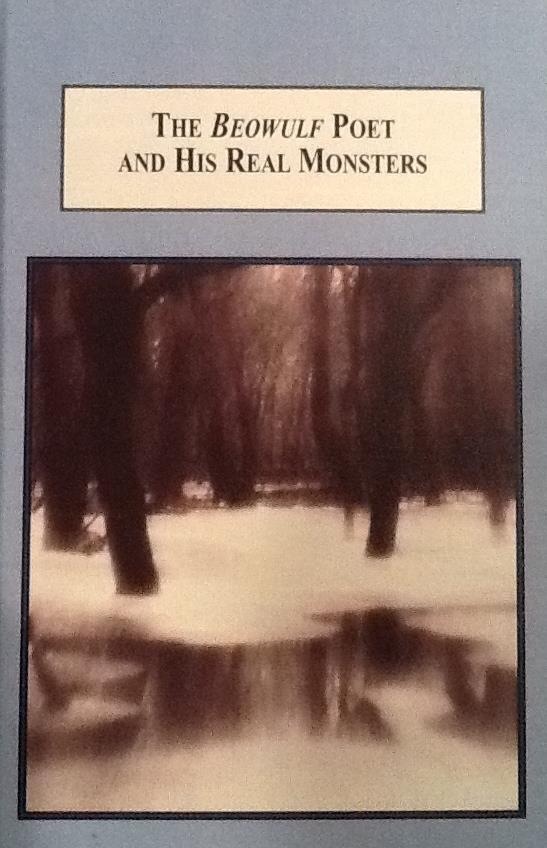
The Beowulf Poet and His Real Monsters Introduction
The following is the Introduction to my monograph The Beowulf Poet and His Real Monsters: A Trauma-Theory Reading of the Anglo-Saxon Poem (Edwin Mellen Press, 2013). Please see the book’s page for further information, including reviews, a brief description, the Table of Contents, and a promotional flyer (flyer also available below).
* * *
“[I]t is a drink dark and bitter: a solemn funeral-ale with the taste of death.”
Thus wrote J. R. R. Tolkien of Beowulf in his prefatory remarks for the republication of John R. Clark Hall’s 1911 prose translation (ix). The professor’s dramatic metaphor captures what many readers sense when they engage the text of the poem, either in the original Old English or in one of the myriad languages into which it has been translated since Sharon Turner began the process in 1803, whether it be a student’s first encounter or a scholar’s innumerable one. To extend Tolkien’s metaphor, the purpose of this monograph is to analyze the recipe of that dark and bitter brew.
The method by which I identify the various ingredients and discuss their influence on the poem’s morbid flavor is trauma theory, a term that Cathy Caruth is given credit for coining in her 1996 book Unclaimed Experience: Trauma, Narrative, and History—though the idea of literary trauma theory as a discernible critical model can be recognized earlier in the decade in such practitioners as Shoshana Felman and Dori Laub. Of course, one can easily make a case for even earlier sightings of trauma theory, with Caruth herself pointing to Sigmund Freud’s marriage of psychoanalysis and literary study via terms like the Oedipus and Elektra complexes. However, in spite of trauma theory’s presence in the humanities for roughly two decades, a precise and universally acknowledged definition has yet to emerge, which provides me an opening to put forward a definition as I am using it in this work.
In the previous paragraph I quietly inserted literary as a qualifier to differentiate between trauma theory as it exists in the vocabulary of psychiatric professionals versus how scholars in the humanities may regard its meaning—though both groups are concerned with how traumatic experience affects the subject’s mind, and they borrow freely from one another, explicitly or implicitly, to advance and articulate their understanding of trauma. In psychiatric medicine, the overarching goal of trauma theory, broadly put, is to use that understanding to assist victims of trauma overcome its devastating effects. In literary scholarship, the goal of trauma theory, broadly put, is to use that understanding to document the effects of traumatic stress on language production. To state it simply (in fact, overly so), psychiatric professionals examine the speech of patients (perhaps “clients” is a better word), while scholars examine texts (e.g., Beowulf).
My specific purpose is to make the case that Beowulf reflects traumatic stresses which the anonymous poet and his fellow Anglo-Saxons felt in their day-to-day lives, and I concentrate my trauma-theory reading on the three monsters, who represented, in all likelihood unconsciously, particular sources of trauma to the poet: the terror of extreme violence, the dangers of sexual reproduction, and the deprivations of chronic disease. My training as a scholar is in English studies, a program that requires coursework in literature, linguistics, rhetoric, and pedagogy—also a program that has prompted me to draw from a wide range of fields, including medicine, history, anthropology, philology, sociology, and psychology, with special emphases on the branches of psychoanalysis and neuropsychology. In other words, English studies in general and this monograph in particular have allowed me to indulge my “attention surplus disorder,” a phrase I commandeered from Susan Sontag, who uses it to mean that she is basically interested in everything.1
What is more, I consider myself primarily a creative writer—a novelist, short-story writer and sometimes poet—which, I believe, gives me further insight into what I call “the psychic origins of creativity” when I take on the roles of critic and scholar, further, that is, than someone who has never tried to devise characters and plot and setting, and to coax them through a narrative arc via dialogue, metaphor and a plethora of other storytelling techniques. That is to say, I feel a brothers-in-arms kinship with the Beowulf poet and an affinity for the task he set before himself that many literature scholars, simply, do not.
In bringing to bear on the poem knowledge from so many different fields, my reading represents a departure from what has been the dominant discourse in Beowulf studies for at least the last thirty years, a discourse that has tended to focus on the extant Cottonian manuscript, a discourse that has resisted critical theory “in the name of empiricism, objectivity, or common sense,” according to John D. Niles (“Introduction” 9). However, as James W. Earl points out in his introductory remarks to Thinking About Beowulf (1994), intense study based on the extant manuscript has failed to yield much that is irrefutable about the poem and even less about its poet. In fact, Earl draws on the concept of the Strange Attractor from chaos theory, meaning “that underlying presence, or nonpresence, that gives its shape to chaos” (10), to conclude the following about new directions in Beowulf scholarship: “If we cannot anchor our thinking about Beowulf in history any longer, we may have to entertain at long last the freedoms of modern and postmodern critical thinking—at least within the parameters set by the fractal text, and its Strange Attractor, the poet” (27).
That is, to better understand the poem, we must do all that we can to better understand the poet.
The trauma-theory reading of the poem rests largely in Chapter 4 of this monograph, while Chapters 1, 2 and 3 lay the groundwork necessary to the reading. The first chapter, for example, discusses the close association between thought and language by examining the work of pioneering psychoanalysts Freud and Jacques Lacan, as well as contemporary trauma theorists and neuropsychologists. Key concepts in the chapter include the effects of trauma and how these effects can be passed from generation to generation, and from location to location. Integral to these concepts are discussions regarding the establishment of trauma cultures and the production of trauma texts. The next chapter focuses on the mimetic parallel between postmodern narrative technique and the narratival characteristics of someone who has been traumatized. In this chapter and elsewhere, the theories of Michel Foucault are engaged, especially those related to analyzing the minds of past peoples via the texts they left behind. When I introduce Foucault to my students, I use the model of the double helix with one strand representing thought and language the other. When a culture has passed, like the Anglo-Saxons’, it is as if its double helix has been stretched and flattened, and we view it from an angle that makes it appear as though only the language strand remains (i.e., its texts), but Foucault tells us that inseparably bonded to that language is the thought that shaped it; therefore, by studying a past culture’s language, we can come to know the culture’s thought as well. In short, the Beowulf poet’s mind produced the topography of the text, so by carefully studying the text we can discern the topography of the poet’s mind.
Chapter 3 is less theoretical and more practical as it examines aspects of the lives of Anglo-Saxons that likely would have resulted in traumatic stress and in particular the traumatic stress I believe to be represented by Grendel, Grendel’s mother, and the dragon. That is to say, if the poet and his people were in fact traumatized, what events and day-to-day features of their lives could have caused that trauma? For this chapter, I rely principally on the writings of Bede and Eddius Stephanus, the anonymously composed Anglo-Saxon Chronicle, and the period’s medical texts: the Herbarium, Leechbooks, and Lacnunga. Then, finally, Chapter 4 brings all of this diverse knowledge together in a trauma-theory reading which focuses on the original language of the poem.
It is important to note, too, that while my reading is a departure from much of the traditional scholarship, I incorporate and build upon a great deal of that scholarship, bringing into the conversation (to name a few) Klaeber, Tolkien, Malone, Mitchell, Robinson, Niles, Bjork, Orchard, Kiernan, Earl, O’Brien O’Keeffe, Chance, Howe, Lerer, Lapidge, Liuzza, Acker, and Foley, as well as newer voices like Joy, Ramsey, Kim, Mizuno, and Warren. All of whom have contributed mightily to what we know about the poem, and thus contribute mightily to what we could possibly come to understand by pursuing critical approaches born of postmodernism, like trauma theory.
Feel free to share the following promotional flyer either electronically or in print.
Beowulf Poet – Morrissey flyer
Note
1. See “Susan Sontag, The Art of Fiction No. 143,” interviewed by Edward Hirsch for The Paris Review, available online at theparisreview.org.
Works Cited
Earl, James W. Thinking About Beowulf. Stanford, CA: Stanford UP, 1994. Print.
Niles, John D. “Introduction: Beowulf, Truth, and Meaning.” Ed. Robert E. Bjork and John D. Niles. A Beowulf Handbook. Lincoln: U of Nebraska P, 1998. 1-12. Print.
Tolkien, J. R. R. “Prefatory Remarks on Prose Translation of Beowulf.” Beowulf and The Finnsburg Fragment. Trans. by John R. Clark Hall. 3rded. London: George Allen and Unwin, 1950. ix-xliii. Print.
William H. Gass’s “Very Cold Winter”
In celebration of the release of William H. Gass’s novel Middle C, I decided to post a couple of the conference papers I’ve presented on Gass’s work in recent years–something I’ve been meaning to do but have put off for one reason or another. Following is the paper I presented at the Louisville Conference on Literature and Culture Since 1900 in 2012 as part of the PsyArt Foundation panel, chaired by Andrew Gordon, “William H. Gass’s ‘Very Cold Winter’: The Trauma of the Fallout Shelter Frenzy as Expressed in The Tunnel.”
William H. Gass’s “Very Cold Winter”:
The Trauma of the Fallout Shelter Frenzy as Expressed in The Tunnel
William H. Gass’s long and densely postmodern novel The Tunnel, which won the American Book Award in 1996, has perplexed both casual readers and literary critics, whose reactions and readings have varied widely, to say the least. Indeed, H. L. Hix, author of Understanding William H. Gass, writes that the “early responses [of which there were many] ranged from wildly enthusiastic to contemptuous” (77). Moreover, not only is The Tunnel an odd novel—bringing together just about every postmodern trope (“cram[med] together like [rush-hour] commuters,” Gass has said [Ziegler 14])—but its writing and publishing history is equally strange in the saga of American letters as Gass worked on the project for nearly thirty years, publishing excerpts from it in literary journals, commercial periodicals, and as small-press monograms on nineteen occasions from 1969 to 1988. Regardless of whether their opinion fell on the “wildly enthusiastic” or the “contemptuous” end of the spectrum, most critics agreed that The Tunnel warranted multiple readings and extensive excavation. When that work has been undertaken, Irving Malin has conjectured that Gass’s magnum opus will be hailed, along with Nabokov’s Pale Fire, as “the most significant novel written since World War II” (11).
Hence, with pick and shovel in hand, I arrive bearing some finds from the dig—a dig, by the way, which has not been especially extensive thus far: A review of the MLA International Database yielded only 30 articles dealing with The Tunnel since its publication, and the majority were generated by the same handful of Gass devotees. What’s more, apparently there have been no scholarly publications on The Tunnel in nearly seven years. Perhaps because Gass himself has been so concerned with language (especially metaphor, the subject of his doctoral dissertation, completed at Cornell in 1954), the readings of his work have often focused on its textual complexities, and only a very few have treated The Tunnel, especially, as an expression of trauma. And if traumatic experience is cited as a wellspring of Gass’s writing, it is generally his well-known miserable childhood that is named as the culprit. In fact, Hix’s essential understanding of Gass is that he “writes to get even for his childhood, his resentment for which he has clearly stated” (1). However, no one seems to have noticed that Gass’s writing career falls perfectly in line with the extreme anxiety caused in Western culture by the United States’ unleashing of atomic weapons and the initiation of the Cold War—events about which Gass has written directly numerous times. What is more, no one that I’ve read has made the, what I consider, obvious connection between the fact that Gass began writing The Tunnel at the height of the U.S.’s fallout shelter frenzy, which was initiated, according to Kenneth D. Rose, in 1961 by John F. Kennedy’s Berlin speech, wherein the President called for an aggressive shelter-building program in response to the Soviet Union’s threats that there would be war if the West did not withdraw from the German capital. Kennedy’s response to Khrushchev was “Then let there be war, Mr. Chairman. It’s going to be a very cold winter” (2).
Given the publishing history of the The Tunnel, not to mention the brevity of this presentation, I’m going to focus my analysis on the first two sections of the novel to appear in print—“We Have Not Lived the Right Life” in New American Review in 1969, and “Why Windows Are Important To Me” in TriQuarterly in 1971—and I’m also going to draw from a paper I presented at the conference in 2010 which provides my study’s trauma-theory underpinnings. That paper, which looks more broadly at the effects of the threat of nuclear annihilation on Gass’s writing, particularly his classic short story “In the Heart of the Heart of the Country,” is posted on my blog.
First, however, it’s necessary to reflect on the fallout shelter phenomenon and its myriad effects on the American people’s psyches—effects that I believe often manifest themselves in Gass’s narrative in which the first-person protagonist, history professor William Kohler, goes to his basement to write the final piece of his masterwork on Nazi Germany, thirty years in the making, but instead begins a meandering autobiography of his painful childhood, lackluster career, and loveless marriage; and, meanwhile, for reasons that are never quite clear, Kohler starts digging a surreptitious and superfluous tunnel behind his basement furnace. While Kennedy’s 1961 speech may mark the beginning of the United States’ frenzy over fallout shelter-building, it was the previous administration, under Eisenhower, that first broached the topic. For about a decade after the bombings of Hiroshima and Nagasaki, the U.S. government and consequently its people were able to convince themselves that nuclear warfare wasn’t all that different from more traditional forms of warfare; however, atomic tests in the mid-fifties demonstrated just how catastrophic a nuclear attack could be on the United States. Ralph Lapp, civil defense editor of the Bulletin of the Atomic Scientists, wrote in 1954 that “the new peril from radioactive fall-out is more than just a threat to civil defense—it is a peril to humanity” (Rose 25-26). In the following issue of the Bulletin, Val Peterson, Eisenhower’s chief civil defense administrator, was quoted as saying that life after a nuclear war would “be stark, elemental, brutal, filthy, and miserable [. . . a] kind of hell” that no one was prepared for (26).
At first, the Eisenhower administration promoted the idea of a government-led program to build fallout shelters in cities throughout the country, but when the estimated costs proved astronomical and the logistics all but impossible, they shifted their emphasis to home-based shelter projects undertaken by private citizens. In spite of efforts to publicize the dangers of nuclear fallout and to cast home shelter-building as an act of patriotism, a 1960 Senate subcommittee study concluded that “few shelters of any description have been constructed in the United States” (Rose 35). However, Kennedy’s Berlin speech a year later dramatically changed national sentiment as it “was made in an atmosphere of crisis and produced an immediate public clamoring for information on how citizens could protect themselves and their families” (37). Responding to this public sentiment, a tidal wave of published material (both factual and fictive, and some a confusing hybrid of each) kept the topics of nuclear annihilation and fallout shelter-building fresh in the American psyche for years to come. As Rose puts it, of possibly “great[est] significance were the numerous nuclear apocalyptic scenarios that appeared in the mainstream magazines and newspapers, often incorporated as part of a feature story on the fallout shelter controversy [. . . as] these descriptions would reach a very wide swath of the public” (40).
The controversy as it quickly emerged was multifaceted, to put it lightly, but in brief it consisted of questions like the following: How would a typical homeowner go about building and supplying a fallout shelter for his family? Could a well-built shelter truly protect a family from the initial bombing and from radioactive fallout? Would a homeowner be prepared to use deadly force against ill-prepared friends and neighbors wanting inside his shelter at the moment of crisis? Would a postapocalyptic life be worth living even if one did survive in the shelter? Was building a shelter courageously patriotic or was it a cowardly act in direct opposition to the American fighting spirit? How would a community that had survived essentially intact respond to homeless and desperate refugees arriving from neighboring towns and cities? Were the shelter-building and -supplying businessmen who suddenly appeared on the landscape genuine professionals who had their clients’ best interests at heart, or were they conmen out to make a quick dollar off of people’s fears and confusion (many swimming-pool builders, for example, recast themselves as fallout-shelter experts)?
Before looking at Gass’s narrative in more detail, let me draw upon my earlier work for a brief discussion of literary trauma theory. In a writers’ symposium on postmodern literature held at Brown University in 1989, Robert Coover, in his welcoming remarks, gave the impression that the writing style which became known as postmodernism sprang up in the 1950s and ’60s almost by sheer coincidence; essentially that individuals writing in isolation on various continents just all happened to begin writing in the same sorts of ways, all in a narrow time span of about fifteen years. According to Coover, writers, with virtual simultaneity, decided to abandon modernist realism for something fragmented, repetitive, largely unrealistic and illogical, and highly intertextual.
A more cogent explanation, I believe, rests with trauma theory: The trauma of the nuclear age, which was experienced by the entirety of Western culture (not to mention Eastern), affected the psyches of these writers in a way that resulted in postmodern literary style—a style, according to theorists like Anne Whitehead, Cathy Caruth, and Laura Di Prete, that reflects the traumatized voice. Meanwhile, historians Jay Lifton and Greg Mitchell have made several provocative assertions regarding twentieth-century zeitgeist as it suddenly evolved after the Second World War. For example, Americans were deeply and immediately conflicted with the atomic bombings of Hiroshima and Nagasaki; that is, they experienced the “contradictory emotions of approval and fear the bomb evoked, a combination that has continued to disturb and confuse Americans ever since” (33). And all of this internal conflict, much of which resides in the unconscious, has contributed to a “sense of the world as deeply absurd and dangerous” (335).
In not recognizing the emergence of postmodern literary style as being connected to the nuclear age, it is quite possible that Coover and the other postmodernists at the Brown University symposium experienced the same sort of repression and dissociation that individual trauma victims frequently do. It is not uncommon for people suffering the symptomology of posttraumatic stress disorder to have no conscious recollection whatsoever of the traumatizing event, or to have a dissociated recollection. Coover also discussed writing as “a kind of therapy.” He said, “There are things you have to work your way through. There are issues that have to be confronted[. . . .] So you work that out in fictional forms, and you do feel that Freudian answer, that kind of power over what would otherwise be your impotent life” (“‘Nothing’” 242). Hence Coover recognized the unsettling cultural climate of post-Hiroshima America and how it contributed to narrative style; also, his view of writing-as-therapy is consistent with trauma theorists who suggest that postmodern techniques are akin to victims’ struggling to transform traumatic memory into narrative memory.
In his examination of the apocalyptic temper in the American novel, Joseph Dewey theorizes about the literary community’s response to Hiroshima and Nagasaki, which he describes as “slow in coming.” Dewey writes, “[T]he literary conscience of America did not seem ready in the 1940s and even in the 1950s to engage the menace of the mushroom cloud” (8). At first, writers, along with the rest of their culture, experienced a “psychic numbing [. . .] in the face of such catastrophe.” In the ’50s, notes Dewey, “the American literary community pondered the bomb only in tentative ways.” He references “a glut of forgettable speculative fiction” that appeared during the decade. In the early ’60s, however, “the American novel began to work with the implications of the nuclear age” (9). Dewey speculates that the Cuban Missile Crisis—“the nuclear High Noon over Cuba”—may have acted as a catalyst for writers in general to “begin to think about the unthinkable.” Dewey does not approach his subject in this way, but he seems to be accounting for the dual starting point for American postmodern literary style, which some trace to the mid-1940s and others to the ’60s. Nor does Dewey tend to speak in psychological terms, but he seems to be suggesting that American writers were by and large repressing the atomic blasts for nearly two decades, until nuclear Armageddon loomed in 1962, which caused the cultural literary psyche to begin to confront the source of its trauma, if only dissociatively. The scenario that Dewey suggests corresponds with the way many individuals respond to a traumatic event. Perhaps the fear of nuclear Apocalypse was part of the American psyche since 1945, but it seemed unreal until 1962’s standoff with Cuba and its ally the Soviet Union. It is also useful to note that groups—entire nations even—can respond to trauma just as individuals do. In fact, Neil J. Smelser, in his work on cultural trauma in particular, notes that societies can undergo a delayed response to trauma akin to the Freudian notion of a breakdown in repression, which “only succeeded in incubating, not obliterating the threat”—though he qualifies the analogy as not being perfect (Alexander et al. 51).
I’ll note that while Rose and Dewey are offering different years, 1961 versus 1962, as the catalytic year for American culture’s traumatic response to atomic annihilation, they are both citing the same source: the sudden heating up of the Cold War.
While evidence of a link between post-Hiroshima trauma and postmodern technique can be found, with greater or lesser conspicuousness, in the work of all writers who occupy the established pantheon of postmodernists, I think the connective tissue is most apparent in the fiction of William H. Gass, one of the writers at the Brown symposium, and, interestingly, the writer Coover called “our real living biographer of the human mind” (242). In his work, which was begun in the early 1950s (when Gass was in his late twenties) but did not start to appear in print consistently until the 1960s, Gass often alludes to trauma and symptoms of posttraumatic stress disorder (though not specifically by these labels), and he cites directly and indirectly the nuclear age as the source of widespread anxiety. As noted earlier, Gass’s childhood was, by his own description, miserable, raised by an alcoholic mother and an agonistic father; and one could certainly point to these influences for his prose’s negativity. There is no question that these facts have affected Gass’s writing, much of which is overtly autobiographical; however, I believe that the Cold War zeitgeist had an even greater impact on his storytelling. One might even conjecture that the insecurities caused by Gass’s childhood made the fear associated with that zeitgeist even more potent. The psychological community has long recognized that individuals respond differently to trauma due to a variety of factors, including their mental health when they experience the trauma, and even their genetic predisposition to dealing with traumatic stress.
Now, in the brief time remaining, to look at some of Gass’s text. The paper that I presented in 2010, which I’ve archived at my blog, deals with apocalyptic images in Gass—mushroom-cloud shapes, cyclones, extreme heat, deadly winds, and in general destruction raining down from above—and such images are certainly abundant in early excerpts from The Tunnel. To bring my discussion from above to below ground, I’ll draw attention to a snatch of song lyric that is frequently repeated in 1969’s “We Have Not Lived the Right Life” in which a crow represents death. The narrator, William Kohler (“Kohler,” by the way, is German for miner), recalls the song from his youth, and the line goes, “Crow—O crow— / don’t cross my path, / so my life lasts / a little longer” (8 et al.). This notion of extending life “a little longer” was central to the fallout shelter issue: Would a shelter merely extend life for a few weeks or months as survivors of atomic attack would eventually have to come above ground, only to die from residual radiation or starvation? The song continues, “Crow—O crow— / each time you pass, / my sickness grows / a little stronger” (10, 12). The song continues with images of protracted and painful death. There are references to enclosure throughout this early published excerpt, especially enclosure within one’s own or another’s body, but the imagery becomes most concentrated late in the piece when Kohler contemplates his sitting in his basement day after day pondering and writing about his wasted life. He says, “I know there are worse ways of living—deeper, darker, damper dungeons—than my own. [. . .] And yet I hold my head and groan and wish these books had fallen in upon me years ago” (30). Furthermore, he posits that “a man who brings his own walls with him is in prison”—perhaps reflective on some level of the fact that the United States has brought this dilemma upon itself with its creation of and unleashing of atomic weapons. This reading is bolstered by other elements in the text that I don’t have time to discuss here.
Instead, I’d like to look at “Why Windows Are Important to Me,” published in 1971, which is even thicker with images of enclosure and the complex psychology associated with becoming hidden. In this excerpt, Kohler discusses his obsession with “trenches, castles, dugouts, outposts, [and] graves” (58), relating several episodes from his childhood and early adult years in which he either created hiding places or discovered such places behind walls and inside maintenance shafts. Kohler describes “that powerful out of the world feeling” (61) he experienced whenever he hid away because, when not hiding, the world of “out there” made him “an ordinary mortal” and “erod[ed him] like rain” (60). Here is a lengthy passage about the “bliss” of hiding that is especially rich in ambiguity when examined closely:
[To hide is t]o enter yourself so completely that you’re like a peeled-off glove; to become to the world invisible, entirely out of touch, no longer defined by the eyes of others, unanswering to anyone; to go away with such utterness behind a curtain or beneath a tented table, in the unfamiliar angles of an attic or the menace of a basement; to be swallowed by a chest or hamper as the whale-god swallowed Jonah, and then to find yourself alive, and even well, in the belly of your own being—in a barn loft, under a porch, anywhere out of the mob’s middle distance like a Stuart Little, a Tom Thumb, or a Tinker Bell—unnoticed and therefore all the more noticing [. . .] to go supremely away like this was to re-enter through another atmosphere [. . .] (57)
Here we get the joy of hiding and surviving, and even the sense of superiority that those who hide feel over those who are not hidden, characterized as a “mob.” To hide is a kind of mystical experience by which one comes to fully understand oneself. Yet there is also present in the passage a sense of extreme isolation and alienation from the world, and there is the frightful image of being swallowed; moreover, we note that of all the hiding places mentioned the only underground one, the basement, is also the only one overtly described negative, as menacing in fact. It is also interesting that when Kohler hides he feels tiny—like Stuart Little, Tom Thumb, Tinker Bell—perhaps suggestive of the cowardliness that many associated with shelter-building. Finally, I’ll point out the idea of transcendence, that via hiding one seems to enter an entirely new realm: maybe the difference between the pre- and post-apocalyptic worlds shelter-builders would experience. In fact, the word bliss itself carries with it the notion of transcendence in addition to simply being joyful—but of course to transcend into bliss, one must die.
In this paper I have only begun to scratch the surface of a rich vein in William H. Gass’s writing—indeed a vein that runs throughout American postmodern literature. In my way of thinking, it’s no coincidence that the vogue of postmodernism fizzled with the end of the Cold War. That is to say, the reading public and publishers in general seemed to suddenly change their tastes, and stopped being attracted to the tropes of postmodern literary style when the threat of nuclear Armageddon no longer seemed imminent. Giants of postmodernism, like Gass and Pynchon, have continued to write as they did in the sixties, seventies and eighties—but honors and accolades, once so numerous, have been far fewer with slumping book sales and contemporary critics who often find them out of step, and perhaps something like curious relics of the Cold War.
Works Cited
Dewey, Joseph. In a Dark Time: The Apocalyptic Temper in the American Novel of the Nuclear Age. West Lafayette, IN: Purdue UP, 1990. Print.
Gass, William H. “We Have Not Lived the Right Life.” New American Review 6 (1969): 7-32. Print.
—. “Why Windows Are Important to Me.” The Best of TriQuarterly. Ed. Jonathan Brent. New York: Washington Square P, 1982. 49-69. Print.
Hix, H. L. Understanding William H. Gass. Columbia: U of South Carolina P, 2002. Print.
Lifton, Robert Jay, and Greg Mitchell. Hiroshima in America: Fifty Years of Denial. New York: Grosset/Putnam, 1995. Print.
Malin, Irving. “Anti-Introduction.” Into The Tunnel: Readings of Gass’s Novel. Ed. Steven G. Kellman and Irving Malin. Newark: U of Deleware P, 1998. 11. Print.
“‘Nothing but Darkness and Talk?’: Writers’ Symposium on Traditional Values and Iconoclastic Fiction.” Critique 31.4 (1990): 235-55. Print.
Rose, Kenneth D. One Nation Underground: The Fallout Shelter in American Culture. New York: New York UP, 2001. Print.
Smelser, Neil J. “Psychological Trauma and Cultural Trauma.” Cultural Trauma and Collective Identity. Ed. Jeffrey C. Alexander et al. Berkeley: U of California P, 2004. 31-59. Print.
In the Heart of the Heart of the Cold War
In celebration of the release of William H. Gass’s novel Middle C, I decided to post a couple of the conference papers I’ve presented on Gass’s work in recent years–something I’ve been meaning to do but have put off for one reason or another. Following is the paper I presented at the Louisville Conference on Literature and Culture Since 1900 in 2010, “In the Heart of the Heart of the Cold War: Cultural Trauma and the Fiction of William H. Gass.”
In the Heart of the Heart of the Cold War:
Cultural Trauma and the Fiction of William H. Gass
In a writers’ symposium on postmodern literature held at Brown University in 1989, Robert Coover, in his welcoming remarks, gave the impression that the writing style which became known as postmodernism sprang up in the 1950s and ’60s almost by sheer coincidence. Among the symposium participants were Leslie Fiedler, John Hawkes, Stanley Elkin, William Gass, Donald Barthelme, and William Gaddis. Coover said, “[T]his group sought out some form, some means by which to express what seemed to them new realities” (“‘Nothing’” 233). However, Coover goes on to suggest a remarkably thin theory as to why so many writers, all working in relative isolation, began constructing narrative in uncannily similar styles:
We felt we were all alone. No one was reading us, nor was anyone writing remotely like the sort of writing we were doing until, in the little magazines, we began slowly to discover one another. Few of us knew one another at the time we began writing. There was a uniform feeling among writers at that time that something had to change, something had to break, some structure had to go. And that was, I think, what most united us.
Even though the panel was intended to be a debate, and not merely a discussion, not a single writer challenged Coover’s explanation for the emergence of postmodern style. At first this assessment may seem startling—that some of the keenest and best-educated minds who were at the forefront of producing and (many) critiquing literary postmodernism accepted the premise that postmodern narrative style more or less just happened; essentially that individuals writing in isolation on various continents, including North and South America, and Europe, just all happened to begin writing in the same sorts of ways, all in a narrow time span, from about 1950 to 1965. According to Coover, writers, with virtual simultaneity, decided to abandon modernist realism for something fragmented, repetitive, largely unrealistic and illogical, and highly intertextual.
A more cogent explanation, I believe, rests with trauma theory: The trauma of the nuclear age, which was experienced by the entirety of Western culture (not to mention Eastern), affected the psyches of these writers in a way that resulted in postmodern literary style—a style, according to theorists like Anne Whitehead, Cathy Caruth, and Laura Di Prete, that reflects the traumatized voice. Meanwhile, historians Jay Lifton and Greg Mitchell have made several provocative assertions regarding twentieth-century zeitgeist as it suddenly evolved after the Second World War. One is that the “[s]truggles with the Hiroshima narrative have to do with a sense of meaning in a nuclear age, with our vision of America and our sense of ourselves” (xvi). Another is that Americans were deeply and immediately conflicted with the atomic bombings of Hiroshima and Nagasaki, that they experienced the “contradictory emotions of approval and fear the bomb evoked, a combination that has continued to disturb and confuse Americans ever since” (33). A third assertion is that “[o]dinary people [. . .] experienced their own post-Hiroshima entrapment—mixtures of nuclearism and nuclear terror, of weapons advocacy and fearful anticipation of death and extinction” (306). And all of this internal conflict, much of which resides in the unconscious, has contributed to a “sense of the world as deeply absurd and dangerous” (335).
It is quite possible that Coover and the other postmodernists at the Brown University symposium experienced the same sort of repression and dissociation that individual trauma victims frequently do. It is not uncommon for people suffering the symptomology of posttraumatic stress disorder to have no conscious recollection whatsoever of the traumatizing event, or to have a dissociated recollection. Coover also discussed writing as “a kind of therapy.” He said, “There are things you have to work your way through. There are issues that have to be confronted[. . . .] So you work that out in fictional forms, and you do feel that Freudian answer, that kind of power over what would otherwise be your impotent life” (242). Hence Coover recognized the unsettling cultural climate of post-Hiroshima America and how it contributed to narrative style; also, his view of writing-as-therapy is consistent with trauma theorists who suggest that postmodern techniques are akin to victims’ struggling to transform traumatic memory into narrative memory.
In his examination of the apocalyptic temper in the American novel, Joseph Dewey theorizes about the literary community’s response to Hiroshima and Nagasaki, which he describes as “slow in coming.” Dewey writes, “[T]he literary conscience of America did not seem ready in the 1940s and even in the 1950s to engage the menace of the mushroom cloud” (8). At first, writers, along with the rest of their culture, experienced a “psychic numbing [. . .] in the face of such catastrophe.” In the ’50s, notes Dewey, “the American literary community pondered the bomb only in tentative ways.” He references “a glut of forgettable speculative fiction” that appeared during the decade. In the early ‘60s, however, “the American novel began to work with the implications of the nuclear age” (9). Dewey speculates that the Cuban Missile Crisis—“the nuclear High Noon over Cuba”—may have acted as a catalyst for writers in general to “begin to think about the unthinkable.” Dewey does not approach his subject in this way, but he seems to be accounting for the dual starting point for American postmodern literary style, which some trace to the mid 1940s and others to the ’60s. Nor does Dewey tend to speak in psychological terms, but he seems to be suggesting that American writers were by and large repressing the atomic blasts for nearly two decades, until nuclear Armageddon loomed in 1962, which caused the cultural literary psyche to begin to confront the source of its trauma, if only dissociatively. The scenario that Dewey suggests corresponds with the way many individuals respond to a traumatic event. Perhaps the fear of nuclear Apocalypse was part of the American psyche since 1945, but it seemed unreal until 1962’s standoff with Cuba and its ally the Soviet Union. It is also useful to recall that groups—entire nations even—can respond to trauma just as individuals do. In fact, Neil J. Smelser, in his work on cultural trauma in particular, notes that societies can undergo a delayed response to trauma akin to the Freudian notion of a breakdown in repression, which “only succeeded in incubating, not obliterating the threat”—though he qualifies the analogy as not being perfect (Alexander et al. 51).
While evidence of a link between post-Hiroshima trauma and postmodern technique can be found, with greater or lesser conspicuousness, in the work of all writers who occupy the established pantheon of postmodernists, I think the connective tissue is most apparent in the fiction of William H. Gass, one of the writers at the Brown symposium, and, interestingly, the writer Coover called “our real living biographer of the human mind” (242). In his work, which was begun in the early 1950s (when Gass was in his late twenties) but did not start to appear in print consistently until the 1960s, Gass often alludes to trauma and symptoms of posttraumatic stress disorder (though not specifically by these labels), and he cites directly and indirectly the nuclear age as the source of widespread anxiety. It must be stated upfront that Gass’s childhood was, by his own description, miserable, raised by an alcoholic mother and an agonistic father; and one could certainly point to these influences for his prose’s negativity. There is no question that these facts have affected Gass’s writing, much of which is overtly autobiographical; however, I believe that the Cold War zeitgeist had an even greater impact on his storytelling. One might even conjecture that the insecurities caused by Gass’s childhood made the fear associated with that zeitgeist even more potent. The psychological community has long recognized that individuals respond differently to trauma due to a variety of factors, including their mental health when they experience the trauma, and even their genetic predisposition to dealing with traumatic stress.
In any event, a good place to begin is Gass’s well-known short story “In the Heart of the Heart of the Country,” which appeared in New American Review and then in a collection by the same title in 1968 (though Gass says that it was written much earlier, implying the beginning of the decade (Bellamy 39)). The oddly and disjointedly segmented story features a disillusioned poet-teacher narrator living in a small Indiana town, called simply “B,” a town which represents (it has been widely noted and in fact acknowledged by Gass) W. B. Yeats’s Byzantium from the poem “Sailing to Byzantium” (1927). The short story has generated a fair amount of critical attention over the past forty years, and much of that criticism examines the psychological underpinnings of the narrative. In one of the earliest studies, in 1973, Frederick Busch writes, “[Gass’s poet-narrator] is caught in the heart of the country, he is fallen. And the country he has come to is his mind. [. . .] This little story is a saga of the mind” (99, 100). Similarly, Charlotte Byrd Hadella says that the “narrator/poet is miserable, lonely, and lost in a fragmented world, much like the world of Eliot’s The Waste Land, because he fails to participate fully in either art or life” (49). As such, “the narrator has left one world and entered another—the world of his own imagination.” What is more, Hadella claims that “[w]ith the fragmented structure of his story, Gass conveys a subliminal message of isolation, loneliness, and departmentalized perception of his narrator” (50). Both critics are unwittingly keying on psychological components of the story that are mimetic of posttraumatic stress disorder—the unbidden merging of real and unreal worlds, profound feelings of disconnectedness with one’s self and others.
These analyses are useful to be sure, and in fact I want to look at some of the same passages in the story that these critics cite, but I believe even more can be gleaned from the story via a trauma-theory paradigm. Given the insightfulness of these critics’ observations, I am struck by an omission that they and other commentators have committed in their readings of the narrative. No one has paid any attention whatsoever to a passage that I see as key to understanding the narrator’s disjointed psyche. In a section subtitled “Politics,” the narrator criticizes his fellow townspeople (and Americans in general I would say) by stating, “I have known men [. . .] who for years have voted squarely against their interests. Nor have I ever noticed that their surly Christian views prevented them from urging forward the smithereening, say, of Russia, China, Cuba, or Korea” (197). Here the narrator makes direct reference to using nuclear weapons against Cold War enemies—attacks which would be squarely against American interests (as it would provoke retaliation, including nuclear retaliation) and which contradict the Christian morality that the majority of Americans claim to advocate. This atomic-bombing reference does not come out of the blue, so to speak. In an earlier section also subtitled “Politics,” the narrator alludes to “the Russians [. . .] launching [. . .] their satellite” (186), and in “Education” he says that at school “children will be taught to read and warned against Communism” (187). Taking into account these Cold War references, the narrator’s disposition and the townspeople he describes sound very much like the divided, post-Hiroshima psyches that Lifton and Mitchell discuss: “By the 1960s, Americans were living a nuclear ‘double life’: aware that any moment each of us and everything around us could be suddenly annihilated, yet at the same time proceeding with our everyday, nitty-gritty lives and conducting ‘business as usual’” (351). Americans, in short, were divided in two, with their measured self (which was interested in making a comfortable and meaningful life) being in constant conflict with their apocalyptic self (which accepted that the nuclear end was at hand and therefore every action was irrelevant). Hadella is noting this conflicted duality in the story when she writes that “the narrator’s mood is a perpetual winter. The poet/narrator avoids thinking of spring as the season of rebirth and renewal. Thus, even when he does mention spring rain, the rain mentioned is only a memory, and it is not associated with desire or awakening to life” (51). It is as if Gass’s narrator, with his measured self, desires a future (the coming of spring rains), but will not allow himself to believe it will arrive because of his apocalyptic self, the self that envisions a spring rain that causes “the trees [to] fill with ice” (181).
Hadella’s careful study is mainly concerned with Gass’s use of weather imagery, especially winter. In the context I am framing, the winter and its snow become even more psychologically significant as mimetic of a nuclear winter and its radioactive (or dirty) snow. Before looking at winter/snow references in way of support, I want to turn to the “Weather” section that describes a summer heatwave in B as Gass uses language suggestive, I think, of a nuclear blast. The passage is lengthy but well worth examining:
In the summer light, too, the sky darkens a moment when you open your eyes. The heat is pure distraction. Steeped in our fluids, miserable in the folds of our bodies, we can scarcely think of anything but our sticky parts. Hot cyclonic winds and storms of dust crisscross the country. In many places, given an indifferent push, the wind will still coast for miles, gather resource and edge as it goes, cunning and force. [. . .] Sometimes I think the land is flat because the winds have leveled it, they blow so constantly. In any case, a gale can grow in a field of corn that’s as hot as a draft from hell, and to receive it is one of the most dismaying experiences of this life, though the smart of the same wind in winter is more humiliating, and in that sense even worse. (180-81)
On the one hand, this is a wonderfully apt description of a Midwestern heatwave, but Gass’s language as it relates to a nuclear blast cannot be easily dismissed: melting, even liquefying “bodies”; widespread devastation by “hot cyclonic winds and storms of dust” driven by “cunning and force”; a flattened landscape, “leveled” by “a draft from hell”; a “dismaying” life experience, but the “wind in winter” to follow is in a “sense even worse.” Then there is the winter and its snow that are so closely linked to death. The narrator says, “I would rather it were the weather that was to blame for what I am and what my friends and neighbors are—we who live here in the heart of the country. Better the weather, the wind, the pale dying snow . . . the snow—why not the snow?” (191). Images of winter/snow connected to death continue in this “Weather” section. He says, “Still I suspect the secret’s in this snow, the secret of our sickness, if we could only diagnose it, for we are all dying like the elms in Urbana” (192). The passage ends with the narrator’s assertion “[. . .] what a desert we could make of ourselves—from Chicago to Cairo, from Hammond to Columbus—what beautiful DeathValleys.” Again, viewed through the prism of the Cold War mentality and how the unconscious must have been affected by the sense of impending nuclear doom, it is reasonable that at some level Gass is describing atomic annihilation and the aftermath for those lucky or unlucky enough to survive the attacks.
An important aspect of the conflicted post-Hiroshima psyche is the sense of responsibility and guilt associated with bombing Japan, combined with pride in American resolve and ingenuity, and an acceptance of the “Hiroshima narrative” propaganda that claimed the attack to be necessary, even justified—and Hadella picks up on these vibes in “In the Heart of the Heart of the Country” as well. She writes, “Through the narrator’s obsessive attention to weather, Gass emphasizes a controlling irony in the story: though the narrator complains about the weather, he is the one who is responsible for the world in which he lives. His complaints suggest that he does not accept this responsibility” (51). Hadella’s analysis reflects to the letter the psychological turmoil Americans found themselves grappling with, according to the research of historians Lifton and Mitchell.
There is much more that could be said of “In the Heart of the Heart of the Country” (indeed, all of Gass’s work) via a trauma-theory paradigm, but in the interest of time I want to shift my focus to the author’s masterwork, the long and difficult novel The Tunnel, published in 1995 but begun in 1966. The plot of the novel, in a nutshell, involves the narrator, history professor William Kohler, sitting down to write the introduction to his masterwork, a book titled Guilt and Innocence in Hitler’s Germany, but instead writing a memoir about his unhappy childhood, mediocre career, and loveless marriage. He writes in his basement and at some point, for reasons that are never crystal clear, decides to start digging a tunnel beneath his house to make a surreptitious and superfluous escape. The novel is especially intriguing when viewed through the lens of trauma theory, but in the interest of brevity I’ll focus mainly on a section of The Tunnel that appeared as a stand-alone piece in The Kenyon Review in 1979, titled “The Old Folks”; it was retitled “The Ghost Folks” in a section of the novel (on pages 128-142, Dalkey Archive edition) with few, but significant, changes. Kohler and his wife, Marty/Martha, along with their two sons visit his parents, returning to his childhood home and all of its unpleasant memories and associations. Kohler’s mother is an alcoholic and his father a quarrelsome racist.
The story is set in approximately 1950, and Kohler says that the emotion he feels when he sets foot in his childhood home is rage. When his boys act up, for which he can’t blame them, he says, “[W]hat I need is total obliteration, now—now that we have the bomb, we can all be blown back into our original pieces with one clean disintegration, instead of being pulled apart slowly with dental pliers” (161; 130 in the novel). He goes on to speak of the inevitability of nuclear annihilation, saying that when a child, “I believed in doom in those days. Now, when the world ends, I doubt it will even whimper” (167; 135). Interestingly, the latter sentence, expressing the inevitability of annihilation, is deleted from the novel, which may reflect Gass’s, as well as the country’s, waning certainty that nuclear war with the Soviets was just a matter of time. In fact, direct references to the Second World War, to Japan, to Hiroshima, to the bomb, and so forth are frequent in the first half or so of the novel, and virtually nonexistent in the last half. I am attempting to determine the stages of development of the book, but it seems, at this point, that the overall structure of The Tunnel does follow, by and large, the chronology of Gass’s composing it. This study is aided by the fact that several parts of the book appeared in print as stand-alone pieces over the decades. Also, in a 1971 interview, Gass claimed to have written 300 manuscript pages of The Tunnel (McCauley 11).
The idea of responsibility, especially shared responsibility, for a ruined future (or perhaps no future at all) is expressed in various ways in “The Old Folks.” As Kohler and Marty are traveling with their children to his parents’ home, he says that the children “cannot realize to what profound degree the adults are conspiring against them” (159; 128). Specifically, Kohler is referring to himself and his wife, but much of the story deals with human history on a broad scale, as Kohler mixes in sparring theoretical conversations he’s had with his colleagues in the history department, so there is a sense that humanity in the twentieth century has conspired against itself. Twice in the story, including its opening words, Kohler asks, rhetorically, “Who is not in league?” (159, 172; 128, 139). On the most superficial level, Kohler is suggesting in the first reference that he and his wife are in league against their unsuspecting children. But given the facts that the question is repeated in connection with a conversation between Kohler’s history department colleagues and that Gass’s attention to linguistic nuance is second to none, the iteration is especially provocative. The word league of course means, among other definitions, conspiring with others for questionable purposes; but in the context of the story, league may be suggestive of the League of Nations, formed in 1920 in an effort to strive for world peace. Even though Woodrow Wilson put forward the initial idea, the United States never officially joined the League. So one way of interpreting Kohler’s question may be “Who is not working toward world peace?” and one legitimate answer would be “the United States.” This reading is bolstered by the fact that immediately after the repetition of the question Kohler morbidly describes his colleagues as mere “skulls [whose shadows] drifted across the opaque glass” (172; 139).
My final point concerns the image of the atomic mushroom cloud, which Joseph Dewey calls a representation of “the last crisis in human history,” as “humans [. . . rather than God] would plot, construct, and then execute their own demise” (7). Gass seems to dissociate the mushroom-cloud shape as tornadic rather than atomic, meaning that he often writes of tornadoes, cyclones, and whirlwinds, and of their destructive abilities. Kohler refers frequently to a childhood episode when a tornado passed so near the house that it blew the shattered windows inward. In “The Old Folks,” Kohler refers to himself and his wife as “whirlwinds” who have taken their children from a place of happiness and contentment to set them down here in his parents’ cheerless home (161; 130). More interesting, still, is Kohler’s discussion of a reoccurring nightmare in which he is falling toward the sea, anticipating his own painful death. In the novel, Kohler visually represents his falling—bomb-like—via text that takes the shape of a tornado, or a mushroom cloud:
it was like falling into the sea
to pass that open door
a wind like cold water
space a cold glass
flights of fish
surprise
my nose
my ah!
breath
goes
f
a
s
s
s
t
and all this has happened before (86)
The “terror” of the dream “wakes” Kohler, who feels “as if I were back in the army and my fall were a part of my duty” (85). It seems significant that Kohler connects the image to the military, the arm of the government most associated with the use of atomic weapons. There is no time to develop the idea further, but this tornado/mushroom-cloud shape also seems to represent the process of moving from chaos (life) to entropic order (death) that Kohler alludes to throughout, directly or indirectly, and it also suggests the overall shape of the novel’s narrative structure, as we move from broad, global, historical issues toward an ending section that focuses quite concretely on Kohler’s tunneling project in his basement, and his wife’s discovery of what he’s been doing these many months behind her back.
To bring this to a close, I will remind us that the first-wave of postmodern writers seemed preoccupied with bombs and the act of bombing. A few examples would be Pynchon’s V. and Gravity’s Rainbow; Vonnegut’s Slaughterhouse-Five and Mother Night; Heller’s Catch-22; and DeLillo’s Underworld. These and other postmodernists may have been responding to their culture’s traumatized psyche—a psyche that was conflicted between nuclearism and nuclear terror, a psyche that was attempting to move the Hiroshima narrative from traumatic memory to narrative memory, and thus come to terms with what the United States had unleashed on the world . . . and on itself. Kohler seems to conclude that the most optimistic thing that could be said about the bomb is that it “will probably bring neither extermination nor peace, but prolong the life and use of conventional arms” (515)—an idea that he sums up in the limerick:
There was a professor of history
who explained to his class every misery
of our human state:
1 war is man’s fate;
2 hate pays for hate;
3 all help comes too late;
4 our lives don’t relate;
but why this is so stays a mystery. (535)
Works Cited
Bellamy, Joe David, ed. The New Fiction: Interviews with Innovative American Writers. Urbana: U of Illinois P, 1974. Print.
Busch, Frederick. “But This Is What It Is to Live in Hell: William Gass’s ‘In the Heart of the Heart of the Country.’” Modern Fiction Studies 19 (1973): 97-109. Microfilm.
Dewey, Joseph. In a Dark Time: The Apocalyptic Temper in the American Novel of the Nuclear Age. West Lafayette, IN: Purdue UP, 1990. Print.
Gass, William H. In the Heart of the Heart of the Country and Other Stories. 1968. Boston, MA: Godine, 1981. Print.
—. “The Old Folks.” The Best American Short Stories of 1980. Ed. Stanley Elkin. New York: Houghton Mifflin. Print.
—. The Tunnel. 1995. Champaign, IL: Dalkey Archive P, 2007. Print.
Hadella, Charlotte Byrd. “The Winter Wasteland of William Gass’s ‘In the Heart of the Heart of the Country.’” Critique 30.1 (1998): 49-58. Print.
Lifton, Robert Jay, and Greg Mitchell. Hiroshima in America: Fifty Years of Denial. New York: Grosset/Putnam, 1995. Print.
McCauley, Carole Spearin. “William H. Gass.” Conversations with William H. Gass. Ed. Theodore G. Ammon. Jackson: UP of Mississippi, 2003. Print.
“‘Nothing but Darkness and Talk?’: Writers’ Symposium on Traditional Values and Iconoclastic Fiction.” Critique 31.4 (1990): 235-55. Print.
Smelser, Neil J. “Psychological Trauma and Cultural Trauma.” Cultural Trauma and Collective Identity. Ed. Jeffrey C. Alexander et al. Berkeley: U of California P, 2004. 31-59. Print.
The True Intruder in William H. Gass’s “The Pedersen Kid”
The following paper — “The Trauma of Alcohol Abuse: The True Intruder in William H. Gass’s ‘The Pedersen Kid'” — was presented at the Louisville Conference on Literature and Culture Since 1900, University of Louisville, Feb. 23, as part of the panel “Barthelme & Gass: Postmodern Fiction,” chaired by Hoang Thi Hue, Hue University, Vietnam. The other presenters on the panel were Nicholas Sloboda, University of Wisconsin-Superior, whose paper was “Image and Textual Play: Adventures in Donald Barthelme’s Alternative and Liminal Narratives”; and Jonathan Imber Shaw, Kutztown University of Pennsylvania, whose paper was “Executive Function in Donald Barthelme’s Early Fiction.”
The Trauma of Alcohol Abuse:
The True Intruder in William H. Gass’s “The Pedersen Kid”
Though written in 1951 and therefore constituting one of William H. Gass’s earliest works of fiction, the novella “The Pedersen Kid” did not appear in print until a full decade later in John Gardner’s short-lived journal MSS. This paper is based specifically on the version of the novella that appeared in Gass’s seminal collection In the Heart of the Heart of the Country in 1968. The title story of that collection and Gass’s long, dense novel The Tunnel (which appeared in 1995) have received the lion’s share of critical attention over the decades, while discussion of “The Pedersen Kid” has been meager to put it mildly. Some writers have noted the connection between Gass’s well-known miserable childhood—made miserable by Gass’s alcoholic mother and hateful bigot of a father—and the fact that the novella’s first-person protagonist is leading his own miserable life thanks mainly to his abusive and alcoholic “Pa”; but they have failed to go much beyond that obvious surface connection.
The purpose of this paper is to suggest that understanding the trauma of alcohol abuse within the context of a family is key to more fully understanding the enigmatic novella, whose final section in particular has left both casual readers and critics scratching their heads in puzzlement for more than forty years. In fact, Arthur M. Saltzman said that attempting to gain a clear view of the plot is “self-defeating” because “Gass steers us into cul-de-sacs, lets loose ends dangle, and plunges without warning into subjective distortions,” thereby leaving the two most suspenseful narrative questions unresolved and unrelieved (60).
Set in mid twentieth-century North Dakota, at the conclusion of a terrible blizzard, the novella begins with the farmhand Big Hans finding the boy from the neighboring Pedersen farm in the yard unconscious and nearly frozen to death as he apparently walked there through the previous night’s storm. Later, partially revived, the boy tells Big Hans (allegedly) that an intruder broke into their house and forced his parents into the frigid root-cellar, but somehow the boy escaped and managed to make it on foot all the way to the Segren farm in spite of the blizzard. Most of the novella centers around the three males of the Segren family—Big Hans, Pa Segren, and the young narrator (12 or 13?), Jorge Segren—making their way to the Pedersen farm through the frozen landscape to see if the boy’s story is true, though the act is more about Pa’s punishing Hans and Jorge than trying to do a neighbor a good turn; in fact, Pa seems to hate Pedersen even more than he hates everyone else around him, referring to him as a “cock,” a “bastard,” a “fool,” and a “shit”; and blaming Pedersen for every bad turn of events, including the previous summer’s grasshopper infestation and even the previous day’s blizzard.
At the root of Pa’s punishment, in addition to his natural mean-spiritedness, is the fact that some of his precious whiskey was found in what he thought was a secure hiding place and used to resuscitate the Pedersen kid without Pa’s permission. That seems to be the reason he keeps driving them forward, toward the Pedersen farm and its possible danger, in a horse-drawn wagon that can barely make it through the all but impassable roads and fields. The motivation is freshened part way there, when they are all so miserable with cold they are thinking of turning back, Pa’s whiskey bottle falls out of the wagon and is eventually broken by a wagon wheel. Even though he had nothing to do with breaking the bottle, Hans apologizes but to no avail: “Pa squinted at the snow [. . . and] drove” (44).
There have been several theories put forward to explain the novella, which at first suggests a distinct and straightforward narrative arc—namely answering the questions “Did an intruder break into the Pedersen house?” and “Are the Pedersens alive or dead?”—but which disintegrates by the end into ambiguity and downright confusion. Saltzman says it well: “Relentlessly convoluted in design, as though the all-compassing blizzard in the story were rendering all perception hesitant and indistinct, ‘The Pedersen Kid’ is replete with allegorical options for the discerning reader and is equally accommodating to Freudian, Christian, and heraldic archetypes” (59). Also well put, Patricia Kane writes, “One can locate several points in the story at which Jorge may have hallucinated the rest. Such alternatives provide semi-rational explanations, but the story remains enigmatic and fails to lend itself to neat exegesis” (90).
In a moment, I will put forward a theory based on the findings of professionals who work with families coping with the trauma of alcohol abuse—families which must have resembled Gass’s own growing up—and it is a theory that can account for some of the novella’s eccentricities, especially its seemingly unresolved resolution. First, though, it is worth looking at how the Segren family exhibits many of the characteristics of families traumatized by alcohol abuse, which adds credence to my use of the substance-abuse theory to examine this work of literary art. Even though alcohol abuse no doubt began almost as soon as the process of fermentation was discovered, culture by culture, seeing it as a “family disease” has been a common practice for only the last twenty to thirty years. In 1985, Stephanie Brown defined alcohol addiction as a family disease “with all family members suffering the consequences of one member’s alcoholism and all seen to play a role in maintaining the destructive interactional patterns that result from alcoholism” (qtd. in Brooks and Rice 92). Indeed, these destructive interactional patterns could easily account for Gass’s “miserable and damaging” childhood, as characterized by H. L. Hix, who quotes Gass as saying, “For a long time I was simply emotionally unable to handle my parents’ illnesses. [. . .] I just fled. [. . .] All along one principal motivation behind my writing has been to be other than the person I am. To cancel the consequences of the past” (2).
G. Harold Smith and his colleagues discuss various types of family structures that form around alcoholic parents, and we can see aspects of these structures in the Segren family. The “enmeshed family,” for example, seems especially applicable as it is extremely isolated and wants little to do with outsiders: “Within these highly self-involved families, children’s needs may be ignored because the family’s attention is focused on the parent who is abusing substances” (Smith et al. 47). The Segren family, of course, is isolated by the very fact they live on a farm in North Dakota, but Pa’s attitude toward the Pedersens suggests that the two families have been kept apart, thus exacerbating the geography’s tendency toward isolation. In spite of the tragic nature of the occurrence (the Pedersen kid nearly died in the blizzard and may die yet), the mother, Hed Segren, seems excited at the possibility of having company, wanting to put out coffee and fresh biscuits with elderberry jelly for Mr. Pedersen and his eldest son when they come to collect the kid. Pa, of course, ridicules her for her intentions.
However, an even more tragic trait of the enmeshed family is the alcoholic’s tendency toward violence. Smith and his colleagues write, “Often that parent’s behavior has to be monitored carefully to avoid negative consequences. For example, much family effort may be expended to avoid provoking a violent reaction from a parent who is intoxicated” (47). Clearly, all three members of Pa Segren’s household are afraid of him, and several instances of his cruel and violent nature are recounted at various points in the story, including references to his emptying a chamber-pot filled with diarrhea on Hans’s head and his destroying Jorge’s favorite picture book and dropping the pieces of torn paper in the privy. In our very first view of Pa in the novella, Jorge is struck in the neck for waking his father to inquire where there is some whiskey with which to try to revive the nearly frozen Pedersen kid. And poor Hed Segren is as skittish and defeated as an abused wife can be; she may even have turned to drinking, too, to cope with her miserable existence.
Because of the enmeshed family’s preoccupation with the alcohol abuser, children are often neglected and fall prey to all sorts of deprivations and depravations. Smith and his colleagues report that sexual abuse is “common” in households where substances are abused by one or both parents (48). In “The Pedersen Kid,” sexual abuse is not obvious, but Big Hans’s relationship with Jorge is questionable and even highly suspicious at times, showing him pornographic magazines, telling him stories about Japanese prostitutes, and even measuring the length of Jorge’s penis. As Ripatrazone puts it, “Jorge stops short of claiming physical abuse, but the actions are grossly inappropriate, perhaps the reason why ‘pa took a dislike to Hans.’” However, Gass may imply that Jorge—our omnisciently very limited, first-person narrator—is repressing more than he is telling as he seems fixated on penises: the Pedersen kid’s, his father’s, his own; and he imagines the intruder’s assault on his mother as more of a sexual assault as the stranger “wav[es his gun barrel] up and down in front of ma’s face real slow and quiet” (19).
There isn’t time to go further into detail here, but there are numerous other elements of the novella that seem to reflect the experiences of someone growing up in a household traumatically affected by alcohol abuse. For example, the creation of the narrative about the Pedersen family’s intruder, which is pulled together from mere scraps of details, may suggest a family’s inclination to invent an alternate narrative about their traumatized existence to fit into their community more easily. Also, there are several spaces brought up in the story that have a duality about them, usually coldness versus warmth, which may suggest the duality of an alcoholic’s home that is supposed to provide familial warmth and comfort (and may even do so at times), but that also breeds hostility, mistrust, and often emotional and physical abuse.
Throughout my paper I refer to the trauma of alcohol abuse, but trauma is a subjective term. At what point, in other words, does a really terrible situation become a genuinely traumatic one? From the Greek for “wound,” trauma originally meant a physical wound. Over time, and especially with the horrors of the First World War, our sense of trauma was extended to include a wound of the mind or psyche as well. Even more recently, the definition of trauma has been expanded to include being subjected to an oppressive and reoccurring situation, like being married to an abusive or potentially abusive spouse, who may have never actually become violent, but whose constant threat of violence creates a traumatic environment. Certainly being a member of a family with a parent who abuses alcohol or other substances constitutes a traumatic situation, and in “The Pedersen Kid” William Gass gives us one of the most poignantly accurate extended metaphors of trauma in American literature:
It’s more than a make-up; it’s more than a dream. It’s like something you see once and it hits you so hard you never forget it even if you want to; lies, dreams, pass—this has you; it’s like something that sticks to you like burrs, burrs you try to brush off while you’re doing something else, but they never brush off, they just roll a little, and the first thing you know you ain’t doing what you set out to, you’re just trying to get them burrs off. I know. I got things stuck to me like that. Everybody has. Pretty soon you get tired of trying to pick them off. (17)
This passage illustrates the intrusive and haunting nature of trauma, its tenaciousness, its ability to disrupt your concentration, and ultimately your life—and the fact that from Hans’s perspective, everyone is traumatized, which makes sense since the novella implies that Hans is a veteran of the First World War. Moreover, this passage suggests that Pa’s drinking has, indeed, traumatized the Segren family, and perhaps especially Jorge, who has grown up with his father’s capricious personality due to the whiskey that is ubiquitous in the novella, from nearly the first page to the last.
Now for that substance-abuse theory that seems to help us to understand “The Pedersen Kid,” especially the ambiguities of its final section.
In 1979, Sharon Wegscheider identified four roles that are often played by children of alcoholics, and it seems that Jorge has assumed each of these roles at some point in “The Pedersen Kid,” with the final one casting light on the novella’s enigmatic ending. The roles identified by Wegscheider are family hero, scapegoat, lost child, and mascot (Ackerman 52-53). The family hero “displays behaviors that are extremely mature” (53), and this role is manifested when Jorge is given the responsibility of making sure the Pedersen kid is still alive before they begin their journey to the Pedersen farm, and especially when Jorge is given Hans’s .45-caliber pistol to load, which he then carries in his belt, even though “the gun felt like a chunk of ice against [his] belly and the barrel dug” (34). Because of the adventure they are about to embark on, Jorge thinks, “It was like I was setting out to do something special and big—like a knight setting out—worth remembering” (32-33). Later, Jorge wants a drink of Pa’s whiskey to warm him, claiming that he has drunk whiskey before; but the request only provokes his father’s sarcasm: “Ain’t you growed up—a man—since yesterday!” (38). In a truly heroic vein, Jorge dreams about confronting the Pedersens’ intruder, wrestling him to the ground and “beating the stocking cap off his head with the barrel of the gun” (33).
An only child, like Gass, Jorge also embodies the family scapegoat, who is often the target of “frustrations and confusions” and as a result may “outwardly [display …] negative behavior” (Ackerman 53). Jorge is often ridiculed by both Pa and Hans; examples are copious in the novella. In the scene mentioned earlier, when the whiskey bottle falls from the wagon, Jorge is forced to search for the bottle in the snow in spite of his being painfully cold already. Frustrated at Jorge’s not finding the bottle, Pa calls him a “smart-talking snot” and threatens to hold him down under the snow until he drowns (37). Meanwhile, Jorge’s negative behaviors are varied, and perhaps his most negative behavior comes in the hallucinatory final section and may or may not happen. An example in the beginning of the story, though, is Jorge’s resentment of the attention being paid to the half-frozen Pedersen kid, especially by his mother. Jorge imagines the boy is actually dead and not just near death, consequently dropping him so that his head hits the kitchen table hard (10). In the final section of the novella, however, it seems that Pa is shot dead just outside the Pedersen house. It may have been the intruder who shot Pa, or it may have been Jorge paying Pa back for years of cruelty and abuse. Patricia Kane seems to lean toward the latter interpretation, thinking that Jorge has become mad by the end of the novella (90); while Nick Ripatrzone, writing in The Quarterly Conversation, believes that Jorge only wishes his father dead and does not actually shoot him.
Jorge also resembles the lost child, who suffers “the most role inconsistency” in the family of an alcoholic (Ackerman 53). At times, Jorge tries to shield his mother from Pa’s abuse, but she also scolds Hans for “pester[ing] the boy” (19)—so when it comes to his mother, he is both a mature protector and a child who needs protection. Even still, he imagines his mother coming to harm, and her fantasized death completes his sense of freedom from his oppressively abusive family. But it is via metaphor that we can see Jorge’s lost child status most clearly. In the beginning of the novella, it is, quite literally, the Pedersen kid who is lost. In fact, the Segrens entertain the idea that the kid merely wandered off in the blizzard of his own accord, and the Pedersens will come looking for him now that the blizzard has stopped. By the end, however, Jorge, now occupying the Pedersen farmhouse by himself, believes that he and the Pedersen kid have “been exchanged, and we were both in our new lands” (73). And by the very end, Jorge and the Pedersen kid are more than exchanged; it is as if they are living parallel lives in their new lands. Thus, Jorge has in essence become the novella’s original lost boy.
It is also via this exchange that we can see Jorge as the mascot, the child who “may be overly protected from the family problems” (Ackerman 53). After Pa has been killed, Jorge takes refuge in the Pedersens’ root-cellar, waiting to be killed himself by the intruder (assuming the version of the story that there is an intruder who has killed the Pedersens and now Pa too). After what seems a long time, the intruder stops waiting for Jorge and leaves the Pedersen house with a slam of the front door (66). So, from this perspective, both Jorge and the Pedersen kid have been spared by the intruder, and in fact Jorge has been protected in a sense because the source of his misery—his alcoholic father—has been permanently removed from his life.
Throughout the novella, the intruder is a vague but ominous figure, with only a handful of descriptors attached to him which are repeated again and again (the black stocking cap, the yellow gloves, the green mackinaw, the gun), just as the whiskey is an object known chiefly by its fecal color, its omnipresence, and its desirability as all the Segrens (even the mother) seem to thirst for it, or at least for the power it lends tyrannical Pa. Thus in my reading of “The Pedersen Kid” the true intruder, the true menace is the whiskey-induced alcoholism. We note that it is en route to the Pedersen farm that whiskey, as an object, disappears from the narrative as Horse Simon shatters Pa’s bottle, which had fallen from the wagon, into the snow. Its destruction propels Pa toward his own demise, empowering or at least enabling Jorge to overcome him in the end. The intruder (whiskey) and his minion (Pa) destroyed, Jorge is overjoyed at the end of the novella; he is “burning up, inside and out with joy,” and joy is, in fact, the novella’s final word (79).
In addition to Wegscheider’s four roles, Norman Garmezy also coined the category of invulnerables: “These are the children, that despite all the family problems, have not only survived, but also have grown into healthy adults” (Ackerman 53). Garmezy estimated that about ten percent of children in homes with an alcoholic parent prove to be invulnerable. It seems that perhaps Gass himself fits this category in that he managed to take his miserable childhood and create from it an illustrious writing and teaching career. What will almost certainly be his last work of fiction and perhaps his last book-length publication, period, the novel Middle C, will be released March 12, and no doubt it will draw on many of the same images and themes his creative genius has tapped into for more than half a century. I preordered the book several months ago and rest assured that I will be watching my mailbox hawkishly come the 12th.
Works Cited
Ackerman, Robert J. Children of Alcoholics: A Guidebook for Educators, Therapists, and Parents. 2nd ed. Holmes Beach, FL: Learning Publications, 1983. Print.
Brooks, Carolyn Seval, and Kathleen Fitzgerald Rice. Families in Recovery: Coming Full Circle. Baltimore, MD: Paul H. Brookes, 1997. Print.
Gass, William H. “The Pedersen Kid.” 1961. In the Heart of the Heart of the Country and Other Stories. Boston, MA: Nonpareil, 1981. Print. 1-79.
Hix, H. L. Understanding William H. Gass. Columbia: U of South Carolina P, 2002. Print.
Kane, Patricia. “The Sun Burned on the Snow: Gass’s ‘The Pedersen Kid.’” Critique 14.2 (1972): 89-96. Print.
Saltzman, Arthur M. The Fiction of William Gass: The Consolation of Language. Carbondale: Southern Illinois UP, 1986. Print.
Smith, G. Harold, et al. Children, Families, and Substance Abuse: Challenges for Changing Educational and Social Outcomes. Baltimore, MD: Paul. H. Brookes, 1995. Print.
Notes from the Illinois Education and Technology Conference 2012
(It’s been several months since my last post. I’ve been writing a monograph on the Anglo-Saxon poem Beowulf, and it’s soaked up a lot of my time and writing energy. In particular, Sunday mornings have been my preferred blogging time, but that has also been the best hours to work on my Beowulf project, which is now far enough along that I can start to devote some thinking-writing time to other pursuits, like this blog. I know: Hooray!)
I’ve deliberately restricted the subject matter of this blog to my reading and writing life, which means I’ve deliberately avoided writing about other things that are important to me, like education. But I’ve been a public schoolteacher for 29 years, plus I’ve also been an adjunct instructor at two universities, one public, one Catholic, for 15 years — so I have a lot of opinions about education (informed opinions, I like to believe). I’ve avoided blogging about education-related issues for a couple of reasons, most likely. One, so much of my life and my being are devoted to teaching, it’s a pleasant break to blog about other pats of my life that are important to me. Two — and no. 2 is the more practical matter — to write about education is to, inevitably, critique education, and since my experiences are limited to specific faculties and specific superiors, that means I must at times critique my colleagues, my administrators, and my school board members.
I believe no. 2 is the reason that one hears so little (i.e., reads or sees via interviews, etc.) from actual practicing teachers: all the power and authority flow in one direction, from the top down. Quite frankly, a school board or an administration that decides it wants to make a teacher’s life miserable can quite easily do so. I know that the media makes it sound like “teacher unions” are these all-powerful entities, but the truth is there’s very little associations can do to shield teachers from their superiors’ day-to-day ire. New tenure/seniority and evaluation laws in Illinois make it fairly easy for administrations to circumvent tenure protection — but even before such laws were adopted, administrations could always rely on the oldest trick in the book: perhaps they couldn’t very easily out and out fire a teacher they didn’t like, but there was nothing preventing them from making his life so miserable that he opted to resign or retire ahead of schedule.
Consequently, the ones who know education best — the classroom teachers who are in the trenches day in and day out — are left standing silently on the sidelines of debates, allowing their associations to speak for them en masse (associations, a.k.a, unions that have been demonized in the media as all that is wrong with education in the United States).
In my long layoff from blogging, while the presidential campaigns burned with rhetorical fury, often misrepresenting teachers and their collective mission, I decided to lift my own ban on writing about education … and I’ll begin by writing about the 19th annual Illinois Education & Technology Conference that I attended in Springfield November 29 and 30. To set the stage, I have been a long-time critic of technology’s powerful role in education. I’m not a Luddite, not by any means. I love technology. I maintain multiple websites, I write two different blogs, I’m on Facebook (too much), I began tweeting before 90% of the world had heard of Twitter, I Skype, I have a smart phone, a netbook, a school-purchased iPad, and this desktop on which I’m writing this post; I love Netflix and Hulu, I have a YouTube channel, I’m on Vimeo, I’ve been into desktop publishing since the mid 80s. . . .
But at the same time, I believe our society and our schools have gone overboard with their worshiping of technology and their advocacy of its use in all circumstances. Quite simply, when it comes to developing the mind via reading, writing and thinking skills, ancient, time-tested (non-computer-technological) ways are still the best — by far. (Now that I’ve lifted my moratorium on discussing education-related issues I’m sure I’ll post more on these specific issues in the coming months.)
So I went to the conference as a devout skeptic, but I was truly hoping to find some reason for hope: some concrete method for employing technology with my students that seemed to be beneficial, or at least some sense that technology would one day be viewed as a tool to be used when circumstances warranted, and not an idol who required daily pacification.
In a word, after two full days of conferencing, I was disappointed.
First of all, there were very few sessions that even pretended to offer practical advice on classroom pedagogy. Many, if not most, of the sessions were conducted by school IT people, the people who bring technology into their districts then keep it running (and expanding). It’s not universal of course, but many IT people seem to view teachers as impediments to their getting the coolest technology into the hands of students. One presenter (who I’m sure is a nice guy in the regular part of his life) even complained about teachers who have the audacity to ask “Why?” — that is, teachers who aren’t willing to embrace every piece of hardware and software that appears at their classroom door, but, rather, they respond critically (as in critically thinking) by asking what the potential benefits and drawbacks are. (One notable exception was Jon Orech, of Downers Grove South High School, who said that asking why is, in fact, the most vital question when it comes to new technology, not what and how as so many seem to think.)
Another IT-person presenter referred to some teachers in his district as being “rock stars,” that is, teachers who use a lot of technology with their students — which of course suggests that more circumspect and more traditional teachers are, sadly, what, Fred Rogers-like? This presenter’s co-presenter expressed what also seems to be a common theme among the pro-tech folks: That if all teachers would simply embrace all that the newest technologies have to offer, then students could finally reach their full potential. Sounds great, except I don’t know what it means, in a practical sense, to embrace the newest technologies. What would that look like in the classroom on a daily basis? How would teachers have to change their approaches to unleash this revolution? No one can seem to say. For that matter, what sorts of potentials in students are we talking about? It seems to have something to do with making them more creative. Achievement is a popular concept; students using technology will achieve more or higher … or something.
Although, the gentleman who made the “rock star” comment also stressed to his fellow IT-ers in the audience, do not — repeat, do not — tell your administration that students will do better on achievement tests, because they probably won’t and then what do you do? He was specifically referring to the concept of one-to-one computing, a trend in education that features giving each student a device of some sort (usually a laptop or a tablet, especially these days an iPad) and having them do just about everything via the device, avoiding traditional textbooks, and paper-based exams and projects, etc. “Rock-star” man also advised his fellows not to count on saving some money in the budget by reducing the amount of paper being used, because this, in essence, “paperless” approach seems to use just as much paper as always.
One-to-one computing, or at least the idea of it, is big right now, especially in the Chicago suburbs it would seem. Schools on the east coast started the trend several years ago, and most have already abandoned it — which isn’t stopping us Midwesterners from giving it a spin around the dancefloor. “Rock star” guy’s co-presenter — both of whom, by the way, seem like very decent and funny human beings — said that their administrator wanted to go to one-to-one because neighboring superintendents were doing it, and he didn’t want to seem out of step. This is another problem in education: many school boards and administrators make decisions out of, basically, peer pressure, and not because of solid research results that support the approach, whichever one we’re talking about.
My final observation: The iPad is extraordinarily popular right now in education — in spite of the fact no one seems to know how to use it in a classroom setting very effectively. It doesn’t easily integrate with existing equipment, like other non-Mac computers, projectors and printers; plus its on-screen keyboard is awkward to use. Teachers really, really like it, but they appreciate what it does for their professional and private lives, not for what it can do in the classroom, which doesn’t seem to be much. I count myself among them. I like my school-purchased iPad a lot and use it every day … at home. I’ve found almost nothing that I can do with it in the classroom, in spite of wanting to find useful applications, which was one of the reasons I attended the conference.
Don’t get me wrong: There were several sessions focused on using the iPad in the classroom, and I of course couldn’t attend all of them — so maybe I just missed the best of the best (my life can be like that) — but based on their descriptions and the sessions I did attend, the suggestions are pretty elementary, and consist of using the iPad in lieu of something else that’s more traditional and more common. For example, use the iPad to make pictures, well, cave children made pictures on their school-cave walls; or use the iPad to make music, well, … you get it. In other words, it seems like a lot of the pedagogical suggestions for the iPad are about playing. And playing, I agree, can be very beneficial and even very educational, but since when did every kid need an iPad to play?
Let me just end by saying that I know tech people are good people, and teachers and administrators who fervently promote technology are good people — it’s just that too many people in education in general are working under the assumption that society has sold them: that technology is inherently positive, and the more schools use it, the better those schools will be at teaching students. We used to think smoking was healthy, too, and that asbestos was a wonderful, life-saving product. Sometimes, even with the best of intentions, we’re wrong; and we have to acknowledge it, and re-think and re-shape what we’re doing. I’d like to believe that time is coming soon in education, but I suspect we’ll be lounging in our asbestos-tiled rooms taking drags on our unfiltered Camels for decades to come.
Thoughts on plot for Pharmacy-VLA workshoppers, and more
Throughout this summer my writing compadres — Lisa Higgs, Meagan Cass and Tracy Zeman — and I are leading a series of workshops at The Pharmacy in Springfield, Illinois, co-sponsored by the Vachel Lindsay Association (of which Lisa, Tracy and I are board members, with Lisa being president of the VLA). We’re having six sessions all together: introductory and concluding sessions, and alternating in between sessions devoted to fiction and poetry. Just this past Tuesday, June 5, Meagan and I led the session focused specifically on characterization and plot. Not surprisingly, two hours was barely enough time to express anything meaningful about characterization, and plot received very short shrift indeed.
So it occurred to me that I should use the private discussion board set up for the workshop at Google Groups to share a few thoughts about plot — or risk being charged with false advertising by the intrepid workshoppers — but I also recognized that it’s been some time since I’ve posted to this blog (due to a plethora of other events and obligations); so I’ve decided to kill the proverbial pair of birds with a single stone. I’ll jot down some thoughts on plot (followed by a few updates, etc.), and I’ll post this entry’s link to the discussion board.
Here goes, then. Having taught creative writing for a number of years, and having been a part of innumerable workshopping sessions, either as participant or leader, it seems to me that the most common plot-related problems that inexperienced writers of fiction (and, I suppose, creative nonfiction) encounter have to do with where to begin a story and where to end it. Certainly there are problems related to conflict and resolution, especially when it comes to plausibility, but those tend to have to be worked out on a case-by-case basis; that is, it’s difficult to offer any general sort of advice regarding how plausibly one has worked out a narrative’s plot and resolution.
When it comes to starting a story, most novice writers begin their tale too far away from the conflict, in terms of narrative temporal distance. For example, the conflict in a story may be that the protagonist’s prom date and presumed girlfriend, Julia, dumps him (Bobby, short for Robert because no modern American male name sounds much like Romeo) the morning of the big dance (tux rented, limousine scheduled, dinner reservations booked, and beautiful courtship, engagement, marriage, family and retirement in their golden years with Julia obsessively fantasized). However, the novice writer begins by telling us about Bobby noticing tanned and golden-haired Julia in study hall three months earlier; then we get several pages of (what we would term) his stalking her at cheerleading practice, at the pizza place where she’s a part-time hostess, at church youth group (Bobby miraculously has been born again), etc., etc.
Finally, on page 10 of the manuscript (printed, incidentally, in 9-pt. Calibri with 1.5 line spacing), Julia dumps Bobby via an emotionless text message, coupled with an inexplicable and unceremonious unfriending on Facebook. In such a story, only the most dedicated of instructors and fellow workshoppers would ever make it to page 10 to experience Bobby’s heartshattering disappointment and profound confusion (perhaps summed up via a scribbled note in the margin of the writer’s manuscript by another workshop participant: “wtf?”). wtf indeed — heck, I just made all this stuff up, and I’m reasonably curious as to what happened with Julia.
With such a story, my most basic advice to the student would be to begin with the text and the unfriending — the rest of it (who Bobby and Julia are, how they met, how Bobby was so in love that he followed her around, just two steps behind an order of restraint, how Bobby spent his life savings — earned by cleaning the kennels at the local veterinarian clinic [I just made that up too] — on his tuxedo, the limo, the flowers, and so on) should be parceled out to us after this teenage boy’s heart is shattered in the first few lines of the narrative:
Bobby McFarland was overjoyed when his phone alerted him to Julia’s text — she must’ve been as anxious and happy as he, sending him a message before six a.m. the day of Prom, the day he’d been looking forward to since he’d summoned the nerve to ask Julia Gunderson, the prettiest girl on the Wakefield High School varsity cheerleading squad, the girl, he could barely admit to himself, he intended one day to marry, and, impossibly, she had said “yes,” nearly bursting his 17-year-old’s heart with utter happiness. . . . Still lying in bed, smiling at the thought of his beautiful girl, he pressed the icon to read her text: i cant go with u 2 prom. sorry
Even when we think that we’ve begun as close to the conflict as humanly possible, there’s an old workshopping experiment (perhaps invented by Aristotle — I’m kidding) that newer writers are encouraged to perform, and that’s to look at the third paragraph and see if perhaps the story would be stronger if it began there, with the third paragraph; in other words, the writer should try to determine if the first two paragraphs are superfluous fluff best relegated to the cutting-room floor. Also part of this old experiment is to look at the next-to-last paragraph of the story and see if perhaps it should be the final paragraph; that is, the writer should try to figure out if the current draft’s final paragraph actually weakens the emotional impact of the story.
The reason why the second part of this workshopping experiment is often successful is due to the key word in the sentence above: emotional. What often happens when we first start writing fiction (and, likely, creative nonfiction) is that we feel duty-bound to conclude the narrative, just as we are taught in school to conclude an essay or report or analysis, and in the act of concluding we explain to the reader what she or he is supposed to have gotten out of the story. Commonly we knock the reader over the head with the theme we believe we’ve been developing throughout. When it comes to theme, my best advice — and it took me years to believe in this advice myself — is that theme is the reader’s prerogative. The writer’s job is to write a compelling story; the reader’s job, should she or he be so inclined, is to judge the story’s theme.
Many years ago I reached a beautiful place as a creative writer: I don’t care at all about what my writing means. And the moment I reached that place, the quality of my writing improved exponentially — and, frankly, it became a lot more fun. Therefore, the reason the workshopping experiment about the next-to-last paragraph works is because very often the action of the story ends there, and, subsequently, the emotional pitch of the story is wrapped up in the protagonist’s final action (that we’re allowed to see): Bobby’s picking up Julia to drive her to an LGBT conference, for example (your brain’s already filling in the narrative in between, isn’t it? — brains are wonderful things that way).
To clarify a point, however: Just because I don’t worry about meaning and therefore try to achieve a particular one, it doesn’t mean that my work is without meaning. As the master, William H. Gass, said in a 1978 interview: “You hope that the amount of meaning that you can pack into the book will always be more than you are capable of consciously understanding. . . . You have to trick your medium into doing far better than you, as a conscious and clearheaded person, might manage” (Conversations p. 47). What is more, in his classic and widely anthologized paper on the literary merit of the monsters in Beowulf, “The Monsters and the Critics,” first presented in 1936, J. R. R. Tolkien said that if the anonymous poet’s theme had been “explicit to him, his poem would certainly have been the worse.” In sum, then, writers shouldn’t be too concerned or, even, concerned at all about their own theme(s) because thinking about meaning is counterproductive to creating a meaningful piece of work.
That’s it; had we had more time last Tuesday I would’ve said some things like I just said here.
The heading of this entry claims there will be “more,” so let there be.
I have a couple of short stories floating around out there that will be a bit challenging to place — one is highly, highly experimental (“Season of Reaping”), and the other is very, very long (“Figures in Blue”). Meanwhile, my story “Crowsong for the Stricken” came out in the Noctua Review this past month. Incidentally, Duotrope’s Digest also recently posted an interview with the journal’s editor-in-chief, Meg Cowen. Speaking of “Crowsong,” I’ll be reading it this weekend, June 16, in Ft. Wayne, Indiana, at Wirepalooza, a semi-private festival put on by Ft. Wayne Metals, where my brother Mike works (his band, Plastic Deformation, will be performing too). In addition, my story “Beside Running Waters” is due out soon in Constellations.
The manuscript for my novella and story collection, Weeping with an Ancient God, is finished and in the hands of my publisher, Punkin House. More about this, I’m sure, at a later date.
Campbell, Smith and Stein — not a law firm but a great National Poetry Month
April, as everyone knows, is National Poetry Month, and here in Springfield, Illinois, we’ve had a great one. Among the highlights have been the visits of Bonnie Jo Campbell, Marc Kelly Smith and Kevin Stein. At the risk of doing each an injustice, I’ll mention here their readings in summary. First, though, I’ll point out that while it’s National Poetry Month, I prefer to think of poetry as Aristotle did: as writing that is imaginative and creative in nature — therefore, fiction and creative nonfiction are forms of poetry as well.
It makes perfect sense then that Bonnie Jo Campbell, known mainly as a novelist and short-story writer, kicked off a terrific string of events by delivering the John Holtz Memorial Lecture April 20 at Brookens Auditorium on the campus of University of Illinois, Springfield. (For you purists out there, she did read a couple of her poems as well). In addition to attending her reading and lecture, I had the good fortune of being able to sit in on her craft talk with creative writing students at the university, and also to be among those who accompanied her to dinner before her event. Even though she did deliver the memorial lecture, calling it a lecture is a bit misleading because Campbell was so down-to-earth with her audience, the word lecture isn’t right in terms of mood as it implies a certain amount of stuffiness, and she was anything but stuffy (in fact, she abandoned the podium on the stage to literally come down to the floor of the auditorium so that she could speak more intimately with the audience). Her plain cotton shirt, faded blue jeans and well-worn boots added to her folksy and completely genuine charm. However, if one thinks of lecture as meaning a vehicle by which to deliver insightful wisdom, then lecture is precisely the right word.
In addition to the poetry, Campbell read from her short fiction and from her latest work, the novel Once Upon a River. In between readings, she would discuss various topics, including her writing process (which she describes as hard work), and the joys and perils of publishing. Interestingly, she read the manuscript version of her story “The Solutions to Brian’s Problem” which is notably different from the version included in her collection American Salvage — not because she prefers it, but because she likes the idea that writers, like visual and musical artists, can have multiple perspectives on a single subject.

With Bonnie Jo Campbell after her reading and lecture at Brookens Auditorium, UIS, April 13. Photo by Shannon Pepita O'Brien.
I’ve been to a lot of readings, but Bonnie Jo Campbell’s was truly one of the most engaging that I’ve had the pleasure of attending. My thanks to the university in general (notably the English Department and Brookens Library) but especially to my friend and colleague Meagan Cass, who did the extensive leg work and made sure the copious i’s and t’s were dotted and crossed to bring this extraordinary writer to Springfield.
A week later, on April 20, The Pharmacy hosted an event with the Father of Slam Poetry, Marc Kelly Smith, who had the dual purpose of performing (and I mean performing) his own poetry and also educating the audience as to the origin and tenets of slam poetry (I’ll be the first to admit, I needed an education). Smith was, in a word, fabulous — even though I was the first “victim” he took from his seat for some spontaneous (and totally unanticipated) audience participation, for which I was prevailed upon, among other things, to spit on the floor and imitate a train whistle.
Smith emphasized that slam poetry is rooted in bringing poetry from some sacred altar, where only the well-educated are allowed to espouse it, and return it to the people, whose feelings, ideas and experiences are just as worthy as the tweed-wearing academic Poet’s, and whose appreciation of language is just as great. Smith conducted a competitive slam so that neophytes, like yours truly, could see how one operates — although he underscored that the efforts of the inexperienced newcomer are just as valid as the veteran poet’s, because slam poetry is about inclusion, as opposed to the university brand of poetry that tends to be exclusionary.
Many thanks to the fine folks at The Pharmacy who made Smith’s visit possible, especially Adam Nicholson, who among other things took the lead in advertising the event, and his efforts paid off as The Pharmacy was packed to its plaster-flaking rafters.

Doing some unexpected audience participation with slam poet Marc Kelly Smith at The Pharmacy April 20. Photo by Shannon Pepita O'Brien.
Last but certainly not least was Illinois Poet Laureate Kevin Stein’s reading and presentation at the Vachel Lindsay Home yesterday, April 21. I’ve had the pleasure of attending Stein’s readings on two other occasions so I knew the enjoyment that was in store. As poet laureate, a post he’s held since 2003 (following Gwendolyn Brooks), Stein, like Smith, has been focused on making poetry accessible to everyone, especially children and teenagers. Stein discussed his efforts to encourage students to write poetry, via his Illinois Youth Poetry project, telling stories about some of his experiences working in schools and also reading some of the poems written by young poets. Speaking from the parlor of the historic Vachel Lindsay Home, Stein also read some of his own poetry and from his most recently published essay collection, Poetry’s Afterlife.
Though not a “tech guru” himself, Stein said, he’s been focused on using technology to promote poetry since he first became laureate, encouraged in large part by his own children, who knew that their peers would more readily respond to audio and video of poetry being recited and performed, more so than plain words on a page or computer screen. They apparently were right because data from his website show that visitors are much more likely to watch and listen to poetry than to simply read it as print text; and, moreover, the video and audio with the most hits are also the texts of poems that have the highest number of hits, suggesting that visitors are more likely to read poetry if they’ve first seen or heard the piece recited.
As with the other writer/poet visitations, bringing Kevin Stein to the Vachel Lindsay Home was a group effort, but special thanks go to Home manager Jennie Battles as well as my friend and colleague Lisa Higgs, president of the Vachel Lindsay Association.
Just a personal update (though not that personal): I’m starting to put together some readings and talks for the summer of my own, and so far only have one date on the calendar, June 16 in Ft. Wayne, Indiana (details to follow). My publisher, Punkin House, is planning to have my novella and story collection Weeping with an Ancient God out by the end of summer. I’ve just finished writing a long short story, “Figures in Blue,” and am starting to send it out to meet people; meanwhile, my stories “Crowsong for the Stricken” and “Beside Running Waters” are due out this spring in the Noctua Review (see the cover) and Constellations, respectively. Also, I’ve accepted a contract with Edwin Mellen Press to write a scholarly monograph (very tentatively working-titled “The Beowulf-poet and His Real Monsters”) on the poem Beowulf, the manuscript of which I hope to have completed by September 1.
Finally, and perhaps most importantly (certainly most fun-ly), my friends Meagan Cass, Lisa Higgs, Tracy Zeman and I are working with Andrew Woolbright and Adam Nicholson to offer a series of fiction and poetry workshops this summer at The Pharmacy, co-sponsored by the Vachel Lindsay Association — much, much more information to follow.
Notes from the Louisville Conference and AWP 2012
The transition of February into March was exceedingly busy for me as I attended both the Louisville Conference on Literature and Culture Since 1900 (Feb. 23-25) and the Association of Writers & Writing Programs (AWP) Conference in Chicago (Feb. 29-March 3). I’ve been a regular attendee and presenter at Louisville the past eight years, but I’ve only attended AWP twice, the other time being Chicago 2004. Hecticness aside, the conferences were well worth the effort, and for this post I’ll record some thoughts and observations about each.
This year’s installment was the fortieth Louisville Conference, and it was typically excellent. I presented a paper on William H. Gass’s novel The Tunnel and how the fallout-shelter phenomenon of the 1950s and ’60s may have affected its writing. The novel, which won the American Book Award in 1996, took Gass nearly thirty years to write, and he published 19 excerpts of The Tunnel in literary journals, commercial periodicals, and as small-press monographs between 1969 and 1988. Given my paper’s focus and the necessary brevity of the presentation, I concentrated my analysis on the two earliest published excerpts: “We Have Not Lived the Right Life” in New American Review (1969) and “Why Windows Are Important to Me” in TriQuarterly (1971). My paper was essentially a companion to a paper I presented at Louisville in 2010 on Gass and nuclear annihilation in general, focusing somewhat on The Tunnel but mainly on his classic short story “In the Heart of the Heart of the Country” (1968).
My paper was part of a prearranged panel for The PsyArt Foundation, organized by Andrew Gordon. My scholarly interests have been associated with literary trauma theory; that is, looking at texts, especially postmodern texts, that may have been significantly influenced by the writer’s traumatized psyche. And I’ve been especially interested in cultural trauma, whereby an entire nation or some other large group of people has experienced the zeitgeist of trauma (e.g., fear of nuclear annihilation). When my interests in literary trauma theory began around 2008, it was not an area that a lot of scholars were exploring; however, the theoretical paradigm seems to be catching on as I was surprised to find that at the 2012 Louisville Conference there were numerous papers involving trauma-theory readings of texts. In fact, in the online program I found 23 panels and papers that contained the word “trauma.” Unfortunately, the Conference doesn’t seem to archive its past programs online, and this link will likely go dead in the near future.
The overall quality of the presentations at Louisville is always excellent, but here are some papers or readings that I found to be especially engaging: The panel on “Modernism & Experimentation” was very thought provoking with presenters Lindsay Welsch (on Forster’s A Passage to India), Elizabeth J. Wellman (on Djuna Barnes), and — especially — Christopher McVey’s paper “Book of Lief, A Comedy of Letters: Finnegans Wake, Historiography, and the Heliotrope.” I also learned a lot from Carolyn A. Durham’s paper “The Spy Novel Parodied: Diane Johnson’s Lulu in Marrakech.” In a panel that I chaired, there were two exceptional papers on films: Patrick Herald’s “I Have Lost Something: Fantasy in American Beauty” and William Welty’s “‘That Rug Really Tied the Room Together’: Why The Dude Is a Lacanian.”
In the creative panel that I was part of, reading “Crowsong for the Stricken,” I had the pleasure of hearing Don Peteroy’s entertaining short story “Too Much Anthropology” and the spellbinding poetry of Cecilia Woloch.
In mentioning these few, I have omitted countless excellent others, but in the interest of everyone’s attention span I’ll move on to some words about AWP 2012. I’d never attended a conference that had literally sold out, but AWP in Chicago did, as there were more than 9,000 participants this year. Besides presentations and readings, one of the most notable aspects of the annual conference is its bookfair, where hundreds of presses (especially small and university presses) and literary journals display the fruits of their labors (of love). I attended AWP as part of the “Q crew” (as I call us), the editors, readers and interns of Quiddity international literary journal and public-radio program, housed on the campus of Benedictine University at Springfield, Illinois. Frankly, I enjoy hanging out at the Quiddity table and telling passers-by about the journal and radio program, but I also attended some very interesting panels and readings.
Among the interesting panels that I attended were “The Fiction Chapbook — A Sleeper Form Wakes Up” (by Nicole Louise Reid, Eric Lorberer, Diane Goettel, Keven Sampsell, and Abigail Beckel) about how the chapbook, known mostly as a format for poetry, could become an excellent way to get short fiction into the hands of readers; and “The Science of Stories: What Cognitive Science Can Tell Us about Making Narratives” (by Jack Wang, Andrew Elfenbein, Tim Horvath, Austin Bennett, and Livia Blackburne) about how and why readers respond to various aspects of storytelling.
I also attended an excellent reception/reading hosted by Ruminate Magazine, Rock & Sling, and WordFarm. Then following that reception was one of the historic moments of the conference, a reading by U.K. and U.S. Poets Laureate Carol Ann Duffy and Philip Levine — I mean, how often does one get to hear a national poet laureate, period, leave be the current U.K. and U.S. poets on the same stage?
My double conference extravaganza was a bit taxing, but both were well worth the time and effort. Just a couple of other quick notes regarding my own writing and publishing: My story “Primitive Scent” appeared in the fall 2011 issue of the Tulane Review. Also, on the day I was to read “Crowsong for the Stricken” at the Louisville Conference I received an email that it will appear in this spring’s edition of Noctua Review. Moreover, just before leaving for AWP I had an email that Constellations will be publishing “Beside Running Waters” in its forthcoming issue. And finally, I’ve heard that the issue of Pisgah Review with my story “The Composure of Death” is out. (The Pisgah website is a bit behind and still featuring the winter 2010 issue.)
The publisher of Men of Winter, Punkin House, plans to bring out my novella and story collection Weeping with an Ancient God. Originally it was slated for spring 2012, but there’s been no movement on it, so that time frame is probably not very realistic. If interested (or even if not), see my website tedmorrissey.com for updates regarding its publication and other news.
Reflections on Best of the Net
The last several weeks have been so busy that time for blogging was all but nonexistent. There was syllabus writing, and preparing my presentation on William H. Gass’s The Tunnel for the fast-approaching Louisville Conference on Literature and Culture Since 1900, and — most time-consuming, but also most interesting, of all — was reading fiction for the Best of the Net 2011 anthology, published by Sundress Publications.
Sundress was founded and is managed by Erin Elizabeth Smith (whom I had the pleasure of meeting and hearing her read her own poetry in the fall), but it was my friend and colleague Meagan Cass who invited me to read fiction nominations for Best of the Net, which strives to publish the best poetry, fiction and nonfiction that appeared originally in online journals. Journal editors must nominate the work (unless it was self-published, in which case the author may submit the piece). See Sundress’s submissions page for full guidelines.
Meagan had lined up several readers for fiction, so I was in a group that was assigned just under seventy short stories to read; in other words, I read about half of the total fiction submissions — so the observations I’m about to share are based solely on that half; perhaps the other half would have suggested different impressions altogether (though I suspect not). According to the email to readers that organized the reading, this was the largest number of nominations Best of the Net had received, a sign, it seems clear, that the anthology is catching on and more and more editors are aware of it and appreciate its mission to give kudos to work published online, as opposed to that which first appeared in print publications.
Strictly online publications (though many do their own “best of” print editions on, say, an annual basis) are gaining legitimacy to be sure. The Modern Language Association, for example, has been establishing criteria for online publication of scholarly work to assist in the tenure-granting process as more and more academics have been turning to peer-reviewed online and e-outlets. (See the MLA’s “The Future of Scholarly Publishing.”)
There remains a certain prestige to being published in traditional print, especially if by a long-established journal (this is true for both academic and creative writers), but I do believe electronic publication is catching up — thanks to a complex web (ha) of factors, including projects like Best of the Net that call attention to the excellent writing which is appearing in online venues.
It was an honor to be asked to read for Sundress’s project, and I knew it would be an educational experience. As a writer (especially as a creative writer) I’m very much interested in trends in electronic publication, and I had certain questions going into my reading that I hoped the experience would help me answer — and I believe it has. First and foremost I was curious about this legitimacy issue; that is, I wanted to know how online-published work seemed to stack up against work appearing in more traditional, and established, journals. I wondered about the writers themselves: Would they primarily be first-timers in terms of publication, or ones who had only published in obscure and eclectic online sites?
And I wondered about the journals and their editors and designers. I’m hardly a babe in the woods when it comes to my exploring and reading online publications (in fact, I like to think of myself as something of an expert, or as much of an expert as one can be in a field that literally changes by the minute); however, I knew the project would introduce me to journals I’d never encountered, in spite of my regular trolling of Duotrope’s Digest, NewPages.com, and the Council of Literary Magazines and Presses’ member directory. I wondered where these journals were originating (from a university English department or from somebody’s basement or from somebody’s smartphone while sipping a latte at Starbucks). I wondered who their editors were, and I wondered what sorts of designs and formats were being used (and how reader friendly they were).
I’m about to get to my observations, I promise, but I should probably point out that I’ve been reading literary journal submissions for years, going back to my undergrad days at Southern Illinois University-Carbondale reading and editing the English Department’s Grassroots journal, but much more recently I published/edited my own chapbook-style journal, A Summer’s Reading, from 1997 to 2004, and since 2007 I’ve been editing then simply reading for Quiddity international literary journal and public-radio program.
So let’s just say I’ve supped deeply from the slush pile.
I suppose I thought reading for Best of the Net would be a lot like slush-pile reading in that I would discover early on in a given piece that I wasn’t smelling what its author was cooking, but this wasn’t the case at all. I said earlier that it was time-consuming, and that’s because I found I really needed to read just about every piece to the final mark of punctuation to try to decide yea or nay, and even then it was often a difficult decision. We fiction readers had been charged with finding only about twelve to fifteen “yeses” (in other words, we had to say “no” to around fifty-five in our own batch). I discovered that the writing was overall very, very good; and, for me, it was often the end of the story that moved my metaphorical thumb up or down — which I suppose isn’t surprising seeing that as a writer and teacher I know how difficult endings can be (much more challenging than writing an effective beginning).
The process was also time-consuming because by and large the submissions were full-length stories. Reading online, it’s difficult to gauge lengths as one might when reading from paper, but in my group there were only a handful that I’d call flash fiction or even a short short, and a roughly equal number were in the neighborhood of 10,000 words (which in paper manuscript would be about forty pages). As an editor and publisher of print journals, I’ve been frustrated by space limitations and have had to say “no” to many a worthy offering because there simply wasn’t room for it in the journal; and, as a writer, I’ve been curious why more journal editors didn’t take advantage of the infinity of cyberspace by publishing longer pieces (to be read by whom I’m not precisely sure — but that’s a whole different issue).
In terms of form, I’d say that in contrast to the cutting-edge nature of online publishing, the stories themselves tended to be very traditional. Again, I’d say only a half dozen or so of my seventy-ish were what I’d term experimental in narrative structure or style. I suppose since writers tend to write in a way that would be publishable by either print or online journals, the web editors receive pieces that have also been sent to their print counterparts. And even the story-writers who did play with form did so in a way that would translate to paper-print in essentially the same manner. (Here I am, I should acknowledge, writing quite specifically for the web, and yet I’m composing almost exactly as I did thirty-five years ago when writing a sports story for the Galesburg Register-Mail newspaper, so it seems the medium itself has not greatly affected how we write and process text, regardless of whether we are a forty-something or a twenty-something.)
Thus it’s fair to say that I was surprised by both the consistently high quality of the nominated pieces and also by their consistent ties to their print forebears. Perhaps online editors had published numerous highly experimental pieces but chose to nominate their more traditional ones. My sense, however, from both my Best of the Net reading and my usual snooping about online journals, is that the vast, vast majority of what’s being published on the web would be equally suited to traditional print.
As far as the writers themselves go, I only scanned bios after I’d read the piece and made my yea/nay decision, but I found quite a mix, just as one does in a print publication. There were writers who had not published before and ones who had only published in barely-on-the-radar venues, but there were also many, many writers who had impressive lists of credits and awards. Also just like their traditional brethren, the editors of these online journals tend to be academically trained and, often, affiliated; they are writers and poets themselves, with their own publishing credits and accolades; many are MFAs and PhDs, or are candidates, respectively.
I found that many of the journal sites were attractive and very readable, but at the same time there were those whose designers didn’t appear to believe that people would actually be attempting to read what they were publishing — with tiny, highly compressed text that seemed to say “Go ahead, just try to read me … I dare ya!” Reader fatigue was a problem I often struggled with, and I tried not to let it affect my judgment of the individual story. I should say that editors tended to nominate pieces in two forms, both in text documents and with links to their publications; I generally toggled back and forth to determine which would be easier on my eyes (even if I opted for the text document, I was curious about the journal itself and would poke around a bit).
Here are just a few journals I encountered due to my BOTN reading that I was especially impressed with in terms of design and, in some cases, general mood or aesthetic philosophy, but it is hardly an exhaustive list: Juked, Cha, Serving House Journal, Fiction Weekly, Ghost Ocean Magazine, and Up the Staircase Quarterly.
The bottom line is that there’s a lot of excellent work being published in online venues, thanks to the loving labor of a lot of dedicated editors and web designers, and as a consequence web-based publication, at least in the creative arts, is quickly achieving the prestige which had been granted exclusively to traditional print journals.
So kudos to these writers and editors; and to presses like Sundress that are dedicated to recognizing online excellence.
Pathfinding: a blog dedicated to helping new writers find outlets for their work

 12 Winters Blog
leave a comment