Writer, Critic, Poet, Educator, Artist — Reflecting on the William H. Gass Centenary

I was invited to deliver this paper at the Louisville Conference on Literature and Culture, Feb. 2025, but unfortunately a bout of influenza prevented my attending. I had written the paper ahead of time, so I post it here, as an undelivered address. I did not finely tune as I normally would (given my weakened condition).
This past year, 2024, marked the centenary of William H. Gass (1924-2017), who is perhaps best known as the author of the postmodern mega-novel The Tunnel, both revered and reviled by reviewers when it landed in 1995. Via conferences here in Louisville and the American Literature Association Conference in Chicago, a day-long program at Washington University in St. Louis, and the forthcoming collection William H. Gass at 100: Essays, the many aspects of Gass’s literary contributions to both American and international letters were emphasized and examined. This paper will survey some of the most vital takeaways regarding Gass’s work, especially in areas not typically addressed, like Gass the poet, Gass the teacher, Gass the mentor, and Gass the photographer. The centenary made clear that William Gass has admirers around the world, and this paper offers a plethora of little-explored avenues for continued Gass scholarship. What is more, translations of various Gass texts are underway, and this paper will speak to some of that work as well (especially the project of translating Cartesian Sonata and Other Novellas into the Greek language, detailing some of the specific issues raised by the translator).

Before talking about 2024 and beyond, I would like to go backward … to 2020, which marked the 25th anniversary of the publication of The Tunnel. That year was the abyss of the Covid pandemic, and nearly everyone was hunkered down in their homes. It occurred to me that the 25th anniversary should be noted, and it could be done online as well as during an in-person event; thus, I conceived of thetunnelat25.com, a website that would publish various contributions by Gass scholars, aficionados and fans regarding the 650-page, postmodern behemoth. Working with Mary Henderson Gass and Catherine Gass (the author’s widow and daughter), I assembled a list of “Gass people” and reached out via email. Responses were enthusiastic, although not everyone felt that they could contribute. Nevertheless, the project took shape. I was actually supposed to deliver a paper on The Tunnel at 25 project at this conference in 2022, but a conflict prevented my attendance. Let me take you on a quick tour of thetunnelat25.com, and highlight some material that is appropriate to our topic today. (You’ll have to tour on your own.)
One of the pieces I contributed to the project was “Stripping the Master of Kohler’s Rags,” and here is an excerpt:
[Begin excerpt]
“People, in my view, are many people. It’s not that we fall apart all the time into separate personalities, but under certain circumstances we display different values and feelings and modes of thinking” (Ziegler, “WHG in Germany” 115). Thus said William H. Gass when asked about the department colleagues of William Kohler, the narrator of The Tunnel. That is, Kohler’s fellow historians (Culp, Governali, Herschel and Planmantee) “each represents a theory of history, and each gets his own little story.” Like so much else in The Tunnel, it is not clear whether Kohler is describing actual colleagues, or, rather, projections of his own multifaceted personality. “I wanted to leave the ontological status of these characters in doubt,” said Gass. “Either these are real people in his world […] or they are simply aspects of his own personality mildly at war with one another” (115).
Given that one of the consistent complaints about The Tunnel when it appeared in 1995 was that its protagonist, Kohler, seemed uncomfortably similar to the author himself, the idea of multidimensional personalities is well worth exploring in a symposium that hopes to re-introduce the reading public to Gass’s magnum opus. There was the name, of course: the given name of William paired with a family name of German ancestry. There was the occupation: a professor at a Midwestern university, one quite like Purdue, where Gass was teaching when he began writing the novel. There was the affinity for many of the same writers: most notably the German poet Marie Rainer Rilke, perhaps Gass’s greatest influence. Over time, another similarity became the length of time Kohler took to write his magnum opus, Guilt and Innocence in Hitler’s Germany: thirty years, four more than the number Gass required to complete a book he imagined finishing in just a fraction of that time. These are only some of the correspondences between the author and his narrative creation, William Frederick Kohler.
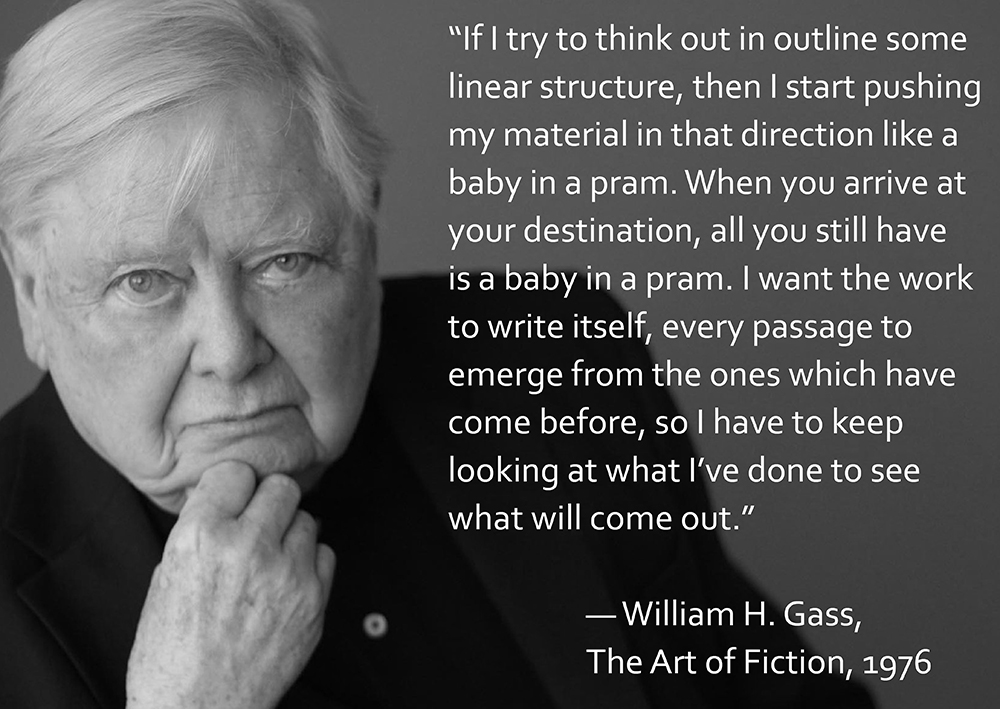
The similarities became troubling for readers and reviewers because Kohler is, well, not nice. In fact, he’s something of a monster. He is mean-spirited toward essentially everyone who has the misfortune of inhabiting his sphere, and he’s downright hateful to his wife, Martha, whom he thinks of as a “guard” that is confining him within the prison of his unhappiness. She has become essentially a non-person to him: “Martha’s face fades as her torso solidifies, her Aryan blood surfacing like lard. I work on her features, but I’ve forgotten what they are[.…] Without a mouth she’ll still talk back, from her crack like as not” (150-51). Worst of all, Kohler’s scholarly work on the Nazis appears more sympathetic toward them than many would like, including the administrators at his university (“those shit-resembling administrators,” he calls them) who overlook him for promotion because they consider him a “Nazi-nuzzler” (133). If Kohler seems to have a soft spot for Nazis and refers flippantly to the Holocaust, he must therefore be anti-Semitic; and if Kohler is an avatar for Gass himself, then the author, too, must be … so went the logic.
Gass anticipated readers who didn’t know how to read well would conflate the persona of the protagonist with the person of the author: “The resemblances between myself and my narrator are wholly trivial, I think, but I did emphasize them in order to test the reader’s sophistication (a test many reviewers failed). […] Unfriendly reviewers delight in the opportunity to clothe me in Kohler’s rags.” Against such charges, Gass pushed back, saying, “[T]he record will show, I believe, that I do not belong in Kohler’s camp” (Ziegler, “WHG in Germany” 116). (You will find the Works Cited at project site.)
The distinction between the author and his creation is a vital one to make as we attempt to read The Tunnel afresh in 2020, on its twenty-fifth anniversary.
[End excerpt]
As you will see in today’s talk, The Tunnel remains a special focus of Gass scholarship and appreciation. In light of that I will also call your attention to another of my contributions to the website: “The Tunnel: A Chronology & Bibliography,” (link) which documents Gass’s progress from its conception in 1966 to its publication in 1995 and beyond. The novel has a complicated publishing history, and my hope is that I will save scholars time and trouble tracking when attempting to piece together and track down the scattered excerpts of The Tunnel. As a writer myself, I always found it interesting that Gass seemed to have concept of how long the writing of the novel would take; so I’ve included quotes from Gass over time as he continued to reassess where he was in the process. Even from the start, completion of the novel always seemed to him a few years away. A complimentary piece at the website is Joel Minor’s “The Tunnel: A Survey of Published Excerpts,” [link] which takes a more scholarly, strictly bibliographic approach to the same sort of information I provide in my “Chronology & Bibliography.”
Let me return to 2024 … or rather December 2023, which is when I posted my first “William H. Gass at 100: A Reading Journal,” [link] in which I describe how I first encountered Gass via his novella (or long story) “In the Heart of the Heart of the Country.” I begin by saying, “As a Gass scholar and devotee (disciple isn’t too strong of a word), I have various projects in the works to mark the Master’s 100th year — all part of my ‘preaching the Gass-pel,’ an evangelism I embarked on more than a decade ago. No doubt I will use this forum to talk about some of those Gass Centenary projects, which tend to be formal and scholarly. It occurred to me that I also wanted to do something less formal, and more personal. It is not an overstatement to say that William H. Gass changed my life. His writing, his theories, his example as torchbearer in the cause of literature: everything has impacted me in ways that I can name and, doubtless, in ways that I cannot.”

My intention was to post a new reading journal, including a new video, periodically throughout 2024. It didn’t quite workout that way (as I feared). I included my various contributions to the Gass Centenary as journal entries, although that isn’t what I had in mind back in December 2023. One such contribution was my paper delivered here a year ago: “William H. Gass at 100: Looking Forward, Looking Backward” [link], which focuses mainly on the backward part as I provide a biography of Gass and his most notable works for the majority of the paper. Sadly, I’ve discovered that Gass is not especially well known, even in literary circles, so describing his career and achievements is necessary.
After the Louisville Conference paper, the next significant event was a panel at the American Literature Association Conference in Chicago in May 2024. In the panel, Joel Minor presented his Tunnel bibliography from thetunnelat25.com project; Ali Chetwynd (American University of Iraq, Sulaimani) presented “Literary Theory Teaching: Founded on William Gass”; and I presented “Let Us Now Praise William Gass’s Greatest Work – And It’s Not the One You Think” [link]. While I am, of course, a fan of The Tunnel, and I’ve presented several papers and published a few on Gass’s magnum opus, I don’t believe it was the most masterful of the master’s work. Rather, artistically, I feel that Cartesian Sonata and Other Novellas represents the pinnacle of his literary achievements. I’ll share the final paragraphs of that paper:
[Begin excerpt]
Though my catalog is incomplete, I’ll end where I began, with The (large, loose, baggie) Tunnel. Gass’s ambitions for the novel were epic, and it took him far longer—far longer—to write than he anticipated. He imagined, maybe, three years or so … let’s say, then, a publication date around 1970. But time marched on and the Master aged along with his aim for the book. He had about 600 manuscript pages in hand when, in 1991 (age 67), he went for an extended stay at The Getty Center in Santa Monica to devote himself fully to finishing the legendary book. Working into 1992, he doubled the size of the novel, completing it at about 1,200 manuscript pages. Begun in the sunny summer of literary postmodernism, the first half of the book displays many of the tropes and tricks that interested Gass in the 1960s and 70s—it resembles in many ways Gass’s wildly experimental novella Willie Masters’ Lonesome Wife (1968)—an experiment that Gass himself deemed a failure in retrospect.5 Though The Tunnel doesn’t quite conform to the chronology of its composition, the latter half doesn’t display the same fondness for postmodern play as the beginning sections do. Released at last in 1995, it was as if the postmodern novel had arrived at the party after practically all the guests had collected their coats and gone home to sleep it off.
Perhaps Gass wittily but unwittingly anticipated the fate of The Tunnel when he wrote the preface to In the Heart of the Heart of the Country (revised 1981):
“I write down these dates, now, and gaze across these temporal gaps with a kind of dumb wonder … hodge against podge, like those cathedrals which have Baroque porches, Gothic naves, and Romanesque crypts; time passed, then passed again, bishops and princes lost interest; funds ran out; men died; … and because they were put in service while they were still being built, the pavement was gone, the pillars in a state of lurch, by the time the dome was ready for its gilt or the tower for its tolling bell …” (xxxii).
We still ought to attend service in William Gass’s great cathedral, but our warmest words of worship should be reserved for Cartesian Sonata and Other Novellas.
[End excerpt]
Gass was born in Fargo, North Dakota, though he moved from there to Warren, Ohio, when still a baby. Nevertheless connections to North Dakota remained, and I attempted to organize some sort of event or conference in Fargo or nearby in the summer of 2024, ideally around Gass’s birthday, July 30. Unfortunately no one locally seemed to have the time or money or interest. Perhaps one day I’ll resume my efforts. Therefore, the next significant event was at Washington University in St. Louis October 3, “William H. Gass Centenary Celebration” [link]. The main event was a panel discussion that I had the honor of moderating. It included Patrick Davis (Unbound Press), Michelle Komie (Princeton University Press), and Gerhild Williams (Washington University German Department, retired). Much of the informal discussion focused on Gass’s founding and directing of the International Writers Center (1990-2000).
One of the more intriguing revelations from the panel discussion was that Patrick Davis, of Unbound Press, plans to republish The Tunnel in the form that Gass always had in mind: a loose collection of about 1,200 manuscript pages, and stuffed with things like paper bags, business cards, and crossword puzzles. Its publication may coincide with the novel’s 35th anniversary. I hope that it comes to pass.
Interest in Gass’s work persists, if not as robustly as enthusiasts like me would prefer. Last year I was contacted by Apostolis Pritsas, who was translating Cartesian Sonata and Other Novellas into Greek, and he requested my informal consultation. I was happy to do it, and we exchanged a few emails over the summer and fall. The two novellas that generated the most questions were “Cartesian Sonata” and “Emma Enters a Sentence of Elizabeth Bishop’s”—both highly experimental works in terms of structure and narrative chronology. The Greek edition is slated for an early March release. Meanwhile, a Spanish-language edition of Cartesian Sonata appeared [link], which changes the order of the novellas, totally undercutting Gass’s concept of the collection.
Finally, I plan to edit, contribute to, and publish William H. Gass at 100: Essays later this year. Contributions include the following: “‘Inward Toward the Other’: The Dancing Minds of William H. Gass and Toni Morrison” by Jose Miguel Alvarado Mendoza; “In Search of William Gass” by Zachary Fine; “William Gass and the Power of Baroque Fictionality” by Yonina Hoffman; “The Meta-Novel as a Container of Self-Consciousness: Linguistic Order and Fascism of the Heart in William H. Gass’s The Tunnel” by Abbie Saunders; “Broken Windows and Dirty Mirrors: Metaphor and Mind in The Tunnel” by Jonathan Moreland; “Defying Form” by Nathan King; “To Create or Capture Consciousness: Reconsidering William H. Gass as ‘The Father of Metafiction’” by Alex Lanz; and “Medium-Specific Foundations: Teaching Literary Theory Across the Gass-Axis” by Ali Chetwynd.
I will draw from several of my Gass conference papers to put together a constellation of pieces, and I also will include a selection of Gass’s photographs. He was a serious photographer, but that aspect of his artistic life has received little attention.
Let Us Now Praise William Gass’s Greatest Work
This paper was presented at the American Literature Association Conference in Chicago, May 2024, as part of the “William H. Gass at 100” panel. Other papers were “Surveying The Tunnel“ by Joel Minor (Washington University in St. Louis) and “Literary Theory Teaching: Founded on William Gass” by Ali Chetwynd (American University of Iraq, Sulaimani). The panel was chaired by Benjamin Seigle (University of Illinois, Chicago).
“I should like to return to my real love, the novella. I think that is what I should have been doing all along, writing storyless stories,” thus spake William H. Gass in 1995 in response to the question, in essence, what would he be working on now that his novel The Tunnel was out in the world, all 650 pages of it, after a legendary gestation of 26 years? Over those nearly three decades of its composition, Gass, as a writer of fiction, became identified with the project as excerpts of it appeared more than 30 times, between 1969 (New American Review, No. 6) and 1995 (Esquire, March), including as reprints in anthologies of award-winners, limited-edition books by boutique presses, and even as a stage play. When finally released in 1995, The Tunnel proved controversial, provoking as much condemnation as praise (as well as a sizable percentage of ambivalence). Nevertheless, its brilliance was recognized with the American Book Award and a nomination for the Pen-Faulkner Prize, both in 1996.
Gass seemed to take the mixed reviews in stride, content that “the past ha[d] been laid to rest,” as he expressed it to Heide Ziegler (119). He was free at last to focus on his real love.
Because of the infamy of The Tunnel—its seemingly never-ending composition, its accolade-earning surface-breaches, its much-anticipated publication, and its ire-inspired critiques—those who know William Gass as a fiction writer almost always connect him to his infamous magnum opus. My purpose here is to posit that of all Gass’s works of fiction—three novels, one stand-alone novella, and three collections—he ought to be known for, and lauded for, the book that came out in the shadow of The Tunnel, while the behemoth’s radioactive dust was still settling: Cartesian Sonata and Other Novellas (1998). Gass, who wore like epaulets the epithets stylist and experimentalist, was always in pursuit of the perfect book, the perfect work of literary art. I believe that Gass achieved that perfection, according to his own standards, in the four novellas brought together as Cartesian Sonata, a work that has not received nearly the attention of Gass’s first four books.1 By the end of the twentieth century, postmodernism had run its course, and there wasn’t a lot of critical attention being paid to its master practitioners (though Gass resisted the label postmodernist).
Fortunately for us, Gass also wrote copious amounts of nonfiction, much of which is devoted to narrative theory, either directly or indirectly. By indirectly, I mean that he was a masterful critic in how own right and wrote illuminatingly about numerous authors, like Henry James, Gertrude Stein, Malcom Lowery, William Gaddis—and of course Gass’s literary idol, Rainier Maria Rilke. He was also a generous granter of interviews, the subjects of which often turned to his thoughts and theories regarding fiction. So, between his essays, his analyses of other authors, and his interview responses, we have a significant body of material regarding his aspirations for a work of fiction.
First, though, some background on the Cartesian Sonata collection. It consists of the title novella (divided into three distinct parts), plus “Bed and Breakfast,” “Emma Enters a Sentence of Elizabeth Bishop’s” and “The Master of Secret Revenges.” As Gass explained in 1998, “Cartesian Sonata” “was written a long time ago in rough draft” and “The Master of Secret Revenges” had been “an idea maybe 35-40 years ago,” while the remaining novellas “were much more recent and don’t appear to have had any lengthy sort of time in my unconscious” (Abowitz 143). Pieces of “Cartesian Sonata” appeared here and there beginning as early as 1964 (Location No. 2). In other words, the beginning and concluding pieces of the novella collection had been on Gass’s mind (and partly on paper) during the same years that he worked in fits and starts on The Tunnel (as well as many other writing projects). However, the middle two novellas were written after The Tunnel was completed. “Emma Enters a Sentence of Elizabeth Bishop’s” first appeared in 1994 (Iowa Review 24.2)—before the publication of The Tunnel, but after its completed composition, in 1992. (For a bibliography and chronology of The Tunnel’s composition see this link.) I want to underscore, then, that when Gass was at last able to return to his first love, the fruits of that impassioned homecoming were the reworking of “Cartesian Sonata” and the writing of the other three novellas—all within the context of a clearly envisioned theme and tightly imagined structure.
No guesswork is needed when it comes to understanding Gass’s agenda for the collection. He spelled it out in a conversation with Michael Silverblatt for the Lannan Foundation reading on November 5, 1998 (happily available via video).2 Gass explains that “the conception was to take the Cartesian problem of the three substances—the uncreated substance, God, which has always existed, and then the created substances, mind and matter [and explore] the problem of Descartes metaphysics: How do you get mind and matter to interact, because they have nothing to do with one another . . . [Silverblatt interjects, ‘So it’s a failure of God …’] Yes.” The title novella is divided into three sections corresponding to the three substances. “Then,” continues Gass, “I decided to write three other novellas. Each would be parallel to that initial sonata. So this [first novella] is a sonata played this way [Gass gestures], then a sonata played that way [opposing gesture], as each one of these others lines up behind one of the sections” (starts around the 13:00 mark).
Like this:
“Cartesian Sonata”
—‘The Writing on the Wall’ [God]
—‘The Clairvoyant’ [Mind]
—‘I Wish You Wouldn’t’ [Matter]
“Bed and Breakfast” [Matter]
“Emma Enters a Sentence of Elizabeth Bishop’s” [Mind]
“The Master of Secret Revenges” [God’s opposite, “a tinhorn Lucifer,” says Gass]
Gass, for whom nothing was sacred,3 presents, as he explains, not “God the great and glorious” and not “God the dead and gone,” but “God the incompetent—the real God, in my opinion.” Taking a familiar self-deprecating posture, ‘The Writing on the Wall’ begins in a (familiar) metafictional mode with Gass, as narrator, speaking directly to the reader about the creation of the main character, Ella Bend Hess, who was a briefly mentioned character in Gass’s earlier novella, Willie Masters’ Lonesome Wife (earlier, though contemporary with the original writing of this story). Gass writes, “Is it right or honest? After all—Ellla Bend—where is she? Isn’t she as much in all those scraps I threw away as in the scraps I saved? Threw away, mind you, when they held her name. Where else did she have her life?” Gass then goes about discussing Ella’s original description and how he is rewriting (recreating) her for this story: “I’d given her a long nose, I remember—no good reason why. Now her nose is middling” (4). So this incompetent God is the author: Gass, the creator of the text, the rearranger of matter from all those scraps.
The section continues in a metafictional mode as we are introduced to other characters in the story. Ella is the focus of the second section, ‘The Clairvoyant.’ Through the gift (or curse) of her clairvoyance Ella lives in a world of spiritual essence, seeing the dead, sensing the lingering presence of the past, and hearing the voices trapped inside inanimate objects: “She possessed an abnormal number of sensitive receivers. She was almost totally attention and antennae” (37). The final section, ‘I Wish You Wouldn’t,’ shifts the focus to Ella’s husband, Edgar Hess, who sees her as sick due to the clairvoyance he doesn’t understand. He becomes abusive, believing “[i]t helped her to hit her” (53), and “he solemnly prayed for his wife’s demise” (45). H. L. Hix describes the problem of Descartes metaphysics as represented in the novella this way: “His wish for her death arises between the disparity between their modes of being. She is almost pure spirit, and he almost pure body. . . . Her gift meant that he was far too material for her, and she was not material enough for him” (143).
In brief, the next novella, “Bed and Breakfast”(representing matter), is about an itinerant accountant, Walt Riff, who specializes in helping business owners cheat on their taxes by creating fraudulent records for them (an act of fiction not terribly far removed from the role of storyteller). However, Walt begins to see the error of his ways when he stays in a bed and breakfast and becomes enchanted by the innumerable homey objects therein. Put simply, Walt begins to see the value of real things, as opposed to the value of imaginary things, like the figures he writes in clients’ ledgers. In “Emma Enters a Sentence of Elizabeth Bishop’s” (representing mind), the main character, Emma Bishop, attempts to escape her abusive and neglectful parents by not eating (thus making her material self disappear little by little) and by immersing herself in books of poetry, by Elizabeth Bishop, Marianne Moore, Edith Sitwell, Emily Dickinson and others (feeding her mind while denying her body). Finally, “The Master of Secret Revenges” returns to the subject of God, but through the twisted theology of Luther Penner, who devises a philosophy and then a religion based on the fulfillment of retribution.
Though I have only provided the sketchiest of sketches here, I submit that in its form Cartesian Sonata and Other Novellas is perfect (or as close to perfection as any work of art can achieve). It has a mathematical symmetry that is apropos to Descartes’ philosophy, which is based in mathematics. And form represented the pinnacle of artistic achievement for Gass: “The form. That is what the long search is for; because form, as Aristotle instructed us, is the soul itself, the life in any thing, and of any immortal thing the whole” (Preface xliv; italics in original). Earlier in his career, Gass expressed another guiding principle of his art to an editor who wanted him to consider revisions to a piece that would eventually become part of Gass’s first novel, Omensetter’s Luck. In essence, the editor’s notes were designed to make the narrative more readable, more traditional. Gass wrote, “[T]he writer [has no] responsibility to the reader. . . . He has a responsibility to the thing he is making. . . . [T]here is no story. There remain but words—the continuous exploration of concepts” (Saltzman 66-67). So even then, in 1958, Gass had decided what his chief objective would be as a writer of fiction: the continuous exploration of concepts, which is perhaps the best way to describe the four novellas that comprise Cartesian Sonata.
However, I hold up Cartesian Sonata and Other Novellas as Gass’s greatest work not just because of its ideal form and its sustained exploration of Decartes’ metaphysics. The four novellas are woven together via the intricate repetition of images, ideas and language. A thorough examination would be the stuff of a doctoral dissertation, but perhaps I can give some sense of these kinds of connections here. For example, the corresponding Cartesian representations are reinforced by the names of the characters. The two narratives that explore the concept of mind feature the main characters Ella and Emma, both abused by men (Ella’s husband and Emma’s father). Early in ‘The Writing on the Wall,’ when we are introduced to Ella Bend, the narrator-writer becomes fixated on the letter m: “I wonder if you understand about that m. The other day I idly scribbled twelve of them in the margin of a canceled page: mmmmmmmmmmmm. . . . Look at them again: mmmmmmmmmmmm. Hear them hum. Isn’t that the purply dove? the witches’ mist? It’s Ella Bend in receipt of her gift” (5). But it also foreshadows the subtle shift in the alphabet from Ella to Emma, who will further explore the concept of mind later in the collection. Gass is similarly playful when it comes to the opening and closing novellas that delve into the two sides of the divine coin. The godlike author-narrator of “Cartesian Sonata” is set alongside tinpot Lucifer Luther Penner, who spreads his gospel of revenge via the written word, “The Moral Self Wears a White Shirt” and “An Immodest Proposal”—“his only public and published document[s]” (244).
Perhaps it goes without saying, but throughout the novellas Gass gives us his trademarks: stunningly superb sentences, magisterial metaphors, and similes whose smiles are as smooth as brie.4
To close, I find myself in the uncomfortable position of stating why Cartesian Sonata outshines, by a fraction, Gass’s other works fiction. Regarding the other collections, In the Heart of the Heart of the Country and Other Stories (1968) offers five fabulous stories in an impressive variety of styles, which means that as a whole they do not proffer the cohesion, the continuous exploration of a concept that we find in Cartesian Sonata; and Eyes: Novellas & Stories (2016) is once again a fabulous gathering of fiction, but it is even more of a potpourri than the first collection. Gass had in mind a collection of three novellas that may have rivaled Cartesian Sonata in terms of artistic concept and execution, but one of the novellas grew beyond his expectation and was published as his third novel, Middle C (2013)—an incredible book and winner of the William Dean Howells Medal. However, its creation almost by accident seems to disqualify it as a masterwork from conception to completion.
Though my catalog is incomplete, I’ll end where I began, with The (large, loose, baggie) Tunnel. Gass’s ambitions for the novel were epic, and it took him far longer—far longer—to write than he anticipated. He imagined, maybe, three years or so … let’s say, then, a publication date around 1970. But time marched on and the Master aged along with his aim for the book. He had about 600 manuscript pages in hand when, in 1991 (age 67), he went for an extended stay at The Getty Center in Santa Monica to devote himself fully to finishing the legendary book. Working into 1992, he doubled the size of the novel, completing it at about 1,200 manuscript pages. Begun in the sunny summer of literary postmodernism, the first half of the book displays many of the tropes and tricks that interested Gass in the 1960s and 70s—it resembles in many ways Gass’s wildly experimental novella Willie Masters’ Lonesome Wife (1968)—an experiment that Gass himself deemed a failure in retrospect.5 Though The Tunnel doesn’t quite conform to the chronology of its composition, the latter half doesn’t display the same fondness for postmodern play as the beginning sections do. Released at last in 1995, it was as if the postmodern novel had arrived at the party after practically all the guests had collected their coats and gone home to sleep it off.
Perhaps Gass wittily but unwittingly anticipated the fate of The Tunnel when he wrote the preface to In the Heart of the Heart of the Country (revised 1981):
“I write down these dates, now, and gaze across these temporal gaps with a kind of dumb wonder … hodge against podge, like those cathedrals which have Baroque porches, Gothic naves, and Romanesque crypts; time passed, then passed again, bishops and princes lost interest; funds ran out; men died; … and because they were put in service while they were still being built, the pavement was gone, the pillars in a state of lurch, by the time the dome was ready for its gilt or the tower for its tolling bell …” (xxxii).
We still ought to attend service in William Gass’s great cathedral, but our warmest words of worship should be reserved for Cartesian Sonata and Other Novellas.
Notes
- Chapter 7 of H.L. Hix’s Understanding William H. Gass focuses on Cartesian Sonata as a whole, but it is a relatively brief chapter. Hix’s emphases are on comparing the novellas to previous Gass fiction, and on the Christian elements found throughout the collection. Otherwise, there are noteworthy discussions of individual novellas (or their genitive pieces). In The Metafictional Muse (U of Pittsburgh P, 1982) Larry McCaffery includes early versions of “Cartesian Sonata” in his analysis of Gass’s work. Another interesting article is “About Reading” by Sally Ball, who makes the case that William Gass is more like Emma Bishop (of “Emma Enters a Sentence of Elizabeth Bishop’s”) than William Kohler (of The Tunnel). See The Review of Contemporary Fiction 24.3 (Fall 2001), pp. 40-45. This note is not intended as an exhaustive list of sources.
- For the Lannon Foundation reading, Gass primarily drew from the The Tunnel. He did, however, also read an excerpt from “Emma Enters a Sentence of Elizabeth Bishop’s.” This part begins at about the 4:30 mark. Of the four novellas in the collection, Gass seemed to think most highly of “Emma.” It was published in Conjunctions No. 30 accompanied by photos by Michael Eastman; and it is the only novella from Cartesian Sonata that Gass included in The William H. Gass Reader (Knopf, 2018).
- In the interview with Richard Abowitz, speaking of hostile reactions to The Tunnel, Gass said, “I don’t think anything is sacred and therefore I am prepared to extol or make fun of anything” (144).
- Due to the necessity of brevity, I am not discussing in detail Gass’s literary techniques in the collection. It must be noted, however, that it is not just the book’s form and continuous exploration of concepts that elevate its status to the most masterful of the Master’s works. Throughout the four novellas, Gass’s virtuosity with the written word is on full display: the metaphors, the similes, the catalogs, the playfulness with typography, and what Gass described as “jingling”—a poetic use of language that emphasizes alliteration, rhyming, repetition and other aural techniques that are not usually so enthusiastically employed in works of prose.
- See Gass’s interview with Thomas LeClair in Conversations, in which he said about Willie Masters’, “I was trying out some things. Didn’t work. Most of them didn’t work…. Too many of my ideas turned out to be only ideas—situations where the reader says: ‘Oh yeah, I get the idea,’ but that’s all there is to get, the idea. I don’t give a shit for ideas—which in fiction represent inadequately embodied projects—I care only for affective effects” (22).
Works Cited
Abowitz, Richard. “Still Digging: A William Gass Interview.” Conversations with William H. Gass, edited by Theodore G. Ammon, UP of Mississippi, 2003, pp. 142-148.
Gass, William H. Cartesian Sonata and Other Novellas. 1998. Dalkey Archive, 2009.
—. “A Revised & Expanded Preface.” In the Heart of the Heart of the Country and Other Stories. 1968. Godine, 2007, pp. xiii-xlvi.
Hix, H. L. Understanding William H. Gass, U of South Carolina P, 2002.
Saltzman, Arthur M. “William H. Gass: Selected Correspondence.” Review of Contemporary Fiction, vol. 11, no. 3, fall 1991, pp. 65-70.
“William Gass with Michael Silverblatt: Readings and Conversations.” Lannan Foundation, 5 Nov. 1998, https://lannan.org/media/william-gass-with-michael-silverblatt.
Ziegler, Heide. “William H. Gass in Germany.” Conversations with William H. Gass, edited by Theodore G. Ammon, UP of Mississippi, 2003, pp. 111-19.
In the Heart of the Heart of William Gass Country
For me 2024 marks a special year: the centenary of William H. Gass (1924-2017). As a Gass scholar and devotee (disciple isn’t too strong of a word), I have various projects in the works to mark the Master’s 100th year — all part of my “preaching the Gass-pel,” an evangelism I embarked on more than a decade ago. No doubt I will use this forum to talk about some of those Gass Centenary projects, which tend to be formal and scholarly. It occurred to me that I also wanted to do something less formal, and more personal. It is not an overstatement to say that William H. Gass changed my life. His writing, his theories, his example as torchbearer in the cause of literature: everything has impacted me in ways that I can name and, doubtless, in ways that I cannot.
Thus, “William H. Gass at 100: A Reading Journal.”
My intention is that throughout 2024 I will post to my blog impressions and musings regarding Gass’s works and words: his fiction, his essays, his reviews, his translations, his thankfully copious interviews. I probably won’t post as frequently as I would like (for one thing, those other Gass Centenary projects are going to be time-consuming and labor-intensive), but hopefully I will be able to share some of the wisdom and insights that have been so meaningful to me, and in the process reflect on how they have affected me: my writing certainly, my teaching definitely, and, most profoundly so therefore also most elusively, my thinking.
I don’t have a set agenda for these posts. The various foci will be organically chosen. Nevertheless, there are some topics that I feel deserve particular attention: Gass’s philosophy when it comes to composing narratives; his magnum opus The Tunnel, which took him more than a quarter century to write; the influence of the German poet Rilke on Gass’s work; his innovative prose techniques; his unflagging support of other writers; and the late work, which hasn’t received nearly the attention it deserves.
That’s a lot, and I will almost certainly fall short of my ambitions. If this reading journal has any success it will be measured in the number of readers who, because of it, have their curiosity piqued and as such will read the Master, perhaps for the first time.
For this journal, I will begin where William Gass began for me, with my almost accidental reading of his long story (some say novella) “In the Heart of the Heart of the Country.” I have told the tale elsewhere. The year was 2009, and I was in the process of amassing as many books as I could afford having to do with postmodernism. I was in the final stages of a Ph.D. in English studies at Illinois State University, rather late in life (46 at the time). Over the previous seven years, chipping away as a part-time student, I had completed my coursework, passed the comprehensive exams, and had my dissertation topic approved. I was looking at the psychological origins of postmodernism, and my plan all along had been to focus on the work of Thomas Pynchon and, especially, William Gaddis.
One of the many books I’d purchased was a (very) used copy of Norton’s Postmodern American Fiction. The well-worn book had recently arrived, and one afternoon, after a day of teaching high school, I decided to thumb through it, briefly. One piece in particular arrested my attention because it was heavily highlighted in yellow by a previous owner of the anthology. Upon further inspection, I saw that it had a strangely long and redundant title, and it was broken up into small sections, each with its own heading.
I began reading the opening, subtitled “A Place,” which starts more in the shape of a poem than a short story: “So I have sailed the seas and come . . . / to B . . . / a small town fastened to a field in Indiana.” I was instantly ensorcelled by the writer’s prose, and I think it was this early set of sentences that hooked me, and hooked me for life: “It’s true there are moments — foolish moments — ecstasy on a tree stump — when I’m all but gone, scattered I like to think like seed, for I’m the sort now in the fool’s position of having love left over which I’d like to lose; what good is it now to me, candy ungiven after Halloween?”
I quickly discerned that “In the Heart of the Heart of the Country” didn’t have a plot per se, at least not in a traditional sense, and it barely had a central character. If it did, it was an aging poet who has come alone to this small Midwestern town, a place that is described in poetic bursts: “Where sparrows sit like fists. Doves fly the steeple. In mist the wires change perspective, rise and twist. If they led to you, I would know what they were. Thoughts passing often, like the starlings who flock these fields at evening to sleep in the fields beyond . . .”
Like so many readers, I knew this place. I’d grown up in the Midwest, and when I encountered “In the Heart” I’d been teaching in a tiny town that reminded me in so many (unpleasant) ways of the fictional “B.” Moreover, I knew these feelings, especially of “having love left over.” I’d been surviving a miserable marriage for two decades, and the plan was to divorce as soon as I completed my doctorate (an agreement we’d reached to put off the inevitable).
As I said, my intention that fateful day was to only skim through the book to get a sense of its contents and what may be of use (I probably mainly bought the book for its introduction). But I couldn’t stop reading “In the Heart of the Heart of the Country.” In Gass I detected a kindred soul, and it was dawning on me that perhaps he would be a better focus for my dissertation than Pynchon and Gaddis. As good fortune would have it, within a week or two I attended the AWP Conference in Chicago. When I arrived at the hotel, late one frigid February night, I perused the conference program and discovered there would be a special program in honor of William H. Gass, a tribute, at which he would give a reading. What luck!
Again, this was 2009. Yet I recall the event and his reading with amazing vividness. It was in a ballroom that seemed suited for a thousand revelers, enormous chandeliers illuminated the room like a rugby pitch, revealing what appeared to be only a handful of audience members. I (im)patiently waited for three speakers to proclaim Gass’s greatness in frustrating detail. Finally the Master was allowed to speak. He had opted for an entomologically themed reading, beginning with his classic short story “Order of Insects,” followed by excerpts from other works that involve insects. I wasn’t yet familiar with Gass’s oeuvre, so I didn’t securely connect the passages to their works, but I know he read the swarm-of-grasshoppers scene from The Tunnel. Always self-deprecating, Gass joked that his reading demonstrated how little he had evolved as a writer over the decades.
Whatever had begun in me with the reading of “In the Heart of the Heart of the Country” it was amplified, intensified and made permanent by the Master’s serendipitous reading at the AWP Conference. I went about collecting all of his works of fiction (at the time), as well as some of the nonfiction; and I changed my dissertation’s focus to Gass. Fortunately my dissertation director, Bob McLaughlin, was quite familiar with Gass, which proved a great asset as I retooled my approach.
Thus began my mission to spread the word about our greatest writer, William H. Gass. My evangelism has mainly taken the form of conference papers (with the majority of them delivered at the Louisville Conference on Literature and Culture Since 1900); but I have preached the Gass-pel elsewhere, including in Portugal and (in 2023) Singapore. Plus at the peak of the pandemic I organized an online symposium focused on The Tunnel, which turned 25 in 2020. For 2024, I plan to edit and publish William H. Gass at 100: Essays (currently just a Call for Papers).
I feel like I should say so much more about “In the Heart of the Heart of the Country.” Perhaps, instead, I will direct the curious to papers I’ve presented previously: “In the Heart of the Heart of the Cold War” (Louisville Conference, 2013); “In the Heart of the Heart of Despair” (American Literature Association Conference, Boston, 2017); and “From Tender Buttons to the ‘Heart of the Country'” (Louisville Conference, 2019). Note that this last paper includes images of early drafts of “In the Heart” from the Gass Papers at Washington University in St. Louis.
I’ll conclude by referring to the title of this post, “In the Heart of the Heart of William Gass Country.” What I mean by it, at least, is that Gass was known as a Midwestern writer. He was born in Fargo, North Dakota, but his parents soon moved to Warren, Ohio, where he graduated from high school in 1942. His undergraduate degree was from Kenyon College. His teaching posts were the College of Wooster (in Ohio), Purdue University, University of Illinois (Urbana), and Washington University in St. Louis. The settings of his stories, novellas and novels were consistently in the Midwest, sometimes explicitly, sometimes implicitly.
Though it likely proved a barrier to his work being embraced by the New York literary establishment, Gass had a great appreciation for the Midwest and how it could function in his fiction. He said in 1997, “The landscape that I work with — the weather and the geography — are designed to be projections of the interior state of the individual or the meaning of the scene. The actual Midwest landscape is by turns cold and beautiful, and like fall here now . . . the leaves are just drifting down, and it’s 72 degrees and gorgeous.” Then he added, “But, of course, you know it may rain in the heart if it rains in the town. That’s the idea. So if my scenery is bleak, it’s because the meaning or the characters’ souls are. It doesn’t mean the Midwest is.”
Thank you for reading my first William Gass reading journal. If I’ve whetted your appetite, “In the Heart of the Heart of the Country” is available in both the collection In the Heart of the Heart of the Country and Other Stories (1968) and The William H. Gass Reader (2018). Or, like me, the ambitious could track down a copy of New American Review No. 1, where the story first appeared in 1967.
Here’s a video I made in conjunction with this blog post:
Beauty Must Come First: The Short Story as Art Made of Language

[This paper was presented at the 16th International Conference on the Short Story in English, held June 20-24, Singapore. It was part of the panel “The Short Story and the Aesthetics of Narration.” Other papers were “A Lot Like Joy: Fractured fragments represented within a composite narrative” by Sarah Giles, and “‘Writing back’—The Sideways Progress of Ideasthetic Imagining” by Julia Prendergast.]
“A second rate writer has no reason to exist unless he is on his way to being a first rate writer, and there is no point at all in doing pleasant easy things, or altering one’s conception of how a story ought to be to get it into print” (Saltzman, “Selected Correspondence” 66).
William H. Gass wrote this statement in a letter, in 1958, to an editor who was considering publishing his fiction, which would have been its first appearance in print. The editor was balking at Gass’s elaborate prose style. Gass, age 34 at the time, preferred to remain unpublished than have his words changed. It was an attitude he maintained – that to be edited was to be rejected – throughout what became a long and illustrious career that claimed numerous awards and distinctions, including Pushcart Prizes, Best American Stories, an O. Henry, the PEN/Nabokov Award, the American Book Award, and the William Dean Howells Medal. Gass – novelist, novella-ist, story-writer, critic, translator, and teacher – passed away in 2017 at the age of 93, working on his final project until he no longer had the energy to continue.
This paper is about Gass’s aesthetic theories when it came to producing narrative, and specifically fiction. Luckily, Gass was a generous granter of interviews, so we have a substantial amount of material in which he discusses his ideas about plot, character, setting, theme, symbolism … all of the elements we associate with storytelling (we have printed material, plus video and audio recordings that are available online). He also wrote numerous “craft” essays in which he goes into detail about his writing, as well as the writing techniques of others (among them Henry James, James Joyce, and Gertrude Stein). Such essays were included in his nine nonfiction collections, beginning with Fiction and the Figures of Life (1970) and concluding, for now, with Life Sentences (2012). And we have copious letters, which are carefully archived at Washington University in St. Louis.
To be clear, Gass’s theories are not designed to make one popular, that is, to make one a bestselling author. On the contrary, Gass never achieved that brand of success. In fact, he said (in another letter to the same editor, Charles Shattuck): “[S]uccess is merely failure at another level” (Saltzman 65), by which he meant that a writer must compromise their artistic principles in order to gain the public attention and financial rewards we (in the United States at least) usually associate with literary success. Gass’s primary goal was to create a work of literary art that he himself was satisfied with; if he had secondary goals they were to earn the respect of writers he admired, and to be read beyond his own lifetime. “I don’t write for a public,” Gass said. “[. . .] It’s the good book that all of us are after. I’ve been fortunate in that I think I have the respect of the writers whom I admire” (Saltzman, “Language and Conscience” 24). He did indeed as his work was praised by authors such as John Barth, Susan Sontag, John Gardner, Stanley Elkin, Joy Williams, and William Gaddis, who called Gass “our foremost writer, a magician with language” (Gaddis 629).
Regarding the goal of having his work read beyond his lifetime, it’s been my mission to make that a reality for more than a decade, during which time I’ve been “preaching the Gass-pel” (an expression coined by one of my students that I immediately filched). I’ve presented dozens of conference paper (all available at my blog, and some elsewhere); I’ve included readings of Gass’s work in my book Trauma Theory as an Approach to Analyzing Literary Texts (2021 edition); and I organized the website thetunnelat25.com, an online symposium devoted to Gass’s magnum opus. In my teaching I regularly place Gass’s books on my syllabi, and I share pearls of his writing wisdom with my students regularly (they may say obsessively). Many of these pearls I also share via social media in the form of memes that I’ve created. Like this one:
[This meme has to do with a topic I’ve recently written about: “To Plan or Not to Plan,” available here.]
And this:
[During the presentation I talked briefly about the inherent problem of writing workshops or writing groups: No matter how well-intentioned, peers’ critiques are oftentimes wrongheaded, and an offhanded criticism can send the unwary writer down a frustrating and fruitless rabbit hole. Instead, writers must accept the unavoidable subjectivity of reader response and stay true to their artistic vision.]
And this:
[I felt this was an especially apropos sentiment to share since the conference was comprised of writers from across the globe — but mainly Asia, Australia and Europe — who compose in English, even though for many it’s not their first language.]
I want to touch on some specific ideas Gass had about writing narrative, but before we get there I’m inclined to discuss the cornerstone of his aesthetic philosophy – as well as my primary focus here: Throughout his long writing career, Gass’s main interest was language, and he sought to use it as a painter uses paint, a sculptor uses marble or metal, a composer uses musical notes, or a photographer uses light and shadow. He stated, in a 1976 interview, “As a writer I only have one responsibility, and that’s to the language I’m using and to the thing I’m trying to make” (Duncan 53). He elaborated elsewhere, “Old romantic that I am, I would like to add objects to the world worthy of love. . . . My particular aim is that it be loved because it is so beautiful in itself, something that exists simply to be experienced. So the beauty has to come first” (LeClair 48).
Allow me to restate Gass’s central tenet: The beauty of the language must come first. By extension, then, everything else – all the other elements associated with fictional narrative, plot, characterization, setting, etc. – are subordinate to the quality of the language, to the beauty of the language. Gass’s devotion to beautiful language took many forms. For example, he regularly employed literary devices we normally associate with poetry: alliteration, assonance, rhyming, repetition. As such, Gass considered himself a stylist, meaning that his main interest was the writing itself. “I’ve always been interested in writing as writing. My interest in the various forms is dominated by an interest in style as such” (Duncan 64). Though Gass considered himself an abysmal poet, his use of poetic language was, he said, “compulsive” and “turns up in almost every line of prose, in sound patterns that get pushy, even domineering” (“Retrospection” 43-44).
Gass’s drive to create art made of language led him away from using narrative elements in traditional ways. Mind you, not ways that are utterly unique – I’m a supporter of Adorno’s assertion that when it comes to art, there is nothing new under the sun, yet the true artist must strive for the new nevertheless – but ways that are certainly unusual in modern American fiction, especially popular fiction. For instance, we normally think of characters in fiction as people, or possibly animals or machines (generally, though, personified animals or machines). However, for Gass a character was “any linguistic location of a book toward which a great part of the rest of the text stands as a modifier” (LeClair 53). Gass’s ideas about characters and characterization were complex, and he wrote and spoke frequently about those ideas (I direct you, especially, to his essay “The Concept of Character in Fiction”), but I will try to communicate the essence of his thinking.
Drawing from the essay above: He wrote, “[T]here are some points in a narrative which remain relatively fixed; we may depart from them, but soon we return, as music returns to its theme. Characters are those primary substances to which everything else is attached . . . anything, indeed, which serves as a fixed point, like a stone in a stream or that soap in Bloom’s pocket, functions as a character” (49-50). As such, physical objects can be characters (everything from Lowry’s volcano to Gogol’s overcoat); symbols can be characters; ideas; concepts; situations. All can function a characters.
If we think of plot as what happens to a narrative’s central character (its protagonist), commonly how the character changes during the course of the narrative, we must be prepared to modify our sense of conflict, resolution and denouement when other things besides people operate as protagonists (and antagonists). A volcano or an overcoat or a crucifix or a bombing or fascism cannot have epiphanies (as Joyce would have phrased it). They do not change as, we hope, people change. No matter how many ghosts visit a volcano on Christmas Eve, it’s still a volcano on Christmas morning, with all the capricious and explosive qualities its kind is known to have.
To be clear, nearly all of Gass’s fiction is populated with human characters as their ostensible narrative focus (two exceptions are the brief stories “Don’t Even Try, Sam” and “Soliloquy for a Chair” in which the protagonist of the former is the legendary piano in the film Casablanca, while it is a folding chair in a barbershop that soliloquizes in the latter – both are collected in Eyes [2013]). However, the human characters’ primary function is to provide a scaffolding on which Gass can develop his thematic interests, and, perhaps chiefly, play with language. “For me,” he said, “a character is really a voice and a source of language. . . . Words are going to come out from that source either as direct speech or as a means of dictating the language you use in the third person to describe scenes or that individual from outside” (Saltzman 85). So, functionally speaking, human characters are providing the means (structurally and linguistically) by which Gass can explore other characters in the narrative: a concept, an attitude, a place, an object.
One may ask at this point: If in Gass’s fiction he was disinclined to maneuver his characters toward epiphanies, toward traditional, Aristotelean kinds of resolutions, how did he develop his narratives? What was their aim? In one sense, Gass developed a piece of fiction as one might develop an expository essay, with the objective being to more fully realize a particular subject. Ultimately, though, and overarchingly, Gass’s interest was to create a beautiful piece of writing: a work of art made of language. Perhaps he expressed his philosophy most clearly and most forcefully in a series of debates with fellow writer (and friend) John Gardner in the 1970s (audio recordings of one such debate session can be accessed here). Gardner believed that fiction should have a moral component, that it should teach the reader something important about how to behave in the world. Gass vehemently disagreed: “John wants a message, some kind of communication to the world. I want to plant some object in the world. . . . I want to add something to the world which the world can ponder the same way it ponders the world” (LeClair 48). Elsewhere Gass bluntly asserted that “literature in not a form of communication” (Duncan 49).
Since we are a gathering of writers, I want to end on what Gass believed to be a kind of side benefit of using artful language, a utilitarian additional advantage. He said, “Shakespeare succeed[s] mainly because the rhetoric succeeds. Psychological shifts, changes of heart, all sorts of things happen which are inexplicable, except that if the speech is good enough, it works. The same is true in the way I go at things” (Saltzman 83-4). To put it plainly, certain weaknesses in a narrative can be bolstered by using language beautifully. Readers can be distracted from fissures in the foundation if the architecture is elaborate and enchanting. May we all build such mesmerizing abodes with our material of choice: the English language.
Works Cited
Duncan, Jeffrey L. “A Conversation with Stanley Elkin and William H. Gass.” The Iowa Review, vol. 7, no. 1, 1976, pp. 48-77.
Gaddis, William. The Letters of William Gaddis, edited by Steven Moore, New York Review Books, 2023.
Gass, William H. Fiction and the Figures of Life. Knopf, 1970.
LeClair, Thomas. “William Gass and John Gardner: A Debate in Fiction.” Conversations with William H. Gass, edited by Theodore G. Ammon, UP of Mississippi, 2003, pp. 46-55.
Saltzman, Arthur M. “An Interview with William H. Gass.” Conversations with William H. Gass, edited by Theodore G. Ammon, UP of Mississippi, 2003, pp. 81-95.
—. “William H. Gass: Selected Correspondence.” Review of Contemporary Fiction,
vol. 11, no. 3, 1991, pp. 65-70.
—. “Language and Conscience: An Interview with William H. Gass.” Review of Contemporary Fiction, vol. 11, no. 3, 1991, pp. 15-28.
Bridging Donne with the Digital Age: William H. Gass’s Devotion to Baroque Prose
(The following paper was presented at the Louisville Conference on Literature and Culture Since 1900, held Feb. 23-26, 2023, at the University of Louisville. It was part of the panel “Some Forms of Postmodernism in American Fiction,” chaired by Hunter Augeri, Duke University. Other papers were “The Violence of Microscopy: Nicholson Baker’s The Mezzanine and Inverted Totalitarianism at the End of History” by Jonathan Vincent, Towson University; and “Susan Sontag’s Death Kit as Pre-Post-Fiction” by Charlie Bertsch, Independent Scholar.)

William H. Gass – master stylist and acclaimed author of novels, essays, criticism, and translation – passed away December 6, 2017, at the age of 93. In the last few months of his long life infirmity prevented him from writing, but not before he was able to bring his final work to completion, simply titled “Baroque Prose.” No doubt it wasn’t as fully rendered as he would have liked, nor as finely tuned certainly, yet it was a fitting end to a life devoted to language: absorbing it, analyzing it, diagraming it, and shaping it into some of the most artful forms ever spoken or read. William Gaddis considered his friend Bill Gass “our foremost writer, a magician with language” (507); John Barth admired Bill Gass the person, but “most of all . . . the writing: in the fiction, those inhospitable landscapes and typically pathetic-when-not-monstrous characters, marvelously rendered into language; in the essays, the play of mind and wide-ranging erudition lightly deployed. And in both the prose, the prose . . .” (72). Perhaps Watson L. Holloway, author of William Gass (1990), put it most succinctly when he refers to “Gass’s finely tuned word machine,” noting it is “the language that must be at the root of any appreciation of his work” (x).
Gass wrote and spoke about the supreme importance of the sound of language too many times to count. Just how much attention he gave the aural quality of language in his own work may best be seen in his comments about his friend William Gaddis’s writing. In Gass’s introduction to the Penguin Classics edition of The Recognitions, he says,
“[W]e must always listen to the language; it is our first sign of the presence of a master’s hand; and when we do that, when we listen, it is because we have first pronounced the words and performed the text, so when we listen we hear, hear ourselves singing the saying, and now we are real readers, we are participating in the making, we are moving the tune along the line. . .” (ix).
Sadly, Gass is not as well known, even among academics and worshippers of the written word, as he should be, so here’s a biography in miniature. Born in Fargo, North Dakota, in 1924, Gass was educated at Kenyon College (A.B. in philosophy, 1947) and Cornell University (Ph.D. in philosophy, 1954). We mainly associate him with Washington University in St. Louis, where he taught from 1969 to 1990 and then established and directed the International Writers Center there until his retirement in 2000. He also taught at the College of Wooster (1949-54) and Purdue University (1955-1969). His fiction and other writings began to appear in the 1950s, and his debut novel, Omensetter’s Luck, came out in 1966, quickly followed by the collection In the Heart of the Heart of the Country (1968), the highly experimental novella Willie Masters’ Lonesome Wife (1968), and the essay collection Fiction and the Figures of Life (1970). He began writing his magnum opus, The Tunnel, in 1966, not finishing it until 1992 (pieces of it appeared regularly over the years, especially in the journal Conjunctions). Knopf released The Tunnel, all 650 postmodern pages of it, in 1995, and it won the American Book Award the following year, meanwhile accumulating an impressive array of both rose-tossing admirers and stone-throwing critics. This is a much-abbreviated description of his writings and awards over the decades.
As noted, Gass spent nearly three decades working on The Tunnel, which is unusual among novelists, but it was typical for the way Gass approached all his writing projects. He tended to work with concepts for years before considering them complete enough to appear in print. By his own admission, Gass wrote slowly and revised obsessively. For instance, characters that first appeared in 1968’s Willie Masters’ are further developed in 1998’s Cartesian Sonata & Other Novellas. The intricate structure of The Tunnel was an elaboration of the structure Gass invented for the long story “In the Heart of the Heart of the Country,” first published in 1967. Gass’s final work is no exception. In fact, we can trace the origins of “Baroque Prose” all the way back to Gass’s unpublished doctoral dissertation, “A Philosophical Investigation of Metaphor” (1954). (Happily, the dissertation and even its early drafts are part of the Gass papers archived at Washington University’s Special Collections Department – a treasure trove of Gass material.)
A brief excerpt from “Baroque Prose” was published in Gass’s lifetime, barely, in the inaugural issue of LitMag, spring 2017; and a longer version of the same excerpt appeared posthumously in the online journal Socrates on the Beach, issue 4, 2022. Gass’s widow, Mary Henderson Gass, generously and graciously sent me the entire manuscript in anticipation of this presentation. To date, plans for publication of the work are undecided. My main goals for this paper are to provide a brief description of “Baroque Prose” and to try to communicate its essence. The latter is challenging for a short presentation. Anyone who has read Gass’s nonfiction recalls that it is both tightly structured and marvelously meandering within its parts, which are constructed of highly poetic prose, often with comic touches. If one has read Gass’s nonfiction, I would say “Baroque Prose” most closely resembles his book-length essay On Being Blue, which is a beautiful examination of all the things we may mean when we use the word blue. But the comparison is far from perfect.
First, there is the word that is at the heart of Gass’s last work: baroque. He spends a significant amount of time telling us what it is, and what it isn’t. We recall, of course, that baroque refers to a style most associated with the seventeenth and eighteenth centuries, frequently applied to European art, music and architecture. We are told by various sources that it was known for its grandeur, sensuous richness, drama, dynamism, movement, tension, and emotional exuberance. Gass does refer fleetingly to some of the art forms known for their baroque attributes, but as his title makes clear, he chiefly analyzes baroque prose, particularly of the seventeenth century as it was practiced in the pulpit by two master rhetoricians, John Donne (1571/2-1631) and Jeremy Taylor (1613-1667). I calculate the “Baroque Prose” manuscript to be about 35,520 words, but I do so without confidence. Gass gives us copious quotes from Donne and Taylor and others, often in single-spaced block quotes; and he indulges what was a lifelong pleasure by providing numerous detailed diagrams in the service of analyzing the passages. The manuscript is divided into three numbered and well-balanced sections of about 45-50 pages, each of which is wide-ranging and sometimes overlapping in scope. There is also a rough chronological organization at work, as Gass’s main interest in the first half of the book is Donne, and Taylor becomes the latter half’s primary focus.
Gass appears to have several purposes, including defining and describing what makes prose baroque; illustrating why it’s effective (when it is effective); describing its rise and fall in the historical context of Europe; providing biographies of principals like Donne and Taylor; arguing for our continued interest in the baroque style of prose; and telling an engaging story whose main character is baroque prose. Along the way, Gass is also entertaining us with his trademark style, not holding back at all in wowing us one last time with his signature metaphors and similes. And like all of Gass’s nonfiction (really all of Gass), “Baroque Prose” is both serious and funny.
As noted earlier, Gass always maintained that effective writing was meant to be heard, not just read on the page by the eyes, but spoken, even if only to one’s internal ear, which makes his attraction to the subject of baroque prose quite natural. Throughout the manuscript, he provides italicized statements about baroque prose, eye-catching insertions that focus the reader on a particular aspect of his central subject. The first italicized insertion says, “Baroque prose begins as prose prepared to be performed . . . a prose that is therefore far from the book or paper, living, if it lives, in the listeners’ ears” ([4]). In fact, continues Gass, “once [the prose] reaches print, it will no longer be pronounced, no longer heard, no longer fed its breath, so no longer in being.” Regarding Donne’s baroque performances from the pulpit (Donne was ordained to the priesthood in the Church of England in 1615 and made Dean of St. Paul’s in 1621), Gass tells us, “Later, when publication was considered, a good deal of polish would be applied, removing, like soil from a shoe, much spontaneity, accident, and improvisation. Reading him now we must imagine dramatic pauses, gestures, sudden changes of posture, a play of facial expressions, extemporaneous additions, and the drama of the whisper and shout” ([11]).
Gass breaks down Donne’s rhetorical strategy: “During his opening Donne is establishing, not his subject, or a textual interpretation . . . ; he is not springing an apothegm to satisfy the men or a sweet sentiment to please the ladies; rather he is gathering his ruling image and its materials as though he were a carpenter arriving at an important moment of construction. . . . Donne’s mind is always moving through the middle of a metaphor” ([15-16]). In this statement we can see that Gass is still working through an analysis that began with his doctoral dissertation, which he wrote in the early 1950s. In his philosophical inquiry into metaphor, Gass turned to Donne regularly. Oftentimes the precise passages appear in both the unpublished dissertation and “Baroque Prose” (for example, passages from Donne’s The Lamentations of Jeremy). One of Gass’s concerns in his dissertation was how prose writers use language devices, like metaphor, compared to how poets tend to use them; and he returns to that comparison in “Baroque Prose,” telling us that “in poetry [] modifiers often lie around as loose as change, so that the reader is at a loss to know into which pocket the pence should go . . . whereas, in prose, number and relation, modification and consignment are to be connected, balanced, obeyed, in pursuit of a coherent and completed arrangement” ([16-17]).
Here is an abbreviated summary of some of Gass’s italicized insertions: “Baroque prose is written as if it were the libretto of an opera; as if it had to compete with an organ . . .” ([17]). Another: “The audiences of baroque prose admired a quick mind and the courtly flourish; they enjoyed it when their man in the pulpit showed a bit of wit and strut. There was a deep playfulness in this prose . . .” ([20]). And another: “Baroque prose loves the parenthetical, the marginal, the afterthought, the postscript, which it then inserts into the middle of things like herbs are stirred into a boiling pot . . . ” ([28]). Yet another: “Baroque prose is built on, and out of, conflict and chaos, paradox and bafflement. Its wish is for the harmony of dissident chords, the melody of dissenting lines . . . “([113]). In each case, Gass expands on the idea with explanation, quotations, and analysis.
In Part 2, Gass turns his attention primarily to Jeremy Taylor, who “does not seem to be as troubled a soul as Donne, and he is certainly, in every way, a more temperate man, liberal to a fault according to his peers” ([49]). Gass then provides a brief biography of Taylor, who was eventually made Bishop of Down and Conner Diocese, in Ireland, by Charles II. Gass points out that Taylor’s preaching was known for its “loose style,” but he goes on to assert that there is a complex rhetorical strategy at work, easily missed by the casual listener (or reader). Gass’s extensive analysis includes detailed diagrams to illustrate the mastery of Taylor’s baroque rhetoric. He again enters into a comparison of poetry versus prose: “Poetry calls out, through the dispositions of its lines, to be read as it requires; but the words that queue up to be prose are like subway passengers during rush: crowded hip to thigh, briefcase to umbrella, shoe to shoe” ([53]).
Gass’s detailed analyses of Taylor’s sermons continues into Part 3, as does his biographical narrative, which is a segue to discussing how the baroque style fell out of favor in England and Europe generally. Gass calls 1641 “[t]he dreadful year” as Taylor was briefly imprisoned and then removed from his clerical posts. Gass writes, “On the European continent the Thirty Years War had been killing people since 1618. Later scholars would declare the conflict in Europe closed in 1648. But England would have its own war now . . .” ([108]). With the rise of Puritanism, baroque’s ornate style of preaching would be out of step with the simplicity they sought. “Another enemy was length,” says Gass. “Sermonizers are likely to be strongly winded, as if their voices were to become themselves sturdy columns, built to last as eternally as a cathedral’s. The Puritan dictatorship had banned all public amusements [including entertaining styles in the pulpit]” ([108]).
Then came another blow to the baroque: the scientific ideal after 1660. Robert South, an opponent of the baroque, “began his attack on rhetorical preachifying by claiming that only the ignorant were impressed by verbal flourish” ([111-112]). In the remainder of the manuscript, the final 30 pages or so, Gass races through the history of the baroque style to the present, meanwhile cataloging with precision various characteristics that make it deserving of our appreciation today, like highlighting “what a little excess will do for you” ([70]). In sum, he says, “In the baroque, beauty begs for more beauty” ([119]). In the these final pages, Gass gives us baroque examples from more modern authors than Donne and Taylor, for instance a passage from Mark Twain’s Life on the Mississippi.
On the one hand, Gass is typically funny in this, his final work, but he has also come to terms with his approaching end. After talking about John Milton’s “flowery style,” Gass says, “I shall take a look at Milton’s use of adjectives later on. And adverbs even later”; then adds in a new paragraph, “A promise I shall probably break” ([33-34]). At first, one thinks he means he will not return to the topics in this book, but really Gass means he will likely never have the chance to write about them. Later we get another comment that, though humorous, underscores Gass’s sense of the inevitable. Following a full-page paragraph, Gass inserts in brackets, “I have decided to leave the foregoing paragraph as it first fell upon the page, as a warning to those who compose” ([82]). Gass, the relentless rewriter of his work, has run out of time and energy to wrestle a paragraph into perfection.
Midway through Part 1, Gass elaborates on the delight of repetition in the baroque and other nuanced techniques, drawing the conclusion, “The difference between writers we should study and admire, and those we may safely ignore, partly lies in their attention to such subtleties” ([21]). Here, it seems, Gass is subtly (or maybe not so subtly) making the case that his work should continue to be studied after his death as his own baroqueness is on full display in practically everything he published. I, for one, have never needed any such prodding. Gass will continue to be the main focus of my scholarship and a limitless source of inspiration for my teaching and writing.
Works Cited
Barth, John. “As Sinuous and Tough as Ivy.” The Review of Contemporary Fiction, vol. 11, no. 3, 1991, pp. 71-72.
Gaddis, William. The Letters of William Gaddis, edited by Steven Moore, Dalkey Archive Press, 2013.
Gass, William H. Introduction. The Recognitions, by William Gaddis, 1955, Penguin Classics, 1993, pp. v-xv.
––. “A Philosophical Investigation of Metaphor.” Doctoral dissertation, Cornell University, 1954.
Holloway, Watson L. William Gass. Twayne, 1990.
Accidental Poets: Paul Valéry’s influence on William Gass
The following paper was presented at the Louisville Conference on Literature and Culture Since 1900, held at the University of Louisville February 18-20. Others papers presented were “The Poet Philosopher and the Young Modernist: Fredrich Nietzshe’s Influence on T.S. Eliot’s Early Poetry” by Elysia C. Balavage, and “Selections from ‘The Poetic Experiments of Shuzo Takiguchi 1927-1937’” by Yuki Tanaka. Other papers on William H. Gass are available at this blog site; search “Gass.”
In William H. Gass’s “Art of Fiction” interview, in 1976, he declared two writers to be his guiding lights—the “two horses” he was now “try[ing] to manage”: Ranier Maria Rilke and Paul Valéry. He added, “Intellectually, Valéry is still the person I admire most among artists I admire most; but when it comes to the fashioning of my own work now, I am aiming at a Rilkean kind of celebrational object, thing, Dinge” (LeClair 18). That interview for The Paris Review was exactly forty years ago, and viewing Gass’s writing career from the vantage point of 2016, I am here to suggest that, yes, Rilke has been a major influence, but Valéry’s has been far greater than what Gass anticipated; and in fact may have been even greater than Rilke’s in the final analysis. Assessing influence, however, is complicated in this case, I believe, because a large part of Gass’s attraction to Valéry’s work in the first place was due to his finding the Frenchman to be a kindred spirit. Hence it is difficult to say how much of Gass is like Valéry because of Valéry’s influence and how much is because of their inherent like-mindedness.


A quick survey of Gass’s work since 1976—which includes two novels, a collection of novellas, a collection of novellas and stories, and eight books of nonfiction—may imply that Rilke has been the greater influence, as Gass intended. After all, Gass’s magnum opus, The Tunnel (1995), for which he won the American Book Award, centers on a history professor of German ancestry who specializes in Nazi Germany (Rilke allusions abound); and his other post-1976 novel, Middle C (2013), for which he won the William Dean Howells Medal, centers on a music professor born in Vienna whose special interest is Austrian composer Arnold Schoenberg; and, glaringly, there is Gass’s Reading Rilke (1999), his book-length study of the problems associated with translating Rilke into English. However, a more in-depth look at Gass’s work over these past four decades reveals numerous correspondences with Valéry, some of which I will touch upon in this paper. The correspondence that I will pay particular attention to, though, is that between the title character of Valéry’s experimental novella The Evening with Monsieur Teste (1896) and the protagonist of Gass’s Middle C, Joseph Skizzen.
Before I go further, a brief biographical sketch of Paul Valéry: He was born in 1871, and published two notable works in his twenties, the essay “Introduction to the Method of Leonardo da Vinci” and Monsieur Teste; then he stopped publishing altogether for nearly twenty years—emerging from his “great silence” with the long poem “The Young Fate” in 1917 at the age of forty-six. During his “silence,” while he didn’t write for publication, he did write, practically every day, filling his notebooks. Once his silence was over, he was catapulted into the literary limelight, publishing poems, essays, and dramas, becoming perhaps the most celebrated man of letters in France. By the end of his life in 1945 he’d been nominated for the Nobel Prize in Literature a dozen times.
The title for this paper comes from Gass himself. In his 1972 review of Valéry’s collected works, in the New York Times Book Review, he wrote that Valéry “invariably . . . [pretended] he wasn’t a poet; that he came to poetry by accident” (The World Within the Word 162). By the same token, Gass has insisted in numerous interviews (and he’s given many, many interviews) that he’s not a poet, that the best he can achieve is an amusing limerick. Others, however, have asserted that Gass’s fiction is more akin to poetry than prose, that his novellas and novels are in essence extremely long prose poems; and in spite of his insistence on his not being a poet, he would seem to agree with this view of his work. In a 1998 interview, for instance, Gass said, “I tend to employ a lot of devices associated with poetry. Not only metrical, but also rhyme, alliteration, all kinds of sound patterning” (Abowitz 144). Moreover, about a decade earlier he said that “all the really fine poets now are writing fiction. I would stack up paragraphs of Hawkes, Coover, Elkin, or Gaddis against the better poets writing now. Just from the power of the poetic impulse itself, the ‘poets’ wouldn’t stand a chance” (Saltzman 91). Critics have tended to include Gass in the group of writers whom Gass described as poet-novelists.
For your consideration, from The Tunnel:
A smile, then, like the glassine window in a yellow envelope. I smiled. In that selfsame instant, too, I thought of the brown, redly stenciled paper bag we had the grocer refill with our breakfast oranges during the splendid summer of sex and sleep just past—of sweetly sweating together, I would have dared to describe it then, for we were wonderfully foolish and full of ourselves, and nothing existed but your parted knees, my sighs, the torpid air. It was a bag—that bag—we’d become sentimental about because (its neck still twisted where we held it) you said it was wrinkled and brown as my balls, and resembled an old cocoon, too, out of which we would both emerge as juicy and new as the oranges, like “Monarchs of Melody,” and so on, and I said to you simply, Dance the orange (a quotation from Rilke), and you said, What? There was a pause full of café clatter. (160-61)
And beyond Gass’s poetic prose, he has written actual poems, besides the off-color limericks that populate The Tunnel. In Middle C, for example, there is a longish, single-stanza poem written via the persona of the protagonist, Joseph Skizzen. It begins, “The Catacombs contain so many hollow heads: / thighbones armbones backbones piled like wood, / some bones bleached, some a bit liverish instead: / bones which once confidently stood / on the floor of the world” (337). And, perhaps more significantly, there are the translated poems in Reading Rilke. There was a celebration held at Washington University in St. Louis in honor of Gass’s ninetieth birthday, Passages of Time, and he read from each of his works in chronological order, except he broke chronology to end with his translation of Rilke’s “The Death of the Poet,” which concludes,
Oh, his face embraced this vast expanse,
which seeks him still and woos him yet;
now his last mask squeamishly dying there,
tender and open, has no more resistance,
than a fruit’s flesh spoiling in the air. (187)
It was a dramatic finale, especially since the event was supposed to be in July, near Gass’s birthday, but he was too ill to read then; so it was rescheduled for October, and the author had to arrive via wheelchair, and deliver the reading while seated. Happily, he was able to give another reading, a year later, when his new book, Eyes, came out. (I wasn’t able to attend the Eyes reading, so I’m not sure how he appeared, healthwise, compared to the Wash U. reading.)
My point is that, like Valéry, Gass has downplayed his abilities as a poet, yet his literary record begs to differ. The fact that he broke the chronology of his birthday celebration reading to conclude with a poem—and he had to consider that it may be his final public reading, held on the campus where he’d spent the lion’s share of his academic life—suggests, perhaps, the importance he has placed on his work as a poet, and also, of course, it may have been a final homage to one of his heroes. In spite of Gass’s frailness, his wit was as lively as ever. When he finished reading “The Death of the Poet,” and thus the reading, he received an enthusiastic standing ovation. Once the crowd settled, he said, “Rilke is good.”
Evidence of the earliness of Valéry’s influence or at least recognized kinship is the preface to Gass’s iconic essay collection Fiction and the Figures of Life (1970), which Gass devotes almost entirely to the connection between the collection’s contents and the way that Valéry had assembled his oeuvre. Gass writes, “It is embarrassing to recall that most of Paul Valéry’s prose pieces were replies to requests and invitations. . . . [H]e turned the occasions completely to his account, and made from them some of his profoundest and most beautiful performances” (xi). Gass continues, “The recollection is embarrassing because the reviews and essays gathered here are responses too—ideas ordered up as, in emergency, militias are”; and then he describes his book as a “strange spectacle” in which he tries “to be both philosopher and critic by striving to be neither” (xii). So, Gass recognizes the parallel between the forces at work in Valéry’s literary life and his own. Gass has readily acknowledged the slowness with which his fiction has appeared (notably, it took him some twenty-six years to write The Tunnel), citing two reasons: the slowness with which he writes, and rewrites, and rewrites; but also the fact that he regularly received opportunities to contribute nonfiction pieces to magazines and anthologies, and to give guest lectures, and they tended to pay real money, unlike his fiction, which garnered much praise but little cash over his career.
This parallel between the circumstances of their output is interesting; however, the correspondences between Valéry’s creative process and his primary artistic focus, and Gass’s, is what is truly significant. In his creative work, Valéry was almost exclusively interested in describing the workings of the mind, of consciousness; and developing complex artistic structures to reflect those workings. T. S. Eliot noted Valéry’s dismissiveness of the idea of inspiration as the font of poetic creation. In Eliot’s introduction to Valéry’s collection The Art of Poetry, he writes, “The insistence, in Valéry’s poetics, upon the small part played [by ‘inspiration’ . . .] and upon the subsequent process of deliberate, conscious, arduous labor, is a most wholesome reminder to the young poet” (xii). Eliot goes on to compare Valéry’s technique and the resulting work to that done by artists in other media, most notably music composers: “[Valéry] always maintained that assimilation Poetry to Music which was a Symbolist tenet” (xiv). James R. Lawler echoes Eliot when he writes that Valéry “makes much of the comparison of poetry to the sexual act, the organicity of the tree, the freedom of the dance, and the richness of music—especially that of Wagner” (x).
The wellspring of music composition as a source of structural principles for poetry (or highly poetic prose) is arguably the greatest correspondence between Valéry as artist and Gass as artist. Examples abound, but The Tunnel and Middle C offer the most radiant ones. For the The Tunnel Gass developed a highly synthetic structure based on Arnold Schoenberg and the Second Viennese School’s musical theory of a twelve-tone system. Consequently there are twelve sections or chapters, and in each Gass develops twelve primary themes or images. He said, “[T]hat is how I began working out the way the various themes come in and out. It’s layered that way too. . . .” (Kaposi 135). In The Tunnel, Gass’s methodology is difficult to discern because Gass gave it a “chaotic and wild” look while in fact it is, he said, “as tightly bound as a body in a corset” (134). He achieved the appearance of chaos by “deliberately dishevel[ing]” the narrative with “all kinds of other things like repetitions [and] contradictions.” He said, “[T]he larger structure must mimic human memory, human consciousness. It lies, it forgets and contradicts. It’s fragmentary, it doesn’t explain everything, doesn’t even know everything” (134). For Middle C, the use of the Schoenberg system is much more overt, with Skizzen, its protagonist, being a music professor whose specialty is Schoenberg and Skizzen’s obsession with getting a statement about humans’ unworthiness to survive just right. Skizzen believes he is on the right track when he writes the sentence in twelve beats, and near the end of the novel he feels he has the sentence perfect:
First Skizzen felt mankind must perish
then he feared it might survive
The Professor sums up his perfect creation: “Twelve tones, twelve words, twelve hours from twilight to dawn” (352). Gass, through his narrator, does not discuss the sentence’s direct correlation to the Second Viennese School’s twelve-tone system, but it does match it exactly.
Let me return to another Valéry-Gass correspondence which I touched on earlier: their concern with the workings of the mind or, said differently, consciousness. Jackson Mathews, arguably the most herculean of Valéry’s translators into English, begins his introduction to Monsieur Teste with the statement that “Valéry saw everything from the point of view of the intellect. The mind has been said to be his only subject. His preoccupation was the pursuit of consciousness, and no one knew better than he that this pursuit led through man into the world” (vii). Valéry’s interest in the mind was present in his earliest published work, the essay on Leonardo’s method and, even more obviously, Monsieur Teste, that is, “Mr. Head” or “Mr. Brain as Organ of Observation” or something to that effect. However, it was during Valéry’s twenty-year “silence” that he delved into the phenomenon of consciousness most critically. Gass writes, “Valéry began keeping notebooks in earnest, rising at dawn every day like a priest at his observances to record the onset of consciousness, and devoting several hours then to the minutest study of his own mind” (“Paul Valéry” 163). As noted earlier, Gass fashioned The Tunnel, all 800 or so pages of it, to mimic the human mind in its intricate workings. In Middle C, Gass pays much attention to Skizzen’s thought processes, especially his copious writing, revising, critique of, and further revising of his statement about humans’ unworthiness for survival. Such concerns are everywhere in Gass’s work, including his most recently published, the collection of novellas and stories, Eyes. I would point in particular to the novella Charity, a challenging stream-of-consciousness narrative, all a single paragraph, that mercilessly bounces between the main character’s childhood and his present, and, chaotically, various times in between, all the while sorting through his feelings about the act of charity and how he came to feel about it as he does in the now of the story.
In the limited time remaining, I’ll turn to the correspondence between Valéry’s character Monsieur Teste and Gass’s Joseph Skizzen (though I think William Kohler, the narrator of The Tunnel, has significant Teste-esque qualities as well). The convention of The Evening with Monsieur Teste is that the narrator is a friend of Edmond Teste’s, and he goes about attempting to describe his friend’s character. There is very little action per se, and as such almost nothing in the way of plot, in a conventional sense at least (very Gassian in that regard). He tells us that he came to “believe that Monsieur Teste had managed to discover laws of the mind we know nothing of. Certainly he must have devoted years to his research” (11). In Middle C, Joseph Skizzen is obsessed with what he calls his Inhumanity Museum, essentially a record, largely in the form of newspaper clippings and personal notes, of humans’ ceaseless cruelty to one another. The collection is associated with his ongoing struggle to word just so his statement about humans’ unworthiness to survive. Monsieur Teste becomes almost a recluse, desiring little contact with other people. He is married, but the narrator suggests that Monsieur and Madam Teste’s relationship is more platonic than passionate, due to Edmond’s preference for the intellectual over the emotional. Similarly, Skizzen never marries in Middle C, and in fact never has sex—he flees as if terrified at the two attempts to seduce him, both by older women, in the novel. Ultimately he ends up living with his mother in a house on the campus where he teaches music history and theory, his few “pleasures” consisting of listening to Schoenberg, assembling his Inhumanity Museum, and revising his pet statement. What is more, Teste’s friend describe Edmond’s understanding of “the importance of what might be called human plasticity. He had investigated its mechanics and its limits. How deeply he must have reflected on his own malleability!” (11-12). Skizzen’s malleability is central to his persona in Middle C. He goes through several name changes, moving from Austria to England to America, and eventually fabricates a false identity, one which includes that he has an advanced degree in musical composition, when in fact his knowledge of music is wholly self-taught. One of the reasons he gravitates toward Schoenberg as his special interest is because of the composer’s obscurity and therefore the decreased likelihood that another Schoenberg scholar would be able to question Skizzen’s understanding of the Austrian’s theories. But over time Skizzen molds himself into a genuine expert on Schoenberg and a respected teacher at the college—though his fear of being found out as a fraud haunts him throughout the novel.
To utter the cliché that I have only scratched the surface of this topic would be a generous overstatement. Perhaps I have eyed the spot where one may strike the first blow. Yet I hope that I have demonstrated the Valéry-Gass scholarly vein to be a rich one, and that an even richer one is the Valéry-Rilke-Gass vein. A couple of years ago I hoped to edit a series of critical studies on Gass, and I put out the call for abstracts far and wide; however, I had to abandon the project as I only received one email of inquiry about the project, and then not even an abstract followed. Nevertheless, I will continue my campaign to bring attention to Gass’s work in hopes that others will follow me up the hill, or, better still, down the tunnel. Meanwhile, if interested, you can find several papers on Gass’s work at my blog.
Works Cited
Abowitz, Richard. “Still Digging: A William Gass Interview.” 1998. Ammon 142-48.
Ammon, Theodore G., ed. Conversations with William H. Gass. Jackson: UP of Mississippi, 2003. Print.
Eliot, T. S. Introduction. The Art of Poetry. By Paul Valéry. Trans. Denise Folliot. New York: Pantheon, 1958. vii-xxiv. Print.
Gass, William H. Charity. Eyes: Novellas and Short Stories. New York: Knopf, 2015. 77-149. Print.
—. Preface. Fiction and the Figures of Life. 1970. Boston, MA: Nonpareil, 2000. xi-xiii. Print.
—. Middle C. New York: Knopf, 2013. Print.
—. Reading Rilke: Reflections on the Problems of Translation. 1999. New York: Basic Books, 2000.
—. The Tunnel. 1995. Champaign, IL: Dalkey Archive, 2007. Print.
—. The World Within the Word. 1978. New York: Basic Books, 2000. Print.
Kaposi, Idiko. “A Talk with William H. Gass.” 1995. Ammon 120-37.
Lawler, James R. Introduction. Paul Valéry: An Anthology. London: Routledge & Kegan Paul, 1977. vii-xxiii. Print.
LeClair, Thomas. “William Gass: The Art of Fiction LXV.” 1976. Ammon 46-55. [online]
Mathews, Jackson. Introduction. Monsieur Teste. By Valéry. Trans. Jackson Mathews. Princeton, NJ: Princeton UP, 1989. vii-ix. Print.
Valéry, Paul. Monsieur Teste. 1896. Trans. Jackson Mathew. Princeton, NJ: Princeton UP, 1989. Print.
Notes on images: The photo of Paul Valéry was found at amoeba.com via Google image. The photo of William H. Gass was found at 3ammagazine.com via Google image.
The Celibacy of Joseph Skizzen and the Principles of “On Being Blue”
The following paper was presented at the Louisville Conference on Literature and Culture Since 1900, Feb. 26-28, 2015, as part of the panel “Sexual Manners,” chaired by Mariah Douglas, University of Louisville. Other papers presented were “‘A world of bottle-glass colours’: Defining Sexual Manners in Subversive Spaces,” by Bonnie McLean, Marquette University; and “Sex as Border Crossing in Anglophone Labanese Fiction,” by Syrine Hout, American University in Beruit. For other Gass papers at this blog, search “gass.”
The Celibacy of Joseph Skizzen and the Principles of On Being Blue
One of William H. Gass’s first publications was the highly experimental novella (?) Willie Masters’ Lonesome Wife, which appeared as a special supplement in TriQuarterly literary journal in 1968 and was republished in book form by Dalkey Archive in 1989. The experiment revolves around the titular character Babs Masters, whose sexual history and growing sexual arousal are represented via a variety of signifiers, including bawdy and explicit diction, typographical features and nude pictures. In fact, the book’s cover features a neck-to-navel photograph of the nude model portraying Babs with the title and author’s name projected onto her pale chest: the word “Wife” is distorted in the cleavage between her breasts, and “BY WILLIAM H. GASS” runs in a straight line beneath them. Appropriately the back cover features a close-up of Babs’ nude backside above a paragraph-length synopsis of the book which reads in part: “Disappointed by her inattentive husband/reader, Babs engages in an exuberant display of the physical charms of language to entice both her new lover and the reader.” Every page of the book features either an erotic photograph of Babs and/or sexually charged language, both explicit and implicit. (As an aside, earlier I called Babs the titular character. I don’t find that funny, but I wanted to point it out for those of you who are less evolved than I am.)

By Gass’s own reckoning, Willie Masters’ was for the most part a failure. “I was trying out some things,” Gass said in a 1976 interview. “Didn’t work. Most of them didn’t work. . . . Too many of my ideas turned out to be only ideas. . . . I don’t give a shit for ideas—which in fiction represent inadequately embodied projects” (LeClair 22). It so happens that 1976 was also the year that he published his novella-like essay (or essay-like novella) On Being Blue, subtitled “A Philosophical Inquiry,” in which he discusses at length various manifestations of the word and concept of blue, especially so-called blue language. It seems that one of the chief lessons he learned from writing Willie Masters’ Lonesome Wife was that writers should avoid at all cost writing about sex:
Art, like light, needs distance, and anyone who attempts to render sexual experience directly must face the fact that the writhings which comprise it are ludicrous without their subjective content, that the intensity of that content quickly outruns its apparent cause, that the full experience becomes finally inarticulate, and that there is no major art that works close in. (19)
He concludes the section by saying “a stroke by stroke story of a copulation is exactly as absurd as a chew by chew account of the consumption of a chicken’s wing” (20). What is more, “the sexual, in most works, disrupts the form; there is an almost immediate dishevelment, the proportion of events is lost” (16-17). In sum, according to Gass, an explicit description of sex is inherently unartful, and the insertion (sorry) of an actual sexual climax in a story counterbalances and therefore diminishes the plot’s narrative climax. (Since the Louisville Conference is devoted to literature and culture, I will make the rather low-brow observation that Gass’s analysis may be borne out by the number of television series that quickly fizzle after the flirtatious main characters finally have sex, dubbed “the Moonlighting curse.” Recent examples include Bones, Castle and New Girl.)
Allow me to raise my brow again to critic H.L. Hix, who has suggested Gass’s fiction writing since Willie Masters’ “can be read as an attempt to restore events to proper proportion” (72). Writing in 2002, Hix cites Gass’s mammoth novel The Tunnel in particular. I agree with Hix’s assessment. The purpose of this paper is to suggest that Gass’s most recent—and presumably his final—novel, Middle C, is an even more overt representation of the principles that the author delineated in On Being Blue. In 2013’s Middle C, the protagonist Joseph Skizzen has several opportunities to pursue romantic relationships with female characters, but in each case he retreats into his safely insulated academic life as a professor of music theory. What is more, Gass frequently alludes to the Genesis story of Adam and Eve, and the sin-bearing serpent could be seen as sex attempting to slither its way into Gass’s narrative and corrupt the pristine text. Indeed, in On Being Blue Gass discusses the “five common methods by which sex gains entrance into literature . . . as through French doors and jimmied windows”; and the “commonest, of course” is “the direct depiction of sexual material—thoughts, acts, wishes” (10).
Middle C keeps its focus on Joseph Skizzen from his birth to retirement age, and twice in Joey’s youth older women attempt to seduce him. Joey’s reaction in both cases suggests perhaps the level of alarm serious writers ought to exhibit when their narratives begin to flirt with describing sexual scenes. The first such episode in the novel involves Joey’s college French teacher Madame Mieux, whose “laughter preceded her like a warning siren” (100). In the word siren, of course, Gass describes Madame Mieux as both a temptress and a warning. Joey’s grades are mediocre, but Madame Mieux invites him to her house on the pretense of listening to music, promising him a “trombone concerto,” and Gass writes, “He made a mistake. He accepted her invitation” (103). Madame Mieux beckons him into a room filled with pillows, where she is lying at its center smoking a joint. She invites him to make himself “comfy,” but instead he flees from her. Outside, “[h]e realized already that he was not embarrassed or repulsed, he was terrified, and that terror was not the appropriate response: amusement maybe, disdain perhaps, a sense of superiority or a feeling of pity” (104). Metaphorically, Joey is akin to the writer who is tempted to narrate a sexual scene but saves himself from the absurd—what Gass calls “Madame Mieux’s pillow party.”
Later, Joseph lands a job as a librarian at a public library run by Miss Marjorie Bruss, a middle-aged woman who also has a room to rent next to her house, so she becomes both Joey’s boss and his landlady. Marjorie gets in the habit of leaving milk and cookies for Joey in his room. One night, Marjorie comes to him wearing only a robe. Gass writes, “She seemed zipped into a towel, her wild hair terrible to behold, and sat upon the bed with the familiarity of one who has made it” (286). Joseph stares at her, “transfixed.” She rises from the bed, telling him that he is a “[g]ood boy . . . [who] deserve[s] a nice surprise.” She then bends over Joseph and puts her hands on his face. Joseph says, “Unhand me, Madame, you forget yourself, . . . frightened from the world into a novel; and Marjorie recoiled as though struck by the book from which he had unconsciously taken the phrase” (286-87). The comically melodramatic scene continues to unfold, becoming more and more ridiculous. Joey’s milk is knocked over when Marjorie is repulsed, and she begins screaming the cliché phrase “Unhand me” louder and louder. She goes outside in her robe and scuffs and removes the blocks from beneath the wheels of Joey’s beat-up car so that it rolls down the drive into a utility pole. At which point the humiliated woman orders him to leave, both his rented residence and his job.
Again, Joseph Skizzen’s extreme reaction to a woman’s attempt to seduce him reflects how authors might best respond when their characters try to seduce them into writing a sexual scene. In the case of Madame Mieux, Joey was invited into her pillow-filled boudoir, whereas Marjorie Bruss invited herself into Joey’s room. In both cases they are women who have power over him, his teacher and his employer/landlady, suggestive at some level perhaps of the strong draw toward the sexual in fiction. In On Being Blue, Gass points out that other extreme acts which are often the stuff of fiction can be controlled by the author—but not so with sex once that path is chosen. He writes, “As writers we don’t hesitate to interrupt murders, stand time on its tail, put back to front, and otherwise arrange events in our chosen aesthetic order, but how many instances of such coitus interruptus are there in the books which speak to us so frankly of the life we never frankly lead?” (20). The comedic nature of the scenes that result from Madame Mieux’s and Miss Bruss’s attempted seductions are deliberate on Gass’s part, but perhaps no more comedic than if he had attempted to render serious sexual scenes—or maybe it would be more accurate to say Gass would find such scenes tragic as far as his success at fashioning them into literary art.
Combining the sexual with the comic has been typical for Gass since the writing of Willie Masters’ Lonesome Wife. In particular, he’s interested in the writing of bawdy limericks. His ponderous novel The Tunnel is filled with limericks of the bluest sort. For example,
A nun went to bed with a sailor
Who said he had come from a whaler.
It was like Moby’s dick—
His blubberous prick—
with which he promptly assailed her. (172)
There’s a second verse to this particular limerick, but I imagine you’re trusting me on this point. Gass has said that he writes limericks because he’s unable to write longer poems. He told LeClair in the 1976 interview, “I can get away with a limerick because it is a very short form. I can turn out couplets, too, but not enough of them to make a whole poem” (31). More significantly, the limerick encapsulates Gass’s attitudes toward writing that involves sexual language. In another interview, Gass said that he’s not interested in writing about sex, but he’s very interested in “the language of sex”: “[T]here’s very little sexuality in my work, but there are a lot of sexual words. I have very few steamy sexual scenes, if any. The metaphor is fundamental, sure. But my interest in the subject and my use of a character’s sexuality are almost invariably either symptomatic or metaphorical, whereas for a great number of writers sex is the direct object” (Brans 107-8). By symptomatic he means that the sexual references represent “some larger quality in the character that isn’t directly sexual at all—dominance, power, or what might be called the verbal sexualization of the mind” (108). These statements were made nearly thirty years prior to the publication of Middle C, but his approach is clearly represented by Joseph Skizzen, who finds himself the locus of female domination throughout the novel: Madame Mieux, Marjorie Bruss, his sister Debbie, his mother Miriam, among several other female characters. In fact, Joey dreams of a pre-Eve Eden, an Eden before the Fall. Gass writes, “He did dream of strolling naked as Adam through a garden [. . .] No . . . rethink that . . . he would be more naked than Adam, leafless as a winter tree, untroubled by any companion, Eve or angel. [. . . H]e’d be free to do whatever he chose to do, to his blame or to his credit [. . .]” (254). Joey’s Edenic daydream ends, and he returns to the real world in which every woman in his life is the cause of some sort of anxiety. He ticks off a list of them and the troubles they cause him.
The prelapsarian world that Skizzen fantasizes about would be one free of the absurdity of sexual situations, and he creates the closest thing he can manage, eventually living with his mother in a rambling and poorly maintained house on the college campus where he teaches. Here, free of any opportunity for a romantic encounter, Professor Skizzen pursues two of his favorite hobbies: collecting newspaper clippings and making notecards that record the daily atrocities of humankind, and writing and revising a sentence regarding the human race. Gass, via his main character, returns to the sentence he is composing and reworking repeatedly throughout the novel, which he finally perfects near the end: “First Skizzen felt mankind must perish, then he feared it might survive” (352). The evolving sentence is in fact a sort of central character in Middle C, which reflects one of Gass’s unusual theories regarding writing fiction: that anything can be a character and people don’t make for the most interesting ones. In his essay “The Concept of Character,” he writes, “Characters are those primary substances to which everything else is attached. [. . . A]nything, indeed, which serves as a fixed point like a stone in a stream or that soap in Bloom’s pocket, functions as a character” (49, 50). Skizzen’s finally perfecting his sentence about the inhumanity of man serves as a kind of climax for the novel. It is obviously an understated sort of climax compared to most works of fiction, and one can see that scenes of sexual climax would certainly tend to eclipse a music professor’s perfectly worded, perfectly balanced sentence—thus bearing out H.L. Hix’s observation that since Willie Masters’ Gass has been working to “restore events to proper proportion.”
Given the subject of my paper and its timing—with all the hubbub in recent weeks about the release of the movie Fifty Shades of Grey—it seems appropriate to refer to E.L. James’s mega bestseller, which has a sexual scene on virtually every page. Last fall, I read through most of Fifty Shades in about an hour in anticipation of teaching a workshop on writing about sex—or rather on not writing about sex—and based on that experience I was loathe to return to the book for this paper, so I’ll rely on Anthony Lane’s review of the movie in the February 23 issue of The New Yorker. In comparing the film to the novel, Lane writes,
Above all, we are denied James’s personifications, which are so much livelier than her characters. . . . No new reader, however charitable, could open “Fifty Shades of Grey,” browse a few paragraphs, and reasonably conclude that the author was writing in her first language, or even her fourth. There are poignant moments when the plainest of physical actions is left dangling beyond the reach of [James’s] prose.
Beyond the vapid prose, James’s problem, according to Gass’s theory, is that it is impossible to create an effective narrative climax when there is a sexual climax described in detail on every other page. As Gass said in one of his most recent interviews, “[T]hat’s what ninety percent of bad literature is. It’s just referring to these scenes in so-called real life that would be quite shattering, or pornographic, or whatever. And it isn’t art” (Gerke 43). Sadly, more than a hundred million people have bought copies of Fifty Shades of Grey (Andrew Lane’s figure)—which helps to explain why it’s so difficult to publish a literary novel in the United States, and if one does, it’s a challenge to get a hundred people to read it, let alone buy a copy.
Middle C will almost certainly be William Gass’s final novel, but the ninety-year-old author has a new collection of novellas and stories coming out in October, titled Eyes, which will no doubt include material that he said he was working on in the mid-1990s. In fact, Middle C was titled that in part because it was supposed to be the second of a trio of novellas, all with titles beginning with “C,” but the story of Joseph Skizzen kept expanding until Gass had a complete novel on his hands. Presumably the novellas included in Eyes will be the companion pieces to Middle C. Very little of that work has seen the light of publication, so not much is known about it. One can rest fairly certain, however, that it will feature sexual language but no sexual scenes—unless they are absurdly comedic ones.
Works Cited
Ammon, Theodore G., ed. Conversations with William H. Gass. Jackson: UP of Mississippi, 2003. Print.
Brans, Jo. “Games of the Extremes: An Interview with William Gass.” Ammon 96-110.
Gass, William H. “The Concept of Character in Fiction.” Fiction and the Figures of Life. Boston, MA: Nonpareil, 2000. 34-54. Print.
—-. Middle C. New York: Knopf, 2013. Print.
—-. On Being Blue: A Philosophical Inquiry. 1976. Boston, MA: David R. Godine, 2007. Print.
—-. The Tunnel. 1995. Champaign, IL: Dalkey Archive, 2007. Print.
—-. Willie Masters’ Lonesome Wife. 1968. Champaign, IL: Dalkey Archive, 1998. Print.
Gerke, Greg. “Many-Layered Anger: A Conversation with William Gass.” Tin House 14.2 (Dec. 2012): 30-45. Print.
Hix, H.L. Understanding William H. Gass. Columbia: U of South Carolina P, 2002. Print.
Lane, Anthony. “No Pain, No Gain: Fifty Shades of Grey.” The New Yorker. 23 Feb. 2015. Web. 15 Feb. 2015. [link]
LeClair, Thomas. “William Gass: The Art of Fiction LXV.” 1976. Ammon 17-38. [link]
Note: I would like to thank Craig Saper, who sent me a pdf of his art book On Being Read, published in a limited edition by Diane Fine in 1985, as it was inspired by Gass’s On Being Blue.
The Loss of Intellect by Ted Morrissey
I appreciate NAR’s invitation to contribute to its blog.


My review of William H. Gass’s novel Middle C for NAR was a warm-up for a longer critical paper that I’ll present at the Louisville Conference on Literature and Culture Since 1900, and in preparing to write that paper I re-read several of Gass’s essays and interviews, including an interview from 1995 that was published in the Hungarian Journal of English and American Studies 3.1 (1997), and reprinted in Conversations with William H. Gass (2003), edited by Theodore G. Ammon.
The interviewer, Idiko Kaposi, asked Gass his view on emerging (mid-90s) technologies and how they would affect writing, reading, and ultimately, thinking. As a teacher, mainly of eighteen-year-olds, looking back at Gass’s remarks from nearly two decades ago, I find his insights disturbingly accurate. Gass, besides being an award-winning novelist and literary critic, was also a professor of philosophy at Washington University in St. Louis, since retired.
Gass suspected that the…
View original post 487 more words
Theory into Praxis: William H. Gass’s Middle C
My paper, “Theory into Praxis: William H. Gass’s Middle C,” was presented Feb. 20, 2014, at the Louisville Conference on Literature Culture Since 1900 as part of the panel “The New Adventures of Old Debates: Postmodernism and the New Sincerity,” chaired by Nick Curry, University of Louisville. Other papers presented were “‘Everything is ending but not yet’: Post-Modern Irony and the New Sincerity in Jennifer Egan’s A Visit from the Goon Squad” by Katherine Leake Weese, Hampden-Sydney College; and “Liminality and Dialogism: Dreamscape Narratives in Donald Barthelme’s Postmodern Paradise” by Nicholas Sloboda, University of Wisconsin-Superior. (A much abridged version of this paper appeared as a review in North American Review, 298.4. Search this blog for other Gass papers.)

Theory into Praxis: William H. Gass’s Middle C
by Ted Morrissey, University of Illinois Springfield
A long and complex novel, or series of novels . . . may present us with a world complete through every principle and consequence, rivaling in its comprehensiveness the most grandiose philosophical systems. (Gass, “Philosophy and the Form of Fiction” 9)
With the release of Middle C in 2013, William H. Gass’s third novel, one imagines that Gass has attempted to do just that: present us with a world complete. For the past half century, William Gass has been one of America’s most prolific essayists and literary critics, as well as one of its most receptive interviewees. Consequently, his ideas about writing, especially about writing the novel and what makes a great one, are well documented, and they’ve remained amazingly consistent decade after decade. Middle C, even more so than his previous two novels, is a praxis of his most heartfelt theories—which makes it a deliberately challenging read, deliberately aimed at a rapidly disappearing readership. What is more, given Gass’s age, Middle C may prove to be the final argument in his legendary debate with John Gardner in which aesthetics was pitted against morality as the rubric for assessing great literature.
Gass, who was born in Fargo, North Dakota, in 1924, is a self-acknowledged slow writer of his own fiction. Therefore, his novels have appeared with great gaps of time in between: Omensetter’s Luck (1966), The Tunnel (1995), and now Middle C—with an iconic collection of stories, In the Heart of the Heart of the Country (1968), a highly experimental novella (?), Willie Masters’ Lonesome Wife (1968), and a collection of novellas, Cartesian Sonata (1998), rounding out his books of fiction. Meanwhile, the professor of philosophy, retired from Washington University in St. Louis, has published ten collections of essays and criticism between 1970 and 2012. Conversations with William H. Gass, a compendium of just some of his copious interviews, was released by University Press of Mississippi in 2003.
This paper will deal with Gass’s concept of narrative structure that he refers to as layering, his views on characterization, and his sense of morality’s proper place in fiction.
In Middle C, via the novel’s singular focus, music professor Joseph Skizzen, Gass demonstrates the narrative elements he believes to be essential to great fiction, but also the ones that have prevented him from being a best-selling author—though they have garnered him numerous honors and accolades, including the American Book Award for The Tunnel, a ponderous novel twenty-six years in the writing, and a Guggenheim Fellowship.
Though not a musician himself, Gass has long been fascinated with musical composition and has tried to structure his novels as if they were orchestral arrangements. More important, Gass’s nonlinear structural technique that he refers to as layering mimics musical composition, he believes, because the goal of a great novel is to affect the reader as a whole creation: “[T]he linear element in fiction is inescapable and must be dealt with, used just as it is in music, but there are other elements too, equally important. So I have a kind of view of a work as being layered: certain layers, or certain aspects of it, are nonlinear and certain aspects are linear. Then what becomes interesting is the tension, the contrasts, contradictions between the layers” (Janssens 60-61).
The result of layering is a narrative that shifts relentlessly between Skizzen’s childhood, adolescence, young adulthood and beyond to nearing retirement age, forcing readers to acquire their temporal bearings with each new section. It is useful that each phase of Skizzen’s life tends to take place in a distinct setting with different casts of characters (except for the professor’s mother, Miriam, as she is a constant throughout). Gass also provides some assistance in how he references Skizzen as either Joey or Joseph, but ultimately the two names appear side by side in the novel as if the young and old versions of his character become conjoined twins and experience the world through dual perceptions.
The merciless shifting in time is due to the thematic elements in the book. Gass writes in “The Concept of Character in Fiction,” “But there are some points in a narrative which remain relatively fixed; we may depart from them, but soon we return, as music returns to its theme” (49). In The Tunnel, Gass employed a twelve-part structure suggestive of Schoenberg’s twelve-tone pattern. “That is how I began working out the way for the various themes to come in and out,” said Gass. “It’s layered that way too” (Kaposi 135). In Middle C, Gass has returned to the concept of Schoenberg’s twelve-tone system but even more overtly. For one thing, Arnold Schoenberg and his disciples, like Alan Berg and Anton Webern, are discussed at various points in the novel via Professor Skizzen’s lectures; and Skizzen himself effects the aura of a Viennese intellectual, reflective of Schoenberg’s Second Viennese School of musical composers. Also, throughout the novel Skizzen wrestles with a sentence, or series of sentences, having to do with the destructive nature of the human race, as he continually composes the thought, critiques it, and revises it. Skizzen believes he is on the right track when he writes the sentence in twelve beats, and near the end of the novel he feels he has the sentence perfect:
First Skizzen felt mankind must perish
then he feared it might survive
The Professor sums up his perfect creation: “Twelve tones, twelve words, twelve hours from twilight to dawn” (352). Gass, through his narrator, does not discuss the sentence’s direct correlation to the Second Viennese School’s twelve-tone system, but it does match it exactly. The twelve-tone system has four parts, described as Prime—Retrograde—Inverse—Retrograde Inverse. As such, the primacy of “First Skizzen felt” is represented literally with the word First, while “mankind must perish” suggests the retrograde movement of the species from existence to extinction. “Then he feared” marks the inverse of Skizzen’s initial impression, and “it might survive” is the retrograde inverse because it reverses his belief that mankind will become extinct and concludes that it will actually persist.
In a microcosmic sense, Skizzen’s capturing of the perfect expression of his fears about the human race reflect Gass’s overarching strategy of novel composition, which he expressed in a 2012 Tin House interview: “You want to organize and make sense out of it on a conceptual level as well as a physical, or musical, level. And indeed, a spatial level. Like a parking garage, there are a bunch of levels” (Gerke 41). On the page, Gass, as he often has, uses typographical features to suggest the multilayered nature of Skizzen’s expression, by indenting, tabbing and boldfacing the words, so that visually they draw attention to their deeper meanings and associations. This evolving thought about humanity is associated with another reoccurring element in the novel, Skizzen’s Inhumanity Museum, which is a collection of newspaper and magazine clippings, and handwritten notecards that detail horrific human actions:
The gothic house he and his mother shared had several attic rooms, and Joseph Skizzen had decided to devote one of them to the books and clippings that composed his other hobby: the Inhumanity Museum. . . . Sometimes he changed the [name] placard to an announcement that called it the Apocalypse Museum. . . . Daily, he would escape his sentence to enter yesterday’s clippings into the scrapbooks that constituted the continuing record. (55)
And just as Gass returns to the evolving sentence throughout the novel, he also references the Inhumanity Museum and its growing record of atrocities. Hence, the motif of humans’ inhumanity to other humans demonstrates one of Gass’s other important theories about fictional narrative: that anything can be a character and people don’t make for the most interesting ones. He writes, “Characters are those primary substances to which everything else is attached. [. . . A]nything, indeed, which serves as a fixed point like a stone in a stream or that soap in Bloom’s pocket, functions as a character” (“The Concept of Character” 49, 50). Perhaps Gass’s interest in developing ideas as characters and not people stems from his most fundamental affections. In the Tin House interview, he acknowledged that he “hate[s] the species” and aligns himself with Spinoza’s advocacy of “lov[ing] ideas” (Gerke 33, 36). People, he says, are less trustworthy than objects, and the singular focus of Middle C, Joseph Skizzen, reflects that lack of trustworthiness in that the music professor is a complete fraud who constructs his career, and his very life, from forged documents and fabricated CVs.
Gass said that Skizzen was based on a real history professor at Wooster College in Ohio who was living under a false identity and on the run from both the English and Canadian authorities. Gass remarked, “I want to talk about—or deal with—somebody who’s a counterfeit of that sort. Professor Skizzen obtains his position with false CVs [. . .] but he gradually expands his dreamland to include the classes he starts to teach” (Gerke 37-8). Skizzen’s falseness even extends to his supposed admiration of Schoenberg, whom he chose as a pet topic because no one knew much about him. Perhaps Skizzen’s irreverent strategy reflects to some degree Gass’s own choice of Schoenberg’s twelve-part system to use as a controlling structure for his fiction. In writing criticism, Gass had to stay within the boundaries of expectation, he said, but for his fiction, which has been more important to him, “there are no expectations, there is no job to fulfill,” allowing him “to be more outrageous, or daring” (32).
Gass’s emphases in Middle C on inhumane behavior and on Skizzen’s profound falseness represent another of his theories about artistic, versus popular, writing. On the one hand, Gass has said that significant novels need to be about significant themes. In the essay “Fiction and the Figures of Life,” Gass writes, “[T]he form and method of metaphor are very much like the form and method of the novel. . . . [T]he artist is able to organize whole areas of human thought and feeling, and to organize them concretely, giving to his model the quality of sensuous display.” He goes on,
[T]hen imagine the Oriental deviousness, the rich rearrangement, the endless complications of the novel conceived as I suggest it should be, as a monumental metaphor, a metaphor we move at length through, the construction of a mountain with its views, a different, figured history to stretch beside our own, a brand-new ordering both of the world and our understanding. (68-9)
Yet this world-altering effect must be executed via mundane plot details. Gass said, “. . . I want to avoid as much as possible situations, extreme situations whose reality is strong because then the reader is reading it like a newspaper or something. If you’re going to write aesthetically about it, you have to defuse its power in order to get anybody to pay any attention to the nature of the prose” (Gerke 42-3). He said that “ninety percent of bad literature” was due to writers focusing on the sensational act itself, the part of real life that is “quite shattering, or pornographic, or whatever. And it isn’t art” (43). As such, Professor Skizzen’s achievement of the perfect twelve-part sentence about humans’ inhumanity acts as a kind of climax for Middle C, and Skizzen’s feared defrocking, which occupies the final pages of the novel, is a sort of anticlimax juxtaposed against the truly climactic narrative event.
This avoidance of the extreme situation has been practiced by Gass ever since his very first written narrative, from about 1951, the novella “The Pedersen Kid,” which carefully sidesteps descriptions of child abuse, molestation, kidnapping, rape and murder, leaving them merely implied on the fringes of the plot. And in The Tunnel, Gass’s most ambitious work, the Holocaust remains in the background while the novel’s protagonist secretly digs a hole to nowhere in his basement.
Gass is in his ninetieth year, and it’s all but certain that he will not write any other novels. He’s said that more novellas, stories, essays and literary criticism could be forthcoming, so Middle C may well be his closing argument in his famous debate with John Gardner, who died in 1982. Gass and Gardner’s debate regarding the chief aim of fiction was often carried out in private, but it also became very public, being transcribed in various interviews and even fictionalized by Larry McCaffery in The Literary Review as a Point-Counterpoint-style “confrontation” (135). At the risk of oversimplifying their positions … Gardner believed that literature’s highest calling was to put forward a moral, life-affirming message, while Gass believed that literature’s highest calling was to be something beautiful, a work of linguistic art. Gass said in a 1978 interview, “There is a fundamental divergence about what literature is. I don’t want to subordinate beauty to truth and goodness. John and others have values which they think are important. Beauty, after all, is not very vital for people. I think it is very important . . .” (LeClair 55). Gardner’s view was that “you create in the reader’s mind a vivid and continuous dream . . . living a virtual life, making moral judgments in a virtual state” (49-50).
More than a decade after Gardner’s death, with the publication of The Tunnel, whose narrator, history professor Frederick Kohler, seems to sympathize with the Nazis, Gass was still clarifying his position on morality versus art in literature. He said that his “position [had] been frequently misunderstood, almost invariably” (Kaposi 122). He went on,
Ethical, political, and social concerns will be present in every writer’s work at every point. The question is not that; the question is how you write about them. . . . My view is that you don’t judge a work to be beautiful because it’s morally uplifting or tells the truth about things. And it’s perfectly possible for a work to be beautiful and not tell the truth, and in fact to be morally not a very nice thing. Ideally of course it would be all these things at once. (122)
Unlike Kohler, Joseph Skizzen is clearly appalled by human behavior, like the Holocaust. In his lectures on Schoenberg’s Moses und Aaron, Skizzen contemplates how Jews were able to reconcile “the Almighty’s malevolence . . . a punishment long in coming and therefore most deserved” (209). Thus, in the context of a novel in which nothing much happens, certainly nothing earthshattering, Gass interjects significant moral issues, especially involving humakind’s inhumane treatment of itself. In The Tunnel, Gass created a character and a book who were “morally not a very nice thing,” and it seemed to distract many readers from its artfulness, its literary beauty. In a 1998 interview, Gass responded to critic Robert Atler’s assertion that The Tunnel was an immoral book because of the way it treated the Holocaust by saying that it must be “to some sorts of reader an immoral book. I want it to be for them. I want it misread in a certain way by certain people. It’s for me the proof in the pudding” (Abowitz 144). Gass said that he considers Middle C “a much lighter” book (Gerke 38), even though he deals with many of the same issues as in The Tunnel. What makes it seem lighter, perhaps, is the first-person narrator’s posture toward atrocities like the Holocaust.
In the end, then, Gass has found a way to create a work of literary art while also taking the higher moral ground that his friend John Gardner advocated. Gardner said in 1978 that his “ambition in life is to outlive Bill Gass and change all of his books” (LeClair 55)—maybe he managed to change Gass’s final novel from beyond the grave.
Gass is adamant that he’s written his last novel as a matter of practicality—after all, eighteen years elapsed between The Tunnel and Middle C (“I can’t live forever,” he told the St. Louis Post-Dispatch)—but he’s working on a collection of essays, a collection short stories (alluded to in the mid-1990s and still not complete apparently), and he’s planning another novella or two.
Let me end on a personal and professional note: I’m planning to edit a series of books on Gass’s work through Twelve Winters Press, and about a week ago I put out a call for submissions (of abstracts) for the first anthology, titled Critical Perspectives on William H. Gass: The Novellas. Please visit TwelveWinters.com/submissions for details and to access the submissions portal. You can also follow my 12 Winters Blog and ReadingGass.org for updates on the project.
Works Cited
Abowitz, Richard. “Still Digging: A William Gass Interview.” 1998. Ammon 142-48.
Ammon, Theodore G., ed. Conversations with William H. Gass. Jackson: UP of Mississippi, 2003. Print.
Gass, William H. “The Concept of Character in Fiction.” Fiction and the Figures of Life. Boston, MA: Nonpareil, 2000. 34-54. Print.
—. “In Terms of the Toenail: Fiction and the Figures of Life.” Fiction and the Figures of Life. Boston, MA: Nonpareil, 2000. 55-76. Print.
—. Middle C. New York: Knopf, 2013. Print.
—. “Philosophy and the Form of Fiction.” Fiction and the Figures of Life. Boston, MA: Nonpareil, 2000. 3-26. Print.
Gerke, Greg. “Many-Layered Anger: A Conversation with William Gass.” Tin House 14.2 (Dec. 2012): 30-45. Print.
Janssens, G. A. M. “An Interview with William Gass.” 1979. Ammon 56-70.
Kaposi, Idiko. “A Talk with William H. Gass.” 1995. Ammon 120-37.
LeClair, Thomas. “William Gass and John Gardner: A Debate on Fiction.” 1978. Ammon 46-55.
McCaffery, Larry. “The Gass-Gardner Debate: Showdown on Main Street.” The Literary Review 23.1 (fall 1979): 134-144. Print.
William H. Gass’s “Very Cold Winter”
In celebration of the release of William H. Gass’s novel Middle C, I decided to post a couple of the conference papers I’ve presented on Gass’s work in recent years–something I’ve been meaning to do but have put off for one reason or another. Following is the paper I presented at the Louisville Conference on Literature and Culture Since 1900 in 2012 as part of the PsyArt Foundation panel, chaired by Andrew Gordon, “William H. Gass’s ‘Very Cold Winter’: The Trauma of the Fallout Shelter Frenzy as Expressed in The Tunnel.”
William H. Gass’s “Very Cold Winter”:
The Trauma of the Fallout Shelter Frenzy as Expressed in The Tunnel
William H. Gass’s long and densely postmodern novel The Tunnel, which won the American Book Award in 1996, has perplexed both casual readers and literary critics, whose reactions and readings have varied widely, to say the least. Indeed, H. L. Hix, author of Understanding William H. Gass, writes that the “early responses [of which there were many] ranged from wildly enthusiastic to contemptuous” (77). Moreover, not only is The Tunnel an odd novel—bringing together just about every postmodern trope (“cram[med] together like [rush-hour] commuters,” Gass has said [Ziegler 14])—but its writing and publishing history is equally strange in the saga of American letters as Gass worked on the project for nearly thirty years, publishing excerpts from it in literary journals, commercial periodicals, and as small-press monograms on nineteen occasions from 1969 to 1988. Regardless of whether their opinion fell on the “wildly enthusiastic” or the “contemptuous” end of the spectrum, most critics agreed that The Tunnel warranted multiple readings and extensive excavation. When that work has been undertaken, Irving Malin has conjectured that Gass’s magnum opus will be hailed, along with Nabokov’s Pale Fire, as “the most significant novel written since World War II” (11).
Hence, with pick and shovel in hand, I arrive bearing some finds from the dig—a dig, by the way, which has not been especially extensive thus far: A review of the MLA International Database yielded only 30 articles dealing with The Tunnel since its publication, and the majority were generated by the same handful of Gass devotees. What’s more, apparently there have been no scholarly publications on The Tunnel in nearly seven years. Perhaps because Gass himself has been so concerned with language (especially metaphor, the subject of his doctoral dissertation, completed at Cornell in 1954), the readings of his work have often focused on its textual complexities, and only a very few have treated The Tunnel, especially, as an expression of trauma. And if traumatic experience is cited as a wellspring of Gass’s writing, it is generally his well-known miserable childhood that is named as the culprit. In fact, Hix’s essential understanding of Gass is that he “writes to get even for his childhood, his resentment for which he has clearly stated” (1). However, no one seems to have noticed that Gass’s writing career falls perfectly in line with the extreme anxiety caused in Western culture by the United States’ unleashing of atomic weapons and the initiation of the Cold War—events about which Gass has written directly numerous times. What is more, no one that I’ve read has made the, what I consider, obvious connection between the fact that Gass began writing The Tunnel at the height of the U.S.’s fallout shelter frenzy, which was initiated, according to Kenneth D. Rose, in 1961 by John F. Kennedy’s Berlin speech, wherein the President called for an aggressive shelter-building program in response to the Soviet Union’s threats that there would be war if the West did not withdraw from the German capital. Kennedy’s response to Khrushchev was “Then let there be war, Mr. Chairman. It’s going to be a very cold winter” (2).
Given the publishing history of the The Tunnel, not to mention the brevity of this presentation, I’m going to focus my analysis on the first two sections of the novel to appear in print—“We Have Not Lived the Right Life” in New American Review in 1969, and “Why Windows Are Important To Me” in TriQuarterly in 1971—and I’m also going to draw from a paper I presented at the conference in 2010 which provides my study’s trauma-theory underpinnings. That paper, which looks more broadly at the effects of the threat of nuclear annihilation on Gass’s writing, particularly his classic short story “In the Heart of the Heart of the Country,” is posted on my blog.
First, however, it’s necessary to reflect on the fallout shelter phenomenon and its myriad effects on the American people’s psyches—effects that I believe often manifest themselves in Gass’s narrative in which the first-person protagonist, history professor William Kohler, goes to his basement to write the final piece of his masterwork on Nazi Germany, thirty years in the making, but instead begins a meandering autobiography of his painful childhood, lackluster career, and loveless marriage; and, meanwhile, for reasons that are never quite clear, Kohler starts digging a surreptitious and superfluous tunnel behind his basement furnace. While Kennedy’s 1961 speech may mark the beginning of the United States’ frenzy over fallout shelter-building, it was the previous administration, under Eisenhower, that first broached the topic. For about a decade after the bombings of Hiroshima and Nagasaki, the U.S. government and consequently its people were able to convince themselves that nuclear warfare wasn’t all that different from more traditional forms of warfare; however, atomic tests in the mid-fifties demonstrated just how catastrophic a nuclear attack could be on the United States. Ralph Lapp, civil defense editor of the Bulletin of the Atomic Scientists, wrote in 1954 that “the new peril from radioactive fall-out is more than just a threat to civil defense—it is a peril to humanity” (Rose 25-26). In the following issue of the Bulletin, Val Peterson, Eisenhower’s chief civil defense administrator, was quoted as saying that life after a nuclear war would “be stark, elemental, brutal, filthy, and miserable [. . . a] kind of hell” that no one was prepared for (26).
At first, the Eisenhower administration promoted the idea of a government-led program to build fallout shelters in cities throughout the country, but when the estimated costs proved astronomical and the logistics all but impossible, they shifted their emphasis to home-based shelter projects undertaken by private citizens. In spite of efforts to publicize the dangers of nuclear fallout and to cast home shelter-building as an act of patriotism, a 1960 Senate subcommittee study concluded that “few shelters of any description have been constructed in the United States” (Rose 35). However, Kennedy’s Berlin speech a year later dramatically changed national sentiment as it “was made in an atmosphere of crisis and produced an immediate public clamoring for information on how citizens could protect themselves and their families” (37). Responding to this public sentiment, a tidal wave of published material (both factual and fictive, and some a confusing hybrid of each) kept the topics of nuclear annihilation and fallout shelter-building fresh in the American psyche for years to come. As Rose puts it, of possibly “great[est] significance were the numerous nuclear apocalyptic scenarios that appeared in the mainstream magazines and newspapers, often incorporated as part of a feature story on the fallout shelter controversy [. . . as] these descriptions would reach a very wide swath of the public” (40).
The controversy as it quickly emerged was multifaceted, to put it lightly, but in brief it consisted of questions like the following: How would a typical homeowner go about building and supplying a fallout shelter for his family? Could a well-built shelter truly protect a family from the initial bombing and from radioactive fallout? Would a homeowner be prepared to use deadly force against ill-prepared friends and neighbors wanting inside his shelter at the moment of crisis? Would a postapocalyptic life be worth living even if one did survive in the shelter? Was building a shelter courageously patriotic or was it a cowardly act in direct opposition to the American fighting spirit? How would a community that had survived essentially intact respond to homeless and desperate refugees arriving from neighboring towns and cities? Were the shelter-building and -supplying businessmen who suddenly appeared on the landscape genuine professionals who had their clients’ best interests at heart, or were they conmen out to make a quick dollar off of people’s fears and confusion (many swimming-pool builders, for example, recast themselves as fallout-shelter experts)?
Before looking at Gass’s narrative in more detail, let me draw upon my earlier work for a brief discussion of literary trauma theory. In a writers’ symposium on postmodern literature held at Brown University in 1989, Robert Coover, in his welcoming remarks, gave the impression that the writing style which became known as postmodernism sprang up in the 1950s and ’60s almost by sheer coincidence; essentially that individuals writing in isolation on various continents just all happened to begin writing in the same sorts of ways, all in a narrow time span of about fifteen years. According to Coover, writers, with virtual simultaneity, decided to abandon modernist realism for something fragmented, repetitive, largely unrealistic and illogical, and highly intertextual.
A more cogent explanation, I believe, rests with trauma theory: The trauma of the nuclear age, which was experienced by the entirety of Western culture (not to mention Eastern), affected the psyches of these writers in a way that resulted in postmodern literary style—a style, according to theorists like Anne Whitehead, Cathy Caruth, and Laura Di Prete, that reflects the traumatized voice. Meanwhile, historians Jay Lifton and Greg Mitchell have made several provocative assertions regarding twentieth-century zeitgeist as it suddenly evolved after the Second World War. For example, Americans were deeply and immediately conflicted with the atomic bombings of Hiroshima and Nagasaki; that is, they experienced the “contradictory emotions of approval and fear the bomb evoked, a combination that has continued to disturb and confuse Americans ever since” (33). And all of this internal conflict, much of which resides in the unconscious, has contributed to a “sense of the world as deeply absurd and dangerous” (335).
In not recognizing the emergence of postmodern literary style as being connected to the nuclear age, it is quite possible that Coover and the other postmodernists at the Brown University symposium experienced the same sort of repression and dissociation that individual trauma victims frequently do. It is not uncommon for people suffering the symptomology of posttraumatic stress disorder to have no conscious recollection whatsoever of the traumatizing event, or to have a dissociated recollection. Coover also discussed writing as “a kind of therapy.” He said, “There are things you have to work your way through. There are issues that have to be confronted[. . . .] So you work that out in fictional forms, and you do feel that Freudian answer, that kind of power over what would otherwise be your impotent life” (“‘Nothing’” 242). Hence Coover recognized the unsettling cultural climate of post-Hiroshima America and how it contributed to narrative style; also, his view of writing-as-therapy is consistent with trauma theorists who suggest that postmodern techniques are akin to victims’ struggling to transform traumatic memory into narrative memory.
In his examination of the apocalyptic temper in the American novel, Joseph Dewey theorizes about the literary community’s response to Hiroshima and Nagasaki, which he describes as “slow in coming.” Dewey writes, “[T]he literary conscience of America did not seem ready in the 1940s and even in the 1950s to engage the menace of the mushroom cloud” (8). At first, writers, along with the rest of their culture, experienced a “psychic numbing [. . .] in the face of such catastrophe.” In the ’50s, notes Dewey, “the American literary community pondered the bomb only in tentative ways.” He references “a glut of forgettable speculative fiction” that appeared during the decade. In the early ’60s, however, “the American novel began to work with the implications of the nuclear age” (9). Dewey speculates that the Cuban Missile Crisis—“the nuclear High Noon over Cuba”—may have acted as a catalyst for writers in general to “begin to think about the unthinkable.” Dewey does not approach his subject in this way, but he seems to be accounting for the dual starting point for American postmodern literary style, which some trace to the mid-1940s and others to the ’60s. Nor does Dewey tend to speak in psychological terms, but he seems to be suggesting that American writers were by and large repressing the atomic blasts for nearly two decades, until nuclear Armageddon loomed in 1962, which caused the cultural literary psyche to begin to confront the source of its trauma, if only dissociatively. The scenario that Dewey suggests corresponds with the way many individuals respond to a traumatic event. Perhaps the fear of nuclear Apocalypse was part of the American psyche since 1945, but it seemed unreal until 1962’s standoff with Cuba and its ally the Soviet Union. It is also useful to note that groups—entire nations even—can respond to trauma just as individuals do. In fact, Neil J. Smelser, in his work on cultural trauma in particular, notes that societies can undergo a delayed response to trauma akin to the Freudian notion of a breakdown in repression, which “only succeeded in incubating, not obliterating the threat”—though he qualifies the analogy as not being perfect (Alexander et al. 51).
I’ll note that while Rose and Dewey are offering different years, 1961 versus 1962, as the catalytic year for American culture’s traumatic response to atomic annihilation, they are both citing the same source: the sudden heating up of the Cold War.
While evidence of a link between post-Hiroshima trauma and postmodern technique can be found, with greater or lesser conspicuousness, in the work of all writers who occupy the established pantheon of postmodernists, I think the connective tissue is most apparent in the fiction of William H. Gass, one of the writers at the Brown symposium, and, interestingly, the writer Coover called “our real living biographer of the human mind” (242). In his work, which was begun in the early 1950s (when Gass was in his late twenties) but did not start to appear in print consistently until the 1960s, Gass often alludes to trauma and symptoms of posttraumatic stress disorder (though not specifically by these labels), and he cites directly and indirectly the nuclear age as the source of widespread anxiety. As noted earlier, Gass’s childhood was, by his own description, miserable, raised by an alcoholic mother and an agonistic father; and one could certainly point to these influences for his prose’s negativity. There is no question that these facts have affected Gass’s writing, much of which is overtly autobiographical; however, I believe that the Cold War zeitgeist had an even greater impact on his storytelling. One might even conjecture that the insecurities caused by Gass’s childhood made the fear associated with that zeitgeist even more potent. The psychological community has long recognized that individuals respond differently to trauma due to a variety of factors, including their mental health when they experience the trauma, and even their genetic predisposition to dealing with traumatic stress.
Now, in the brief time remaining, to look at some of Gass’s text. The paper that I presented in 2010, which I’ve archived at my blog, deals with apocalyptic images in Gass—mushroom-cloud shapes, cyclones, extreme heat, deadly winds, and in general destruction raining down from above—and such images are certainly abundant in early excerpts from The Tunnel. To bring my discussion from above to below ground, I’ll draw attention to a snatch of song lyric that is frequently repeated in 1969’s “We Have Not Lived the Right Life” in which a crow represents death. The narrator, William Kohler (“Kohler,” by the way, is German for miner), recalls the song from his youth, and the line goes, “Crow—O crow— / don’t cross my path, / so my life lasts / a little longer” (8 et al.). This notion of extending life “a little longer” was central to the fallout shelter issue: Would a shelter merely extend life for a few weeks or months as survivors of atomic attack would eventually have to come above ground, only to die from residual radiation or starvation? The song continues, “Crow—O crow— / each time you pass, / my sickness grows / a little stronger” (10, 12). The song continues with images of protracted and painful death. There are references to enclosure throughout this early published excerpt, especially enclosure within one’s own or another’s body, but the imagery becomes most concentrated late in the piece when Kohler contemplates his sitting in his basement day after day pondering and writing about his wasted life. He says, “I know there are worse ways of living—deeper, darker, damper dungeons—than my own. [. . .] And yet I hold my head and groan and wish these books had fallen in upon me years ago” (30). Furthermore, he posits that “a man who brings his own walls with him is in prison”—perhaps reflective on some level of the fact that the United States has brought this dilemma upon itself with its creation of and unleashing of atomic weapons. This reading is bolstered by other elements in the text that I don’t have time to discuss here.
Instead, I’d like to look at “Why Windows Are Important to Me,” published in 1971, which is even thicker with images of enclosure and the complex psychology associated with becoming hidden. In this excerpt, Kohler discusses his obsession with “trenches, castles, dugouts, outposts, [and] graves” (58), relating several episodes from his childhood and early adult years in which he either created hiding places or discovered such places behind walls and inside maintenance shafts. Kohler describes “that powerful out of the world feeling” (61) he experienced whenever he hid away because, when not hiding, the world of “out there” made him “an ordinary mortal” and “erod[ed him] like rain” (60). Here is a lengthy passage about the “bliss” of hiding that is especially rich in ambiguity when examined closely:
[To hide is t]o enter yourself so completely that you’re like a peeled-off glove; to become to the world invisible, entirely out of touch, no longer defined by the eyes of others, unanswering to anyone; to go away with such utterness behind a curtain or beneath a tented table, in the unfamiliar angles of an attic or the menace of a basement; to be swallowed by a chest or hamper as the whale-god swallowed Jonah, and then to find yourself alive, and even well, in the belly of your own being—in a barn loft, under a porch, anywhere out of the mob’s middle distance like a Stuart Little, a Tom Thumb, or a Tinker Bell—unnoticed and therefore all the more noticing [. . .] to go supremely away like this was to re-enter through another atmosphere [. . .] (57)
Here we get the joy of hiding and surviving, and even the sense of superiority that those who hide feel over those who are not hidden, characterized as a “mob.” To hide is a kind of mystical experience by which one comes to fully understand oneself. Yet there is also present in the passage a sense of extreme isolation and alienation from the world, and there is the frightful image of being swallowed; moreover, we note that of all the hiding places mentioned the only underground one, the basement, is also the only one overtly described negative, as menacing in fact. It is also interesting that when Kohler hides he feels tiny—like Stuart Little, Tom Thumb, Tinker Bell—perhaps suggestive of the cowardliness that many associated with shelter-building. Finally, I’ll point out the idea of transcendence, that via hiding one seems to enter an entirely new realm: maybe the difference between the pre- and post-apocalyptic worlds shelter-builders would experience. In fact, the word bliss itself carries with it the notion of transcendence in addition to simply being joyful—but of course to transcend into bliss, one must die.
In this paper I have only begun to scratch the surface of a rich vein in William H. Gass’s writing—indeed a vein that runs throughout American postmodern literature. In my way of thinking, it’s no coincidence that the vogue of postmodernism fizzled with the end of the Cold War. That is to say, the reading public and publishers in general seemed to suddenly change their tastes, and stopped being attracted to the tropes of postmodern literary style when the threat of nuclear Armageddon no longer seemed imminent. Giants of postmodernism, like Gass and Pynchon, have continued to write as they did in the sixties, seventies and eighties—but honors and accolades, once so numerous, have been far fewer with slumping book sales and contemporary critics who often find them out of step, and perhaps something like curious relics of the Cold War.
Works Cited
Dewey, Joseph. In a Dark Time: The Apocalyptic Temper in the American Novel of the Nuclear Age. West Lafayette, IN: Purdue UP, 1990. Print.
Gass, William H. “We Have Not Lived the Right Life.” New American Review 6 (1969): 7-32. Print.
—. “Why Windows Are Important to Me.” The Best of TriQuarterly. Ed. Jonathan Brent. New York: Washington Square P, 1982. 49-69. Print.
Hix, H. L. Understanding William H. Gass. Columbia: U of South Carolina P, 2002. Print.
Lifton, Robert Jay, and Greg Mitchell. Hiroshima in America: Fifty Years of Denial. New York: Grosset/Putnam, 1995. Print.
Malin, Irving. “Anti-Introduction.” Into The Tunnel: Readings of Gass’s Novel. Ed. Steven G. Kellman and Irving Malin. Newark: U of Deleware P, 1998. 11. Print.
“‘Nothing but Darkness and Talk?’: Writers’ Symposium on Traditional Values and Iconoclastic Fiction.” Critique 31.4 (1990): 235-55. Print.
Rose, Kenneth D. One Nation Underground: The Fallout Shelter in American Culture. New York: New York UP, 2001. Print.
Smelser, Neil J. “Psychological Trauma and Cultural Trauma.” Cultural Trauma and Collective Identity. Ed. Jeffrey C. Alexander et al. Berkeley: U of California P, 2004. 31-59. Print.

 12 Winters Blog

leave a comment