Digital Resources that Facilitate the Study of English through Its Various Stages
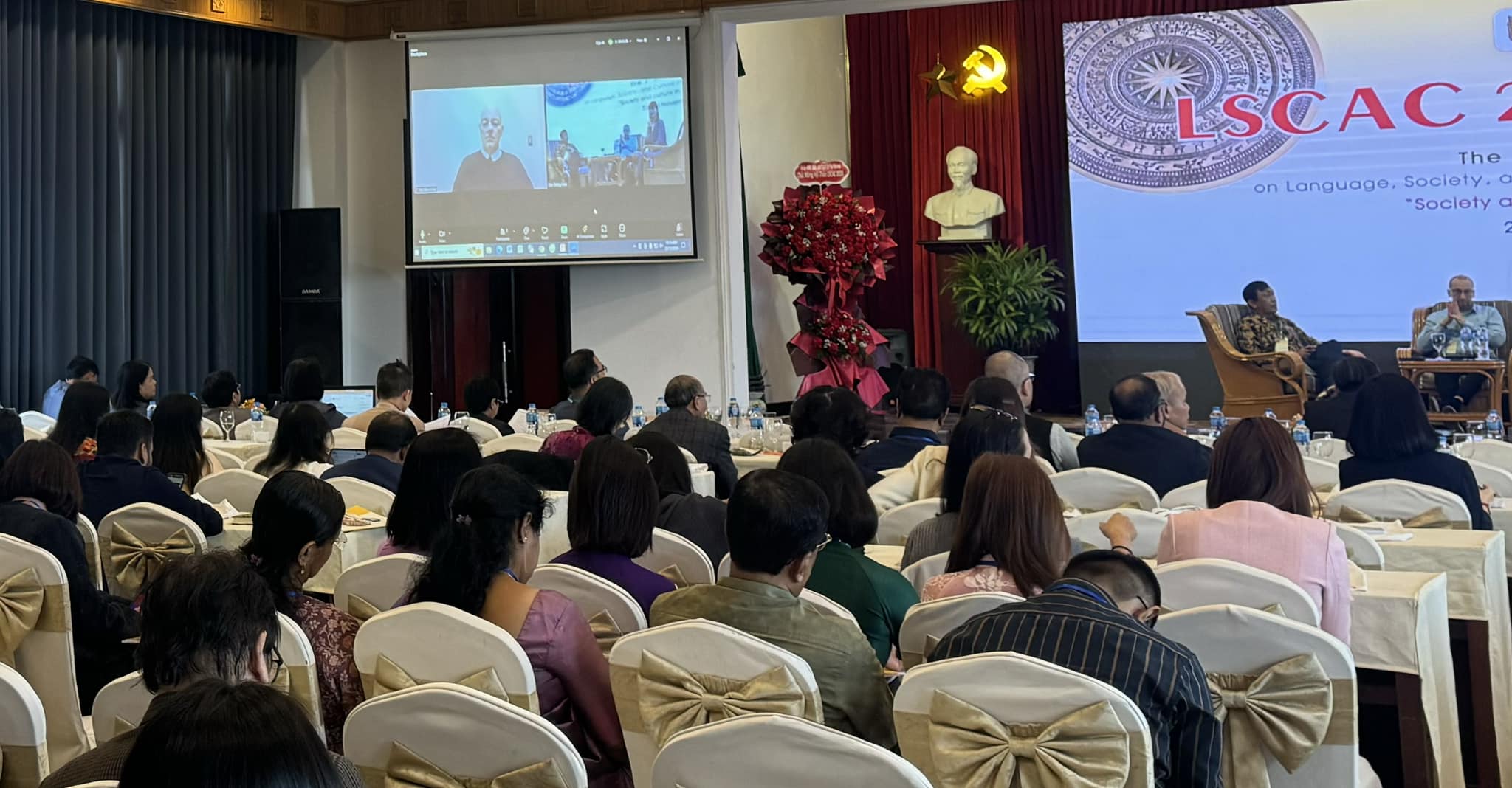
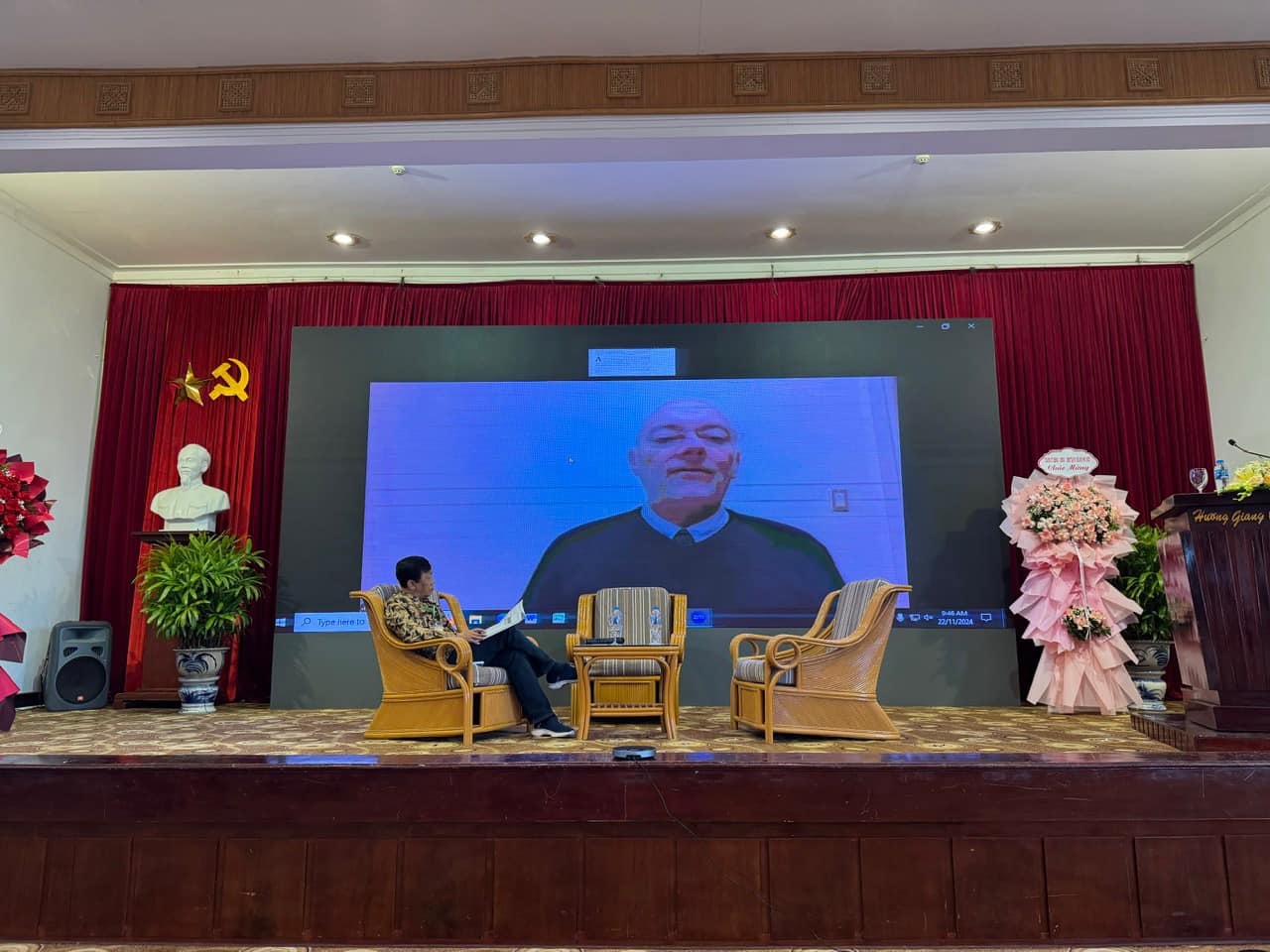
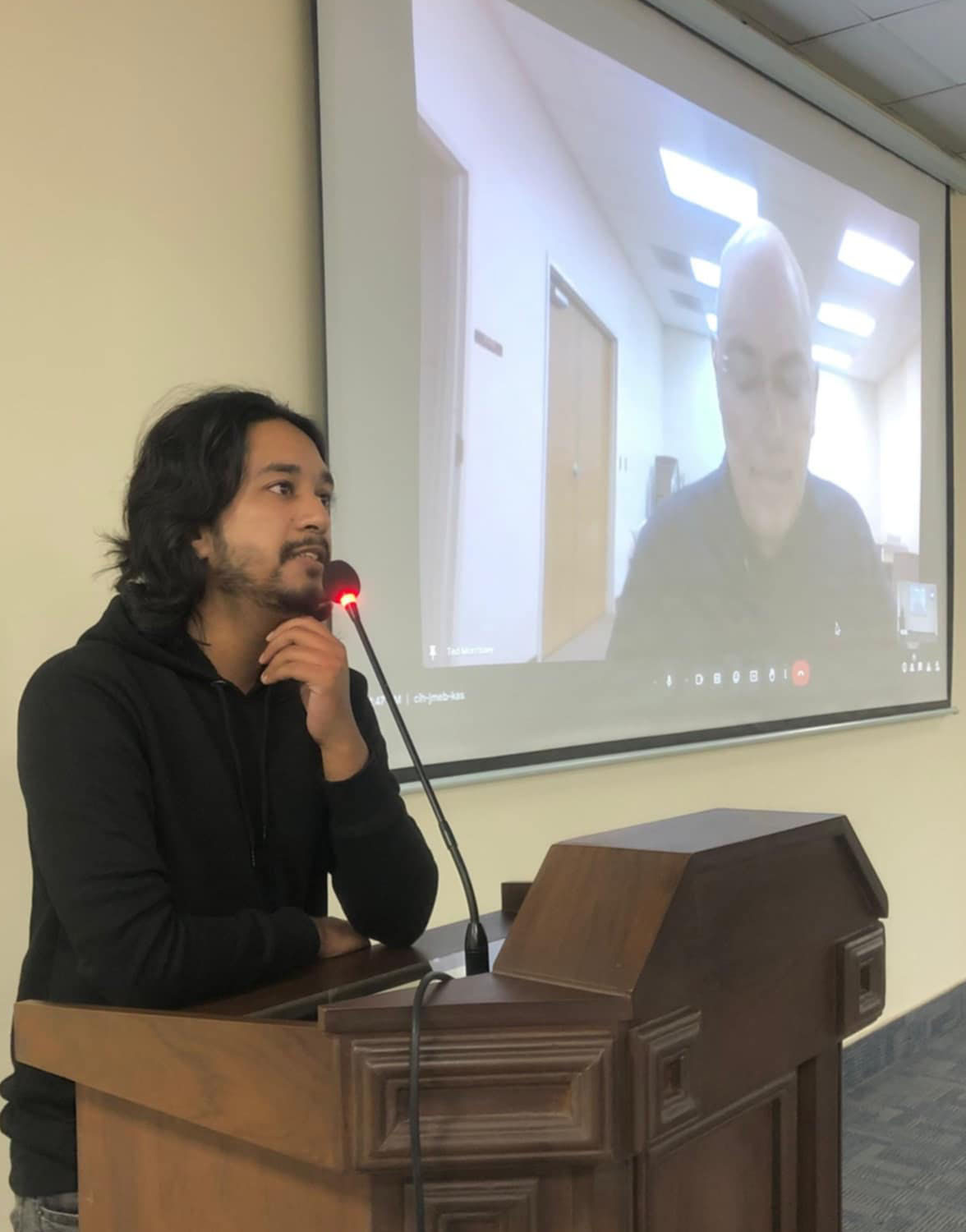
This text—“Digital Resources that Facilitate the Study of English Through Its Various Stages: Old, Middle and Modern”—was a keynote address at the 7th International Conference on Language, Society and Culture in Asian Contexts, organized by The Institute of Cultural Anthropology, held in Hue, Vietnam, November 22-24, 2024. It was delivered remotely concurrently with a translation into Vietnamese.

This paper has a few modest goals. Principally, I want to identify various digital resources that facilitate the study of the English language, from its earliest form to the present. In particular I will focus on the poem known as Beowulf, which was composed in the earliest form of recognizable English, called either “Anglo-Saxon” or “Old English.” I also want to suggest reasons why students in Asia may find such study both useful and engaging. What is more, a program in Old English and related subjects at Nanjing University in China provides a precedent of success for such study.

First, some background information regarding the evolution of English through its three phases as an identifiable language: commonly known as Old English, Middle English, and Modern English. It is convenient to begin a discussion of English with the retreat of the Romans, who colonized and occupied the island of Britain for approximately 350 years, until A.D. 410. Under Roman rule, Latin was the dominant language. However, in the sudden absence of Roman control, a language emerged that was greatly influenced by native tribes in (current-day) England and Scotland, as well as Germanic and Scandinavian groups arriving from mainland Europe. Though dialects varied widely, this language has become known as “Old English.” It’s worth noting that a synonym for Old English used by many is “Anglo-Saxon,” but it’s a term that has fallen further and further out of favor in recent years for a variety of reasons. Nevertheless, when searching for information about Old English, one definitely would want to include the phrase Anglo-Saxon and recognize that they are referring to the same language and literature.
The language we call Old English was the dominant language throughout Britain until the dramatic events of 1066, when the French-Norman King William (also known as “William the Conqueror”) defeated the Anglo-Saxon King Harold at the Battle of Hastings, in southeast England. The quickly ensuing “Norman Conquest” of England led to the evolution of Old English into the language we term “Middle English,” a hybrid of the native language and the French-Norman language (also known as “Old French”), which was spoken by William, his army, and the thousands of his subjects who flooded into England over the next two decades. Middle English, then, is derived from both the Germanic branch of languages and the Latin branch (so-called Romance languages). It is a gross oversimplification, but essentially Old English words were largely retained, but the mechanics associated with syntax and conjugation were adopted from Old French (that is, French-Norman).

Middle English was the dominant vernacular from, roughly, 1100 to 1430, when, mainly due to bureaucratic necessity, a standard language was adopted by law. This government-sanctioned language was the beginning of what we call “Modern English.” It is worth noting that the adoption of this standard form of English was more or less concurrent with the invention and development of the printing press in the West—a fact which has led to the difficulties of spelling modern English. With the advent of mass printing, when English was still using phonetically spelled Middle English vocabulary, those spellings were in essence frozen in time. Meanwhile, spoken English continued to evolve, which was primarily a process of simplification. For example, many two-syllable words (like bake, cake and take) became pronounced as one-syllable words; yet English retained their Middle-English two-syllable spellings. Now we say such words have a “silent e.” We have many silent letters and letter combinations in modern English because words continue to be spelled in their Middle-English forms but spoken in simplified and streamlined modern English.
For different reasons, we have relatively little literature from either the Old English period or the Middle English period. We have a dearth of Old English texts because of their agedness and also because of deliberate destruction by King Henry VIII during his feud with the Catholic Church (monasteries—repositories of such texts—were burned to the ground). We have very few Middle English texts because they were written prior to the printing press and only exist in rare hand-copied illuminated manuscripts, and most writers during this period were composing in French (not in the common vernacular of Middle English). Therefore, the texts we have from these two language periods are treasured examples of England’s national literature. From the Old English period, the crown jewel is clearly the poem Beowulf (approximately A.D. 725). From the Middle English period, Geoffrey Chaucer’s The Canterbury Tales (circa 1380) stands apart.
The text of Beowulf exists in a single volume, copied by hand on vellum, dating from about the year 1000. The poem is one of four texts gathered into what is known as The Nowell Codex, housed in the British Library. The Codex is in poor condition, due to its antiquity, rough handling, and a famous fire in 1731 that could have destroyed it completely if not for a librarian’s quick action. Consequently, there are passages in the poem of 3,182 lines that are essentially unreadable and passages that have disappeared off the page entirely—which has led to a great deal of scholarly speculation. Old English is so far removed from modern English that contemporary readers must rely on the work of translators (to date there have been more than 350 modern-English translations of Beowulf).
Given the fragile condition of the Beowulf manuscript, it is extremely difficult to gain access to its crumbling pages. Luckily, there are many digital resources that can substitute for access to the original. Here I will identify only a small sample of such resources.
To examine the original Beowulf manuscript itself, the most useful resource is Electronic Beowulf: Index & Guide (https://ebeowulf.uky.edu/), made available by University of Kentucky and edited by the esteemed Beowulf scholar Kevin Kiernan. The site features high-resolution digital images of the Beowulf manuscript, page by page, searchable via a variety of options, including line number and word entry. There is a wealth of other information available at the site; I only provide the briefest sketch here.
Another especially valuable site is Fordham University’s Internet History Sourcebooks Project, edited by Paul Halsall. Again, it is a treasure trove of information, divided into three general categories: Ancient, Medieval, and Modern. Moreover, it is not limited to English texts (geographically). Given my focus here, I will underscore that it provides reliable texts of Beowulf in both Old English (https://origin.web.fordham.edu/halsall/basis/beowulf-oe.asp) and in translation, by Francis Gummere (https://origin.web.fordham.edu/halsall/basis/beowulf.asp).
There are numerous side-by-side translations available. That is, on one side of the screen is Beowulf in Old English and opposite is the modern-English translation. One such site is based on Seamus Heaney’s widely read translation (https://www.hieronymus.us.com/latinweb/Mediaevum/Beowulf.htm). Another especially ambitious bilingual site is Beowulf in Steorarume, edited by Benjamin Slade, who provides detailed hypertextual notes along with the side-by-side translation (https://heorot.dk/beowulf-rede-text.html). Perhaps the simplest and most straightforward bilingual edition available online is provided by Massachusetts Institute of Technology as Bilingual Beowulf in a downloadable PDF format (https://www.mit.edu/~jrising/webres/beowulf.pdf).
As I say, these are only a few of the countless online resources that provide the poem in Old English, in translation, or both. I believe them to be especially reliable. For assistance with Old English itself I recommend the “Old English dictionary” provided by Lexilogos: Words and Wonders of the World (https://www.lexilogos.com/english/english_old.htm); and I am especially fond of the site’s link to “Old English Translator” (https://www.oldenglishtranslator.co.uk/), a handy online tool for translating Old English words to modern English, or vice versa. For simplicity and thoroughness, I also like the Old English “Glossary” (http://www.oereader.ca/glos.htm) that can be quickly searched using the “find” function on one’s computer.
In addition to teaching the poem Beowulf for decades, I have been working on my own modern-English translation. All of the sources discussed above have been invaluable in my work as both a teacher and a translator. Of course, there are myriad printed texts that are of great importance, but they may not be readily available in all locations. Online resources tend to be.
In the interest of brevity, I will not go into as much detail regarding resources associated with Middle English, but they are just as copious as those dedicated to Old English and are easily found online. Here are three especially useful and well-vetted sources: Rider University Library’s “English Language History and Linguistics” (https://guides.rider.edu/c.php?g=420552&p=2872234); University of Michigan Library’s “Middle English Compendium” (https://quod.lib.umich.edu/m/middle-english-dictionary); and Harvard University’s “METRO Resources” (https://chaucer.fas.harvard.edu/metro-resources-0).
This topic was largely inspired by a program of study at Nanjing University in China. Professor Leonard Neidorf, a leading medieval scholar, teaches courses in Old English, Middle English, and Old Norse, as well as literatures composed in those languages. Chinese students complete both M.A. and Ph.D. degrees under Dr. Neidorf’s supervison, and they are widely published in English in the field of medieval studies. See Dr. Neidorf’s supervision page online (https://leonardneidorf.com/supervision). I have interacted with the students via Zoom; their erudition and enthusiasm are both obvious and impressive.

Beyond the inherent value of serious study, scholarship and publication, engaging with works like Beowulf can provide a bridge between cultures. Researchers in psychology, for example, have long been aware of myths, folktales and themes that appear ubiquitously across cultures. Claude Lèvi-Strauss developed his concept of “mythemes” as a way of identifying the structures that build similar narratives across cultures and languages. As just one small but obvious example, I will point to the dragon that appears in the final sections of Beowulf. Dragons, or dragon-like creatures, appear in stories on practically every continent, in untold numbers of cultures and languages, including, of course, the origin tales of Vietnam in the form of Lạc Long Quân. So, even in the stories of medieval England, in a language as remote as Old English (which was practically a dead language even among native English speakers for several centuries), students everywhere can find common elements that engage them both intellectually and emotionally.
Indeed, I believe that students who approach a poem like Beowulf from a cultural perspective that is definitively non-Western can detect aspects of the work previously unexplored through scholarship. In spite of intense academic study for more than 200 years, there remain an infinite number of new things to discover and to say about the old poem and its literary kin. My hope is that this brief presentation will spark interest in medieval studies, and that I have provided a few useful resources to begin to explore that interest.
Psychoanalytic Criticism and the Creative Writer
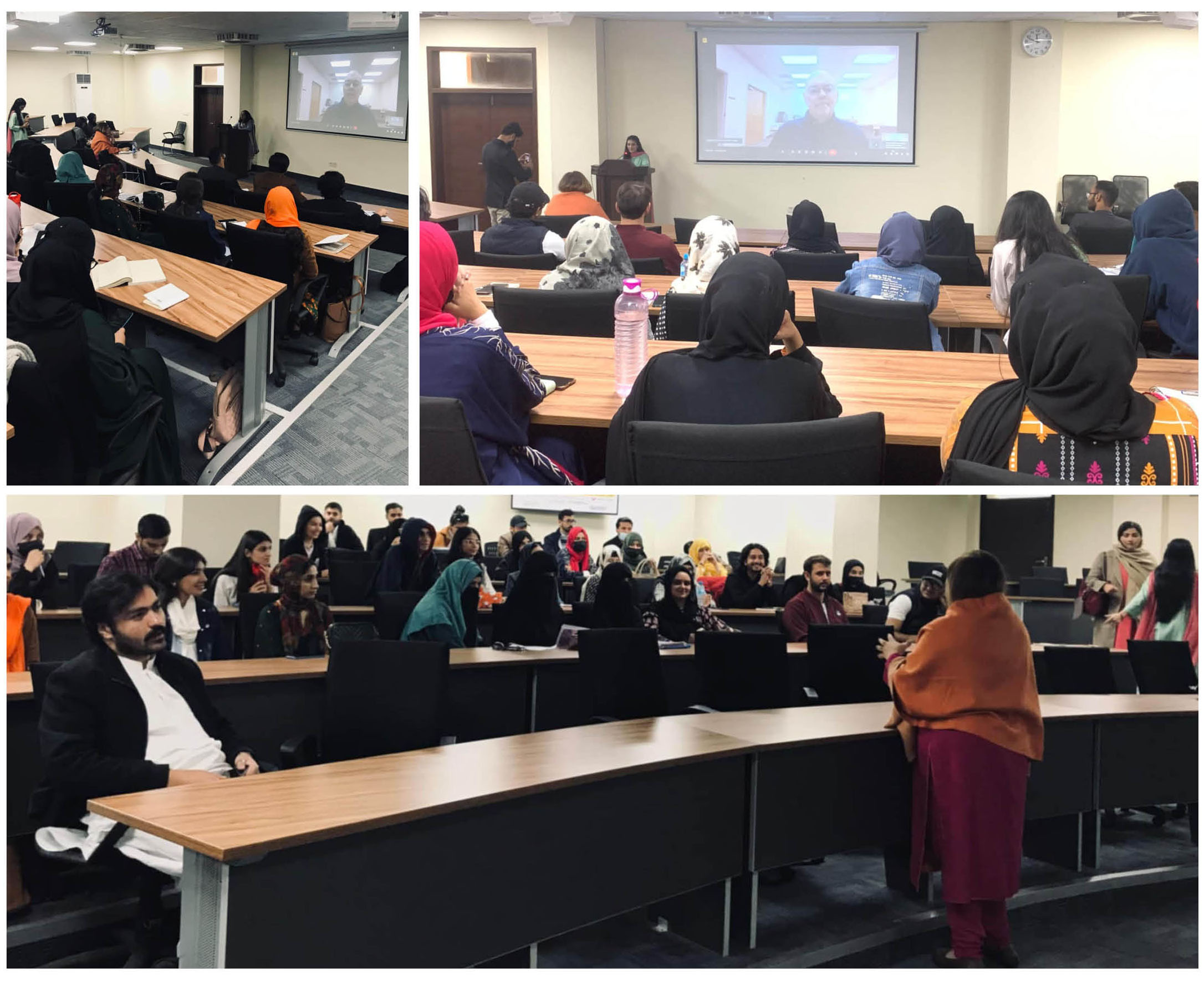
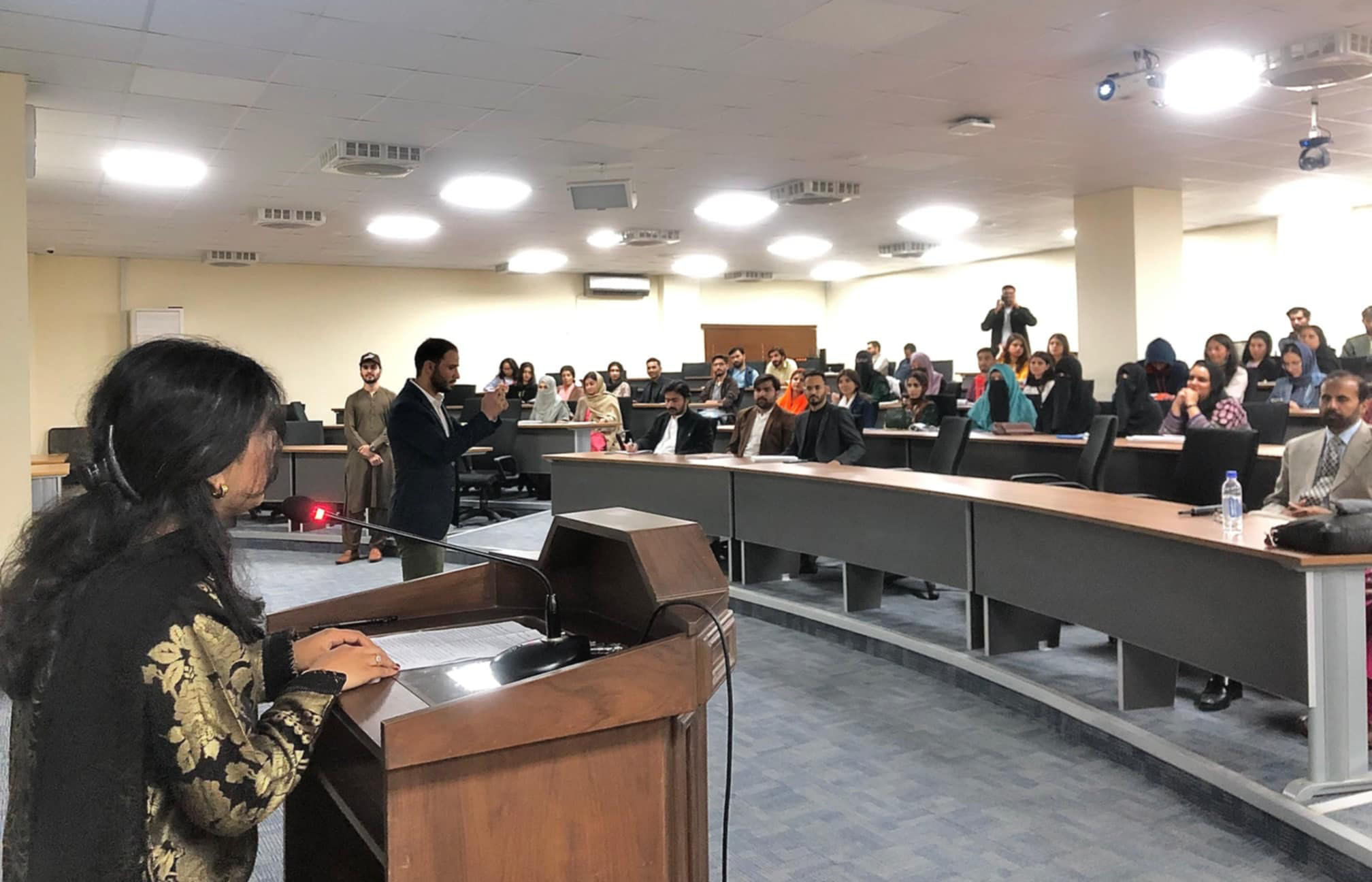
The following is the principal lecture of a seminar on psychoanalytic criticism delivered remotely to students at the National University of Modern Languages, Islamabad, Pakistan. It was hosted by the Department of English and arranged by Dr. Amina Ghazanfar. The seminar was held November 19, 2024.
My plan is to speak to you about psychoanalytic criticism along four axes: one set stretching from the past to the future; and the other set running from reader to writer. Even though these two sets exist on different planes of thought, their data points will no doubt cross paths and even bump into one another at times. Mixed in with all the theorizing, I hope to impart some actual useful information now and again. And let us start with that (just in case there is no more to be had).

When asked to discuss psychoanalytic criticism, the immediate response is to focus on the adjective, psychoanalytic, and to regard the noun as a given. But let’s not. Criticism and especially its related word critic tend to have bad connotations, especially in everyday English. One definition of criticism, in fact the most prominent one, means to offer an unfavorable opinion about someone or something. A fed-up spouse may say to their partner (or child to their parent, employee to their employer), “I’m tired of your constant criticism!” Or the person who finds themselves surrounded by people who feel free to judge them may say, “Sure, everyone’s a critic!”
These negative connotations associated with criticism and with the critic have drifted over to the words as they’re used in the arts, meaning to evaluate a work of art, and the one doing the evaluation. In fact, there seems to be a natural antagonistic, even adversarial, relationship between the artist and the critic, perhaps because so much of an artist’s reputation (and possibly, in turn, their livelihood) depends on the critic’s opinion. A good or bad review, in a prominent place, could make or break an artist’s standing.
In the academy, criticism has managed to avoid the most negative associations and survives more on par with the neutral critique, which is less about passing judgment and more about asking interesting questions and stimulating interesting discussion. Criticism is about opening up possibilities regarding a work of art; it’s about multiplying potential interpretations. It’s not about identifying truths regarding the art; it’s not about solving the art, as a mathematician may solve a complicated equation.
This may be the first important thing I’ve said: Budding critics must guard against the sense that they’ve said something definitive about the work under consideration. Everything is speculative, and they should manage their rhetoric to make that clear. When writing criticism, there should be a lot of hedging. Not “Shakespeare clearly had a troubled relationship with his mother”; rather, “Shakespeare may have had a troubled relationship with his mother.” In the sciences, they strive for declarative statements. In the humanities, we almost always avoid them. We happily traffic in ambiguity.
All of this brings me round (finally) to the adjective, psychoanalytic, which is an especially intriguing critical approach because it is a kind of hybrid school of criticism, marrying science with humanism (although it may be an unhappy or at least unequal marriage). The term of course means that we, psychoanalytic critics, are about analyzing (examining, testing, dissecting) the psyche. That seems straightforward enough. But since we love ambiguity, let’s ask “What do we mean by the psyche?” Are we examining the mind? The soul? The personality? The spirit? These are all synonyms for psyche. If this were a question on a multiple-choice exam, and we could only choose one answer, nearly all of us would probably choose A) The mind. But I think each of the choices is potentially correct, depending on factors like the work being critiqued and the working thesis of the critic. For example, my first monograph—The “Beowulf” Poet and His Real Monsters—was, yes, an examination of the poet’s mind, but also (equally) an examination of the poet’s culture and community, its zeitgeist, which comes closer to psyche as “spirit,” as geist is German for “ghost” or “spirit.” (Zeit, if you’re curious, means “time.”)
So, upon a closer look, psychoanalytic has a broader sense than just an examination of the mind. “Whose mind?” we of course need to ask—and we will.
Before going there, though, let’s spend some time on the origins of psychoanalysis itself. Note the plural: origins. Returning to that simplistic multiple-choice exam, if there were a question about the origin of psychoanalysis, being brilliant students, we would look for “Sigmund Freud.” But in truth it’s not that simple. I do want to talk about Freud—because he was a crucial theorist, a foundational theorist—but he wasn’t the first human being to notice that people have a lot of complicated things happening under the hood. Ancient storytellers had a sense of multi-faceted personalities, of “good” versus “evil,” of twins (Romulus and Remus, for example), of trios forged into a single entity (the Fates); in more contemporary times, of doppelgangers, of Jekyll-and-Hyde personas.

Freud’s masterstroke was to take the sense of an unconscious part of the mind to a much further point, theorizing that people’s behavior is chiefly due to their unconscious. They may believe, consciously, that their decisions and their subsequent actions are due to a, b and c. But in reality their actions are, unconsciously, due to x, y and z. Nearly all of the time, said Freud, people are unaware—oblivious even—to their own true motivations, their own true reasoning. Moreover, Freud said the dominance of the unconscious mind is completely natural. Finally, in his theorizing (and in his prolific publishing) Freud provided a vocabulary for discussing the workings of the unconscious mind: terms like Id, Ego and Superego, as well as processes drawn from literature like Oedipal complex, Electra complex, and narcissism.
In essence, Freud theorized that the unconscious drivers of human behavior are our unexpressed fears and our unacknowledged wishes. Our fears and wishes find expression in four ways: neurotic behaviors (like anger, anxiety, depression, paranoia); dreams and nightmares; accidental vocalization and diction (so-called “Freudian slips”); and the creative arts. It is of course this last kind of expression that is our main interest. In other words, when artists create (when writers write, painters paint, music composers compose, dance choreographers choreograph), they are accessing their hidden fears and wishes, usually unwittingly.
I don’t want to be overly technical, but Freud used the concepts of condensation and displacement to describe the processes by which the mind obfuscates its fears and wishes. With condensation, the writer, let’s say, brings together several ideas or personas into a single representation. With displacement, a fear or wish may be moved from its true origin to become associated with someone or something else. It must be underscored that the mind conceals its fears and wishes because it would be unbecoming or downright taboo to discuss them openly, that is, consciously.
Just as Freud did not develop his theories in isolation, other psychologists, psychiatrists and psychoanalysts either accepted them, modified them, or rejected them in favor of competing theories, during Freud’s lifetime (he died in 1939) and up to the present. It is a cast of thousands, and even the most significant are too numerous to mention even in the briefest summary. Nevertheless, I want to mention one psychoanalyst who, for our purposes, provided the most useful clarifications and extensions of Freud: Frenchman Jacques Lacan.
Like Freud, with whom he was somewhat of a contemporary (Lacan, 1901-1981), the Frenchman was a prolific writer and lecturer; therefore, his discussion of Freud’s theories takes up many volumes, and he was oftentimes at odds with Freud, tinkering, extending, or frequently outright disagreeing. From my perspective, there are two Lacanian concepts that are crucial to our effectiveness as psychoanalytic critics. First, while Freud certainly believed in the significance of language, Lacan took that belief further to the point of making careful attention to language paramount. In fact, he believed that psychoanalysts must work with language just as literary critics do, microscopically and all-encompassingly. No word-choice, no word-order-choice can be taken for granted. Each has significant bearing on interpretation. (I suppose one could go further and say that each word-omission and word-order-not-taken is worthy of attention, too.)
Second, a major criticism (there’s that word) of Freud had to do with causation. Lacan felt that Freud tended to oversimplify the relationship between cause and effect. What appears to be the cause is not the real cause at all. Or it may be more accurate to say that anything attributed to a single cause is misleading because for everything there are multiple causes, with some causes being more significant than others. The analyst—and by extension, the critic—who is satisfied with a one-to-one causal relationship is almost certainly overlooking important facets of cause.
These two Lacanian concepts are so crucial I want to repeat them. Let’s call them important points two and three: The psychoanalytic critic must consider every aspect of the text’s language as significant—diction, syntax, rhetorical posture, everything. Also, psychoanalytic critics must approach each effect as having multiple causes, and therefore they must be dissatisfied with analyses that suggest a facile, single cause, no matter how logical, no matter how well supported by the critique. Causes are always multiple and/or multilayered.
By stopping with Lacan I don’t want to imply that he represents the last word in psychoanalysis. Far from it. Advances in psychoanalysis, psychiatry, and perhaps especially neuropsychology have continued apace for the last half century. Consequently, literary critics inclined toward psychoanalytic interpretation should be aware of the latest advances in our study of the mind. I was recently asked to peer-review an article using trauma theory (a branch of psychoanalytic critique), and the writer only cited pioneers in the field, as if there has been no advancement in our understanding of the mind in decades. I recommended against publication without significant revision to include the work of contemporary (living and practicing) psychologists and psychological theorists. I was gratified to read a later draft that made good use of some of the names I suggested. I was happy to greenlight publication as a useful contribution to the field (and not just a well-written rehash of what has come before).
Let’s call that important point number four: Our understanding of the human psyche and how it relates to behavior is constantly evolving and improving. Psychoanalytic critics must make an effort to stay abreast of new knowledge, at least new knowledge that is directly relevant to the critique they have in mind.
It is also worth noting that we sometimes hear “psychoanalytic criticism” and “Freudian criticism” as synonymous terms, but it’s probably best to think of them as somewhat different. Psychoanalytic criticism is any critique that deals with the unconscious, whereas Freudian criticism makes use specifically of terms and concepts developed by Freud. By the same measure, we may employ Lacanian criticism or Jungian criticism, which are types of psychoanalytic criticism, but as one may imagine they make use of Lacan’s or Jung’s theories and terminologies.
So, then, what is the mission of psychoanalytic criticism? I want to suggest that psychoanalytic criticism has two broad agendas. Through careful examination the critic seeks to find at work the author’s unconscious fears and wishes as they are represented in a literary text. Or (and/or) the critic seeks to find at work a character’s unconscious fears and wishes. With some texts, we can do one or the other or both because we know the author; that is, we have access to their biographies and therefore, to a degree, their personalities. With other texts we are limited to the analysis of the fictional characters (or other literary elements) because we do not have access to the author’s personality. Either the author is unknown, or there is so little known about them that nothing of use can be definitively said. A third approach would be to critique a text psychoanalytically in an effort to reconstruct an unknown or little-known author’s persona. What fears and wishes may be operating in the text, and what may they tell us about the person who created the text? Referencing again my Beowulf monograph, my objective was this last one: I attempt to reconstruct the persona of the anonymous poet by psychoanalyzing the text of the poem.
What does it matter? Why bother to critique a text psychoanalytically, or any other way? T. S. Eliot, considered one of the most astute critics of the twentieth century, put it simply (I paraphrase): The ultimate goal of criticism is to understand a work of art better. We psychoanalytic critics may say our goal is to better understand the relationship between the artist and their art, and in so doing understand the work of art better. Is criticism, then, simply an academic pastime, using academic in both its meanings? Is criticism a behavior of the academy, something done by scholars as a function of their scholarship? And is criticism of no practical value?
Regarding the first meaning of academic, I would say yes, probably: It primarily happens in the academy. That is, it is primarily scholars who engage in criticism as we are thinking of it here, psychoanalytic and otherwise. Regarding the second meaning, I hope and believe the answer is no. Criticism does have practical value. Since art is a product of human beings, and a reflection of all that it means to be human, then I think we can modify Eliot’s assessment to say that the ultimate goal of criticism is to understand ourselves better: ourselves as a species, ourselves as a society, and our each individual selves. Important point number five. What could be of greater value? We hardly have time here for a meaningful discussion of whether or not the value is practical. Going back to Plato at least, we have debated the usefulness of knowledge—and if there is a difference between knowledge and understanding. In a contemporary, real-world sense of practicality, understanding human beings is essential to modifying human behavior, whether individually or en masse, including behaviors that are either constructive or destructive.
My literary idol William Gass believed that art (including literature) could impact consciousness, that it could assemble ethical paradigms that would lead individuals and societies to behave more humanely, more empathically. I would direct you in particular to his essay “The Artist and Society,” which I know is not easily available. There is an insightful discussion of the essay, with several block quotes, available online. (here) I am beginning to stray far afield, so I will end this line of thought by simply reiterating that if art has value, practical or ethereal, then criticism of that art is at least equally valuable.
Let me return to psychoanalytic criticism’s mission and restate how we may use it: Through careful examination the critic seeks to find at work the author’s unconscious fears and wishes as they are represented in a literary text. Or (and/or) the critic seeks to find at work a character’s unconscious fears and wishes. With some texts, we can do one or the other or both because we know the author; that is, we have access to their biographies and therefore, to a degree, their personalities. With other texts we are limited to analysis of the fictional characters (or other literary elements) because we do not have access to the author’s personality. Either the author is unknown, or there is so little known about them that nothing of use can be definitively said. A third approach would be to critique a text psychoanalytically in an effort to reconstruct an unknown or little-known author’s persona. What fears and wishes may be operating in the text, and what may they tell us about the person who created the text?
Of the first order would be a text like Henry James’s novella “The Turn of the Screw” (1898). In brief, it is the first-person account of an English governess who comes to believe that her two young charges, a brother and sister, are being harassed or even possessed by the ghosts of two adults who worked at the estate before their deaths. The employees, who were lovers, had an oddly close relationship with the children in life, and are perhaps continuing the relationships as ghosts. In fact, they may have had inappropriate relationships with the children. In the novella, Henry James is always highly suggestive and lightly clear. His vagueness has left a great deal to our imaginations, and to the ingenuity of critics. Via plot details, via characterization, and via a host of symbols (some rather heavy-handed), critics have penned copious readings over the past 125 years. Many of those critiques are based on our understanding of the author, who was a lifelong bachelor. It is believed that James was attracted to men at a time when that would have been an impossible situation in England: perhaps this is reflected in the same-sex relationships between the adults and the children in the story—the wholly inappropriate same-sex relationships. Some critics have speculated that James was a victim of sexual abuse as a child, and that fact has found its way into the novella. What is more, the vagueness of the novella, James’s seeming inability to state anything plainly and directly, may represent his inability to discuss his sexuality and (possibly) the abuse he experienced as a child. “The Turn of the Screw” (with the suggestive imagery of its title) is, above all, a story of psychological repression.
Another interesting example from the same time period is the work of Sir Arthur Conan Doyle and his Sherlock Holmes mysteries, of which he ultimately wrote four novels and sixty short stories. The apparently platonic relationship of Holmes and his sidekick Dr. Watson has of course been the subject of countless critiques. The fictional character Holmes, like the real Henry James, never marries. Perhaps of greater interest is the fact that the danger in the Holmes stories is always associated with British colonization. Conan Doyle was writing during an expansionary period of the Empire. Britain’s global influence was steadily increasing from about 1815 to 1915, adding 10 million square miles of territory and subjugating as many as 400 million people. Conan Doyle’s first Holmes story appeared in 1886, the last in 1927—all but the final twelve were published during the height of British colonial expansion prior to the First World War. Again, the antagonist or antagonistic element consistently comes from one of the colonies. In the first Sherlock Holmes story, A Study in Scarlet, the murders are connected to Mormonism, a religion that originated in the United States. In the second story, The Sign of Four, the murder is provoked by treasure brought back from India. In the third, “A Scandal in Bohemia,” again it is an American, an opera singer, who is at the root of an extortion plot. In the fourth, “The Red-Headed League,” an American millionaire is behind a robbery that is to unfold in the heart of London. Plot after plot hinges on someone or something that has returned to England from a colony or former colony: The U.S., Canada, South America, Asia, Africa. Critics have suggested that the guilt associated with the subjugation and exploitation of millions led Conan Doyle to enact revenge on British citizens at the hands of the colonized. The guilt, as well as the fear of retribution. Conan Doyle was staunchly and outspokenly pro-Queen Victoria, pro-King Edward VII, and pro-Empire, which contributed greatly to his being knighted in 1901.
At the most fundamental Freudian level, we can see that both Henry James and Arthur Conan Doyle were motivated, on some level, by fear and/or inappropriate wish fulfillment.
This time period—around 1900, which we also associate with the writings of Sigmund Freud—is important to our interests, but for now let me go back a bit further.
Of course all of Shakespeare’s plays have been fertile ground for a wide variety of critical analyses. In terms of psychological criticism, his most famous play, Hamlet, has lent itself to discussions of the Oedipal complex: young Hamlet fosters a desire to kill his uncle and stepfather, Claudius, upon marrying Gertrude after what may appear an inappropriately short period of mourning the death of King Hamlet. Young Hamlet had been in love with Ophelia, but he rejects her after developing his obsession to kill Claudius, who has usurped King Hamlet’s status.
William Shakespeare, as a person, is much more of a mystery than authors like Henry James and Arthur Conan Doyle, for whom we have extensive biographical accounts as well as diaries, letters, and other documents directly attached to their lives. It is difficult to say anything with certainty when it comes to the life of Shakespeare. There are no letters, no diaries, and scant official documentation. We have the texts of the plays and the poems, and we have a great deal of documentary evidence from the time period. We can’t say for certain what may have motivated Shakespeare based on his personal history, but we do know about the outbreaks of plague, the assassinations and attempted assassinations of monarchs, and we know about the fear of invasion by Spain, France and other European powers. Psychoanalytic critics can make educated guesses about how this cultural milieu may have impacted Shakespeare’s writing.

I have done similar guesswork when it comes to the Old English poem Beowulf and its anonymous poet, composed around AD 725. We know nothing of the poet himself (assuming a male poet), not even his name, but we know quite a lot about his time period. It isn’t nearly as well documented as Shakespeare’s day, almost a thousand years later, but there is a considerable record, including numerous firsthand, eyewitness accounts. Drawing from this material, I theorized in The “Beowulf” Poet and His Real Monsters that the three monsters in the poem may have represented specific sources of anxiety for the poet and his audience: continual armed violence, the dangers of reproduction, and illnesses that were caused by agents beyond people’s comprehension—manifested in Grendel, Grendel’s Mother, and the dragon.
I want to return to the year 1900. It has been noted that creative writers in the twentieth century and beyond have been more concerned with character motivation than writers in the past. Let’s take as one example a writer I’ve already alluded to—considered by many the greatest writer in the English language, Shakespeare. As great as Shakespeare was, his treatment of character motivation was consistently cursory. Why is Hamlet so quick to turn against his mother and his girlfriend, based on the urgings of a ghost? In The Winter’s Tale, why does Leontes turn against his wife, Hermione, based solely on the friendly hospitality she shows her husband’s oldest friend? How can Othello move so easily from adoring Desdemona to murdering her? The examples are abundant. We could explore any number of explanations, but the important point is that Shakespeare’s audience didn’t seem to care much about character motivation, a token effort is all they required of their playwrights. Said differently, the early modern audiences appeared to have little interest in the psychology of their fictional characters. Of course, Shakespeare was interested in his characters’ psychology. It was often the element he added to his revisions of previously existing plays: a focus on his characters’ tendency toward introspection. Yet it was still minimal compared to the psychological novels and plays (and films) as they developed in the twentieth century. One theory is that the wide dissemination of Freud’s theories—which began in the 1890s, but not until the 1920s were his works widely translated and read—made twentieth-century readers and theatergoers much more interested in the psychology (i.e. the motivation) of the fictional characters they were seeing on the page, the stage, and ultimately the screen. Important point number six.
It may be worth noting that in the United States the first college to establish a course in “psychology” was Harvard, in 1873, taught by Henry James’s older brother William, who eventually wrote the first psychology textbook, The Principles of Psychology, published in 1890. It was the primary college psychology textbook for decades, and greatly influenced thought in other disciplines as well.
I want to turn now from one side of the page to the other, from psychoanalytic critic to writer of fiction, which has been my chief interest since childhood. As a writer, I’m not mindful of my characters’ psychology—and certainly not of my own. It sounds like a simple goal, but when I put pen to paper I’m trying to tell an interesting story in an interesting way. I know there are elements at work beneath the surface of my awareness, but when I’m writing a story or a novel or a poem (my poetry tends to be strongly narrative), I’m not thinking about what those influential elements may be. Similarly, I’m not even thinking about what the text I’m writing may mean. Long ago I decided that meaning was the reader’s purview. In fact, when I let go of my concern for meaning in my stories, my stories became much, much better—more interesting and probably more meaningful.
William Gass said it well: “You hope that the amount of meaning you can pack into a book will always be more than you are capable of consciously understanding…. You have to trick your medium into doing far better than you, as a conscious and clearheaded person, might manage” (my italics).
That is, Gass understood that while he was writing consciously—making deliberate choices about plot, characterization, setting, word choice, and so on—his unconscious mind was at work as well, perhaps operating on a more symbolic level; and because of the influence of his unconscious thoughts, the work would turn out more complex, more engaging, and more interesting than it would if just his consciousness was directing the narrative.
When I write, I deliberately (i.e. consciously) put what I think of as “constellations of images” into the work: repeated words, phrases, ideas (much as we do in poetry, even when I’m writing prose), as well as allusions to the great, classical repositories of narrative. In the west, writers have tended to allude to four narrative sources: the Bible, classical mythology, history, and Shakespeare. I don’t limit myself to these sources for allusions, but I do draw from them copiously. These techniques are not done at random. I have intentions, but I also know that each reader is going to bring their own perspective, their own experiences to my text, and therefore read it and interpret it idiosyncratically. By using these “constellations of images” I’m feeding their imaginations as readers, giving them a lot of handholds for scaling their own personal understanding of the text (and perhaps their own personal understanding of me as the author of the text).
I have experienced two phenomena as a writer that I want to share because they relate directly to our interest in psychology and the unconscious mind. For more than thirty years my process has been to write in the morning, Monday through Friday. When I taught full-time, I would only manage about 30 minutes per morning writing session (now it’s somewhat more). Some mornings I sat down to write knowing precisely where I was in the narrative I was working on. That is, I’d left off the previous morning with a clear sense of what to write next (I’d just run out of time). On those mornings, the writing tended to produce a fine enough first draft. The writing session was satisfactory. Other mornings, I wasn’t sure where to take the narrative. I would sit with my coffee and a blank sheet of paper staring at me. Some writers, I knew, would say at that point “Well, I don’t have anything today. I’ll try again tomorrow.” I, on the other hand, had learned that if I just start writing—put pen to paper and begin producing text—the ideas would come. Not only that, the writing tended to be much, much better on those days that began so aimlessly. More interesting, more creative, more linguistically complex. I have a theory as to why.
On the mornings when I had a clear sense of what I wanted to write, the composing of text was directed primarily by my conscious mind, whereas on the mornings when I had a fuzzy sense or no sense at all, the composing of text was directed by my unconscious mind. And, lo and behold, it turns out my unconscious mind is a much better writer than my conscious mind. Said differently, my conscious mind operates in the real, and my unconscious mind operates in the surreal. And most of us would agree that surrealistic images are more engaging, more captivating than realistic ones.
The other phenomenon has to do with not writing. I’m dedicated to my creative writing, but I will have stretches when I’m not writing for several days—generally this happens when I’m traveling or on vacation. I have had a few occasions where a significant illness or injury has prevented me from writing for several days. I notice that I begin to get anxious, I have difficulty concentrating, I become impatient, and generally I just feel uneasy. These symptoms of my not-writing correspond precisely with sleep deprivation. Returning to Freud, he compared creative writing to daytime dreaming. He theorized that the mind of the creative writer is functioning in much the same way as the brain does when we’re sleeping and dreaming. I feel that my experience gives credence to Freud’s theory. By not writing for several days I’m depriving my mind of its process for analyzing and interpreting my world. I’ve often said that my writing is a kind of meditation. It keeps me centered. It may also be keeping me mentally healthy.
I will end on a note about a possible future for psychoanalytic criticism. As we know, a dominant topic in the academy is artificial intelligence: how is it reshaping society, how is it reshaping education, how is it reshaping us? It is a broad and constantly changing subject, so I want to focus on a very narrow sliver: AI’s production of narrative text. I have no doubt that commercial publishers in the U.S. and elsewhere will start marketing books written by artificial-intelligence “authors.” There will be no need for royalty payments, no authorial egos for editors to bruise (really, no need for editors), no missed deadlines by unpredictable human writers, who become sick, who become distracted, who become blocked.
If you follow developments in artificial intelligence, you’re probably familiar with the “black box problem.” AI is autodidactic, gathering data and “learning” from that data of its own mysterious volition. When AI begins doing things that its programmers didn’t program it to do, demonstrating processes and outcomes the programmers themselves don’t understand, the AI is operating in a so-called black box. AI that is composing narratives—telling stories, writing novels, etc.—is essentially drawing from its unconscious, its impenetrable black box. At that point, computer scientists are unable to untangle and understand the AI author’s complex programming, but perhaps psychoanalytic critics can employ their skill sets, analyzing the language of the narrative itself to perceive the artificial author’s unconscious mind. Such a process was predicted by science fiction writers. In Robert Heinlein’s novel The Moon Is a Harsh Mistress (1966), computer technicians are essentially psychoanalysts who diagnose and fix problems by talking to the computer, asking it questions, and analyzing its responses. Similarly, in Arthur C. Clarke’s 2001: A Space Odyssey (1968), the computer, HAL, has what amounts to a nervous breakdown when faced with an ethical dilemma.
As the new generation of critics, you may well be at the forefront of working with artificial intelligences, reading their output, analyzing their language, and assessing their unconscious programming. If so, I encourage you not to ignore the old, human-produced texts, for they are the gateway to comprehending the artificial authors of the very near future, and humanity will likely depend on that comprehension. Humanity will likely depend on you. Vitally important point number seven.
On the Whale Road (Beowulf)
Introduction to the translation-in-progress
I’ve been fascinated by the Old English poem Beowulf since I was a teenager. Even though my primary focus was American postmodernism and the work of William H. Gass, my doctoral dissertation (2010) included chapters concerned with Beowulf. For my dissertation, however, I relied on modern-English translations of the poem. In 2012, I wrote my monograph, The “Beowulf” Poet and His Real Monsters, and tried my hand at translating the Old English for the first time. It was difficult, to put it mildly, but also invigorating. My translating for the monograph was primarily literal. Being a novelist, I wanted to try a literary translation, and I finally got around to it in 2019, focusing on the central section of the poem, the Grendel’s mother episode. The editors at EKL Review published my translation. Then in 2022, upon retiring from teaching full-time, I returned to the poem, and began translating it from the beginning.

Rather than searching for publishers as I completed each section, I decided to use the Kindle Vella platform and put the poem-in-progress out into the world myself. I managed six installments before Kindle Direct Publishing announced the closing of their Vella platform as of February 2025. At that time I migrated my translation-in-progress to this blog. The translation here appears in two parts, as I’m in the process of joining the beginning sections with the central section that I translated in 2019.
You’ll notice that I’ve changed the title from the typical, simply, Beowulf. That title is one of custom. In the codex that contains the one and only manuscript of the poem, it is untitled. We have no idea what name the story may have carried in the, likely, eighth and ninth centuries when it was perhaps a standard tale in Anglo-Saxon halls. Since I want my translation to be unique (among the approximately 350 other modern-English translations currently on record), I decided to give it a unique title, On the Whale Road, which includes a homage to Jack Kerouac and the Beats.
My secondary title — “A New & True Translation of the Poem Known as ‘Beowulf'” — reflects that my objective is to create a prose poetry version of the poem that has fidelity with the original poet’s intentions. That is, my translation is rooted in the poem’s original language, but I always have an eye (and ear) on the story’s narrative energy. The poem would be performed for a hall filled with probably boozy listeners, likely heavily armed — not to mention the capricious king himself. The poet had a vested interest in keeping his audience on the edge of their benches. So at every turn of the translation, when there are choices to be made among equally enigmatic options of Anglo-Saxon, I always choose the most captivating, or as we would say today, the most page-turning.
+ + +
BOOK I: DENMARK
—
Prologue (ll. 1-52)
A Leader for the Leaderless
Halt! – And recall the spear-wielding Danes of old, whose kings gifted greatness to their people and whose princes played the role of hero time and again.
Scyld Scefing served fear to his many enemies in their very own halls, unseated the terror-struck lords and murdered their mercenary bands, even the dread Eruli. He was a foundling forlorn, though consolation would come his way as he flourished beneath the sky, rising in fame and forcing tribute from foes near at hand whose misfortune arrived via the whale road. That was a virtuous king!
After a time, a son came to court, God-sent and a tremendous comfort to the community. He sensed the distress the leaderless Danes had long endured. Thus the Lord of Life, Warden of the Wide World, granted him glory, and the renown of Scyld’s son, Beaw, burst across his father’s land. Thus a young leader, while still at his father’s hearth and privy to his wealth, would do well to lavish gifts upon his close companions so that when war erupts their loyalty can be counted on. It’s true everywhere that noble deeds enrich a man’s name.
When destiny declared Scyld’s departure, the old man, still imbued with youthful strength, was called into the Lord’s keeping. He’d commanded his companions to carry his cherished body to the surging sea, which lapped at a land he had long ruled.
A regal ring-prowed ship – ice-adorned and eager – waited impatiently at the water’s edge. The beloved leader, illustrious ring-giver, was laid by the main mast, the beating heart of the breathtaking bark. Fabulous treasures from far-away lands were brought forth. Never have I heard of a ship so fulsomely equipped with weapons of war: swords made of malice and finely crafted mail. On his breast they heaped many a marvelous treasure to travel with him far onto the frothing flood. Their great gifts – finery of a faithful flock – were no less fantastic than those given him in the beginning when he embarked upon the waves, a little child alone.
High above his head they erected a gold-bright banner and allowed the sea to guide him, giving him back to the gaping ocean. They watched with sunken spirits and heavy hearts. No one can say precisely – neither hall councilors nor noble men under heaven – who received that precious cargo.
I (ll. 53-114)
The Hell-Born Fiend
Beaw, beloved leader of his people, held the land firmly and famously for a long time after his noble father had reached another realm – then he himself fathered highborn Healfdene, who ruled the glory-greedy Scyldings, becoming ancient and battle-hardened by the end. In time, four children were born to that unrivaled ruler of troops – Heorogar, Hrothgar and Halga the Good. I’ve heard that the daughter (Yrse, I think) was Onela’s queen, or at least the War-Scylfing’s favored bed companion.
Then Hrothgar became known for his war-glory and battle-savvy so that his novice followers blossomed into a mighty warrior band. A plan came to mind: he would command that a wondrous hall be built, a marvel to outlive memory for mead-drinking and the division of war booty among young and old alike – everything God had bestowed, save for common ground and men’s lives. I’ve heard that work orders spread widely across the region summoning craftsmen of every skill to build the people’s beautiful hall. As such, it was completed in no time, this grandest of greathalls. He whose words were not questioned anywhere said the hall’s name was Hereot. True to his boasts, at banquet he gave gifts of rings, treasure galore. The hall towered tall, gabled with horns and beckoning the unholy flames of war-wrath. The day of the blade-hate had not yet been born between son- and father-in-law, sown by a long-buried hostility.
A darkness-dwelling demon, powerful with pain, had long endured the din of debauched merrymaking in the meadhall. The harpstrings sang stingingly, as did the song-shaping poet, who could keenly recount the creation of men from long ago. He declaimed how the Almighty made the earth, a lovely land ringed with water and a triumph of design when the sun and moon were set in motion there; and how He ornamented every corner with branches and leaves while animating myriad forms of life.
They lived prosperously, a chosen people, until the hell-born fiend burned with rage, became fixed on their ruin. Grendel, the grim outcast was called, infamous guardian of lonely haunts, fens and forsaken wastes. The mournful monster had dwelt for a time among his kind, all expelled by God, the marked kin of the murderer Cain. For the slaying of Abel, the Lord exacted revenge. Indeed, he extracted no joy from that evil act, only the Lord’s hostility and banishment from humankind. Thereafter were born all manner of monstrous things – ogres and evil-minded elves and ghouls who go among the dead, as well as the giants that waged war against God for ages (an outrage for which they were fully compensated).
II (ll. 115-188)
The Burning Embrace
At nightfall, the Ring-Danes’ foe fell upon the awe-inspiring house, after the beer-drinking was done. Inside he beheld the noble band abed amid their abandoned banquet – their sleep was carefree, with no thoughts of the misery men must sometimes endure. The unclean creature, cruel and ruthless, was ready at once for a savage assault and wrested thirty thanes from their rest. Proud of his plunder, he left for his lair, his hellish home, bearing on his shoulders the bloody slaughter.

In the predawn twilight, Grendel’s war prowess was revealed, and the night’s raucous feasting was replaced by woeful wailing. The famous king, long-known for his nobility, sat stunned by sorrow. The great one grieved for his taken thanes as they beheld the track of that hated haint, that soulless specter. The fight proved fierce, pernicious and persistent. The very next night he resumed his murderous rampage, dedicated as he was to death and devastation, to unmitigated malice, doling out not a morsel of remorse. Many were the men, then, who found sleeping quarters elsewhere, a room removed from the hall and its unwelcome guest, once the unmistakable signs of his savagery were made abundantly clear. To escape the fiend, the deft sought safety via distance. Thus did Grendel ravage right, ruling over all until the hallowed hall was hollow.
The Scyldings’ patriarch suffered the pain of misfortune, the misery of unimaginable woe, for an interminable time, twelve withering winters. Reports of Grendel’s crimes were recited far from the site of his unending war on Hrothgar, so that a generation of children grew up hearing of his wicked and wrathful ways. He sought no substitute for his feud with the Danes – no pact, no price could curtail this deadly curse. Hrothgar’s hall councilors needn’t hope for a radiant reprieve from the death-dealer’s claws. On the contrary, the monster – shadow-cloaked and death-draped – continued to hunt whomever he pleased, from battle-weary warriors to dewey youths, plotting and pouncing from the mist-covered wastes where he presided over a never-ending night. No one can say where hell’s messengers may meet them on their meandering path.
So, mankind’s menace, always alone, committed uncountable crimes, unending acts of evil that caused unbearable anguish. On lead-dark nights he would occupy Heorot’s lonely treasure-laden halls. Unworthy, he avoided the hallowed throne, which was to be occupied by men deemed godlike — and never would he know such adoration. The Scyldings’ heartbroken lord suffered a misery that was acute. Men granted authority debated strategems by which the courageous could defend against the sudden assaults. Desperate, they would seek out heathen shrines and make pledges to the stealer of souls, soliciting diabolical assistance in hopes of halting the nation’s destruction.
Such was the heathens’ habit of mind, their misguided hope: they imagined that turning toward hell would be their salvation. They knew nothing of God, the Maker of everything who would judge their deeds. Their ignorance didn’t allow them to ask for the Lord’s protection – He whose glory gilded the world. Woe to those who throw their souls into hatred’s burning embrace, a sacrifice that will effect nothing no matter how desperate their desire. Well, though, will it be for those who find the enfolding arms of the Lord. A protective father’s comfort and security will be theirs!
III (ll. 189-257)
Across the Waves
So Healfdene’s son suffered ceaselessly, his sorrow seething without end, the best of princes unable to move past the perpetual grief. Nothing could overturn the trouble that had been wrought, that pernicious night-evil. It clung to him, loathsome and cruel.
In his distant home, a great man among the Geats, Hygelac’s thane, heard of Grendel’s misdeeds. Among men, back then, his might was unmatched, so too his nobility and his strength of character. He commanded that a sturdy seaworthy ship be outfitted for a crossing upon the swan-road to the war-king, the worthy prince who was in need of equally worthy warriors. Clever-headed men declined to dissuade him, though he was dear to them. Rather, they hailed him a hero, confident in the signs they studied. The born-leader selected from among the Geats the best and boldest – fourteen seasoned soldiers – and led his troops to the heavy-timbered ship. The warrior knew the ways of the sea and marched them to the water’s edge.
The time had come, and the boat waited upon the water. Floating just beyond the high beachhead. The eager warriors, noisy in their excited chatter, leaped above the twisting tide onto the boat. Each bore a splendid array of war-gear, stowing it in the bosom of the stout-timbered ship. The glad warriors were launched, then, on their glorious journey.
Wind-driven across the waves, the ship flew like a foam-plumed bird for a full day – until the sea-voyagers sighted land. Before the curved prow rose glimmering cliffs, abrupt bluffs, and fanning forelands. Then their sea-crossing had come to an end. The Weder Geats hastened to the hard ground, tying tight their ship, shaking out their mail-shirts, and gathering their war-gear. The crossing was easy, and, pleased, they thanked God.
From the high seawall, a Scylding watchman, charged with guarding the coast, counted as gleaming shields were carried across the gangway, followed by other worthy war-gear. Worry threatened to wreck him: he must know the minds of these well-armed men. Heavy shaft in hand, Hrothgar’s man boldly rode down to the strand to interrogate this newly arrived band:
Halt and identify yourselves! You chain-mailed men who have steered your ship here along the sea-path, skillfully crossing the deep. Long has it been my duty to dwell at land’s end and monitor the sea for hostile mariners who mean harm to the Danes. No shieldbearing warriors have disembarked so boldly, not without displaying some sign that they’d been granted permission. I have never beheld a man in battle-gear of greater stature – nowhere on earth is there such a fearsome figure. Unless his physique and even his fine face deceive, he is no mere hall hanger-on propped up with battle panoply. Now, before you advance farther into the land of the Danes, I must know where you came from – I must be convinced you are not false-hearted spies. Don’t hesitate, seafaring foreigners, and take me seriously when I say I must know your place of origin.
IV (ll. 258-319)
The Shining Hall
Their leader, who was eldest and wisest, unlatched his lockbox of language and answered: We are from Geat-land, hearth-guardians of our lord, Hygelac. My father’s name, Edgtheow, was synonymous with nobility, and known by people of many nations for his bravery in battle. He outlasted many bitter winters, proving their better, before leaving his home deep into old age. His memory lives on among the wisest advisers everywhere. We seek your leader, Healfdane’s son, lord and protector of his people. Our intentions are noble. Provide us your wise advice. We are on an errand of great import to the legendary leader of the Danes; and have nothing to hide, I assure you.
You must confirm if what we have heard is true, that among the Scyldings dwells some sort of destroyer, an enigmatic enemy who reveals his rage in the terror he brings on dark-black nights, unspeakable acts resulting in shame and slaughter. I have advice for Hrothgar that comes from a kindred spirit, a way for he who is wise and good to vanquish this villain and cool his accumulated cares, a remedy that will bring sweet relief. Otherwise he will eternally endure this troubled time, this everlasting season of distress, dwelling there in that high hall, gleaming emblem of his greatness.
Before speaking, the coast-warden, stalwart servant upon his steed, considered that a shrewd shield-warrior must be able to distinguish between words and deeds. Said: My sense is that your war-band is here on behalf of the lord of the Scyldings. Go forth, then, bearing weapons and armor. I shall be your guide. What is more, I shall command my young men, on their honor, to keep safe your ship against any ne’er-do-wells – this freshly tarred vessel on the beach – so that the stout timbers of its curved keel can easily return you, esteemed sea-farers, over the deep currents to your home coast in Wederland. May your noble intentions buy you protection in battle so that each of you comes through unharmed.
They then proceeded. Their boat floated quietly. The broad-beamed ship was at anchor and firmly secured with ropes. Golden boar images gleamed above their cheek-guards. The fire-hardened ornament was an added protection, and the grim masks were a reflection of their war-ready hearts. The troop hurried as one and soon beheld the high, timbered hall, magnificently trimmed in gold. Earthbound men held that it was the best-known building under heaven. Home of a powerful king, its brilliance beamed across many lands. The brave-hearted guard pointed out the straightest way to the shining hall, pride of the people. Turning his horse, the singular watchman shared these words: The time has come for me to depart. May Father Almighty look upon you all with favor in times of strife and bring you through it whole. I return to the seaside to resume my duty guarding against hostile troops.
V (ll. 320-370)
Audience with the King
The road, paved in stone, showed the group the way. Their iron mail was hard, hand-linked, and that shining war-gear made an unmistakable statement. Outfitted as they were, in their terrifying gear, they went directly to the hall and straight away placed their shields, which were wide, circular and sturdy, against the outside wall of the building. Weary from the sea, they rested on benches, their armor loudly announcing the arrival of brave men. These men of the sea stood their ash-wood weapons together, gray tips pointing up. The troop was impressively armed.
A fellow, uncowed, inquired of their origin: From where have you carried these gilded shields, these gray shirts of mail and grim-looking helmets, an armory of battle-ready spears? I am Hrothgar’s herald and servant. Never have I seen a gathering of men, foreigners too, whose deportment was so daring. I trust your motives in seeking Hrothgar are honorable, an expression of courage – not because you are needy exiles. The clear leader of the Weders, he of noble bearing, speaking firmly from beneath his helmet, answered with these well-chosen words: We are Hygelac’s close companions, table-mates. Beowulf is my name. I desire to explain my errand to Healfdane’s famous son, your lord, if he would be gracious enough to grant the time and allow an audience. Wulfgar – a leader of the Wendals, well-known for his war-skills and wisdom – replied: I shall approach the friend of the Danes, the Scyldings’ chief and ring-giver, and communicate your quest, as you ask, then quickly bring back whatever response the best of men cares to give.
With that, he went confidently to the place where Hrothgar, haggard and gray-headed, sat among his most-trusted men. The stalwart messenger, shoulders squared, stood before the lord of the Danes. He knew the ways of these noble people. Wulfgar spoke to his lord as one does who is a reliable retainer: Standing just outside, come from across the wide sea, are men of the Geats. This warrior band calls Beowulf their leader. They seek, my lord, a conference. I encourage you to grant their request, gracious Hrothgar. By the worth of their war-gear they warrant consideration. Their chief, without question, is a warrior worthy of respect.
VI (ll. 371-455)
A Single Request
Hrothgar, defender of the Scyldings, declared: I last saw him when he was but a boy. His honored father was named Ecgtheow, and it was to him that the Geat Hrethel gave his only daughter. Now the son, grown strong, is calling on a dependable friend. Those who have traveled across the sea, delivering gifts to the Geats to demonstrate our goodwill, report his hand-grip to be that of thirty men, giving him great advantage in battle. My hope is that he has been sent to us, the West Danes, by the grace of God to contend with Grendel’s terror. This good man shall receive great rewards for his courageous spirit. Quickly now, bring them in to see the assembled kinsmen. Say to them also, the words meaning they are welcome among the Danes.
Wulfgar went to the hall door and issued this summons: I have been instructed by the leader of the East Danes, a victorious king, to say he knows your noble lineage, and, stout-hearted seafarers, you are welcome guests. You may now go – in battle-gear, face-plates raised – to see Hrothgar. Leave behind your war-shields and -shafts until the conversation is concluded.
The powerful one rose from among his many powerful men, a loyal band. Some were instructed by their savvy leader to stay and watch the weapons. Promptly they walked as one, guided under Heorot’s roof. The bold one, stone-faced beneath his helmet, went forward until he stood in the center of the room. Beowulf spoke – his chain-mail shone, a war-net artfully woven by a master smith:
Hail to you, Hrothgar. I am Hygelac’s kinsman and subject. I have performed many magnificent feats in my youth. In my fatherland this affair with Grendel became well known to me. Seafarers say that this hall, the finest of such strongholds, stands vacant and worthless to warriors after the light hides in the night sky. All of my people, from the noblest to the most common, said I must place my uncommon strength at your service, great Hrothgar. They witnessed my return wearing my enemies’ blood after capturing a clan of giants, five strong, and slaughtering them, as I had water-monsters in night-waves. The Weders’ strife was mine to remedy, whoever meant them harm. They deserved utter destruction. And now with Grendel, that fiercest of fighters, shall I alone settle the score with the ogre.
To you now, prince of the Bright-Danes, shelter of the Scyldings, I must make a single request – do not deny me, fortress of fighting-men, proud prince of the people, now that I have come so far, I be allowed alone to purge Heorot, beside my band of worthy warriors. Furthermore, it is my understanding that the fierce foe brazenly forsakes weapons. Thus, in the spirit of honorable Hygelac I shall bear into battle neither shining sword nor gleaming shield. Rather, I shall wrestle the hateful wraith, grip against grasp, a fight that will leave only one of us living. Then he who is taken in death must trust in the Lord’s judgment.
I suspect, should he succeed, he will eat us Geats with gusto, as he has so often done the bravest Danes. No, my head shall not require a shroud, should death seize me, for it will be covered in blood as he carries off my gory corpse, intending, I should think, to make a meal of me. The solitary swamp-walker will eat it heartily, fouling his fen-hollow with the feast. My body then will be beyond your care, and, too, your worry. Should I be taken in battle, send to Hygelac my war-shirt, a finely wrought garment that has faithfully guarded my breast. It was handed down from Hrethel, the legendary work of Weland. It shall go as fate intends.
VII (ll. 456-498)
A Gathering of Heroes
Hrothgar, guardian of the Scyldings, said: You have assumed this quest, Beowulf my friend, from a sense of obligation, as well as kindness. Your father provoked a pestilent feud when he murdered Heatholaf, guest of the Wylfings. Then, afraid of war, his Weder clan was wary of having him. So over the swelling waves he came, seeking the people of the South Danes, the honorable Scyldings. I was a new ruler of the Danes at that time – yet my youthful hand held a wide-ranging realm, a land rich with heroes. Heorogar, my elder brother, had died–Healfdene’s heir, my better, dead! I paid the price of ancient treasure to settle the feud. The sea’s back bore it to the Wylfings, and he pledged an oath to me as repayment.
It is dispiriting to acknowledge to anyone how my heart is weighted with humiliation, sunken with shame to think what devastation Grendel’s attacks have brought to Heorot, laced with his hatred and hostility. My hall-troop has been decimated, my personal guard diminished, their fate to be swept away by Grendel’s grasping hate. God could quickly quell this deadly enemy’s deeds.
Often, drunk and full of beer-boasts, warriors would declare over cups their intention to await combat in the hall, meeting the horror of Grendel with their own horrible blades. Come morning, daylight revealed the noble hall’s benches dripping with blood, wound-gore everywhere. Death dispatched my dearest companions, taken from me one by one, diminishing the courageous band. Rest now, feast – feed your spirit in the hall where noble warriors like you have celebrated great victories. At once space was made for the Geatish men, a bench all their own in the beerhall, and the bold band took their seats, preening their strength. Then a serving-thane performed his duty to bring forth a decorated cup brimming with bright drink. The court poet sang clearly in Heorot as the sizable company of heroes, Geats and Weders, enjoyed themselves.
VIII (ll. 499-558)
A Public Challenge
Ecglaf’s son spoke, Unferth, seated at the feet of the Scyldings’ king, words weighted with provocation. Beowulf’s courageous coming here from across the sea irritated him in the extreme because he desired that no other man in middle-earth should accrue more daring deeds under heaven than himself. Aren’t you the Beowulf that competed with Breca on the open sea, the two of you quick to settle your quarrel, pride placing you in the deep water and risking your lives? No one, confidante or crank, could convince you two of the recklessness of your plan to row upon the open sea. There you both would accept the assessment of the sea-path, drawing the water with your arms, slipping over the surface that stretched before you: chaotic tides enkindled with winter’s temper. For seven long nights you labored against the water’s powerful pull. He bested you, Breca did, demonstrated mightier drive on the sea. Then the morning’s tide cast him upon the shore of the Heathoræmes. From there, well-loved by his people, the Brondings, he set out for his cherished homeland, where he ruled in its handsome citadel, keeping safe its citizens and its resources. Beanstan’s son followed through on his boast to beat you. So I imagine you will get the worst of it – even though elsewhere you met with success the rush of oncoming battle, grim warfare – should you dare to wait through the long night for Grendel’s grim hour.
Beowulf, Ecgtheow’s son, replied: Gee, Unferth my friend, you’ve said a lot about Breca and his harrowing time – with your beer-bathed tongue. I maintain, as a matter of truth, that I possessed mightier sea-strength, overcame more adversity on the waves, than any other man. The two of us vowed, when we were just boys, brimming with youth, that we would wager our lives out on the open ocean – thus we did. As we rowed at sea, we had at hand hardened swords, thinking we would use them to ward off whales. He was unable to drift beyond me, to float faster on the wicked waves. And I wouldn’t abandon him. Five nights we managed to stay together, until the turbulent sea tore us apart, separated by the surging swells. We battled bone-chilling storms, deepening night and a vicious north wind – everything turned against us.
The waves were wrathful. Outrage riled the sea-fish. Against their hatred I had my handmade mail, hard-woven war-gear threaded with gold, spread protectively across my breast. An especially angry beast hooked me in its horrible grip, pulling me to the depths. Nevertheless it was granted me that my sword-point should pierce the vile fighter. By my hand, the mighty ocean menace was dispatched in the frothing melee.
IX (ll. 559-661)
A Passing of the Torch
Again and again the hateful haints set upon me savagely. I repaid them appropriately with my most-trusted sword. The devious demons were disappointed in their design to devour me ’round a banquet-table near the bottom of the sea. But by morning they lay upon the beach – blade wounds from my sword had them resting peacefully. Afterward mariners could cross the high sea unhindered by their harassment. Light, God’s bright beacon, came in the east. Then the sea calmed and the wind-whipped cliffs of a cape appeared. Fate will often favor the brave, as yet unmarked for death, if their courage doesn’t falter. Thus it befell me to slay with my sword nine sea-beasts. I know of no more bitter combat contested by night beneath heaven’s arching buttresses, nor of a man in more dire circumstances caught in the ocean’s current. Nonetheless, I slipped their treacherous grip, saving my life, but worn out from the struggle. Then the sea’s surging current carried me to the land of the Finns – its frothing flood.
There are no such tales of your clashing combat, not that I have heard. Nothing at all about your dread sword. Neither you nor Breca ever achieved impressive deeds in battleplay, with swords gory with glory. My boast is no exaggeration. You, on the other hand, became the killer of your brothers, your own close kin. Your punishment will be to suffer in hell, and no amount of cleverness will save you.
I speak the truth, son of Ecglaf, when I say that menacing monster, Grendel, would never have inflicted such misery on your chief, painted Heorot in the hue of humiliation, if your mind and your fighting-spirit were as grim in battle as you yourself proclaim. But he has discovered he need not greatly fear a feud – no storm of swords – from the Victory-Scyldings. He levies his toll on the Victory-Scyldings without a tittle of mercy for the Danish people; indeed he satisfies his appetite, putting them to sleep and sending them off with no fear of fight from spear-fierce Danes. But very soon now I shall reveal to him the Geats’ strength and valor in battle. Go then boldly, those who so desire, to drink mead, once morning light – a new day’s gold-draped sun – rises in the south to shine over the children of men.
The giver of riches was rewarded with happiness then. The grayhaired and battle-savvy ruler of the Bright-Danes, shepherd of his people, believed that help had finally arrived in Beowulf, whose boasts showed his resolve.
Among and around the warriors a pleasant din developed: music, laughter, convivial conversation. Wealtheow then came forth, Hrothgar’s queen, well known for her courtesy. Glittering in gold, she greeted the men in the hall, and the dutiful wife gave the drinking-cup first to her husband, guardian of the East-Danes’ homeland – and wished him happiness in his beer-drinking, loved as he was by his people. Delighted, the king who was famous for his conquests accepted the ceremonial cup and thus initiated the feast. The lady of the Helmings then went around serving old and young (warriors all), tipping the precious pitcher herself, until the treasure-attired queen, true of heart, carried the container of mirth to Beowulf. She greeted the Geats’ leader with well-chosen words, thanking God that her desperate plea had been answered: that some noble soul would bring comfort by defeating their tormentor.
The battlefield killer, keen for the fight, accepted the brimful cup from Wealtheow and made a declaration. Beowulf, born of Ecgtheow, said, My intention when I boarded the boat with my brothers-in-arms and we launched upon the sea was that I would at once render complete relief to your kingdom, or fall a bloodied corpse in the baneful clutches of my foe. I shall accomplish this feat, marked with courage, or meet my end in this meadhall. The Geat’s speech, his well-chosen words, well pleased the queen. Aglow in gold, the cherished wife went to sit at her husband’s side.
It was then as before in the hall – the happy noise of an again brave nation, again recounting proudly (and loudly) their countless victories – until Healfdene’s son suddenly needed to seek his evening rest. No longer able to see the sun’s light, he knew the monster meant to hit the exalted hall, now that day had surrendered to night’s all-encompassing darkness, allowing shadow-draped shapes to approach unmolested. The hall-troops rose all. Then one guardian to the next, Hrothgar to Beowulf, offered him as good omen the wish for safe stewardship of the stately winehall, uttering these words: Never before have I entrusted to any other man the security of the Danes’ great hall – since raising my own hand and shield – that is, until now to you. Now have and hold this good house. Be mindful of glory, demonstrate your might, be ready for the coming wrath. Reward beyond your most ardent desires is forthcoming should you come through this courageous undertaking alive.
To be continued
+ + +
XX (ll. 1321-1382)
Retribution
Hrothgar, helmet of the Scyldings, replied [to Beowulf]: Ask not after our happiness—for sorrow again lurks in our luckless land. Aeschere, Yrmenlaf’s elder brother, is lost, my keeper of secrets and wellspring of wisdom. We stood shoulder-to-shoulder striking as one when clashing footsoldiers tried to remove our boar-crested heads. However bathed in bravery a man should be, demonstrating a nobility from olden times, that was princely Aeshere. But now a wandering blood-thirsty wight has snatched him from Hereot hoping for a rich reward. The bold terror has fled somewhere, perhaps to devour her hapless victim, I cannot say. She has avenged the crushing grip by which you caught Grendel on his last night, payment for my people’s pernicious annihilation. Something terrible has now befallen Aeschere in this feud, his future likely forfeited, as a new threat, a vicious visitant, has come to continue the deadly quarrel after a death among her clan. Many a thane knows the weight of a heart’s bitter weeping following the loss of a beloved brother-in-arms, a generous bearer of gifts. Now that hand which would have given you—all of you!—your heart’s desire is hidden from us.
It has been reported by those who work the land, and confirmed by my councilors, that two powerful prowlers have been spotted among the marshes, queer characters who rule over the waste-lands. One, according to the most reliable reports, has a feminine form, while the other misshapen outcast seems male, but larger and more powerful than any other . . . man at least: Grendel, or so he was named by the workers of the earth in days long gone. No father for the pair is known, nor whether any other fearsome creatures came before them. They live in a place shrouded in secrecy, a treacherous track thick with wolves, where windy cliffs loom above the waste-land and dark waters cascade into a tumult that races toward the nether-world. Marked off in miles, it is not far, their hoarfrosted fen, where firmly rooted woods darken the wretched water. There, kinsmen claim, flames flicker ominously upon the flood, night after night. No man lives, no matter how old or how wise, who can surmise the mere’s malignant depths. The hard-horned hart, high-stepper of the heath, pushed there by hounds, would rather surrender to the savage pack than hide—it is such an unholy place. Black waves blast toward the heavens when hostile storms further disturb the surge, salting the air as if the sky were weeping. Now you alone can save us, even though you know not this perilous place. You may find her there, this sinister creature. Dare to seek her, and if you survive the fight, I shall again reward you with the worthiest treasure of wound gold.
XXI (ll. 1383-1472)
A Churning Sea
Beowulf, son of ecgtheow, replied: Your wisdom must inform you it is better to punish those who pile sorrow at our door than to be forlorn over a friend’s sad fate. We must all bear knowing our life in this world will end. Allow whoever is able to achieve their glory before death. For afterward, it will be their most enduring memorial. Take heart, wisest watchman of the realm—we shall swiftly take to the track of Grendel’s dam, and on this threat I will make good: She has no chance to lose herself, not in the earth’s embrace, not among the mountain’s forest, not on the sea’s sandy floor—flee where she will. Patience can be excruciating, but I know you will practice it today. The ancient one’s spirit was lifted by this bold speech, and he gave thanks to God, praised the All-Powerful.
Then Hrothgar’s mount was duly dressed, a haughty warhorse with a mane of intricate braids. The wise old king set off in a magnificent manner, leading a fine troop of linden-bearing footsoldiers. The tracks were easily seen where she had borne the best of thanes along the forest floor and directly to her dark domain. The lifeless captive had always helped Hrothgar watch over his home. The king and his company worked their way along the unwelcoming path, at times so narrow they were compelled to squeeze through one by one, then edge along a high seawall where myriad monsters made their home. He went first, with some seasoned soldiers, to spy out the land. Quickly they came to a forbidding forest where mountain trees angled above gray rock. Below, the water was grim with gore. Misery dealt a murderous blow to the Danes on that sea-cliff—to every last warrior, including the friends of the Scyldings—when they came upon Aeschere’s severed head. The bloody sea-surge boiled with gore, upon which all were drawn to gaze. Then battle-horns sounded, singing their readiness for war—and the waiting soldiers stole a moment’s rest.
The water churned with many strange creatures of the sea, while kindred monsters lay upon the rocks, the sorts of sea-serpents and wild beasts that menace mariners as they navigate early-morning channels. The creatures sank away, furious and fulminating, the second they heard the battle-horns’ sharp song. A Geat, their chief archer, used his bow to bury a war-hardened shaft in one such water-beast, cutting short its struggles. It swam slowly in the surf toward the realm of death. A barbed javelin designed for hunting boars hooked the desperate wave-roamer and hauled it onto the rocks. All gaped at the gruesome guest.
Beowulf dressed for battle, not in the least mindful of his mortality. The well-made mail, ample and artfully adorned, must safeguard his body as he searched the sea, shielding his breast when caught in the grip of war, in the malicious grasp of a murderous foe. A rare helmet—refulgent and complete with a curtain of rings covering the neck, created by a master smith of the olden days—would protect the hero’s head; and when the sandy seafloor was churned into a cloud of chaos, a boar-crest amulet would prove impenetrable to any war-sword or battleax. At this critical moment Hrothgar’s humbled advisor, Unferth, lent Beowulf a powerful aid: the specially hilted sword known as Hrunting, a nightmare of a weapon, highly treasured in times of strife. Its ferric edge was festooned with terrible tendrils, poison-laced thorns hard-varnished with the blood of the vanquished. It had proved worthy of every warrior who had wielded it in the stronghold of his enemies. Indeed, this was hardly the first time it would be relied upon to carry out an act of courage. It seemed certain that Unferth, son of Ecglaf, wanted to forget the drunken insults he had hurled at the superior swordsman, skilled in feats of strength, when he lent him the weapon. He would not dare risk his life beneath that turbulent tide—in his failure to seek fame he lost his good name forever. Not so for the other, the man wardrobed in war-gear.
XXII (ll. 1473-1556)
The Mere-Wolf
Beowulf, son of Ecgtheow, said: I am eager to set off, son of Healfdene, wisest of kings and gold-friend to your men. Bear in mind our arrangement, of which we spoke before, that should I fall in fulfilling my promise, you will embrace the role of my father. Likewise, grant your guardianship to my young comrades, closest of companions, if this battle carries me off. Furthermore, beloved Hrothgar, forward to Hygelac the spectacular gifts you have showered upon me. Thus the great leader of the Geats, Hrethel’s son, when he is struck by the magnificence of the treasure, will realize that I have made the most of my time here and was richly rewarded by a gracious ring-giver. And you, Unferth, man widely known, have this revered heirloom—this hard-edged sword with its perfect blade expertly patterned after the sea. I shall bear Hrunting in my hunt for fame, or be borne away by death.
After these bold words, the much-loved leader of the Weather-Geats rushed away without awaiting reply, and the swirling sea accepted the impetuous warrior. Then daylight helped him discover the dim bottom.

Soon the grim and greedy one who had ruled that watery realm with a ravenous ferocity for some fifty years sensed that a man from above was penetrating her unwelcoming place. She clutched the warrior in her wicked claws, hoping to pierce the woven rings of his shirt, but it saved his body and his life from her searching, sickening fingers. Coming to the bottom, the mere-wolf managed the ring-clad prince toward her warren, and, in spite of his resolve, he was restrained from freeing his weapon. All the while a bevy of mysterious sea-beasts beat at his battle-mail and tore at it with their tusks as they pursued the tangled pair. Then the hero discovered he had entered some kind of hostile hall, cut off from the water and the current’s cruel grip, due to the hall’s high roof. He saw the white light of a fire, its flames flickering brightly.
The valiant visitor also saw the sickening lake-wife, duchess of this lepers’ den. He swung the ring-embellished war-sword, saving nothing back, and its aria was a hideous battle-song against her head. But the guest found that the gleaming blade would not bite, let alone prove baneful, its edge failing the imperiled prince. That precious treasure had prevailed countless times in hand-to-hand conflict, cutting helmets, hewing harnesses, delivering enemies to their doom—this was its debut failure.
Recalling his fame and retaining his courage, the determination of Hyglac’s kinsman was intact. The enraged warrior tossed to the ground the artfully adorned sword, though rigid and razor-edged. He must trust in his own tireless grip. Such is required of a man if his reputation in battle is to become legendary. He must be willing to forfeit his life.
The War-Geats’ great prince grasped Grendel’s mother by her hair, harboring no remorse for the move. Many a hard battle helped him to keep his head, and he used his swelling rage to force his lethal lover to the floor. She instantly retaliated with the grasp of her terrible talons, clawing at him. The relentless onslaught wearied the strongest of warriors, the surest of foot, so that he stumbled and fell. She put her full weight upon the visitor to her hall and brandished a short sword, its blade broad and biting, meaning to avenge her only son, her sole offspring. Across his shoulder and breast lay the braided mail, and it protected his body from being pierced or hacked. The Geats’ guardian, Ecgtheow’s son, would have perished there, beneath the wide earth, if not for his battle-tested gear, true to its purpose in helping holy God determine the contest’s victor. The Ruler of the heavens easily foresaw the right result when Beowulf again was upright.
XXIII (ll. 1557-1590 )
Striking with Fury
Then he spotted among the scattered war-gear a blade imbued with countless victories in battle, an ancient sword, strong-edged and worthy of the finest fighters. It was a choice weapon but far more than most men could wield in combat—only the hardiest of heroes could harness its special might, manufactured, as it was, by giants. The Scyldings’ bold savior drew the ring-marked blade and struck with fury, breaking the bone-rings of her neck, the ancient blade slicing straight through, her body doomed. Lifeless, it crumpled to the floor. The sword-blade glinted with gore—the swordsman with satisfaction.
A light flared, illuminating the interior, as if heaven’s own candle had pierced the pall. He surveyed the chamber, quickly turning to the wall. Hygelac’s thane, still furiously focused, took up his weapon by its heavy hilt. The blade would prove its worth once more as the warrior wished to repay Grendel for the vicious work he performed on the West-Danes. Hrothgar’s hearth-friends, fifteen dozing Danes, were devoured during a recent attack, and as many carried off as a loathsome prize for later. The fierce champion had rewarded him for that, as was evident when he found Grendel, battle-worn, in his final resting-place. He lay dead, obviously drained of life, fatally injured as he was in Heorot. His shattered corpse split wide open, suffering a sort of second brutal death upon Beowulf’s merciless sword-stroke, severing completely his head.
To be continued
Note: All artwork by the author. All rights reserved.
Let Us Now Praise William Gass’s Greatest Work

This paper was presented at the American Literature Association Conference in Chicago, May 2024, as part of the “William H. Gass at 100” panel. Other papers were “Surveying The Tunnel“ by Joel Minor (Washington University in St. Louis) and “Literary Theory Teaching: Founded on William Gass” by Ali Chetwynd (American University of Iraq, Sulaimani). The panel was chaired by Benjamin Seigle (University of Illinois, Chicago).
“I should like to return to my real love, the novella. I think that is what I should have been doing all along, writing storyless stories,” thus spake William H. Gass in 1995 in response to the question, in essence, what would he be working on now that his novel The Tunnel was out in the world, all 650 pages of it, after a legendary gestation of 26 years? Over those nearly three decades of its composition, Gass, as a writer of fiction, became identified with the project as excerpts of it appeared more than 30 times, between 1969 (New American Review, No. 6) and 1995 (Esquire, March), including as reprints in anthologies of award-winners, limited-edition books by boutique presses, and even as a stage play. When finally released in 1995, The Tunnel proved controversial, provoking as much condemnation as praise (as well as a sizable percentage of ambivalence). Nevertheless, its brilliance was recognized with the American Book Award and a nomination for the Pen-Faulkner Prize, both in 1996.
Gass seemed to take the mixed reviews in stride, content that “the past ha[d] been laid to rest,” as he expressed it to Heide Ziegler (119). He was free at last to focus on his real love.
Because of the infamy of The Tunnel—its seemingly never-ending composition, its accolade-earning surface-breaches, its much-anticipated publication, and its ire-inspired critiques—those who know William Gass as a fiction writer almost always connect him to his infamous magnum opus. My purpose here is to posit that of all Gass’s works of fiction—three novels, one stand-alone novella, and three collections—he ought to be known for, and lauded for, the book that came out in the shadow of The Tunnel, while the behemoth’s radioactive dust was still settling: Cartesian Sonata and Other Novellas (1998). Gass, who wore like epaulets the epithets stylist and experimentalist, was always in pursuit of the perfect book, the perfect work of literary art. I believe that Gass achieved that perfection, according to his own standards, in the four novellas brought together as Cartesian Sonata, a work that has not received nearly the attention of Gass’s first four books.1 By the end of the twentieth century, postmodernism had run its course, and there wasn’t a lot of critical attention being paid to its master practitioners (though Gass resisted the label postmodernist).
Fortunately for us, Gass also wrote copious amounts of nonfiction, much of which is devoted to narrative theory, either directly or indirectly. By indirectly, I mean that he was a masterful critic in how own right and wrote illuminatingly about numerous authors, like Henry James, Gertrude Stein, Malcom Lowery, William Gaddis—and of course Gass’s literary idol, Rainier Maria Rilke. He was also a generous granter of interviews, the subjects of which often turned to his thoughts and theories regarding fiction. So, between his essays, his analyses of other authors, and his interview responses, we have a significant body of material regarding his aspirations for a work of fiction.
First, though, some background on the Cartesian Sonata collection. It consists of the title novella (divided into three distinct parts), plus “Bed and Breakfast,” “Emma Enters a Sentence of Elizabeth Bishop’s” and “The Master of Secret Revenges.” As Gass explained in 1998, “Cartesian Sonata” “was written a long time ago in rough draft” and “The Master of Secret Revenges” had been “an idea maybe 35-40 years ago,” while the remaining novellas “were much more recent and don’t appear to have had any lengthy sort of time in my unconscious” (Abowitz 143). Pieces of “Cartesian Sonata” appeared here and there beginning as early as 1964 (Location No. 2). In other words, the beginning and concluding pieces of the novella collection had been on Gass’s mind (and partly on paper) during the same years that he worked in fits and starts on The Tunnel (as well as many other writing projects). However, the middle two novellas were written after The Tunnel was completed. “Emma Enters a Sentence of Elizabeth Bishop’s” first appeared in 1994 (Iowa Review 24.2)—before the publication of The Tunnel, but after its completed composition, in 1992. (For a bibliography and chronology of The Tunnel’s composition see this link.) I want to underscore, then, that when Gass was at last able to return to his first love, the fruits of that impassioned homecoming were the reworking of “Cartesian Sonata” and the writing of the other three novellas—all within the context of a clearly envisioned theme and tightly imagined structure.
No guesswork is needed when it comes to understanding Gass’s agenda for the collection. He spelled it out in a conversation with Michael Silverblatt for the Lannan Foundation reading on November 5, 1998 (happily available via video).2 Gass explains that “the conception was to take the Cartesian problem of the three substances—the uncreated substance, God, which has always existed, and then the created substances, mind and matter [and explore] the problem of Descartes metaphysics: How do you get mind and matter to interact, because they have nothing to do with one another . . . [Silverblatt interjects, ‘So it’s a failure of God …’] Yes.” The title novella is divided into three sections corresponding to the three substances. “Then,” continues Gass, “I decided to write three other novellas. Each would be parallel to that initial sonata. So this [first novella] is a sonata played this way [Gass gestures], then a sonata played that way [opposing gesture], as each one of these others lines up behind one of the sections” (starts around the 13:00 mark).
Like this:
“Cartesian Sonata”
—‘The Writing on the Wall’ [God]
—‘The Clairvoyant’ [Mind]
—‘I Wish You Wouldn’t’ [Matter]
“Bed and Breakfast” [Matter]
“Emma Enters a Sentence of Elizabeth Bishop’s” [Mind]
“The Master of Secret Revenges” [God’s opposite, “a tinhorn Lucifer,” says Gass]
Gass, for whom nothing was sacred,3 presents, as he explains, not “God the great and glorious” and not “God the dead and gone,” but “God the incompetent—the real God, in my opinion.” Taking a familiar self-deprecating posture, ‘The Writing on the Wall’ begins in a (familiar) metafictional mode with Gass, as narrator, speaking directly to the reader about the creation of the main character, Ella Bend Hess, who was a briefly mentioned character in Gass’s earlier novella, Willie Masters’ Lonesome Wife (earlier, though contemporary with the original writing of this story). Gass writes, “Is it right or honest? After all—Ellla Bend—where is she? Isn’t she as much in all those scraps I threw away as in the scraps I saved? Threw away, mind you, when they held her name. Where else did she have her life?” Gass then goes about discussing Ella’s original description and how he is rewriting (recreating) her for this story: “I’d given her a long nose, I remember—no good reason why. Now her nose is middling” (4). So this incompetent God is the author: Gass, the creator of the text, the rearranger of matter from all those scraps.
The section continues in a metafictional mode as we are introduced to other characters in the story. Ella is the focus of the second section, ‘The Clairvoyant.’ Through the gift (or curse) of her clairvoyance Ella lives in a world of spiritual essence, seeing the dead, sensing the lingering presence of the past, and hearing the voices trapped inside inanimate objects: “She possessed an abnormal number of sensitive receivers. She was almost totally attention and antennae” (37). The final section, ‘I Wish You Wouldn’t,’ shifts the focus to Ella’s husband, Edgar Hess, who sees her as sick due to the clairvoyance he doesn’t understand. He becomes abusive, believing “[i]t helped her to hit her” (53), and “he solemnly prayed for his wife’s demise” (45). H. L. Hix describes the problem of Descartes metaphysics as represented in the novella this way: “His wish for her death arises between the disparity between their modes of being. She is almost pure spirit, and he almost pure body. . . . Her gift meant that he was far too material for her, and she was not material enough for him” (143).
In brief, the next novella, “Bed and Breakfast”(representing matter), is about an itinerant accountant, Walt Riff, who specializes in helping business owners cheat on their taxes by creating fraudulent records for them (an act of fiction not terribly far removed from the role of storyteller). However, Walt begins to see the error of his ways when he stays in a bed and breakfast and becomes enchanted by the innumerable homey objects therein. Put simply, Walt begins to see the value of real things, as opposed to the value of imaginary things, like the figures he writes in clients’ ledgers. In “Emma Enters a Sentence of Elizabeth Bishop’s” (representing mind), the main character, Emma Bishop, attempts to escape her abusive and neglectful parents by not eating (thus making her material self disappear little by little) and by immersing herself in books of poetry, by Elizabeth Bishop, Marianne Moore, Edith Sitwell, Emily Dickinson and others (feeding her mind while denying her body). Finally, “The Master of Secret Revenges” returns to the subject of God, but through the twisted theology of Luther Penner, who devises a philosophy and then a religion based on the fulfillment of retribution.
Though I have only provided the sketchiest of sketches here, I submit that in its form Cartesian Sonata and Other Novellas is perfect (or as close to perfection as any work of art can achieve). It has a mathematical symmetry that is apropos to Descartes’ philosophy, which is based in mathematics. And form represented the pinnacle of artistic achievement for Gass: “The form. That is what the long search is for; because form, as Aristotle instructed us, is the soul itself, the life in any thing, and of any immortal thing the whole” (Preface xliv; italics in original). Earlier in his career, Gass expressed another guiding principle of his art to an editor who wanted him to consider revisions to a piece that would eventually become part of Gass’s first novel, Omensetter’s Luck. In essence, the editor’s notes were designed to make the narrative more readable, more traditional. Gass wrote, “[T]he writer [has no] responsibility to the reader. . . . He has a responsibility to the thing he is making. . . . [T]here is no story. There remain but words—the continuous exploration of concepts” (Saltzman 66-67). So even then, in 1958, Gass had decided what his chief objective would be as a writer of fiction: the continuous exploration of concepts, which is perhaps the best way to describe the four novellas that comprise Cartesian Sonata.
However, I hold up Cartesian Sonata and Other Novellas as Gass’s greatest work not just because of its ideal form and its sustained exploration of Decartes’ metaphysics. The four novellas are woven together via the intricate repetition of images, ideas and language. A thorough examination would be the stuff of a doctoral dissertation, but perhaps I can give some sense of these kinds of connections here. For example, the corresponding Cartesian representations are reinforced by the names of the characters. The two narratives that explore the concept of mind feature the main characters Ella and Emma, both abused by men (Ella’s husband and Emma’s father). Early in ‘The Writing on the Wall,’ when we are introduced to Ella Bend, the narrator-writer becomes fixated on the letter m: “I wonder if you understand about that m. The other day I idly scribbled twelve of them in the margin of a canceled page: mmmmmmmmmmmm. . . . Look at them again: mmmmmmmmmmmm. Hear them hum. Isn’t that the purply dove? the witches’ mist? It’s Ella Bend in receipt of her gift” (5). But it also foreshadows the subtle shift in the alphabet from Ella to Emma, who will further explore the concept of mind later in the collection. Gass is similarly playful when it comes to the opening and closing novellas that delve into the two sides of the divine coin. The godlike author-narrator of “Cartesian Sonata” is set alongside tinpot Lucifer Luther Penner, who spreads his gospel of revenge via the written word, “The Moral Self Wears a White Shirt” and “An Immodest Proposal”—“his only public and published document[s]” (244).
Perhaps it goes without saying, but throughout the novellas Gass gives us his trademarks: stunningly superb sentences, magisterial metaphors, and similes whose smiles are as smooth as brie.4
To close, I find myself in the uncomfortable position of stating why Cartesian Sonata outshines, by a fraction, Gass’s other works fiction. Regarding the other collections, In the Heart of the Heart of the Country and Other Stories (1968) offers five fabulous stories in an impressive variety of styles, which means that as a whole they do not proffer the cohesion, the continuous exploration of a concept that we find in Cartesian Sonata; and Eyes: Novellas & Stories (2016) is once again a fabulous gathering of fiction, but it is even more of a potpourri than the first collection. Gass had in mind a collection of three novellas that may have rivaled Cartesian Sonata in terms of artistic concept and execution, but one of the novellas grew beyond his expectation and was published as his third novel, Middle C (2013)—an incredible book and winner of the William Dean Howells Medal. However, its creation almost by accident seems to disqualify it as a masterwork from conception to completion.
Though my catalog is incomplete, I’ll end where I began, with The (large, loose, baggie) Tunnel. Gass’s ambitions for the novel were epic, and it took him far longer—far longer—to write than he anticipated. He imagined, maybe, three years or so … let’s say, then, a publication date around 1970. But time marched on and the Master aged along with his aim for the book. He had about 600 manuscript pages in hand when, in 1991 (age 67), he went for an extended stay at The Getty Center in Santa Monica to devote himself fully to finishing the legendary book. Working into 1992, he doubled the size of the novel, completing it at about 1,200 manuscript pages. Begun in the sunny summer of literary postmodernism, the first half of the book displays many of the tropes and tricks that interested Gass in the 1960s and 70s—it resembles in many ways Gass’s wildly experimental novella Willie Masters’ Lonesome Wife (1968)—an experiment that Gass himself deemed a failure in retrospect.5 Though The Tunnel doesn’t quite conform to the chronology of its composition, the latter half doesn’t display the same fondness for postmodern play as the beginning sections do. Released at last in 1995, it was as if the postmodern novel had arrived at the party after practically all the guests had collected their coats and gone home to sleep it off.
Perhaps Gass wittily but unwittingly anticipated the fate of The Tunnel when he wrote the preface to In the Heart of the Heart of the Country (revised 1981):
“I write down these dates, now, and gaze across these temporal gaps with a kind of dumb wonder … hodge against podge, like those cathedrals which have Baroque porches, Gothic naves, and Romanesque crypts; time passed, then passed again, bishops and princes lost interest; funds ran out; men died; … and because they were put in service while they were still being built, the pavement was gone, the pillars in a state of lurch, by the time the dome was ready for its gilt or the tower for its tolling bell …” (xxxii).
We still ought to attend service in William Gass’s great cathedral, but our warmest words of worship should be reserved for Cartesian Sonata and Other Novellas.
Notes
- Chapter 7 of H.L. Hix’s Understanding William H. Gass focuses on Cartesian Sonata as a whole, but it is a relatively brief chapter. Hix’s emphases are on comparing the novellas to previous Gass fiction, and on the Christian elements found throughout the collection. Otherwise, there are noteworthy discussions of individual novellas (or their genitive pieces). In The Metafictional Muse (U of Pittsburgh P, 1982) Larry McCaffery includes early versions of “Cartesian Sonata” in his analysis of Gass’s work. Another interesting article is “About Reading” by Sally Ball, who makes the case that William Gass is more like Emma Bishop (of “Emma Enters a Sentence of Elizabeth Bishop’s”) than William Kohler (of The Tunnel). See The Review of Contemporary Fiction 24.3 (Fall 2001), pp. 40-45. This note is not intended as an exhaustive list of sources.
- For the Lannon Foundation reading, Gass primarily drew from the The Tunnel. He did, however, also read an excerpt from “Emma Enters a Sentence of Elizabeth Bishop’s.” This part begins at about the 4:30 mark. Of the four novellas in the collection, Gass seemed to think most highly of “Emma.” It was published in Conjunctions No. 30 accompanied by photos by Michael Eastman; and it is the only novella from Cartesian Sonata that Gass included in The William H. Gass Reader (Knopf, 2018).
- In the interview with Richard Abowitz, speaking of hostile reactions to The Tunnel, Gass said, “I don’t think anything is sacred and therefore I am prepared to extol or make fun of anything” (144).
- Due to the necessity of brevity, I am not discussing in detail Gass’s literary techniques in the collection. It must be noted, however, that it is not just the book’s form and continuous exploration of concepts that elevate its status to the most masterful of the Master’s works. Throughout the four novellas, Gass’s virtuosity with the written word is on full display: the metaphors, the similes, the catalogs, the playfulness with typography, and what Gass described as “jingling”—a poetic use of language that emphasizes alliteration, rhyming, repetition and other aural techniques that are not usually so enthusiastically employed in works of prose.
- See Gass’s interview with Thomas LeClair in Conversations, in which he said about Willie Masters’, “I was trying out some things. Didn’t work. Most of them didn’t work…. Too many of my ideas turned out to be only ideas—situations where the reader says: ‘Oh yeah, I get the idea,’ but that’s all there is to get, the idea. I don’t give a shit for ideas—which in fiction represent inadequately embodied projects—I care only for affective effects” (22).
Works Cited
Abowitz, Richard. “Still Digging: A William Gass Interview.” Conversations with William H. Gass, edited by Theodore G. Ammon, UP of Mississippi, 2003, pp. 142-148.
Gass, William H. Cartesian Sonata and Other Novellas. 1998. Dalkey Archive, 2009.
—. “A Revised & Expanded Preface.” In the Heart of the Heart of the Country and Other Stories. 1968. Godine, 2007, pp. xiii-xlvi.
Hix, H. L. Understanding William H. Gass, U of South Carolina P, 2002.
Saltzman, Arthur M. “William H. Gass: Selected Correspondence.” Review of Contemporary Fiction, vol. 11, no. 3, fall 1991, pp. 65-70.
“William Gass with Michael Silverblatt: Readings and Conversations.” Lannan Foundation, 5 Nov. 1998, https://lannan.org/media/william-gass-with-michael-silverblatt.
Ziegler, Heide. “William H. Gass in Germany.” Conversations with William H. Gass, edited by Theodore G. Ammon, UP of Mississippi, 2003, pp. 111-19.
Preface to ‘The Artist Spoke’
Like all novels, The Artist Spoke is about many things — some that I, as the author, am privy to, and some, as the author, I am not. One of the things it’s about (I know) is what it means to be a writer when the book, as an art form, is gasping its final breaths. Why labor over a novel, a story, a poem, an essay when you’re certain almost no one is going to read it?

It’s a question I’ve been contemplating, on various levels, for a number of years — as a writer certainly, but also as a publisher, a teacher, a librarian, and a reader. I have found solace in the words of my literary idol William H. Gass: “Whatever work [the contemporary American writer] does must proceed from a reckless inner need. The world does not beckon, nor does it greatly reward. . . . Serious writing must nowadays be written for the sake of the art.”
Gass shows up, explicitly, a couple of times in The Artist Spoke. I use most of the above quote as an epigraph for Part II of the novel, “Americana.” Then later, the two main characters, Chris Krafft and Beth Winterberry, visit a bookstore where they briefly discuss Gass’s iconic essay collection Fiction and the Figures of Life and specifically its concluding piece “The Artist and Society.” I read the essay often, as a reminder — a kind of mantra — that what I do, answering the call of the “reckless inner need,” is not only worthwhile but important.
Quoting the Master again: “[The world] does not want its artists, after all. It especially does not want the virtues which artists must employ in the act of their work lifted out of prose and paint and plaster into life.” Gass goes on to discuss these virtues, which include honesty, presence, unity, awareness, sensuality, and totality (that is, “an accurate and profound assessment of the proportion and value of things”).
Gass concludes the essay, written toward the end of the 1960s (the Vietnam era), by saying that “the artist is an enemy of the state [. . . but also] an enemy of every ordinary revolution [. . . because] he undermines everything.” That is, to be true to their art, artists must be ready to stand alone. As soon as they lend their voice to a cause, their art becomes something else, like propaganda, jingoism, a corporate slogan.
The Artist Spoke is a departure for me in several ways. For one, it has a contemporary setting. When I began writing the novel, in late 2015 or early 2016, I even intended for it to have a somewhat futuristic setting — but when it takes five years to write a novel nowadays, the future quickly becomes the now, if not the past. My other novels and novellas have been set in the past: Men of Winter (early twentieth century, First World War-ish), Figures in Blue (also early twentieth century), Weeping with an Ancient God (July 1842), An Untimely Frost (1830s), Crowsong for the Stricken (1950s, mainly), and Mrs Saville (1816 or 17).
I prefer writing in a past setting. My current project is set in 1907 (the first three episodes are going to be published by Wordrunner as an e-novella or abbreviated collection, First Kings and Other Stories). I like the definitiveness of the past, and I enjoy reading history — so doing research is one of the most pleasurable parts of the writing process. What rifle would the hunter have been using? When did electricity come to that part of the country? How were corpses embalmed?
Though a devout atheist, I’m fascinated with the Bible, as a narrative and as a cultural artifact, so I often incorporate biblical elements into my fiction. I did this to some degree in Crowsong for the Stricken, but in the current project all the stories (episodes?) are rooted in Bible stories and biblical imagery, which is reflected in their titles: “First Kings,” “Hosea,” “The Widow’s Son,” and (the newest) “The Buzite.”
Religious faith is explored in The Artist Spoke as well. For instance, the novel asks, is faith in literature — or devotion to a particular author — not a kind of religion, and one that could be more meaningful than a traditional religion? A faith’s liturgy, after all, is at the core of its beliefs (in theory). Are not Joyceans, then, a kind of congregation? People who consider life’s meaning through the lenses of Ulysses or Finnegans Wake or another Joyce text, like “The Dead”?
For me, though a fan and admirer of Joyce, my religion is rooted in the writings of William H. Gass. They help me to understand the world and to sort through my own opinions and feelings regarding what the world offers up to me, like a pandemic, like a country where many of its citizens refuse to take precautions against spreading the virus, believing it to be some sort of hoax or conspiracy. Gass said, “One of the themes of my work is that people certainly do not want to know the truth, and they construct all sorts of idiocies to avoid facing it.” Amen.
Reading Gass helps me to cope with what is going on in the country right now. I would want that sort of solace for anyone, for everyone — but one needs to read literature and read it well and read it often. And those days are quickly coming to an end.
Another way that The Artist Spoke is a departure for me is that I feel I have stepped from behind a curtain to acknowledge that the book is all me: I wrote it, I took the photographs, I designed the book, I designed the cover, I edited it. I have done everything. I have been slowly inching my way into full view. With my last book, Mrs Saville, I was essentially out but was perhaps not quite as vocal about it.
Self-publishing is still seen by many as “vanity publishing.” In other artistic fields, taking charge of your own art is viewed as rebellious and bold: musicians who create their own labels, fashion designers who found their own boutiques, visual artists who start their own galleries, etc. The simple truth is that commercial publishing houses are not interested in what I’m doing in my writing, thus literary agents aren’t either. Nevertheless, I still feel that “reckless inner need”; and, what is more, I enjoy the entire process. I love writing the stories and novels, and I enjoy designing the books and illustrating them.
By taking control of the whole process, I can shape the book into a unified artistic expression. The design can complement the words. I’ve had run-ins over the years with editors, and I’ve been disappointed by the efforts of graphic designers who didn’t seem to get my work (perhaps they didn’t read it, or comprehend it).
That said, I do have an ego, so I seek publication for pieces of my books as I work on them (perhaps I am more sensitive to the charge of vanity publishing than I like to let on). Most of The Artist Spoke appeared in print, here and there, prior to the novel’s full publication, in Floyd County Moonshine, Lakeview Journal, Adelaide Magazine, Central American Literary Review, and Litbreak Magazine. I say in the Acknowledgments, “I wrote this book in fits and starts, often losing my way, at one point abandoning it for nearly two years. The editors who saw something of value in the work and published pieces of it over time provided more encouragement than they can know.”
My ego also hopes at least a few people read and enjoy The Artist Spoke, but I didn’t write it for a mass audience. Ultimately, I suppose, I wrote it for an audience of one. In any case, I give it to the world, to take or to leave. Gass-speed, little book.
William H. Gass’s Transformative Translations of Rilke
The following paper, “The ‘Movement of Matter in Mind’: William H. Gass’s Transformative Translations of Rilke,” was presented at the Louisville Conference on Literature and Culture Since 1900, held Feb. 20-23, 2020, University of Louisville. Other papers in the panel “Germanic Modernisms Then and Now” were “Exodus into Death: Effi Briest as the Other” by Olivia G. Gabor-Peirce, Western Michigan University; “The Meaning of Life–Thoughts on Hugo von Hofmannsthal’s Die Frau ohne Schatten” by Enno Lohmeyer, Case Western Reserve University; and “The Ek-static Image: Tracing Essence of Language & Poetry in Heidegger” by Ariana Nadia Nash, University of Buffalo, SUNY. The panel was chaired by Brit Thompson, University of Louisville.
The “Movement of Matter in Mind”:
William H. Gass’s Transformative Translations of Rilke
I would like to say a motivation for this paper is that one of William H. Gass’s least read and least appreciated books is Reading Rilke: Reflections on the Problems of Translation, and I want to direct some much-deserved attention to this oddly beautiful and beautifully odd book; but in truth I don’t believe I grasped the breadth of the slight until I was absorbing material in preparation of writing. Of course, as a devotee of the Master I believe that all of Gass’s books are read too little and appreciated too sparingly. Indeed I’ve been on a mission for more than a decade to right that wrong.
 Nevertheless, I didn’t realize just how invisible Reading Rilke was even among those cherished few who cherish Gass nearly as much as I. I was struck, for example, when re-reading Stanley Fogel’s otherwise excellent assessment of Gass’s work up to the point of its publication in the summer 2005 edition of The Review of Contemporary Fiction that Fogel doesn’t speak of Reading Rilke at all, even though it came out in 1999, and Gass’s translations of Rilke that it collects began to appear in print in 1975 (in North Country, University of North Dakota).1 Similarly, H. L. Hix’s useful Understanding William H. Gass (2002) is organized by Gass’s book publications, and there is no chapter devoted to Reading Rilke. In fact, there is barely a mention beyond Hix’s pointing out the strangeness of the Rilke book not appearing until 1999 even though “Gass reports having been preoccupied with Rilke nearly his whole adult life, indeed seldom letting a day pass without reading some Rilke” (4). One more example: Wilson L. Holloway’s fascinating book William Gass, which offers a mid-career assessment of “an emerging figure in contemporary literature” (ix), makes only a passing reference to Rilke as one of Gass’s chief influences. Granted, Holloway’s book appeared nearly a decade before Reading Rilke, but it also appeared five years before The Tunnel, and yet Holloway managed an entire chapter on the work-in-progress based on the excerpts that had been appearing now and again since 1969—interspersed with appearances of Gass’s Rilke translations throughout the same period.
It seems strange to me, now, that books and articles devoted to explicating William Gass wouldn’t spend more time discussing Gass’s self-identified greatest influence.
 I could go on referencing the lack of references in Gass scholarship to Reading Rilke, but, I suspect, my point is beyond made, like a bed piled high with a scaffolding of pillows. I think at the root of the silence regarding Reading Rilke is that writers tend to organize their assessments by genre (Gass’s fiction versus Gass’s criticism or Gass’s nonfiction), and Reading Rilke is a hodgepodge of a book: part Rilke biography, part autobiography, part criticism, part philosophical inquiry (into translation, into art), and part poetry collection—laced throughout with Gass’s insights, advice, and arid humor. Writers of Gass’s ilk have always written for a narrow audience (an audience which shrinks by the day), and the book’s various components appeal to even thinner subgroups of readers. Taken as a whole, however, I believe anyone who is interested in art, literature, and especially poetry—in aesthetics in other words—would find a book very much to taste, indeed, a book to savor.
I must admit that I came to Reading Rilke after partaking of the Master’s less hybridized offerings. Like many, I found the fiction first (In the Heart of the Heart of the Country, for instance, and Omensetter’s Luck); then the criticism (Fiction and the Figures of Life, On Being Blue, and The World Within the Word, etc.). But anyone who knows Gass at all knows of his Rilke obsession, something about which he made no bones.
It is clear in Gass’s “Fifty Literary Pillars,” in which he catalogs the (actually) fifty-one books/authors that shaped him as a writer and thinker. Four of the pillars belong to Rilke, and about the Duino Elegies in particular Gass writes, “[These poems] gave me my innermost thoughts, and then they gave those thoughts an expression I could never have imagined possible.” While discussing Sonnets to Orpheus, Gass acknowledges that “[i]t is probably embarrassingly clear by now that works of art are my objects of worship,” and, moreover, “works of art are often more real than we are because they embody human consciousness completely fulfilled” (WHG Reader 43). Heide Ziegler, a scholar and a friend of William Gass with whom he consulted on his Rilke work, describes the Gass-Rilke connection even more dramatically than Gass did himself, writing, “William H. Gass is Rainer Maria Rilke’s alter ego, deeply tied to him through like sensitivity, insight, giftedness. Deeply tied to him most of all, however, through their shared concept of space, Rilke’s Raum, Weltraum, the realm of all things, which denies any chronological sequence” (55). She goes further in describing their connectedness: “Gass the son attempts to provide that space for Rilke the father” (56).
We do not, of course, have to rely on secondary-source assessments of what Rilke meant to Gass and his work: we have Gass’s own analyses, especially in Reading Rilke:
The poet himself is as close to me as any human being has ever been […] because his work has taught me what real art ought to be; how it can matter to a life through its lifetime; how commitment can course like blood through the body of your words until the writing stirs, rises, opens its eyes; and, finally, because his work allows me to measure what we call achievement: how tall his is, how small mine. (xv-xvi)
Regarding the creative process as he learned it from reading Rilke, Gass writes, “In the case of the poet, the perception will have soaked for a long time in a marinade of mind, in a slather of language, in a history of poetic practice.” At which point the “resulting object will not be like other objects; it will have been invested with consciousness, the consciousness of the artist.” Done properly, those who experience the object “shall share this other superior awareness” (148). It is worth noting that Gass is using poet in a classical sense, as anyone who aspires to create art. Though Gass did not consider himself a poet per se (and in fact disparaged his own efforts), he aspired to make his fiction, especially, art objects via their poetic use of language.
The above quote references the word perception, and this is such a vital point in this discussion it warrants further attention. Gass believed that Rilke’s aesthetic philosophy grew out of his infatuation with the sculptor Rodin, about whom he wrote critical essays and was attached to as a secretary for a time. The lessons learned included that “the poet’s eye needs to be so candid that [… everything] must be fearlessly reported,” and that “exactitude is prerequisite to achievement.” Ultimately, then, it is “not the imitation of nature but its transformation [that] is the artist’s aim” (Reading Rilke 40). However, it is not the poet’s objective to describe everything encountered with candor and precision. Art only happens via careful selection. Gass writes, “Rilke proclaimed the poet’s saintly need to accept reality in all its aspects, meanwhile welcoming only those parts of the world for which he could compose an ennobling description” (31). The only means by which a poet—any writer—has to ennoble even the ugliest aspects of the world is though the artful use of language.
This lesson is perhaps the most profound one that Gass took from his literary idol. Throughout his career, Gass mixed the loveliest of language with the coarsest (even crudest) of subject matter, a technique that many critics criticized. Indeed, in Gass’s most ambitious novel, The Tunnel, his greatest ambition was to write about the Holocaust in a beautifully literary way via his first-person narrator William Kohler, whose correspondences with Gass himself were uncomfortably close for many readers. After a twenty-six-year gestation, The Tunnel appeared in 1995 and promptly won the American Book Award in ’96; however, it also quaked a tidal wave of negative reviews. Richard Abowitz, who interviewed Gass about his book in 1998, captured the controversy quite succinctly:
The Tunnel may well be the greatest prose performance since Nabokov’s Pale Fire, but only the most stalwart reader will be able to last the full trip [650-plus pages] through Kohler’s anti-Semitic, sexually depraved and bathroom-humor obsessed world. When The Tunnel was published, almost every major critic felt the need to weigh in on it. Many abandoned their professional tone and responded in ways that were shockingly personal. (142)
Gass claimed that he was prepared for the onslaught, saying, “I knew it would happen. The book does set a number of traps for reviewers, and that identification certainly occurred [that Gass and his narrator were practically the same person]. But the book in sly ways even encourages it; so that these people who don’t really know how to read will fall into the trap.” He added, “[S]o when it happened, I had to suffer it. I had asked for it in a way” (144).
Returning to Reading Rilke itself, the opening chapter is a biographical sketch of the poet. In “Fifty Literary Pillars,” Gass calls Rilke “the most romantic of romantics” (WHG Reader 43), and in this first chapter Gass explains in detail this designation. He writes, “With a romantic naiveté for which we may feel some nostalgia now, and out of a precocity for personality as well as verse, Rilke struggled his entire life to be a poet—not a pure poet, but purely a poet—because he felt, against good advice and much experience to the contrary, that poetry could only be written by one who was already a poet: and a poet was above ordinary life” (23). Gass devotes several sentences to describing the concept of a true poet, and concludes by saying that “the true poet was an agent of transfiguration whose sole function was the almost magical movement of matter into mind” (24).
Gass’s reputation as a literary critic was at least equal to his reputation as a writer of fiction. Indeed, among the things that impeded the production of his fiction, which he preferred to write, were the unending requests to write reviews and to speak at symposia—requests that were accompanied by a paycheck and were therefore difficult to turn down. One of the joys of reading Reading Rilke is that Gass has collected and expanded on his insights into the act of literary translation, which, he says, is the highest form of reading: “Translating is reading, reading of the best, the most essential kind” (50). That is, to render something, like a poem, into your mother tongue from a language that you have learned through study, you must read carefully, deeply and slowly, meanwhile taking into consideration a plethora of contextual elements. Even still, the most successful of translations leave behind something important in the original: “It is frequently said that translation is a form of betrayal: it is a traduction, a reconstitution made of sacrifice and revision. One bails to keep the boat afloat” (51).
Gass elaborates on the idea of translation as essential reading by comparing his translations of specific Rilkean lines to those produced by other translators, organized chronologically from Leishman (1939) to Oswald (1992), and then Gass himself in 1999: fifteen translators of Rilke all together. Gass carefully critiques each rendering, discussing the choices each translator made, what they captured of the original and what escaped. His critiques are ruthless, but he is just as hard on himself. He refers to himself in the third-person as “a jackal who comes along after the kill to nose over the uneaten hunks, keeping everything he likes” to acknowledge his debt to Rilke’s earlier translators and his benefitting from their successes and their shortcomings. Elsewhere, still in third-person critique, Gass compares his effort in translating a particular line to someone “who flails like [he is] drowning here” (80). About the difficulty of translation in general, Gass writes, “The individuality, the quirkiness, the bone-headed nature of every translation is inevitable” (61).
Nevertheless, Gass obviously believed literary translation was worthwhile, and with proper care it could be done well. Even though something is always left behind, he says that “[t]he central ideas of the stanza, provided we have a proper hold on them, can be transported without loss” (51). Gass goes into detail about some of the pitfalls of translating, and perhaps chief among them is that “[m]any translators do no bother to understand their texts [because t]hat would interfere with their own creativity and with their perception of what the poet ought to have said.” He adds that such translators “would rather be original than right,” comparing their work to a type of thievery whereby “they insist on repainting a stolen horse” (69). In the final analysis, a worthwhile translation is one that “allow[s] us a glimpse of the greatness of the original” (53). Such a translation does not come easily, emphasizes Gass, who was known for his obsessive revising: “It will usually take many readings to arrive at the right place. Somewhere amid various versions like a ghost the original will drift” (54).
Gass’s translations of Rilke’s poetry (and some of his prose) are sprinkled throughout Reading Rilke, but the climactic section is a straightforward collection of Gass’s translations of the Duino Elegies,2 without commentary. These poems began appearing in 1978 when The American Poetry Review published Gass’s translations of the first and ninth elegies, and they concluded the same year the collection appeared, 1999, when Conjunctions and The Minnesota Review published the seventh and fifth elegies respectively. Even though critics have been reluctant to recognize the significance of Gass’s translations of Rilke, Gass himself consistently gave them pride of place. At the celebration of Gass’s ninetieth birthday, on the campus of Washington University in St. Louis, the author read excerpts from his works over the decades, essentially in chronological order, with the exception that he saved his reading of Rilke’s “The Death of the Poet” for his finale—a dramatic conclusion to be sure given that the birthday celebration had to be postponed by several months due to Gass’s deteriorating health (see my post, which includes a link to a video of the entire reading). Moreover, Gass’s final authorized work was The William H. Gass Reader, published in 2018, a year after his death; however, Gass was able to see the book into press, selecting its contents and their order himself. The nearly 1,000-page reader opens with Gass’s translation of an untitled poem from Rilke’s The Book of Hours (“Put my eyes out”); and Gass ended the reader with an essay titled “The Death of the Author,” echoing Rilke’s poem “The Death of the Poet.”
To publish Reading Rilke, Gass had to force himself to complete his translations of the Duino Elegies, a project on which he’d been working nearly as long as he’d worked on his magnum opus The Tunnel—that is, more than twenty years. He said finishing the book was necessary to “get rid of [Rilke’s] ghost” (Abowitz 147), but the exorcism didn’t work, given the evidence of the prominent place Gass reserved for Rilke for the remainder of his life. As a disciple of the Master I of course believe there is too little attention paid to William Gass, period, but his translations of Rilke and the book Reading Rilke have generated almost no scholarly attention whatsoever—which translates to an inverse correlation given the primacy of Rilke in Gass’s world. Indeed, in “The Seventh Elegy” Gass discovered the core secret to living a meaningful life: to cherish, to internalize and thus immortalize “great things,” like poetry, literature and art. He writes, “Those few attainments which display the grace of great things, we must take into ourselves and save from an indifferent multitude. Because all our knowledge, even the gift of a pleasant life, comes to nothing if we know more, enjoy more, only to destroy more” (165).
I encourage you to take into yourself Reading Rilke and the Master’s masterful translations of Rainer Maria Rilke.
Notes
- The Acknowledgments page for Reading Rilke does not wholly agree with William Gass’s own vita (released to me by Mary Henderson Gass). For example, the vita lists the earliest published Rilke translations as “The Panther” and “Torso of an Archaic Apollo” in North Country, 1975; and then indicates that the latter was reprinted in River Styx 8 in 1981. North Country does not appear on the Acknowledgments page. Nor does Schreibheft 54, credited with first publishing “The First Elegy” in 2000; nor does The Eliot Review, credited with publishing “Marionette Theater” (undated but presumably between 1984 and 1998). I’m not sure what to make of these omissions, other than perhaps Gass forgot and did not consult his vita when preparing Reading Rilke.
- Gass’s translations of the Duino Elegies are not available online, but other translations are accessible, including A. S. Kline’s at the poetry in translation site. An added bonus is that Kline’s elegies are illustrated by photos of Rodin’s sculptures.
Works Cited
Abowitz, Richard. “Still Digging: A William Gass Interview.” Conversations with William H. Gass, edited by Theodore G. Ammon, UP of Mississippi, 2003, pp. 142-148.
Fogel, Stanley. “William H. Gass.” The Review of Contemporary Fiction, vol. 25, no. 2, 2005, pp. 7-45.
Gass, William H. Reading Rilke: Reflections on the Problems of Translation. Basic Books, 1999.
—. The William H. Gass Reader. Knopf, 2018.
Hix, H. L. Understanding William H. Gass, U of South Carolina P, 2002.
Holloway, Watson L. William Gass, Twayne, 1990.
Ziegler, Heide. “Three Encounters with Germany: Geothe, Hölderlin, Rilke.” The Review of Contemporary Fiction, vol. 24, no. 3, 2004, pp. 46-58.
From Tender Buttons to the “Heart of the Country”: Gertrude Stein’s Structural Influence on William H. Gass
The following paper, “From Tender Buttons to the ‘Heart of the Country’: Gertrude Stein’s Structural Influence on William H. Gass,” was presented at the Louisville Conference on Literature and Culture Since 1900, the University of Louisville, Feb. 23, 2019, as part of the panel Material Readers and the Dynamics of Reception, chaired by Mark Mattes, University of Louisville. Other papers in the panel were “A Publication ‘edited by its readers’: Representation and Materiality in the Working-Class Newspaper Correspondence” by Emily Spunaugle, Wayne State University; and “Thirty Thoughts on Little House on the Prairie and The Absolutely True Diary of a Part-Time Indian” [revised title] by Amy Gilley, Arkansas State University, Queretaro.
The author “wrote densely and brilliantly and beautifully and perversely and with intense contrivance and deep care and . . . skill” (108). Those too few who are intimately familiar with William H. Gass may have written this description regarding his contribution to belles-lettres. In fact, however, this is how Gass described one of his greatest influences, Gertrude Stein, in his landmark essay “Gertrude Stein and the Geography of the Sentence” (1973). Gass always emphatically credited Stein’s influence on his work. He discovered her in graduate school, he said, and made the study of her writing a life-long occupation. (He studied at Cornell in the late 1940s, taking the Ph.D. in philosophy in 1954; and he passed away in 2017.) Yet in all his many discussions of Stein he never expressly linked her experimental poem Tender Buttons (1914) to his experimental short story “In the Heart of the Heart of the Country” (1967). The purpose of this paper is to suggest that Stein’s early poem had a direct impact on both the substance and the structure of Gass’s story—a story that became the title piece in the collection which solidified his reputation on the national literary stage, and which became the prototype for his magnum opus, the novel The Tunnel, famously 26 years in the writing.
I’ve been presenting papers at the Louisville Conference for, I think, fourteen years, and for the last decade or so my papers have focused exclusively on William H. Gass. Since discovering the Master in 2008 I have become a self-described Gass scholar and disciple—the only one I believe. I must credit the conference specifically for this paper topic. I’m ashamed to admit that until this past year I hadn’t read Tender Buttons. It had been on my must-read list for decades, but last February while browsing the new books in their usual spot on the third floor of the Humanities Building, outside of conference registration, I happened upon a critical edition of Tender Buttons, edited by Leonard Diepeveen, and as soon as I flipped it open I experienced something like déjà vu. Simply, the look of Stein’s text on the page was uncannily similar to the physical appearance of Gass’s “In the Heart of the Heart of the Country,” an odd plot-less tale carved up into sections, some brief, some longer, each with its own subtitle. Being well aware of Stein’s influence on Gass in general, I immediately became suspicious that Tender Buttons served as a model for “In the Heart,” and I’ve spent the past year investigating that belief (in fits and starts of course).
When I submitted this paper proposal to the conference committee last summer, I hypothesized that Stein’s influence on the piece was mainly structural—thus my title—but the further I’ve looked into it, I believe the connections are even greater.
A quick refresher on Tender Buttons, which was first published in New York by the avant-garde press Claire Marie in 1914. It is divided into three parts—Objects, Food, and Rooms—with each part being further divided into subtitled pieces, some as brief as a few words, others consisting of several paragraphs. At a glance, Tender Buttons appears to be prose, but Stein called it poetry (more on this to follow). It has the reputation for being all but incomprehensible—although many have taken a stab at unlocking its meanings, including Gass in the essay previously mentioned. Diepeeven states it plainly in the introduction to his critical edition: “For many readers, one could not read Tender Buttons, or understand what it was . . .” (10). I believe his for many readers is generous: most, nearly all would probably be more accurate. The trouble begins immediately with the opening section “A Carafe, That Is A Blind Glass.”:
A kind in glass and a cousin, a spectacle and nothing strange a single hurt color and an arrangement in a system to pointing. All this and not ordinary, not unordered in not resembling. The difference is spreading. (33)
Similarly, Gass structured “In the Heart of the Heart of Country” as a series of small segments or vignettes, each with its own subtitle (some of which repeat). Among the subtitles are “A Place,” “Weather,” “My House,” “Vital Data,” and “My House, My Cat, My Company.” They vary in length from a single sentence to multiple paragraphs. The story’s first-person narrator is an aging poet who goes about describing his town, his neighbors, and himself; however, there is no easily discernible plot. As far as I know, I’m the only person to see the structure of Tender Buttons in “In the Heart,” and that may be because on the surface, and from the start, Gass invites readers to make comparisons to Yeats’s poem “Sailing to Byzantium” (1928). The story begins, “So I have sailed the seas and come . . . to B . . .” with “B” standing for both a small Indiana town, Brookston, and Yeats’s Byzantium. Moreover, Yeats’s poem is about old age and the struggle to keep one’s artistic flame burning while one’s body slowly deteriorates toward death. Gass’s narrator is an aging poet who is “in retirement from love.” He says, “I’ve lost my years. . . . I’m the sort now in the fool’s position of having love left over which I’d like to lose; what good is it to me now, candy ungiven after Halloween?” (173). So, thematically, there are definite correlations between Yeats’s poem and Gass’s story, in addition to the overt clue Gass provides in the opening sentence.
What is more, critics have noted that there are the same number of sections in the story as there are lines in “Sailing to Byzantium,” a fact that Gass did not dispute. In an interview Gass said, “It was pointed out by some anal observer [Larry McCaffery] that the sections of the story and the lines of the poem are the same [thirty-six]. And that’s true . . . That’s a little kind of imposed formality that I did to help shape the work” (qtd. in Hix 48). However, Gass’s acknowledgment is troublesome for a few reasons. McCaffery’s counting is based on the version of the story which appeared in the 1968 collection of the same title, a version which has been subsequently reprinted on numerous occasions, including in The William H. Gass Reader this past year. Yet in its original published form, in New American Review in 1967, the story had significantly fewer sections, only thirty. It’s possible that the difference in the number of sections (and other differences) are the result of editorial intervention; that is, perhaps the changes were necessary for its inclusion in the journal, to pare it back, for example, due to space limitations. The definitive answer to that question may lie in the massive Gass archive at Washington University in St. Louis, an archive which contains tens of thousands of pages (or more) of manuscript drafts, letters, and other material. I have visited the archive a handful of times and have spent perhaps a dozen hours seriously reading through the material there, but suffice it to say I’ve barely scratched proverbial surface.
Nevertheless, the archive’s contents provide the other reason I’m dubious about Gass’s acknowledgment that the number of lines of Yeats’s poem provided a guiding structure for “In the Heart of the Heart of the Country.” Among Gass’s papers are myriad drafts of the story which suggest his initial writing of the piece was fairly conventional, meaning that he composed long chunks of text, and then later he cut up and rearranged these smaller chunks until the story achieved its final form (well, one of its final forms). What is more, Gass played with numerous versions of the structure that resulted in its having fewer than thirty-six sections, the number necessary to match Yeats’s number of lines. Gass made numbered lists and plugged in the various fragmented vignettes; then toyed with moving around the pieces. Some of these numbered lists suggest he had in mind twenty-four subtitled pieces (see figures 1, 2 and 3). Another list, more detailed and messier, reveals that Gass considered the pieces falling into four broad categories, A through D, (reminiscent of Stein’s three categories) of eight vignettes each for a grand total of thirty-two, four short of Yeats’s thirty-six lines (figure 4).

Fig. 1. Photograph of a handwritten page by William H. Gass as part of the drafting of “In the Heart of Heart of the Country.” Washington University Archives. Photo by the Author.

Fig. 2. Photograph of a handwritten page by William H. Gass as part of the drafting of “In the Heart of Heart of the Country.” Washington University Archives. Photo by the Author.
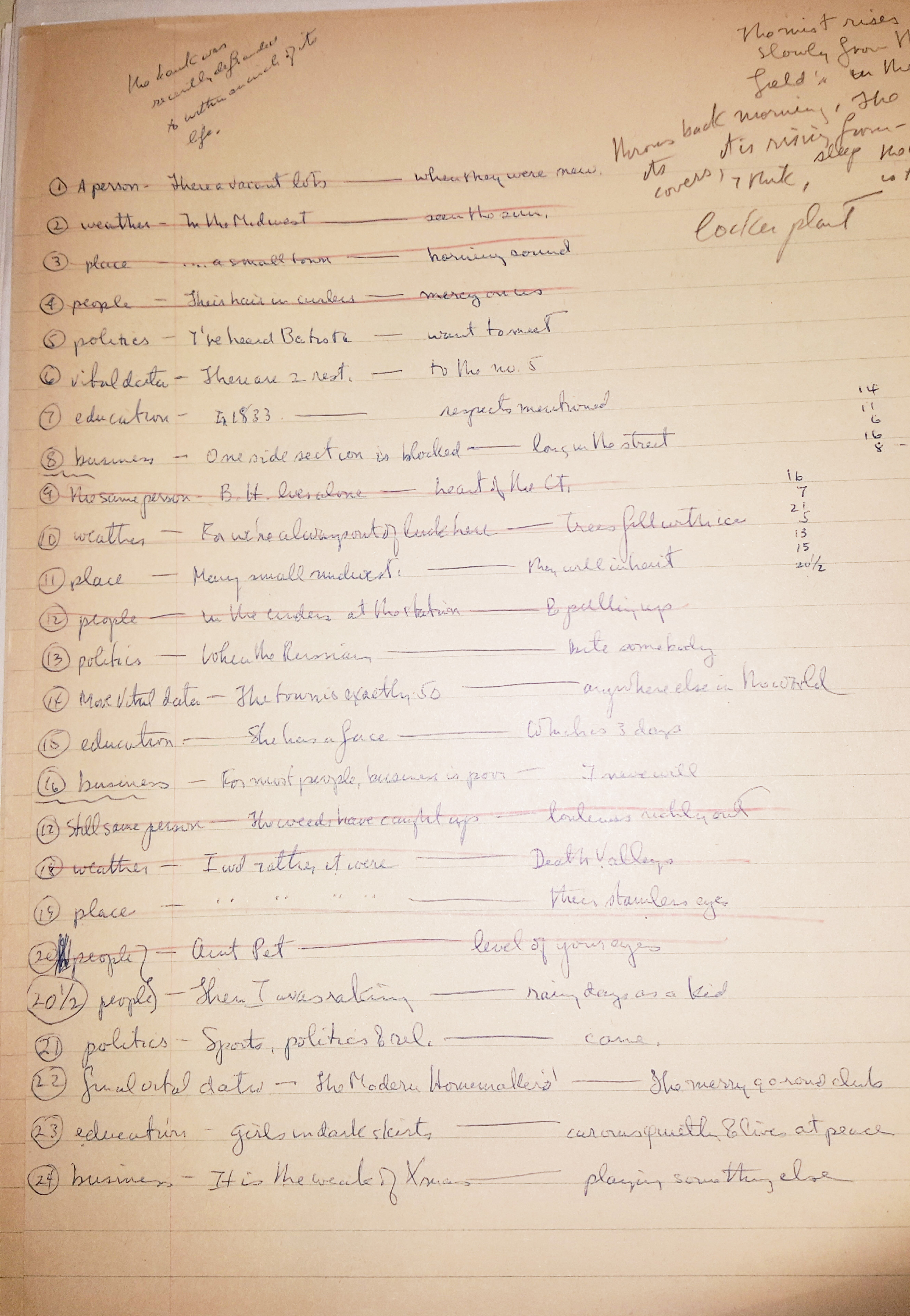
Fig. 3. Photograph of a handwritten page by William H. Gass as part of the drafting of “In the Heart of Heart of the Country.” Washington University Archives. Photo by the Author.

Fig. 4. Photograph of a handwritten page by William H. Gass as part of the drafting of “In the Heart of Heart of the Country.” Washington University Archives. Photo by the Author.

Fig. 5. Photograph of a manually typewritten page by William H. Gass as part of the drafting of “In the Heart of Heart of the Country.” Washington University Archives. Photo by the Author.
At this point in his career Gass wrote on a manual typewriter, so the rough drafts of “In the Heart” are on full-size sheets of paper; however, while revising he might rewrite the same paragraph, or part of a paragraph, multiple times on the same sheet (see figure 5, which became part of a long vignette subtitled “Education” in the latter half of the story, in both the 1967 and ’68 versions, section 21/32 and 16/30, respectively). Each of these pieces is suggestive of the index cards Gertrude Stein used to write, by hand, and arrange Tender Buttons (see Appendix B of Diepeveen’s critical edition). So it isn’t that their writing processes were similar while originally drafting their poem and story, but through the process of revision Gass seems to have pared down his longer chunks of text to crystalline bite-size bits of a similar heft to Stein’s index cards, at least in some cases. Gass invested a significant amount of time in considering and rearranging these bits of text, as evidenced by the numberings and revised numberings in the margins of the drafts (figure 6). Without further examination of his papers, I can’t say how pervasive this kind of paring down was in the process of writing “In the Heart,” but I can say it wasn’t wholly unique to this short story. His technique of isolating single paragraphs or parts of paragraphs and revising them again and again, often on the same sheet of typing paper, can be seen in the archive for other works. I can attest to the novella Willie Masters’ Lonesome Wife (1968) and parts of The Tunnel (1995). For that matter, a kindred technique became part of the published draft of Middle C (2013), whereby the protagonist, Joseph Skizzen, works on rewriting the same brief paragraph throughout the novel, rearranging sentences, substituting words, until he has it perfect. In fact, the reaching of the paragraph’s final form is a kind of climax in the novel.

Fig. 6. Photograph of a manually typewritten page by William H. Gass as part of the drafting of “In the Heart of Heart of the Country.” Washington University Archives. Photo by the Author.
I want to return to Stein’s profound influence on Gass, which he made no bones about. In his “Fifty Literary Pillars,” in which Gass identified the books (and authors) who were most influential on his development as a writer, he listed Stein’s Three Lives and said, “I knew I had found the woman my work would marry” (54). Anyone who knows Gass at all probably knows that his greatest influence was the German poet Rilke. It’s true that Rilke is everywhere in Gass’s work, and he wrote a book about the difficulty of translating Rilke (Reading Rilke, 1999), which he tried his hand at himself. Gass said that Rilke helped to solidify ideas he’d had for years which he’d gotten from other great writers, like Stein: “. . . I had certainly come across and become enamored of Gertrude Stein a lot earlier and Flaubert somewhat, also—they all came together; Rilke just brought them together. . . . He sort of coalesced it all for me.” In particular “Rilke discovers that the poet’s aim is to add something to reality rather than comment on it or express something, to be something” (Ammon 161). Ultimately, said Gass, “you have an [art] object sitting there which is the result of this big cycle from objects observed by the poet or painter and it’s not that the painting is about anything; it is a transformation and a new object in the world” (162).
This concept is key to understanding Gass’s work. His stories, novellas and novels are not interested in advancing a plot via narration—as one would normally think of as the defining feature of fiction—but rather his stories, novellas and novels are interested in being works of art. The characters and their actions (the term plot doesn’t really apply) are a means to an end, and that end is to create a unique piece of literary art. This core artistic aim in Gass can be traced to Gertrude Stein’s philosophy of aesthetics, and Tender Buttons may be her most pure expression of that aesthetic. By the same token, “In the Heart of the Heart of the Country” may be Gass’s starkest example of the sort of fiction he would become infamous for, fiction which downplayed the typical foci on character development and plot, and instead emphasized stylistic components and thematic repetition.
Stein spoke of her narrative philosophy on numerous occasions, but her second lecture at the University of Chicago in 1935 zeroed in on this aspect of her writing process most directly. “Lecture 2” deals with the distinction between prose and poetry as they had been evolving in the modernist movement after the First World War, a movement of which Stein had been the vanguard for more than twenty years by the time she delivered her Chicago lectures. She said, as only she could,
When one used to think of narrative one meant telling of what is happening in successive moments of its happening the quality of telling depending upon the conviction of the one telling that there was a distinct succession in happening, that one thing happened after something else and since that happening in succession was a profound conviction in every one then really there was no difference whether any one began in the beginning or the middle or the ending because since narrative was a progressive telling of things that were progressively happening it really did not make any difference where you were at what moment you were in your happening since the important part of telling anything was the conviction that anything that everything was progressively happening. But now we have changed all that we really have. (17)
If I may, before modernism prose was defined by the narrative quality of cause and effect, of one event leading to another and then another and another in a story or novel, say. In modernism, however, prose has become like poetry in that there is “not a sense of anything being successively happening” (19). Prose is no longer “being a successive thing but being something existing. That is then the difference between narrative as it has been and narrative as it is now,” explained Stein (20). Or as Liesl M. Olson paraphrases the key idea in her foreword to Narration: “A ‘modern’ narrative need not have an event, according to Stein; nothing need ‘happen’” (ix-x). Thus, Stein called Tender Buttons poetry because even though it has the outward trappings of prose (sentences and paragraphs), ontologically it is poetry in that each piece stands alone as a carefully crafted, multilayered thing of linguistic art. There is no traditional narrative substructure of things happening to characters via cause and effect.
In his essay “Gertrude Stein and the Geography of the Sentence,” Gass said that Tender Buttons is written “in a kind of code . . . a coding which dangerously confounds the surface . . . [which often] effects a concealment.” This concealment, though, is key to understanding Stein’s genius, “because the object of art is to make more beautiful that which is, and since that which is is rarely beautiful, often awkward and ugly and ill-arranged, it must be sometimes sheeted like a corpse, or dissolved into its elements and put together afresh, aright, and originally” (105). This objective of art was embraced by Gass throughout his career as he frequently tried to make the ugly beautiful via the beauty of his language. In The Tunnel, the centerpiece of oeuvre, for example, Gass wrote beautifully about the Holocaust, and attempted to redeem his deplorable first-person narrator through the loveliness of his language.
Gass’s emphasis on language over plot, on style over characterization has made some readers consider his novellas and novels long prose poems, placing them in the same arena as Tender Buttons. Unlike Stein, however, Gass insisted he was not adept at writing poetry. He did say, though, that the best poets of his generation were writers of fiction, naming in particular John Hawkes, Robert Coover, Stanley Elkin and William Gaddis (Saltzman 91). It would’ve been the height of egotism to list himself, but his was a name that often appeared among them. He readily acknowledged his frequent use of devices more typically attached to poetry. Among his “quirks” he listed in his essay “Retrospection” are “whoring and metaphoring” and “jingling,” which includes his love of alliteration and limericks.
I’ll end where I began. One of the reasons it’s worth considering if Tender Buttons was a model of sorts for “In the Heart of the Heart of the Country” is because Gass stated explicitly that the short story’s structure led him to his most ambitious work, The Tunnel. He said in an interview with Bradford Morrow, “[The Tunnel] also elaborates the structure of the story in In the Heart of the Heart of the Country. [The novel’s] in sections roughly seventy pages long, instead of paragraphs. These are musically organized. There are sections within sections: It’s sectioned up like an insect or a worm.” I believe there is much more to learn about the story “In the Heart of the Heart of the Country” by reading it alongside Stein’s techniques in Tender Buttons; therefore, by extension, Stein’s enigmatic experimental poem may also whisper some clues in our ears, sibyl-like, to help us better comprehend the many levels of The Tunnel.
Works Cited
Ammon, Theodore G. “Interview with William Gass.” Conversations with William H. Gass, edited by Theodore G. Ammon, UP of Mississippi, 2003, pp. 149-170.
Gass, William H. “Fifty Literary Pillars.” A Temple of Texts, Dalkey Archive, 2007, pp. 29-60.
—. “Gertrude Stein and the Geography of the Sentence.” The World within the Word. Basic Books, 1978, pp. 63-123.
—. “In the Heart of the Heart of the Country.” In the Heart of the Heart of the Country and Other Stories. Godine, 1981, pp. 172-206.
—. “Retrospection.” Life Sentences, Knopf, 2012, pp. 36-55.
Hix, H. L. Understanding William H. Gass, U of South Carolina P, 2002.
Morrow, Bradford. “An Interview: William H. Gass.” Conjunctions, no. 4, 1983, pp. 14-29. Available online http://www.conjunctions.com/print/article/william-h-gass-c4.
Olson, Liesl M. Foreword. Narration by Gertrude Stein, The U of Chicago P, 2010, pp. vii-xii.
Saltzman, Arthur M. “An Interview with William Gass.” Conversations with William H. Gass, edited by Theodore G. Ammon, UP of Mississippi, 2003, pp. 81-95.
Stein, Gertrude. Narration. The U of Chicago P, 2010.
—. Tender Buttons. Edited by Leonard Diepeveen, Broadview, 2018.
Interview with Pauline Uchmanowicz: Starfish
Since founding Twelve Winters Press in 2012 and beginning to publish in 2013, oftentimes I’ve had to do a fair amount of detective work to find the projects I wanted to bring out. For example, I might read a writer’s work that I like very much in a journal , and their contributor’s note says they have a novel, or story collection, or poetry collection that’s looking for a home–then I go about tracking down the author and trying to get a look at their manuscript. In other instances, wonderful manuscripts have come to me out of the blue, as if handed down by the literary divinities. Such was the case with Starfish, a collection of poems by Pauline Uchmanowicz.
Last June my wife Melissa and I attended the North American Review Bicentennial Conference in Cedar Falls, Iowa, and we had the good fortune of making the acquaintance of Stephen Haven, the director of The Ashland Poetry Press. After the conference, Stephen and I stayed in touch about this or that poetry- or publishing-related issue. In the fall, an email arrived from Stephen with a manuscript attached to it: a collection of poetry by Pauline Uchmanowicz. Stephen admired the collection, but it wasn’t going to fit into Ashland’s publishing schedule, so he was wondering if Twelve Winters may be interested in it.
I, too, was much impressed by the work, and downright moved by many of the poems. I contacted the poet, who directs the undergraduate creative writing program at SUNY New Paltz. It turns out she was at the NAR Conference also, and she had visited Twelve Winters’ table, and picked up The Waxen Poor, a poetry collection by J. D. Schraffenberger, so she was familiar with the Press and with the quality of the work we were producing. Soon we came to an agreement to release her spellbinding collection in print and digital editions.
I asked Twelve Winters’ contributing editor John McCarthy to work with Pauline to finalize the manuscript for publication, and I’m happy to report that Starfish was released last week, available in print, Kindle and Nook editions. It’s become a tradition that I interview our authors about their books, and so what follows are Pauline’s unedited responses to a series of questions I sent her.

You’ve been published widely, including two chapbooks of poetry, but Starfish is your first full-length collection. Would you discuss the evolution of this project, and its path to publication?
Bill Knott, with whom I studied in the 1980s, liked to boast that Stéphane Mallarmé wrote few poems in his lifetime, and “nearly all of them perfect.” Also during the 80s, Israeli poet Yehuda Amichai (to paraphrase remarks he made at a public reading) said it surprised him when poets proclaimed to be working on a book: “You don’t hear a painter say, ‘I’m working on a museum installation.’ A painter works on a painting; a poet works on a poem.” (The present-day art and publishing worlds might contest this dictum.) Meanwhile, Virginia Hamilton Adair—though her work appeared widely in top literary journals—published her first volume of poems, Ants on the Mellon, at the age of eighty-four.
So, for the past thirty years, always “working on a poem” until as realized as possible, I was never in a hurry to publish a full-length volume until the time to do so felt right. Now is the time.

Stephen Haven, director of The Ashland Poetry Press, shared your manuscript with me because he was impressed by it, but budget issues were impacting his wherewithal to bring out new titles. Obviously it’s been challenging for poets to place their work with presses for a long time (forever?), but is your sense that it’s becoming more and more challenging?
Thank you for mentioning Stephen Haven, a wonderful poet to whom I owe sincere gratitude. The fact that he passed my manuscript on to you in part illustrates what follows.
In some ways, because of independent, small-press, online, and self-publishing, it’s easier than ever for poets to place their work—but in many ways much, much harder, due in large part to the proliferation of MFA programs and professionalization of Creative Writing as an academic discipline. Moreover, these days there is so much competition—and among very good writers. At the same time, the poetry world has always been somewhat insular, with established writers helping younger ones break into publishing. Poets continue to need support from the literary community and also must make themselves known within it—whether small-scale or large. For better or for worse, writers today who “network” increase their chances for publication. Of course, many talented writers (and editors) rightly promote others like themselves.
Crucially, the current wave of small presses—perhaps the lifeblood of “print” today—remains vital to keeping publishing possibilities alive, often through contests and awards with submission fees to defray costs. Also, due to the sheer volume of books that come out each year, poets have to do much more of the marketing and promotion than ever before, even if working with national or university presses.
All that said, working closely with Twelve Winters Press has been a privilege, my own input valued throughout the publishing process.
Starfish is divided into three parts. What was your thinking in terms of its structure, and the arrangement of the poems? Were there any agonizing choices, or once you figured out your modus operandi did the structure come together fairly easily?
In addition to book design (and TWP does a great job), the ordering of poems remains essential among elements in any poetry volume. While I’d like to claim a grand scheme for organizing Starfish into three sections—a trinity of mind, body, soul, for example—instead my decision was based on how poems might meaningfully unfold consecutively as well as side-by-side (verso and recto). Specific themes, motifs, and catalogs became apparent, such as a suite of poems that questions what to relinquish, what to retain, proceeding from the final lines of “Beachside Burial”: “why no one returns / for what was left / behind?” But broad categories do emerge. For example, the middle section has several seaside poems, while in contrast the final one is announced by the poem “Landlocked.” Also, after working for so many years on the manuscript, I had a fairly good idea of where to place each selection.
The poems in the collection tend to be brief, often a single stanza. Has this brevity been typical of your poetry throughout your career, or is Starfish a departure in this regard?
My preference as a reader has always been for small, well-made poems featuring suppressed subjectivity (as in the absence of “I”) and universal emblems—poems that likely will endure in terms of structural integrity and subject matter—fifty or a hundred years from now. The poetry of Ted Kooser, mid-career Louise Glück, and Jean Follain, respectively, comes to mind. So yes, “miniatures” have been a staple of my work all along. Sometimes I do aim to write beyond a page or two, but the process can feel forced (for me), so that I end up editing a poem down to its imagistic essences. With small poems, one can hone in on manifold parts, such as verb choices and rhetorical figures that underscore meaning overall.
I recently attended a program by Juan Felipe Herrera, the U.S. Poet Laureate (and a former creative writing teacher of mine); and one of the issues he discussed was the difficulty associated with writing a long poem and maintaining the intensity of the emotion from beginning to end. Would you agree that longer poems (however one may define “long”) can be challenging for a poet, especially in terms of sustaining the poem’s energy and emotional impact?
Associated with poetry writing today is the buzzword “elliptical,” meaning that beyond sustaining long form and retaining within it a unified vision a poem ought to take surprising, unexpected leaps relative to imagery, as Billy Collins’s work notably does. Such a poem might arrive at an epiphany or apocalyptic closure, circling back to early moments in its body. But I agree that it can be difficult to sustain vision overall in long form, which some poets resolve through use of numbered or titled section breaks. Also, I do see many poems published today that are long-lined and long form, confessional in tone and at times adopting diffused autobiography for “emotional impact.”
Your question also reminds me of a former newspaper editor I worked with who, on the subject of “length” and wordiness, once quipped by way of analogy, “I would have written you a short letter—if I had time.” The challenge of poetry writing in general, I believe, is to use the least amount of words possible to achieve what critic Paul Fussell calls “absolute density.”
Juan Felipe also said that for him, in revision, he often cuts the opening and ending lines of a poem, finding that its core is where the “heat” resides—and by cutting the beginning and ending lines, he can intensify the poem’s emotional impact. As a poet and as a teacher of creative writing, does his process strike a familiar chord with you? How would you describe your writing and revising process?
Juan Felipe’s revision process has resulted in good poetry for him, and in some ways resembles how I work. Like for many poets, a piece of my own may start with a line or an image that places pressure on what follows; I don’t usually cut first lines. Other times, I know where a poem will end, so the challenge becomes building to those final lines. This was the case with the allegorical poem “Death,” which ends with the eponymous figure speaking to a recently departed soul.
But I do find myself cutting not just last lines but whole stanzas. And in teaching creative writing, I sometimes do recommend that student poets cut a final line or couplet, which could serve as the opening of a “new” poem. I’m also big on recommending transpositions, so that the placement of engaging or charged material resonates at well placed moments within a poem.
Speaking of teaching . . . many writers/poets who teach find teaching rewarding but also draining, especially their creative energies. How do you balance teaching with your creative output? Do you find that teaching in some ways encourages and informs your writing and publishing?
The fresh and surprising output of young writers is always delightful to me, making it easy to devote energy to their creative endeavors over my own. Whether teaching writing or literature, I aim to be “fresh” myself in terms of readings, written assignments, and pedagogical approaches. One can spend hours reading and commenting on student work, or on preparing lecture notes and assignments. And in addition to a heavy teaching load, during any given semester I’m directing an independent study, Honors Program thesis, or editorial internship—sometimes all three at once.
Since I direct an undergraduate Creative Writing program, a huge block of my time and energy goes into programming—over a dozen events an academic year with demanding details involved, from booking writers to securing funding. We also put out an expansive student literary magazine, which I edit.
I believe all of these endeavors “encourage” my writing. But the way it gets completed is the same for how teaching and administrative tasks do: I compartmentalize. I’ve always admired writers who work every day—say by rising at 5 a.m. to squeeze in an hour before going to a job. That’s not me, though my writing notebook is always within reach beside the morning cereal bowl and coffee cup.
Which poems in Starfish were the most difficult to write? Were there any technical issues with the poems that presented particular challenges? Are there poems that you’re especially proud of?
Almost every poem in Starfish was difficult to write, some requiring a ridiculous number of drafts (Bill Knott sitting on one’s shoulder, as it were). The same technical issues attend to every selection in the book: the aim of achieving “absolute density” mentioned above. But every once in a while, a poem just “happened.” For example, flipping through a notebook one day, I came upon “Postmark” (untitled at the time), which I barely remembered even writing. So the challenge was to find the emotional center of the poem then to tinker with a few words, and also find an expressive title. A recurring technical puzzle for me in general involves line breaks. I tend to end-stop (rhythmically) lines and always want to find alternate ways of phrasing or incorporating enjambment instead.
At one point, I was proud of the meta-poem Explication de texte, which actually did come about when I was teaching a graduate seminar with close reading at its core. The poem is a single sentence, with every line commenting on itself by using the language of prosody. Usually though, the “current” poem I’m working on most enchants me.
You do other sorts of writing besides poetry (reviews, for example). For lack of a better way of asking this question—do you feel that all your writing, regardless of form or genre, comes from the same place? Or do you have to tap into different parts of your … brain … soul … psyche … to write, say, verse, as opposed to an essay or review?
No matter what one writes, there’s always a rhetorical performance involved, and many of the devices and techniques used to craft poetry influence my writing in prose, from sharpening and tightening for readability and clarity to aiming for lyricism or metaphors that suggest the subject at hand.
Does writing a book review or author profile derive from a different aspect of consciousness than writing a poem? Sure, absolutely, because one’s energy is on representing and championing other people. What does come from the “same place” though is the desire to write as exactingly or as beautifully as possible.
How important do you believe it is for younger poets to be well studied in the history and traditions of poetry? Do you believe it’s crucial to become at least proficient in fixed forms (like the sonnet or sestina) before working with less formally structured poems?
Not to lapse into clichés here, but we all know too many young people who become turned off to poetry before they even engage it fully because canonical works are not familiar to them in terms of imagery or cadences. So I tend to start with free-verse short forms (readings as well as writing assignments)—to focus on what a line is and how it operates—then introduce basic poetic units. But I do believe it’s vital and necessary for younger poets to study and understand historical traditions and also to experiment in fixed forms and accentual-syllabic meter. My tendency though is to always insert the qualifier that a poem crafted in response to an assignment (write a sonnet, write a poem in terza rima) may “modify” a fixed or traditional form.
Overall in teaching poetry writing, I take a page from Martín Espada’s pedagogy: the goal is for each person to develop a unique poetic identity in terms of language and subject matter, with focus on the image (Espada). Thus, learning to read and write poetry means understanding and appreciating poetic images.
Recently I was reading Paul Valéry’s thoughts on writing poetry, and I was particularly struck by his belief that too many young poets, of his day, put too much faith in inspiration, and therefore not enough effort into the hard work of writing and revising a poem. What role do you think inspiration plays in the process, and would you tend to agree with Valéry (as I’ve represented him here)?
I can’t speak to young poets as a whole, but while some known to me reject revision, believing “inspiration” to be an article of faith, most come to the realization that drafting, revising, and polishing are important aspects of “writing” poetry.
On this subject, when interviewing Charles Simic for a profile in Chronogram magazine, and mentioning that his sparse, elegant poems appear divinely made, I was reassured when he stated, unequivocally: “There’s no muse. I don’t take dictation. It’s really a slow process of making the poem—of endless tinkering and revising to make it sound inspired.” So, a goal is for a poem to appear inspired—as if just written down in a single sitting—even if its genesis was far different than that.
Nearly every poet I know enjoys public recitation of their work, and many seem to feel that public performance is the truest way for an audience to receive their work. What are your feelings? Do you enjoy sharing your work via your voice, and do you feel you’re able to represent your poetry more completely than when it is merely read on the page?
Nationally and internationally celebrated poets I’ve heard speak on page-versus-stage poetry have maintained that a poem should read easily on the page and also be easily comprehended—for its lyricism as well as its meaning—when read aloud. I believe if a poem has integrity it will be well received in print or performance. As far as reading one’s work aloud, for me, that takes practice as well. I’m especially struck by what Richard Blanco says on this subject in his brief memoir, For All of Us, One Today, about how he prepared to read his occasional poem for President Obama’s second inaugural. If you watch the video of Blanco’s performance it appears seamless and effortless—but hours and hours of rehearsal went into his four minutes or so on the podium.
Who are some poets, past and present, that you especially admire, and why? Would you point to any poet or two who have been particularly instructive or inspiring?
My list is long and lengthy. I like all kinds of poets and poems from various eras, mainly beginning with the British Romantics (John Keats and William Blake, especially) and moving forward. I like Emily Dickinson and Walt Whitman from the nineteenth-century American canon. Poets I read over and over again in translation include Jean Follain and Wisława Szymborska. I like dozens and dozens of American poets (some already named but worth repeating here): Lucille Clifton, Ted Kooser, Kay Ryan, Martin Espada, Linda Gregg, Carl Dennis, and often whomever I happen to be reading or teaching at the moment. I also seek out books by poets whose works I’ve enjoyed reading in literary journals, or who may have won a distinguished prize, like Ansel Elkins for Blue Yodel (Yale Younger Poets Award, 2014). It’s always good to check out what young writers are up to today.
What new projects are currently underway?
I’m “working on a poem” (and another, and another). My notebook is stuffed with nonfiction essays in progress and I’ve recently written a number of short fiction pieces. My next deadline (about one week from now) is for four book reviews.
Pauline Uchmanowicz is the author of two poetry chapbooks and has received residency grants at the MacDowell Colony and Yaddo. A freelance writer in the Hudson Valley, her poems, essays, and reviews have appeared in Crazyhorse, Ohio Review, Ploughshares, Provincetown Arts Journal, Radcliffe Quarterly, Woodstock Times, Z Magazine, and elsewhere. She is associate professor of English and director of Creative Writing at SUNY New Paltz. (Author photo by Franco Vogt)
Accidental Poets: Paul Valéry’s influence on William Gass
The following paper was presented at the Louisville Conference on Literature and Culture Since 1900, held at the University of Louisville February 18-20. Others papers presented were “The Poet Philosopher and the Young Modernist: Fredrich Nietzshe’s Influence on T.S. Eliot’s Early Poetry” by Elysia C. Balavage, and “Selections from ‘The Poetic Experiments of Shuzo Takiguchi 1927-1937’” by Yuki Tanaka. Other papers on William H. Gass are available at this blog site; search “Gass.”
In William H. Gass’s “Art of Fiction” interview, in 1976, he declared two writers to be his guiding lights—the “two horses” he was now “try[ing] to manage”: Ranier Maria Rilke and Paul Valéry. He added, “Intellectually, Valéry is still the person I admire most among artists I admire most; but when it comes to the fashioning of my own work now, I am aiming at a Rilkean kind of celebrational object, thing, Dinge” (LeClair 18). That interview for The Paris Review was exactly forty years ago, and viewing Gass’s writing career from the vantage point of 2016, I am here to suggest that, yes, Rilke has been a major influence, but Valéry’s has been far greater than what Gass anticipated; and in fact may have been even greater than Rilke’s in the final analysis. Assessing influence, however, is complicated in this case, I believe, because a large part of Gass’s attraction to Valéry’s work in the first place was due to his finding the Frenchman to be a kindred spirit. Hence it is difficult to say how much of Gass is like Valéry because of Valéry’s influence and how much is because of their inherent like-mindedness.


A quick survey of Gass’s work since 1976—which includes two novels, a collection of novellas, a collection of novellas and stories, and eight books of nonfiction—may imply that Rilke has been the greater influence, as Gass intended. After all, Gass’s magnum opus, The Tunnel (1995), for which he won the American Book Award, centers on a history professor of German ancestry who specializes in Nazi Germany (Rilke allusions abound); and his other post-1976 novel, Middle C (2013), for which he won the William Dean Howells Medal, centers on a music professor born in Vienna whose special interest is Austrian composer Arnold Schoenberg; and, glaringly, there is Gass’s Reading Rilke (1999), his book-length study of the problems associated with translating Rilke into English. However, a more in-depth look at Gass’s work over these past four decades reveals numerous correspondences with Valéry, some of which I will touch upon in this paper. The correspondence that I will pay particular attention to, though, is that between the title character of Valéry’s experimental novella The Evening with Monsieur Teste (1896) and the protagonist of Gass’s Middle C, Joseph Skizzen.
Before I go further, a brief biographical sketch of Paul Valéry: He was born in 1871, and published two notable works in his twenties, the essay “Introduction to the Method of Leonardo da Vinci” and Monsieur Teste; then he stopped publishing altogether for nearly twenty years—emerging from his “great silence” with the long poem “The Young Fate” in 1917 at the age of forty-six. During his “silence,” while he didn’t write for publication, he did write, practically every day, filling his notebooks. Once his silence was over, he was catapulted into the literary limelight, publishing poems, essays, and dramas, becoming perhaps the most celebrated man of letters in France. By the end of his life in 1945 he’d been nominated for the Nobel Prize in Literature a dozen times.
The title for this paper comes from Gass himself. In his 1972 review of Valéry’s collected works, in the New York Times Book Review, he wrote that Valéry “invariably . . . [pretended] he wasn’t a poet; that he came to poetry by accident” (The World Within the Word 162). By the same token, Gass has insisted in numerous interviews (and he’s given many, many interviews) that he’s not a poet, that the best he can achieve is an amusing limerick. Others, however, have asserted that Gass’s fiction is more akin to poetry than prose, that his novellas and novels are in essence extremely long prose poems; and in spite of his insistence on his not being a poet, he would seem to agree with this view of his work. In a 1998 interview, for instance, Gass said, “I tend to employ a lot of devices associated with poetry. Not only metrical, but also rhyme, alliteration, all kinds of sound patterning” (Abowitz 144). Moreover, about a decade earlier he said that “all the really fine poets now are writing fiction. I would stack up paragraphs of Hawkes, Coover, Elkin, or Gaddis against the better poets writing now. Just from the power of the poetic impulse itself, the ‘poets’ wouldn’t stand a chance” (Saltzman 91). Critics have tended to include Gass in the group of writers whom Gass described as poet-novelists.
For your consideration, from The Tunnel:
A smile, then, like the glassine window in a yellow envelope. I smiled. In that selfsame instant, too, I thought of the brown, redly stenciled paper bag we had the grocer refill with our breakfast oranges during the splendid summer of sex and sleep just past—of sweetly sweating together, I would have dared to describe it then, for we were wonderfully foolish and full of ourselves, and nothing existed but your parted knees, my sighs, the torpid air. It was a bag—that bag—we’d become sentimental about because (its neck still twisted where we held it) you said it was wrinkled and brown as my balls, and resembled an old cocoon, too, out of which we would both emerge as juicy and new as the oranges, like “Monarchs of Melody,” and so on, and I said to you simply, Dance the orange (a quotation from Rilke), and you said, What? There was a pause full of café clatter. (160-61)
And beyond Gass’s poetic prose, he has written actual poems, besides the off-color limericks that populate The Tunnel. In Middle C, for example, there is a longish, single-stanza poem written via the persona of the protagonist, Joseph Skizzen. It begins, “The Catacombs contain so many hollow heads: / thighbones armbones backbones piled like wood, / some bones bleached, some a bit liverish instead: / bones which once confidently stood / on the floor of the world” (337). And, perhaps more significantly, there are the translated poems in Reading Rilke. There was a celebration held at Washington University in St. Louis in honor of Gass’s ninetieth birthday, Passages of Time, and he read from each of his works in chronological order, except he broke chronology to end with his translation of Rilke’s “The Death of the Poet,” which concludes,
Oh, his face embraced this vast expanse,
which seeks him still and woos him yet;
now his last mask squeamishly dying there,
tender and open, has no more resistance,
than a fruit’s flesh spoiling in the air. (187)
It was a dramatic finale, especially since the event was supposed to be in July, near Gass’s birthday, but he was too ill to read then; so it was rescheduled for October, and the author had to arrive via wheelchair, and deliver the reading while seated. Happily, he was able to give another reading, a year later, when his new book, Eyes, came out. (I wasn’t able to attend the Eyes reading, so I’m not sure how he appeared, healthwise, compared to the Wash U. reading.)
My point is that, like Valéry, Gass has downplayed his abilities as a poet, yet his literary record begs to differ. The fact that he broke the chronology of his birthday celebration reading to conclude with a poem—and he had to consider that it may be his final public reading, held on the campus where he’d spent the lion’s share of his academic life—suggests, perhaps, the importance he has placed on his work as a poet, and also, of course, it may have been a final homage to one of his heroes. In spite of Gass’s frailness, his wit was as lively as ever. When he finished reading “The Death of the Poet,” and thus the reading, he received an enthusiastic standing ovation. Once the crowd settled, he said, “Rilke is good.”
Evidence of the earliness of Valéry’s influence or at least recognized kinship is the preface to Gass’s iconic essay collection Fiction and the Figures of Life (1970), which Gass devotes almost entirely to the connection between the collection’s contents and the way that Valéry had assembled his oeuvre. Gass writes, “It is embarrassing to recall that most of Paul Valéry’s prose pieces were replies to requests and invitations. . . . [H]e turned the occasions completely to his account, and made from them some of his profoundest and most beautiful performances” (xi). Gass continues, “The recollection is embarrassing because the reviews and essays gathered here are responses too—ideas ordered up as, in emergency, militias are”; and then he describes his book as a “strange spectacle” in which he tries “to be both philosopher and critic by striving to be neither” (xii). So, Gass recognizes the parallel between the forces at work in Valéry’s literary life and his own. Gass has readily acknowledged the slowness with which his fiction has appeared (notably, it took him some twenty-six years to write The Tunnel), citing two reasons: the slowness with which he writes, and rewrites, and rewrites; but also the fact that he regularly received opportunities to contribute nonfiction pieces to magazines and anthologies, and to give guest lectures, and they tended to pay real money, unlike his fiction, which garnered much praise but little cash over his career.
This parallel between the circumstances of their output is interesting; however, the correspondences between Valéry’s creative process and his primary artistic focus, and Gass’s, is what is truly significant. In his creative work, Valéry was almost exclusively interested in describing the workings of the mind, of consciousness; and developing complex artistic structures to reflect those workings. T. S. Eliot noted Valéry’s dismissiveness of the idea of inspiration as the font of poetic creation. In Eliot’s introduction to Valéry’s collection The Art of Poetry, he writes, “The insistence, in Valéry’s poetics, upon the small part played [by ‘inspiration’ . . .] and upon the subsequent process of deliberate, conscious, arduous labor, is a most wholesome reminder to the young poet” (xii). Eliot goes on to compare Valéry’s technique and the resulting work to that done by artists in other media, most notably music composers: “[Valéry] always maintained that assimilation Poetry to Music which was a Symbolist tenet” (xiv). James R. Lawler echoes Eliot when he writes that Valéry “makes much of the comparison of poetry to the sexual act, the organicity of the tree, the freedom of the dance, and the richness of music—especially that of Wagner” (x).
The wellspring of music composition as a source of structural principles for poetry (or highly poetic prose) is arguably the greatest correspondence between Valéry as artist and Gass as artist. Examples abound, but The Tunnel and Middle C offer the most radiant ones. For the The Tunnel Gass developed a highly synthetic structure based on Arnold Schoenberg and the Second Viennese School’s musical theory of a twelve-tone system. Consequently there are twelve sections or chapters, and in each Gass develops twelve primary themes or images. He said, “[T]hat is how I began working out the way the various themes come in and out. It’s layered that way too. . . .” (Kaposi 135). In The Tunnel, Gass’s methodology is difficult to discern because Gass gave it a “chaotic and wild” look while in fact it is, he said, “as tightly bound as a body in a corset” (134). He achieved the appearance of chaos by “deliberately dishevel[ing]” the narrative with “all kinds of other things like repetitions [and] contradictions.” He said, “[T]he larger structure must mimic human memory, human consciousness. It lies, it forgets and contradicts. It’s fragmentary, it doesn’t explain everything, doesn’t even know everything” (134). For Middle C, the use of the Schoenberg system is much more overt, with Skizzen, its protagonist, being a music professor whose specialty is Schoenberg and Skizzen’s obsession with getting a statement about humans’ unworthiness to survive just right. Skizzen believes he is on the right track when he writes the sentence in twelve beats, and near the end of the novel he feels he has the sentence perfect:
First Skizzen felt mankind must perish
then he feared it might survive
The Professor sums up his perfect creation: “Twelve tones, twelve words, twelve hours from twilight to dawn” (352). Gass, through his narrator, does not discuss the sentence’s direct correlation to the Second Viennese School’s twelve-tone system, but it does match it exactly.
Let me return to another Valéry-Gass correspondence which I touched on earlier: their concern with the workings of the mind or, said differently, consciousness. Jackson Mathews, arguably the most herculean of Valéry’s translators into English, begins his introduction to Monsieur Teste with the statement that “Valéry saw everything from the point of view of the intellect. The mind has been said to be his only subject. His preoccupation was the pursuit of consciousness, and no one knew better than he that this pursuit led through man into the world” (vii). Valéry’s interest in the mind was present in his earliest published work, the essay on Leonardo’s method and, even more obviously, Monsieur Teste, that is, “Mr. Head” or “Mr. Brain as Organ of Observation” or something to that effect. However, it was during Valéry’s twenty-year “silence” that he delved into the phenomenon of consciousness most critically. Gass writes, “Valéry began keeping notebooks in earnest, rising at dawn every day like a priest at his observances to record the onset of consciousness, and devoting several hours then to the minutest study of his own mind” (“Paul Valéry” 163). As noted earlier, Gass fashioned The Tunnel, all 800 or so pages of it, to mimic the human mind in its intricate workings. In Middle C, Gass pays much attention to Skizzen’s thought processes, especially his copious writing, revising, critique of, and further revising of his statement about humans’ unworthiness for survival. Such concerns are everywhere in Gass’s work, including his most recently published, the collection of novellas and stories, Eyes. I would point in particular to the novella Charity, a challenging stream-of-consciousness narrative, all a single paragraph, that mercilessly bounces between the main character’s childhood and his present, and, chaotically, various times in between, all the while sorting through his feelings about the act of charity and how he came to feel about it as he does in the now of the story.
In the limited time remaining, I’ll turn to the correspondence between Valéry’s character Monsieur Teste and Gass’s Joseph Skizzen (though I think William Kohler, the narrator of The Tunnel, has significant Teste-esque qualities as well). The convention of The Evening with Monsieur Teste is that the narrator is a friend of Edmond Teste’s, and he goes about attempting to describe his friend’s character. There is very little action per se, and as such almost nothing in the way of plot, in a conventional sense at least (very Gassian in that regard). He tells us that he came to “believe that Monsieur Teste had managed to discover laws of the mind we know nothing of. Certainly he must have devoted years to his research” (11). In Middle C, Joseph Skizzen is obsessed with what he calls his Inhumanity Museum, essentially a record, largely in the form of newspaper clippings and personal notes, of humans’ ceaseless cruelty to one another. The collection is associated with his ongoing struggle to word just so his statement about humans’ unworthiness to survive. Monsieur Teste becomes almost a recluse, desiring little contact with other people. He is married, but the narrator suggests that Monsieur and Madam Teste’s relationship is more platonic than passionate, due to Edmond’s preference for the intellectual over the emotional. Similarly, Skizzen never marries in Middle C, and in fact never has sex—he flees as if terrified at the two attempts to seduce him, both by older women, in the novel. Ultimately he ends up living with his mother in a house on the campus where he teaches music history and theory, his few “pleasures” consisting of listening to Schoenberg, assembling his Inhumanity Museum, and revising his pet statement. What is more, Teste’s friend describe Edmond’s understanding of “the importance of what might be called human plasticity. He had investigated its mechanics and its limits. How deeply he must have reflected on his own malleability!” (11-12). Skizzen’s malleability is central to his persona in Middle C. He goes through several name changes, moving from Austria to England to America, and eventually fabricates a false identity, one which includes that he has an advanced degree in musical composition, when in fact his knowledge of music is wholly self-taught. One of the reasons he gravitates toward Schoenberg as his special interest is because of the composer’s obscurity and therefore the decreased likelihood that another Schoenberg scholar would be able to question Skizzen’s understanding of the Austrian’s theories. But over time Skizzen molds himself into a genuine expert on Schoenberg and a respected teacher at the college—though his fear of being found out as a fraud haunts him throughout the novel.
To utter the cliché that I have only scratched the surface of this topic would be a generous overstatement. Perhaps I have eyed the spot where one may strike the first blow. Yet I hope that I have demonstrated the Valéry-Gass scholarly vein to be a rich one, and that an even richer one is the Valéry-Rilke-Gass vein. A couple of years ago I hoped to edit a series of critical studies on Gass, and I put out the call for abstracts far and wide; however, I had to abandon the project as I only received one email of inquiry about the project, and then not even an abstract followed. Nevertheless, I will continue my campaign to bring attention to Gass’s work in hopes that others will follow me up the hill, or, better still, down the tunnel. Meanwhile, if interested, you can find several papers on Gass’s work at my blog.
Works Cited
Abowitz, Richard. “Still Digging: A William Gass Interview.” 1998. Ammon 142-48.
Ammon, Theodore G., ed. Conversations with William H. Gass. Jackson: UP of Mississippi, 2003. Print.
Eliot, T. S. Introduction. The Art of Poetry. By Paul Valéry. Trans. Denise Folliot. New York: Pantheon, 1958. vii-xxiv. Print.
Gass, William H. Charity. Eyes: Novellas and Short Stories. New York: Knopf, 2015. 77-149. Print.
—. Preface. Fiction and the Figures of Life. 1970. Boston, MA: Nonpareil, 2000. xi-xiii. Print.
—. Middle C. New York: Knopf, 2013. Print.
—. Reading Rilke: Reflections on the Problems of Translation. 1999. New York: Basic Books, 2000.
—. The Tunnel. 1995. Champaign, IL: Dalkey Archive, 2007. Print.
—. The World Within the Word. 1978. New York: Basic Books, 2000. Print.
Kaposi, Idiko. “A Talk with William H. Gass.” 1995. Ammon 120-37.
Lawler, James R. Introduction. Paul Valéry: An Anthology. London: Routledge & Kegan Paul, 1977. vii-xxiii. Print.
LeClair, Thomas. “William Gass: The Art of Fiction LXV.” 1976. Ammon 46-55. [online]
Mathews, Jackson. Introduction. Monsieur Teste. By Valéry. Trans. Jackson Mathews. Princeton, NJ: Princeton UP, 1989. vii-ix. Print.
Valéry, Paul. Monsieur Teste. 1896. Trans. Jackson Mathew. Princeton, NJ: Princeton UP, 1989. Print.
Notes on images: The photo of Paul Valéry was found at amoeba.com via Google image. The photo of William H. Gass was found at 3ammagazine.com via Google image.
Interview with Lynette D’Amico: Road Trip
Twelve Winters Press doesn’t solicit submissions as a general rule. Sometimes we’ll have a call for submissions for a special project, but otherwise, as a publisher, I see myself as more of a hunter-gatherer. That is, I keep my eyes and ears open for interesting projects, and when I pick up a scent, I track it down to see if it pans out. I believe it was in the summer of 2014 that I received the Quarterly West newsletter which included an announcement of the winner and finalists of its annual novella contest. One of the finalists was “Road Trip” by Lynette D’Amico. There were several finalists, and I’m not sure why that one stood out to me. I’m a big fan of the road trip motif — I’ve taught Homer’s Odyssey many, many times, as I have tales from Chaucer’s Canterbury Tales, and I’m a fan of Kerouac’s On the Road, and McCarthy’s The Road . . . and so on. So maybe it’s as simple as that.

I went about tracking down this Lynette D’Amico person on the Web (which took a little doing), and introduced myself and Twelve Winters via email. She responded, and come to find out, her novella had been three times a bridesmaid. Prior to the Quarterly West finalist finish, her little book also had been a finalist for the Paris Literary Prize and, as part of a collection, for the 2014 Flannery O’Connor Award for Short Fiction. She had some other impressive writing credentials, including placing a piece with The Gettysburg Review, “Ashes, Ashes,” that had been nominated for a Pushcart Prize. She said in her email that being contacted by a publisher took some of the sting out of her third close-but-not-quite finish, and she agreed to send me the manuscript.
I was blown away by her novella — its complexity, its intricate structure, its mixing of genres, its main characters who are thoroughly lovable in spite of their glaring flaws, and its offbeat humor. I very much wanted to bring this strange little book into the world. We began our negotiations. I entertained the idea of bringing “Road Trip” out as part of a collection, but ultimately we agreed that it should stand on its own as a novella. The story is highly intertextual, so I liked the idea of perhaps mixing in yet another mode of communication in the form of illustrations of some sort (at least, I think it was my idea — maybe Lynette suggested it first . . . I could easily be persuaded she did). Ultimately, Lynette found some photographs from the Wisconsin Historical Society and from a book titled Death of the Dream that she wanted to include in the book. The odd and often haunting photographs definitely added another layer to her already multi-layered novella.
I enlisted the aid of a couple of the Press’s loyal editors to read the manuscript and work with Lynette to finalize it for publication; then beginning in about March of this year I re-entered the process, and Lynette and I went about creating Road Trip in its final form, in print and digital editions. (Lynette is at work on an audio version of Road Trip as well.) On June 22, 2015, the novella entered the world. I sent Lynette some interview questions about her book and her process, and what follows are her unedited responses. SPOILER ALERT: At times the interview drifts into details of the novella you may not want to know before reading it (I wouldn’t have).

The travel narrative obviously has a rich history. The Bible is filled with travel stories. There’s Homer’s Odyssey, Chaucer’s Canterbury Tales, Gulliver’s Travels, with your own book perhaps being more closely related to Kerouac’s On the Road. Why do you think the travel narrative has been so attractive to storytellers, and what specifically attracted you to it for Road Trip?
Isn’t it a version of the travel narrative that we all see ourselves as coming from somewhere on our way to somewhere else? Well, maybe that’s a version of the travel narrative written by white men of a particular social class. When I was 21 or 22, I tried to wrangle a posse of girlfriends to drive from a first-ring suburb of St. Louis to the Pacific Ocean. My friends wanted to bake on a beach, so I wrote to chambers of commerce, collected maps, a sleeping bag, and hit the road alone. I made it as far as Taos before I exhausted my credit limit and my own capacity for adventure—sleeping and not sleeping in my car with all the doors locked at state parks.
The notion of the road trip immediately inspires a sense of the unknown; it has its own engine—we’re heading out from Point A to Point B, or to points unknown. I needed a trajectory for Road Trip, something that would propel the story forward, and place the characters of Myra and Pinkie in time and space, and a literal road trip does the trick.
There’s a line in a story by Paul Yoon, “So That They Do Not Hear Us,” that I get caught on, “. . . there was a time she had departed and was now wishing to return to.” This nostalgia for returning is also a part of the mythology of a road trip: we want to go back to where we started, and the inherent sadness of the road trip for Myra and Pinkie is that even if they get back to where they started, even if they return, nothing will ever be the same again.
Some of the travel narratives I mentioned have a significant supernatural element in them—as does your novella. What do you think the connection is between travel and the supernatural?
Travel removes us from the familiar. In Rebecca Solnit’s A Field Guide to Getting Lost, she says that “to be lost is to be fully present, and to be fully present is to be capable of being in uncertainty and mystery.” The expectation of the travel narrative is exploration of the unknown; to turn a corner or come into a clearing, where “I have never seen this place before” and the unexpected becomes possible.
Flimic references that inform Road Trip include David Lynch’s Wild At Heart, the Cohen brothers’ O Brother Where Art Thou?, The Wizard of Oz, and Wim Wenders’ Paris, Texas. And by “inform,” I mean I paid attention that if you’re on a road trip, something’s gotta happen along the way, and I like it when the something that happens along the way is a little weird, or incorporates unreal elements.
A few years back my spouse and I were staying in a cabin in the Adirondacks. We woke up early the morning we were due to leave and rather than go back to sleep, we packed the car and got on the road before dawn. There were no cars on the road, no lights; it was foggy and misty, and all of a sudden we saw a one-armed figure in the middle of the road. Polly was driving. We both screamed and Polly, who has the reflexes of an athlete, swerved and braked hard. We looked around and there was no one on the road. We kept driving. Did we really see a one-armed man on a foggy road? And where did he go? In writing, and perhaps in life, anything is possible on the road—one-armed hitchhikers, or red-headed hitchhikers in one-piece bathing suits and flip-flops pulling doughnuts and mini-bottles of vodka out of a bottomless purse.
The structure of Road Trip is decidedly nonlinear. You have several characters embarking on various storylines, and the reader constantly shifts between these storylines, as well as back and forth temporally. How did this rather frenetic structure come about? Was it planned early on in the composition, or did it develop more organically while you were writing Road Trip?
Nothing was planned! I so rarely work with any kind of intentionality unless I’m writing an essay, but even then I leave plenty of space for discovery. Road Trip started as one straight-line short story called “No Brakes”—the story of Myra and Pinkie—more or less. It was a big sprawling mess, but from the one draft I had the last words, “no brakes,” and in subsequent drafts I wrote towards that line. It was always fragmented, but I had sections in it about Ed Gein, the Plainfield, Wisconsin, killer who is the model for Norman Bates in Psycho and Buffalo Bill in Silence of the Lambs, which didn’t make the cut and sections called “What Does My Mother Have to Do with This” that were kind of funny stories about my mother talking about death, but their destiny was foretold by their heading. Then my first semester in grad school I worked with the brilliant Kevin (Mc) McIlvoy, who taught me one simple thing about braiding story chords (I don’t mean that he told me one thing; he told me a million things, but I actually managed to hold onto this one right thing): He referred to the turns in the long version of “Layla” by Derek and the Dominos: “You thought we were entering a pond? No. You thought we were entering a lake? No. Here: the ocean. The ocean: hear.” His comment translated into some kind of circular, touch-and-go movement in the story. Mc encouraged me to think about fragmentation—breaking blocks of text into small islands to introduce a rhythmic discontinuity and dynamic disjunction into the narrative. To my surprise, as I broke the main narrative down and split the secondary narrative into discrete modules, I was able to see the shape of the story. In pulling everything apart, the story came together for me.
Myra Stark (the narrator) and Pinkie have a complex relationship. What do you think is at the core of their friendship? Are you basing this complex friendship on any real-life models?
In all the conversations and discussions I’ve had about this book, I’ve never tried to explain the relationship between Myra and Pinkie, except maybe to myself. Early feedback I got on the story was that Myra was so mean to Pinkie wasn’t I worried that readers wouldn’t like her? I also heard that Pinkie was beyond believable infuriating. Beyond believable in a story with ghosts and an animated butter and cheese doll? Well, it doesn’t hurt my feelings if readers don’t like Myra or Pinkie. My interest is in creating complex, difficult characters that readers want to argue with or talk to on a long road trip. My interest is that readers keep reading.
I had in mind a complicated relationship between two women, a relationship if not as clear-cut as lovers, then maybe a friendship betrayed, or a friendship of history and habit and conflicted feelings. In my own life, I’ve had friendships that blew up, I’ve disappointed and been disappointed by friends. I wrote pages and pages, which is my way of thinking, trying to discover a relationship that existed beyond estrangement and death. What I discovered in the process was that I wasn’t really interested in Myra and Pinkie making peace. Theirs was a relationship that would extend in its contentiousness beyond death. One of my models for Myra and Pinkie’s relationship was Sula Peace and Nel Wright from Toni Morrison’s Sula. Sula is a devastating novel about the relationship between two black women from the fictional town of Medallion, Ohio. The story follows Sula and Nel from the 1920s as young girls, then young women; their falling apart, and through the death of the title character, which corresponds with the slow decline of the black community they come from. When Sula is ill and alone, Nel visits her and asks her a question she had been struggling with since the friends had ceased being friends after Sula slept with Nel’s husband:
“I was good to you, Sula, why don’t that matter?” Sula turned her head away from the boarded window. . . . “It matters, Nel, but only to you. Not to anybody else. Being good to somebody is just like being mean to somebody. Risky. You don’t get nothing for it.”
“Being good to somebody is just like being mean to something. Risky. You don’t get nothing for it.” That line is at the heart of the relationship between Myra and Pinkie.
Road Trip was originally part of a collection (which was a finalist for the Flannery O’Connor Award for Short Fiction in 2012). How is Road Trip similar to and different from other pieces in that collection?
Other stories in the collection, although not all the stories, use similar nonreal elements as appear in Road Trip, such as ghosts, and a couple of the stories try to be funny. I think a problem with the collection is that Road Trip was in it. The other stories are about families: mothers and daughters, sisters, and the relationships you are born into versus the relationships you choose. Road Trip might have been too much of its own animal to work with the collection.
For a long time the novella, as a form, was “persona non grata” in the publishing world—too long to be published as a story, and too short to be taken as seriously as a novel. But the novella’s status seems to have improved in recent years. Major houses are publishing them, and some have even fared well in national contests competing right alongside full-length novels. How do you personally feel about the novella form, compared to story and novel writing?
I love the novella form. I went around for a while pitching a book that was going to be comprised of three novellas! That plan fell by the wayside due to lack of interest—not on my part but on the part of every publishing venue that I approached—but I like to keep a novella percolating on the back burner, something to dip into from time to time. I’m still new to novel writing. I’m writing a novel, but I am a little shy about saying that I’ve written a novel yet. Time will tell. The only form that I feel sure about before I write it is the short story. Sure, in that I usually know if a short story is going to be a short story when I start writing, although I’m open to surprises too.
The most obvious way to differentiate novellas from stories and novels is, of course, by word count, which is typically in the 20,000 to 40,000 word range—but word count is only one indicator of what a novella is and it doesn’t address form. Author Debra Spark, who I had the great fortune to work with at Warren Wilson, has an essay about the novella in her book on the craft of writing called Strange Attractions. She refers to Howard Nemerov’s essay “Composition and Fate in the Short Novel,” and says that novellas “must represent not simply a compression but a corresponding rhythmic intensification, and not just for plot—which we expect from most fiction—but for design.” Rhythmic intensification to me means exerting pressure on every element: language, sentences, paragraphs, which is compounded by and propelled by tone. It’s a process of distillation. The best way I can think of to illustrate what I’m talking about is with these few novellas and short novels that are particularly important to me:
The Body Artist, Don DeLillo.
I am a freak for DeLillo and then I go through periods where I can’t read another word of his. The Body Artist is a drifty, dreamy book with the thinnest of plots and the first fifty pages or so is this excruciating chapter of a domestic scene that is written kind of like in real time. The book is like a dream. I love The Falling Man by DeLillo too.
The Great Gatsby, F. Scott Fitzgerald
I reread or listen to Gatsby two or three times a year. I would like to write a collection of essays from lines from Gatsby. Every line opens a world.
Tinkers, Paul Harding
Another drifty, dreamy novella, and the first chapter in which the main character tells his own death in the context of the house he built falling down around him is brilliant.
Train Dreams, Denis Johnson
The main character of Train Dreams is opaque and unreflective, but Johnson evokes a whole way of life and period of history through the character Grainier—of logging and the woods and labor and heartbreak in Idaho in the early part of the twentieth century. I love this book as an example of how to tell a story through characterization.
So Long, See You Tomorrow, William Maxwell
I like my fiction a little slapdash and hard-edged, language-driven or image-driven or just voice-y—funny, snappy voice-y. So Long, See You Tomorrow isn’t that kind of book. It’s such a quiet, meditative book, but I read it, then listened to the audio file of the author William Maxwell reading it, which is an extraordinary experience, then I read it again. And maybe a few more times. I’ve heard the book referred to as a nonfiction novel because the first half of the book is written like a memoir in which the author William Maxwell is the central character. He tells an account of a murder on a tenant farm outside of Lincoln, Illinois, the small Midwestern town where Maxwell was born and lived until he started high school. The second half of the book is a fictionalized account of the murder from a third-person omniscient perspective. I love that this book tells the same story many different ways.
Coming Through Slaughter, Michael Ondaatje
The subject of the novella is a fictionalized account of the life of New Orleans jazz trumpet player Buddy Bolden. The novel incorporates point of view jump cuts, lists, lyrics, descriptions of photographs, and invented and historical interviews in an attempt to enter the character and historical figure of Buddy Bolden. The presentation is disjointed and imagistic and opens up whole worlds.
Why Did I Ever, Mary Robison
Funny as hell. And sad. Written in 536 little sections. Not an extra word.
Road Trip must have had a fairly long and adventurous trip of its own before being published. Could you talk about your efforts to get it into print, and what kind of a journey that was for you as a writer, including emotionally.
Over the past several years, Road Trip was a finalist in a few well-considered contests—always a bridesmaid, as they say. Every time I got on one of those close-but-no-cigar lists, an agent or two would contact me and ask “what else you got?” Nobody was interested in a novella, or in the novella as part of a collection of short fiction. I think Road Trip didn’t really work in a collection. If the collection had won some prize, that might have made a difference, but generally, what I heard from agents was that they wanted a novel, and there’s nothing like the attention of a few publishing professionals to completely derail my writing practice and sidetrack me from the work, which is ultimately what matters. So, I tried to keep my head down and just keep focused on the page.
I had stopped submitting Road Trip to journals—the few that are open to considering novella-length work—but I’d gear up and send it around to the couple of novella contests that come around every year. After an appearance on the finalist list for the 2014 Quarterly West Novella contest (which I lost to Nathan Poole, a fellow Warren Wilson alum, which by the way, if you’re a fan of the novella or just gorgeous writing, read his winning novella Pathkiller as the Holy Ghost or his collection of short fiction from Sarabande, Father, Brother, Keeper), you contacted me. As I think I said to you in my initial response, nothing takes the sting out of losing like a query from a publisher. I was impressed with Twelve Winters’ dedication to independent publishing, your commitment to publishing literary titles that might be a little off the beaten track, as well as your plans to expand the press’s fiction list. Let me just say, too, that I have a lot of writer friends who operate like literary hoarders. Playwrights who are holding out and holding out—they don’t want their work to be produced at a small local theater in case Steppenwolf or The Public wants to consider their play, writers who have their marketing plans in place before they finish a first draft. The upshot is an unproduced play (or an unpublished book) sitting in a drawer or on a computer file. I started writing later in life, and besides feeling the pressure of age in a youthful field, I want my work to be in the world. I liked that Twelve Winters is an entrepreneurial endeavor. I liked that you are a reasonable guy who is interested in working with his authors to make the best books possible. I liked that you were willing to take a chance on my weird, sad-funny novella. I think it’s worked out.
How did a Midwesterner with “a prairie eye” end up in Boston? Does your writing tend to focus on the Midwest, or do you sometimes find your East Coast environment an appropriate setting for your fiction?
I lived a lifetime in Minnesota and Wisconsin. Then my spouse, who works in theatre, got a job offer in Chicago. While she was in Chicago interviewing, my mother died. We sold our house, I quit my job, and we moved three months later.
After kicking me around for a year or so, Chicago became my best friend. I came to think of Chicago as my place. And then we moved again. To Boston, following Polly’s career again. We’ve been here now for three years. Boston has been a culture shock, more so even than the traffic in Chicago, where I drove for three years without ever making a left turn. There’s the cost of housing in Boston and the contrast with all the hardscrabble Massachusetts hill towns and then all these tiny, tight New England states. I can drive for twenty minutes and cross three state lines. I miss having an uninterrupted view. I miss driving for hours and hours and the unchanging landscape. I miss parking. To find my place here, I’m considering the ocean, which is right across the street from where we live in South Boston. I’ve lived with Lake Superior and Lake Michigan, both beloved to me, but the ocean requires a different relationship. I haven’t written anything yet about the East Coast, beyond ranting emails, but I likely will.
Could you talk about your writing process? Are you someone who consistently follows a routine, or do you write more in fits and starts as ideas and inspiration come to you?
I try to write everyday, which some days is more aspirational than realistic.
I think of it as exercise—another aspirational pursuit. If I don’t have a couple hours to write during the day, then I at least try to engage my current project in some way—through research, which can include reading, watching movies, listening to podcasts, music, eating whole boxes of dry cereal and bags of chips—I’ll use anything. Of course having an open-ended definition of research sometimes means that I lose days on the internet reading about how to frame a door, or birds of the prairie, or just googling writer bios in publications that have rejected me and comparing their lives to my own.
What are your current writing/creative projects?
I’m presently finishing a novel called The Third Twin, which is about renditions of home, how to make a home, homesickness, homelessness. It might be a reaction to moving around so much. Myra Stark appears in The Third Twin too. I also have a collection of short fiction called Below the Surface.
You’re a graduate of the MFA Program for Writers at Warren Wilson College. There’s been a lot of discussion of late about the escalating number of MFA programs, and whether or not they actually help someone to become a better writer and establish a career as a writer, etc. What are your thoughts on the “MFA question”? How did Warren Wilson and its instructors nurture (or hinder) you as a writer?
I spent years trying to write over weekends, or in one-week or two-week increments—my allotted vacation time—or early in the morning or late at night, between working full-time. When I met Polly, I was introduced to the work of some of the best theater artists in the country—Lisa D’Amour, Deborah Stein, Kirk Lynn, Dominic Orlando, Sherry Kramer. My proximity to the world of theater and playwriting allowed me a fuller understanding of what it means to be an artist and the odds against gaining any kind of recognition or audience for your work. It was the example of many of these theater artists that pushed me to consider what I was doing with my own writing and what it meant to pursue a career as a writer. I saw the value of formal training in my chosen field, the necessity of credentials, and the importance of being connected to an academic institution or a professional organization. I decided to pursue an MFA. Writer friends, who had gone back to school later in life, recommended low-residency MFA programs.
My MFA program was a great gift to myself. Since I had been making my living as a writer in advertising and marketing communications, I came into the program thinking that I really didn’t have much to learn. It took one residency to disabuse me of that particular delusion. I listened to James Longenbach deliver a lecture on the excess of poetry to show how excess can be used to heighten a poem’s meaning, citing examples from Ezra Pound’s Canto 74, Emily Dickinson’s “The vastest earthly day,” John Keats’s “Ode to a Nightingale,” and my head blew off. I realized I didn’t know anything. But I knew the difference between inspiration, a first draft, and material that was ready for an audience. I didn’t take rejection personally. I trusted my skills and I was prepared to start over every day. With the help of brilliant mentors and an intentionality that considers the arc of a student’s development as a writer throughout the program, I cultivated a craft lens to consider what I’m doing in my work and how to look at the work of other writers. I came out of the program a better writer, reader, and editor, and I’d also say, a better cultural citizen as part of a community of Warren Wilson alumni that extends after graduation.
So to get back to the question, earning an MFA changed me as a writer and a person, and it allowed me entrance to a supportive and far-reaching community of faculty and alumni.
I don’t pay much attention to the pervasive rhetoric that circles around every season or so, calling out that MFA programs in creative writing are mass producing mediocre writers who support the uninspired and uninspiring literary journals and elite publishing venues that publish work by the same crew of insiders from insider MFA programs. I am mostly indifferent to the ongoing MFA controversy. Where I’d shed blood is over the line that creative writing can’t be taught. Teaching is complicated, writing students are varied, and my life is forever changed by the dedication and generosity of my teachers.
Who are some writers or works of literature that have been especially important to you? What have you learned from them, either about writing or about living?
In addition to the list of books above, I’ll add a few others: Lewis Nordan, author of (among other titles) Wolf Whistle, Music of the Swamp, and Lightning Song. Some time ago, I heard Lewis Nordan read in Minneapolis with Dorothy Allison. I was at the reading for Dorothy Allison, but what I remember was Lewis Nordan reading an extended scene from Wolf Whistle, which is a fictional account of the murder of Emmett Till. The scene Nordan read was from the point of view of Bobo’s—the murdered child’s—“demon eye,” the eye that is knocked out by the killer’s bullet. Nordan gives Bobo a voice in death that was not available to him in life. Not only does the dead boy’s vision expand to see past his own death into the lives of characters he hadn’t encountered previously, he also sees into the future and the significance of his murder, “worlds invisible to him before death.” The scene is devastating and out of place and so audacious. I read Nordan to model how to tell a sad story funny. Ditto with Lorrie Moore, Mary Robison, Sherman Alexie, and—Samuel Beckett? I saw a production of Endgame at Steppenwolf Theatre when we lived in Chicago. There was an Eastern European woman sitting next to me with her grandson, I presumed, who looked to be about 11 or 12. Before the show started, she leaned over to her young companion and said, “To understand everything, you must first understand the Nothingness. This is the Nothingness.” I think the Nothingness is pretty funny.
It wasn’t until I traveled to Asheville, North Carolina, for grad school that I was anywhere south, but I read so many Southern writers, like Harry Crews, Larry Brown, Barry Hannah, Tennessee Williams to understand the use of voice, language, tone, velocity, and relationship to place.
An author that I turn to often is Marilynne Robinson. Housekeeping is my version of a perfect book. I like imperfection in novels, sideroads, an authorial breakdown or two. If a work is shorter, I have higher expectations. Perfection is realized in Housekeeping. It’s just a book that I love so much. I love those sad sisters, I love the elegant, image-dense sentences, I love the lake, I love the name of the town—Fingerbone! When I was writing many of the stories in my collection Below the Surface, I looked at Housekeeping for a view of another version of family, and on the first page of my novel, The Third Twin I have this quote from Housekeeping, “Memory is the sense of loss, and loss pulls us after it.”
Books that I’m living with at the moment, and by living with, I mean literally, the books I have piled on every surface in my apartment:
Snow Hunters, Paul Yoon. This is a beautiful novel where the pressure on the language drives the story. Not much happens. Almost no dialogue. Close third POV. A North Korean war refugee is relocated to Brazil. On a sentence by sentence level, an exquisite book.
Citizen, Claudia Rankine. My particular interest is in how Rankine incorporates visual art into her poetry. She and her husband, the videographer John Lucas, made a series of video “Situations” that are referred to in Citizen. The book is a living document, or art installation.
The Argonauts, Maggie Nelson. I’m not a theory head. I like to read bits and pieces of theory to sort of launch off of, but mostly it’s not my thing. My thing is story. I write creative nonfiction too, so when I’m reading The Argonauts, I’m considering the story first, then form and structure, POV, language, and then somewhere down the line, if I get around to it, I’ll think about the ideas. Nelson’s subjects—falling in love, making family, motherhood, change and transition inherent in any relationship and the queering of those constructs—are reflected in the form of the text which are short little paragraphs.
What compelled you to use historic photos in the novella? What do you hope they add to the novella as part of the reading experience? How’d you go about finding them?
For me, the photos are all about entering the story. I visited the Wisconsin Historical Society in Madison, Wisconsin, this past spring to do photo research.
A book of photographs by William G. Gabler of abandoned Midwestern farmplaces was one of the inspirations for Road Trip. The book is The Death of the Dream and two of the photographs from that book appear in Road Trip. When I came across Gabler’s book I was living in Western Wisconsin on 20 acres in an L-shaped farmhouse. I had grown up living in new houses, built to order. Living in a rural area in a house that was built at the turn of the century, on land that had been cleared and cultivated and then gone back to woods, excited my imagination. From Gaston Bachelard’s The Poetics of Space, “…the house shelters day-dreaming, the house protects the dreamer, the house allows one to dream in peace.”
In that farmhouse I dreamed and those dreams enter everything I write.
I came across another book, Wisconsin Death Trip by Michael Lesy, which is a collection of photographs by the nineteenth century photographer Charles Van Schaik taken in the city of Black River Falls, Wisconsin. The photographs are paired with news reports of suicides and murder, infant death, crime, mental illness, and business failure. The images cast a spell. The first time I looked at Wisconsin Death Trip, I kept the book in my car. I didn’t want the book in the house, I didn’t want it in the place where I ate breakfast and slept; the book is at odds with the idea of shelter.
When I started thinking of Road Trip, I used Death of the Dream and Wisconsin Death Trip to set the scene, so to speak, for the story. Then I became fixated on a photo of threshing from the Wisconsin Historical Society. This photo evoked Road Trip for me, which is kind of funny because it’s not an image of a wagon train or any other kind of a road trip—it’s a photo of threshing with horse-drawn wagons in the early 20th century. The photo ultimately didn’t make it into the book, but it was an early contender for the cover image and it was my screen saver while I was writing Road Trip. Then I saw the image of the mannequin in the window of a hat shop in Black River Falls. I wrote the scene of Carmella shaping a butterhead girl/man with a mustache based on this image. The photos in the book are not necessarily specific to the time period of the Starks’ story line, but I was more interested in conveying atmosphere rather than hyperrealism. So in some instances, the photos informed the story and in others, the story is enhanced I hope by the photos.
Lynette D’Amico worked in publishing and advertising for a decade. Today, she is a former ad writer and graduate of the Warren Wilson MFA Program for Writers. Her work has appeared in The Gettysburg Review, The Ocean State Review and at Brevity and Slag Glass City. She is the content editor for the online performance journal HowlRound. Born in Buffalo, New York, she has lived in St. Louis, Minneapolis and Chicago. She makes her home in Boston with her love Polly Carl.
(Author photo by Meg Taintor)

 12 Winters Blog
leave a comment