Beauty Must Come First: The Short Story as Art Made of Language

[This paper was presented at the 16th International Conference on the Short Story in English, held June 20-24, Singapore. It was part of the panel “The Short Story and the Aesthetics of Narration.” Other papers were “A Lot Like Joy: Fractured fragments represented within a composite narrative” by Sarah Giles, and “‘Writing back’—The Sideways Progress of Ideasthetic Imagining” by Julia Prendergast.]
“A second rate writer has no reason to exist unless he is on his way to being a first rate writer, and there is no point at all in doing pleasant easy things, or altering one’s conception of how a story ought to be to get it into print” (Saltzman, “Selected Correspondence” 66).
William H. Gass wrote this statement in a letter, in 1958, to an editor who was considering publishing his fiction, which would have been its first appearance in print. The editor was balking at Gass’s elaborate prose style. Gass, age 34 at the time, preferred to remain unpublished than have his words changed. It was an attitude he maintained – that to be edited was to be rejected – throughout what became a long and illustrious career that claimed numerous awards and distinctions, including Pushcart Prizes, Best American Stories, an O. Henry, the PEN/Nabokov Award, the American Book Award, and the William Dean Howells Medal. Gass – novelist, novella-ist, story-writer, critic, translator, and teacher – passed away in 2017 at the age of 93, working on his final project until he no longer had the energy to continue.
This paper is about Gass’s aesthetic theories when it came to producing narrative, and specifically fiction. Luckily, Gass was a generous granter of interviews, so we have a substantial amount of material in which he discusses his ideas about plot, character, setting, theme, symbolism … all of the elements we associate with storytelling (we have printed material, plus video and audio recordings that are available online). He also wrote numerous “craft” essays in which he goes into detail about his writing, as well as the writing techniques of others (among them Henry James, James Joyce, and Gertrude Stein). Such essays were included in his nine nonfiction collections, beginning with Fiction and the Figures of Life (1970) and concluding, for now, with Life Sentences (2012). And we have copious letters, which are carefully archived at Washington University in St. Louis.
To be clear, Gass’s theories are not designed to make one popular, that is, to make one a bestselling author. On the contrary, Gass never achieved that brand of success. In fact, he said (in another letter to the same editor, Charles Shattuck): “[S]uccess is merely failure at another level” (Saltzman 65), by which he meant that a writer must compromise their artistic principles in order to gain the public attention and financial rewards we (in the United States at least) usually associate with literary success. Gass’s primary goal was to create a work of literary art that he himself was satisfied with; if he had secondary goals they were to earn the respect of writers he admired, and to be read beyond his own lifetime. “I don’t write for a public,” Gass said. “[. . .] It’s the good book that all of us are after. I’ve been fortunate in that I think I have the respect of the writers whom I admire” (Saltzman, “Language and Conscience” 24). He did indeed as his work was praised by authors such as John Barth, Susan Sontag, John Gardner, Stanley Elkin, Joy Williams, and William Gaddis, who called Gass “our foremost writer, a magician with language” (Gaddis 629).
Regarding the goal of having his work read beyond his lifetime, it’s been my mission to make that a reality for more than a decade, during which time I’ve been “preaching the Gass-pel” (an expression coined by one of my students that I immediately filched). I’ve presented dozens of conference paper (all available at my blog, and some elsewhere); I’ve included readings of Gass’s work in my book Trauma Theory as an Approach to Analyzing Literary Texts (2021 edition); and I organized the website thetunnelat25.com, an online symposium devoted to Gass’s magnum opus. In my teaching I regularly place Gass’s books on my syllabi, and I share pearls of his writing wisdom with my students regularly (they may say obsessively). Many of these pearls I also share via social media in the form of memes that I’ve created. Like this one:
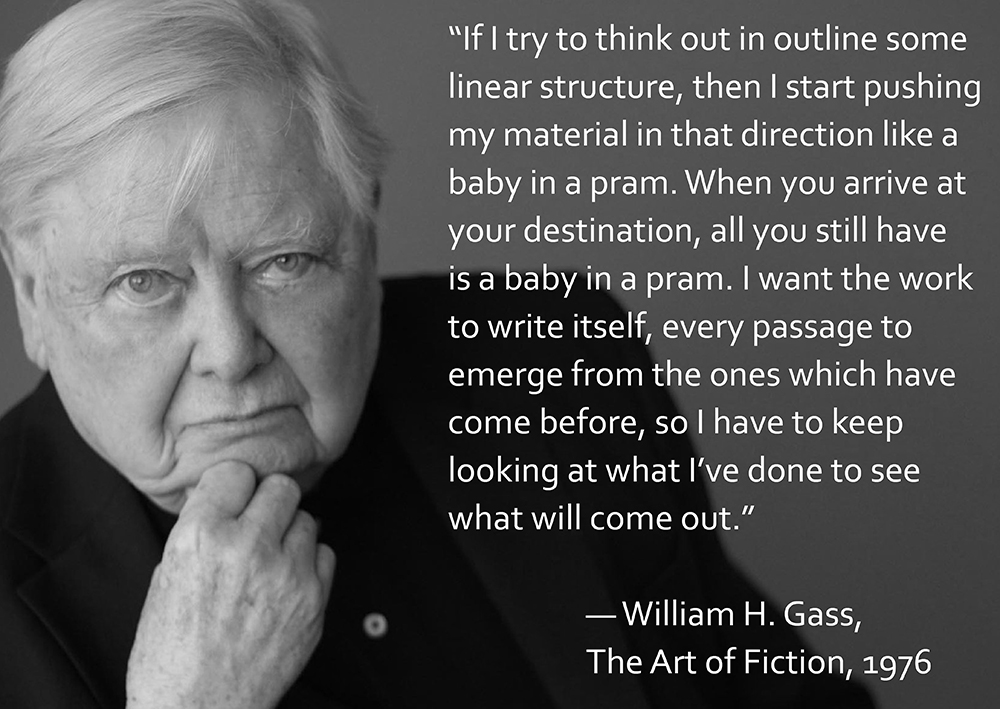
[This meme has to do with a topic I’ve recently written about: “To Plan or Not to Plan,” available here.]
And this:
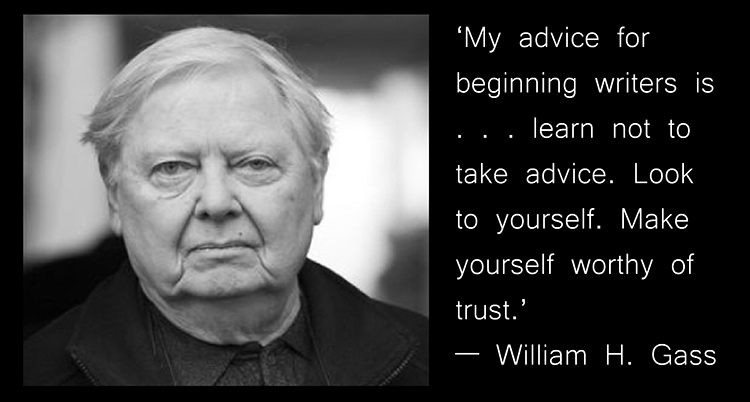
[During the presentation I talked briefly about the inherent problem of writing workshops or writing groups: No matter how well-intentioned, peers’ critiques are oftentimes wrongheaded, and an offhanded criticism can send the unwary writer down a frustrating and fruitless rabbit hole. Instead, writers must accept the unavoidable subjectivity of reader response and stay true to their artistic vision.]
And this:

[I felt this was an especially apropos sentiment to share since the conference was comprised of writers from across the globe — but mainly Asia, Australia and Europe — who compose in English, even though for many it’s not their first language.]
I want to touch on some specific ideas Gass had about writing narrative, but before we get there I’m inclined to discuss the cornerstone of his aesthetic philosophy – as well as my primary focus here: Throughout his long writing career, Gass’s main interest was language, and he sought to use it as a painter uses paint, a sculptor uses marble or metal, a composer uses musical notes, or a photographer uses light and shadow. He stated, in a 1976 interview, “As a writer I only have one responsibility, and that’s to the language I’m using and to the thing I’m trying to make” (Duncan 53). He elaborated elsewhere, “Old romantic that I am, I would like to add objects to the world worthy of love. . . . My particular aim is that it be loved because it is so beautiful in itself, something that exists simply to be experienced. So the beauty has to come first” (LeClair 48).
Allow me to restate Gass’s central tenet: The beauty of the language must come first. By extension, then, everything else – all the other elements associated with fictional narrative, plot, characterization, setting, etc. – are subordinate to the quality of the language, to the beauty of the language. Gass’s devotion to beautiful language took many forms. For example, he regularly employed literary devices we normally associate with poetry: alliteration, assonance, rhyming, repetition. As such, Gass considered himself a stylist, meaning that his main interest was the writing itself. “I’ve always been interested in writing as writing. My interest in the various forms is dominated by an interest in style as such” (Duncan 64). Though Gass considered himself an abysmal poet, his use of poetic language was, he said, “compulsive” and “turns up in almost every line of prose, in sound patterns that get pushy, even domineering” (“Retrospection” 43-44).
Gass’s drive to create art made of language led him away from using narrative elements in traditional ways. Mind you, not ways that are utterly unique – I’m a supporter of Adorno’s assertion that when it comes to art, there is nothing new under the sun, yet the true artist must strive for the new nevertheless – but ways that are certainly unusual in modern American fiction, especially popular fiction. For instance, we normally think of characters in fiction as people, or possibly animals or machines (generally, though, personified animals or machines). However, for Gass a character was “any linguistic location of a book toward which a great part of the rest of the text stands as a modifier” (LeClair 53). Gass’s ideas about characters and characterization were complex, and he wrote and spoke frequently about those ideas (I direct you, especially, to his essay “The Concept of Character in Fiction”), but I will try to communicate the essence of his thinking.
Drawing from the essay above: He wrote, “[T]here are some points in a narrative which remain relatively fixed; we may depart from them, but soon we return, as music returns to its theme. Characters are those primary substances to which everything else is attached . . . anything, indeed, which serves as a fixed point, like a stone in a stream or that soap in Bloom’s pocket, functions as a character” (49-50). As such, physical objects can be characters (everything from Lowry’s volcano to Gogol’s overcoat); symbols can be characters; ideas; concepts; situations. All can function a characters.
If we think of plot as what happens to a narrative’s central character (its protagonist), commonly how the character changes during the course of the narrative, we must be prepared to modify our sense of conflict, resolution and denouement when other things besides people operate as protagonists (and antagonists). A volcano or an overcoat or a crucifix or a bombing or fascism cannot have epiphanies (as Joyce would have phrased it). They do not change as, we hope, people change. No matter how many ghosts visit a volcano on Christmas Eve, it’s still a volcano on Christmas morning, with all the capricious and explosive qualities its kind is known to have.
To be clear, nearly all of Gass’s fiction is populated with human characters as their ostensible narrative focus (two exceptions are the brief stories “Don’t Even Try, Sam” and “Soliloquy for a Chair” in which the protagonist of the former is the legendary piano in the film Casablanca, while it is a folding chair in a barbershop that soliloquizes in the latter – both are collected in Eyes [2013]). However, the human characters’ primary function is to provide a scaffolding on which Gass can develop his thematic interests, and, perhaps chiefly, play with language. “For me,” he said, “a character is really a voice and a source of language. . . . Words are going to come out from that source either as direct speech or as a means of dictating the language you use in the third person to describe scenes or that individual from outside” (Saltzman 85). So, functionally speaking, human characters are providing the means (structurally and linguistically) by which Gass can explore other characters in the narrative: a concept, an attitude, a place, an object.
One may ask at this point: If in Gass’s fiction he was disinclined to maneuver his characters toward epiphanies, toward traditional, Aristotelean kinds of resolutions, how did he develop his narratives? What was their aim? In one sense, Gass developed a piece of fiction as one might develop an expository essay, with the objective being to more fully realize a particular subject. Ultimately, though, and overarchingly, Gass’s interest was to create a beautiful piece of writing: a work of art made of language. Perhaps he expressed his philosophy most clearly and most forcefully in a series of debates with fellow writer (and friend) John Gardner in the 1970s (audio recordings of one such debate session can be accessed here). Gardner believed that fiction should have a moral component, that it should teach the reader something important about how to behave in the world. Gass vehemently disagreed: “John wants a message, some kind of communication to the world. I want to plant some object in the world. . . . I want to add something to the world which the world can ponder the same way it ponders the world” (LeClair 48). Elsewhere Gass bluntly asserted that “literature in not a form of communication” (Duncan 49).
Since we are a gathering of writers, I want to end on what Gass believed to be a kind of side benefit of using artful language, a utilitarian additional advantage. He said, “Shakespeare succeed[s] mainly because the rhetoric succeeds. Psychological shifts, changes of heart, all sorts of things happen which are inexplicable, except that if the speech is good enough, it works. The same is true in the way I go at things” (Saltzman 83-4). To put it plainly, certain weaknesses in a narrative can be bolstered by using language beautifully. Readers can be distracted from fissures in the foundation if the architecture is elaborate and enchanting. May we all build such mesmerizing abodes with our material of choice: the English language.
Works Cited
Duncan, Jeffrey L. “A Conversation with Stanley Elkin and William H. Gass.” The Iowa Review, vol. 7, no. 1, 1976, pp. 48-77.
Gaddis, William. The Letters of William Gaddis, edited by Steven Moore, New York Review Books, 2023.
Gass, William H. Fiction and the Figures of Life. Knopf, 1970.
LeClair, Thomas. “William Gass and John Gardner: A Debate in Fiction.” Conversations with William H. Gass, edited by Theodore G. Ammon, UP of Mississippi, 2003, pp. 46-55.
Saltzman, Arthur M. “An Interview with William H. Gass.” Conversations with William H. Gass, edited by Theodore G. Ammon, UP of Mississippi, 2003, pp. 81-95.
—. “William H. Gass: Selected Correspondence.” Review of Contemporary Fiction,
vol. 11, no. 3, 1991, pp. 65-70.
—. “Language and Conscience: An Interview with William H. Gass.” Review of Contemporary Fiction, vol. 11, no. 3, 1991, pp. 15-28.
Bridging Donne with the Digital Age: William H. Gass’s Devotion to Baroque Prose
(The following paper was presented at the Louisville Conference on Literature and Culture Since 1900, held Feb. 23-26, 2023, at the University of Louisville. It was part of the panel “Some Forms of Postmodernism in American Fiction,” chaired by Hunter Augeri, Duke University. Other papers were “The Violence of Microscopy: Nicholson Baker’s The Mezzanine and Inverted Totalitarianism at the End of History” by Jonathan Vincent, Towson University; and “Susan Sontag’s Death Kit as Pre-Post-Fiction” by Charlie Bertsch, Independent Scholar.)

William H. Gass – master stylist and acclaimed author of novels, essays, criticism, and translation – passed away December 6, 2017, at the age of 93. In the last few months of his long life infirmity prevented him from writing, but not before he was able to bring his final work to completion, simply titled “Baroque Prose.” No doubt it wasn’t as fully rendered as he would have liked, nor as finely tuned certainly, yet it was a fitting end to a life devoted to language: absorbing it, analyzing it, diagraming it, and shaping it into some of the most artful forms ever spoken or read. William Gaddis considered his friend Bill Gass “our foremost writer, a magician with language” (507); John Barth admired Bill Gass the person, but “most of all . . . the writing: in the fiction, those inhospitable landscapes and typically pathetic-when-not-monstrous characters, marvelously rendered into language; in the essays, the play of mind and wide-ranging erudition lightly deployed. And in both the prose, the prose . . .” (72). Perhaps Watson L. Holloway, author of William Gass (1990), put it most succinctly when he refers to “Gass’s finely tuned word machine,” noting it is “the language that must be at the root of any appreciation of his work” (x).
Gass wrote and spoke about the supreme importance of the sound of language too many times to count. Just how much attention he gave the aural quality of language in his own work may best be seen in his comments about his friend William Gaddis’s writing. In Gass’s introduction to the Penguin Classics edition of The Recognitions, he says,
“[W]e must always listen to the language; it is our first sign of the presence of a master’s hand; and when we do that, when we listen, it is because we have first pronounced the words and performed the text, so when we listen we hear, hear ourselves singing the saying, and now we are real readers, we are participating in the making, we are moving the tune along the line. . .” (ix).
Sadly, Gass is not as well known, even among academics and worshippers of the written word, as he should be, so here’s a biography in miniature. Born in Fargo, North Dakota, in 1924, Gass was educated at Kenyon College (A.B. in philosophy, 1947) and Cornell University (Ph.D. in philosophy, 1954). We mainly associate him with Washington University in St. Louis, where he taught from 1969 to 1990 and then established and directed the International Writers Center there until his retirement in 2000. He also taught at the College of Wooster (1949-54) and Purdue University (1955-1969). His fiction and other writings began to appear in the 1950s, and his debut novel, Omensetter’s Luck, came out in 1966, quickly followed by the collection In the Heart of the Heart of the Country (1968), the highly experimental novella Willie Masters’ Lonesome Wife (1968), and the essay collection Fiction and the Figures of Life (1970). He began writing his magnum opus, The Tunnel, in 1966, not finishing it until 1992 (pieces of it appeared regularly over the years, especially in the journal Conjunctions). Knopf released The Tunnel, all 650 postmodern pages of it, in 1995, and it won the American Book Award the following year, meanwhile accumulating an impressive array of both rose-tossing admirers and stone-throwing critics. This is a much-abbreviated description of his writings and awards over the decades.
As noted, Gass spent nearly three decades working on The Tunnel, which is unusual among novelists, but it was typical for the way Gass approached all his writing projects. He tended to work with concepts for years before considering them complete enough to appear in print. By his own admission, Gass wrote slowly and revised obsessively. For instance, characters that first appeared in 1968’s Willie Masters’ are further developed in 1998’s Cartesian Sonata & Other Novellas. The intricate structure of The Tunnel was an elaboration of the structure Gass invented for the long story “In the Heart of the Heart of the Country,” first published in 1967. Gass’s final work is no exception. In fact, we can trace the origins of “Baroque Prose” all the way back to Gass’s unpublished doctoral dissertation, “A Philosophical Investigation of Metaphor” (1954). (Happily, the dissertation and even its early drafts are part of the Gass papers archived at Washington University’s Special Collections Department – a treasure trove of Gass material.)
A brief excerpt from “Baroque Prose” was published in Gass’s lifetime, barely, in the inaugural issue of LitMag, spring 2017; and a longer version of the same excerpt appeared posthumously in the online journal Socrates on the Beach, issue 4, 2022. Gass’s widow, Mary Henderson Gass, generously and graciously sent me the entire manuscript in anticipation of this presentation. To date, plans for publication of the work are undecided. My main goals for this paper are to provide a brief description of “Baroque Prose” and to try to communicate its essence. The latter is challenging for a short presentation. Anyone who has read Gass’s nonfiction recalls that it is both tightly structured and marvelously meandering within its parts, which are constructed of highly poetic prose, often with comic touches. If one has read Gass’s nonfiction, I would say “Baroque Prose” most closely resembles his book-length essay On Being Blue, which is a beautiful examination of all the things we may mean when we use the word blue. But the comparison is far from perfect.
First, there is the word that is at the heart of Gass’s last work: baroque. He spends a significant amount of time telling us what it is, and what it isn’t. We recall, of course, that baroque refers to a style most associated with the seventeenth and eighteenth centuries, frequently applied to European art, music and architecture. We are told by various sources that it was known for its grandeur, sensuous richness, drama, dynamism, movement, tension, and emotional exuberance. Gass does refer fleetingly to some of the art forms known for their baroque attributes, but as his title makes clear, he chiefly analyzes baroque prose, particularly of the seventeenth century as it was practiced in the pulpit by two master rhetoricians, John Donne (1571/2-1631) and Jeremy Taylor (1613-1667). I calculate the “Baroque Prose” manuscript to be about 35,520 words, but I do so without confidence. Gass gives us copious quotes from Donne and Taylor and others, often in single-spaced block quotes; and he indulges what was a lifelong pleasure by providing numerous detailed diagrams in the service of analyzing the passages. The manuscript is divided into three numbered and well-balanced sections of about 45-50 pages, each of which is wide-ranging and sometimes overlapping in scope. There is also a rough chronological organization at work, as Gass’s main interest in the first half of the book is Donne, and Taylor becomes the latter half’s primary focus.
Gass appears to have several purposes, including defining and describing what makes prose baroque; illustrating why it’s effective (when it is effective); describing its rise and fall in the historical context of Europe; providing biographies of principals like Donne and Taylor; arguing for our continued interest in the baroque style of prose; and telling an engaging story whose main character is baroque prose. Along the way, Gass is also entertaining us with his trademark style, not holding back at all in wowing us one last time with his signature metaphors and similes. And like all of Gass’s nonfiction (really all of Gass), “Baroque Prose” is both serious and funny.
As noted earlier, Gass always maintained that effective writing was meant to be heard, not just read on the page by the eyes, but spoken, even if only to one’s internal ear, which makes his attraction to the subject of baroque prose quite natural. Throughout the manuscript, he provides italicized statements about baroque prose, eye-catching insertions that focus the reader on a particular aspect of his central subject. The first italicized insertion says, “Baroque prose begins as prose prepared to be performed . . . a prose that is therefore far from the book or paper, living, if it lives, in the listeners’ ears” ([4]). In fact, continues Gass, “once [the prose] reaches print, it will no longer be pronounced, no longer heard, no longer fed its breath, so no longer in being.” Regarding Donne’s baroque performances from the pulpit (Donne was ordained to the priesthood in the Church of England in 1615 and made Dean of St. Paul’s in 1621), Gass tells us, “Later, when publication was considered, a good deal of polish would be applied, removing, like soil from a shoe, much spontaneity, accident, and improvisation. Reading him now we must imagine dramatic pauses, gestures, sudden changes of posture, a play of facial expressions, extemporaneous additions, and the drama of the whisper and shout” ([11]).
Gass breaks down Donne’s rhetorical strategy: “During his opening Donne is establishing, not his subject, or a textual interpretation . . . ; he is not springing an apothegm to satisfy the men or a sweet sentiment to please the ladies; rather he is gathering his ruling image and its materials as though he were a carpenter arriving at an important moment of construction. . . . Donne’s mind is always moving through the middle of a metaphor” ([15-16]). In this statement we can see that Gass is still working through an analysis that began with his doctoral dissertation, which he wrote in the early 1950s. In his philosophical inquiry into metaphor, Gass turned to Donne regularly. Oftentimes the precise passages appear in both the unpublished dissertation and “Baroque Prose” (for example, passages from Donne’s The Lamentations of Jeremy). One of Gass’s concerns in his dissertation was how prose writers use language devices, like metaphor, compared to how poets tend to use them; and he returns to that comparison in “Baroque Prose,” telling us that “in poetry [] modifiers often lie around as loose as change, so that the reader is at a loss to know into which pocket the pence should go . . . whereas, in prose, number and relation, modification and consignment are to be connected, balanced, obeyed, in pursuit of a coherent and completed arrangement” ([16-17]).
Here is an abbreviated summary of some of Gass’s italicized insertions: “Baroque prose is written as if it were the libretto of an opera; as if it had to compete with an organ . . .” ([17]). Another: “The audiences of baroque prose admired a quick mind and the courtly flourish; they enjoyed it when their man in the pulpit showed a bit of wit and strut. There was a deep playfulness in this prose . . .” ([20]). And another: “Baroque prose loves the parenthetical, the marginal, the afterthought, the postscript, which it then inserts into the middle of things like herbs are stirred into a boiling pot . . . ” ([28]). Yet another: “Baroque prose is built on, and out of, conflict and chaos, paradox and bafflement. Its wish is for the harmony of dissident chords, the melody of dissenting lines . . . “([113]). In each case, Gass expands on the idea with explanation, quotations, and analysis.
In Part 2, Gass turns his attention primarily to Jeremy Taylor, who “does not seem to be as troubled a soul as Donne, and he is certainly, in every way, a more temperate man, liberal to a fault according to his peers” ([49]). Gass then provides a brief biography of Taylor, who was eventually made Bishop of Down and Conner Diocese, in Ireland, by Charles II. Gass points out that Taylor’s preaching was known for its “loose style,” but he goes on to assert that there is a complex rhetorical strategy at work, easily missed by the casual listener (or reader). Gass’s extensive analysis includes detailed diagrams to illustrate the mastery of Taylor’s baroque rhetoric. He again enters into a comparison of poetry versus prose: “Poetry calls out, through the dispositions of its lines, to be read as it requires; but the words that queue up to be prose are like subway passengers during rush: crowded hip to thigh, briefcase to umbrella, shoe to shoe” ([53]).
Gass’s detailed analyses of Taylor’s sermons continues into Part 3, as does his biographical narrative, which is a segue to discussing how the baroque style fell out of favor in England and Europe generally. Gass calls 1641 “[t]he dreadful year” as Taylor was briefly imprisoned and then removed from his clerical posts. Gass writes, “On the European continent the Thirty Years War had been killing people since 1618. Later scholars would declare the conflict in Europe closed in 1648. But England would have its own war now . . .” ([108]). With the rise of Puritanism, baroque’s ornate style of preaching would be out of step with the simplicity they sought. “Another enemy was length,” says Gass. “Sermonizers are likely to be strongly winded, as if their voices were to become themselves sturdy columns, built to last as eternally as a cathedral’s. The Puritan dictatorship had banned all public amusements [including entertaining styles in the pulpit]” ([108]).
Then came another blow to the baroque: the scientific ideal after 1660. Robert South, an opponent of the baroque, “began his attack on rhetorical preachifying by claiming that only the ignorant were impressed by verbal flourish” ([111-112]). In the remainder of the manuscript, the final 30 pages or so, Gass races through the history of the baroque style to the present, meanwhile cataloging with precision various characteristics that make it deserving of our appreciation today, like highlighting “what a little excess will do for you” ([70]). In sum, he says, “In the baroque, beauty begs for more beauty” ([119]). In the these final pages, Gass gives us baroque examples from more modern authors than Donne and Taylor, for instance a passage from Mark Twain’s Life on the Mississippi.
On the one hand, Gass is typically funny in this, his final work, but he has also come to terms with his approaching end. After talking about John Milton’s “flowery style,” Gass says, “I shall take a look at Milton’s use of adjectives later on. And adverbs even later”; then adds in a new paragraph, “A promise I shall probably break” ([33-34]). At first, one thinks he means he will not return to the topics in this book, but really Gass means he will likely never have the chance to write about them. Later we get another comment that, though humorous, underscores Gass’s sense of the inevitable. Following a full-page paragraph, Gass inserts in brackets, “I have decided to leave the foregoing paragraph as it first fell upon the page, as a warning to those who compose” ([82]). Gass, the relentless rewriter of his work, has run out of time and energy to wrestle a paragraph into perfection.
Midway through Part 1, Gass elaborates on the delight of repetition in the baroque and other nuanced techniques, drawing the conclusion, “The difference between writers we should study and admire, and those we may safely ignore, partly lies in their attention to such subtleties” ([21]). Here, it seems, Gass is subtly (or maybe not so subtly) making the case that his work should continue to be studied after his death as his own baroqueness is on full display in practically everything he published. I, for one, have never needed any such prodding. Gass will continue to be the main focus of my scholarship and a limitless source of inspiration for my teaching and writing.
Works Cited
Barth, John. “As Sinuous and Tough as Ivy.” The Review of Contemporary Fiction, vol. 11, no. 3, 1991, pp. 71-72.
Gaddis, William. The Letters of William Gaddis, edited by Steven Moore, Dalkey Archive Press, 2013.
Gass, William H. Introduction. The Recognitions, by William Gaddis, 1955, Penguin Classics, 1993, pp. v-xv.
––. “A Philosophical Investigation of Metaphor.” Doctoral dissertation, Cornell University, 1954.
Holloway, Watson L. William Gass. Twayne, 1990.
“Honored by the Error”: The Literary Friendship of Gass and Gaddis
The following paper was presented at the William Gaddis Centenary Conference, Washington University, St. Louis, Missouri, October 20-22, 2022. It was part of the opening panel on Friday, Oct. 21, “Historical Gaddis & Literary Gaddis.” I had the honor of introducing the keynote speaker, Steven Moore. See the end of this post for my introductory remarks.

Anyone who knows William Gaddis or William Gass more than just a little likely knows of their long friendship. They first met at the National Book Award ceremony April 21, 1976—Gass being one of the judges that gave the prize to J R—and when Gaddis was near death in 1998 Bill Gass was one of the last people he wanted to speak to. Unfortunately Gass received the message too garbled and too late, and that final telephone conversation never took place. Throughout their more than twenty-year friendship, they supported each other’s work in myriad ways, both publicly and privately, and they shared in the amusement of people confusing them due to their sound-alike names and similar ambitions when it came to the written word.
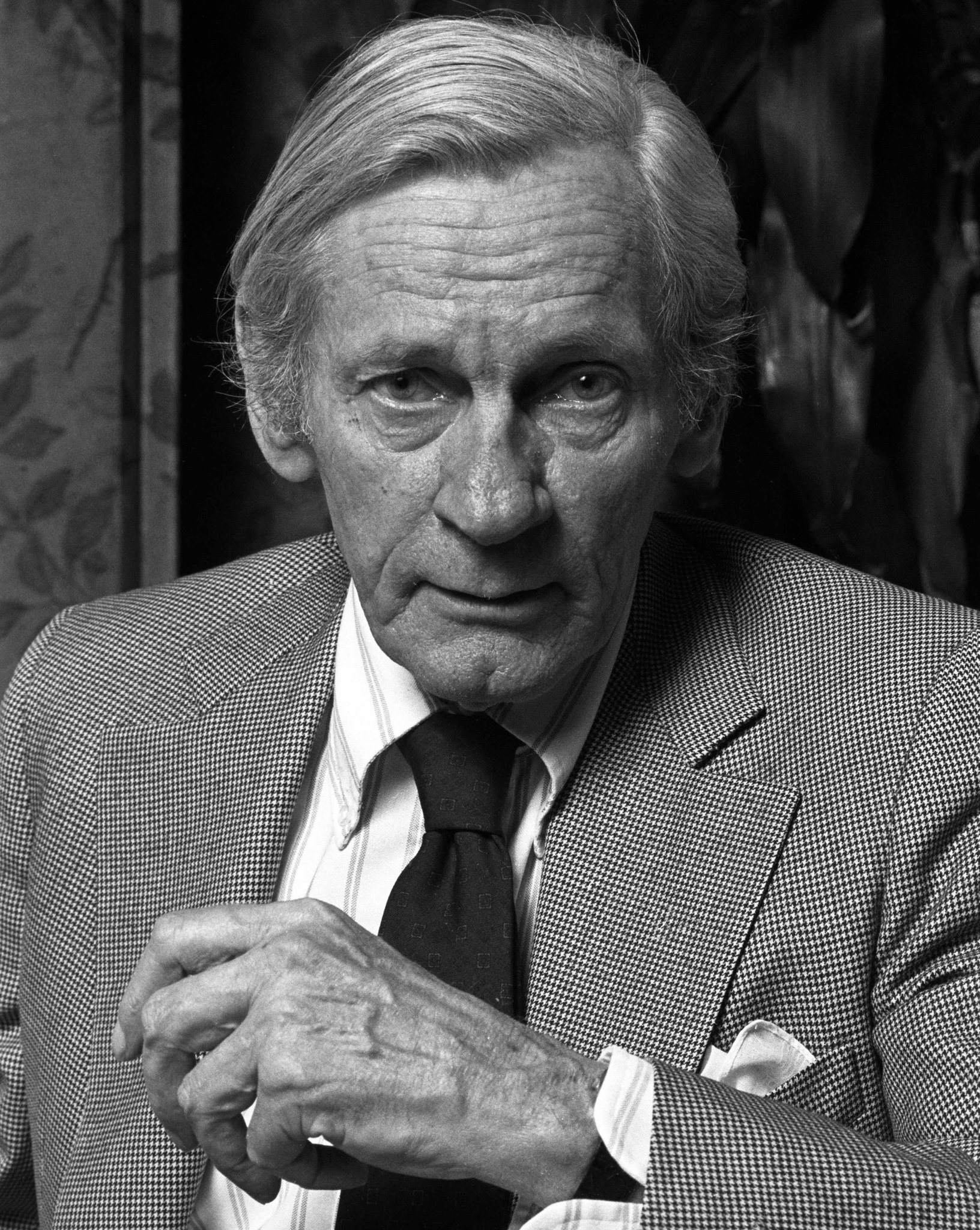
I’m ashamed to admit that I was nearly 40 when I learned of both writers practically simultaneously, which I hope indicts the shortcomings of the U.S.’s literary culture more severely than it does my own. What I mean is, I read Gass’s brilliant introduction to The Recognitions before embarking on my maiden voyage into Gaddis’s now-mythical inaugural novel. Indeed, Gass’s introduction is probably almost as well known as the novel itself, and quite possibly more frequently read than the masterpiece it precedes in the Penguin Classics edition. The intro took on a life of its own, being reprinted in various iterations and quoted countless times. Unlike the book it introduces, the piece’s brilliance was recognized (sorry) from the start. Michael Millman, senior editor at Viking Penguin, wrote to Gass on January 21, 1993: “Would you have any objections to our approaching The New York Times Book Review [sic] about running your introduction? In my experience . . . I can’t remember another time when we had an essay of this caliber as an introduction to one of our volumes. . . .”

As we recall, Gass begins the piece by talking about the enigmas and confusions surrounding William Gaddis. Writes Gass, “Even The New York Times, at one low point, attributed his third novel, Carpenter’s Gothic, to that self-same and similarly sounding person. Yes, perhaps William Gaddis is not B. Traven after all, or J.D. Salinger, Ambrose Bierce, or Thomas Pynchon. Perhaps he is me” (179). What follows is where I borrowed for this paper’s title: “When I was congratulated,” continues Gass, “I was always gracious. When I was falsely credited, I was honored by the error.” In his tribute to Gaddis, in 1999, Gass said that he “could enjoy these mistakes, since Gaddis seemed equally amused” (204).
It’s difficult to say when the two writers became aware of each other’s work. They were close contemporaries. Gaddis was born in 1922, Gass in ’24. The Recognitions came out in 1955, the same decade that Gass’s earliest fiction began to appear (the literary journal Accent, published by University of Illinois-Urbana’s English Department, co-edited by Stanley Elkin, included three pieces by Gass in its Winter 1958 number). Gass’s writing began to appear here and there in this journal or that (unlikely to be on Gaddis’s radar), but his first novel, Omensetter’s Luck, came out in 1966, quickly followed by In the Heart of the Heart of the Country (a collection of novellas and stories) and Willie Masters’ Lonesome Wife (a wildly experimental novella), both in 1968, and Fiction and the Figures of Life (a collection of essays, including essays on the writer’s craft), in 1970. The essays were well regarded by Gass’s peers. We know, for example, that Cormac McCarthy acquired a copy of the collection while he was writing Child of God, published in ’73 (King 31).
It seems fair to assert, then, that by the ’70s both Gaddis and Gass had read one another, and apparently approvingly. In a Gaddis letter dated March 17, 1976, having to do with J R’s National Book Award nomination, he references Gass, writing to his second wife Judith, “But if the book selections are odd, the judges are even odder; a writer, a critic, and a complete idiot: Wm Gass, Mary McCarthy, and Maurice Dolbier” (Letters 310). Compared to the epithet he uses for Dolbier, a novelist among other things, too, the neutrality of “a writer” almost sounds like praise. That same year, 1976, Gass talks about Gaddis in his “Art of Fiction” interview in The Paris Review, specifically in response to Thomas LeClair’s question “Who are some living novelists you respect?” Gaddis makes the list. Gass says he admires Gaddis for the same reasons he admires John Barth: “What I like . . . is the unifying squeeze which that great intellectual grasp of his gives to his work, and the combination of enormous knowledge with fine feeling and artistic pride and total control. I really admire a master” (37). Gass underscores Gaddis’s masterful control of the narrative apparatuses in his books.
Gass read his peers’ work and commented on it regularly, in interviews, guest lectures, critical articles, and book reviews. Gaddis, on the other hand, was not inclined to read his contemporaries. Steven Moore writes that “[h]e seemed to have little interest in the novels of those contemporaries with whom he is most often associated,” including Barth, Barthelme, Robert Coover, Don DeLillo, John Hawkes, Cormac McCarthy, and Thomas Pynchon. “William H. Gass was an exception,” says Moore, “whom he admired both personally and professionally” (William Gaddis 13). At the tribute to her father in 1999, Sarah Gaddis said, “William Gass was important to Gaddis. . . . He held Gass in the highest esteem for his work, and no other writer made him feel so understood” (150-151). This respect for Gass and his opinions, literary and otherwise, is made clear by Gaddis’s frequently quoting or paraphrasing his friend in letters to others over the years (e.g. see Letters pp. 423, 459, 464, 477 and 481); and his admiration for Gass’s abilities as a writer is put plainly in an April 13, 1994, letter to Michael Silverblatt, host of the literary radio program Bookworm: “Gass is for me our foremost writer, a magician with the language” (Letters 507).
Similarly, Gass’s admiration of Gaddis had a great deal to do with his poetic use of language. In a 1984 interview with Arthur M. Saltzman, Gass said that “all the really fine poets now are writing fiction. I would stack up paragraphs of Hawkes, Coover, Elkin, or Gaddis against the better poets writing now. Just from the power of the poetic impulse itself, the ‘poets’ wouldn’t have a chance” (91). In Gass’s introduction to The Recognitions he writes about the poetry of both that book and J R, saying: “. . . J R was as different from the earlier novel as Joyce from James. But do not put down what you have to go to J R yet, even if it is almost as musical as Finnegans Wake. . . . [W]e must always listen to the language; it is our first sign of the presence of a master’s hand; and when we do that, when we listen, it is because we have first pronounced the words and performed the text, so when we listen, we hear, hear ourselves singing the saying . . .” (184).
After their meeting at the National Book Award ceremony, the two writers became fast friends. The following year they were slated to be at a writers’ conference in Sarasota, Florida, and Gaddis’s participation was somewhat contingent on Gass’s being there, also. In a March 18 letter to Judith, Gaddis laments that other writers had canceled or declined—namely Barth, Susan Sontag, and Donald Barthelme—and says that “if Gass abruptly disappears I may be tempted to do the same.” Gaddis explains that he was looking forward to “hav[ing] a good & encouraging talk with William Gass [who is] coming with his wife [Mary].” Otherwise Gaddis had been “shying from readings and panels” because they interfered with his writing process. He notes that “Gass admires me because I’ve been able to stay out (till now), I admire him because he separates it all clearly & relaxedly in his head” (Letters 319). Later that year, Gaddis was scheduled to appear at an event closer to home, in Stonington, New York, for which—he says in a July 7, 1977, letter to Joy Williams and Rust Hills—he was “girding his loins.” Part of his trepidation was that “it won’t have Gass” (321).
Reading their personal correspondence, filled with warm regards and jokes that each man knows will land because of their kindred kinds of humor, it is obvious how much they genuinely liked each other. An excellent example of this tone appears in a letter to Gass dated August 25, 1980, in which Gaddis alludes to a previous trip to Washington University in St. Louis. Gaddis begins, “Dear Bill. Attending a stylish Hamptons opening of a very good painter [Polly Kraft] out here.” He believes that Gass will appreciate her art and has enclosed some slides of her paintings. He says, “I inveigled them from her on grounds of your sterling generous & rowdy character & Mary’s good looks.” Then, “I write this on the assumption that you are still alive, after day after day reports of 114° in St. Louis (my recollection being -10°)” (Letters 358). Gaddis had been in St. Louis in February 1979 for a three-week teaching session at Wash U. A few months beforehand (October 14, 1978) he wrote to his daughter Sarah about receiving “a letter from Washington Univ in St. Louis (where Bill Gass is)” with the teaching proposal. The letter was from Stanley Elkin, a writer who is “marvelous.” Gaddis says that he “accepted immediately . . . mostly for the prospect of rowdy time with Elkin & Gass & I’m really looking forward to it. I think we’ve all 3 got similar views on what good writing’s about plus highly compatible senses of humor” (Letters 341). He concludes the August 25, 1980, letter by encouraging Gass and his wife to visit him on Long Island when they can. It is an open invitation that Gaddis expresses in several letters.
Their relationship was not just about mutual admiration and sharing “rowdy” times together. They also did what they could to advance each other’s careers and reputations. Gass’s efforts on Gaddis’s behalf began with his judgment of J R for the National Book Award and continued for the next two decades. It included his writing the introduction for the Penguin edition of The Recognitions, and his being instrumental in bringing Gaddis to St. Louis to teach, and then again, in 1994, to contribute to a symposium on “The Writer and Religion.” What is more, Gass wrote a recommendation that contributed to Gaddis’s being awarded a Guggenheim Fellowship in 1981. Gaddis wrote to him (April 12), “Do you KNOW what joy (read money, prestige, vainglory) your kind effort has contributed to this modest household?” (Letters 361). Gaddis, for his part, appeared to always have Gass’s best interests at heart. In the 1980 letter in which he references St. Louis’s harsh weather, he also writes that he “escaped Knopf for Viking (a move I’d encourage you in . . . enthusiastic leaves-you-alone . . .)”; and he recommends a specific editor at Viking he thinks Gass would like (Letters 358). In 1991 and ’92 Gass more or less sequestered himself at the Getty Center in Los Angeles, to complete, at long last, his novel The Tunnel, which he’d been writing since 1966. Gaddis wrote to him at his Santa Monica address to offer some comic relief (composing much of the letter in Huck Finn-esque dialect), as well as encouragement and support. He says, “[I]t would be something if we both finished these god dam books this same year 1992 . . .” (“Letter [January?] 1992”). Gaddis, presumably, is referring to A Frolic of His Own, published in 1994. Gaddis informs Gass that his daughter Sarah is soon to arrive in California also and closes by saying “let me know if theres [sic] anything I can do for you here.”
If one were to do a Venn diagram (so popular these days) of the two writers’ influences, there would of course be notable common ground. Both had a taste for some Medieval authors as well as Elizabethans, especially Donne and Shakespeare (Gaddis’s favorite play was As You Like It, while Gass counted Antony and Cleopatra as one of his “Fifty Literary Pillars” [Moore 11; Gass 36]). Contemporary European authors were among each man’s favorites, perhaps most notably Rilke, who was Gass’s literary lodestar. They had their differences too, however. Gaddis claimed to have read little of James Joyce, in spite of the critics who were convinced of the Irish writer’s influence; whereas Gass counted Ulysses and Finnegans Wake among his “pillars” and alluded to Joyce frequently in his nonfiction. Perhaps the most significant disagreement centered around Russian novelists, particularly Dostoevsky, whose place for Gaddis, says Steven Moore, was “paramount” (10).
This difference of opinion was comically and touchingly captured by Gass in his piece about the two writers’ participation in a trip to Soviet Russia in 1985, which included frigid visits to landmarks associated with Dostoevsky and especially his writing of Crime and Punishment. Gass was in the mood to be flippant and wanted Gaddis to be too. Writes Gass, “Gaddis’s love for the Russian novel—and for the predictable Russians at that—had surprised me, though in hindsight it shouldn’t have, if I’d kept The Recognitions fully in front of me . . .” (94). As such, Gaddis didn’t “relish [Gass’s] popping off” during the tour, and Gass’s wife Mary worked to keep his tongue in check by squeezing his arm when she knew he was about to say something that could prove regrettable. Gass continues, “I could see [Gaddis’s] youthful love glowing plainly when our group visited Dostoyevsky’s apartment. The sight of the master’s desk actually wet Willy’s eyes. I envied him. When my eyes moistened, it was only for Bette Davis, and such a shallow show of weakness made me angry with my soul” (196-97).
Gass concluded his tribute to his friend by recounting Gaddis’s arrival at a celebration in his honor in Cologne, Germany: “Gaddis slowly emerged into a starfall of flashbulbs worthy of the Academy Awards, the popping of a hundred corks” (205). I don’t believe in an afterlife, although I think it’s a swell idea. In fact, I like to imagine a Literary Great Beyond, a kind of Valhalla for writers instead of warriors. And if such a place did exist, I would hope that the great friends, Gaddis and Gass, were both greeted as novelist titans just as Gaddis was on that glorious Teutonic night.
Works Cited
Gaddis, Sarah. “A Note of Gratitude.” Conjunctions 33, 1999, pp. 149-51.
Gaddis, William. Letter to William H. Gass. [January?] 1992. Gass Papers, Washington University in St. Louis.
——. The Letters of William Gaddis, edited by Steven Moore, Dalkey Archive Press, 2013.
Gass, William H. A Temple of Texts. Dalkey Archive Press, 2007.
King, Daniel Robert. Cormac McCarthy’s Literary Evolution: Editors, Agents, and the Crafting of a Prolific American Author, The U of Tennessee P, 2016.
LeClair, Thomas. “William Gass: The Art of Fiction LXV.” Conversations with William H. Gass, edited by Theodore G. Ammon, UP of Mississippi, 2003, pp. 17-38.
Millman, Michael. Letter to William H. Gass. 21 Jan. 1993. Gass Papers, Washington University in St. Louis.
Moore, Steven. William Gaddis: Expanded Edition, Bloomsbury, 2015.
Saltzman, Arthur M. “An Interview with William Gass.” Conversations with William H. Gass, edited by Theodore G. Ammon, UP of Mississippi, 2003, pp. 81-95.
Keynote Introduction of Steven Moore
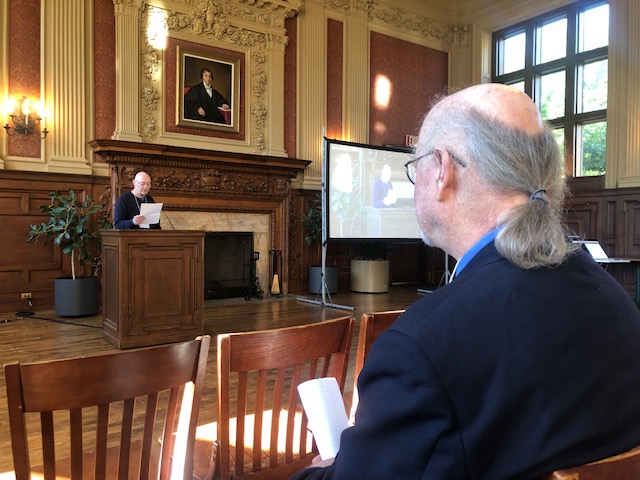
I don’t recall the context, but some twenty years ago I said “Everything I know about William Gaddis I learned from Steven Moore.” For the past few weeks, in anticipation of this conference, I’ve been getting back into a William Gaddis state of mind, and it occurred to me that the statement is still true. Everything I know about William Gaddis I learned from Steven Moore. Like so many of us, I first encountered Steven’s scholarship while grappling with The Recognitions. His Reader’s Guide, first published in 1982, was an invaluable lifeline. A revised edition appeared in 1995, and an edition translated into German was brought out in 1998. As my own interests were sparked by Gaddis’s work, Steven continued to be my guide, especially his critical biography of Gaddis and his books, simply titled William Gaddis—both the 1989 edition, and the expanded edition of 2015. As if being the founder and leading voice of William Gaddis studies wasn’t enough, Steven has produced scholarship in an impressively diverse range of areas; perhaps most notable are his two volumes of The Novel, An Alternative History, the latter of which won the Christian Gauss Award for literary criticism in 2013. However, one of the more obscure credits on his bibliography is the most personally meaningful to me. In 2012 I was finalizing my first academic book for publication—a postmodern take on the Anglo-Saxon poem Beowulf—and my publisher was hoping I could land a scholar of note to write the book’s foreword. I was hoping that too. A few years earlier I’d had one brief exchange of emails with Steven. He’d actually contacted me for assistance with a Gaddis project (I think he was editing the letters). In my recollection I was little to no help. However, that one exchange encouraged me to reach out to Steven about writing the foreword. To my surprise, he agreed to do it. I sent him the manuscript and in short order he’d written a wonderfully insightful, not to mention generous, opening for the monograph. My only concern was reading reviews that would say something like “What a terrific foreword—it’s too bad Steven Moore couldn’t have written the whole book.” Luckily for us all, Steven has written several whole books, and he’s not done yet. This coming spring, Zerogram Press will release his memoir Dalkey Days about his time with the legendary Dalkey Archive Press from 1987-96. We have to wait a bit for the book, but our time of waiting to hear this keynote address—on “New Directions for Gaddis Scholarship”—is over. Please help me welcome Steven Moore.
Joyce’s Ulysses as a Catalog of Narrative Techniques for MFA Candidates
(The following paper was presented at the Southwest Popular/American Culture Association Conference in Albuquerque, New Mexico, Feb. 26, 2022, moderated by Yasminda Choate, Seminole State College.)
I must say regarding the title of this talk: what it lacks in cleverness it at least makes up for in near-childlike self-explanation. I’m going to discuss why focusing an entire course on a single daunting text like Ulysses is worthwhile, at least in the setting of an MFA program; and I’m going to offer some specific suggestions for reading focuses and writing assignments. (It’s not one of those papers you run into at conferences sometimes, a paper that purports to be about how waxed fruit influenced the writing style of Gertrude Stein, and ten minutes in the presenter hasn’t yet mentioned waxed fruit, Gertrude Stein, or writing style, or, for that matter, writing.)

First some further context: I teach in an MFA in Writing program that has both on-campus and online courses of the two traditional varieties: workshop and literature. I teach online literature courses exclusively. Nevertheless, I do think this course, or this kind of course, could work just as well in-person. I have the luxury of designing my own courses. Maybe three years ago, I decided to pitch a course with a singular focus: James Joyce’s legendarily difficult novel Ulysses. My thinking was that it would be a great text for discussing a wide array of narrative techniques, all gathered together in one unruly place. Also, for people planning to be fiction writers (meaning probably novelists) and perhaps wanting to be college teachers themselves, being familiar with the book that many consider the greatest English-language novel of the twentieth century, if not of all time, would be beneficial—if for no other reason than to avoid embarrassment at some future department mixer.
I’ve now taught the course several times (four?), and it’s scheduled again for this summer. From my perspective it’s been a success, and also a blast to teach. Student evaluations support my perspective. (Pro tip: I call the course “Joyce’s Ulysses” to try to avoid confusion; nevertheless, I do get the occasional student hoping to take a deep dive into Homer—which would also be a great course.) The course attracts students with a variety of motives, but a common one is that they’ve tried reading Ulysses before—and have had to limp, defeated, from the field of battle (a nod to Ulysses’ first publishers, Jane Heap and Margaret Anderson). Or, often, it sat on a shelf, untouched, glaring arrogantly at its owner for years. Now, with some guidance and the motivation of a grade hanging in the balance, they hope to slay the beast, or at least land a scratch.
I can relate. I’m among those who tried and failed a few times to read Ulysses before finally getting through the text in its entirety. So as a recovering Ulysses failure, I can speak to the students on their own level of self-loathing, and offer them the sort of encouragement they need to not drop the course after seeing the reading requirements. When I started teaching Ulysses we had eleven-week sessions; then the program was revised to offer eight-week sessions. The book was a bear to teach in eleven weeks, so eight is extra challenging. Yet doable.
We look at two episodes per week, and tackle an inhumane amount of material the penultimate week, episodes 16, 17, and 18; that is, Part III, “Eumaeus,” “Ithaca,” and “Penelope,” some 150 pages—which isn’t unusual in a typical grad course, but it’s 150 pages of Ulysses, capped off by Molly Bloom’s nearly punctuation-free, stream-of-consciousness monologue. To accommodate the move from eleven weeks to eight weeks, I basically cut Part I, the three opening episodes that focus on Stephen Dedalus, and begin in earnest with Leopold Bloom starting his day in Episode 4, “Calypso.” I provide a summary of those opening episodes and encourage students to read them even though they aren’t required per se.
I stress—again and again—that our purpose is not to unlock all the literary mysteries of the novel. Joyce specialists (of which I am decidedly not one) devote whole careers to the book, or only individual episodes. Rather, we want to achieve a basic understanding of what happens in the book, yes, but more importantly we want to lift the hood and see what Joyce was up to in individual episodes, and in the structure of the novel as a whole. In other words, we’re reading the novel as practicing writers, not as literary scholars. I hope to spark an interest in Joyce so that later in life students may feel warm and fuzzy enough about Ulysses to return to it, and to engage with other Joyce texts. Typically I do have a few students who’ve been bitten by the Joyce bug by the end of the session, and they ask for recommendations about where to go next, unaided. Finnegans Wake?, they sometimes ask. God no. I generally recommend Dubliners, and even more specifically “The Dead,” which is available in stand-alone critical editions if a reader is so inclined.
Another piece of advice I offer at the outset: The novel features a cast of thousands, and trying to synthesize all of the characters into your gray matter for easy recall later is probably one of the reading habits that leads to so many normally successful readers giving up in a hailstorm of self-condemnation. Instead, I say, there are just three main characters—Stephen, Bloom, and Molly—so keep an eye out for them. As long as you have a sense of what they do in the novel, from episode to episode, until you reach the Promised Land of “Yes” at the end of 18, then you’re doing just fine.
(We do get into some literary analysis, and one of the aspects we talk about is the novel’s unusually encyclopedic nature, and that Joyce didn’t intend, probably, for it to be read like a typical novel. There’s just too much data to try to hold in one’s head from start to finish. I will admit that in spite of reading the novel from stem to stern at least twice, and some sections multiple times, and even having published about it, plus taught it multiple times, it’s not uncommon for me to read an article or hear a presentation on the novel, and think, “That happens in Ulysses? Really? That sounds interesting.”)
Students are required to write weekly discussion posts based on the episodes, and I give them something concrete to glom onto. I share with them the famous Ulysses schemas, the Gilbert and the Linati, and ask them to write about how two of the elements operate in the week’s readings. Again, I don’t pretend that this an approach that will help them penetrate to the core of the novel’s meaning. Rather, as writers we’re looking at ways that Joyce tried to unify eighteen episodes, or chapters, that use increasingly experimental techniques of storytelling and shift point of view frequently. The schemas are one method, as are the running parallels with Homer’s Odyssey (which are often hard to spot even when one knows to look for them). Another unifying element is Joyce’s attention to chronology, with the narrative unfolding in more or less accurate time over 24 hours. Finally, there is Joyce’s attention to the point of obsession regarding the geography of Dublin in June 1904.
The novel is famous for its stream-of-consciousness narration, which nowadays isn’t exactly revolutionary. Joyce is, however, a master of the technique so a closer examination of almost any episode can lead to a fruitful discussion of how it’s working in detail. “Penelope,” of course, is the example par excellence of interior monologue. To mimic the randomness of one’s thought process, Joyce uses almost no punctuation for more than 30 pages, a section broken into only eight “sentences.” Nevertheless, we can isolate specific thoughts and images. How does Joyce manage it, without the traditional use of punctuation?
Every episode offers a multitude of techniques that could be of value to fiction writers, but in the interest of time here are some approaches that stand out to me.
Episode 4, “Calypso.” The opening three episodes, focused on Stephen Dedalus, establish a realistic chronological approach in the novel, from the start of Stephen’s day at the Martello tower to his meeting with Mr. Deasy to his walk along the strand. Then, abruptly, in this fourth episode time is reset to around 8:00 as we’re introduced to Leopold Bloom. From then on time in the novel unfolds consistently. The lesson: Don’t be afraid to break your own rules.
Episode 6, “Hades.” Bloom takes a carriage ride with three men who are also attending Paddy Dignam’s funeral. Bloom is both part of the group and yet set apart from his companions because of his Jewish heritage and being seen as a quasi-foreigner. This feeling, of being alone in a crowd, is exquisitely human and has obviously been explored by writers and artists throughout history, but no one does it better than Joyce in this iconic episode. The lesson: How to create a character who is both accepted into a social circle while simultaneously being excluded from it.
Episode 7, “Aeolus.” Bloom visits the Freeman newspaper offices, where he has a series of encounters, including with Stephen for the first time in the novel. This episode initiates Joyce’s more overtly experimental techniques as he breaks up the narrative with frequent headline-like insertions throughout. These headlines were a relatively late addition to the episode as it was published without them in The Little Review. Lesson: Don’t be afraid to play with narrative techniques and step from behind the curtain as the storyteller.
Episode 9, “Scylla and Charybdis.” Here Stephen expounds on his theory regarding Shakespeare’s Hamlet in the National Library with a group of fellow literati. His theory has been alluded to previously in the novel. Intertextuality—bringing other texts to bear on the narrative’s primary text—happens frequently in Ulysses. Indeed, Homer’s Odyssey serving as a structural apparatus is itself intertextual. But the use of Hamlet as a well-known literary figure (perhaps the best-known literary figure) to amplify the novel’s own concerns about parent-child relationships, among other issues, is worthy of careful study. Lesson: Bring other texts into conversation with your own narrative.
Episode 10, “Wandering Rocks.” In this scene our attention wanders between a host of different characters and objects. Very little happens in terms of advancing the novel’s plot, but Joyce brings together many of the characters and items of significance we’ve already encountered. Many see this odd episode—with its cinematically sweeping point of view—as a way to tie the earlier (more conventional) chapters of the novel to the later (more experimental) chapters. Lesson: Chapters can have principal objectives other than to advance the plot or evolve characterization; they can serve more purely artistic functions.
Episode 12, “Cyclops.” We join Bloom in Barney Kiernan’s pub, but from the point of view of a new anonymous, first-person narrator. Besides the switch in POV, Joyce also plays with various prose styles, including Irish mythological, legalistic, journalistic, and biblical. This episode, then, breaks two cardinal rules young writers often learn in workshop: to be consistent when it comes to (1) point of view and (2) voice. Without warning, Joyce switches from third- to first-person, and then injects some thirty different prose styles into the telling. Lesson: Know the rules so that you can break them; or, the only rule when it comes to telling a compelling story is that there are no rules.
Episode 14, “Oxen of the Sun.” Joyce takes the technique of Episode 12—the use of multiple prose styles—and goes even further by emulating the evolution of the English language, from its Latin/Germanic roots to Anglo-Saxon to Chaucer to Shakespeare to Defoe to Lamb, and many more. The plot advances at the Holles Street maternity hospital, but it does so via this history of the stages of the English language. Lesson: Have fun. Don’t be afraid to toy with voices and styles within the same piece.
Episode 15, “Circe.” We find ourselves in Nighttown, Dublin’s red-light district, but now the storytelling mode is dramatic. The episode unfolds as a play script, complete with character names and stage directions. The lesson: Go ahead. Begin in one mode and switch to another; then back again, or whatever you feel like doing.
Episode 17, “Ithaca.” Bloom and Stephen walk to Bloom’s residence, an important plot advancement, especially in light of the novel’s Odyssey subtext, but now it’s told via a series questions and answers, resembling, most say, either catechism or Socratic dialogue. Lesson: Why the heck not?
And like Bloom, we return to Episode 18 and No. 7 Eccles Street.
A quick word or two on other kinds of writing assignments one might assign, besides the weekly posts tied to the schemas. For their final project, I have students try their hand at one or more experimental techniques they’ve encountered in the book, creating their own original scene. It’s a two-part assignment. There’s the creative writing itself; then there’s an analytical element in which they identify the episodes and techniques they used as inspiration, quoting and citing from the novel as needed.
In the original eleven-week version of the course, I attempted an ambitious midterm paper. I had students access an episode as it first appeared in either The Little Review or The Egoist (using the Modernist Journals Project online), and compare it to the 1922 book version, identifying Joyce’s revisions and speculating as to why Joyce may have made the changes (almost always additions) that he did. That is, what did he gain through revision? I think it’s a terrific assignment, but, as I say, ambitious, and students were not terribly successful with it. It is perhaps too labor intensive when up against the amount of reading students have to do just to keep pace with the syllabus. So when we went to eight-week sessions, I dropped the assignment. My main purpose was to emphasize the importance of revision and how much care Joyce took in revising his work. I think it’s a potentially fruitful exercise, and maybe given a longer time frame and the right students, it could be a reasonable assignment. (By the way, I did the activity myself, based on Episode 9, “Scylla and Charybdis,” and the brief article was published at Academia Letters—if you want to see an example of what I have in mind with the assignment.)
It’s especially interesting to be teaching Ulysses during its centenary year—an event that will add even more resources from which one might draw (not that there was a shortage previously). If you teach in the right circumstances, I encourage you to consider a course on Ulysses. Or if not that large, loose, baggy monster, maybe another long, challenging text. I’ve thought about War and Peace, but in eight weeks that would be quite a battle. I welcome suggestions.
Illinois Shakespeare Festival’s Measure for Measure a must-see production
Shakespeare’s Measure for Measure is a comedy, but comedy meant something different in the seventeenth century, as did tragedy. Rooted in the traditions of Greek theater, the labels had to do with structure and the elements each sort of play was expected to have, not whether the plots were tragic or comic, as we use the terms today. The endings of each sort tend to be a telltale sign. Tragedies end in death (maybe lots of them . . . think Hamlet); comedies end in marriage (which is a polite metaphor for what is presumed to happen on the wedding night, let’s call it procreation, the opposite of death . . . think Much Ado About Nothing).
So, yes, Measure for Measure is a comedy, but the issues it raises are quite serious. Likely written and first performed in 1604, it was Shakespeare’s twelfth and final comedy (as far as we can say), and the scholarly consensus is that Will had done all he cared to with the comedic form and was ready to take on more serious subjects, subjects which fit more easily into the tragic mode. Soon to follow, then, were Othello (probably the same year, 1604), Macbeth, King Lear, and Antony and Cleopatra (all, let’s say, 1605-1606 – definitive dating is tricky).
This summer the Illinois Shakespeare Festival has accepted the challenge of presenting this most serious of comedies – and, as one would expect, given the Festival’s tradition of excellence, director Jenny McKnight, cast and crew have created a production that is as entertaining as it is thought-provoking. Due to Covid restrictions, it is a lean cast of only ten players, making their achievement with such a complex text even more impressive. My wife and I saw the July 14 production on an absolutely ideal night for the Globe-like open-air theater.
Set in Vienna, the city-state’s Duke, Vincentio, places his Deputy, Angelo, in charge while he goes on a long journey. Vincentio has been lax in enforcing the laws of Vienna, and the city has become rife with corruption and debauchery. Bordellos and monasteries stand side by side. Angelo, in the duke’s absence, decides to exercise his power and set Vienna in order. The first person to be caught in Angelo’s legal snare is Claudio, who has gotten his intended one, Juliet, with child before their marriage. Claudio is sentenced to death by the overzealous Angelo. Claudio’s sister, Isabella, who is on the verge of taking her vows to become a nun, goes to Angelo to plead for her brother’s life. In actuality, the Duke does not leave the city, but disguises himself as a friar.
Much of the play’s action involves Vincentio (disguised as a friar usually), Angelo, and Isabella (played by Grant Goodman, Chauncy Thomas, and Isa Guitian, respectively). It is mainly through their impassioned exchanges that Measure for Measure explores issues of morality, legality, mercy, and salvation (among other weighty topics). Isabella is the dramatic focal point, as both Vincentio and Angelo desire her and use their positions of authority to claim her (or her body at least) for their own. In this regard, Guitian manages most of the play’s heavy lifting, and she does so with admirable flair. Goodman and Thomas prove worthy sparring partners.
From our contemporary perspective, there is definitely a #MeToo aspect to the play. Given events over the last several months in particular, involving George Floyd, Breonna Taylor, Eric Garner (and, sadly, so on and so on), I also found myself keenly focused on what the play says about the authority of the state to enact and enforce laws without accountability. In her Director’s Note, McKnight writes, “The world of Measure for Measure is a world out of balance, particularly where gender and power are concerned. Women have little agency, Men become intoxicated with the authority and status that they possess. Characters who represent the state, characters who represent the church, characters who represent the citizenry, and characters who represent the marginalized all seek – as Isabella demands – ‘justice, justice, justice, justice’.”
The director’s description of the world being “out of balance” is communicated in myriad ways, including particularly subtle and clever ones. I noted, for example, that Vincentio and Angelo (representatives of the state) wear tunics that appear almost metallic (suggesting the state’s power and rigidity), but their cut is asymmetrical (literally, from a sartorial perspective, out of balance). Susie L. High is credited with costume design for the production. I offer only this one costume-related example, but costuming is an especially important element in the Festival production, and I would encourage paying special attention to it.
On a related note, McKnight has devised an interesting framing device involving the costuming of the players. Shakespeare is fond of using clothing metaphors as a way of suggesting characters’ deceptive natures: they appear one thing, but in truth are something quite different. Nearly every character in Measure for Measure is hypocritical to a greater or lesser degree, and McKnight’s framing device seems to play with this Shakespearean conceit.
Measure for Measure is a serious comedy, but there are definitely funny bits. Several are expertly provided by the roguish characters of Lucio (Dan Matisa) and Pompey (Nathan Stark, who also plays the condemned, Claudio). The best comic material falls to Elbow, a “simple constable” (cut from a similar cloth as Much Ado’s Dogberry), and Rondale Gray plays the part to perfection.
All the Festival players deliver strong performances, several with dual roles: Lisa Gaye Dixon (Escalus/Francisca), Christian Castro (Froth/Friar Thomas, as well as fight captain), Nora McKirdle (Juliet), and Erica Cruz Hernández (Overdone/Marina).
Measure for Measure, along with The Winter’s Tale, is playing throughout July and into the first week of August. Both are must-see productions.
Illinois Shakespeare Festival delivers an endearing performance of The Winter’s Tale
Even among Shakespeare enthusiasts, The Winter’s Tale may be something of an acquired taste. It is a strange play. The contrast in tone between the opening acts’ heart-wrenching tragedy and the closing acts’ rollicking comedy has made it seem to many that Shakespeare fused together two very different plays, and perhaps not wholly successfully. In the eighteenth century, many saw The Winter’s Tale as a blemish on Shakespeare’s legacy. Alexander Pope included it among a handful of plays that were so poorly crafted they couldn’t have been the work of the Bard, who may have only contributed a few lines here and there to a flawed play that mistakenly bears his name. In 1756, the legendary Shakespearean David Garrick rescued the play by essentially amputating its first half and titling his revision Florizel and Perdita. A Dramatic Pastoral in Three Acts, Altered from The Winter’s Tale of Shakespeare.
Appreciation for the play grew over the centuries, but even in contemporary times it has been known as a problematic play to produce. There are those starkly contrasted halves, for one thing. Also, it is almost entirely a play of effect with very little attention devoted to cause. And, frankly, what are we going to do about the bear?
Always attracted to the odd literary duck, I fell in love with The Winter’s Tale on my first reading, more than forty years ago. My 18-year-old self probably couldn’t have articulated very well just why I found it so appealing, but my 58-year-old self can say without question it is, in fact, the play’s strangeness that I find so engaging. Shakespeare was taking a risk (actually several risks), which was nothing new, but these specific risks were unusual, even for him. There is evidence that his star had faded toward the end of his career; even his own King’s Men were inclined to perform other playwrights’ work. He must have been tempted to return to a style that packed houses just a few years before, or to mimic the plots of his colleagues who were now shining more brightly. Instead, he gives us The Winter’s Tale and The Tempest (both, probably, 1611)—plays that are so unusual they do not fit nicely into the three canonical categories of tragedies, comedies, and histories; instead, becoming known as romances.
I teach a graduate course in Shakespeare, and I always make sure to include The Winter’s Tale (in recent iterations, the other two plays are The Tempest and Othello, with The Taming of the Shrew on standby and sometimes getting the nod). I am so enamored of The Winter’s Tale it is difficult to imagine a production causing me to love it even more—but the Illinois Shakespeare Festival production, directed by Rebekah Scallet, has done just that. Apollo held back the rains long enough for my wife and me to attend the July 11 performance, and we are in his divine debt.
The Festival was not in production last year, of course, because of the pandemic, a pandemic that we are still very much in the throes of; therefore, Covid-19 impacted the current production. Shakespearean theater is minimalist by its very nature, but Scallet managed to create an even more scaled-down performance. Most notably, the play is performed by a skeleton crew of just twelve actors, each of whom has at least two parts, some three. Doubling and tripling, etc., of roles in Shakespeare is not unusual, but generally it doesn’t involve actors handling two or three major roles in the same production. What is more, there are no ensemble actors who could add to the production’s energy onstage.
According to Scallet’s note in the program (online), the smaller cast was an effort to observe social distancing as much as possible, to create space between the actors. The strategy certainly tests the players’ mettle—and each meets the challenge with aplomb. Because of the strange nature of the play—its fusion of tragedy and comedy—the actors have to assume both kinds of roles, resonating at both ends of the spectrum, darkly serious and raucously comedic, at times turning on a dime (a sixpence?).
Dan Matisa, for example, takes on the lead role of King Leontes, who inexplicably comes up with the deranged notion that his very pregnant wife, Hermione (Erica Cruz Hernández), and dearest friend, Polixenes (Christian Castro), have been having an affair, and that the soon-to-arrive baby isn’t his. Leontes is positively venomous, ordering Hermione to be imprisoned and wanting the newborn baby girl to be burned alive. Matisa also plays Autolycus, the roguish prankster who is the source of much of the final acts’ merrymaking. The characters are diametrically opposed, yet Matisa manages both convincingly, with his Autolycus, especially, being among the best performances of that part I’ve seen.
Another standout for me is Grant Goodman, carrying the roles of Antigonus and the Shepherd who finds Leontes’ abandoned baby girl, Perdita (played delightfully by Isa Guitian, once she grows up). Antigonus convinces the enraged Leontes to spare the girl’s life, but as a compromise he must deliver her to the wilds of Bohemia and abandon her there. Again turning on that sixpence, Goodman’s Shepherd ushers in the transition from tragedy to comedy and is responsible for some of the biggest laughs in the second half of the play. Goodman’s chemistry with his Shepherd’s Son (Nathan Stark) is worth the price of admission by itself. Their comic timing is flawless.
Perhaps the best example of how the pared-down casting has led to some of the play’s most memorable moments comes in Act 5, scene 2, when Shakespeare compresses the action into a series of reports by three passing Gentlemen, updating Autolycus regarding what has transpired in King Leontes’ palace. In the Festival production, Autolycus is replaced by a Sicilian Attendant at Court (Ben Matthew), and the three Gentlemen’s reports are delivered via a positively protean performance from Chauncy Thomas, becoming The Gossips, inhabiting three distinct personas, one after another, much to the audience’s delight. Thanks to Matthew and Thomas (along with Scallet’s creativity), a scene which largely serves the function of hastening the plot in the original becomes a high point in the Festival production.
One of the alterations that Scallet makes is adding a prologue to the play, delivered from the upper tier of the stage by personified Time, played by Lisa Gaye Dixon (also Paulina). The personification of Time was one of the play’s features that turned early critics, like Pope, against it; and even in modern performances, directors often delete the character. Instead, Scallet leans into the narrative device, even adding, as I said, a new speech to open the play. The prologue puts the production in context, identifying that the pandemic has affected the production and in what ways, all in language worthy of Shakespeare’s original. Dixon’s stage presence, especially as Paulina, is commanding; and one senses that her fellow actors know they must achieve their best performances to keep from being overshadowed.
I must also underscore the performance of Rondale Gray (Cleomenes, Mariner, Florizel), whose energy and athleticism seem a throwback to the King’s Men themselves. The entire cast is wonderful, even those players not mentioned here in the interest of brevity.
I know I’ve experienced a great production when I begin to see a play I already know well in new ways. The ISF production of The Winter’s Tale definitely accomplished that. As mentioned earlier, we believe the play was first performed in 1611, and Shakespeare may have written it after an especially deadly outbreak of the plague which closed the London theaters for most of 1609 and 1610. The Festival’s staging of The Winter’s Tale seemed like history repeating itself. I felt great joy at being back in the Festival’s Globe-like theater after nearly two years, but I couldn’t help thinking of the half million Americans who lost their lives to Covid in the meantime (a half million and counting). In this context, the two distinct moods of the play seem exactly right: the fear and the darkness attached to the years of pestilence, contrasted with the pure joy of having survived when so many others did not. The theatergoers who saw the earliest performances of The Winter’s Tale must have felt a similar relief to what my wife and I experienced last night: the delight of returning to something close to normal, after so much fear and anxiety.
Moreover, in the play’s presentation of an out-of-control king who insists on a reality he has created from his own deluded imagination, I thought of what the country has experienced for the last five years (and continues to experience). I felt the desperation of Leontes’ councilors as they tried to bring him to his senses before destroying everything in the wake of his ego-driven fury. But no logic can alter his absurd ideas, not even a proclamation from Apollo’s oracle.
Finally, what about the bear? Those familiar with The Winter’s Tale know it has one of the oddest stage directions in the Shakespeare canon (presumably written by the Bard himself, and not a later editor). From Act 3, scene 3: “Exit, pursued by a bear.” We don’t know what Shakespeare had in mind. Some like to believe the King’s Men brought a live bear onstage to pursue Antigonus. Thanks to the popularity of bear-baiting in Shakespeare’s day and the popularity of performing bears, there were plenty of bears to be had in London, both wild and tamed. There were bear-baiting pits near the Globe in fact. Some believe Shakespeare had an actor dress in a bear costume, or maybe it was a special effect (a sound made offstage perhaps).
When I saw the Festival’s production in 2011, the director went with an enormous silhouette of a bear projected onto the stage’s backdrop along with a terrifying series of roars amplified via the sound system. It was neat. So when one attends a performance of The Winter’s Tale, there’s always the intriguing issue of how they will handle the bear.
You wish . . . you’ll just have to go see for yourself. Performances of The Winter’s Tale, along with Measure for Measure, will run throughout July into the first week of August. Go. You deserve it.
Preface to ‘Mrs Saville’–2021 Reboot
My novel Mrs Saville was published in 2018, although it had begun to appear two years earlier in serialized installments at Strands Lit Sphere. It was important to me that the book come out in 2018, the bicentennial year of Mary Shelley’s novel Frankenstein, because, as the cover makes plain, Mrs Saville is “a novel that begins where Mary Shelley’s Frankenstein ends.”
I thought it was appropriate homage to the novel, and the author, that inspired my sequel; and I hoped it would be a statement readers would find intriguing. In retrospect, tying Mrs Saville so overtly to Mary Shelley’s classic may have been a marketing misstep. Mrs Saville has been languishing without readers for going on three years — a situation I hope to ease in 2021.

I’ve been teaching Frankenstein for more than twenty years, and I always begin our study by noting that students probably think they know the basic story already, but in fact what they know is a greatly simplified misrepresentation of what Mary Shelley wrote as a profoundly depressed, yet highly motivated, as well as eclectically educated, teenager. The novel was published anonymously in January 1818. In spite of a small initial press run, Frankenstein; or, The Modern Prometheus caused an immediate stir among readers and reviewers alike.
Several editions soon followed, as did stage productions that proved highly profitable (not to Mary, however, as modern copyright laws did not yet exist). Beginning with the stage adaptations and continuing with screen adaptations almost the moment cinema was invented (Thomas Edison’s film company produced the first Frankenstein movie, a silent film, in 1910), the novel was reduced to a simplistic horror story about a mute monster terrorizing his creator and anyone unlucky enough to encounter him.
This basic narrative was solidified in the cultural psyche with director James Whales’ wildly popular 1931 movie Frankenstein, and Boris Karloff’s portrayal of the creature (bolts in his neck and all) became emblematic of Mary Shelley’s novel, even though the movie and the monster have little to do with what she created on the page. In the film, Karloff’s creature is an inarticulate fiend, unable to control his emotions and his strength.
The Whales film, like the adaptations that came before and the majority to follow, misrepresented Frankenstein, the novel, as a story about a frightening, out-of-control monster. So, perhaps, my tying Mrs Saville directly to the novel may encourage would-be readers to think my book is just the further exploits of a monster running amok. Such an assumption about Mrs Saville would be as far from the truth as the stage and film adaptations have been from Mary Shelley’s original.
Readers who open the pages of Frankenstein soon find out just how watered-down the story has become in the popular imagination. Scholar Susan J. Wolfson covers the misrepresentation well in her introduction to the Longman Cultural Edition of the 1818 text. Frankenstein is
a vibrant intersection of interlocking cultural concerns: the claims of humanity against scientific exploration; the relationship between ‘monsters’ and their creators; the questionable judgments by which physical difference is termed monstrous; the responsibility of society for the violent behavior of those to whom it refuses care, compassion, even basic decency; the relationships between men and women, and parents and children (and the symbolic version in care-givers and care-receivers); and the psychological dynamics of repression, doubling, and alter egos.
Wolfson’s description accurately represents the novel for which I wrote a sequel. A lot is going on in Frankenstein, and (I like to believe) a lot is going on in Mrs Saville. That said, I don’t want to make my novel out to be a dry, introspective treatise. Far from it. Nor was Mary Shelley’s. Regarding her book’s genesis, she tells us in the introduction to the novel’s 1831 edition:
I busied myself to think of a story; . . . One which would speak to the mysterious fears of our nature, and awaken thrilling horror–one to make the reader dread to look around, to curdle the blood, and quicken the beatings of the heart. If I did not accomplish these things, my ghost story would be unworthy of its name.
In writing Mrs Saville, similar goals were foremost in my mind as well. Otherwise, my sequel would be unworthy of its connection to Frankenstein, a book I have loved nearly all of my adult life.
When a reviewer for Kirkus Reviews wrote that Mrs Saville is “a fantastically chilling psychodrama intelligently woven into literary history,” I felt that I had hit my mark. Moreover, in an unsolicited review, the novelist Spenser Stephens said of the book: “The author fits the pieces together with a seamless and terrifying logic. He shows a nuanced understanding of the darkness that lives within us all.”
I was gratified by these early assessments, and further gratified when Mrs Saville began to receive some critical distinctions. It was a quarterfinalist for the ScreenCraft Cinematic Novel Award in 2018, and the same year the novel was a finalist for American Book Fest’s Best Book Award. Then in 2020 Mrs Saville won the Manhattan Book Award in the category of literary fiction.
I felt that the accolades, modest though they be, vindicated the artistic risks I took with the novel. I wanted Mrs Saville to seem an artifact of the same time period and the same place as its impetus; that is, London at the dawn of the nineteenth century. I tried to achieve this effect primarily through two means. Like Mary Shelley’s original, I used an epistolary structure (a novel told via a series of letters). I also imagined Margaret Saville, my narrator, as a woman similar to Shelley in that she was largely self-educated via her own voracious reading.
My novel also needed to be in British English, as opposed to American English, meaning spellings, expressions, punctuation style, syntax, and so forth in the manner that Mary Shelley used in the early 1800s. I found that I had difficulty composing while keeping in mind British English’s differences from modern American English, so I decided to write the first drafts as I was accustomed to writing; then to convert my Americanisms into nineteenth-century British vernacular in the processes of revising and editing. I found, then, that the unfamiliar style didn’t impede my creativity.
In spite of the work I’d put into writing Mrs Saville, and its good reviews and modest accomplishments, finding readers for the book has proven a considerable challenge. I wasn’t able to capitalize on its winning the Manhattan Book Award to any great extent because I was notified of the prize in the summer of 2020, when the pandemic was peaking again. Furious debates were raging everywhere about opening up businesses, etc., and whether or not schools should open in August. Everyone, including me, was distracted by weightier matters than a novel’s winning a prize.
I promoted Mrs Saville on social media, and I purchased advertisements here and there (spending more money than I care to recall . . . in the thousands of dollars), but none of it accomplished much as far as attracting readers. Nearly every writer is facing this challenge. It is estimated that more than 3 million books are published each year, and yet only a handful of authors account for the vast majority of books sales, according to EPJ Data Science.
Writers trying to build a readership face a classic catch-22: Librarians and bookstore managers are reluctant to devote shelf space to an author that readers don’t recognize; and readers don’t recognize these authors because librarians and bookstore managers are reluctant to devote shelf space to them.
So, instead of relying on social media and costly advertising, for this promotional reboot I’m targeting book clubs in hopes of getting Mrs Saville directly into the hands of readers. From the start, however, there’s an obstacle. Book clubbers don’t tend to buy books, preferring to borrow them from libraries — therefore, if libraries haven’t acquired your title, book clubs will most likely pass.
To overcome this obstacle, I’m happy to send interested book clubs copies of Mrs Saville. I’d much rather spend money on getting my books out into the world, as opposed to buying a few meager inches of expensive and inconsequential advertising space. Moreover, I’ll be happy to speak with groups, in person or via Skype or Zoom, etc. I’m happy to do readings and interviews — essentially anything to connect with potential readers.
Here is the novel’s description:
Margaret Saville’s husband has been away on business for weeks and has stopped replying to her letters. Her brother, Robert Walton, has suddenly returned after three years at sea, having barely survived his exploratory voyage to the northern pole. She still grieves the death of her youngest child as she does her best to raise her surviving children, Felix and Agatha. The depth of her brother’s trauma becomes clear, so that she must add his health and sanity to her list of cares. A bright spot seems to be a new friendship with a young woman who has just returned to England from the Continent, but Margaret soon discovers that her friend, Mary Shelley, has difficulties of her own, including an eccentric poet husband, Percy, and a book she is struggling to write. Margaret’s story unfolds in a series of letters to her absent husband, desperate for him to return or at least to acknowledge her epistles and confirm that he is well. She is lonely, grief-stricken and afraid, yet in these darkest of times a spirit of independence begins to awaken. ‘Mrs Saville’ begins where Mary Shelley’s ‘Frankenstein’ ends. The paperback edition includes the short story “A Wintering Place” and an Afterword by the author.
It’s important to note that even though Mrs Saville is a sequel to Frankenstein, it’s not necessary to have read Frankenstein in order to understand and (I trust) enjoy my novel.
Anyone interested in talking with me about using Mrs Saville for their book club or another literary function, please contact me through my website — tedmorrissey.com — or email me, jtedmorrissey [at] gmail [dot] com.
I’ve always written, and I’ve always written in the same state as most writers — largely without readers. I will always write, but some readers would be nice.
Preface to ‘First Kings and Other Stories’
I am delighted that Wordrunner eChapbooks has brought out First Kings and Other Stories, which functions on multiple levels. It is, as the title implies, a collection of stand-alone stories. The stories are interconnected, though, and work together as an independent novella. They also represent a work in progress–a novel that takes place over a 24-hour period in 1907 (as I am envisioning it now).
This larger work in progress is a further evolution of a concept I experimented with in my novel Crowsong for the Stricken (2017), in that each piece was designed to work on the microcosmic as well as the macrocosmic level, meaning that each piece could be read as a fully realized short story while also contributing a vital piece to the macrocosm of the novel. Crowsong was mainly set in 1957, in an isolated, unnamed Midwestern village, but the narrative structure is deliberately indeterminate. That is, my hope was that readers would encounter the twelve pieces in an order of their own choosing. The various possible combinations would change the reader’s experience of the novel as a whole. I called it a “prismatic novel” for this reason.
I am trying to take the idea further in this current work in progress. Similar to Crowsong, each piece is intended to function on both the micro- and macrocosmic levels, but the structure is much tighter, both in terms of narrative timing and in the number of interlocking pieces. It is challenging. Not infrequently, when writing, I think of a plot advancement or some other detail that would work quite nicely in the limited world of the short story, but it would throw off, or even contradict, something in the more expansive world of the novel of which it is also part. At the same time, the connective tissue I’m building within each piece so that it harmonizes with the whole must fit seamlessly in the short story, too.
So far it seems to be working. The title story, “First Kings,” appeared originally in North American Review and was reprinted in Sequestrum. The second piece, “Hosea,” was published by Belle Ombre. Quite honestly, it was the third story, “The Widow’s Son,” that prompted me to send the entire manuscript (as it stood at the time) to Wordrunner when they put out a call for novella-length submissions. “The Widow’s Son,” at just over 8,300 words, is about twice as long as either “First Kings” or “Hosea,” and its length would make it a difficult placement with literary journals. Once one writes beyond 5,000 words it becomes increasingly difficult to place. I had only just begun to circulate “The Widow’s Son,” to one or two places, when I saw the Wordrunner notice.
Wordrunner responded promptly, and publication was scheduled for December 2020. In the intervening months I continued the work in progress, mainly producing one new piece, “The Buzite.” I mentioned it to Jo-Anne Rosen, the editor with whom I was working at Wordrunner, but I felt trying to include it in the First Kings collection would throw the three pieces out of balance. I think I was right about that, so “The Buzite” is currently making the literary-journal rounds (as is another brand-new, somewhat fragmentary piece, “The Appearance of Horses”).
It has been a wonderfully rewarding experience working with Jo-Anne Rosen and Wordrunner. One issue we discussed has to do with the pieces’ titles, which are obviously derived from the Bible. Yet the connections between the titles and their stories isn’t crystal clear. Jo-Anne was in favor of adding epigraphs to each story in an attempt to connect the dots, so to speak, for readers. I tend to like epigraphs in my books, so I was open to the idea and tried to find some suitable quotes from the Bible. It proved harder than I imagined. I didn’t much like any of the quotes I came up with for their stories, but suggested a compromise whereby we would use one as an epigraph for the collection as a whole. Jo-Anne wisely, and diplomatically, demurred.
The problem, I discovered, is that the biblical associations are deliberately abstract and multifaceted, and trying to pin an epigraph to the stories forced a more limited and more concrete connection. I very much believe in the notion that interpreting a piece of writing is a partnership between writer and reader. When it comes to finding associations between the biblical references and the texts of the narratives, I prefer for readers to have free imaginative rein. I obviously have something in mind, but I believe readers could come up with cleverer and more interesting ideas. It’s one of the joys of reading, after all.
Writing a novel–or any long work, imaginative or otherwise–can be a lonely business. It requires countless hours of being alone, to write, to research, to think, to wonder. I like to have some human contact regarding the work along the way, which is why I send out pieces as a work progresses. The editors who see fit to publish them provide more encouragement than they can know. Wordrunner eChapbooks’ publishing First Kings and Other Stories has provided me a great deal of satisfaction as well as artistic fuel. It will be years yet before the larger work is complete, but all the editors who will have helped it along the way are invaluable to the process and truly appreciated
First Kings and Other Stories is available via Smashwords, Kindle, and at the Wordrunner site. Visit the book’s site at my author page, and access the sell sheet here.
Preface to ‘The Artist Spoke’
Like all novels, The Artist Spoke is about many things — some that I, as the author, am privy to, and some, as the author, I am not. One of the things it’s about (I know) is what it means to be a writer when the book, as an art form, is gasping its final breaths. Why labor over a novel, a story, a poem, an essay when you’re certain almost no one is going to read it?

It’s a question I’ve been contemplating, on various levels, for a number of years — as a writer certainly, but also as a publisher, a teacher, a librarian, and a reader. I have found solace in the words of my literary idol William H. Gass: “Whatever work [the contemporary American writer] does must proceed from a reckless inner need. The world does not beckon, nor does it greatly reward. . . . Serious writing must nowadays be written for the sake of the art.”
Gass shows up, explicitly, a couple of times in The Artist Spoke. I use most of the above quote as an epigraph for Part II of the novel, “Americana.” Then later, the two main characters, Chris Krafft and Beth Winterberry, visit a bookstore where they briefly discuss Gass’s iconic essay collection Fiction and the Figures of Life and specifically its concluding piece “The Artist and Society.” I read the essay often, as a reminder — a kind of mantra — that what I do, answering the call of the “reckless inner need,” is not only worthwhile but important.
Quoting the Master again: “[The world] does not want its artists, after all. It especially does not want the virtues which artists must employ in the act of their work lifted out of prose and paint and plaster into life.” Gass goes on to discuss these virtues, which include honesty, presence, unity, awareness, sensuality, and totality (that is, “an accurate and profound assessment of the proportion and value of things”).
Gass concludes the essay, written toward the end of the 1960s (the Vietnam era), by saying that “the artist is an enemy of the state [. . . but also] an enemy of every ordinary revolution [. . . because] he undermines everything.” That is, to be true to their art, artists must be ready to stand alone. As soon as they lend their voice to a cause, their art becomes something else, like propaganda, jingoism, a corporate slogan.
The Artist Spoke is a departure for me in several ways. For one, it has a contemporary setting. When I began writing the novel, in late 2015 or early 2016, I even intended for it to have a somewhat futuristic setting — but when it takes five years to write a novel nowadays, the future quickly becomes the now, if not the past. My other novels and novellas have been set in the past: Men of Winter (early twentieth century, First World War-ish), Figures in Blue (also early twentieth century), Weeping with an Ancient God (July 1842), An Untimely Frost (1830s), Crowsong for the Stricken (1950s, mainly), and Mrs Saville (1816 or 17).
I prefer writing in a past setting. My current project is set in 1907 (the first three episodes are going to be published by Wordrunner as an e-novella or abbreviated collection, First Kings and Other Stories). I like the definitiveness of the past, and I enjoy reading history — so doing research is one of the most pleasurable parts of the writing process. What rifle would the hunter have been using? When did electricity come to that part of the country? How were corpses embalmed?
Though a devout atheist, I’m fascinated with the Bible, as a narrative and as a cultural artifact, so I often incorporate biblical elements into my fiction. I did this to some degree in Crowsong for the Stricken, but in the current project all the stories (episodes?) are rooted in Bible stories and biblical imagery, which is reflected in their titles: “First Kings,” “Hosea,” “The Widow’s Son,” and (the newest) “The Buzite.”
Religious faith is explored in The Artist Spoke as well. For instance, the novel asks, is faith in literature — or devotion to a particular author — not a kind of religion, and one that could be more meaningful than a traditional religion? A faith’s liturgy, after all, is at the core of its beliefs (in theory). Are not Joyceans, then, a kind of congregation? People who consider life’s meaning through the lenses of Ulysses or Finnegans Wake or another Joyce text, like “The Dead”?
For me, though a fan and admirer of Joyce, my religion is rooted in the writings of William H. Gass. They help me to understand the world and to sort through my own opinions and feelings regarding what the world offers up to me, like a pandemic, like a country where many of its citizens refuse to take precautions against spreading the virus, believing it to be some sort of hoax or conspiracy. Gass said, “One of the themes of my work is that people certainly do not want to know the truth, and they construct all sorts of idiocies to avoid facing it.” Amen.
Reading Gass helps me to cope with what is going on in the country right now. I would want that sort of solace for anyone, for everyone — but one needs to read literature and read it well and read it often. And those days are quickly coming to an end.
Another way that The Artist Spoke is a departure for me is that I feel I have stepped from behind a curtain to acknowledge that the book is all me: I wrote it, I took the photographs, I designed the book, I designed the cover, I edited it. I have done everything. I have been slowly inching my way into full view. With my last book, Mrs Saville, I was essentially out but was perhaps not quite as vocal about it.
Self-publishing is still seen by many as “vanity publishing.” In other artistic fields, taking charge of your own art is viewed as rebellious and bold: musicians who create their own labels, fashion designers who found their own boutiques, visual artists who start their own galleries, etc. The simple truth is that commercial publishing houses are not interested in what I’m doing in my writing, thus literary agents aren’t either. Nevertheless, I still feel that “reckless inner need”; and, what is more, I enjoy the entire process. I love writing the stories and novels, and I enjoy designing the books and illustrating them.
By taking control of the whole process, I can shape the book into a unified artistic expression. The design can complement the words. I’ve had run-ins over the years with editors, and I’ve been disappointed by the efforts of graphic designers who didn’t seem to get my work (perhaps they didn’t read it, or comprehend it).
That said, I do have an ego, so I seek publication for pieces of my books as I work on them (perhaps I am more sensitive to the charge of vanity publishing than I like to let on). Most of The Artist Spoke appeared in print, here and there, prior to the novel’s full publication, in Floyd County Moonshine, Lakeview Journal, Adelaide Magazine, Central American Literary Review, and Litbreak Magazine. I say in the Acknowledgments, “I wrote this book in fits and starts, often losing my way, at one point abandoning it for nearly two years. The editors who saw something of value in the work and published pieces of it over time provided more encouragement than they can know.”
My ego also hopes at least a few people read and enjoy The Artist Spoke, but I didn’t write it for a mass audience. Ultimately, I suppose, I wrote it for an audience of one. In any case, I give it to the world, to take or to leave. Gass-speed, little book.
An Open Letter to the 30%
As a schoolteacher my number-one priority is my students’ safety. An English and speech teacher, I’m charged with improving their reading, writing, speaking, listening and thinking skills, but, by mandate, curricular objectives are secondary to assuring my students’ physical and emotional well-being. To that end, I appeal to the 30 percent of parents in my district who appear open to reason and rationality: Keep your children home. Allow them to be remote learners for their safety and the safety of your family.
The Illinois Chapter of the American Academy of Pediatrics analyzed the school district’s “Return to Learning” plans and found them “insufficient.” In other words, the schools are not safe. The Academy’s final recommendation: “We recommend schools not open, unless the recommended modifications/clarifications are made to protect the health and safety of students and staff.” (see the report)
The Academy, which analyzed the plans at the request of the Illinois Education Association and our local association, identified five areas of concern: 1) the classrooms are overcrowded and cannot establish the three feet or six feet of social distancing recommended, depending on the age of the students; 2) students move from class to class in the upper grades, which makes keeping areas sanitized next to impossible; 3) the hallways and stairwells are overcrowded and cannot establish proper social distancing during passing periods, regardless of traffic flow; 4) during lunch, an extended time when masks cannot be worn, students are crowded into spaces that are too small and unventilated; and 5) bathroom hygiene is questionable.
If the schools could rectify these problems, then they could be deemed safe by the Academy, but they cannot. In spite of everyone’s best efforts — from administrators to teachers to aides to custodians to cooks to bus drivers and to the students themselves (who have been amazingly cooperative) — the physical reality of the buildings and the way human beings function cannot be overcome. Making the schools safe from Covid-19 infection is literally impossible.
We have been operating in a hybrid model that splits the student body into two groups who have been attending two days a week (Mondays are non-attendance days devoted to remote learning and planning). The hybrid model was not safe, according to the Academy’s standards, but it came closer to being acceptable. During the first quarter, we had Covid-positive students and staff, and many people had to quarantine or isolate.
According to surveys, the relative success of the hybrid model was irrelevant to about 70% of parents in the district, and they wanted to see the schools go to full attendance. The Board of Education acquiesced to the majority, even though Covid numbers are on the rise in the country, in the state, in the county, in the community, and in the school buildings. Thus far, no amount of data or logic or appeal to compassion has been able to move the Board off their decision to start full attendance beginning next week.
It is a surreal situation for those of us who are trapped. In recognition of the schools’ dangerousness, students have been allowed to opt for full remote from the start of the year. At first it was a small percentage (about 10 percent at the high school), but it grew throughout the first nine weeks; and since the Board’s decision to move to full attendance, there has been a spike in students moving to full-remote status, especially among older students.
Moreover, teachers who have special medical situations — confirmed by a doctor — are being allowed to teach remotely now that we are transitioning to full attendance. I’m thankful that some teachers are allowed that option. However, for the rest of us — those who cannot establish a medical necessity for teaching remotely — we have no choice. We must teach in buildings that the American Academy of Pediatrics deems unsafe, and the Board, too, must understand on some level are unsafe: otherwise, why would they allow students and some staff to opt out of attendance?
This letter is addressed to the 30 percent of parents who seem open to logic and rationality based on scientific data. The other 70 percent — who, I would wager, are getting their information from faulty sources — are beyond being reached at this point.
For the sake of your children’s safety and the safety of your families, do not send them into unsafe school buildings. My colleagues and I will continue to do our best to make their remote-learning experiences beneficial. It can never be the same as in-person learning, but at the same time in-person learning during a deadly pandemic is not the school situation we’re all used to either.
I know remote learning is challenging for many students and parents — perhaps traumatic for some. I get it, and I sympathize. But the difficulties have no bearing on whether or not schools are safe. They are not. We must deal with the problems associated with remote learning — no question — but the solution is not to send children into dangerous spaces.
Again, I write and post this because I am mandated by law to safeguard the health and safety of the children in my charge. At this time, in-person learning is inherently dangerous, and I would be shirking my responsibility as an educator (and, frankly, as a human being) to turn a blind-eye to the reality of the situation.
The photo is not from my school. It is from this site: https://www.kunr.org/post/special-education-faces-additional-challenges-person-learning-during-covid-19#stream/0

 12 Winters Blog
1 comment