Popular Fiction – An Historical Perspective
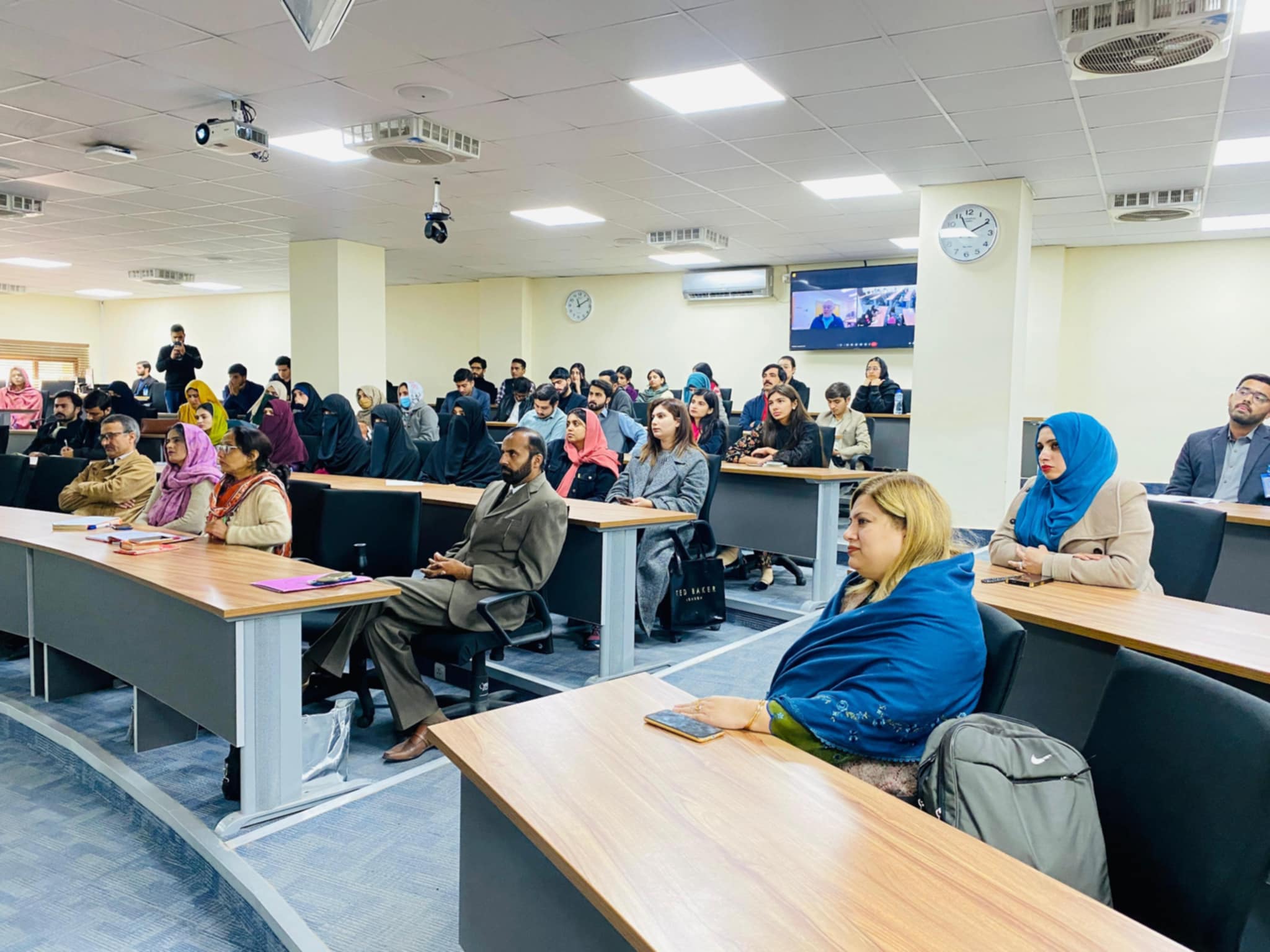
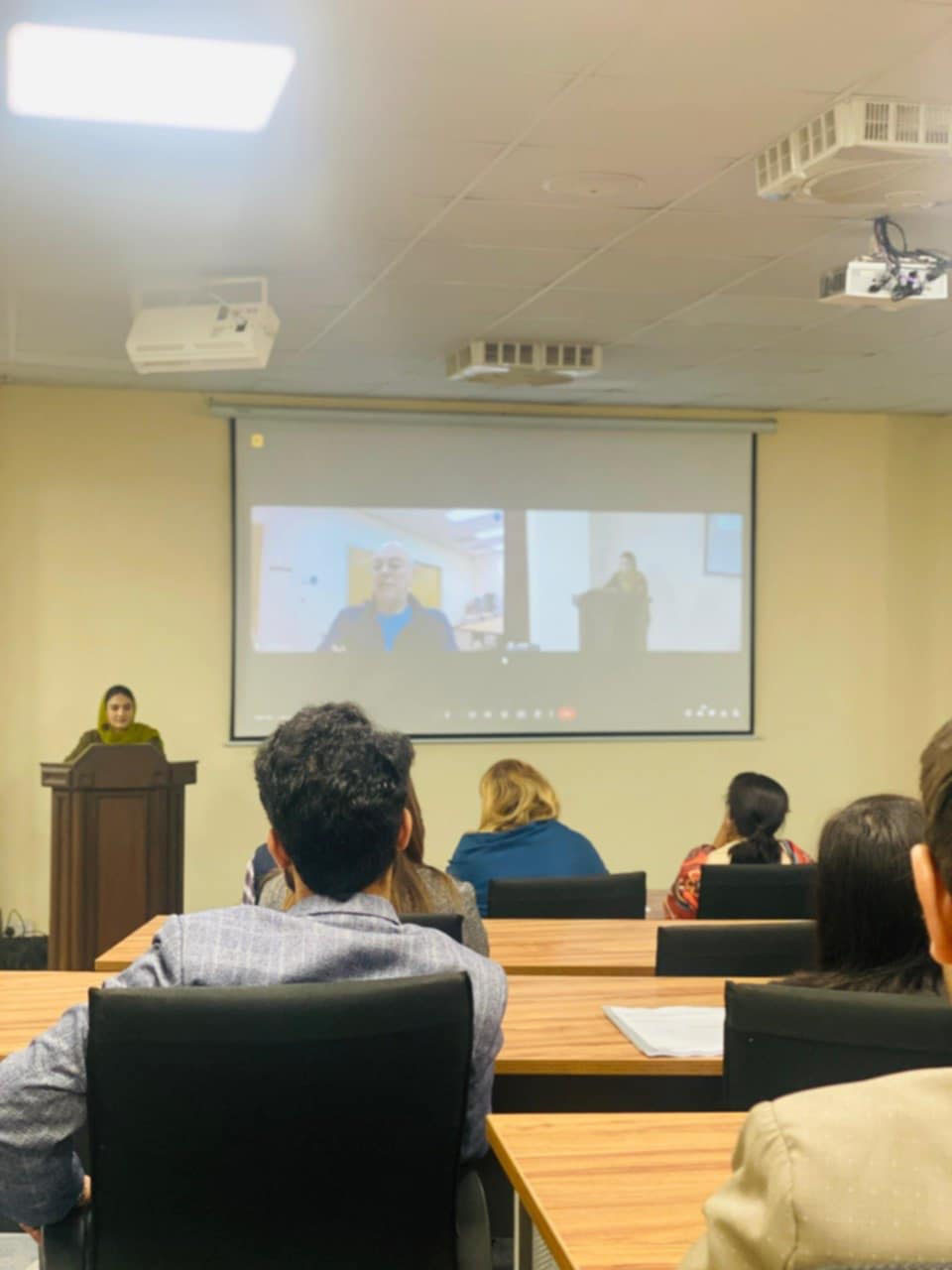
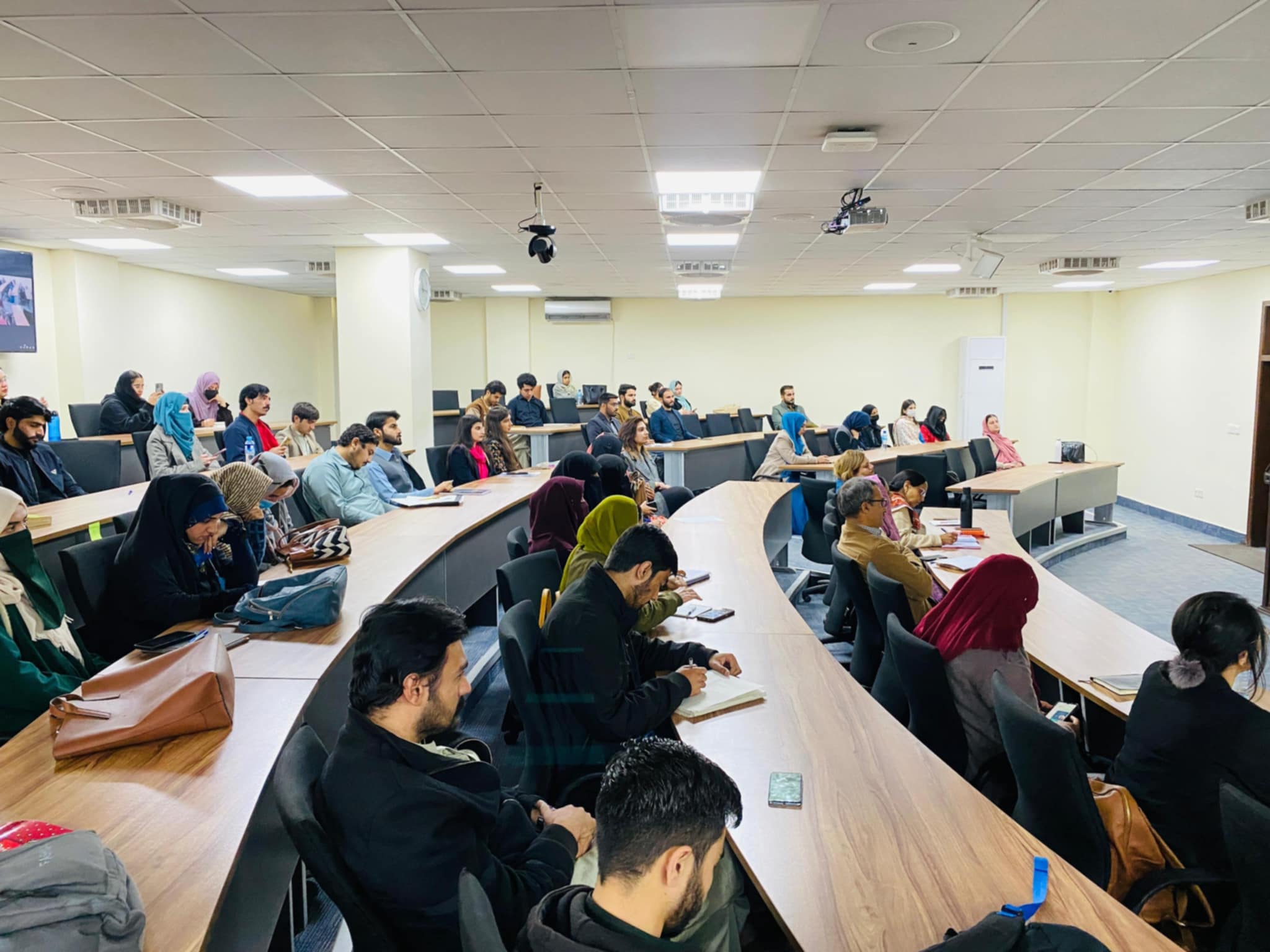
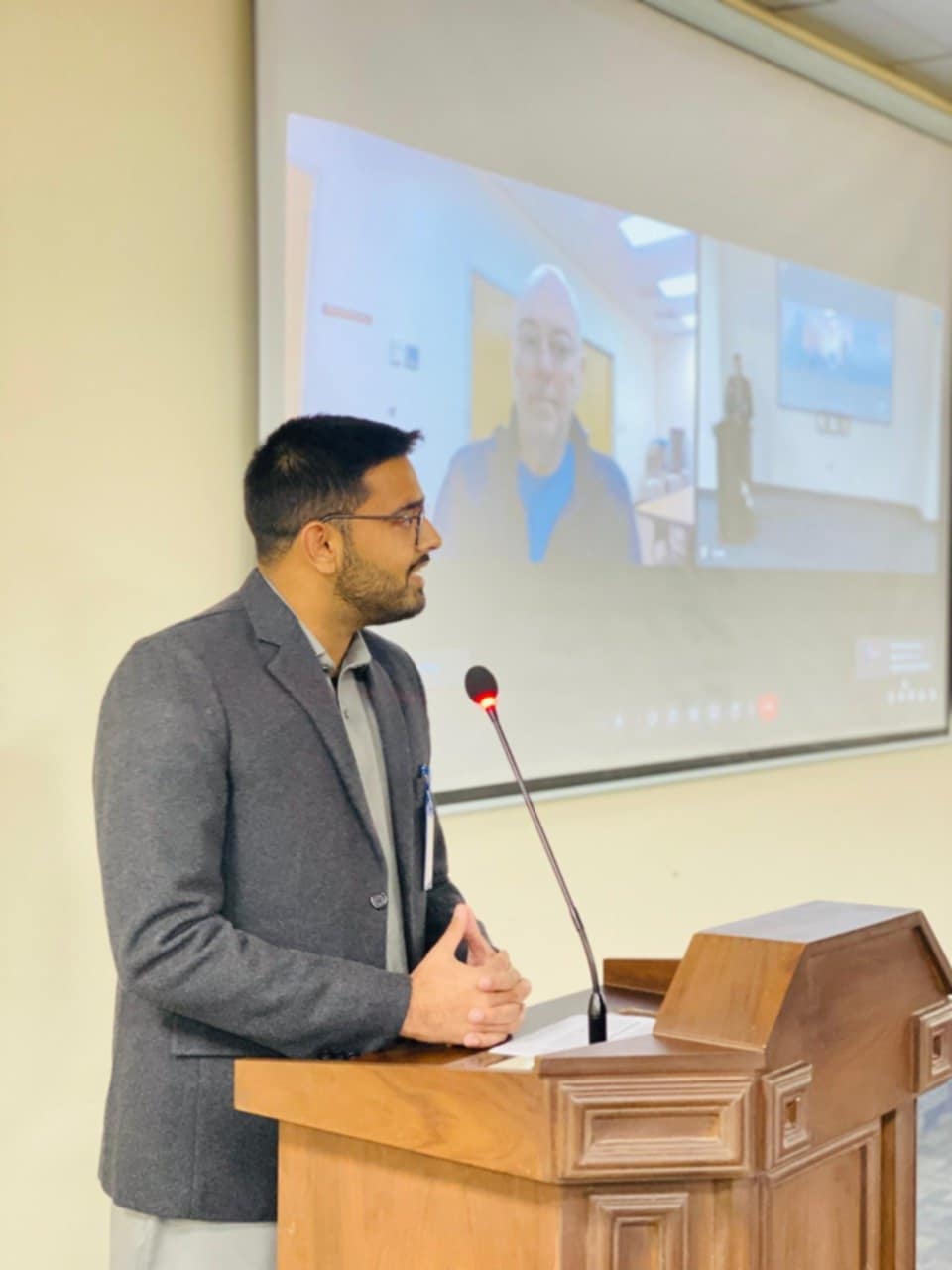
(The following lecture was presented remotely to students and faculty at the National University of Modern Languages, Islamabad, Pakistan, on February 12, 2025. It was at the invitation of and organized by Ms. Ambrina Qayyum, Dr. Amina Ghazanfar, and Ms. Farihatulaen Rizvi; with student organizers Moazzam Ali and Minha Iman.)

I begin with a quotation:
“Persons attempting to find a motive in this narrative will be prosecuted; persons attempting to find a moral in it will be banished; persons attempting to find a plot in it will be shot.” – the “Notice” that appears on the title page of Adventures of Huckleberry Finn, by Mark Twain (1884), considered by many the quintessential American novel. As you may know, Adventures of Huckleberry Finn is a picaresque novel narrated by the title character, Huck, who is about 13 years old. Huck and the escaped slave Jim travel down the Mississippi River on a raft, having a series of adventures along the way. I feel like beginning with this quotation is appropriate to our purposes here because the Notice seems to be the author’s warning to the reader not to take the book too seriously. Its purpose is entertainment, and thinking about loftier things, like the novel’s meaning, will not be tolerated. Mark Twain, whose real name was Samuel Clemens, was a master storyteller and satirist. So how serious was Clemens in his Notice? Did he truly not want readers to search for motive, moral, and plot in his book? If there was some sincerity to his Notice, it may have been because he anticipated that Huckleberry Finn would be a highly controversial book.
Sincere or not, his Notice was disregarded, and Adventures of Huckleberry Finn has been one of the most studied and discussed novels in American (and world) literature. And in spite of the seriousness that readers have found in the text, it became a fabulously popular novel and contributed to Mark Twain (aka, Samuel Clemens) becoming the most popular author in the U.S. by the end of the nineteenth century.
Let me leave Samuel Clemens and Huckleberry Finn for now.
I’ve been asked to speak on “popular fiction,” and I agreed even though at the time I realized the term was malleable in my mind. That is, I wasn’t completely sure what the term even meant. In the last month or so I’ve been looking into the topic – browsing the internet, reading articles, giving it some quasi-serious thought – and I can say with confidence that I’m still not sure what it means. I have, however, stumbled across a lot of interesting ideas associated with the concept of “popular fiction,” so I’ll share them with you (in the hope that you’ll find them interesting too). What is more, largely due to my roles as a writer and publisher, but also as a teacher of writing, I’ve been interested in the history of the publishing industry (in the West, and in particular the United States), and I’ve presented some conference papers on the topic. I will draw from these as well.
Let me begin with some assumptions and/or questions that first came to mind when considering this topic:
What do we mean by popular?
What is the measuring stick for determining popularity?
That is, how popular does a novel have to be to be considered “popular fiction”?
Can a novel be “popular fiction” without actually being popular?
Is popular code, or a kind of euphemism, for bad?
Is the previous question elitist?
How do we determine good versus bad fiction?
For that matter, who determines it?
If popular does mean bad fiction, what is the term for good fiction?
Again, how do we judge?
Again, who judges?
And if the fiction is so darn good, why isn’t it popular?
When did the idea of a book being a “bestseller” begin?
How is bestselling determined?
Ok, I’ll stop there for now. Let’s begin to consider these questions.
From one perspective, popular fiction is fiction (probably in the form of novels) that is read by a lot of people in a given culture. A book gains the label “popular fiction” by attracting a significant number of readers. From this perspective, books are not published as “popular fiction,” but they may become popular over time. Nowadays we call such books “bestsellers,” but that itself is a nebulous term. Quite honestly, until I started researching for this talk I didn’t know much about how a book (or an author) earns the epithet “bestselling.” For the last quarter century I’ve also worked as a librarian, and every week we add new titles to our shelves that are said to be bestsellers or by bestselling authors—books and authors, oftentimes, I’ve never heard of, which suggests that the standard for determining bestselling is fairly low. Low, of course, is relative, but my research has determined that the standard is both nonstandard and mysterious. What I mean by nonstandard is that different organizations will disseminate “bestseller” lists, and each will use its own criteria. In the U.S., we tend to think of The New York Times newspaper and its The New York Times Book Review as the arbiter of bestseller status, but, really, there are many bestsellers lists: Publishers Weekly, USA Today and Indiebound are among the more common publications that provide lists of bestsellers. Moreover, booksellers, like Amazon and Barnes and Noble, will put out their own lists of bestsellers. Complicating things further is the fact that each will put out multiple lists, based on categories of books and types of book (hardback versus paperback versus ebook).
Each entity and each list generated will have its own criteria for determining bestseller status. They’re all based on sales, kind of, but on data that comes from a wide variety of sources. I say “kind of” because the sales data can be rather fluid and open to interpretation, so that, in some lists more than others, the accolade of “bestseller” may be as much subjective impression as empirical conclusion. (Indiebound, for example, tends to rely more on booksellers’ hunches than actual hard sales figures.) Another nonstandard element is sales period. One list may be based on a week’s worth of sales, Monday to Sunday, say, (reported from here versus there), while another list considers data drawn from a different period of time, longer or shorter, or simply a different bracketing of time.
Even though numbers have nebulous meanings, for a frame of reference let’s look at The New York Times bestseller list. To make the list in a given week, a novel must sell between 1,000 and 10,000 copies. However, such sales do not guarantee inclusion on the list because it also depends on other factors, like the total number of books that achieve those sales figures for a single week. Earlier I said the standards were both nonstandard and mysterious; here is where the mystery comes in. The New York Times won’t reveal precisely how they determine the bestseller lists. Sales are an important factor, but there are others that are closely held secrets. Allegedly even the editors of The NYT Book Review aren’t privy to the exact methodology. Their secrecy, they say, is partly in an effort to prevent people from manipulating the system. Nevertheless, people (like authors, agents and publishers) do try to manipulate the system, and if the NYT suspects such manipulation they’ll mark a title on the list as suspicious, printing a dagger symbol next to it.
Another aspect of popularity is the number of weeks that a book remains on the bestseller list. About a quarter of novels make the NYT list for a single week. Incidentally, it seems the idea of a bestsellers list, as we think of it, began in 1895 with the New York-based journal The Bookman. The New York Times began publishing its list in 1936 (based only on New York City sales). The list, resembling its current form, became established by the 1950s.
I said that people will try to manipulate the bestseller lists, and the reason for that is that appearing on a bestseller list can be a major boon for sales, especially for “new” and little-known authors. So, appearing on a bestseller list reflects some level of popularity, and it further promotes popularity. Said differently, bestsellers sales are self-perpetuating. [In addition to Wikipedia entries, information for these last few paragraphs was taken from “The Convoluted World of Best-Seller Lists, Explained” by Constance Grady.]
In recent years another route to popularity has emerged, namely social media. I would like to speak to this phenomenon, but I find such a discussion will have to wait for another occasion.
For now, let’s shift our perspective on the term “popular fiction,” away from a status based (obliquely) on sales, to a term we use to describe a kind of fiction. One can find many definitions of popular fiction as a kind of writing. I like Britannica.com’s definition:
“[S]ome common attributes of popular literature have been defined. First, it is crafted primarily to entertain the reader, as entertainment is a quality that attracts and appeals to a wide audience. To promote a pleasurable reading experience, works of popular fiction are usually written in a simple and straightforward style. They are largely plot-driven, rather than character-driven, and adhere to conventional narrative structures. As such, they are intended less to provoke deep reflection or aesthetic appreciation than to be read casually and quickly. Books that are successful at this aim, especially through their employment of techniques that stimulate readers’ interest and compel them to continue reading, are praised as ‘page-turners.’”
Popular fiction tends toward escapism rather than self-reflection. That is, readers of popular fiction often want to be distracted from their cares and concerns, not prompted to think deeply about them. As a consequence, popular fiction frequently falls into various genre categories: romance, Western, science fiction, mysteries, so-called “chic lit.” All in all, popular fiction is written to be accessible to the average reader. Literary fiction, meanwhile, (sometimes just called “literature” among other synonyms) tends to require more of the reader: more careful attention, more time, more cognitive effort, a broader working vocabulary.
Nowadays, we tend to think of a wide schism between popular fiction and literary fiction. Writers must be either fish or fowl. Indeed, many earlier texts—let’s say, pre-twentieth century—are studied today because of their seriousness; that is, their author’s attention to significant issues, and the book’s facilitation of meaningful analysis and discourse. Whether it’s Mary Shelley’s meditations on society and the individual, Jane Austen’s examination of unequal inheritance laws, Charles Dickens’s depiction of the mechanisms of poverty, Charlotte Brontë’s proto-feminism, or Joseph Conrad’s indictment of colonialism—the writers and their works were unquestionably popular. That is, they sold well, were widely reviewed, and frequently discussed across social strata.
These writers, of course, benefited from the popularity of reading in general. Authors competed with playwrights (who often adapted authors’ works to the stage, without necessarily paying for the privilege), but reading for pleasure was a major pastime for both men and women, across socioeconomic lines. Periodicals were hugely popular. These were newspapers and magazines that printed stories and excerpts from novels and sold them quite inexpensively. It was common practice for a novel to appear in a periodical serially, and then later be brought together for book publication. Serialization didn’t seem to negatively impact eventual book sales. One can find examples of authors or publishers shying away from periodical publication to begin with for fear of it diminishing the sales potential of the book version. Nevertheless, serialization was an effective way for the reading public to become familiar with an author and their work.
Charles Dickens’s The Pickwick Papers (1836) is often cited as the work that popularized the approach of serialization, first, followed by the book publication. Throughout the nineteenth century and well into the twentieth, magazine publication (either of serial installments of a longer work, or stand-alone stories) was the vehicle that brought mass popularity to authors. Popularity gained through magazine publication was not limited to England, where authors like Wilkie Collins, Elizabeth Gaskell, William Thackeray, Anthony Trollope, and Arthur Conan Doyle thrived. In France, a notable example is Alexander Dumas, whose The Three Muskateers (1844) and The Count of Monte Cristo (1844-1846) were widely read serials. Another would be Gustave Flaubert and his serial publication of Madame Bovary (1856). In Russia, both Leo Tolstoy and Fyodor Dostoevsky found readers via the serialization of Anna Karenina (1875-1877), and The Brothers Karamazov (1879-1880), respectively. In the U.S., publishers were quick to follow Dickens’s example, and many writers found popularity via magazine publication and serialization, among them Harriet Beecher Stowe, Henry James, and Herman Melville. Across Europe and into Asia and Australia, having their work appear in magazines was vital for authors achieving popularity.
Obviously not everything published in this time period combined popularity with serious literary merit. For that matter, it’s difficult to know how serious authors were when writing the books that became popular. Their literary quality—and their ability to generate in-depth study and discourse—may be in part due to our projections. That is, we recognize the significance of their work when they, perhaps, did not. They were merely trying to tell an entertaining tale, but because of the milieu in which they were writing, and their own inherent insightfulness, they wove into the telling significant issues. I think, for example, of a writer like Jane Austen and her series of drawing-room romances, like Sense and Sensibility (1811), and Pride and Prejudice (1813), where the plots mainly center on the marriageability of young women without financial means. They are in some ways extensions of Samuel Richardson’s rather vapid Pamela (1740) and Clarissa (1748). Yet Austen also examines the unequal roles of men and women in marriage, the unfairness of English law when it came to inheritance and gender, the hypocrisy of the Church, and myriad other significant issues, including family dynamics and the interrelationships of siblings.
From almost precisely the same period, an antithetical example would be Mary Shelley’s Frankenstein (1818). On the one hand, it is a fantastical Gothic tale about a creature who has been constructed from body parts, both human and animal, brought to life, then left to fend for himself in a harsh and unsympathetic world. From the start of its composition, however, the teenage author saw the potential for her novel to be so much more than a sensational page-turner. Throughout she alludes to numerous books—which she had thoroughly digested, often in their original language and not in translation—regarding science, history, geography, philosophy, religion, and ethics. Like all authors I suppose, Mary Shelley hoped that her book would be popular, but she did not expect it. She and her husband, Percy Shelley, and their children left for the Continent before Frankenstein was published, and Mary was quite surprised several months later when she heard, while in Italy, that her strange book was the talk of London. It has never been out of print.
What all of these pre-twentieth-century books—the merely popular and the popular while also being serious—have in common is accessibility. That is, they are highly readable regardless of one’s educational background. Frankenstein, for all the complex issues that it raises, remains a novel that can be read and understood by practically anyone who is functionally literate. Whether they recognize the complex issues in the book and whether they consider them deeply, those are other matters.
It is worth noting that there were authors in the nineteenth century who became canonized in academic circles, but they were not especially accessible in their day. Nor, then, were they popular. Two well-known examples are Nathaniel Hawthorne and his friend and neighbor Herman Melville. Both are considered giants of the nineteenth century, and for much of the twentieth century they were staples on high school and college syllabi in the U.S. Hawthorne—famous now for such novels as The Scarlet Letter and The House of the Seven Gables—was frustrated and perplexed by his slow book sales. Meanwhile, authors whom he considered inferior enjoyed wide popularity. He was especially annoyed by the status enjoyed by Henry Wadsworth Longfellow, someone he knew in their younger days as a fellow student at Bowdoin College. To compare, 10,000 copies of The Scarlet Letter were printed, and during Hawthorne’s lifetime only 7,800 copies were sold. Meanwhile, Longfellow’s poem The Song of Hiawatha sold 50,000 copies in its first year, 1857. It was just one of Longfellow’s highly popular publications. It’s estimated that during his lifetime, Longfellow wrote more than 20,000 letters in response to the fan mail that he received. (One close friend speculated that Longfellow’s dedication to responding to his fans led to exhaustion and a too-early grave.) [For this section, I relied on various Wikipedia entries as well as the article by Lauren Gatti “Seriously Popular: Rethinking 19th-Century American Literature through the Teaching of Popular Fiction,” published in The English Journal, vol. 100, no. 5, 2011, pp. 47–53, available via JSTOR.]

Hawthorne’s friend and neighbor, Melville, is another interesting case when discussing authorial popularity. Melville’s first novels were page-turning sea adventures, based on his real-life adventures as a seaman. However, he longed to write something more complex, more artistic, even though he knew such a book wouldn’t be popular. In a famous letter to Hawthorne (May 1851), Melville spelled out his dilemma: “Dollars damn me … What I feel most moved to write [Moby Dick], that is banned,—it will not pay. Yet, altogether, write the other way I cannot. So the product is a hash, and all my books are botches.” In other words, writing simple sea adventures was profitable but they bored him; instead, he wanted to write a book that was much more complex and artistically challenging, even though it likely wouldn’t sell. In the end, he chose artistic satisfaction over popularity. There were 3,000 copies of Moby Dick printed, and copies were left unsold forty years later at Melville’s death. Both Hawthorne and Melville had to support their families by taking low-paying government jobs.
In retrospect, we can see that writers like Hawthorne and (especially) Melville were ahead of their time. A novel like Moby Dick has much more in common with the modernist experimental books produced seventy years later by James Joyce, T.S. Eliot, Virginia Woolf, and D.H. Lawrence. In fact, Moby Dick was essentially rediscovered in the 1920s (thirty years after its author’s death), which led to its becoming a classic and a staple on college syllabi by the 1950s. Hawthorne and his works were also canonized in the twentieth century, while Longfellow and other popular writers of the nineteenth century became marginalized in the academy.
So, if depth of thought and the poetic quality of the language do not lead to popularity, what is the key? I’ve already used the word several times: accessibility. In essence, a book has to be easily comprehensible for it to be widely read and have the potential to become a bestseller. In other words, to become “popular fiction” a book must be written in the style of “popular fiction.” To cement this idea, let me repeat Britannica’s definition: “First, it is crafted primarily to entertain the reader, as entertainment is a quality that attracts and appeals to a wide audience. To promote a pleasurable reading experience, works of popular fiction are usually written in a simple and straightforward style. They are largely plot-driven, rather than character-driven, and adhere to conventional narrative structures. As such, they are intended less to provoke deep reflection or aesthetic appreciation than to be read casually and quickly. Books that are successful at this aim, especially through their employment of techniques that stimulate readers’ interest and compel them to continue reading, are praised as ‘page-turners.’”
I began this talk with a reference to Mark Twain and Adventures of Huckleberry Finn, published in 1884, a novel that has the patina of a simple tale of adventure, perhaps even one for younger readers, but in fact is packed with serious and controversial ideas, especially regarding the institution of slavery (which had been abolished two decades before, but its aftermath was still very much a part of American society … as, sadly, it is today). It is a gross overgeneralization, but we could think of Huckleberry Finn as a kind of temporal marker: a delineation between a time when authors could be both serious and popular, and a time when authors had to choose between the two. Herman Melville’s conundrum of the 1850s (to write Moby Dick and forfeit his growing popularity, or not) foreshadowed the dilemma that increasing numbers of writers would face in the twentieth century and beyond: To be either a writer of popular fiction (read by the masses) or to be a writer of serious fiction (read mainly in academic circles)?
The so-called modernist writers who began publishing after the First World War—Pound, Eliot, Stein, Woolf, Joyce, Forster, Lawrence, et al.—were rejecting accessibility for deeper (especially psychological) meaning. They were grappling with the horrors of the War and developing styles of narration and poetics that responded to both personal and cultural trauma. While the modernists may not have been bestselling authors, they were known and therefore influential. Some of their less challenging work (especially stories and individual poems) appeared in popular magazines (while their more challenging work came out in literary journals, including via serialization—all three of James Joyce’s high-modernist novels, A Portrait of the Artist as a Young Man, Ulysses, and Finnegans Wake, were first published serially). But even if people weren’t reading Joyce, Stein, Woolf, etc., they knew who they were and what kind of writing they were doing because the popular press closely covered the modernist movement. As an example, when Gertrude Stein, one of the least comprehensible modernists, returned to the United States after a self-imposed thirty-year exile in France, she was met by a group of reporters at the New York City docks, and lights in Times Square announced “Gertrude Stein Has Arrived.” Next to no one in the U.S. had actually read Stein’s highly experimental work (and even fewer understood it), yet she had gained celebrity status among the general public. Stein was, in a word, popular. I must acknowledge that the previous year, 1933, Stein had published The Autobiography of Alice B. Toklas, which was by far her most readable book, and its accessibility and popularity contributed to her surprisingly warm welcome home.
During this period, while writers like Stein, Joyce and Eliot prided themselves on the difficulty of their texts, there were many writers who sought both kinds of attention. They thought of themselves as serious literary artists, but they also wanted to be widely read (and well paid). There could be many examples, of course, but two that come to mind are Ernest Hemingway and F. Scott Fitzgerald. Though they had very different personalities, they took similar approaches to achieving both popularity and respect from the high-literary establishment. Again, I oversimplify, but Hemingway saw his short fiction and his novels as products of his highest literary aspirations; while his nonfiction, especially his journalism and newspaper reporting, helped to fund his adventurous lifestyle. Similarly, Fitzgerald devoted great time and energy to his novels, wanting them to be as complex and as literary as possible, but at the same time he churned out one lackluster short story after another to sell to magazines and support his dizzyingly wild lifestyle (his and his wife Zelda’s).
Writers like Hemingway and Fitzgerald were able to aim for both kinds of writing—popular and serious—because the periodical industry was still thriving in the U.S. and elsewhere. Allow me to share a quote from Theodore Peterson’s Magazines in the Twentieth Century (University of Illinois Press, 1956):
“Despite pessimistic forecasts from time to time … magazines had a tremendous growth between 1900 and 1955. The number of magazine readers increased remarkably. When Frank Munsey brought out his Mimsey’s Magazine in 1893, he later estimated, there were about 250,000 magazine purchasers in the United States. By 1899, the ten-cent magazine, he further estimated, had increased the number to 750,000. In 1947, in its nationwide audience study, the Magazine Advertising Bureau found 32,300,000 magazine reading families—those in which members could identify specific items from recent issues. The number of individual magazines also increased; there were well over a thousand more magazines in the United States in 1955 than in 1900. The aggregate circulation of all magazines in the United States mounted steadily, and the sales of individual publications soared from thousands to millions. In 1900 there seems to have been no magazine with a circulation of a million; in 1955 there were at least forty-six general and farm magazines with circulations of one million or more, and one of them had a circulation of more than ten million for its domestic edition alone.”
While not all of these magazines published short fiction, I will risk saying that the majority did. Many, in fact, specialized in publishing fiction in the form of short stories and serialized novels. Moreover, they paid writers well. Let me quote from my introduction to Delta of Cassiopeia (which is available online at Twelve Winters Miscellany):
“There had been a Golden Age of magazine publication for much of the twentieth century, when fiction writers could make a good living selling stories to magazines. In the 1920s, F. Scott Fitzgerald and Zelda lived their legendary high life almost solely from Fitz’s short stories, which could fetch as much as $4,000 each (nearly $60,000 in 2023 money). It’s estimated that during the 1920s and 30s Fitzgerald made almost a quarter of a million dollars from 164 magazine stories (more than $3.25 million today). A generation later, in the 1950s, Kurt Vonnegut Jr. sold four stories to magazines in the course of about eighteen months, allowing him to quit his job in the marketing department at General Electric and devote himself fully to writing. At the time, Vonnegut was supporting a wife [who didn’t work] and six children.”
I continue from my introduction:
“By the 1960s, however, television had begun turning the Golden Age into lead. And by the time I started to write effectively enough to publish, the Golden Age was a rapidly receding memory. In sum, television had superseded book reading as a popular pastime, and nationally distributed magazines had either severely cut back or eliminated space for short stories altogether, thus closing a crucial avenue for new writers to build an audience—let alone make a living.”
From then on it’s been a succession of inventions and developments that have made reading books a lower and lower priority for mass culture: the microcomputer (1980s); the internet and World Wide Web (1990s-2000s); social media and streaming services (2000s-present). Concurrent with these technological arrivals, the publishing industry was consolidated into a handful of multinational entertainment conglomerates. Here I’ll draw from my paper “The Loss of the Literary Voice and Its Consequences” (available at tedmorrissey.blog):
“[T]he corporate takeover of the publishing industry … was largely undocumented when André Schiffrin wrote The Business of Books (2000). ‘In Europe and in America,’ writes Schiffrin, ‘publishing has a long tradition as an intellectually and politically engaged profession. Publishers have always prided themselves on their ability to balance the imperative of making money with that of issuing worthwhile books.’ However, in the turbulent sixties, large conglomerates began acquiring publishing houses. Schiffrin continues, ‘It is now increasingly the case that the owner’s only interest is in making money and as much as possible’ (emphasis in original). Schiffrin’s study is wide-ranging and thorough, but he focuses particular attention on the demise of Pantheon, where he’d been managing director for a number of years when it was acquired by Random House, which in turn was purchased by media mogul S. I. Newhouse, who inevitably insisted on changes to try to increase profits, unreasonably and unrealistically so, according to Schiffrin: ‘As one publishing house after another has been taken over by conglomerates, the owners insist that their new book arm bring in the kind of revenue their newspapers, cable television networks, and films do. … New targets have therefore been set in the range of 12-15 percent, three to four times what publishing houses have made in the past.’”
The only way for these remaining commercial publishers to achieve the sort of profits that are expected by their parent companies (and the companies’ shareholders) is to only publish fiction that has the potential to become popular. In other words, it must be easily accessible to the small percentage of the public that continues to read fiction. The internet is full of statistics that highlight the rapid decline of reading (and therefore in people’s ability to read well). One reliable source in the U.S. is the National Endowment for the Arts. NEA’s report from October 2024 said that in its most-recent surveyed year, 2022, just over a third of American adults reported reading a novel or a short story in the previous year. Let me emphasize: a novel or a short story, singular. And practically every survey from practically every organization confirms a downward trend over several decades. Test Prep Insight published a less thorough but even more recent report (January 2025) that confirms this same kind of decline in reading. The report cites several factors:
- The fast pace of the modern world: With the demands of work, family, and social obligations, many people feel they simply don’t have time to read.
- The rise of digital media: In our constantly connected world, it’s easy to get your news and entertainment from sources other than books.
- The cost of books: Books can be expensive, especially if you’re buying them new. Used books are a cheaper option, but many people simply don’t have the time to hunt for them.
- The declining popularity of reading: As fewer people read, it becomes less socially acceptable to do so. This can create a vicious cycle that leads to even fewer people reading.
So what does all this mean in terms of our topic, “popular fiction”? For one thing, in the West at least, there are fewer and fewer authors who can achieve popularity. Also, for those writers who desire mass appeal, they must make sure their books are easily accessible (that is, as easy to read and comprehend as possible).
There are many interesting issues associated with the idea of fiction’s popularity, like the following:
How has social media, especially TikTok, impacted popular fiction?
How do contemporary authors navigate writing for popularity versus writing for artistic satisfaction?
Why, in the U.S., are we seeing an explosion in creative writing programs at universities (and an explosion in the number of creative writers) during the same period that we see a steady decrease in the number of readers?
How do factors like the age and gender of readers affect what books are being published by the few remaining commercial publishers?
I will have to leave these and other questions unanswered for now.
Trauma theory as an approach to analyzing literary texts
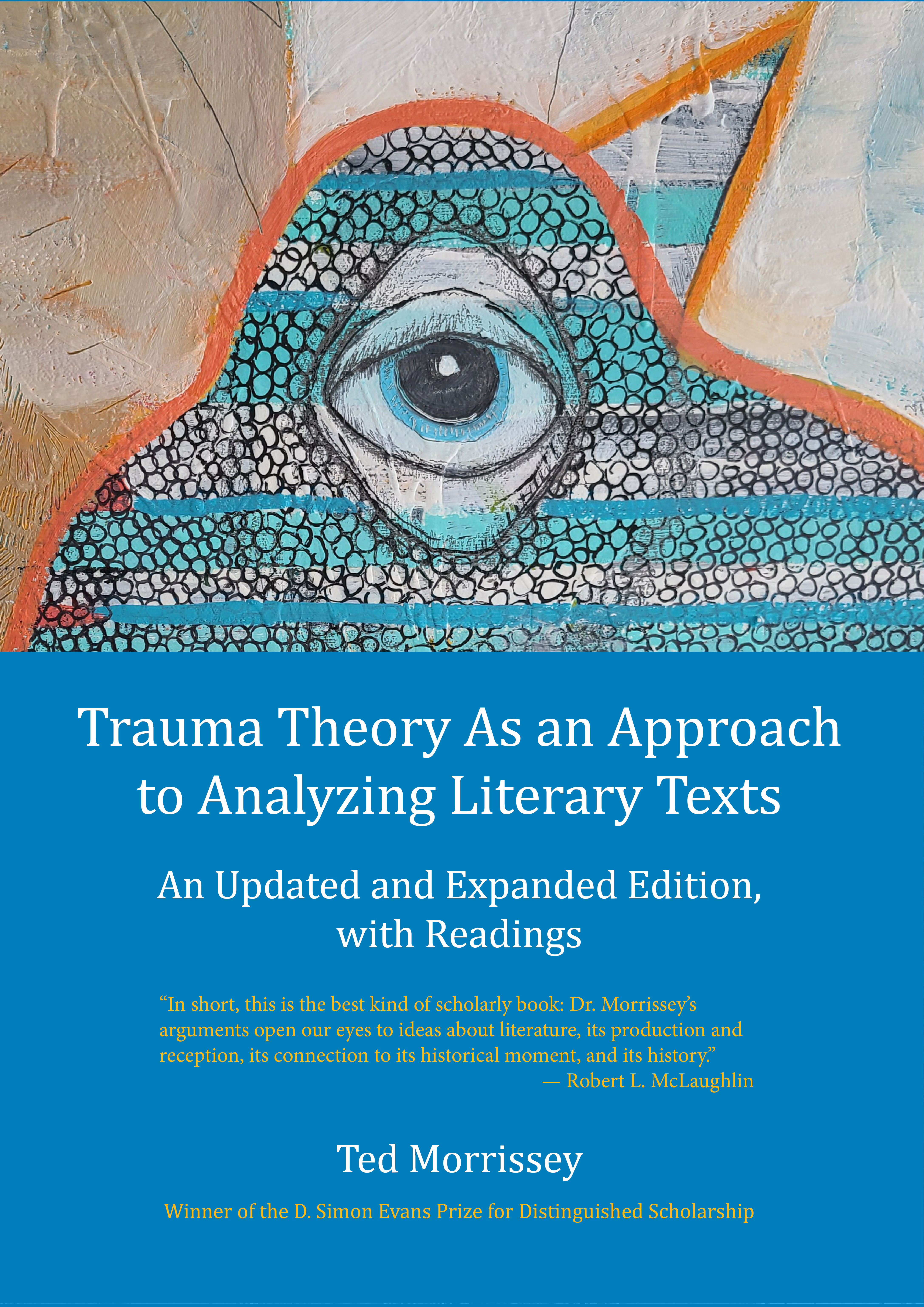
The following is the primary text of a presentation for academics in Kabul and Tehran, arranged by Dr. Nasir Arian, Assistant Professor of Persian Literature and Middle Eastern Studies at Penn State University. It was conducted via Zoom December 5, 2024. This text is excerpted and updated from a much longer article published by Eclectica Magazine, “Cultural Trauma and the Postmodern Voice” (April/May 2021), which was itself excerpted and updated from my book Trauma Theory as an Approach to Analyzing Literary Texts (2021).
In a writers’ symposium on postmodern literature at Brown University in 1989, Robert Coover, in his welcoming remarks, gave the impression the writing style that became known as postmodernism sprang up in the 1950s and ’60s almost by sheer coincidence. Among the symposium participants were Leslie Fiedler, John Hawkes, Stanley Elkin, William Gass, Donald Barthelme, and William Gaddis. Coover noted other writers who certainly would have fit in but were not in attendance, including John Barth, Thomas Pynchon, Angela Carter, Italo Calvino, and Gunter Grass. Coover said, “[T]his group sought out some form, some means by which to express what seemed to them new realities.” However, Coover went on to suggest a remarkably thin theory as to why so many writers, all working in relative isolation, began constructing narrative in uncannily similar styles:
We felt we were all alone. No one was reading us, nor was anyone writing remotely like the sort of writing we were doing until, in the little magazines, we began slowly to discover one another. Few of us knew one another at the time we began writing. There was a uniform feeling among writers at that time that something had to change, something had to break, some structure had to go. And that was, I think, what most united us.
Even though the panel was intended to be a debate, and not merely a discussion, not a single writer challenged Coover’s explanation for the emergence of postmodern style. At first this assessment may seem startling—that some of the keenest and best-educated minds who were at the forefront of producing and (many) critiquing literary postmodernism accepted the premise that postmodern narrative style more or less just happened; essentially individuals writing in isolation on various continents, including North and South America, and Europe, just all happened to begin writing in the same sorts of ways, all in a narrow time span, from about 1950 to 1965. According to Coover, writers with virtual simultaneity decided to abandon modernist realism for something fragmented, repetitive, largely unrealistic and illogical, and highly intertextual.
Joe David Bellamy, in his preface to The New Fiction (1974), expresses a similar notion as to the origins of postmodern narrative style. Bellamy cites an essay by Louis D. Rubin, Jr., who “described his sense that the most interesting writers (at that hour of the world [mid 1960s]) were in the process of struggling against a ‘whole way of using language . . . a whole way of giving order to experience,’ which had been imposed on the sensibility of the times by the great writers of the immediate past.” Again, Bellamy appears to support the idea that postmodern writers simply decided to rebel against modernist literary convention.
A more cogent explanation, I believe, rests with trauma theory. The trauma of the nuclear age, experienced by the entirety of Western culture, affected the psyches of these writers in a way that resulted in postmodern literary style—a style reflecting the traumatized voice. (More on this in a moment.) Historians Jay Lifton and Greg Mitchell, in Hiroshima in America (1995), make several assertions regarding the 20th-century’s zeitgeist as it suddenly evolved after the Second World War. One is the “[s]truggles with the Hiroshima narrative have to do with a sense of meaning in a nuclear age, with our vision of America and our sense of ourselves.” Another is Americans were deeply and immediately conflicted with the atomic bombings of Hiroshima and Nagasaki. They experienced the “contradictory emotions of approval and fear the bomb evoked, a combination that has continued to disturb and confuse Americans ever since.” A third assertion is “[or]dinary people [. . .] experienced their own post-Hiroshima entrapment—mixtures of nuclearism and nuclear terror, of weapons advocacy and fearful anticipation of death and extinction.” And all of this internal conflict, much of which resides in the unconscious, has contributed to a “sense of the world as deeply absurd and dangerous.” Similarly, literary critic Ihab Hassan sees a connection between the horrors of the Second World War and postmodernism: “Postmodernism may be a response, direct or oblique, to the Unimaginable that Modernism glimpsed only in its most prophetic moments. Certainly it is not the Dehumanization of the Arts that concerns us now [1987]; it is rather the Denaturalization of the Planet and the End of Man.”
It is quite possible Coover and the other postmodernists at the Brown University symposium experienced the same sort of repression and dissociation individual trauma victims frequently do. We know it is common for people suffering the symptomology of post-traumatic stress disorder (PTSD) to have no conscious recollection whatsoever of the traumatizing event, or to have a dissociated recollection, so that trauma can be simultaneously indelible and forgettable. While the symposium participants did not seem to recognize post-nuclear cultural trauma as the source of their collective postmodern style, they inadvertently came near the mark—so much so that reading their comments from here in the 21st century, with our growing understanding of trauma theory, one experiences a sort of dramatic irony. An example is this exchange between Fiedler and Elkin regarding the role of the unconscious in narrative production:
Fiedler: [. . . The writer’s] possessed with certain hallucinations that he would like other people to take as real and to weep over and laugh over and shiver over. [. . .] One of the marvelous things about being a writer is many of the things you do you don’t know you’re doing until you get somebody’s response to it.
Elkin: I don’t believe that.
Fiedler: You don’t believe anything’s out of control in a writer?
Elkin: There’s plenty out of control, yes. Absolutely. But I don’t think there’s any such thing as serendipitous meaning.
Fiedler: Well, there’s meaning that comes from writers who are gifted, especially in writers who please many and please long—and it comes from levels deep within their unconsciousness.
I would call attention to Fiedler’s use of the word “possessed,” as we know trauma tends to possess its victim, distorting reality in numerous ways; and “hallucinations” of course are among the symptomology of the traumatized. Also, while Fiedler and Elkin disagree on specific points, they concur fiction is harvested in large part from the writer’s unconscious mind. Moreover, William Gass cited Gertrude Stein’s theory of composition and applied it to Elkin’s earlier statement where he imagined William Faulkner peering over his shoulder as he composed: “[Stein] wrote, she said, finally, for the human mind, which was the same in some remote, abstract sense. When Stanley [Elkin] says he’s writing with Faulkner looking over his shoulder, that’s the superego who’s telling you that your paragraphs are lousy.” Stein’s assessment gets at the notion of a collective unconsciousness, where writers and their readers are able to connect because all are tapping into the same neuropsychic substructures. Coover, meanwhile, referenced the nuclear-age zeitgeist of the 1960s:
I also wanted to get involved in telling stories. But we were in that period of time in the 1960s when telling stories was no longer so simple. A lot of people were telling stories, and it was getting us into wars. It didn’t seem to stop the growth of nuclear armaments in the world. The stories seemed to be contributing in some way to all those activities.
Coover also discussed writing as “a kind of therapy.” He said, “There are things you have to work your way through. There are issues that have to be confronted[. . . .] So you work that out in fictional forms, and you do feel that Freudian answer, that kind of power over what would otherwise be your impotent life.” Hence Coover recognized the unsettling cultural climate of post-Hiroshima America and how it contributed to narrative style; also, his view of writing-as-therapy is consistent with trauma theorists who suggest postmodern techniques are akin to victims’ struggling to transform traumatic memory into narrative memory. Even the Rubin quote Bellamy cites in The New Fiction—about writers “struggling” to find a “way of giving order to experience”—sounds very much like the difficult transformation from traumatic into narrative memory.
Characteristics of the Traumatized Voice
Before going further, let me take a step back to discuss, in brief, the correspondences between the postmodern narrative voice and the struggles facing the traumatized when trying to articulate the events surrounding their traumatic experience. To avoid the trap of making “postmodernism” into such an enormous net that, when cast into literary history, it ensnares virtually everything, I turn to the work of contemporary trauma theorists and limit, quite definitively, what it means to say a text is postmodern. Cathy Caruth and others have looked to psychoanalysts such as Freud and Lacan to illustrate the close connections between trauma and literature. Caruth writes, “If PTSD must be understood as a pathological symptom, then it is not so much a symptom of the unconscious, as it is a symptom of history. The traumatized, we might say, carry an impossible history within them, or they become themselves the symptom of a history that they cannot entirely possess.”
I want to call particular attention to Caruth’s statement that the traumatized “become themselves the symptom of a history that they cannot entirely possess” as it implies a duality. The traumatized usually have a conscious awareness of the causal event, but it also colonizes their subconscious in a way beyond their control and quite possibly even their awareness (a common phenomenon, according to neuropsychologists). As a result of the trauma, points out Anne Whitehead, there are “[u]nsettling temporal structures and disturbing relations between the individual and the world.” That is, the victim of trauma is unable to perceive time and space normally. And, as psychologists Bessel A. van der Kolk and Onno van der Hart explain, the impediment to processing time and space perceptions normally are not limited to the traumatic event itself (if, indeed, there was a specific and singular event), but rather affect non-traumatic events as well (until such time that the PTSD can be effectively treated). Here, too, we must recall the group psyche operates much the same as the individual psyche. Whitehead reiterates, “[Traumatic] crisis extends beyond the individual to affect the ways in which historical experience can be accessed at a cultural level.” Ronald Granofsky is among critics who have studied the close ties between the traumatic events of the Second World War and the literature that emerged in its aftermath, with Granofsky coining the term “the trauma novel” to refer to the work of writers like Kurt Vonnegut, Jr., and Thomas Pynchon. Moreover, Laura Di Prete explains, “all of these writers tackle the issue of trauma by depicting imagined collective disasters that only indirectly relate to real historical or personal traumas.”
Indeed, the emergence of postmodernism seems a direct reflection of cultural PTSD. Writes Whitehead,
[Postmodernism’s] innovative forms and techniques critique the notion of history as grand narratives, and it calls attention to the complexity of memory. Trauma fiction emerges out of postmodernist fiction and shares its tendency to bring conventional narrative techniques to their limit. In testing formal boundaries, trauma fiction seeks to foreground the nature and limitations of narrative and to convey the damaging and distorting impact of the traumatic event.
Professionals working with victims of trauma in an attempt to help them articulate and come to terms with their traumatizing event(s)—to relocate their “traumatic memory” to “narrative memory”—note the traumatized voice mirrors narrative techniques of postmodern writers. “[T]raumatic knowledge cannot be fully communicated or retrieved without distortion,” says Whitehead, who has identified key features of postmodern texts reflecting aspects of the traumatized voice: “intertextuality, repetition and a dispersed or fragmented narrative voice.” Here, then, is the vehicle for limiting my examination of “postmodern” texts. Or, said differently, the intersection of trauma and postmodern literature is at these key points:
1) intertextuality, that is, the use of various “texts” to create meanings when contextualized together that are somehow different from the meanings of those same texts when read independently
2) repetition, that is, the compulsion to return to images and events, particularly ones that at first blush may seem relatively insignificant but that gain significance(s) with each return, with each echo
3) a dispersed or fragmented narrative voice, that is, a style of narration that employs multiple authorial voices/perspectives, and/or a decidedly nonlinear emplotment (or even a decidedly “non-plotted” emplotment)
Whitehead explicitly names these three aspects of postmodern technique that mirror the traumatized voice, but I would augment the list with a fourth (implied) aspect: a search for language—if you will, for powerful, indeed, almost magical words—that will uncouple the traumatized from the traumatizing event. One significant aspect of this language-power is the act of testimony; in fact, some trauma theorists have dubbed the end of the 20th century and the beginning of the 21st the Age of Testimony. Shoshana Felman writes, “It has been suggested that testimony is the literary—or discursive—mode par excellence of our times, and that our era can precisely be defined as the age of testimony.” She goes on to compare writing about trauma in a testimonial mode as akin to psychoanalysis, in which patients confide to their therapist.
Development of the Apocalyptic Temper
In his examination of the apocalyptic temper in the American novel, Joseph Dewey theorizes about the literary community’s response to Hiroshima and Nagasaki, which he describes as “slow in coming.” Citing the work of Paul Boyer, Dewey writes, “[T]he literary conscience of America did not seem ready in the 1940s and even in the 1950s to engage the menace of the mushroom cloud.” At first, writers, along with the rest of their culture, experienced a “psychic numbing [. . .] in the face of such catastrophe.” In the ’50s, notes Dewey, “the American literary community pondered the bomb only in tentative ways.” He references “a glut of forgettable speculative fiction” that appeared during the decade. In the early ’60s, however, “the American novel began to work with the implications of the nuclear age.” Dewey speculates the Cuban Missile Crisis—”the nuclear High Noon over Cuba”—may have acted as a catalyst for writers in general to “begin to think about the unthinkable.” Dewey does not approach his subject in this way, but he seems to be accounting for the dual starting point for American postmodern literary style, which some trace to the mid-1940s and others to the ’60s. Nor does Dewey tend to speak in psychological terms, but he seems to be suggesting American writers were by and large repressing the atomic blasts for nearly two decades, until nuclear Armageddon loomed in 1962, which caused the cultural literary psyche to begin to confront the source of its trauma, if only dissociatively. The scenario Dewey suggests corresponds with the way many individuals respond to a traumatic event. As Bessel A. van der Kolk and Alexander C. McFarlane explain,
[p]eople’s interpretations of the meaning of the trauma continue to evolve well after the trauma itself has ceased. This is well illustrated by a case of delayed PTSD reported by Kilpatrick et al. (1989): A woman who was raped did not develop PTSD symptoms until some months later, when she learned that her attacker had killed another rape victim. It was only when she received this information that she reinterpreted her rape as a life-threatening attack and developed full-blown PTSD.
Perhaps the fear of nuclear Apocalypse was part of the American psyche since 1945, but it seemed unreal until 1962’s standoff with Cuba and its ally the Soviet Union. It is also useful to recall that groups—entire nations even—can respond to trauma just as individuals do. In fact, Neil J. Smelser, in his work on cultural trauma in particular, notes societies can undergo a delayed response to trauma akin to the Freudian notion of a breakdown in repression, which “only succeeded in incubating, not obliterating the threat”—though he qualifies the analogy as not being perfect.
The Leading Voices of American Postmodernism
There is more to be said regarding “In the Heart of the Heart of the Country” and, indeed, the rest of Gass’s fiction, but in closing I would like to turn, more broadly, to other postmodern writers who emerged at about the same time as William Gass. As stated earlier, my choice to focus on the fiction of Gass is because of all the postmodernists I have studied, his work most readily and most consistently reveals the connective tissue between cultural trauma and postmodern narrative style. It is worth noting that among the leading voices of American postmodernism, narratives about the Second World War are plentiful. A short list includes Thomas Pynchon’s Gravity’s Rainbow (1973), Kurt Vonnegut, Jr.’s Slaughterhouse-Five (1969), and Joseph Heller’s Catch-22 (1961). Interestingly, bombs and bombing play pivotal parts in nearly all of these novels: Gravity’s Rainbow centers on the rockets Germany is aiming toward the West, and the title itself refers to the parabolic arc of a rocket; the central event of Slaughterhouse-Five is the firebombing of Dresden, Germany, the site of an American POW camp; and Catch-22 focuses on an American bomber squadron stationed in Italy, and the kernel of the narrative returned to again and again happens on a bomber during a mission. So it seems these postmodernists are not only concerned with the events of the Second World War, but they are especially interested in bombs. None of the narratives mentioned deals directly with the bombings of Japan, but it is provocative that in each case Americans are harmed or even killed by the bombs. This indirect engagement of nuclear threat could be a dissociative response. “Avoidance may take many different forms,” write van der Kolk and McFarlane, “such as keeping away from reminders [. . .] or utilizing dissociation to keep unpleasant experiences from conscious awareness.”
In addition to these novels, there appeared a second wave of significant postmodern novels dealing with United States nuclearism, Cold War anxiety, and/or profound government mistrust. On that list would be books like Robert Coover’s The Public Burning (1977), John Barth’s Sabbatical (1982), and Don DeLillo’s Libra (1988) and Underworld (1997). The Public Burning focuses on the Rosenberg espionage trial of 1951 in which Julius and Ethel Rosenburg were charged with selling nuclear secrets to the Soviet Union. Barth’s Sabbatical tells the tale of an ex-CIA analyst who has retired from the agency and written a book about government subterfuge, and who also suspects a cover-up of the murder of his brother and other former colleagues at the CIA. Libra, meanwhile, centers on Lee Harvey Oswald and his dealings with the Soviets and Cubans leading up to the assassination of John F. Kennedy; and Underworld involves a government nuclear testing facility and focuses in part on one of its employees.
Current Perspective
Sadly, 2024, on the brink of 2025, finds no shortage of trauma in the world, on both a personal level and a cultural level, which may explain the steady interest in my trauma-theory book. In addition to my academic work, I’m also a novelist, publisher, podcaster, librarian, and educator of new writers. As a consequence I’m very interested in and very aware of current trends in the writing and publishing world, as least in the U.S., where there are fewer and fewer readers of any sort, but especially the sort of writing that we may call “trauma texts.” Therefore, agents and commercial publishers are not interested in novels and story collections that may be written from a place of trauma. The writers and the books I have discussed here are mid- to late-twentieth-century authors. They had significant (even bestseller) readerships; they won literary awards; they gave readings and lectures; they taught young writers and offered workshops. All of which may have provided a kind of cultural catharsis, mass treatment of cultural posttraumatic stress.
As a writer and teacher of new writers, I know trauma texts are being produced, here in 2024; however, most such texts are not being published (unless they’re self-published), and they’re not finding a wide readership. Moreover, new writers who may be drawn to writing trauma-inspired texts could ignore those psychic impulses because of market pressures. The only writers who are being widely read now are producing simplistic, repetitive plots—escapist fiction composed with fast, shallow consumption in mind. If the writing and reading of trauma literature does act as a therapeutic response to posttraumatic stress, what will be the consequences to stifling the traumatized voice?
What is more, I wonder if future scholars will be able to gauge the amount of cultural trauma being experienced in the beginning decades of the twenty-first century if there is a dearth of trauma texts being published (and read, reviewed, critiqued, judged, promoted, etc.). Will scholars develop a skewed sense of our reality because of market pressures and readers’ tastes?
I also fully anticipate artificial intelligence taking over the production of popular fiction (which is already essentially the only kind of fiction being published by the five remaining major houses in the U.S.). How will AI-produced texts respond to our personal and cultural needs to voice and to process trauma?
Preface to ‘Mrs Saville’–2021 Reboot
My novel Mrs Saville was published in 2018, although it had begun to appear two years earlier in serialized installments at Strands Lit Sphere. It was important to me that the book come out in 2018, the bicentennial year of Mary Shelley’s novel Frankenstein, because, as the cover makes plain, Mrs Saville is “a novel that begins where Mary Shelley’s Frankenstein ends.”
I thought it was appropriate homage to the novel, and the author, that inspired my sequel; and I hoped it would be a statement readers would find intriguing. In retrospect, tying Mrs Saville so overtly to Mary Shelley’s classic may have been a marketing misstep. Mrs Saville has been languishing without readers for going on three years — a situation I hope to ease in 2021.

I’ve been teaching Frankenstein for more than twenty years, and I always begin our study by noting that students probably think they know the basic story already, but in fact what they know is a greatly simplified misrepresentation of what Mary Shelley wrote as a profoundly depressed, yet highly motivated, as well as eclectically educated, teenager. The novel was published anonymously in January 1818. In spite of a small initial press run, Frankenstein; or, The Modern Prometheus caused an immediate stir among readers and reviewers alike.
Several editions soon followed, as did stage productions that proved highly profitable (not to Mary, however, as modern copyright laws did not yet exist). Beginning with the stage adaptations and continuing with screen adaptations almost the moment cinema was invented (Thomas Edison’s film company produced the first Frankenstein movie, a silent film, in 1910), the novel was reduced to a simplistic horror story about a mute monster terrorizing his creator and anyone unlucky enough to encounter him.
This basic narrative was solidified in the cultural psyche with director James Whales’ wildly popular 1931 movie Frankenstein, and Boris Karloff’s portrayal of the creature (bolts in his neck and all) became emblematic of Mary Shelley’s novel, even though the movie and the monster have little to do with what she created on the page. In the film, Karloff’s creature is an inarticulate fiend, unable to control his emotions and his strength.
The Whales film, like the adaptations that came before and the majority to follow, misrepresented Frankenstein, the novel, as a story about a frightening, out-of-control monster. So, perhaps, my tying Mrs Saville directly to the novel may encourage would-be readers to think my book is just the further exploits of a monster running amok. Such an assumption about Mrs Saville would be as far from the truth as the stage and film adaptations have been from Mary Shelley’s original.
Readers who open the pages of Frankenstein soon find out just how watered-down the story has become in the popular imagination. Scholar Susan J. Wolfson covers the misrepresentation well in her introduction to the Longman Cultural Edition of the 1818 text. Frankenstein is
a vibrant intersection of interlocking cultural concerns: the claims of humanity against scientific exploration; the relationship between ‘monsters’ and their creators; the questionable judgments by which physical difference is termed monstrous; the responsibility of society for the violent behavior of those to whom it refuses care, compassion, even basic decency; the relationships between men and women, and parents and children (and the symbolic version in care-givers and care-receivers); and the psychological dynamics of repression, doubling, and alter egos.
Wolfson’s description accurately represents the novel for which I wrote a sequel. A lot is going on in Frankenstein, and (I like to believe) a lot is going on in Mrs Saville. That said, I don’t want to make my novel out to be a dry, introspective treatise. Far from it. Nor was Mary Shelley’s. Regarding her book’s genesis, she tells us in the introduction to the novel’s 1831 edition:
I busied myself to think of a story; . . . One which would speak to the mysterious fears of our nature, and awaken thrilling horror–one to make the reader dread to look around, to curdle the blood, and quicken the beatings of the heart. If I did not accomplish these things, my ghost story would be unworthy of its name.
In writing Mrs Saville, similar goals were foremost in my mind as well. Otherwise, my sequel would be unworthy of its connection to Frankenstein, a book I have loved nearly all of my adult life.
When a reviewer for Kirkus Reviews wrote that Mrs Saville is “a fantastically chilling psychodrama intelligently woven into literary history,” I felt that I had hit my mark. Moreover, in an unsolicited review, the novelist Spenser Stephens said of the book: “The author fits the pieces together with a seamless and terrifying logic. He shows a nuanced understanding of the darkness that lives within us all.”
I was gratified by these early assessments, and further gratified when Mrs Saville began to receive some critical distinctions. It was a quarterfinalist for the ScreenCraft Cinematic Novel Award in 2018, and the same year the novel was a finalist for American Book Fest’s Best Book Award. Then in 2020 Mrs Saville won the Manhattan Book Award in the category of literary fiction.
I felt that the accolades, modest though they be, vindicated the artistic risks I took with the novel. I wanted Mrs Saville to seem an artifact of the same time period and the same place as its impetus; that is, London at the dawn of the nineteenth century. I tried to achieve this effect primarily through two means. Like Mary Shelley’s original, I used an epistolary structure (a novel told via a series of letters). I also imagined Margaret Saville, my narrator, as a woman similar to Shelley in that she was largely self-educated via her own voracious reading.
My novel also needed to be in British English, as opposed to American English, meaning spellings, expressions, punctuation style, syntax, and so forth in the manner that Mary Shelley used in the early 1800s. I found that I had difficulty composing while keeping in mind British English’s differences from modern American English, so I decided to write the first drafts as I was accustomed to writing; then to convert my Americanisms into nineteenth-century British vernacular in the processes of revising and editing. I found, then, that the unfamiliar style didn’t impede my creativity.
In spite of the work I’d put into writing Mrs Saville, and its good reviews and modest accomplishments, finding readers for the book has proven a considerable challenge. I wasn’t able to capitalize on its winning the Manhattan Book Award to any great extent because I was notified of the prize in the summer of 2020, when the pandemic was peaking again. Furious debates were raging everywhere about opening up businesses, etc., and whether or not schools should open in August. Everyone, including me, was distracted by weightier matters than a novel’s winning a prize.
I promoted Mrs Saville on social media, and I purchased advertisements here and there (spending more money than I care to recall . . . in the thousands of dollars), but none of it accomplished much as far as attracting readers. Nearly every writer is facing this challenge. It is estimated that more than 3 million books are published each year, and yet only a handful of authors account for the vast majority of books sales, according to EPJ Data Science.
Writers trying to build a readership face a classic catch-22: Librarians and bookstore managers are reluctant to devote shelf space to an author that readers don’t recognize; and readers don’t recognize these authors because librarians and bookstore managers are reluctant to devote shelf space to them.
So, instead of relying on social media and costly advertising, for this promotional reboot I’m targeting book clubs in hopes of getting Mrs Saville directly into the hands of readers. From the start, however, there’s an obstacle. Book clubbers don’t tend to buy books, preferring to borrow them from libraries — therefore, if libraries haven’t acquired your title, book clubs will most likely pass.
To overcome this obstacle, I’m happy to send interested book clubs copies of Mrs Saville. I’d much rather spend money on getting my books out into the world, as opposed to buying a few meager inches of expensive and inconsequential advertising space. Moreover, I’ll be happy to speak with groups, in person or via Skype or Zoom, etc. I’m happy to do readings and interviews — essentially anything to connect with potential readers.
Here is the novel’s description:
Margaret Saville’s husband has been away on business for weeks and has stopped replying to her letters. Her brother, Robert Walton, has suddenly returned after three years at sea, having barely survived his exploratory voyage to the northern pole. She still grieves the death of her youngest child as she does her best to raise her surviving children, Felix and Agatha. The depth of her brother’s trauma becomes clear, so that she must add his health and sanity to her list of cares. A bright spot seems to be a new friendship with a young woman who has just returned to England from the Continent, but Margaret soon discovers that her friend, Mary Shelley, has difficulties of her own, including an eccentric poet husband, Percy, and a book she is struggling to write. Margaret’s story unfolds in a series of letters to her absent husband, desperate for him to return or at least to acknowledge her epistles and confirm that he is well. She is lonely, grief-stricken and afraid, yet in these darkest of times a spirit of independence begins to awaken. ‘Mrs Saville’ begins where Mary Shelley’s ‘Frankenstein’ ends. The paperback edition includes the short story “A Wintering Place” and an Afterword by the author.
It’s important to note that even though Mrs Saville is a sequel to Frankenstein, it’s not necessary to have read Frankenstein in order to understand and (I trust) enjoy my novel.
Anyone interested in talking with me about using Mrs Saville for their book club or another literary function, please contact me through my website — tedmorrissey.com — or email me, jtedmorrissey [at] gmail [dot] com.
I’ve always written, and I’ve always written in the same state as most writers — largely without readers. I will always write, but some readers would be nice.
Writing Too Good to Publish
The following paper — “Writing Too Good to Publish: A Disheartening Dispatch from the Heartland” — was presented at the North American Review Writing Conference, April 19-21, 2019, in Cedar Falls, Iowa, as part of the panel “Published Worlds.” Other papers presented were “Something About a Frying Pan and a Fire: Why I Gave up a Tenured Position and Launched a Publishing Imprint” by Kathy Flann, and “To Publish or Not to Publish” by Sayeed Ahmad.
I want to begin by updating the title of this talk. To the main title “Writing Too Good to Publish,” I’m adding “A Disheartening Dispatch from the Heartland.” I see my presentation as a semi-formal prologue to a paper I’m presenting in July at the MLA International Symposium in Lisbon. That paper is on the loss of the literary voice and its ramifications for society. Today my main objective is to generate some thought and discussion, and I’m building my talk around observations by my literary idol William H. Gass, who quipped in a 1971 interview, regarding his eventual novel The Tunnel, that if he achieved his goal “perhaps it will be such a good book no one will want to publish it,” adding, “I live on that hope.” Gass was suggesting, nearly fifty years ago, that in the publishing world there was emerging a negative correlation between the quality of a book and its likelihood for publication.
 So at the root of my talk is the question: Has Gass’s darkly humorous prediction come true? That is, in 2019 can one produce such a well-written book that no publisher will touch it—or at least no major publisher? Since I’ve gone to the trouble of proposing this topic for the writing conference and putting together some thoughts regarding it, you can no doubt surmise that my answer to the question is yes.
First, I acknowledge that my working thesis is bathed in subjectivity. What, for example, constitutes a “good book”? What did Gass mean by the term in 1971, and is his meaning relevant today? For that matter, what is a “major” publisher?
This last question is perhaps the simplest to answer, so I’ll begin there. When I refer to major publishers, I’m thinking of what Publisher’s Weekly calls the “Big Five” (Milliot), commercial publishers who have the wherewithal to publish an author in a massive press run, and promote the work in a way that will get it reviewed by the top reviewers, put it in the running for prestigious prizes, prominently placed in bookstores, and purchased by libraries far and wide. Publisher’s Weekly identifies the Big Five as Penguin Random House, HarperCollins, Simon & Schuster, Hachette Book Group, and Macmillan (at least as of 2017). Just outside the Big Five is Scholastic. A quick perusal of book spines in Barnes & Noble (the only nationwide bookseller remaining) would suggest there are a lot more commercial publishers than a mere handful, but it’s misleading because these big publishers have been buying up smaller presses for decades, so what appear to be dozens of New York-based publishers are in fact entities which fall under the auspices of a few parent companies.
 For these parent companies, profit is the number-one driving force; in fact, nearly the only force. The situation is efficiently summarized in Daniel Robert King’s Cormac McCarthy’s Literary Evolution (2016). McCarthy’s first publisher was Random House, but “[b]y 1962 Random House was on the path to becoming a big business” (21). King goes on, “In the context of the American publishing industry as a whole, it was the purchase of Random House by RCA in 1965 that marked the real beginning” of book publishers being purchased by corporations whose main financial interest wasn’t publishing books (22). During McCarthy’s time at Random House, presidents came and went, and with each successor there may have been more attention paid to profit and less to literary quality. Perhaps the low point was reached in 1980 with the installment of Alberto Vitale, a former banker who André Schiffrin describes as a “business man with a thuggish disposition and a thoroughly anti-intellectual attitude—the pose of a rough-and-ready street fighter who gets things done and isn’t afraid to do what it takes to make as much money as possible” (qtd. in King 22-23). Chief among Vitale’s changes to the Random House modus operandi, writes Schiffrin, was “that each book should make a profit on its own and that one title should no longer be allowed to subsidize another” (23). This pressure for each book to make a profit has led to a high turnover rate among editors at corporate publishing houses, and agents have replaced editors as “the fixed points in authors’ lives,” according to Schiffrin (23).
By extension, then, agents have had to become more preoccupied with profit potential than the weighty quality of the work. Being a literary agent is not charity work, after all, so what good does it do to take on a project unless one is reasonably certain it can catch the eye of a market-minded editor?
Up until the corporate takeover of the publishing world, which began in the 1960s, editors at places like Random House would find talented writers and nurture their careers until sales could catch up. As King notes, “Random House took on and retained McCarthy as one of their authors despite unpromising sales over the first twenty years of his career” (23). In fact, it was due to the persistence of McCarthy’s editor Albert Erskine that McCarthy’s earliest titles even stayed in print. Had it not been for Erskine’s clout and consistent badgering, Random House might have let McCarthy’s titles go out of print (32-33). Ultimately, McCarthy’s novels were moved to Knopf, which by then, in the early 1990s, had been fully acquired by Random House as an imprint for its “loss leaders”—“low-selling books which add prestige to a company’s name . . . despite their underwhelming sales” (103-104).
Knopf was William Gass’s publisher as well, beginning with the hardcover reprint of Willie Masters’ Lonesome Wife in 1971. The outrageously experimental novella was originally published as a special supplement by the literary journal TriQuarterly in 1968. Nineteen seventy-one was of course the year Gass made his comment about writing such a good book no one would publish it. Knopf did publish it, in 1995, and it won a few accolades, including the American Book Award in 1996, but it must have been commercially challenging, especially given Gass’s ambitions for the book’s design. For example, the hardcover edition includes several full-color illustrations. HarperCollins produced a paperback edition in 1996, and just three years later Gass appealed to the small press Dalkey Archive to produce another paperback edition to keep The Tunnel in print. (In 1989, Dalkey began reprinting Willie Masters’ Lonesome Wife in paperback.)
Gass worked on The Tunnel for 26 years, and various parts of it were published in more than a dozen literary journals (and in two instances, limited and signed editions by boutique presses). Meanwhile, the publishing industry went through its transformations, along with the reading public. Gass labored on The Tunnel for nearly three decades (along with numerous other projects) in spite of the fact he didn’t expect the novel to receive a hero’s welcome once it was published. He said in 1981, for example, “Readers don’t want difficult works—not just mine—anybody’s. The reward for the time, effort, agony of getting into some of these things is always problematic. It isn’t simply that I have a small audience. Most of the writers I admire don’t really have much of an audience” (Castro 71). Nearly a decade before, Gass compared writing serious fiction to writing poetry, as far as reception was concerned:
I think fiction is going the way of poetry. It’s getting increasingly technical, increasingly more aimed at a small audience, and so forth. And this is what happened to poetry—over a long period of time. And now fiction, which I suppose was once the leading popular art form, certainly isn’t any more. And serious fiction does not even hope for it. (Mullinax 14)
Indeed, by the time The Tunnel finally emerged in book form, Gass claimed that he “expected to be ignored. . . . There were some [critics] who were quite enthusiastic, but by and large it was the usual: just shrugs and nobody paid much attention” (Abowitz 145).
So as the publishing industry transformed from the 1960s onward, with a greater and greater emphasis on profit over literary merit, what sorts of writers were being picked up by the Big Five? According to Gass, in 1976, “[a] lot of modern writers . . . are writing for the fast mind that speeds over the text like those noisy bastards in motor boats. . . . They stand to literature as fast food to food” (LeClair 25). The Internet Age was still an embryo when Gass made this observation. Since then, how much faster have our minds become, how much more inclined toward simplistic texts that can be skimmed at a lightning pace—if read at all?
Obviously, the historical and cultural forces which have led us here are too complicated to explore in such a brief talk, but it may be worth noting that the corporate takeover of the publishing industry and reading’s decline in popularity have been concurrent with the rise and fall of literary postmodernism. Anis Shivani has suggested that by the end of the twentieth century too many fiction writers were engaged in a “pale” imitation of postmodern pioneers like Donald Barthelme and Robert Coover (Shivani et al. 226). He said, “We’re suffering in different ways from the huge wave of appropriation, mixing, and flattening that carried all of us along with it” (227). Shivani further argues that the postmodern effort to “reconcile high and low” culture proved to be a failed experiment. Young writers’ “reverence for junk is too great; they haven’t known anything else but video culture, and they can’t think past it, let alone ironize time and space, restructure it in new narrative” as early postmodernists, like Kurt Vonnegut, were able to do (227). I have only begun to consider possible correlations between the current state of affairs in writing and publishing, and the rise and fall of postmodernism—but I wanted to at least underscore the fact they are historical bedfellows.
I feel I have a unique vantage point regarding the literary landscape. I’m a writer of the sort of stuff spurned by the Big Five. My short fiction and novel excerpts have appeared in nearly 70 journals (including Glimmer Train and Southern Humanities Review) and have earned a few distinctions, but agents and larger publishers remain enthusiastically disinterested. I’ve been teaching high school English in the heartland for 36 years, and I’ve witnessed, in brutal proximity, teenagers’ shrinking interest in reading—reading anything, leave be challenging literature. Indeed, more and more they find the idea of being a reader amusingly quaint and wholly incomprehensible. As a small-press publisher, I’ve discovered that the world is filled with amazing writers and poets who have awe-inspiring manuscripts, but there are practically no readers to be had anywhere. Literally every title I’ve released since founding Twelve Winters Press in 2012 has taken a loss (in spite of almost no labor costs). As a librarian in my hometown library, I experience the phenomenon of avid readers checking out anything written by James Patterson (or his minions), Danielle Steel, Nora Roberts (or her alter ego J. D. Robb), Janet Evanovich, Stephen King, Dan Brown, etc.—but having no interest in sampling fare which may be a wrung or two juicier on the literary food-chain.
Finally, as a lecturer in an online MFA program, I’ve had to reassess what my long-term goals should be. When I first started teaching for Lindenwood University in 2016, I assumed my graduate students would want to be James Joyce, Virginia Woolf, William Faulkner, or at the very least Ernest Hemingway—but I quickly discovered that for most their aspirations were quite different. They want to be J. K. Rowling, J. R. R. Tolkien, George R. R. Martin, Stephenie Meyer, Stephen King, Dan Brown, Janet Evanovich, and, yes, James Patterson. I do what I can to open their eyes to other possibilities, but who am I to say their aims are too low? Who am I to doom them to near-certain obscurity by browbeating them in the general direction of Finnegans Wake? Instead, if they so choose, I hope to make them the best version of James Patterson they can be: perhaps to write like James Patterson on his very best day (or the very best day of whichever writer in his stable is writing his book).
Where, then, does that leave us—we dwindling few who love to read and write challenging texts? Gass had to come to terms with this question himself—although he was able to ride the inertial momentum of mid-century publishing to at least maintain his place on Knopf’s list. In my dreariest moods I look to the preface he wrote for the paperback edition of In the Heart of the Heart of the Country, and I’ll leave you with the Master’s words:
The contemporary American writer is in no way a part of the social and political scene. He is therefore not muzzled, for no one fears his bite; nor is he called upon to compose. Whatever work he does must proceed from a reckless inner need. The world does not beckon, nor does it greatly reward. This is not a boast or a complaint. It is a fact. Serious writing must nowadays be written for the sake of the art. The condition I describe is not extraordinary. Certain scientists, philosophers, historians, and many mathematicians do the same, advancing their causes as they can. One must be satisfied with that. (xviii-xix)
Works Cited
Abowitz, Richard. “Still Digging: A William Gass Interview.” Ammon, pp. 142-148.
Ammon, Theodore G., editor. Conversations with William H. Gass. UP of Mississippi, 2003.
Castro, Jan Garden. “An Interview with William Gass.” Ammon, pp. 71-80.
Gass, William H. Preface. In the Heart of the Heart of the Country, by Gass. 1968. Godine, 1981, pp. xiii-xlvi.
King, Daniel Robert. Cormac McCarthy’s Literary Evolution: Editors, Agents, and the Crafting of a Prolific American Author. The U of Tennessee P, 2016.
LeClair, Thomas. “William Gass: The Art of Fiction LXV.” Ammon, pp. 17-38.
Milliot, Jim. “Ranking America’s Largest Publishers.” Publisher’s Weekly, 24 Feb. 2017, https://www.publishersweekly.com/pw/by-topic/industry-news/publisher-news/article/72889-ranking-america-s-largest-publishers.html. Accessed 14 April 2019.
Mullinax, Gary. “An Interview with William Gass.” Ammon, pp. 13-16.
Shivani, Anis, et al. “Symposium: Is Postmodernism in decline? Why or why not? How do you assess its legacy?” Boulevard, vol. 26, nos. 1-2, 2010, pp. 226-246.
Locating Our Common Humanity through Expressive Writing
The following was the opening keynote address at the Fifth International Conference on Language, Society and Culture in Asian Contexts, “Inclusiveness and Sustainability of Asian Societies,” Hue City, Vietnam, May 25 – 26, 2018.
When the conference committee graciously invited me to speak to you, my first response was to go to the conference’s website and read about its overarching objective, which, I discovered, has to do with breaking down cultural barriers between nations. Even though I do not regularly travel between nations, it is an idea with which I am profoundly familiar. In the United States, the election of our current president has dramatized the theory that we have within our borders two distinct cultures, two dominant ideologies, two divisive world views which threaten to tear us into two separate nations. Or perhaps a better way of contextualizing the situation is to say that the wound caused by our Civil War which nearly broke us in two 150 years ago has never actually healed—and the current administration has merely made us painfully aware of what has always been true.
One can despair when one considers the seeming hopelessness of bridging political, ideological and cultural divides. Emotions run deep, and people are quick to anger and to become defensive when their worldview, when their belief system is challenged. In my classroom, I encourage my students to engage in discussions of the issues that divide them: gun control, immigration, gay rights, reproductive rights, among many others. I daresay that little progress appears to be made in convincing either side to alter their perceptions.
However, when my students access other aspects of their lives—when they move away from issues related to ideologies—they instantly have things in common. In fact, I would assert, they have everything in common. When I ask them to access their emotions—their joys, their disappointments, their frustrations, their achievements—they speak the same language, regardless of whether they are conservative or liberal, straight or gay, gun-owning or gun-controlling, gendered or gender-neutral, Pro-Life or Pro-Choice. That is to say, when they are asked to communicate expressively, students, above all else, are human.
 Which brings me at long last to my thesis: Through expressive writing, we can locate our common humanity. In other words, what divides us tends to be the product of intellect, while what unites us is our emotional responses to the world.
Allow me to take a moment to define some terms, especially to define them as I am using them in this presentation. The key term, obviously, is “expressive” writing, by which I mean writing that explores and communicates one’s emotional reaction to a given situation, generally a situation that one has experienced personally. I am adopting and somewhat adapting concepts discussed by James Britton, who identified three writing functions: transactional, expressive, and poetic. Briefly, “transactional” writing aims to inform and/or persuade the audience through the manipulation of primary- and secondary-source material (i.e. “research”), and in this transactional mode the writer’s self all but disappears. Transactional writing, in academic settings, takes the form of analyses and research-based reports, wherein personal experience, even in the form of anecdotal evidence, is frowned upon almost to the point of nonexistence, especially in the sciences but even in the humanities.
As Jeff Park remarks in his book Writing at the Edge, transactional writing is by far the dominant mode in the academy, while expressive writing “continues to be underdeveloped” (25). Returning to James Britton’s terms, the other modes besides “transactional” are “expressive” and “poetic.” Here things can become confusing. By “poetic,” Britton means something made out of language for language’s own sake but having little to do with writers’ expressing their feelings on the subject. Riddles, puns, acrostics, limericks may be examples of poetic language use in the way that Britton is defining the term.
Generally, though, poetry refers to writing that is highly personal and expressive. Therefore, when I use the phrase “expressive writing” I am using it as synonymous with what, in the U.S., we most often term “creative writing,” which includes fiction, poetry, and creative nonfiction (or the personal essay). Adding to the confusion is the fact that writers can certainly create stories, novels, poems, and essays that are not especially expressive of their emotions. They may be trying to entertain, to titillate, or to expound on some subject, but they are not trying to communicate a personal experience and how it affected them on an emotional level.
Here, today, I am specifically advocating expressive writing as a means to breaking down or through cultural barriers.
Educators have long advocated reading as a key to developing empathy in students, including empathy for people of other cultures. I certainly agree that reading about other sorts of people can spark interest and understanding, which can in turn lead to empathy. More often that not in the U.S., however, reading literature is the sole means of encouraging empathy in the humanities. Empathy development is not bolstered routinely with expressive writing, and that, I believe, is a mistake. We should be having our students write expressively—and, importantly, sharing their writing through some means of publication (more on this in a moment).
While literary study may be only one component of fostering empathy, it is through literary study that we can most vividly see evidence of our common humanity, which is so often obscured by our politics and competing ideologies. I do not want to get too sidetracked here, but I am referring to the concept of archetypal narratives which seem to spring from a common past that transcends geography and culture. I give as just one example, in brief, the narrative of the woebegone sailor who, driven off course, finds himself and his men trapped inside the dwelling of a man-eating giant. Through his cleverness and courage, the sailor manages to blind the giant and escape the dwelling by hiding amongst the giant’s grazing flock. Whether one recognizes this as the story of Odysseus, or of Sinbad, or of the Man with No Legs depends on whether one is familiar with a Greek, Persian, or Korean literary tradition.
In essence, then, the tale of the woebegone sailor is foundational in Western, Middle Eastern, and Eastern cultures (to use Western distinctions)—a tale so ancient no one can cite its precise origin. These parts of the world are sharply divided when it comes to religions and political ideologies, yet the tale of the woebegone sailor must speak to us all: the disorientation and frustration of being lost, the primal fear of being trapped by a predator of superior power, the exhilaration of resourcefulness, and the joy of our life-preserving escape: all peoples, everywhere, can relate to these emotional registers in the common story.
Through expressive writing—that is, writing that accesses and communicates our emotions rather than our ideologies—students from diverse backgrounds can locate their common humanity, and see there is as much that unites us as there is that divides us.
 This topic is obviously complex, and I can only begin, here, to outline some of its component parts, but I will touch on the following areas: the theories which underpin the effectiveness of expressive writing for fostering empathy; the likelihood of students engaging in traumatic writing when given the opportunity to express themselves; some of the side benefits of expressive writing; the importance of publishing, and not just creating, the results of expressive writing; and some concrete classroom practices if one is inclined to use expressive writing in their curriculum.
Theories about expressive writing & empathy
First, then, how does expressive (or creative) writing create a connection between writer and reader that goes beyond, that goes deeper than other sorts of modes of communication? To respond, I turn to the work of Marcelle Freiman, who is especially interested in the cognitive connections between creative writers and their readers. Building on the work of cognitive scientists like Gerrig, Oatley and Djikic, Freiman asserts that “human long-term memory” is not only “‘based on memory’” but also “‘actively generates meaning’” (133). Thus, the act of writing helps writers to organize their thoughts and reconstruct memories—including all the associations those memories evoke—and it creates “an extended, externalised mental model” which readers are invited to enter. A well-wrought narrative can make a reader experience the story as if they had direct involvement in it. I am referring to the phenomenon of being lost in a story, to which nearly everyone can relate.
Freiman theorizes that the phenomenon is caused by the reader in essence “‘writing’ the text (in the mind) while reading” (134). Here she quotes Hawkes directly: “[Writers] thus involve us in the dangerous, exhilarating activity of creating our worlds now, together with the author, as we go along” (135, emphasis in the original). Freiman is suggesting that the relationship between writer and reader goes beyond being complementary into the realm of genuine partnership; the writer and reader are literally working together to create meaning. This process of shared responsibility in the text is true of all writing, says Freiman, but it has an enhanced dynamic when it comes to expressive writing: “This capacity for the writing of the creative or literary text occurs, perhaps, even more vividly ‘as experience’ because now the process involves imagination, including experiential representations of referents such as perceptions and emotions, in the language that writes what is imaginatively construed, to be read by a reader” (135). I want to underscore the words perceptions and emotions as these are key elements in an act of empathy. Understanding how others perceive their world and the emotions their perceptions elicit is absolutely vital to seeing people as people and not merely avatars for the ideologies they appear to represent.
Likelihood of students writing about trauma
Let me move on to the question, why are students likely to write about trauma when given the opportunity to write expressively? When left to choose their own subject, many students will, of course, elect to write about happy things, which is valid. Writing about successes, about favorite memories, about the love of family and friends are all legitimate responses to an open-ended task to compose; and others can relate to positive experiences. But many, many students will choose to write about a traumatic experience in their lives, and it is due to the nature of trauma. The term “trauma” is slippery, and it is used to describe a vast array of life experiences; thus, depending on how widely or how narrowly one defines what constitutes “trauma,” the number of people who are suffering from some level of traumatic stress fluctuates up and down. Various studies identify between a quarter and three-quarters of the U.S. population as having had some kind of traumatic experience.1 People who have been traumatized tend to want to write about the experience, either explicitly or implicitly. Studies in the field of neuropsychology have suggested that trauma-related language dominates the linguistic functioning of victims.2 As MacCurdy observes, “Invariably writers gravitate to their difficult stories, the ones that cause the most pain and confusion . . .” (15).
Because the academy does not privilege expressive writing, relatively few educators are trained to facilitate it, and, consequently, to respond to students’ writing about their traumatic experiences. When students elect to write about traumatic episodes in their lives, the complexities of the writing classroom multiply exponentially. The most immediate question educators must ask themselves is “Which is more important: the student’s acquisition of writing skills, or the student’s emotional welfare, which may be improved by engaging the traumatic event?” Before responding to my own question, I should say that communicating one’s trauma is a standard practice in therapy, either through one-on-one discussions with one’s therapist, in a group-therapy setting, or through writing (or some combination of these basic approaches). Once a teacher encourages students to engage their trauma in the classroom, the distinction between teacher and therapist can become murky. MacCurdy attempts to draw a distinction when she writes, “Teachers are advisers, mentors, and role models. Listening with compassion helps to fulfill those responsibilities and creates the trust needed for the student to delve into a difficult topic. . . . However, teachers are not therapists. While a therapist may listen and then counsel, teachers listen and, if appropriate, suggest counseling and other professional services” (6).
I find no fault with MacCurdy’s assessment other than to say that she makes it plain why teaching—and perhaps especially teaching writing—is more art than science. Knowing when and how to respond to students’ work relies almost entirely on professional judgment; there are no clear-cut guidelines to follow, as much as we may wish at times there were.3
Benefits of expressive writing
So, writing about trauma can have therapeutic benefits for students. If one looks at that aspect of trauma writing—potential emotional benefits—certain pedagogical difficulties emerge regarding the sort of work students produce (in essence, how fragmentary or how complete it may be or must be), the ways in which it should be assessed (according to traditional guidelines for written work or by some other kind of rubric), and whether or not it should be shared with others (that is, published). How one responds to each of these issues may depend in large part on the end goal. If the end goal is for students to produce something that is most definitely going to be shared with others (versus something mainly for their own experiencing of the process), then the pedagogy must shift accordingly.
Again, we are in the realm of art more than of science. The difference between students writing something only for themselves and students writing something which will be shared with others may lie in how the teacher contextualizes the act of writing and the possible benefits of sharing highly personal experiences. Allow me to say what may be needless to say: The best writing—the best art—is generally rooted in the highly personal experience. In order to create texts that are meaningful, and emotionally and intellectually engaging for readers, writers must be willing to reveal their most personal and their most private experiences and ideas. Marguerite MacRobert recommends that writers use techniques similar to those employed by method actors (à la Stanislavski). She says, “Writers are often spoken of as observers, and many writing workshops hone observation skills, but what Stanislavski says of acting could be emphasised in writing too: openness to experience as it occurs and being able to access emotional memories are crucial writing abilities. . . .” (353).
I will add anecdotally that when I took fiction writing workshops with the novelist Kent Haruf, in the opening class session Kent would always ask us to share something personal about ourselves that we had never shared with anyone else. The point of his exercise was that to be effective fiction writers we must be willing and able to share our most personal thoughts and experiences with our readers. Holding back leads to writing that is less than it could be. This sort of openness may seem like a tall order to expect of young students, but recall that traumatized students generally want to write about their traumatic experiences. In fact, they need to write about them. The pedagogical trick is not to get them to write personally, but to be willing to share their personal writing with others: to instill them with confidence, and to teach them that their sharing can benefit others, namely their readers.
Given our setting and the conference’s overarching mission it is vital to note that expressive writing can transcend language barriers, and in fact can benefit from them. That is, students writing in languages other than their primary language (in English for instance) can be beneficial to the expressive-writing process in several ways. Here I will turn to the work of Owens and Brien, who developed a project in which international students attending universities in Australia wrote expressively in English with the goal of producing a published journal. Too often, international students’ language skills are viewed as a weakness or an obstacle to be overcome; however, Owens and Brien, among others (I included), advocate seeing these students’ language skills as a strength and an opportunity. They write, “[P]erceptions about the English skills of [Learners of English as an Alternative (or Additional) Language] have serious implications for large numbers of students, teachers, employers and, more broadly, the higher education industry. . . . [R]ecognising these learners as linguistically complex (rather than deficient) and finding new and enhanced methods to support their language needs . . . could transform both university practices and the students’ experience of those practices” (361-362). In particular, Owens and Brien advocate the use of creative writing as a way to foster these learners’ acquisition of alternative languages and to ease their assimilation into unfamiliar environments.
In Owens and Brien’s project, they found that international students were drawn to writing about the difficulties associated with cultural assimilation. While writing in a language other than their mother tongue did present some challenges, there were also numerous benefits. They write, “[Alternative Language speakers] have both less (English) and more (languages other than English) lexical-syntactic-semantic knowledge than monolingual English speakers. They rely on a more restricted English resource but have alternative language options available to express meaning. . . . So, whilst mother tongue speakers may use their language creatively in response to situational characteristics, Alternative Language speakers may use English more creatively . . .” (362). What is more, the way Alternative Language speakers approach language may lead to particularly poetic constructions, say Owens and Brien. As someone who has taught Alternative Language speakers in creative writing workshops (especially speakers of Asian languages and, most often, speakers of Chinese), I can attest that even beginning creative writers can compose some startlingly beautiful phrases and images in English because of their knowledge of multiple languages, not in spite of it.
Importance of sharing & publishing
It definitely goes without saying that if expressive writing is going to help break down cultural barriers, it must be shared across borders (both geographic and ideologic), which is where publication enters the discussion. Though discussing their project in the microcosm of their university settings, Owens and Brien found that Alternative Language students writing expressively benefited both the writers themselves and their audience: “It allows readers, such as academic staff as well as other students, to gain insight into the cross-cultural experience and develop greater empathy for the cultural sojourner” (369). Moreover, “the act of authoring such texts” can be “empowering” on multiple levels: “Promoting the creative and unique English language capacities of [Alternative Language students] . . . across English speaking host-communities, can help . . . build empathy, understanding and appreciation in a language context where they are conventionally de-valued” (369). Moreover, Jess-Cooke believes that students’ producing “a completed piece of work is a significant part of building self-esteem, and therefore contributes to wellbeing” (254).
Fortunately, we live in a time when sharing writing (or video or audio) across the globe is relatively simple. Material can be posted to the Web of course. Texts can be made available to download to various sorts of e-readers (Kindle, etc.), and print-on-demand options make physically published anthologies readily and cheaply available via outlets like Amazon among many others. Speaking as a publisher and author, the challenge is not to make students’ writing available across cultural boundaries, but rather how to help others realize it is available in the flood of material that is published, one way or another, every day. Some estimates put the number of new book titles alone released each year in the neighborhood of a million. On any given day, several thousand new titles may become available. Unfortunately I have not solved this conundrum. I would say, as with any project, the way to begin, at least, is to start small. That is, micro-target specific audiences, perhaps via university networking opportunities, as afforded via conferences like this one. Work with colleagues in other countries to produce expressive writing and share it beyond physical borders. Perhaps combine the work of students from several countries in a single anthology to be shared and distributed amongst the project participants. Students’ texts could be captured via audio recordings and video performances, adding additional contextual layers to the communicated experiences.
Concrete classroom practices
I would like to end with a practical suggestion for a writing prompt. I have found that students respond quite effectively to what I call “A Moment of Clarity” narrative essay. I ask them to write about a time when they came to understand something about themselves or about their world due to a specific event in their lives. (I have provided the specific assignment and pre-drafting activity as an appendix to this presentation.) Some students write about positive things in their lives: learning the importance of teamwork or dedication, discovering what they want to do with their lives, embracing their spiritual selves, accepting their true sexuality, and so on. More students, though, tend to write about traumatic, life-transforming experiences: the death of a loved one, a near-death experience of their own, the separation of their parents, the crushing loss of a best friend or first girlfriend or boyfriend.
Allow me to share some brief excerpts of papers my students wrote this past year as a response to the “Moment of Clarity” prompt (the students have granted their permission, and I have obscured their identities):
 From a student whose boyfriend was driving recklessly and lost control of his car: “The convertible Mustang [car] flipped, pinning me underneath the vehicle. The only thing that kept me from getting my head smashed was the headrest that held it up just enough. I needed to stay calm. I couldn’t focus on anything else but the sound of the blood dripping on the ground. I tried to move my right arm and couldn’t.”
 From a student who struggled with the death of her grandmother after a long illness: “Now I understand that death occurs in everyone’s life and everyone is affected by it differently. She was in pain because of the cancer and all of the medicine she was taking. Seeing her in the casket was different because she looked peaceful and beautiful compared to the cancer’s effect on her. I have to let her go because I love her and she would not want me to be afraid or sad. She would want me to strive and achieve my goals and to live my life.”
 From a student who attempted suicide: “I spent my teenage years begging myself at night not to give up, not to kill myself. My first attempt at suicide was in 2015. I remember sitting in my room and the feeling rushed upon me. ‘You’re not good enough . . . you don’t deserve to live . . . just do it.’ I felt numb in that moment. I didn’t feel like a person. I got up and grabbed the bottle of pills. I begged myself to get help and go get my mother, but all I could think about was swallowing the pills and not being here anymore.”
 From a student who has given up her Christian faith: “I think how many Native Americans think. How we’re all connected and that you should put out what you want in return. I feel life is sacred, but so is the afterlife. The two worlds co-exist with one another. Death doesn’t mean the end of life, it’s just the beginning.”
These narratives were written by young people living in a small town in the heart of the United States, but I daresay they express feelings and concerns and issues that young people—that all people—face daily, no matter their culture, no matter their country, no matter their ideology.
Notes
- See Bessel A. Van der Kolk, Alexander C. McFarlane, and Lars Weisaeth, editors. Traumatic Stress: The Effects of Overwhelming Experience on Mind, Body, and Society. Guilford, 2007, p. 5.
- See Jennifer J. Vasterling, and Chris R. Brewin, editors. Neuropsychology of PTSD: Biiological, Cognitive, and Clinical Perspectives, Guilford, 2005. In particular see Joseph I. Constans. “Information-Processing Biases in PTSD,” Vasterling and Brewin, pp. 105-130.
- See Ted Morrissey. Trauma Theory As a Method for Understanding Literary Texts: The Psychological Basis of Postmodern Hermeneutics, Edwin Mellen, 2016. In particular see Chapter 7, “Pedagogical Implications and Conclusions,” pp. 185-224.
Works Cited
Freiman, Marcelle. “A ‘Cognitive Turn’ in Creative Writing — Cognition, Body and Imagination.” New Writing: International Journal for the Practice and Theory of Creative Writing, vol. 12, no. 2, 2015, pp. 127-142.
Jess-Cooke, Carolyn. “Should Creative Writing Courses Teach Ways of Building Resilience?” New Writing: International Journal for the Practice and Theory of Creative Writing, vol. 12, no. 2, 2015, pp. 249-259.
MacCurdy, Marian Mesrodian. The Mind’s Eye: Image and Memory in Writing about Trauma. U of Massachusetts P, 2007.
MacRobert, Marguerite. “Exploring an Acting Method to Contain the Potential Madness of the Creative Process: Mental Health and Writing with Emotion.” International Journal for the Practice and Theory of Creative Writing, vol. 9, no. 3, 2012, pp. 349-360.
Owens, Alison R., and Donna L. Brien. “Writing Themselves: Using Creative Writing to Facilitate International Student Accounts of Their Intercultural Experience.” New Writing: International Journal for the Practice and Theory of Creative Writing, vol. 11, no. 3, 2014, pp. 359-374.
Park, Jeff. Writing at the Edge: Narrative and Writing Process Theory. Peter Lang, 2005.
Interview with Brady Harrison: The Dying Athabaskan
I’ve long been interested in the long story and novella; that is, literary work that falls in the gray-area length between a typical (nowadays) short story and a full-length novel — let’s say, about 5,000 words and 50,000 words. That’s an awfully large gap separating what most literary journals will consider and what most agents and commercial publishers will look at for book publication. Yet this is a fairly recent development in the publishing biz. In the nineteenth and early twentieth century it was commonplace for national magazines to publish longer pieces (often serially) which would then be picked up by a commercial publisher for book publication.
Think Charles Dickens, Elizabeth Gaskell, Leo Tolstoy, Henry James, Edith Wharton, Kate Chopin, and Joseph Conrad, resulting in works like A Christmas Carol, Cranford, The Cossacks, The Turn of the Screw, Ethan Frome, The Awakening, and Heart of Darkness, among many, many other great works that are powerful even though — or maybe because — they are not full-length novels.
My interest in the form led me to design a course on the long story and novella for Lindenwood University’s MFA in Writing program (online), which I’ll be teaching for the third time in summer quarter; and it led me to create the Publisher’s Long Story Prize via my literary press, Twelve Winters. The first calls went out in the summer of 2016, and the response was immediate. We appeared to strike a rich and largely untapped vein.
 From that initial round of submissions, we eventually culled our first winner: The Dying Athabaskan by Brady Harrison, a complex narrative about a freelance writer who embarks on discovering the inspiration for a famous sculpture, The Dying Athabaskan. We recently released our first Long Story Prize winner in paperback and digital editions, and author Brady Harrison generously agreed to be interviewed about his book, his writing process, and today’s literary landscape, especially as it pertains to these in-between-length works of fiction. Here are Brady’s unedited responses.
TM: Even though my main literary love interest is William Gass, by the transitive property of literary love I’m also a fan of James Joyce, and I seem to see a lot of Joycean influence in The Dying Athabaskan: experimenting with varying forms; alluding to other books and artwork, often within the context of working-class drinking establishments; playing with language in the service of lyricism; and even your treatment of dialogue is very Joycean, from a mechanical perspective especially. In particular I’m seeing a lot of Ulysses. Am I projecting that onto your text, or would you count Joyce among your influences?
 BH: Joyce: absolutely, and for all the reasons you indicate: the restless mind, the interest in experimentation and blending different genres, the love of language and how it sounds, and the love of books, music, art. And, the love of bars, of course. In addition to Joyce, my favorite writers are the anatomists, those writers of big, all-over-the-place narratives that refuse to settle on one storytelling mode or style, but that keep experimenting, keep trying out new ideas and ways of expressing them. I’m thinking here of those great comic, yet serious writers like Melville, Sterne, Diderot, Flann O’Brien, Flaubert (in Bouvard and Pécuchet), Woolf, Stein, and Sebald, among many others. Oh, and Gass, though I know you’re a bigger fan than I am. For language, the same folks, and Faulkner, too. A list of my literary heroes. (For the record, I’m also a big fan of Margaret Atwood, despite O’Keevan’s dig.)
In a relatively brief narrative you offer a variety of perspectives and forms. Is this typical of your style, or is The Dying Athabaskan a departure in some ways?
Left to my own devices, this would be my style, but over the years I’ve found it’s easier to place stories that don’t change gears so often, that don’t mix forms, but rather that rely on a consistent point of view and more straight-forward narrative strategies. And, I’m mostly ok with that: the straight-forward story imposes a kind of discipline that I need, and reminds me that I’m not just writing for myself. I remember something that was going around on the web: “Shakespeare wrote for money.” Whenever I find myself wanting to experiment, to turn a story into a play or a letter or a tale from the Arabian nights, and then turn it back and then into something else again, I usually have to reel myself back in. In the case of The Dying Athabaskan, however, I think it works because Ritu, in the process of trying to understand whether or not a thing can mean, tries out any number of forms and approaches. She’s also trying to find out about herself, about her own powers and mind.
Mainstream publishers — even mainstream literary publishers — aren’t inclined to embrace narrative experimentation. Yet you wrote a long, experimental story, perhaps doubling the difficulty of finding a publisher. Can you speak to your interest in experimentation?
After working on stories for a few years, I wanted to try something longer, and wrote a novel about a real-life French poet-explorer set in North Africa in 1930, and I wrote it in the form of an explorer’s journal. It began realistically — what would it be like to travel in the Western Sahara, about the only place in the world that’s not a country, while trying to avoid capture by Berbers and Moors? — but soon enough the journal begins to mutate into other narrative forms and the narrator begins to meet other writer-adventurers who died before he was born, or were born after he died, and at least one of his guides keeps changing shapes and sizes. The narrator, disguised as a woman, begins to turn into a woman. Of course, I thought it was great, comic yet serious, and a number of publishers asked to review the ms.: no takers, and one perhaps made plain what the others were thinking: how could we possibly market so strange a novel about a gender-shifting Frenchman to American readers? Oh, and some sections were written in French, and much of the plot turned around a letter written and mailed to the un-hero before he was born. All to say, I learned my lesson: experimentation and a sort of wildness, at least as I managed them, seem not to be suited to the contemporary marketplace. Or, maybe it wasn’t any good.
The Dying Athabaskan is the title story of a collection you’re shopping. How would you describe the other stories and their relationship to Athabaskan?
For a long time, the working title of the collection was “Sever,” and most of the stories turn around key moments when the protagonist breaks or severs ties with others or with themselves, usually through an act of emotional or physical violence. In The Dying Athabaskan, Brion wants desperately to sever himself from Sister, Briony breaks rather violently with Neil, and O’Keevan seems to want to push almost everyone away. In another story, a no-longer-young man has finally resolved, at his mother’s urging, to leave his parents’ failing farm; in a third, a successful engineer abandons his family while on vacation. In a one page story, two friends follow through on a long-ago promise to murder, if a certain thing ever happens, a third buddy. And, then, having severed ties, how does a person go about reconnecting, reconciling, making peace? Some of the stories are about trying to repair the damage done, or about trying to make meaningful connections where they seem unlikely. In one way or another, they all turn around that very human problem of loss and what to do about it. But I should add: they’re not all as grim as I might be making them sound; some of them, I hope, are funny, and I’ll call the one about the brothers-by-choice killing their buddy a black comedy.
One of your pub credits is the journal The Long Story — a journal I’ve admired for years, decades perhaps (its editor has rejected my work several times) — which suggests that Athabaskan isn’t your first piece of long narrative fiction. Is the long story/novella a length/form you find yourself especially drawn to? And if so, why? (William Gass felt that the novella was his natural medium, and he was at his best writing in that in-between length, or perhaps his most comfortable.)
If I love the long, baggy, all-over-the-place anatomies (except Pynchon: can’t stand his work, save for The Crying of Lot 49, and have no idea why he’s so celebrated), I also love, equally, the novella, and routinely teach courses on the genre. My lure to students: “If, as Randall Jarrett famously remarked, a ‘novel is a prose narrative of some length that has something wrong with it,’ and if, as some readers protest, short stories simply cannot offer the richness and complexities of longer works, then what could be more perfect than the novella, that rare, gem-like form somewhere-in-between?” Really good novellas seem to achieve a degree of perfection — I’m not making that claim for myself! — that novels cannot, and seem to offer a richer tapestry than can usually be achieved in stories.
And, some writers, I think, achieve their best work in the form: I think, for example, that Joyce Carol Oates does some of her best work in the novella, and she’s one of the few contemporary writers who works consistently in the genre. Same thing for Stephen King: while I find his novels way too long, he seems best when he self-edits yet gives plenty of character and just enough plot in works like “Stand by Me” or “The Mist.” The truly sublime novellas: there are many of course, but I would say, Sheila Watson’s The Double Hook, Michael Ondaatje’s Coming Through Slaughter, and any short novel by Penelope Fitzgerald. In the latter case, every time I read one of her short works, I wonder, How does she do it? Oh, and many of Georges Simenon’s roman durs, outstanding.
Ok, to sort of get back to your question! I was really lucky (and really honored) to place a story in The Long Story, a journal that, like you, I’ve admired forever. “The Guest” is a really tough thing to read: it’s about a driver hitting a homeless person, who then sails through the front windshield, and the driver, rather than calling the police and ambulance, drives home and parks in the garage. When I first wrote the story, it was about twice as long: I wanted to honor the tradition in the novella of a frame narrative, and I told, alongside the story of the accident and its aftermath, the story of the narrator, an investigative journalist, and how and why he was dying. Suffering a traumatic injury of his own, this will be his last work as a reporter. In the end, I cut the frame, and while the story certainly gained in intensity and focus, it also perhaps lost something, too. All to say, I hope to keep working on the long story: call it the best of both worlds, novel and short fiction.
Long stories are so difficult to place these days, did you think about that as you were writing it? Did you consider restraining the narrative to try to keep it within a more publishable length? How difficult was it to find a publisher for Athabaskan?
I’ll be blunt: I’m damn lucky you created the Publisher’s Long Story Prize! Like most folks, I’d like to see my work into print, but at the same time I’m just perverse enough to also want to write what I want to write and the market be damned. But you’re right: I was taking a chance in writing that weird in-between length. At the same time, the long story or novella has enjoyed a bit of a renaissance in the last decade or so. I’m thinking of Melville House’s Art of the Novella series (though of course they mostly republish the “classics”) and a few literary journals have novella contests every other year or so. There seems to be a modest market for the form, and it’s not unusual for collections by big guns like David Gates or George Saunders to include a long story. And, as I say, Joyce Carol Oates (who’s a force of nature) routinely does her part to keep the form alive and well.
As you know, the Press publishes Grant Tracey’s Hayden Fuller Mystery Series, and Hayden is Grant’s alter ego ex-NHL star turned detective, gumshoeing his way through the mean streets of 1960s Toronto, where Grant grew up. Hockey is a major element in Athabaskan as well. Can you talk about hockey’s influence on your creative psyche growing up in Canada?
 Grant! The G-man! I love Cheap Amusements (and Parallel Lines and the Hockey Universe) in no small part because of the hockey connections. And, I remember vividly the hard-boiled short films Grant made while we were in grad school: in the Fuller mysteries, we get two of Grant’s passions, two-fisted action on and off the ice. More on Grant in a moment.
Hockey? I guess you could say I’m about as Canadian as they come. I still play hockey two nights a week, skate in as many pond hockey tournaments as I can, and will often hang around after our games to watch other buddies play; I still count the Montreal Canadiens as my favorite team (the arch enemies of Grant’s beloved Toronto Maple Leafs) and try to catch their games on TV. I love everything about hockey: the speed, the way skates work on ice, the team play, the sheer thrill of scoring a goal. I also love weird things about the sport: I love the sounds of the game, and I’m fascinated by the way players talk to one another in mid-play. I’m a true rink-rat, for sure, always have been.
Ok, that’s a long preamble to a question that I probably can’t answer: hockey’s always been a big part of my life, but The Dying Athabaskan is my first story to include the game. Winter: that has shaped my imagination in every way possible, and hockey is a part of my winter mind: I find in so many of my stories that the cold creeps into the action, that snow and ice and how it feels to be out in winter creeps into the characters and how they move and perhaps even think. There’s a certain caution that comes with winter, but also a genuine exhilaration. I’m rambling: I know and love winter, I can say that much.
After selecting The Dying Athabaskan for the Publisher’s Long Story Prize, we learned that you and Grant have more in common than both being from Canada and writing about hockey. You actually went to grad school together. Can you dish a favorite grad school story on Grant?
Ok, this is the question I’ve been waiting for! Grant was such a big part of my life in those days, and we’ve remained friends over the years. Back in the day, Grant had a punk rock show on the local public radio station, and he was kind enough to invite me, on several occasions, to sit in and have some time on the mic talking about the music and the history and evolution of punk. I remember the hot, cramped little booth at WEFT, and most of all I remember Grant’s passion and encyclopedic knowledge. What a blast it was: the Clash, Patti Smith, the Ramones, MC5, Iggy, X-Ray Spex, the Pistols, real old school turned up to 11. Grant was such a great host, and the show was on late, and who knows who was out there, listening, but we had such a brilliant time. (G-man: if you’re reading this, hit me with your ultimate Spirit of ’77 playlist: now that the smoke has cleared, what’s the one, perfect show’s worth of songs?!)
One other story: one day, we hopped in his explode-able Pinto and drove from Champaign-Urbana to Washington, D.C., to see, at the Library of Congress, an alternative ending to Kiss Me Deadly a noir starring Ralph Meeker as Mike Hammer. We were just kids, and we had the time of our lives: Grant was doing research on hard-boiled films, and I had never seen the capital, and we talked music and movies and books for hours and hours. Did the alternative ending actually exist? That’s a secret.
You’re also attracted to the poetry and essay forms. Is one your strength, would you say? What are some of your current projects?
I enjoy trying out all forms, but I’m really committed to two: one of my heroes is that great wildman of American letters, Leslie Fiedler (who wrote many of his masterpieces while at the University of Montana), and when asked if he preferred writing articles or stories, he remarked that he saw no difference between writing stories and writing about stories. I’ve taken that as my cue (as perhaps you have!), and these days I seem to divide my time about equally between fiction and scholarly research and writing. In terms of “creative writing” — truth be told, I can never understand why scholarly writing is not considered “creative” when, to my mind, it’s absolutely as creative as writing, say, stories, poems, or personal essays — I’m interested in narrative. So, I hope to find a good home for the collection of stories I’ve put together, and if that works out, I have a couple of ideas for novels. We’ll see. In my day job, I’m currently writing a book about, of all things, quantum physics and literary interpretation. I’m really enjoying the research—quantum physics is just so damn strange, even comic, at least to me—and hope to finish the book in the next year or so. I’m also co-editing a collection of essays on teaching Western American literature in colleges and universities. I can say this: I’ve been lucky: I’ve had the opportunity to work on things that interest me.
Brady Harrison’s fiction, poetry, and essays have appeared in Cerise Press, J Journal, The Long Story, The Prairie Journal of Canadian Literature, Serving House Journal, and Wascana Review, among literary journals others. His fiction has been nominated for a Pushcart Prize, and recent poetry appears in the anthology, Poems Across the Big Sky II. He is also edited two books on Montana literature, These Living Songs: Reading Montana Poetry and All Our Stories Are Here: Critical Approaches to Montana Literature. His most recent book is Punk Rock Warlord: The Life and Music of Joe Strummer. He lives in Missoula, Montana, and teaches at the University of Montana. (Photo credits: Brady Harrison / David Baumstark; Grant Tracey / Mitchell D. Strauss)
An Interview with John Paul Jaramillo: Little Mocos
I’ve known John Paul Jaramillo for several years. Shortly after my first novel, Men of Winter, came out, John Paul interviewed me for a video journal that he edited. He also had a book out, a collection of stories titled The House of Order (Anaphora Literary Press, 2011), which, I discovered, had garnered John Paul much praise and several accolades. Fast forward to, I believe, 2014. John Paul shared with me a manuscript for a book he’d spent quite a bit of time writing and revising (and revising). It was a novel of sorts, comprised of more than thirty interconnected stories and vignettes, a complex family saga that unfolded over decades and multiple generations.
John Paul’s main interest was getting my feedback on the manuscript. I had relied on John Paul’s opinion and expert eye more than once, sharing my own work with him as well as work by some of the authors I was publishing via Twelve Winters Press. I was interested in doing more than giving him feedback on his book; I very much wanted to publish it. I think he was genuinely surprised. We were having coffee at Wm. Van’s Coffee House in Springfield, Illinois. It was summertime so we both had a bit more time on our hands than we normally would during the academic year. We sat there over our coffees talking for a long while.
My sense was that John Paul had worked on the book for so long and had received so much advice, so many critiques, he wasn’t sure any longer quite what he wanted the book to be. So I asked him to take a few months, perhaps enough time to let some of that advice fade away, and figure out exactly what he wanted to publish. The book did go through some changes, including a title change, before he submitted the more or less final version of the manuscript, which I then assigned to one of the Press’s talented and dedicated editors, Pamm Collebrusco, who worked with John Paul to finalize (now) Little Mocos for publication.
I fell behind the publishing schedule I’d hoped to adhere to, but John Paul was consummately patient. We finalized a book cover this past winter; then this summer we were able, at long last, to make available to the world Little Mocos, a novel in stories, available in hardcover and digital editions.

It’s become a tradition that when I publish an author’s work, I also give them some interview questions. What follows are John Paul’s unedited responses.
My sense is that Little Mocos had a long gestation. When you and I first discussed the manuscript it had a different title, and you talked about a few incarnations of the text. Would you talk about the writing and development of the book?
I’ve been working on this particular book Little Mocos and a grouping of stories for five years I believe. I have always known my writing process is incredibly slow and meandering. I often say it is a mis-perspective that writers have an ease with words and language, because I feel it is the opposite—writers struggle to capture the right words and structure. I have an idea and I like to give myself the time to follow that idea and see where the language or my thoughts take me. I don’t think I am the kind of writer who just sits and executes the outline, premise or story—I have to take time and find the story arc and premise and find the surprises. I have to think and re-think and find the ideas rather than drive them. Also I think I am the kind of writer that is always looking for the better angle into the story in terms of means of perception. So there are drafts on my computer in third person and first person and just different experiments to find the right way to approach the stories I want to tell. Drafts that include or exclude different characters. Fragments that fail and fragments that succeed. Writing and drafting a book is incredibly difficult, and taming that and coming to terms with that takes a long while. Also an editor friend and mentor of mine Jennifer C. Cornell has given me advice and guidance to tweak the book to the current organization. I always need help and I am always second-guessing the manuscript as well as my choices.
At one point you were calling the book “a novel” and then altered that to “a novel in stories.” As a writer I’ve been struggling a bit with those labels myself on a particular project. What do you think the difference is, and why did you ultimately decide on the latter label?
 I feel as though I work in a way to send stories out to get feedback from editors. So my work is intentionally worked out in bite-size chunks. Also I think I am a minimalist so always trying to do more with less. And most publications or lit websites I admire are looking for short pieces—one needs to be a bit more experienced and known for a novel excerpt I believe. I usually label something a short story rather than a chapter though I believe a chapter and a short story are similar in many ways—they both have a beginning, middle and end. I also seem to float back to the same “universe” of characters and that keeps them together. I often say the material comes how it comes and I follow it. I hear stories or read stories about Colorado and just try and get them re-imagined and down into bite-size chunks for publication. I’ve always advised my students to create relationships with editors who publish similar work and I’ve tried to submit and gather feedback from Latino lit publications to help with revision and these aesthetic choices. I guess simply the label “novel-in-stories” or “composite novel” or even “novella” comes back to the writer’s decisions and style.
I mean I’ve always known I have a sort of disjointed sort of style. I have always written smaller stories following the same characters, and I’ve always felt these smaller stories as “complete and autonomous.” Interrelated enough yet at the same time creating a complete whole. Creating a story arc the way a novel would. And I’ve never liked fiction too on-the-nose. I like a rougher feel to the writing. Like punk music or something. But as it comes down to the wire on revisions and I get closer and closer to turning over the manuscript to the publisher I struggle with labeling the work a novel-in-stories, composite novel or just plain stories as well. Making decisions is difficult.
The one guiding organizational principle to the book is thematic but also follows the same characters and quite nearly stays in a similar place. The family I am writing about has a family tree that is broken and winding and shattered and so the structure should mirror that. Astillarse, one character describes in the book, or splintered.
My book features a composite structure from what Chapter 1 from The Composite Novel—a book I read once by Margaret Dunn and Ann Morris—classifies as the following: Setting—(all my work takes place in the old neighborhood); Protagonist—I follow the Ortiz family; Collective protagonist–the family and neighborhood in different time periods and perspectives; Pattern/patchwork—identical or similarly themed stories focusing on trouble, problems, work/joblessness, etc.
I know some of the elements of the book, for example the character Cornbread Vigil, are pulled directly from history, while others, I presume, are purely fictional. In your writing process how did you negotiate history and fiction, and I suppose those gray areas in between?
Cornbread Vigil is a character based on a man named Ray Baca who is pretty infamous in Colorado—his name appeared in the newspaper quite often. He was a local criminal from my old neighborhood of Pueblo, Colorado, who folks often talked about. Mostly they talked about how they were afraid of him. My Grandfather talked about him since he robbed some local places. He was a person who had multiple crimes attached to him and he was the kind of person who always seemed to get out of trouble—petty crimes and thefts. He became somewhat of a local infamous character but also a weird folk hero/character. In my mind he represents the complex place I was raised and also the moral problem young Latino males perhaps face growing up. The violent expression that is sometime nurtured. I had so few literary or teacher heroes growing up but my heroes were “around-the-way” kinds of heroes at least when I was very young.
I think in much of my writing I try to take these stories from the paper and try to imagine or re-imagine them. To try and make sense of them, especially the darker or the more senseless stories. It felt as if this Baca criminal was from the same place I was from and I always found that to be very interesting. He always represented the myths and flavor of Colorado, and I wanted to re-create and re-imagine his story and how it merged with some of my own family.
You and I have discussed some of the difficulties presented by using Spanish and Spanish slang in the text, particularly when it came to dealing with editors and finding a publisher. Could you discuss some of the issues that you encountered?
I try to create relationships with Latino lit publications—with editors more sympathetic to the use of Spanish in a manuscript. This seems to be a very American issue. I always try to write the way folks talk in Southern Colorado and they speak Spanish and I guess Spanglish would be the term. A blending of Spanish and English—incorrect Spanish and incorrect English. But I have a collection of emails and responses from editors who were pretty aggressive in wanting me to take out the Spanish or to make the stories somewhat of a caricature of how folks speak in Colorado. Perhaps it was my fault for not knowing the publication well enough. There are so few Latino publications. I guess I want to represent but not sell-out anyone from my old neighborhoods.
Also though there is a professional dimension where Latinos who speak fluent Spanish will question my decision to omit or to use italics with Spanish in the stories. One writer I admire has Spanish italicized in all of his work and yet criticized me for my decision to italicize in my last publication. The idea being the language is not foreign so one shouldn’t italicize it. Until only recently I have become confident enough to edit what I choose in my own manuscripts and fight for more of my aesthetic choices. I see the whole problem as just working with presses who are sympathetic or understanding of these representation issues or not. I’ve received complaints from some editors and emails from some readers who say I’ve captured the way folks in Colorado speak accurately. So perhaps this is also an issue of representation of place as well as representation of the Spanish language in stories.
Little Mocos covers similar territory to your first book, The House of Order. In fact, one of the stories in Little Mocos is titled “House of Order.” How do these projects connect? In what ways does Little Mocos extend or perhaps complicate some of the elements in The House of Order?
The House of Order was a collection of stories published in differing publications and collected in somewhat of a linear narrative structure though missing quite a bit of backstory to the families and relationships. Little Mocos is the fuller story. Readers of The House of Order didn’t read it as a collection of stories but read it as a novel and this book is the novel bringing in many similar stories that have been tweaked to act as a portion of a larger story rather than to just act as a standalone story. There is more time and room to explore the family and legacy only hinted at, I think, in the collection of short pieces. I wanted to tell the fuller and larger trajectory of the story here. I very much see this novel as a continuation and sequel of sorts to that earlier book.
Little Mocos is divided into six parts which vary considerably in terms of length. What was your organizing principle in determining how to fit the various stories together? Ultimately do you feel satisfied with the structure of the book, or is there anything that still nags at you in the middle of the night?
I have a hard time telling a linear story. Also like many other writers, Leslie Marmon Silko as the greatest influence on me, I wanted to tell a story that was not linear but more at liberty with the timeline. The timeline or the structure is circular almost. Later in the book the narrator is criticized for overly thinking on past events in the story and I think that is similar to me. I am drawn to family stories and family history and my mind is rarely in the moment but racing in time to backstory and I wanted that feel in the book. I like to recreate moments of simply sitting and recounting the past. I am not so much interested in linear stories, I guess, but stories that represent the complexity of past and present relationships. I feel that I carry my family with me and the movement in time from section to section is my way to recreate that in the structure. Also I am more and more interested in this idea of legacy and family spirits that mold an individual. I feel I carry my Uncle and Father who have passed away with me in my everyday decision-making as well as in the genetic similarity of appearance and personality. Family trauma is always at the heart of my stories and the stories I like to read and so again this is my way of re-creating that familial dimension to a daily life.
I do very much feel satisfied with the structure though I’m drafting new stories all the time I wish could’ve found their way into the final manuscript—drafts that fill-in certain characters’ back story. I’m always drafting and note-taking on the Bea character and the Tio Neto character though I know they won’t find their way into the fuller story because of deadlines for turning in drafts. I guess what keeps me up would be exploring more stories with these characters and including all of them in one manuscript.
I know your teaching takes up a lot of time and energy. How do you balance teaching and writing? How does teaching and working with your students inform and energize your writing?
I teach composition and literature and I keep a blog on teaching and writing, so this is something I think all writers who work in schools may struggle with—the balance of time. I teach many classes to pay the bills and also teach creative writing. And I think all of my classes represent my thinking about the written word and also books I admire. I think as a writer I am perhaps a bit more skilled to teach about form or structure of writing as well as meaning. I have an MFA in creative writing instead of an MA or PhD and so I feel I might speak differently about writing and reading than say someone who studied literary criticism theory. I often say I have a degree in writing rather than in the study of writing since I see myself as a creative writer first and foremost, rather than as a researcher, teacher, or critic. Writers rarely think about meaning or theme and yet most classes and most instructors lecture on dominant themes and dominant interpretation, and I am more interested in how the writer or the character is represented in the work. I think there is a large distinction between what a work is saying and how the work is constructed. As a writer I am rarely thinking about what I am trying to say and more and more interested in how to construct a more dynamic experience for the reader. I like the idea that perhaps I can bring a different perspective on writing as a writer than say a lit scholar.
Other than finalizing Little Mocos for publication by the press, you’ve been done with the book for quite awhile. What else have you been working on? Is writing fiction your only interest, or have you explored other modes of writing?
Little Mocos in many ways is a love letter to my father’s side of my family. The last story in the book is about my mother’s family. While Little Mocos is an entire book about my father and his relationship to his brother and father, I have a whole manuscript of material I’ve been working on that follows the relationship between my mother and her father. Again I am interested in family legacy and family trauma. This manuscript is tentatively titled Monte Stories or Mountain Stories as my mother’s side of the family is from the San Luis Valley in Colorado and that is where most of these stories take place. I am more and more obsessed with my mother’s father and his life in the San Luis Valley. Recently I’ve had a story from this manuscript featured at La Casita Grande Lounge—a website for Chicano and Latino literature. I have a good dozen of these stories I am slowly hoping to build into another book taking place in the same Colorado universe of characters.
I have also been working on a collection of creative non-fiction essays. Most of my favorite fiction writers are also my favorite essayists. I hope to turn more of my blog post son teaching and writing and on the Colorado steel industry into essays. I am also hoping to write more memoir-styled essays. Essays that read as short stories but driven more by facts. I have always written little fragments of reviews and recounting of experiences on my blog and I hope to conduct more interviews and also gather more of these essays for a non-fiction collection. I am interested in the steel industry in Colorado and its history as well as the subject of being a Latino male in the teaching profession.
John Paul Jaramillo’s stories and essays have appeared in numerous publications, including The Acentos Review, PALABRA: A Magazine of Chicano and Latino Literary Art and Somos en Escrito. In 2013 his collection The House of Order was named an International Latino Book Award Finalist. In 2013 Latino Boom: An Anthology of U.S. Latino Literature listed Jaramillo as one of its Top 10 New Latino Authors to Watch and Read. Originally from Colorado, he lives in Springfield, Illinois, where he is a professor of English at Lincoln Land Community College. (Author photo by Polly Parsons)
Interview with Jim O’Loughlin: Dean Dean Dean Dean
I met Jim O’Loughlin, in person, in September 2011. My first novel Men of Winter had come out at the end of 2010, and our mutual friend Jeremy Schraffenberger (also, a colleague of Jim’s at University of Northern Iowa) helped arrange an invitation for me to read from the novel at Jim O’Loughlin’s long-running Final Thursday Reading Series at the Hearst Center for the Arts in Cedar Falls, Iowa. Jim was the consummate host, both from a literary standpoint and a personal standpoint.
Time passed (as it does), and in April 2015 I was delighted to do another reading for Jim and Final Thursday — this time a group reading of my story “The Drama of Consonants” (part of my forthcoming book Crowsong for the Stricken). It was great fun. Each paragraph in the story focuses on a specific character. I read the narrator part. Jim pitched in and read a part, as did Jeremy Schraffenberger, as did my wife Melissa, plus some conscripted graduate students, and even Jim’s mother, who was in town for a visit.
Afterward, a group of us went to Whiskey Road in downtown Cedar Falls for refreshments and to talk shop. One of the news items we discussed was the fact that Jim’s collection of flash fiction, Dean Dean Dean Dean, had been picked up by a small press and would be out in the next year or so. I didn’t know Jim had a collection; for a brief moment I entertained the idea of trying to poach Jim’s book away from the competitor press, but it was patently unethical. (I’m blaming my wobbly ethics on the refreshments.) That summer I invited Jim to read from his forthcoming book at an event I co-hosted in Springfield, Illinois. It was a terrific reading, and Jim even got his daughter and son in on the act. The next day my wife and I had the opportunity to do one of our favorite activities: play tour guides for the O’Loughlin family as we visited various Abraham Lincoln sites in Springfield.
Time continued to pass — and the press that intended to bring out Dean Dean Dean Dean collapsed (as small presses will). I never like to see such things happen, but it afforded Twelve Winters Press the opportunity to pick up the book in its stead. In summer 2016, Jim worked with TWP editor Pamm Collebrusco to finalize the collection for publication. In the fall I stepped back into the process to create the book, working closely with Jim, who also directs Final Thursday Press in conjunction with the Reading Series.
I’m pleased to announce the publication of Dean Dean Dean Dean, a collection of flash fiction by Jim O’Loughlin, available in print and digital editions (Kindle and Nook).
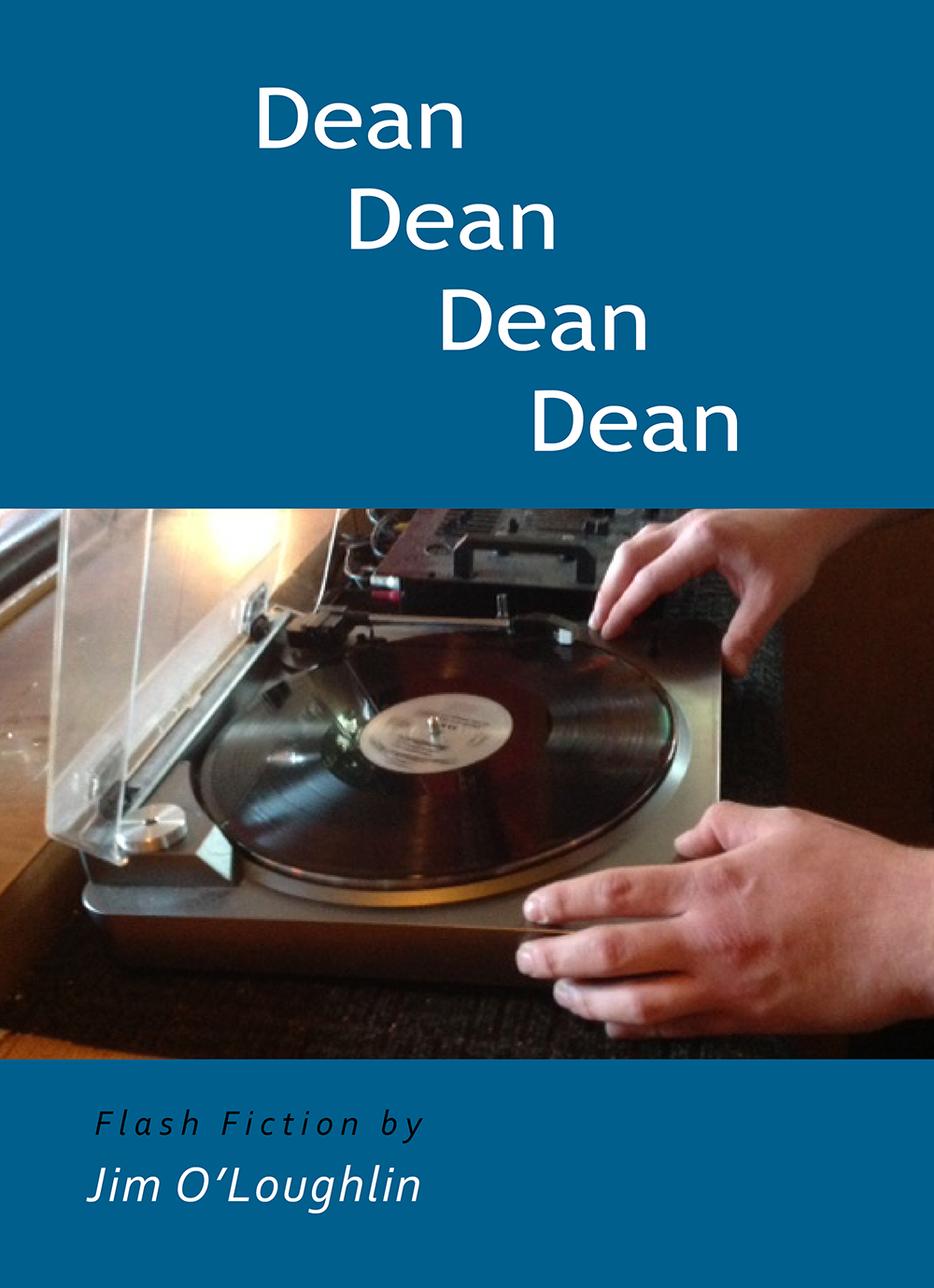
It’s become a tradition that when the Press releases a new title, I interview the author about the book and writing-related issues. The posted interviews attract a considerable amount of traffic on the Web. I sent Jim some questions, and here are his emailed responses.
What do you find attractive about the flash form?
Here’s the thing: you will often find people who reluctantly admit that flash fiction is okay, maybe, because young people have such short attention spans now. What people? The generation that grew up reading the Harry Potter series, even the will-break-your-toe-if-you-drop-it fifth book? Readers don’t have a problem with long works. The issue is that many readers now process information quickly and have less tolerance for windy prose. Flash fiction speaks to that audience, and it is not afraid to fight for them in the arena of contemporary media.
Have you also been working on longer creative work as well?
I write both flash and traditional length stories, and I have a novel I’m currently revising, so I feel all kinds of fiction have a place.
Tell us about the Final Thursday Reading Series. How it began, how it has evolved, how you’ve been able to maintain it for so long … that kind of thing.
I started FTRS not long after I moved to Iowa. There was a local used bookstore, Bought again Books, that had just started a coffeehouse in an attached space, and they were open to new programming ideas. The monthly series started there in a room that comfortably fit a dozen people and broke fire code at about 40, and we hit both extremes over the eight years we were there. When the owner, David Crownfield, developed health issues and had to close the bookstore, the series moved to the Hearst Center for the Arts, a community arts center located in the former house of poet James Hearst. In this new location and with the support of the Hearst Center, the series has grown in popularity, attracting anywhere from 40-70 people each month. It’s in its 16th season now, and it has become an important part of the local literary culture. First, there’s coffee. Then, there’s an open mic. After that, a regional author takes the stage. Sometimes we wind up at a bar afterward. Occasionally there’s bowling or billiards. No one has gotten hurt yet.
My sense is that many of the flash pieces, if not all, were written with the open mic part of the Reading Series in mind, with your wanting to have a short piece or two you could read as time allowed or necessitated before the featured author’s reading. Is that true?
I typically start off the open mic each month, and I try to come up with a new piece each time. When the series first started, the open mic attracted some really dour poets — don’t get me wrong: I love dour poetry! I just found it was good to give the audience permission to laugh at the beginning of the night. Over time, having a humorous opening story to lead with became a conscious goal. Also, having a deadline I have to hit each month keeps me honest. It’s been good training, and the vast majority of the stories in Dean Dean Dean Dean got their start as performance pieces.
Who are some of your favorite writers of humor or satire? Do you see your work in this collection as being in the tradition of a specific author or group of authors?
I regularly teach a class on Mark Twain, Dean Dean Dean Dean riffs on Joseph Heller’s character Major Major Major Major, and I’m currently working on a critical book on Kurt Vonnegut, so those are clear influences on me. But I’m also influenced by writers like Louise Erdrich, who is a master of the short scene, and Jennifer Egan, who can create complex characters concisely (I claim the alliteration for myself).
Was it Edmund Gwenn who said “Dying is easy. Comedy is hard”? Do you agree? Is humor writing especially challenging? Do you begin by trying to write a humorous piece, or does the humor work its way into the narrative organically?
Maybe Edmund Kean? Google is divided on the attribution. Humor writing, like cilantro, free jazz, and the films of Baz Luhrmann, is not for everyone. But it is something that you can get better at over time, particularly if you get to see how an audience reacts to your work.
In terms of organizing Dean Dean Dean Dean, what was your thought process in terms of which pieces should be included, which excluded, and how did you arrive at the final order?
My main goal was to have the stories in the collection not be predictable, so I tried a range of different approaches and styles. I hope that keeps readers on their toes and eager to see what’s next.
What are some other projects you’re working on?
I’m currently revising a science fiction novel called The Cord. The book is set in the future on either end of a space elevator connecting the Earth with an orbiting station. No punch line: That’s really what I’m doing. If you don’t believe me, ask me a question about apex anchors or carbon nanotubes.
Jim O’Loughlin is an associate professor of English at the University of Northern Iowa, where he teaches courses in American literature, creative writing and digital humanities. He is the director of the long-running Final Thursday Reading Series and Final Thursday Press. He lives in Cedar Falls, Iowa, with his wife and children. Dean Dean Dean Dean is his first collection. (Author photo by Carole Fishback)
Interview with Grant Tracey: Final Stanzas
I’d known of Grant Tracey and his writing for years, because of his editing of the North American Review, but I had never met Grant before this past June. A few weeks previous to our meeting, in late April, my wife Melissa and I were visiting Cedar Falls, Iowa, the home of the University of Northern Iowa, where Grant teaches; and I was sitting in on a creative writing class being taught by my friend and Twelve Winters Press author Jeremy (J.D.) Schraffenberger, when Jeremy mentioned that his colleague, Grant Tracey, had a short story collection that he was interested in publishing, but he was disenchanted with the process of looking for a small-press publisher. In fact, even though Grant had published three previous collections of fiction, he was considering self-publishing this new book.

I realized immediately that a great opportunity for my press, Twelve Winters, had presented itself, out of the blue as it were. I told Jeremy that I was very much interested in looking at Grant’s collection, and he put us in touch via email. Grant graciously sent me a collection to read through, in a couple of installments, both published and unpublished stories (seventeen pieces all together, I believe). Then in June Melissa and I attended the North American Review Bicentennial Conference in Cedar Falls, and we arranged to meet Grant for coffee on our first morning there. By that time I’d read Grant’s terrific stories and very much wanted to bring out some sort of collection. So when we got together at Cup of Joe, it was just a matter of going over the contract details and possibilities for bringing out the book in print, digital and audio.
Grant decided on eleven stories for the collection, ten previously published and one new story. I asked the Press’s faithful and talented editors Pamm Collebrusco and Adam Nicholson to read the collection, which was still untitled. As luck would have it, the Press’s publishing schedule opened up for the fall, and we could bring out the collection quite quickly, especially in the world of publishing, where it may take years for an accepted book to see the light of day. By early August, Pamm and Adam had sent their editorial notes to Grant. We were getting close to having a finished manuscript, but the collection still didn’t have a title. Grant didn’t want to use one of the stories’ titles for the collection’s title, but rather he wanted some phrase or image in the stories to suggest the title. I thought the phrase “final stanzas” from the story “Turnstiles” would be perfect–and Grant also liked it.
On August 24, Final Stanzas was released.
It’s become a Press tradition that I interview the authors upon the release of their books, so I sent Grant some interview questions, and what follows are his unedited responses. I think you’ll enjoy the interview almost as much as the delightful collection itself.

What’s the time span of the writing of these eleven stories? In other words, how old is the oldest story, and how recent is the most recently written?
The oldest story in here is “Dead Flowers.” I wrote that in 2009 right around the time my last collection Lovers and Strangers was coming out with Pocol. It was a story inspired by my troubled relationship with my father and a lot of things that went down during my childhood. I thought I had moved past them, but writing the story proved to me that I hadn’t. Anyway, that’s the oldest. The newest in terms of publication date is “Ossining, 1918.” Aethlon printed that just last June. However, I had been shopping that story around for three to four years.
The newest in terms of composition is “Written on the Sky” (I wrote it about a year and a half ago and it appeared in Green Hills Literary Lantern) and “Still the Bomber,” which I revised yet again, just weeks before sending it to you. “Ossining” was an important story because it was the first one where I really felt like I was playing with time. I was free to move into the past and flash-forward into the future whenever I wanted because the narrative sensibilities were that of an artist, James Cagney. “Written” was a voice-driven piece. I’m not as comfortable in first-person—I like the control of limited third—but this was a very autobiographical story, and I felt the voice was real and honest.
It’s funny that you mentioned autobiography a couple of times. At least in one of your stories you refer to a real-life colleague at UNI (Dr. Julie Husband). I trust she’s all right with being a character in your fiction. Usually novelists and short-story writers cast at least a thin veil over themselves and friends and family. Why did you decide to dispense with the veil altogether in this case, and is this a technique you’ve used with some regularity in your fiction?
Two reasons why I dispensed with the veil: one, I respect and admire Dr. Husband so I wanted to give her a shout-out; and two, all that stuff about Philip Roth in the story I got from reading an article of hers on the writer, so I wanted to, in a sly way, acknowledge that. And yes, I asked her permission. She was amused. Anyway, many of the stories are artistic creations, imagined probabilities, not biographies, but two or three come pretty close to my life or people I know. The second story in the collection, “Seeing Red, Feeling Blue,” was inspired by the relationship between my sister and mother. The event never happened but some of the sensibilities in that story derive from the complex dynamics of their love for each other. In “Written on the Sky” the mother takes the son out of school to see Woody Allen movies. My mother did that. She somehow always knew when I was struggling and needed to get away from all the crap that goes on in junior high. But the rest of that story is a leap of the creative imagination. Yes, I had a neighbor who I had a crush on. And yes she liked to sun bathe, but we never hung out and discussed theatre. She did say I looked like Johnny Cash, however. Oh, and the scene with all the Playboy playmates fastened to the wall? That did happen. My father took me to a bachelor pad where I couldn’t tell you what the paint color a certain wall was. But all kidding aside, if there are any connections to real people in these stories, they are for the most part accidents or composites.
The actor James Cagney seems to be a hero, or at least a person of particular interest to you. You’ve published critical work on him and chose a quote from one of his movie roles for the book’s epigraph, as well as his being the main character in two of the stories (plus in a third, a character has named his dog Cagney). What about James Cagney do you find so fascinating or perhaps even inspiring?
I think he’s one of the most authentic actors of all time. Cagney had a simple approach to acting: plant your feet, look the other fella in the eye, and tell the truth. And that’s him. I also love his energy, the way he moves. He talks fast, has a territorial lean, raises an eyebrow with all-knowing awareness, and plays things big. So many actors, especially working today, go for the less-is-more, naturalism style of acting. Underplay, underplay, underplay—Steve McQueen style. That’s cool. But Cagney was like Orson Welles once said, “a thousand firecrackers going off all at once.” I also found the contradiction between his tough-guy persona and the quiet, shy person he was off screen fascinating. Cagney tired of playing the tough guy and wanted to branch out, but it was difficult. Audiences loved the tough-talking wise guy, but I’m attracted to the man who wanted more from his art. Earlier, I called him an artist and he was. He took the craft of acting seriously, read Nobel Prize-winning authors, danced, painted, and saw art as essential to living a better, richer life.
Besides the two included in Final Stanzas, are there other James Cagney stories that you’ve written? Are these stories fictionalized biographies, or wholly made up tales based on your perception of Cagney as a person?
I haven’t written any other Cagney stories, not yet, but I plan to. The two stories here are tales based on my perception of Cagney as a person. Tony Kushner, when I met him at [University of Northern Iowa], said about Abraham Lincoln (whom he’d just written a screenplay about) or Jackie Gleason (whom I was writing some stories about) that it’s okay to take imaginative leaps from the historical record as long as you don’t alter the personality or reality of the person. Stay true to the character. I like that way of thinking about it.
Both of the Cagney stories featured in Final Stanzas were grounded in some reality. Cagney was a catcher on a local baseball team that did travel and played at Sing-Sing. I took that reality and blended it with an event that happed to me. In the late 1970s, my parents ran a group home, and the social worker overseeing things arranged a softball game at a local prison. Our team consisted of a bunch of group home parents and their kids, and I played catcher against a prison team. My dad was on the field that day with us and during the game kept looking up at the turrets and guards and machine guns and shook his head, mumbling, “I hope we get out of here. Alive that is.” He was joking and not joking at the same time. I think he was feeling mighty claustrophobic.
Anyway, I took two realities and blended them into fiction. Cagney’s father in that story is, in a way, modeled on my father. Both were alcoholics, both loved their sons deeply. For “Faraway Girl” I wanted to write a kind of weird love story that was also a detective yarn of sorts. In 1932, to protest the roles Warners was giving him, Cagney walked off the studio lot and went back home to New York. What follows is my imagined probabilities of what he might have done during his “vacation.” The story and the characterization of Melissa Coors is also inspired by Shirley MacLaine’s dynamic performance in Some Came Running and F. Scott Fitzgerald’s The Great Gatsby (the list stuff that Missy is told to follow versus Jimmy Gatz’s lists and desires to re-imagine himself).
When we first started talking about the Press bringing out this collection, I believe the manuscript you shared with me consisted of twelve previously published stories; then a day or two later you emailed me five newer, unpublished stories to consider as well. Ultimately you decided on ten published stories, plus “Still the Bomber.” Can you describe your thought process as to how you arrived at Final Stanzas in its final form?
Yes. There are six previously published stories that aren’t in the collection, including one, “Bright Lights,” that I’m quite proud of, but I didn’t think it fit in with the arc of what Final Stanzas became. I realized as I was putting the order of the stories together that much of this collection is, not to sound too theoretical, about the interface of life and art, how one informs the other. It’s a circle, a perpetual feedback system: we get meaning from and impose meaning on art. And all of the stories are, in some way, about seeking out an authentic existence: whether it’s a college student trying to create a student film and live life his way (“The Hermit Finds Solace”) or an actor fighting for better scripts and trying to rectify things with his teenage daughter (“Still the Bomber”). For all of the characters in these stories living in a world of art matters because it’s what sustains us.
You teach film studies in addition to creative writing at UNI. How has your love of and critical analysis of film informed your story writing? What cinema-informed lessons have you brought to your teaching of creative writing?
My experience in community theatre has improved my writing. I’ve acted in over twenty plays, most recently taking on the role of Peter in Edward Albee’s Zoo Story. What I love about acting is making the hot choice, the risky choice, and that’s what I try to do in my writing, flip the moment, find a contrary impulse, and never let the characters on the page be defined around one truth. Humans are way too complex for that. Secondly, from acting I get the central question to all art: “Where’s the love?” Stories to me are about love, how we respond to and live with or without it. Right now I’m working on a craft essay entitled, “On Method Writing,” in which I look at how to write more meaningful dialogue in fiction. Writer Ron Carlson has argued that in dialogue characters speak from their own space, freed up from the controlling voice and narrative point-of-view of the writer. Yes! But how do we create real meaning within that space?
Looking at the films of John Cassavetes, the writing of Julie Orringer and Clifford Odets, I explore how well-written dialogue creates trigger words, key bits, that characters respond to. This leads to beat changes, shifts in a scene, escalating or ameliorating the tension. As an actor, when I learn lines, I don’t necessarily focus on the last few words or “cue” of the other actor’s utterance. Instead, I ask what’s the intent behind his or her words that force a response from me. What do I want? What’s emerging here? I circle the word the other actor speaks that elicits a response or new tactic from me. That word is my trigger. For example: character A says, “You never do the dishes. I came home and this place was a mess.” Character B, me: “I didn’t know you wanted me to do the dishes.” Character A: “What do you think I wanted? I can’t write when the place looks like this.” Anyway, the trigger words here: “dishes,” “wanted” and “write.” This is a simple example, but Sidney Lumet said that acting is a verb, and I think each time we write a line of dialogue we should asks what verb best describes this utterance. Am I shaming, chastising, praising, cajoling the other person? If we look at the small sample of dialogue above us, Character A first scolds. Character B attempts to placate. Character A responds to that choice with greater anger, shaming.
If your dialogue in a scene isn’t working, change a verb, an intention. Choose a different one and re-write the line of dialogue accordingly.
You turned the story “According to Chelsea” into a stage play, which you directed in what you called a “guerilla theater” production in 2014. Talk about that experience, including the process of transforming a short story into a dramatic script.
It was amazing. There’s nothing like hearing words you wrote performed by an actor, because that actor infuses the words with life and makes them his or her own. It’s a truly collaborative experience and suddenly you realize that the art really is bigger than you. As a writer you surrender what you wrote over to the actors and engage with the choices they make and what they bring to the project. Of course to write the play I had to really expand upon a rather short short story, writing extensive dialogue scenes and developing a subplot involving Wally Bober’s brother Manny and their Zeyda. In Paddy Chayefsky’s teleplays there are always two main plot lines. Take a look at Marty. There’s the love plot: Marty and Clara. And then there’s the subplot: the in-laws needing their own space, struggling with Marty’s aunt, and asking Marty and his mother to take her in. From this subplot, emerges the desire of Marty’s mother to discourage her son’s love for Clara. I often like to have two narrative strands, like Chayefsky, going on in my stories, but for the play I really developed those two plot lines.
If a century from now the world only knows Grant Tracey, short-story writer by one story from this collection, which story would you want it to be, and why that one?
That’s a tough one. I’m fond of “Ossining, 1918” because, like I said earlier, it was a real breakthrough in terms of the art of time in fiction. I also love “Still the Bomber” because I struggled with that story for five years and found a way to tell a story with a lot of half-scenes: nine or so. “Written on the Sky” was nominated for a Pushcart Prize so I guess I should pick that one, but I’m not going to. I do like the ease with which I slipped into a first-person voice there, but my favorite of all in the collection would be the lead story and the one the book’s title comes from, “Turnstiles.” The story is personal, in the sense that it’s set in a part of Toronto my mother grew up in (and she was raised above a mom and pop Variety store). I am of Macedonian-Roma origins, and those are my grandparents in that story. “Turnstiles” also comes closest to Bernard Malamud in terms of its narrative telling voice (and Malamud is my favorite short-story writer, and I’ve always wanted to write a Malamud–type story. I was thinking of the Assistant and an early story by John Cheever the whole time I was composing this). “Turnstiles” wrote itself quickly. It was one of those rare gifts for a writer where it was just there. Yes, I revised for language but the narrative arc emerged fully upon the first draft. It has hockey in it (my favorite sport) and ends with an image that is original and kind of cool. I just really, really like it. I realize this is a personal response, but hey, that’s how I roll. It’s the one I want to be remembered by.
You’ve acted in several community-theater productions, and in fact this past summer you were on the stage again. Therefore, you were keenly interested when I talked about the potential of creating an audiobook edition of Final Stanzas for the Press. What do you have in mind for the audiobook?
I think I’d like to have members of the local theatre community read some of the stories. I’d read 3–4 of them and surrender the bulk of the project to other voices, getting actor pals to read. The variety of voices I think might enhance the work and make the audio experience a rich one for our listeners. I’ve already got the green light from five community actors. They’re ready.
It was in essence dumb luck that the Press got the opportunity to bring out this terrific book. Our mutual friend Jeremy (J.D.) Schraffenberger mentioned to me offhandedly that you had a collection you’d like to publish, but you were considering doing it as a self-published project because you didn’t want to go through the hassle of finding a publisher for it. Is that more or less where you were with this book when my ears perked up, and I asked Jeremy to put us in touch? If so, why did the process of finding a publisher seem so unappealing to you? Or, if not unappealing, how would you describe your feelings of looking for a publisher?
Honestly, I was burned out. At AWP, one of the panels I went to said if you want to find an agent or a small-press publisher you must have a web presence. Well, I don’t Facebook, tweet tweet, or blog. I have no web presence. I’d rather be writing fiction than documenting my life for others to read. Platform was the word they kept saying, platform. Well, I do have a platform, I’m Fiction Editor at the North American Review, but I don’t have a presence or platform online. So I was discouraged. I wasn’t willing to change. I’m not comfortable talking about myself. My work, yes. I tried entering contests, was a finalist at Snake Nation, but that was about it. I wasn’t getting a nibble. So I was thinking I’ll just self-publish. I’m a full professor. It’s not like I’m fighting for a promotion. And most of the stories had already been accepted in small magazines. But I’m glad I waited and Jeremy put us on touch. I was extremely happy that when I met you and we drank coffee together, you said I didn’t have to have a big web presence. You allowed me to be myself and I appreciate that. What I wanted more than anything was to work with an editor in producing a product that enhances the stories. I’m an old-fashioned, retro writer. I admire stories that have a strong narrative arc, explore the human heart and questions of love, and seek out authenticity. And working with Twelve Winters and you has really brought the stories to life. I’m proud of the look and feel to Final Stanzas and all that you’ve done to make it such a rewarding experience. The cover art; the inside font; the headers: wow. And I’ve never had my work copyedited the way Adam and Pamm did. It was awesome and a little embarrassing. I couldn’t believe all the errors they caught and I’m grateful that they did. A big shout-out to them!!
Finally, tell us about your current writing project, which you describe as a crime novel set in 1965 Toronto?
I’m a big fan of detective stories. But as you probably guessed I like 1950s and 60s crime noir, stuff that’s edgy and doesn’t rely on CSI to solve its murders. But as much I love the genre I’m troubled by all the misogyny that abounds. So I wanted to write something that was a nod to the retro crime noir antecedents, without necessarily subscribing to the darker elements of sexism. Moreover, I wanted to find a voice that was unique: literary but also hard-boiled. What I admire most about Raymond Chandler, Mickey Spillane, and Richard Stark is that you can tell their prose style apart from all the rest. Chandler is a romantic coated with loneliness. Similes abound. Spillane, especially in the early years, revs up the anger, aggression, and male hysteria. And Stark. He’s bare and spare, full of a professional’s restraint, but every now and then he gives you a mouthful of glass.
The plot to my novel: Former Toronto Maple Leafs left-winger and now private-eye, Hayden Fuller, didn’t expect to be back in Maple Leaf Gardens, let alone mixing it up with a consortium of corrupt NHL owners and ruthless gangsters in the burgeoning permissive society of Toronto, 1965. When Cathy Stabulas goes missing, Hayden’s on the case, confronting his past while moving forward in a much different game, one involving murder. Cheap Amusements is a 65,000-word crime novel with a skate in the world of hockey (sports figures are conspicuously absent from two-fisted tales) and another in the violent undertow of the American hardboiled. The narrative is full of double crosses, liars and lies, and deadly deceptions (double twists abound). Hayden, like a pinball cushioning off bumpers, bounces from one encounter to another. Sure he’s a smart-ass, but he’s caught up in a whirl of irrational chaos and hopes—like that thudding pinball—to stay in the game. Oh, and his name? A composite of two of my favorite noir icons: actor Sterling Hayden and director Samuel Fuller.
Grant Tracey is the fiction editor of the North American Review and a professor at the University of Northern Iowa, where he teaches film studies and creative writing. He has published nearly fifty short stories, as well as three previous collections of fiction. He has twice been nominated for a Pushcart Prize. (Author photo by Mitchell D. Strauss)
Interview with Melissa Morrissey: Shawna’s Sparkle
When I founded Twelve Winters Press in 2012, I didn’t anticipate establishing an imprint for children’s literature — nor did I anticipate meeting my (now) wife, Melissa. Besides our both being educators, Melissa and I are bibliophiles (if not -maniacs). She’d always written and had in mind that she’d like to publish books (like her father, Larry D. Underwood, who wrote and published several history books and even an historical novel). In particular, she had some ideas for children’s books, but she wasn’t sure how to go about getting them published. I told her I’d be happy to show her the ropes — how to look for an agent … and wait and wait and wait … or submit directly to a publisher … and wait and wait and wait … Or, instead, we could direct our time and creative energies to establishing our own children’s literature imprint, and bring out her books ourselves.
So that’s what we’ve done. This past year we established Shining Hall, and our first project was to publish Melissa’s book Shawna’s Sparkle. As Melissa was writing the book, she had characters in mind in the style of one of our favorite local artists, Felicia Olin. When the story was completed, we crossed our fingers and contacted Felicia about possibly doing the illustrations. She agreed, in spite of her busy schedule getting her paintings ready for upcoming exhibits and various art shows. Earlier in the summer of 2015, Felicia sent us the illustrations that she’d created. We were blown away. We’d only had a brief meeting with Felicia over coffee at Wm. Van’s in Springfield, and gave her very little in the way of direction, trusting her artistic instincts — and our trust was well placed.
I went to work designing the book (my first children’s book), and on July 10 Shawna’s Sparkle was released in hardcover, paperback and Kindle editions. So far response to the book has been overwhelmingly positive, to both the story itself and to Felicia’s wonderful illustrations. It’s become something of a tradition that I interview the authors I’m publishing about their books, and even though I of course already know a lot about Melissa’s book, I didn’t see any reason to suspend the tradition on account of our being married. I gave Melissa some questions about the book and her writing of it, and what follows are her unedited responses. We have other books by Melissa in the works, and Shining Hall will begin publishing books by other children’s authors in the near future. We’re also planning a children’s book contest for early 2016.

What made you want to write a book for children?
I am a teacher, so I feel I can easily relate to children. They are so open. They love to read and people love to read to them.
For most authors, their characters are composites of different people they’ve known, maybe mixed with a healthy dose of self. Who is Shawna, would you say?
She is a part of me, of course. Anytime you write, a part of you comes out. I have changed some details, such as only having a brother. However, as a child, I felt very much like Shawna and sometimes still do.
You’ve said that you want the book to teach children to love themselves and appreciate their special gifts. Why do you think that’s so important for kids?
Children are born with a connection and lots of sparkle. Put a child in a room and every eye in the room is transfixed. They have such light. Life, and unfortunately sometimes school and adults, makes their sparkle dim. They can forget that connection. Kids that struggle in school have it especially hard because they have to go to school all day and practice things they are not good at or comfortable doing. What torture! As adults, we mostly do things to reinforce talents. School doesn’t always work that way. We all have gifts, however, and capitalizing on them makes us sparkle in all areas of our life. Any child who learns this early, has a leg up on life so to speak.
In what ways does Shawna’s Sparkle reflect your interests in meditation and mindfulness?
My interests in meditation and mindfulness come out in Shawna’s dream, especially. The book is simplistic in that a simple dream changes everything; however, it can be that easy. One moment can change your whole life. Reconnecting with your “sparkle” occurs naturally when you meditate or become more mindful of your gifts. I am passionate about people becoming more mindful because as we all increase our sparkle, the whole world is filled with more light. There are a lot of children hurting right now. I believe learning mindfulness would equip them with tools that would serve them their entire lives.
Shawna seems to be something of a throw-back to an earlier time in that she loves books and reading, and there’s no mention in your book of modern technology — no iPad, not even any TV. Why do you think reading, and maybe especially reading old-fashioned books, is so important for children?
There is so much to be learned about life, humans, and empathy through the characters in literature. There is currently a push to read more nonfiction, and indeed nonfiction has its place in education, but purely reading nonfiction makes your brain lazy. I think that is why struggling readers and kids on the spectrum can be drawn to nonfiction. When you read literature there are all kinds of characters and emotions to keep straight in your brain. It is a real workout but so rewarding! We can see through a character’s eyes and experience a side of life and a point of view that we may not have otherwise considered. I like to think that if we knew how others were feeling we would all be gentler and kinder.
What about artist Felicia Olin’s work made you think she’d be the perfect illustrator for Shawna’s Sparkle? How did you feel about the illustrations she created?
When writing Shawna’s Sparkle, I pictured the characters as if created by Felicia. I actually mentioned the book to one person who suggested I contact her. He was amazed when I told him I already had her in mind. People that know me know I don’t believe in coincidences. I was very thankful that she agreed to do this project. Felicia brought the book to life in a way I certainly could never have done. I am eternally grateful and continually wowed by her work.
How much do you think your father’s example of being an author impacted your desire to write and publish?
My earliest childhood memories were of sitting on my father, author Larry D. Underwood’s, lap and stating that “when I grow up I’m going to be a teacher and a writer just like you!” He inspired me to challenge myself in both my reading and writing. I wrote a teen novel for a contest in high school. It wasn’t chosen, so I stuck it in a drawer. However, I continued writing various articles and editorials including one in Springhouse magazine. I always planned to get back to writing more seriously. Since my dad has been “in spirit” I feel the urge to write more strongly, which can no longer be ignored.
You spent two decades teaching special education students. How did that experience influence your writing of the book?
My father encouraged me to go into special education and the career has served me well. I am perfectly suited to smaller groups and children who respond to love, attention, and my gentle nature. My administrators and supervisors always commented that I had a calming effect on students. I was grateful that they recognized and appreciated that in me because I do not believe in yelling at children to motivate them. I am now in special education administration and miss that classroom connection immensely. This book, I feel, is allowing me to reach a larger audience than my single classroom, including all the people I never had the honor to teach.
Why is it important to you that your book was published in Dyslexie font, which is designed to be easier to read for learners with dyslexia?
I was always bothered by my inability to “fix” dyslexia, which was really the wrong way to approach it because students with dyslexia have so many other gifts, like their ability to see the world in a different way. However, I feel that the font will help students access print more readily. I also intend to release the book in an audio format soon.
What other writing projects are you working on?
I am working on a teacher’s guide for Shawna’s Sparkle that will align with Common Core. I have other books written that teach social emotional skills. We are working on getting illustrators for them. Also, I am working on a new series of books that center around our rescue dog, Einstein, and will help teach the Next Generation Science Standards. We are hoping to release the first one soon, if we get an illustrator on board.
Melissa Morrissey, an Illinois Teacher of the Year Finalist, has been a special education teacher and administrator for over twenty years. She holds degrees from Eastern Illinois University, Southern Illinois University Edwardsville, and University of Illinois Springfield. Shawna’s Sparkle is her first book. (Author photo by Polly Parsons)

 12 Winters Blog
1 comment