Danielson Framework criticized by Charlotte Danielson
I’ve been writing about the Danielson Framework for Teacher Evaluation for a couple of years, and in fact my “Fatal Flaws of the Danielson Framework” has been my most read and most commented on post, with over 5,000 hits to date. I’ve also been outspoken about how administrators have been misusing the Framework, resulting in demoralized teachers and unimproved (if not diminished) performance in the classroom. (See in particular “Principals unwitting soldiers in Campbell Brown’s army” and “Lowered teacher evaluations require special training.”) At present, teachers are preparing — at great time and expense — to embark on the final leg of the revamped teacher evaluation method with the addition of student performance into the mix (see ISBE’s “Implementing the Student Growth Component in Teacher and Principal Evaluation”). I’ve also written about this wrongheaded development: “The fallacy of testing in education.”
Imagine my surprise when I discovered an unlikely ally in my criticism of Charlotte Danielson’s much lauded approach: Charlotte Danielson herself. The founder of the Danielson Framework published an article in Education Week (April 18 online) that called for the “Rethinking of Teacher Evaluation,” and I found myself agreeing with almost all of it — or, more accurately and more egocentrically, I found Charlotte Danielson agreeing with me, for she is the one who has changed her tune.
My sense is that Ms. Danielson is reacting to widespread dissatisfaction among teachers and principals with the evaluation process that has been put in place which is based on her Danielson Framework. Her article appeared concurrently with a report from The Network for Public Education based on a survey of nearly 3,000 educators in 48 states which is highly critical of changes in teacher evaluation and cites said changes as a primary reason for teachers exiting the profession in droves and for young people choosing not to go into education in the first place. For example, the report states, “Evaluations based on frameworks and rubrics, such as those created by Danielson and Marzano, have resulted in wasting far too much time. This is damaging the very work that evaluation is supposed to improve . . .” (p. 2).
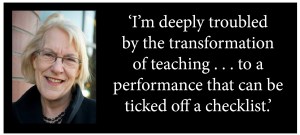
Ms. Danielson does not, however, place blame in her Framework, at least not directly. She does state what practically all experienced teachers have known all along when she writes, “I’m deeply troubled by the transformation of teaching from a complex profession requiring nuanced judgment to the performance of certain behaviors that can be ticked off a checklist.” Her opinion is a change from earlier comments when she said that good teaching could be easily defined and identified. In a 2012 interview, Ms. Danielson said that her assessment techniques are “not like rocket science,” whereas “[t]eaching is rocket science. Teaching is really hard work. But doing that [describing what teaching “looks like in words”] isn’t that big a deal. Honestly, it’s not. But nobody had done it.”
Instead of her Framework, then, Ms. Danielson places the lion’s share of the blame with state legislators who oversimplified her techniques via their adoptions, and — especially — with administrators who are not capable of using the Framework as it was intended. She writes, “[F]ew jurisdictions require their evaluators to actually demonstrate skill in making accurate judgments. But since evaluators must assign a score, teaching is distilled to numbers, ratings, and rankings, conveying a reductive nature to educators’ worth and undermining their overall confidence in the system.”
Amen, Sister Charlotte! Testify, girlfriend!
Ms. Danielson’s critique of administrators is a valid one, especially considering that evaluators were programmed, during their Danielson training, to view virtually every teacher as less than excellent, which put even the best-intentioned evaluators in a nitpicking mode, looking for any reason, no matter how immaterial to effective teaching, to find a teacher lacking and score them “proficient” instead of “excellent.” In her criticism of administrators Ms. Danielson has touched upon what is, in fact, a major shortcoming of our education system: The road to becoming an administrator is not an especially rigorous one — especially when it comes to academic rigor — and once someone has achieved administrative status, there tends to be no apparatus in place to evaluate their performance, including (as Ms. Danielson points out) their performance in evaluating their teachers.
Provided that administrators can keep their immediate superior (if any) content, as well as the seven members of the school board (who are almost never educators themselves), they can appear to be effective. That is, as long as administrators do not violate the terms of the contract, and as long as they are not engaging in some form of obvious harassment, teachers have no way of lodging a complaint or even offering constructive criticism. Therefore, if administrators are using the Danielson Framework as a way of punishing teachers — giving them undeservedly reduced evaluations and thus exposing them to the harms that can befall them, including losing their job regardless of seniority — there is no way for teachers to protect themselves. They cannot appeal an evaluation. They can write a letter to be placed alongside the evaluation explaining why the evaluation is unfair or invalid, but their complaint does not trigger a review of the evaluation. The evaluator’s word is final.

According to the law of averages, not all administrators are excellent; and not all administrators use the evaluation instrument (Danielson or otherwise) excellently. Some administrators are average; some are poor. Some use the evaluation instrument in a mediocre way; some use it poorly. Hence you can quite easily have an entire staff of teachers whose value to the profession is completely distorted by a principal who is, to put it bluntly, bad at evaluating. And there’s not a thing anyone can do about it.
Another crucial point that Charlotte Danielson makes in her Education Week article is that experienced teachers should not be evaluated via the same method as teachers new to the field: “An evaluation policy must be differentiated according to whether teachers are new to the profession or the district, or teach under a continuing contract. . . . Once teachers acquire this status [i.e. tenure], they are full members of the professional community, and their principal professional work consists of ongoing professional learning.” In other words, experienced teachers, with advanced degrees in their content area and a long list of professional accomplishments, shouldn’t be subjected to the same evaluation procedure as someone who is only beginning their career and has much to learn.
In fact, using the same evaluation procedure creates a very odd dynamic: You oftentimes have an administrator who has had only a limited amount of classroom experience (frequently fewer than ten years, and perhaps only two or three) and whose only advanced degree is the one that allows them to be an administrator (whereby they mainly study things like school law and school finance), sitting in judgment of a teacher who has spent twenty or thirty years honing their teaching skills and who has an advanced degree in their subject area. What can the evaluator possibly say in their critique that is meaningful and appropriate? It is commonplace to find this sort of situation: A principal who was a physical education or drivers education teacher, for perhaps five years, is now sitting in an Advanced Placement Chemistry classroom evaluating a twenty-year veteran with a masters degree or perhaps even a Ph.D. in chemistry. The principal feels compelled to find something critical to say, so all they can do is nitpick. They can’t speak to anything of substance.
What merit can there be in a system that makes evaluators omnipotent judges of teachers in subject areas that the evaluators themselves literally are not qualified to teach? It isn’t that veteran teachers don’t have anything to learn. Far from it. Teaching is a highly dynamic, highly challenging occupation; and the successful teacher is constantly learning, growing, self-reflecting, and networking with professional peers. The successful principal makes space for the teacher to teach and for the student to learn, and they protect that space from encroachment by anyone whose design is to impede that critical exchange.
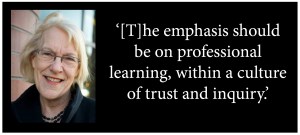
Ms. Danielson offers this alternative to the current approach to evaluation: “An essential step in the system should be the movement from probationary to continuing status. This is the most important contribution of evaluation to the quality of teaching. Beyond that, the emphasis should be on professional learning, within a culture of trust and inquiry. . . . Experienced teachers in good standing should be eligible to apply for teacher-leadership positions, such as mentor, instructional coach, or team leader.”
Ironically, what Ms. Danielson is advocating is a return to evaluation as most teachers knew it prior to adoption of the Danielson Framework.
(Grammar alert: I have opted to use the gender-neutral pronouns they and their etc. even when they don’t agree in number with their antecedents.)
Interview with Theo Landsverk: The Madman’s Rhyme
Shining Hall, an imprint of Twelve Winters Press, has recently released the book of children’s poetry, The Madman’s Rhyme, written and illustrated by Theo Landsverk. All of my press’s releases are special, but this one is especially so because The Madman’s Rhyme began as a class project by one of my students, and I approached Theo about transforming the project into a publishable book. He was interested, but we had to wait for him to be old enough to sign the publishing agreement. Also, the manuscript wasn’t quite long enough to be a book, so he took some time to add more material, and also to tidy up some of the illustrations via Photoshop.
Everything came together by end of 2015, so we went to work on producing the book, which was released in hardcover and Kindle editions in February. It’s become a tradition for me to interview the press’s authors when their work is released, so I sent Theo some questions and what follows are his responses.
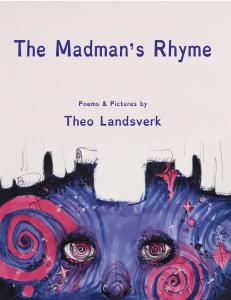
How would you describe the process you used to create “The Madman’s Rhyme”? Did the poetry tend to come first, and then you illustrated the poems? Or did the art come first and the words followed?
I would describe the process to be like the growth of a plant. First comes the seed, an idea. Then roots come next, which would be a line of poetry. More lines of poetry trickle after each other until a stem of poetry is produced. Once the poem was completely grown the illustrations would blossom around it.
Which did you find more challenging, writing the poems or creating the artwork? Why?
I found both of them to have their challenges, but by far the poetry itself was the toughest part. Fragments of poetry would pop in my head without trying but the hard part was completing the poem. Some days I had more poetic creativity and inspiration than others so that also caused some trouble when I was on a deadline.
The Madman’s Rhyme is considered children’s literature; however, some may consider the themes of some of the poems as being more adult. What are your thoughts on the “appropriate age” of your book?
It is hard to judge a true “appropriate age” for poetry because any age group can enjoy it thoroughly. I myself can enjoy a Dr.Seuss at the age of 18, so if the concern is that older audiences may feel too aged for such childish literature I would say that is nothing to worry about. A lot of my poems tend to have insight on deeper things and darker subjects making some question if this book is suitable for younger children. I can’t really judge that myself because at the age of 8 I was reading Poe’s poetry and stories. To say it shortly, age is irrelevant when reading poetry.
I have compared your work to the Brothers Grimm and even Edgar Allan Poe. Do those comparisons work for you? Did you read the Grimms as well as Poe growing up?
I feel rather honored to be compared to those works because those are what I indeed read growing up. When I was young I was very fond of fairytales and Disney movies, but I was more in love with the rustic and crude Brothers Grimm stories. They were like the unedited Disney for me. I also read a lot of Poe’s works. I admit it was a lot for an 8-year-old to even try to comprehend deeply, but I still enjoyed it and kept reading his works. It was Poe who inspired me to write poems to begin with.
Did you enjoy reading children’s books of poetry when you were very young? What were some of your favorite children’s books or children’s authors?
I loved reading children’s poetry books growing up. Shel Silverstein’s books had me in awe and held my attention span for so long with his witty words and pen illustrations. I would say his works are right in line with Poe’s when it comes to those who inspired me the most. I also really enjoyed Dr. Seuss, but who didn’t?
I know you’re interested in animation. What do you find so attractive about animation compared to “still” art? What are you goals as far as being an animator?
Animation is visual storytelling. It is bringing life to artwork. The possibilities are endless with animation and those are the reasons it fascinates me. My goal in animation is to work for a big-name company and make children’s movies.
Are there any poems or pictures in The Madman’s Rhyme that you’re especially proud of? Why?
It is really hard to choose because I am proud of them all, but I must say my favorite poems are “Feed Me,””Sip the Sorrow,” and “Wallpaper.” I am not too sure the reason why but those are the ones I treasure most. When it comes to illustrations, those for “Wallpaper,””In the Trenches,” and “Feed Me” are my favorites.
You did some of the illustrations free hand, and for others you used Photoshop . Do you prefer one approach to the other?
I prefer traditional. It feels more personal and almost mystical to illustrate traditionally. The physical process is more rewarding to me and the product is visually unique.
This is your first book, but you’ve won other awards and accolades – for example?
I have won numerous awards in the regional Scholastic Art competitions and New Berlin art competition throughout my high school career. I have also won a poster competition for drug and alcohol abuse awareness.
Do you have some other projects you’re working on, or what are your plans for school, etc.?
As of right now I do not have any major projects I am working on, just small ones to experiment with mediums. My plan for school is to go to the DAVE School (Digital Animation and Visual Effects school) in Florida.

Theo Landsverk reads from The Madman’s Rhyme at the Hoogland Center for the Arts in Springfield, Illinois, March 17, 2016.
Interview with Pauline Uchmanowicz: Starfish
Since founding Twelve Winters Press in 2012 and beginning to publish in 2013, oftentimes I’ve had to do a fair amount of detective work to find the projects I wanted to bring out. For example, I might read a writer’s work that I like very much in a journal , and their contributor’s note says they have a novel, or story collection, or poetry collection that’s looking for a home–then I go about tracking down the author and trying to get a look at their manuscript. In other instances, wonderful manuscripts have come to me out of the blue, as if handed down by the literary divinities. Such was the case with Starfish, a collection of poems by Pauline Uchmanowicz.
Last June my wife Melissa and I attended the North American Review Bicentennial Conference in Cedar Falls, Iowa, and we had the good fortune of making the acquaintance of Stephen Haven, the director of The Ashland Poetry Press. After the conference, Stephen and I stayed in touch about this or that poetry- or publishing-related issue. In the fall, an email arrived from Stephen with a manuscript attached to it: a collection of poetry by Pauline Uchmanowicz. Stephen admired the collection, but it wasn’t going to fit into Ashland’s publishing schedule, so he was wondering if Twelve Winters may be interested in it.
I, too, was much impressed by the work, and downright moved by many of the poems. I contacted the poet, who directs the undergraduate creative writing program at SUNY New Paltz. It turns out she was at the NAR Conference also, and she had visited Twelve Winters’ table, and picked up The Waxen Poor, a poetry collection by J. D. Schraffenberger, so she was familiar with the Press and with the quality of the work we were producing. Soon we came to an agreement to release her spellbinding collection in print and digital editions.
I asked Twelve Winters’ contributing editor John McCarthy to work with Pauline to finalize the manuscript for publication, and I’m happy to report that Starfish was released last week, available in print, Kindle and Nook editions. It’s become a tradition that I interview our authors about their books, and so what follows are Pauline’s unedited responses to a series of questions I sent her.

You’ve been published widely, including two chapbooks of poetry, but Starfish is your first full-length collection. Would you discuss the evolution of this project, and its path to publication?
Bill Knott, with whom I studied in the 1980s, liked to boast that Stéphane Mallarmé wrote few poems in his lifetime, and “nearly all of them perfect.” Also during the 80s, Israeli poet Yehuda Amichai (to paraphrase remarks he made at a public reading) said it surprised him when poets proclaimed to be working on a book: “You don’t hear a painter say, ‘I’m working on a museum installation.’ A painter works on a painting; a poet works on a poem.” (The present-day art and publishing worlds might contest this dictum.) Meanwhile, Virginia Hamilton Adair—though her work appeared widely in top literary journals—published her first volume of poems, Ants on the Mellon, at the age of eighty-four.
So, for the past thirty years, always “working on a poem” until as realized as possible, I was never in a hurry to publish a full-length volume until the time to do so felt right. Now is the time.

Stephen Haven, director of The Ashland Poetry Press, shared your manuscript with me because he was impressed by it, but budget issues were impacting his wherewithal to bring out new titles. Obviously it’s been challenging for poets to place their work with presses for a long time (forever?), but is your sense that it’s becoming more and more challenging?
Thank you for mentioning Stephen Haven, a wonderful poet to whom I owe sincere gratitude. The fact that he passed my manuscript on to you in part illustrates what follows.
In some ways, because of independent, small-press, online, and self-publishing, it’s easier than ever for poets to place their work—but in many ways much, much harder, due in large part to the proliferation of MFA programs and professionalization of Creative Writing as an academic discipline. Moreover, these days there is so much competition—and among very good writers. At the same time, the poetry world has always been somewhat insular, with established writers helping younger ones break into publishing. Poets continue to need support from the literary community and also must make themselves known within it—whether small-scale or large. For better or for worse, writers today who “network” increase their chances for publication. Of course, many talented writers (and editors) rightly promote others like themselves.
Crucially, the current wave of small presses—perhaps the lifeblood of “print” today—remains vital to keeping publishing possibilities alive, often through contests and awards with submission fees to defray costs. Also, due to the sheer volume of books that come out each year, poets have to do much more of the marketing and promotion than ever before, even if working with national or university presses.
All that said, working closely with Twelve Winters Press has been a privilege, my own input valued throughout the publishing process.
Starfish is divided into three parts. What was your thinking in terms of its structure, and the arrangement of the poems? Were there any agonizing choices, or once you figured out your modus operandi did the structure come together fairly easily?
In addition to book design (and TWP does a great job), the ordering of poems remains essential among elements in any poetry volume. While I’d like to claim a grand scheme for organizing Starfish into three sections—a trinity of mind, body, soul, for example—instead my decision was based on how poems might meaningfully unfold consecutively as well as side-by-side (verso and recto). Specific themes, motifs, and catalogs became apparent, such as a suite of poems that questions what to relinquish, what to retain, proceeding from the final lines of “Beachside Burial”: “why no one returns / for what was left / behind?” But broad categories do emerge. For example, the middle section has several seaside poems, while in contrast the final one is announced by the poem “Landlocked.” Also, after working for so many years on the manuscript, I had a fairly good idea of where to place each selection.
The poems in the collection tend to be brief, often a single stanza. Has this brevity been typical of your poetry throughout your career, or is Starfish a departure in this regard?
My preference as a reader has always been for small, well-made poems featuring suppressed subjectivity (as in the absence of “I”) and universal emblems—poems that likely will endure in terms of structural integrity and subject matter—fifty or a hundred years from now. The poetry of Ted Kooser, mid-career Louise Glück, and Jean Follain, respectively, comes to mind. So yes, “miniatures” have been a staple of my work all along. Sometimes I do aim to write beyond a page or two, but the process can feel forced (for me), so that I end up editing a poem down to its imagistic essences. With small poems, one can hone in on manifold parts, such as verb choices and rhetorical figures that underscore meaning overall.
I recently attended a program by Juan Felipe Herrera, the U.S. Poet Laureate (and a former creative writing teacher of mine); and one of the issues he discussed was the difficulty associated with writing a long poem and maintaining the intensity of the emotion from beginning to end. Would you agree that longer poems (however one may define “long”) can be challenging for a poet, especially in terms of sustaining the poem’s energy and emotional impact?
Associated with poetry writing today is the buzzword “elliptical,” meaning that beyond sustaining long form and retaining within it a unified vision a poem ought to take surprising, unexpected leaps relative to imagery, as Billy Collins’s work notably does. Such a poem might arrive at an epiphany or apocalyptic closure, circling back to early moments in its body. But I agree that it can be difficult to sustain vision overall in long form, which some poets resolve through use of numbered or titled section breaks. Also, I do see many poems published today that are long-lined and long form, confessional in tone and at times adopting diffused autobiography for “emotional impact.”
Your question also reminds me of a former newspaper editor I worked with who, on the subject of “length” and wordiness, once quipped by way of analogy, “I would have written you a short letter—if I had time.” The challenge of poetry writing in general, I believe, is to use the least amount of words possible to achieve what critic Paul Fussell calls “absolute density.”
Juan Felipe also said that for him, in revision, he often cuts the opening and ending lines of a poem, finding that its core is where the “heat” resides—and by cutting the beginning and ending lines, he can intensify the poem’s emotional impact. As a poet and as a teacher of creative writing, does his process strike a familiar chord with you? How would you describe your writing and revising process?
Juan Felipe’s revision process has resulted in good poetry for him, and in some ways resembles how I work. Like for many poets, a piece of my own may start with a line or an image that places pressure on what follows; I don’t usually cut first lines. Other times, I know where a poem will end, so the challenge becomes building to those final lines. This was the case with the allegorical poem “Death,” which ends with the eponymous figure speaking to a recently departed soul.
But I do find myself cutting not just last lines but whole stanzas. And in teaching creative writing, I sometimes do recommend that student poets cut a final line or couplet, which could serve as the opening of a “new” poem. I’m also big on recommending transpositions, so that the placement of engaging or charged material resonates at well placed moments within a poem.
Speaking of teaching . . . many writers/poets who teach find teaching rewarding but also draining, especially their creative energies. How do you balance teaching with your creative output? Do you find that teaching in some ways encourages and informs your writing and publishing?
The fresh and surprising output of young writers is always delightful to me, making it easy to devote energy to their creative endeavors over my own. Whether teaching writing or literature, I aim to be “fresh” myself in terms of readings, written assignments, and pedagogical approaches. One can spend hours reading and commenting on student work, or on preparing lecture notes and assignments. And in addition to a heavy teaching load, during any given semester I’m directing an independent study, Honors Program thesis, or editorial internship—sometimes all three at once.
Since I direct an undergraduate Creative Writing program, a huge block of my time and energy goes into programming—over a dozen events an academic year with demanding details involved, from booking writers to securing funding. We also put out an expansive student literary magazine, which I edit.
I believe all of these endeavors “encourage” my writing. But the way it gets completed is the same for how teaching and administrative tasks do: I compartmentalize. I’ve always admired writers who work every day—say by rising at 5 a.m. to squeeze in an hour before going to a job. That’s not me, though my writing notebook is always within reach beside the morning cereal bowl and coffee cup.
Which poems in Starfish were the most difficult to write? Were there any technical issues with the poems that presented particular challenges? Are there poems that you’re especially proud of?
Almost every poem in Starfish was difficult to write, some requiring a ridiculous number of drafts (Bill Knott sitting on one’s shoulder, as it were). The same technical issues attend to every selection in the book: the aim of achieving “absolute density” mentioned above. But every once in a while, a poem just “happened.” For example, flipping through a notebook one day, I came upon “Postmark” (untitled at the time), which I barely remembered even writing. So the challenge was to find the emotional center of the poem then to tinker with a few words, and also find an expressive title. A recurring technical puzzle for me in general involves line breaks. I tend to end-stop (rhythmically) lines and always want to find alternate ways of phrasing or incorporating enjambment instead.
At one point, I was proud of the meta-poem Explication de texte, which actually did come about when I was teaching a graduate seminar with close reading at its core. The poem is a single sentence, with every line commenting on itself by using the language of prosody. Usually though, the “current” poem I’m working on most enchants me.
You do other sorts of writing besides poetry (reviews, for example). For lack of a better way of asking this question—do you feel that all your writing, regardless of form or genre, comes from the same place? Or do you have to tap into different parts of your … brain … soul … psyche … to write, say, verse, as opposed to an essay or review?
No matter what one writes, there’s always a rhetorical performance involved, and many of the devices and techniques used to craft poetry influence my writing in prose, from sharpening and tightening for readability and clarity to aiming for lyricism or metaphors that suggest the subject at hand.
Does writing a book review or author profile derive from a different aspect of consciousness than writing a poem? Sure, absolutely, because one’s energy is on representing and championing other people. What does come from the “same place” though is the desire to write as exactingly or as beautifully as possible.
How important do you believe it is for younger poets to be well studied in the history and traditions of poetry? Do you believe it’s crucial to become at least proficient in fixed forms (like the sonnet or sestina) before working with less formally structured poems?
Not to lapse into clichés here, but we all know too many young people who become turned off to poetry before they even engage it fully because canonical works are not familiar to them in terms of imagery or cadences. So I tend to start with free-verse short forms (readings as well as writing assignments)—to focus on what a line is and how it operates—then introduce basic poetic units. But I do believe it’s vital and necessary for younger poets to study and understand historical traditions and also to experiment in fixed forms and accentual-syllabic meter. My tendency though is to always insert the qualifier that a poem crafted in response to an assignment (write a sonnet, write a poem in terza rima) may “modify” a fixed or traditional form.
Overall in teaching poetry writing, I take a page from Martín Espada’s pedagogy: the goal is for each person to develop a unique poetic identity in terms of language and subject matter, with focus on the image (Espada). Thus, learning to read and write poetry means understanding and appreciating poetic images.
Recently I was reading Paul Valéry’s thoughts on writing poetry, and I was particularly struck by his belief that too many young poets, of his day, put too much faith in inspiration, and therefore not enough effort into the hard work of writing and revising a poem. What role do you think inspiration plays in the process, and would you tend to agree with Valéry (as I’ve represented him here)?
I can’t speak to young poets as a whole, but while some known to me reject revision, believing “inspiration” to be an article of faith, most come to the realization that drafting, revising, and polishing are important aspects of “writing” poetry.
On this subject, when interviewing Charles Simic for a profile in Chronogram magazine, and mentioning that his sparse, elegant poems appear divinely made, I was reassured when he stated, unequivocally: “There’s no muse. I don’t take dictation. It’s really a slow process of making the poem—of endless tinkering and revising to make it sound inspired.” So, a goal is for a poem to appear inspired—as if just written down in a single sitting—even if its genesis was far different than that.
Nearly every poet I know enjoys public recitation of their work, and many seem to feel that public performance is the truest way for an audience to receive their work. What are your feelings? Do you enjoy sharing your work via your voice, and do you feel you’re able to represent your poetry more completely than when it is merely read on the page?
Nationally and internationally celebrated poets I’ve heard speak on page-versus-stage poetry have maintained that a poem should read easily on the page and also be easily comprehended—for its lyricism as well as its meaning—when read aloud. I believe if a poem has integrity it will be well received in print or performance. As far as reading one’s work aloud, for me, that takes practice as well. I’m especially struck by what Richard Blanco says on this subject in his brief memoir, For All of Us, One Today, about how he prepared to read his occasional poem for President Obama’s second inaugural. If you watch the video of Blanco’s performance it appears seamless and effortless—but hours and hours of rehearsal went into his four minutes or so on the podium.
Who are some poets, past and present, that you especially admire, and why? Would you point to any poet or two who have been particularly instructive or inspiring?
My list is long and lengthy. I like all kinds of poets and poems from various eras, mainly beginning with the British Romantics (John Keats and William Blake, especially) and moving forward. I like Emily Dickinson and Walt Whitman from the nineteenth-century American canon. Poets I read over and over again in translation include Jean Follain and Wisława Szymborska. I like dozens and dozens of American poets (some already named but worth repeating here): Lucille Clifton, Ted Kooser, Kay Ryan, Martin Espada, Linda Gregg, Carl Dennis, and often whomever I happen to be reading or teaching at the moment. I also seek out books by poets whose works I’ve enjoyed reading in literary journals, or who may have won a distinguished prize, like Ansel Elkins for Blue Yodel (Yale Younger Poets Award, 2014). It’s always good to check out what young writers are up to today.
What new projects are currently underway?
I’m “working on a poem” (and another, and another). My notebook is stuffed with nonfiction essays in progress and I’ve recently written a number of short fiction pieces. My next deadline (about one week from now) is for four book reviews.
Pauline Uchmanowicz is the author of two poetry chapbooks and has received residency grants at the MacDowell Colony and Yaddo. A freelance writer in the Hudson Valley, her poems, essays, and reviews have appeared in Crazyhorse, Ohio Review, Ploughshares, Provincetown Arts Journal, Radcliffe Quarterly, Woodstock Times, Z Magazine, and elsewhere. She is associate professor of English and director of Creative Writing at SUNY New Paltz. (Author photo by Franco Vogt)
Accidental Poets: Paul Valéry’s influence on William Gass
The following paper was presented at the Louisville Conference on Literature and Culture Since 1900, held at the University of Louisville February 18-20. Others papers presented were “The Poet Philosopher and the Young Modernist: Fredrich Nietzshe’s Influence on T.S. Eliot’s Early Poetry” by Elysia C. Balavage, and “Selections from ‘The Poetic Experiments of Shuzo Takiguchi 1927-1937’” by Yuki Tanaka. Other papers on William H. Gass are available at this blog site; search “Gass.”
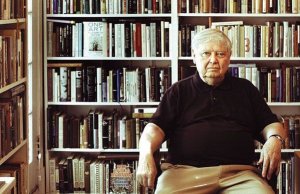
In William H. Gass’s “Art of Fiction” interview, in 1976, he declared two writers to be his guiding lights—the “two horses” he was now “try[ing] to manage”: Ranier Maria Rilke and Paul Valéry. He added, “Intellectually, Valéry is still the person I admire most among artists I admire most; but when it comes to the fashioning of my own work now, I am aiming at a Rilkean kind of celebrational object, thing, Dinge” (LeClair 18). That interview for The Paris Review was exactly forty years ago, and viewing Gass’s writing career from the vantage point of 2016, I am here to suggest that, yes, Rilke has been a major influence, but Valéry’s has been far greater than what Gass anticipated; and in fact may have been even greater than Rilke’s in the final analysis. Assessing influence, however, is complicated in this case, I believe, because a large part of Gass’s attraction to Valéry’s work in the first place was due to his finding the Frenchman to be a kindred spirit. Hence it is difficult to say how much of Gass is like Valéry because of Valéry’s influence and how much is because of their inherent like-mindedness.

A quick survey of Gass’s work since 1976—which includes two novels, a collection of novellas, a collection of novellas and stories, and eight books of nonfiction—may imply that Rilke has been the greater influence, as Gass intended. After all, Gass’s magnum opus, The Tunnel (1995), for which he won the American Book Award, centers on a history professor of German ancestry who specializes in Nazi Germany (Rilke allusions abound); and his other post-1976 novel, Middle C (2013), for which he won the William Dean Howells Medal, centers on a music professor born in Vienna whose special interest is Austrian composer Arnold Schoenberg; and, glaringly, there is Gass’s Reading Rilke (1999), his book-length study of the problems associated with translating Rilke into English. However, a more in-depth look at Gass’s work over these past four decades reveals numerous correspondences with Valéry, some of which I will touch upon in this paper. The correspondence that I will pay particular attention to, though, is that between the title character of Valéry’s experimental novella The Evening with Monsieur Teste (1896) and the protagonist of Gass’s Middle C, Joseph Skizzen.
Before I go further, a brief biographical sketch of Paul Valéry: He was born in 1871, and published two notable works in his twenties, the essay “Introduction to the Method of Leonardo da Vinci” and Monsieur Teste; then he stopped publishing altogether for nearly twenty years—emerging from his “great silence” with the long poem “The Young Fate” in 1917 at the age of forty-six. During his “silence,” while he didn’t write for publication, he did write, practically every day, filling his notebooks. Once his silence was over, he was catapulted into the literary limelight, publishing poems, essays, and dramas, becoming perhaps the most celebrated man of letters in France. By the end of his life in 1945 he’d been nominated for the Nobel Prize in Literature a dozen times.
The title for this paper comes from Gass himself. In his 1972 review of Valéry’s collected works, in the New York Times Book Review, he wrote that Valéry “invariably . . . [pretended] he wasn’t a poet; that he came to poetry by accident” (The World Within the Word 162). By the same token, Gass has insisted in numerous interviews (and he’s given many, many interviews) that he’s not a poet, that the best he can achieve is an amusing limerick. Others, however, have asserted that Gass’s fiction is more akin to poetry than prose, that his novellas and novels are in essence extremely long prose poems; and in spite of his insistence on his not being a poet, he would seem to agree with this view of his work. In a 1998 interview, for instance, Gass said, “I tend to employ a lot of devices associated with poetry. Not only metrical, but also rhyme, alliteration, all kinds of sound patterning” (Abowitz 144). Moreover, about a decade earlier he said that “all the really fine poets now are writing fiction. I would stack up paragraphs of Hawkes, Coover, Elkin, or Gaddis against the better poets writing now. Just from the power of the poetic impulse itself, the ‘poets’ wouldn’t stand a chance” (Saltzman 91). Critics have tended to include Gass in the group of writers whom Gass described as poet-novelists.
For your consideration, from The Tunnel:
A smile, then, like the glassine window in a yellow envelope. I smiled. In that selfsame instant, too, I thought of the brown, redly stenciled paper bag we had the grocer refill with our breakfast oranges during the splendid summer of sex and sleep just past—of sweetly sweating together, I would have dared to describe it then, for we were wonderfully foolish and full of ourselves, and nothing existed but your parted knees, my sighs, the torpid air. It was a bag—that bag—we’d become sentimental about because (its neck still twisted where we held it) you said it was wrinkled and brown as my balls, and resembled an old cocoon, too, out of which we would both emerge as juicy and new as the oranges, like “Monarchs of Melody,” and so on, and I said to you simply, Dance the orange (a quotation from Rilke), and you said, What? There was a pause full of café clatter. (160-61)
And beyond Gass’s poetic prose, he has written actual poems, besides the off-color limericks that populate The Tunnel. In Middle C, for example, there is a longish, single-stanza poem written via the persona of the protagonist, Joseph Skizzen. It begins, “The Catacombs contain so many hollow heads: / thighbones armbones backbones piled like wood, / some bones bleached, some a bit liverish instead: / bones which once confidently stood / on the floor of the world” (337). And, perhaps more significantly, there are the translated poems in Reading Rilke. There was a celebration held at Washington University in St. Louis in honor of Gass’s ninetieth birthday, Passages of Time, and he read from each of his works in chronological order, except he broke chronology to end with his translation of Rilke’s “The Death of the Poet,” which concludes,
Oh, his face embraced this vast expanse,
which seeks him still and woos him yet;
now his last mask squeamishly dying there,
tender and open, has no more resistance,
than a fruit’s flesh spoiling in the air. (187)
It was a dramatic finale, especially since the event was supposed to be in July, near Gass’s birthday, but he was too ill to read then; so it was rescheduled for October, and the author had to arrive via wheelchair, and deliver the reading while seated. Happily, he was able to give another reading, a year later, when his new book, Eyes, came out. (I wasn’t able to attend the Eyes reading, so I’m not sure how he appeared, healthwise, compared to the Wash U. reading.)
My point is that, like Valéry, Gass has downplayed his abilities as a poet, yet his literary record begs to differ. The fact that he broke the chronology of his birthday celebration reading to conclude with a poem—and he had to consider that it may be his final public reading, held on the campus where he’d spent the lion’s share of his academic life—suggests, perhaps, the importance he has placed on his work as a poet, and also, of course, it may have been a final homage to one of his heroes. In spite of Gass’s frailness, his wit was as lively as ever. When he finished reading “The Death of the Poet,” and thus the reading, he received an enthusiastic standing ovation. Once the crowd settled, he said, “Rilke is good.”
Evidence of the earliness of Valéry’s influence or at least recognized kinship is the preface to Gass’s iconic essay collection Fiction and the Figures of Life (1970), which Gass devotes almost entirely to the connection between the collection’s contents and the way that Valéry had assembled his oeuvre. Gass writes, “It is embarrassing to recall that most of Paul Valéry’s prose pieces were replies to requests and invitations. . . . [H]e turned the occasions completely to his account, and made from them some of his profoundest and most beautiful performances” (xi). Gass continues, “The recollection is embarrassing because the reviews and essays gathered here are responses too—ideas ordered up as, in emergency, militias are”; and then he describes his book as a “strange spectacle” in which he tries “to be both philosopher and critic by striving to be neither” (xii). So, Gass recognizes the parallel between the forces at work in Valéry’s literary life and his own. Gass has readily acknowledged the slowness with which his fiction has appeared (notably, it took him some twenty-six years to write The Tunnel), citing two reasons: the slowness with which he writes, and rewrites, and rewrites; but also the fact that he regularly received opportunities to contribute nonfiction pieces to magazines and anthologies, and to give guest lectures, and they tended to pay real money, unlike his fiction, which garnered much praise but little cash over his career.
This parallel between the circumstances of their output is interesting; however, the correspondences between Valéry’s creative process and his primary artistic focus, and Gass’s, is what is truly significant. In his creative work, Valéry was almost exclusively interested in describing the workings of the mind, of consciousness; and developing complex artistic structures to reflect those workings. T. S. Eliot noted Valéry’s dismissiveness of the idea of inspiration as the font of poetic creation. In Eliot’s introduction to Valéry’s collection The Art of Poetry, he writes, “The insistence, in Valéry’s poetics, upon the small part played [by ‘inspiration’ . . .] and upon the subsequent process of deliberate, conscious, arduous labor, is a most wholesome reminder to the young poet” (xii). Eliot goes on to compare Valéry’s technique and the resulting work to that done by artists in other media, most notably music composers: “[Valéry] always maintained that assimilation Poetry to Music which was a Symbolist tenet” (xiv). James R. Lawler echoes Eliot when he writes that Valéry “makes much of the comparison of poetry to the sexual act, the organicity of the tree, the freedom of the dance, and the richness of music—especially that of Wagner” (x).
The wellspring of music composition as a source of structural principles for poetry (or highly poetic prose) is arguably the greatest correspondence between Valéry as artist and Gass as artist. Examples abound, but The Tunnel and Middle C offer the most radiant ones. For the The Tunnel Gass developed a highly synthetic structure based on Arnold Schoenberg and the Second Viennese School’s musical theory of a twelve-tone system. Consequently there are twelve sections or chapters, and in each Gass develops twelve primary themes or images. He said, “[T]hat is how I began working out the way the various themes come in and out. It’s layered that way too. . . .” (Kaposi 135). In The Tunnel, Gass’s methodology is difficult to discern because Gass gave it a “chaotic and wild” look while in fact it is, he said, “as tightly bound as a body in a corset” (134). He achieved the appearance of chaos by “deliberately dishevel[ing]” the narrative with “all kinds of other things like repetitions [and] contradictions.” He said, “[T]he larger structure must mimic human memory, human consciousness. It lies, it forgets and contradicts. It’s fragmentary, it doesn’t explain everything, doesn’t even know everything” (134). For Middle C, the use of the Schoenberg system is much more overt, with Skizzen, its protagonist, being a music professor whose specialty is Schoenberg and Skizzen’s obsession with getting a statement about humans’ unworthiness to survive just right. Skizzen believes he is on the right track when he writes the sentence in twelve beats, and near the end of the novel he feels he has the sentence perfect:
First Skizzen felt mankind must perish
then he feared it might survive
The Professor sums up his perfect creation: “Twelve tones, twelve words, twelve hours from twilight to dawn” (352). Gass, through his narrator, does not discuss the sentence’s direct correlation to the Second Viennese School’s twelve-tone system, but it does match it exactly.
Let me return to another Valéry-Gass correspondence which I touched on earlier: their concern with the workings of the mind or, said differently, consciousness. Jackson Mathews, arguably the most herculean of Valéry’s translators into English, begins his introduction to Monsieur Teste with the statement that “Valéry saw everything from the point of view of the intellect. The mind has been said to be his only subject. His preoccupation was the pursuit of consciousness, and no one knew better than he that this pursuit led through man into the world” (vii). Valéry’s interest in the mind was present in his earliest published work, the essay on Leonardo’s method and, even more obviously, Monsieur Teste, that is, “Mr. Head” or “Mr. Brain as Organ of Observation” or something to that effect. However, it was during Valéry’s twenty-year “silence” that he delved into the phenomenon of consciousness most critically. Gass writes, “Valéry began keeping notebooks in earnest, rising at dawn every day like a priest at his observances to record the onset of consciousness, and devoting several hours then to the minutest study of his own mind” (“Paul Valéry” 163). As noted earlier, Gass fashioned The Tunnel, all 800 or so pages of it, to mimic the human mind in its intricate workings. In Middle C, Gass pays much attention to Skizzen’s thought processes, especially his copious writing, revising, critique of, and further revising of his statement about humans’ unworthiness for survival. Such concerns are everywhere in Gass’s work, including his most recently published, the collection of novellas and stories, Eyes. I would point in particular to the novella Charity, a challenging stream-of-consciousness narrative, all a single paragraph, that mercilessly bounces between the main character’s childhood and his present, and, chaotically, various times in between, all the while sorting through his feelings about the act of charity and how he came to feel about it as he does in the now of the story.
In the limited time remaining, I’ll turn to the correspondence between Valéry’s character Monsieur Teste and Gass’s Joseph Skizzen (though I think William Kohler, the narrator of The Tunnel, has significant Teste-esque qualities as well). The convention of The Evening with Monsieur Teste is that the narrator is a friend of Edmond Teste’s, and he goes about attempting to describe his friend’s character. There is very little action per se, and as such almost nothing in the way of plot, in a conventional sense at least (very Gassian in that regard). He tells us that he came to “believe that Monsieur Teste had managed to discover laws of the mind we know nothing of. Certainly he must have devoted years to his research” (11). In Middle C, Joseph Skizzen is obsessed with what he calls his Inhumanity Museum, essentially a record, largely in the form of newspaper clippings and personal notes, of humans’ ceaseless cruelty to one another. The collection is associated with his ongoing struggle to word just so his statement about humans’ unworthiness to survive. Monsieur Teste becomes almost a recluse, desiring little contact with other people. He is married, but the narrator suggests that Monsieur and Madam Teste’s relationship is more platonic than passionate, due to Edmond’s preference for the intellectual over the emotional. Similarly, Skizzen never marries in Middle C, and in fact never has sex—he flees as if terrified at the two attempts to seduce him, both by older women, in the novel. Ultimately he ends up living with his mother in a house on the campus where he teaches music history and theory, his few “pleasures” consisting of listening to Schoenberg, assembling his Inhumanity Museum, and revising his pet statement. What is more, Teste’s friend describe Edmond’s understanding of “the importance of what might be called human plasticity. He had investigated its mechanics and its limits. How deeply he must have reflected on his own malleability!” (11-12). Skizzen’s malleability is central to his persona in Middle C. He goes through several name changes, moving from Austria to England to America, and eventually fabricates a false identity, one which includes that he has an advanced degree in musical composition, when in fact his knowledge of music is wholly self-taught. One of the reasons he gravitates toward Schoenberg as his special interest is because of the composer’s obscurity and therefore the decreased likelihood that another Schoenberg scholar would be able to question Skizzen’s understanding of the Austrian’s theories. But over time Skizzen molds himself into a genuine expert on Schoenberg and a respected teacher at the college—though his fear of being found out as a fraud haunts him throughout the novel.
To utter the cliché that I have only scratched the surface of this topic would be a generous overstatement. Perhaps I have eyed the spot where one may strike the first blow. Yet I hope that I have demonstrated the Valéry-Gass scholarly vein to be a rich one, and that an even richer one is the Valéry-Rilke-Gass vein. A couple of years ago I hoped to edit a series of critical studies on Gass, and I put out the call for abstracts far and wide; however, I had to abandon the project as I only received one email of inquiry about the project, and then not even an abstract followed. Nevertheless, I will continue my campaign to bring attention to Gass’s work in hopes that others will follow me up the hill, or, better still, down the tunnel. Meanwhile, if interested, you can find several papers on Gass’s work at my blog.
Works Cited
Abowitz, Richard. “Still Digging: A William Gass Interview.” 1998. Ammon 142-48.
Ammon, Theodore G., ed. Conversations with William H. Gass. Jackson: UP of Mississippi, 2003. Print.
Eliot, T. S. Introduction. The Art of Poetry. By Paul Valéry. Trans. Denise Folliot. New York: Pantheon, 1958. vii-xxiv. Print.
Gass, William H. Charity. Eyes: Novellas and Short Stories. New York: Knopf, 2015. 77-149. Print.
—. Preface. Fiction and the Figures of Life. 1970. Boston, MA: Nonpareil, 2000. xi-xiii. Print.
—. Middle C. New York: Knopf, 2013. Print.
—. Reading Rilke: Reflections on the Problems of Translation. 1999. New York: Basic Books, 2000.
—. The Tunnel. 1995. Champaign, IL: Dalkey Archive, 2007. Print.
—. The World Within the Word. 1978. New York: Basic Books, 2000. Print.
Kaposi, Idiko. “A Talk with William H. Gass.” 1995. Ammon 120-37.
Lawler, James R. Introduction. Paul Valéry: An Anthology. London: Routledge & Kegan Paul, 1977. vii-xxiii. Print.
LeClair, Thomas. “William Gass: The Art of Fiction LXV.” 1976. Ammon 46-55. [online]
Mathews, Jackson. Introduction. Monsieur Teste. By Valéry. Trans. Jackson Mathews. Princeton, NJ: Princeton UP, 1989. vii-ix. Print.
Valéry, Paul. Monsieur Teste. 1896. Trans. Jackson Mathew. Princeton, NJ: Princeton UP, 1989. Print.
Notes on images: The photo of Paul Valéry was found at amoeba.com via Google image. The photo of William H. Gass was found at 3ammagazine.com via Google image.
Interview with Melissa Morrissey: Shawna’s Sparkle
When I founded Twelve Winters Press in 2012, I didn’t anticipate establishing an imprint for children’s literature — nor did I anticipate meeting my (now) wife, Melissa. Besides our both being educators, Melissa and I are bibliophiles (if not -maniacs). She’d always written and had in mind that she’d like to publish books (like her father, Larry D. Underwood, who wrote and published several history books and even an historical novel). In particular, she had some ideas for children’s books, but she wasn’t sure how to go about getting them published. I told her I’d be happy to show her the ropes — how to look for an agent … and wait and wait and wait … or submit directly to a publisher … and wait and wait and wait … Or, instead, we could direct our time and creative energies to establishing our own children’s literature imprint, and bring out her books ourselves.
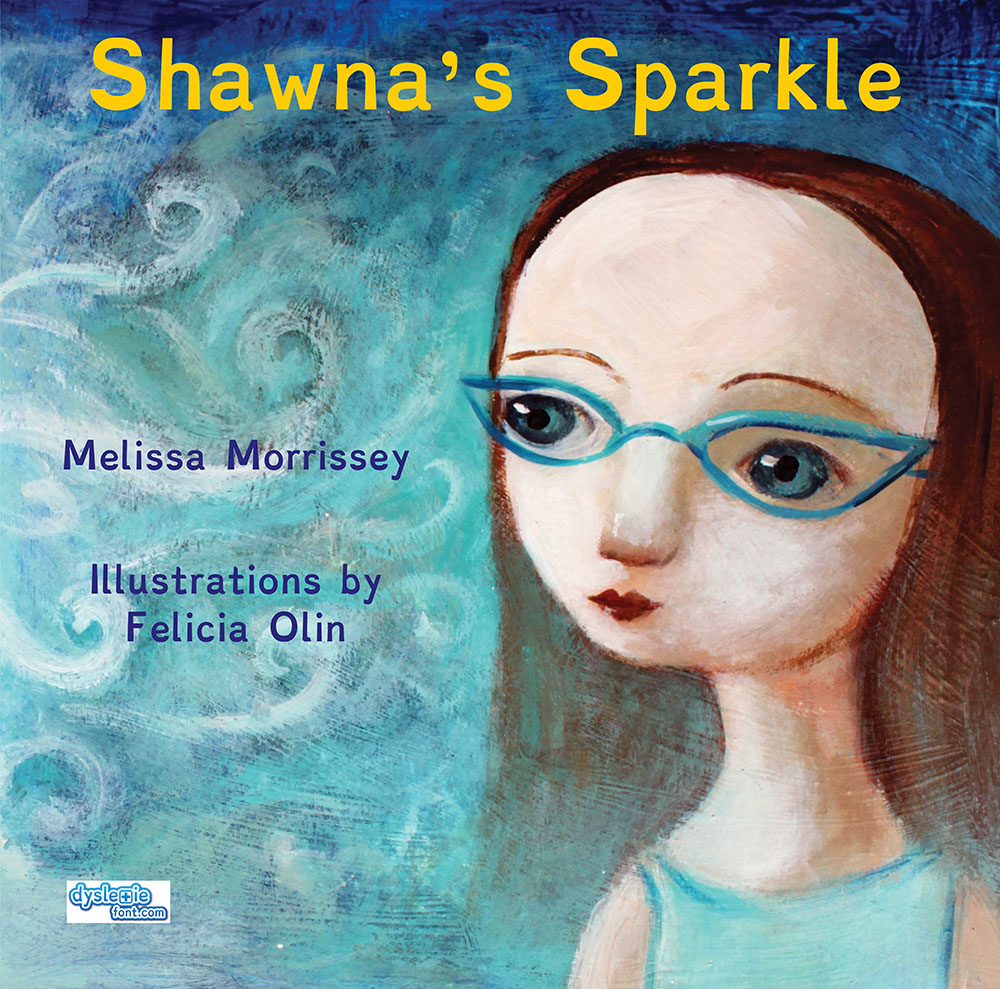
So that’s what we’ve done. This past year we established Shining Hall, and our first project was to publish Melissa’s book Shawna’s Sparkle. As Melissa was writing the book, she had characters in mind in the style of one of our favorite local artists, Felicia Olin. When the story was completed, we crossed our fingers and contacted Felicia about possibly doing the illustrations. She agreed, in spite of her busy schedule getting her paintings ready for upcoming exhibits and various art shows. Earlier in the summer of 2015, Felicia sent us the illustrations that she’d created. We were blown away. We’d only had a brief meeting with Felicia over coffee at Wm. Van’s in Springfield, and gave her very little in the way of direction, trusting her artistic instincts — and our trust was well placed.
I went to work designing the book (my first children’s book), and on July 10 Shawna’s Sparkle was released in hardcover, paperback and Kindle editions. So far response to the book has been overwhelmingly positive, to both the story itself and to Felicia’s wonderful illustrations. It’s become something of a tradition that I interview the authors I’m publishing about their books, and even though I of course already know a lot about Melissa’s book, I didn’t see any reason to suspend the tradition on account of our being married. I gave Melissa some questions about the book and her writing of it, and what follows are her unedited responses. We have other books by Melissa in the works, and Shining Hall will begin publishing books by other children’s authors in the near future. We’re also planning a children’s book contest for early 2016.

What made you want to write a book for children?
I am a teacher, so I feel I can easily relate to children. They are so open. They love to read and people love to read to them.
For most authors, their characters are composites of different people they’ve known, maybe mixed with a healthy dose of self. Who is Shawna, would you say?
She is a part of me, of course. Anytime you write, a part of you comes out. I have changed some details, such as only having a brother. However, as a child, I felt very much like Shawna and sometimes still do.
You’ve said that you want the book to teach children to love themselves and appreciate their special gifts. Why do you think that’s so important for kids?
Children are born with a connection and lots of sparkle. Put a child in a room and every eye in the room is transfixed. They have such light. Life, and unfortunately sometimes school and adults, makes their sparkle dim. They can forget that connection. Kids that struggle in school have it especially hard because they have to go to school all day and practice things they are not good at or comfortable doing. What torture! As adults, we mostly do things to reinforce talents. School doesn’t always work that way. We all have gifts, however, and capitalizing on them makes us sparkle in all areas of our life. Any child who learns this early, has a leg up on life so to speak.
In what ways does Shawna’s Sparkle reflect your interests in meditation and mindfulness?
My interests in meditation and mindfulness come out in Shawna’s dream, especially. The book is simplistic in that a simple dream changes everything; however, it can be that easy. One moment can change your whole life. Reconnecting with your “sparkle” occurs naturally when you meditate or become more mindful of your gifts. I am passionate about people becoming more mindful because as we all increase our sparkle, the whole world is filled with more light. There are a lot of children hurting right now. I believe learning mindfulness would equip them with tools that would serve them their entire lives.
Shawna seems to be something of a throw-back to an earlier time in that she loves books and reading, and there’s no mention in your book of modern technology — no iPad, not even any TV. Why do you think reading, and maybe especially reading old-fashioned books, is so important for children?
There is so much to be learned about life, humans, and empathy through the characters in literature. There is currently a push to read more nonfiction, and indeed nonfiction has its place in education, but purely reading nonfiction makes your brain lazy. I think that is why struggling readers and kids on the spectrum can be drawn to nonfiction. When you read literature there are all kinds of characters and emotions to keep straight in your brain. It is a real workout but so rewarding! We can see through a character’s eyes and experience a side of life and a point of view that we may not have otherwise considered. I like to think that if we knew how others were feeling we would all be gentler and kinder.
What about artist Felicia Olin’s work made you think she’d be the perfect illustrator for Shawna’s Sparkle? How did you feel about the illustrations she created?
When writing Shawna’s Sparkle, I pictured the characters as if created by Felicia. I actually mentioned the book to one person who suggested I contact her. He was amazed when I told him I already had her in mind. People that know me know I don’t believe in coincidences. I was very thankful that she agreed to do this project. Felicia brought the book to life in a way I certainly could never have done. I am eternally grateful and continually wowed by her work.
How much do you think your father’s example of being an author impacted your desire to write and publish?
My earliest childhood memories were of sitting on my father, author Larry D. Underwood’s, lap and stating that “when I grow up I’m going to be a teacher and a writer just like you!” He inspired me to challenge myself in both my reading and writing. I wrote a teen novel for a contest in high school. It wasn’t chosen, so I stuck it in a drawer. However, I continued writing various articles and editorials including one in Springhouse magazine. I always planned to get back to writing more seriously. Since my dad has been “in spirit” I feel the urge to write more strongly, which can no longer be ignored.
You spent two decades teaching special education students. How did that experience influence your writing of the book?
My father encouraged me to go into special education and the career has served me well. I am perfectly suited to smaller groups and children who respond to love, attention, and my gentle nature. My administrators and supervisors always commented that I had a calming effect on students. I was grateful that they recognized and appreciated that in me because I do not believe in yelling at children to motivate them. I am now in special education administration and miss that classroom connection immensely. This book, I feel, is allowing me to reach a larger audience than my single classroom, including all the people I never had the honor to teach.
Why is it important to you that your book was published in Dyslexie font, which is designed to be easier to read for learners with dyslexia?
I was always bothered by my inability to “fix” dyslexia, which was really the wrong way to approach it because students with dyslexia have so many other gifts, like their ability to see the world in a different way. However, I feel that the font will help students access print more readily. I also intend to release the book in an audio format soon.
What other writing projects are you working on?
I am working on a teacher’s guide for Shawna’s Sparkle that will align with Common Core. I have other books written that teach social emotional skills. We are working on getting illustrators for them. Also, I am working on a new series of books that center around our rescue dog, Einstein, and will help teach the Next Generation Science Standards. We are hoping to release the first one soon, if we get an illustrator on board.
Melissa Morrissey, an Illinois Teacher of the Year Finalist, has been a special education teacher and administrator for over twenty years. She holds degrees from Eastern Illinois University, Southern Illinois University Edwardsville, and University of Illinois Springfield. Shawna’s Sparkle is her first book. (Author photo by Polly Parsons)
A Hot and Cold ‘Frost’
A mixed review, but appreciated nevertheless. (I intended the novel to be a bit of a challenge.)

 An Untimely Frost (or, The Authoress)
A Novel
by Ted Morrissey
An Untimely Frost is prefaced by two quotes on loneliness, one from Washington Irving, the other Mary Shelley. These quotes serve both to set up one of the major themes of the novel and to nod toward its inspiration: the rumored hint of romance between the aforementioned authors.
 Written by Illinois author Ted Morrissey, An Untimely Frost concerns Jefferson Wheelwright, an American author hailing from a family of industrial wealth, traveling Europe to promote the impending publication of his latest work, and on Margret Healey, a mysterious, reclusive British author whose only published novel to date, Dunkelraum, regards a German scientist who built a man from the body parts of dead people and reanimated him. The two authors’ lives of solitude intertwine when Wheelwright visits Healey’s house in an attempt to meet her, having been a fan of…
View original post 595 more words
A Sensory Feast
A concise and thoughtful review of my novella “Weeping with an Ancient God” from Chicago Book Review.
 Weeping with an Ancient God
A Novella
by Ted Morrissey
Ted Morrissey’s Weeping with an Ancient God is a fictional revision of Herman Melville’s own telling of his time spent amongst cannibals. The story begins with Melville and his friend Toby trapped on an island, unable to speak the native language, and unaware of what exactly the cannibals want from them. They over time try to devise a plan to escape.
 Morrissey does a great job at the beginning with establishing the isolation of the main character. Immediately the reader is introduced to heavy sensory detail as Melville awakens to darkness and heat, pain throbbing in his leg, remembering whom he now lives among. This tone of darkness is carried throughout, with only small dollops of light. The darkness is found not just amongst Melville’s relationships with the cannibals, or his entrapment on the island, but within his own mind…
View original post 404 more words
Destroying Public Education for Dummies
“I’m as mad as hell, and I’m not gonna take this anymore!”
It’s the iconic line from the 1976 film Network in which news anchor Howard Beale (Peter Finch) is pushed beyond the breaking point and implores his viewers to get mad, go to their windows, open them and shout: “I’m as mad as hell, and I’m not gonna take this anymore!” — and people do . . . by the thousands.
This is essentially the message of Williamsville (Illinois) school superintendent David Root in the District Dispatch he sent out yesterday in which he writes: “So, want to destroy public education and prevent people from wanting to teach? Not a problem. It’s actually pretty simple.”

Superintendent David Root
Root uses the metaphor of the how-to books “for Dummies” to say that the dummies in charge of state government — recently elected governor Bruce Rauner and the General Assembly as a whole — have managed, without breaking a sweat, to destroy public education and the morale of educators by slashing funds, mandating a litany of pointless tests, and demonizing and demoralizing teachers. One of the points I especially appreciate alludes to the Danielson Framework for Teacher Evaluation and how its adoption by the state is part of a scheme to make teachers in Illinois look ineffective (and thus, I say, pave the way for the lucrative privatization of schools) — an argument I’ve been making for months, especially in my August 17, 2014, post “Principals unwitting soldiers in Campbell Brown’s army.”
Please read superintendent Root’s superb jeremiad in its entirety here. (Or you can also access it via the district’s webpage here.).
Some people were surprised at Root’s vitriol, even though it’s been building for some time, and suggested that perhaps Mr. Root should have held off sending it out until he’d calmed down a bit. But I unequivocally disagree: I say we are long past the point of civility. We need more — all! — administrators, teachers, school board members, parents and students to raise their windows and shout: I’m mad as hell and I’m not going to take it anymore!
And we shouldn’t stop our raging against the “education reform” machine until public schools and public educators receive the support and the respect they deserve. Because, ultimately, our students deserve no less.
Bravo, superintendent Root! I too am as mad as hell!
“Professor Tolkien’s Rebel Readings of Beowulf” by Ted Morrissey
An addendum to my review of J.R.R. Tolkien’s translation of “Beowulf” which ran in NAR 300.2.

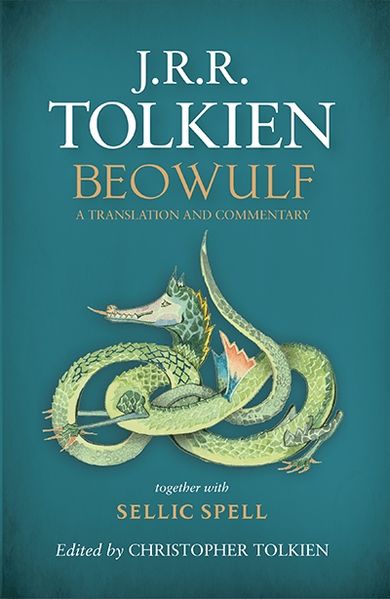
In my review (issue 300.2) of J.R.R. Tolkien’stranslation of the Old English poem Beowulf, I allude to the Oxford professor’s radical interpretations of certain sections of the poem; however, space limitations in the print magazine didn’t allow me to elaborate on those interpretations, so I spoke with NAR editors about using their blog to further discuss Tolkien’s rebel readings.
The word rebel is not used merely for dramatic effect. Scholarship devoted to Beowulf has been a thriving subculture in the academic world for more than 150 years. Opinions are often held passionately, and challenges to those opinions can be contentiously and even bitterly met. Tolkien held the post of Professor of Anglo-Saxon at Oxford University from 1925 to 1959. It was an esteemed professorship, of course, and brought with it respect, but also a host of jealous rivals. Tolkien seems to have been keenly aware of his colleagues…
View original post 1,458 more words
Big Questions in Small Doses
A smart and insightful review of Twelve Winters Press’s “Extinguished and Extinct: An Anthology of Things That No Longer Exist,” edited by John McCarthy. Thanks much, Melissa Wiley and the Chicago Review of Books.
 Extinguished & Extinct:
An Anthology of Things That No Longer Exist
Edited by John McCarthy
Extinction is a sad business, and poets have as much to say about it as scientists. Don’t mistake Extinguished & Extinct: An Anthology of Things That No Longer Exist for an elegy, however, because most readers will encounter more life forms here than they likely knew existed. The volume beckons readers to embark and reflect on a meditation regarding what it means to pass through this world and then pass out of it. The longevity of any given species is the least of the matter.
 Within these pages, everything these writers turn their attention to—from airships to nomadic tribes to lovers who have left to love someone else—feels more alive for being gone or its absence only imagined. A free-verse speculation of being the last surviving Jew follows upon a conjuring of the ghosts of…
View original post 761 more words

 12 Winters Blog
95 comments