Writer, Critic, Poet, Educator, Artist — Reflecting on the William H. Gass Centenary

I was invited to deliver this paper at the Louisville Conference on Literature and Culture, Feb. 2025, but unfortunately a bout of influenza prevented my attending. I had written the paper ahead of time, so I post it here, as an undelivered address. I did not finely tune as I normally would (given my weakened condition).
This past year, 2024, marked the centenary of William H. Gass (1924-2017), who is perhaps best known as the author of the postmodern mega-novel The Tunnel, both revered and reviled by reviewers when it landed in 1995. Via conferences here in Louisville and the American Literature Association Conference in Chicago, a day-long program at Washington University in St. Louis, and the forthcoming collection William H. Gass at 100: Essays, the many aspects of Gass’s literary contributions to both American and international letters were emphasized and examined. This paper will survey some of the most vital takeaways regarding Gass’s work, especially in areas not typically addressed, like Gass the poet, Gass the teacher, Gass the mentor, and Gass the photographer. The centenary made clear that William Gass has admirers around the world, and this paper offers a plethora of little-explored avenues for continued Gass scholarship. What is more, translations of various Gass texts are underway, and this paper will speak to some of that work as well (especially the project of translating Cartesian Sonata and Other Novellas into the Greek language, detailing some of the specific issues raised by the translator).

Before talking about 2024 and beyond, I would like to go backward … to 2020, which marked the 25th anniversary of the publication of The Tunnel. That year was the abyss of the Covid pandemic, and nearly everyone was hunkered down in their homes. It occurred to me that the 25th anniversary should be noted, and it could be done online as well as during an in-person event; thus, I conceived of thetunnelat25.com, a website that would publish various contributions by Gass scholars, aficionados and fans regarding the 650-page, postmodern behemoth. Working with Mary Henderson Gass and Catherine Gass (the author’s widow and daughter), I assembled a list of “Gass people” and reached out via email. Responses were enthusiastic, although not everyone felt that they could contribute. Nevertheless, the project took shape. I was actually supposed to deliver a paper on The Tunnel at 25 project at this conference in 2022, but a conflict prevented my attendance. Let me take you on a quick tour of thetunnelat25.com, and highlight some material that is appropriate to our topic today. (You’ll have to tour on your own.)
One of the pieces I contributed to the project was “Stripping the Master of Kohler’s Rags,” and here is an excerpt:
[Begin excerpt]
“People, in my view, are many people. It’s not that we fall apart all the time into separate personalities, but under certain circumstances we display different values and feelings and modes of thinking” (Ziegler, “WHG in Germany” 115). Thus said William H. Gass when asked about the department colleagues of William Kohler, the narrator of The Tunnel. That is, Kohler’s fellow historians (Culp, Governali, Herschel and Planmantee) “each represents a theory of history, and each gets his own little story.” Like so much else in The Tunnel, it is not clear whether Kohler is describing actual colleagues, or, rather, projections of his own multifaceted personality. “I wanted to leave the ontological status of these characters in doubt,” said Gass. “Either these are real people in his world […] or they are simply aspects of his own personality mildly at war with one another” (115).
Given that one of the consistent complaints about The Tunnel when it appeared in 1995 was that its protagonist, Kohler, seemed uncomfortably similar to the author himself, the idea of multidimensional personalities is well worth exploring in a symposium that hopes to re-introduce the reading public to Gass’s magnum opus. There was the name, of course: the given name of William paired with a family name of German ancestry. There was the occupation: a professor at a Midwestern university, one quite like Purdue, where Gass was teaching when he began writing the novel. There was the affinity for many of the same writers: most notably the German poet Marie Rainer Rilke, perhaps Gass’s greatest influence. Over time, another similarity became the length of time Kohler took to write his magnum opus, Guilt and Innocence in Hitler’s Germany: thirty years, four more than the number Gass required to complete a book he imagined finishing in just a fraction of that time. These are only some of the correspondences between the author and his narrative creation, William Frederick Kohler.
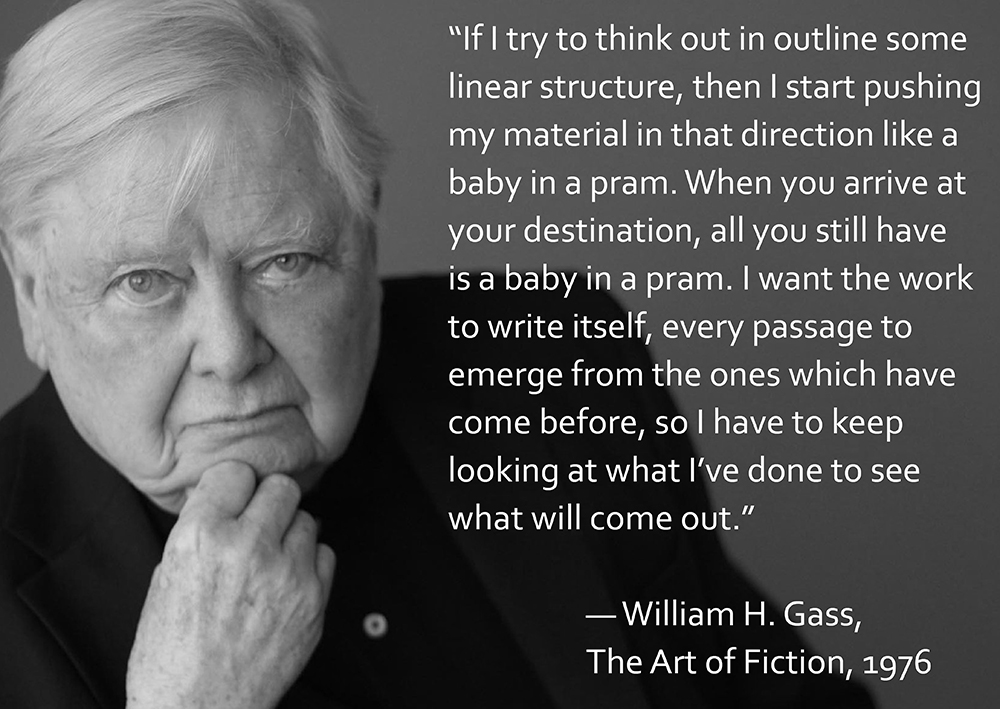
The similarities became troubling for readers and reviewers because Kohler is, well, not nice. In fact, he’s something of a monster. He is mean-spirited toward essentially everyone who has the misfortune of inhabiting his sphere, and he’s downright hateful to his wife, Martha, whom he thinks of as a “guard” that is confining him within the prison of his unhappiness. She has become essentially a non-person to him: “Martha’s face fades as her torso solidifies, her Aryan blood surfacing like lard. I work on her features, but I’ve forgotten what they are[.…] Without a mouth she’ll still talk back, from her crack like as not” (150-51). Worst of all, Kohler’s scholarly work on the Nazis appears more sympathetic toward them than many would like, including the administrators at his university (“those shit-resembling administrators,” he calls them) who overlook him for promotion because they consider him a “Nazi-nuzzler” (133). If Kohler seems to have a soft spot for Nazis and refers flippantly to the Holocaust, he must therefore be anti-Semitic; and if Kohler is an avatar for Gass himself, then the author, too, must be … so went the logic.
Gass anticipated readers who didn’t know how to read well would conflate the persona of the protagonist with the person of the author: “The resemblances between myself and my narrator are wholly trivial, I think, but I did emphasize them in order to test the reader’s sophistication (a test many reviewers failed). […] Unfriendly reviewers delight in the opportunity to clothe me in Kohler’s rags.” Against such charges, Gass pushed back, saying, “[T]he record will show, I believe, that I do not belong in Kohler’s camp” (Ziegler, “WHG in Germany” 116). (You will find the Works Cited at project site.)
The distinction between the author and his creation is a vital one to make as we attempt to read The Tunnel afresh in 2020, on its twenty-fifth anniversary.
[End excerpt]
As you will see in today’s talk, The Tunnel remains a special focus of Gass scholarship and appreciation. In light of that I will also call your attention to another of my contributions to the website: “The Tunnel: A Chronology & Bibliography,” (link) which documents Gass’s progress from its conception in 1966 to its publication in 1995 and beyond. The novel has a complicated publishing history, and my hope is that I will save scholars time and trouble tracking when attempting to piece together and track down the scattered excerpts of The Tunnel. As a writer myself, I always found it interesting that Gass seemed to have concept of how long the writing of the novel would take; so I’ve included quotes from Gass over time as he continued to reassess where he was in the process. Even from the start, completion of the novel always seemed to him a few years away. A complimentary piece at the website is Joel Minor’s “The Tunnel: A Survey of Published Excerpts,” [link] which takes a more scholarly, strictly bibliographic approach to the same sort of information I provide in my “Chronology & Bibliography.”
Let me return to 2024 … or rather December 2023, which is when I posted my first “William H. Gass at 100: A Reading Journal,” [link] in which I describe how I first encountered Gass via his novella (or long story) “In the Heart of the Heart of the Country.” I begin by saying, “As a Gass scholar and devotee (disciple isn’t too strong of a word), I have various projects in the works to mark the Master’s 100th year — all part of my ‘preaching the Gass-pel,’ an evangelism I embarked on more than a decade ago. No doubt I will use this forum to talk about some of those Gass Centenary projects, which tend to be formal and scholarly. It occurred to me that I also wanted to do something less formal, and more personal. It is not an overstatement to say that William H. Gass changed my life. His writing, his theories, his example as torchbearer in the cause of literature: everything has impacted me in ways that I can name and, doubtless, in ways that I cannot.”

My intention was to post a new reading journal, including a new video, periodically throughout 2024. It didn’t quite workout that way (as I feared). I included my various contributions to the Gass Centenary as journal entries, although that isn’t what I had in mind back in December 2023. One such contribution was my paper delivered here a year ago: “William H. Gass at 100: Looking Forward, Looking Backward” [link], which focuses mainly on the backward part as I provide a biography of Gass and his most notable works for the majority of the paper. Sadly, I’ve discovered that Gass is not especially well known, even in literary circles, so describing his career and achievements is necessary.
After the Louisville Conference paper, the next significant event was a panel at the American Literature Association Conference in Chicago in May 2024. In the panel, Joel Minor presented his Tunnel bibliography from thetunnelat25.com project; Ali Chetwynd (American University of Iraq, Sulaimani) presented “Literary Theory Teaching: Founded on William Gass”; and I presented “Let Us Now Praise William Gass’s Greatest Work – And It’s Not the One You Think” [link]. While I am, of course, a fan of The Tunnel, and I’ve presented several papers and published a few on Gass’s magnum opus, I don’t believe it was the most masterful of the master’s work. Rather, artistically, I feel that Cartesian Sonata and Other Novellas represents the pinnacle of his literary achievements. I’ll share the final paragraphs of that paper:
[Begin excerpt]
Though my catalog is incomplete, I’ll end where I began, with The (large, loose, baggie) Tunnel. Gass’s ambitions for the novel were epic, and it took him far longer—far longer—to write than he anticipated. He imagined, maybe, three years or so … let’s say, then, a publication date around 1970. But time marched on and the Master aged along with his aim for the book. He had about 600 manuscript pages in hand when, in 1991 (age 67), he went for an extended stay at The Getty Center in Santa Monica to devote himself fully to finishing the legendary book. Working into 1992, he doubled the size of the novel, completing it at about 1,200 manuscript pages. Begun in the sunny summer of literary postmodernism, the first half of the book displays many of the tropes and tricks that interested Gass in the 1960s and 70s—it resembles in many ways Gass’s wildly experimental novella Willie Masters’ Lonesome Wife (1968)—an experiment that Gass himself deemed a failure in retrospect.5 Though The Tunnel doesn’t quite conform to the chronology of its composition, the latter half doesn’t display the same fondness for postmodern play as the beginning sections do. Released at last in 1995, it was as if the postmodern novel had arrived at the party after practically all the guests had collected their coats and gone home to sleep it off.
Perhaps Gass wittily but unwittingly anticipated the fate of The Tunnel when he wrote the preface to In the Heart of the Heart of the Country (revised 1981):
“I write down these dates, now, and gaze across these temporal gaps with a kind of dumb wonder … hodge against podge, like those cathedrals which have Baroque porches, Gothic naves, and Romanesque crypts; time passed, then passed again, bishops and princes lost interest; funds ran out; men died; … and because they were put in service while they were still being built, the pavement was gone, the pillars in a state of lurch, by the time the dome was ready for its gilt or the tower for its tolling bell …” (xxxii).
We still ought to attend service in William Gass’s great cathedral, but our warmest words of worship should be reserved for Cartesian Sonata and Other Novellas.
[End excerpt]
Gass was born in Fargo, North Dakota, though he moved from there to Warren, Ohio, when still a baby. Nevertheless connections to North Dakota remained, and I attempted to organize some sort of event or conference in Fargo or nearby in the summer of 2024, ideally around Gass’s birthday, July 30. Unfortunately no one locally seemed to have the time or money or interest. Perhaps one day I’ll resume my efforts. Therefore, the next significant event was at Washington University in St. Louis October 3, “William H. Gass Centenary Celebration” [link]. The main event was a panel discussion that I had the honor of moderating. It included Patrick Davis (Unbound Press), Michelle Komie (Princeton University Press), and Gerhild Williams (Washington University German Department, retired). Much of the informal discussion focused on Gass’s founding and directing of the International Writers Center (1990-2000).
One of the more intriguing revelations from the panel discussion was that Patrick Davis, of Unbound Press, plans to republish The Tunnel in the form that Gass always had in mind: a loose collection of about 1,200 manuscript pages, and stuffed with things like paper bags, business cards, and crossword puzzles. Its publication may coincide with the novel’s 35th anniversary. I hope that it comes to pass.
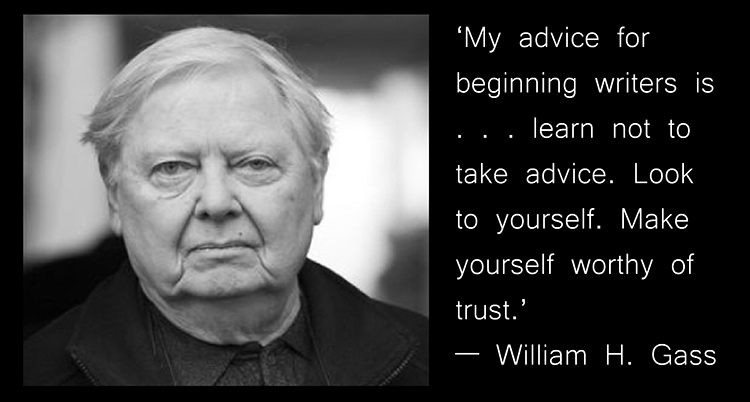
Interest in Gass’s work persists, if not as robustly as enthusiasts like me would prefer. Last year I was contacted by Apostolis Pritsas, who was translating Cartesian Sonata and Other Novellas into Greek, and he requested my informal consultation. I was happy to do it, and we exchanged a few emails over the summer and fall. The two novellas that generated the most questions were “Cartesian Sonata” and “Emma Enters a Sentence of Elizabeth Bishop’s”—both highly experimental works in terms of structure and narrative chronology. The Greek edition is slated for an early March release. Meanwhile, a Spanish-language edition of Cartesian Sonata appeared [link], which changes the order of the novellas, totally undercutting Gass’s concept of the collection.
Finally, I plan to edit, contribute to, and publish William H. Gass at 100: Essays later this year. Contributions include the following: “‘Inward Toward the Other’: The Dancing Minds of William H. Gass and Toni Morrison” by Jose Miguel Alvarado Mendoza; “In Search of William Gass” by Zachary Fine; “William Gass and the Power of Baroque Fictionality” by Yonina Hoffman; “The Meta-Novel as a Container of Self-Consciousness: Linguistic Order and Fascism of the Heart in William H. Gass’s The Tunnel” by Abbie Saunders; “Broken Windows and Dirty Mirrors: Metaphor and Mind in The Tunnel” by Jonathan Moreland; “Defying Form” by Nathan King; “To Create or Capture Consciousness: Reconsidering William H. Gass as ‘The Father of Metafiction’” by Alex Lanz; and “Medium-Specific Foundations: Teaching Literary Theory Across the Gass-Axis” by Ali Chetwynd.
I will draw from several of my Gass conference papers to put together a constellation of pieces, and I also will include a selection of Gass’s photographs. He was a serious photographer, but that aspect of his artistic life has received little attention.
Popular Fiction – An Historical Perspective
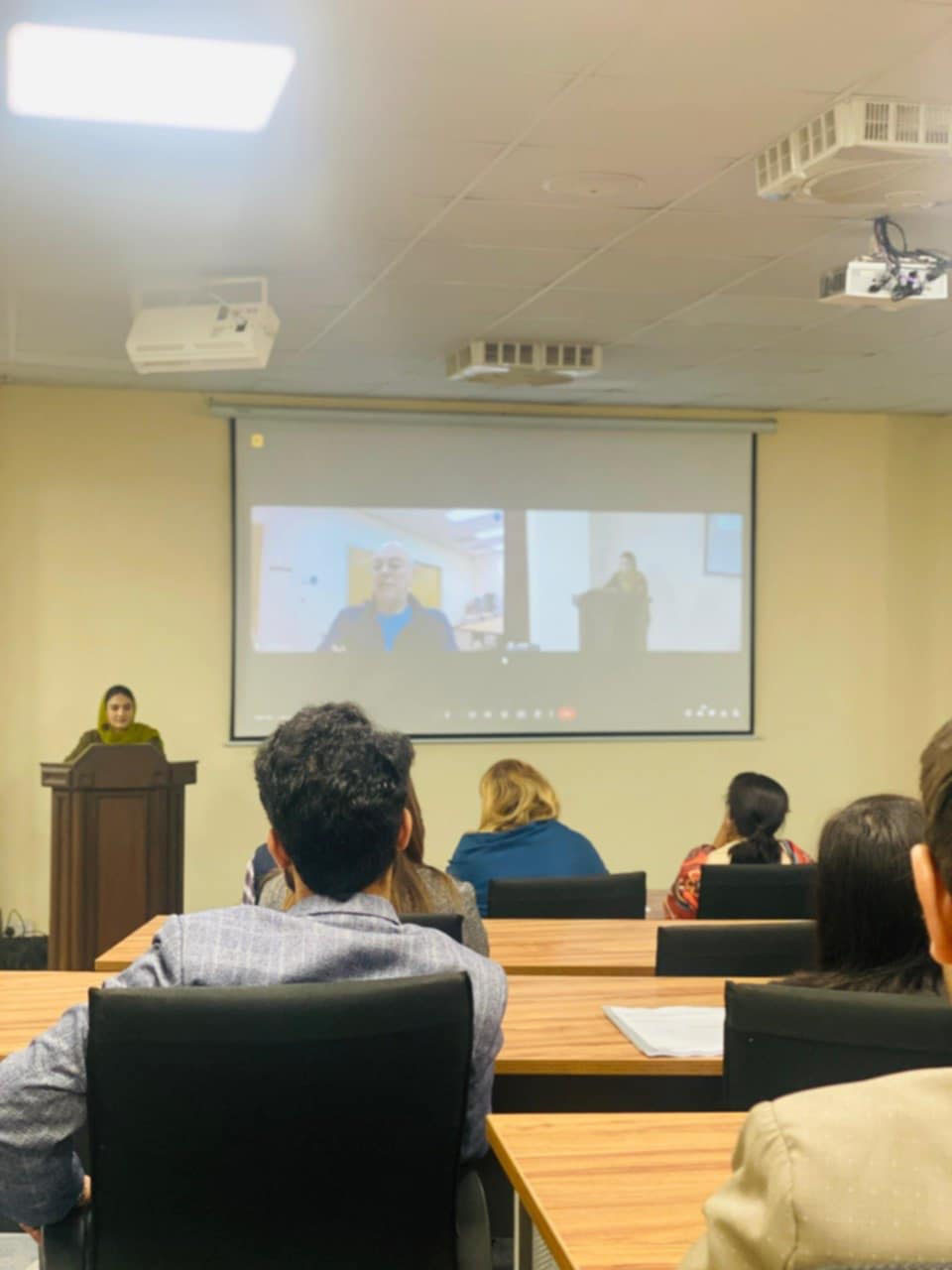
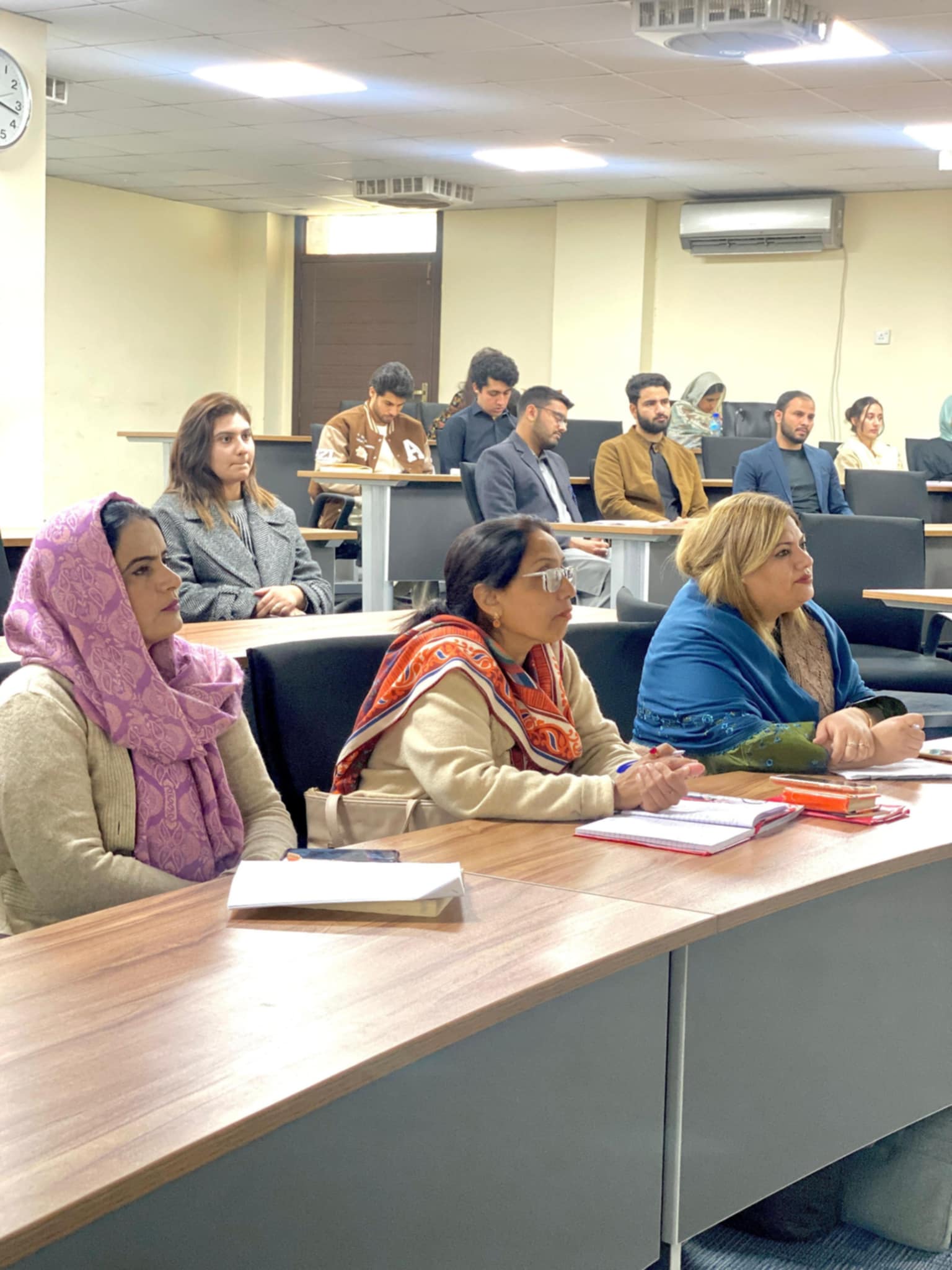
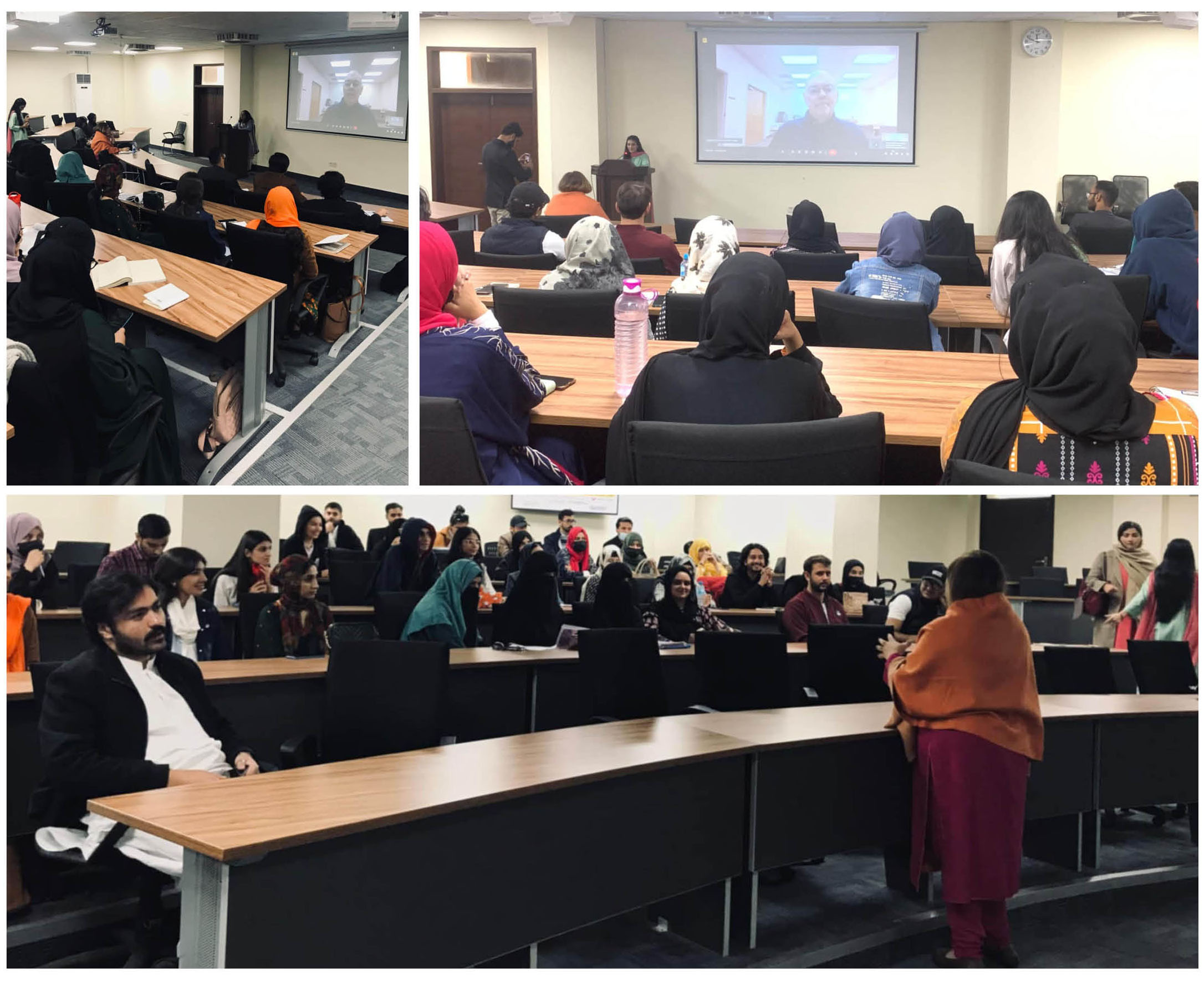
(The following lecture was presented remotely to students and faculty at the National University of Modern Languages, Islamabad, Pakistan, on February 12, 2025. It was at the invitation of and organized by Ms. Ambrina Qayyum, Dr. Amina Ghazanfar, and Ms. Farihatulaen Rizvi; with student organizers Moazzam Ali and Minha Iman.)

I begin with a quotation:
“Persons attempting to find a motive in this narrative will be prosecuted; persons attempting to find a moral in it will be banished; persons attempting to find a plot in it will be shot.” – the “Notice” that appears on the title page of Adventures of Huckleberry Finn, by Mark Twain (1884), considered by many the quintessential American novel. As you may know, Adventures of Huckleberry Finn is a picaresque novel narrated by the title character, Huck, who is about 13 years old. Huck and the escaped slave Jim travel down the Mississippi River on a raft, having a series of adventures along the way. I feel like beginning with this quotation is appropriate to our purposes here because the Notice seems to be the author’s warning to the reader not to take the book too seriously. Its purpose is entertainment, and thinking about loftier things, like the novel’s meaning, will not be tolerated. Mark Twain, whose real name was Samuel Clemens, was a master storyteller and satirist. So how serious was Clemens in his Notice? Did he truly not want readers to search for motive, moral, and plot in his book? If there was some sincerity to his Notice, it may have been because he anticipated that Huckleberry Finn would be a highly controversial book.
Sincere or not, his Notice was disregarded, and Adventures of Huckleberry Finn has been one of the most studied and discussed novels in American (and world) literature. And in spite of the seriousness that readers have found in the text, it became a fabulously popular novel and contributed to Mark Twain (aka, Samuel Clemens) becoming the most popular author in the U.S. by the end of the nineteenth century.
Let me leave Samuel Clemens and Huckleberry Finn for now.
I’ve been asked to speak on “popular fiction,” and I agreed even though at the time I realized the term was malleable in my mind. That is, I wasn’t completely sure what the term even meant. In the last month or so I’ve been looking into the topic – browsing the internet, reading articles, giving it some quasi-serious thought – and I can say with confidence that I’m still not sure what it means. I have, however, stumbled across a lot of interesting ideas associated with the concept of “popular fiction,” so I’ll share them with you (in the hope that you’ll find them interesting too). What is more, largely due to my roles as a writer and publisher, but also as a teacher of writing, I’ve been interested in the history of the publishing industry (in the West, and in particular the United States), and I’ve presented some conference papers on the topic. I will draw from these as well.

Let me begin with some assumptions and/or questions that first came to mind when considering this topic:
What do we mean by popular?
What is the measuring stick for determining popularity?
That is, how popular does a novel have to be to be considered “popular fiction”?
Can a novel be “popular fiction” without actually being popular?
Is popular code, or a kind of euphemism, for bad?
Is the previous question elitist?
How do we determine good versus bad fiction?
For that matter, who determines it?
If popular does mean bad fiction, what is the term for good fiction?
Again, how do we judge?
Again, who judges?
And if the fiction is so darn good, why isn’t it popular?
When did the idea of a book being a “bestseller” begin?
How is bestselling determined?
Ok, I’ll stop there for now. Let’s begin to consider these questions.
From one perspective, popular fiction is fiction (probably in the form of novels) that is read by a lot of people in a given culture. A book gains the label “popular fiction” by attracting a significant number of readers. From this perspective, books are not published as “popular fiction,” but they may become popular over time. Nowadays we call such books “bestsellers,” but that itself is a nebulous term. Quite honestly, until I started researching for this talk I didn’t know much about how a book (or an author) earns the epithet “bestselling.” For the last quarter century I’ve also worked as a librarian, and every week we add new titles to our shelves that are said to be bestsellers or by bestselling authors—books and authors, oftentimes, I’ve never heard of, which suggests that the standard for determining bestselling is fairly low. Low, of course, is relative, but my research has determined that the standard is both nonstandard and mysterious. What I mean by nonstandard is that different organizations will disseminate “bestseller” lists, and each will use its own criteria. In the U.S., we tend to think of The New York Times newspaper and its The New York Times Book Review as the arbiter of bestseller status, but, really, there are many bestsellers lists: Publishers Weekly, USA Today and Indiebound are among the more common publications that provide lists of bestsellers. Moreover, booksellers, like Amazon and Barnes and Noble, will put out their own lists of bestsellers. Complicating things further is the fact that each will put out multiple lists, based on categories of books and types of book (hardback versus paperback versus ebook).
Each entity and each list generated will have its own criteria for determining bestseller status. They’re all based on sales, kind of, but on data that comes from a wide variety of sources. I say “kind of” because the sales data can be rather fluid and open to interpretation, so that, in some lists more than others, the accolade of “bestseller” may be as much subjective impression as empirical conclusion. (Indiebound, for example, tends to rely more on booksellers’ hunches than actual hard sales figures.) Another nonstandard element is sales period. One list may be based on a week’s worth of sales, Monday to Sunday, say, (reported from here versus there), while another list considers data drawn from a different period of time, longer or shorter, or simply a different bracketing of time.
Even though numbers have nebulous meanings, for a frame of reference let’s look at The New York Times bestseller list. To make the list in a given week, a novel must sell between 1,000 and 10,000 copies. However, such sales do not guarantee inclusion on the list because it also depends on other factors, like the total number of books that achieve those sales figures for a single week. Earlier I said the standards were both nonstandard and mysterious; here is where the mystery comes in. The New York Times won’t reveal precisely how they determine the bestseller lists. Sales are an important factor, but there are others that are closely held secrets. Allegedly even the editors of The NYT Book Review aren’t privy to the exact methodology. Their secrecy, they say, is partly in an effort to prevent people from manipulating the system. Nevertheless, people (like authors, agents and publishers) do try to manipulate the system, and if the NYT suspects such manipulation they’ll mark a title on the list as suspicious, printing a dagger symbol next to it.
Another aspect of popularity is the number of weeks that a book remains on the bestseller list. About a quarter of novels make the NYT list for a single week. Incidentally, it seems the idea of a bestsellers list, as we think of it, began in 1895 with the New York-based journal The Bookman. The New York Times began publishing its list in 1936 (based only on New York City sales). The list, resembling its current form, became established by the 1950s.
I said that people will try to manipulate the bestseller lists, and the reason for that is that appearing on a bestseller list can be a major boon for sales, especially for “new” and little-known authors. So, appearing on a bestseller list reflects some level of popularity, and it further promotes popularity. Said differently, bestsellers sales are self-perpetuating. [In addition to Wikipedia entries, information for these last few paragraphs was taken from “The Convoluted World of Best-Seller Lists, Explained” by Constance Grady.]
In recent years another route to popularity has emerged, namely social media. I would like to speak to this phenomenon, but I find such a discussion will have to wait for another occasion.
For now, let’s shift our perspective on the term “popular fiction,” away from a status based (obliquely) on sales, to a term we use to describe a kind of fiction. One can find many definitions of popular fiction as a kind of writing. I like Britannica.com’s definition:
“[S]ome common attributes of popular literature have been defined. First, it is crafted primarily to entertain the reader, as entertainment is a quality that attracts and appeals to a wide audience. To promote a pleasurable reading experience, works of popular fiction are usually written in a simple and straightforward style. They are largely plot-driven, rather than character-driven, and adhere to conventional narrative structures. As such, they are intended less to provoke deep reflection or aesthetic appreciation than to be read casually and quickly. Books that are successful at this aim, especially through their employment of techniques that stimulate readers’ interest and compel them to continue reading, are praised as ‘page-turners.’”
Popular fiction tends toward escapism rather than self-reflection. That is, readers of popular fiction often want to be distracted from their cares and concerns, not prompted to think deeply about them. As a consequence, popular fiction frequently falls into various genre categories: romance, Western, science fiction, mysteries, so-called “chic lit.” All in all, popular fiction is written to be accessible to the average reader. Literary fiction, meanwhile, (sometimes just called “literature” among other synonyms) tends to require more of the reader: more careful attention, more time, more cognitive effort, a broader working vocabulary.
Nowadays, we tend to think of a wide schism between popular fiction and literary fiction. Writers must be either fish or fowl. Indeed, many earlier texts—let’s say, pre-twentieth century—are studied today because of their seriousness; that is, their author’s attention to significant issues, and the book’s facilitation of meaningful analysis and discourse. Whether it’s Mary Shelley’s meditations on society and the individual, Jane Austen’s examination of unequal inheritance laws, Charles Dickens’s depiction of the mechanisms of poverty, Charlotte Brontë’s proto-feminism, or Joseph Conrad’s indictment of colonialism—the writers and their works were unquestionably popular. That is, they sold well, were widely reviewed, and frequently discussed across social strata.
These writers, of course, benefited from the popularity of reading in general. Authors competed with playwrights (who often adapted authors’ works to the stage, without necessarily paying for the privilege), but reading for pleasure was a major pastime for both men and women, across socioeconomic lines. Periodicals were hugely popular. These were newspapers and magazines that printed stories and excerpts from novels and sold them quite inexpensively. It was common practice for a novel to appear in a periodical serially, and then later be brought together for book publication. Serialization didn’t seem to negatively impact eventual book sales. One can find examples of authors or publishers shying away from periodical publication to begin with for fear of it diminishing the sales potential of the book version. Nevertheless, serialization was an effective way for the reading public to become familiar with an author and their work.
Charles Dickens’s The Pickwick Papers (1836) is often cited as the work that popularized the approach of serialization, first, followed by the book publication. Throughout the nineteenth century and well into the twentieth, magazine publication (either of serial installments of a longer work, or stand-alone stories) was the vehicle that brought mass popularity to authors. Popularity gained through magazine publication was not limited to England, where authors like Wilkie Collins, Elizabeth Gaskell, William Thackeray, Anthony Trollope, and Arthur Conan Doyle thrived. In France, a notable example is Alexander Dumas, whose The Three Muskateers (1844) and The Count of Monte Cristo (1844-1846) were widely read serials. Another would be Gustave Flaubert and his serial publication of Madame Bovary (1856). In Russia, both Leo Tolstoy and Fyodor Dostoevsky found readers via the serialization of Anna Karenina (1875-1877), and The Brothers Karamazov (1879-1880), respectively. In the U.S., publishers were quick to follow Dickens’s example, and many writers found popularity via magazine publication and serialization, among them Harriet Beecher Stowe, Henry James, and Herman Melville. Across Europe and into Asia and Australia, having their work appear in magazines was vital for authors achieving popularity.

Obviously not everything published in this time period combined popularity with serious literary merit. For that matter, it’s difficult to know how serious authors were when writing the books that became popular. Their literary quality—and their ability to generate in-depth study and discourse—may be in part due to our projections. That is, we recognize the significance of their work when they, perhaps, did not. They were merely trying to tell an entertaining tale, but because of the milieu in which they were writing, and their own inherent insightfulness, they wove into the telling significant issues. I think, for example, of a writer like Jane Austen and her series of drawing-room romances, like Sense and Sensibility (1811), and Pride and Prejudice (1813), where the plots mainly center on the marriageability of young women without financial means. They are in some ways extensions of Samuel Richardson’s rather vapid Pamela (1740) and Clarissa (1748). Yet Austen also examines the unequal roles of men and women in marriage, the unfairness of English law when it came to inheritance and gender, the hypocrisy of the Church, and myriad other significant issues, including family dynamics and the interrelationships of siblings.
From almost precisely the same period, an antithetical example would be Mary Shelley’s Frankenstein (1818). On the one hand, it is a fantastical Gothic tale about a creature who has been constructed from body parts, both human and animal, brought to life, then left to fend for himself in a harsh and unsympathetic world. From the start of its composition, however, the teenage author saw the potential for her novel to be so much more than a sensational page-turner. Throughout she alludes to numerous books—which she had thoroughly digested, often in their original language and not in translation—regarding science, history, geography, philosophy, religion, and ethics. Like all authors I suppose, Mary Shelley hoped that her book would be popular, but she did not expect it. She and her husband, Percy Shelley, and their children left for the Continent before Frankenstein was published, and Mary was quite surprised several months later when she heard, while in Italy, that her strange book was the talk of London. It has never been out of print.
What all of these pre-twentieth-century books—the merely popular and the popular while also being serious—have in common is accessibility. That is, they are highly readable regardless of one’s educational background. Frankenstein, for all the complex issues that it raises, remains a novel that can be read and understood by practically anyone who is functionally literate. Whether they recognize the complex issues in the book and whether they consider them deeply, those are other matters.
It is worth noting that there were authors in the nineteenth century who became canonized in academic circles, but they were not especially accessible in their day. Nor, then, were they popular. Two well-known examples are Nathaniel Hawthorne and his friend and neighbor Herman Melville. Both are considered giants of the nineteenth century, and for much of the twentieth century they were staples on high school and college syllabi in the U.S. Hawthorne—famous now for such novels as The Scarlet Letter and The House of the Seven Gables—was frustrated and perplexed by his slow book sales. Meanwhile, authors whom he considered inferior enjoyed wide popularity. He was especially annoyed by the status enjoyed by Henry Wadsworth Longfellow, someone he knew in their younger days as a fellow student at Bowdoin College. To compare, 10,000 copies of The Scarlet Letter were printed, and during Hawthorne’s lifetime only 7,800 copies were sold. Meanwhile, Longfellow’s poem The Song of Hiawatha sold 50,000 copies in its first year, 1857. It was just one of Longfellow’s highly popular publications. It’s estimated that during his lifetime, Longfellow wrote more than 20,000 letters in response to the fan mail that he received. (One close friend speculated that Longfellow’s dedication to responding to his fans led to exhaustion and a too-early grave.) [For this section, I relied on various Wikipedia entries as well as the article by Lauren Gatti “Seriously Popular: Rethinking 19th-Century American Literature through the Teaching of Popular Fiction,” published in The English Journal, vol. 100, no. 5, 2011, pp. 47–53, available via JSTOR.]

Hawthorne’s friend and neighbor, Melville, is another interesting case when discussing authorial popularity. Melville’s first novels were page-turning sea adventures, based on his real-life adventures as a seaman. However, he longed to write something more complex, more artistic, even though he knew such a book wouldn’t be popular. In a famous letter to Hawthorne (May 1851), Melville spelled out his dilemma: “Dollars damn me … What I feel most moved to write [Moby Dick], that is banned,—it will not pay. Yet, altogether, write the other way I cannot. So the product is a hash, and all my books are botches.” In other words, writing simple sea adventures was profitable but they bored him; instead, he wanted to write a book that was much more complex and artistically challenging, even though it likely wouldn’t sell. In the end, he chose artistic satisfaction over popularity. There were 3,000 copies of Moby Dick printed, and copies were left unsold forty years later at Melville’s death. Both Hawthorne and Melville had to support their families by taking low-paying government jobs.
In retrospect, we can see that writers like Hawthorne and (especially) Melville were ahead of their time. A novel like Moby Dick has much more in common with the modernist experimental books produced seventy years later by James Joyce, T.S. Eliot, Virginia Woolf, and D.H. Lawrence. In fact, Moby Dick was essentially rediscovered in the 1920s (thirty years after its author’s death), which led to its becoming a classic and a staple on college syllabi by the 1950s. Hawthorne and his works were also canonized in the twentieth century, while Longfellow and other popular writers of the nineteenth century became marginalized in the academy.
So, if depth of thought and the poetic quality of the language do not lead to popularity, what is the key? I’ve already used the word several times: accessibility. In essence, a book has to be easily comprehensible for it to be widely read and have the potential to become a bestseller. In other words, to become “popular fiction” a book must be written in the style of “popular fiction.” To cement this idea, let me repeat Britannica’s definition: “First, it is crafted primarily to entertain the reader, as entertainment is a quality that attracts and appeals to a wide audience. To promote a pleasurable reading experience, works of popular fiction are usually written in a simple and straightforward style. They are largely plot-driven, rather than character-driven, and adhere to conventional narrative structures. As such, they are intended less to provoke deep reflection or aesthetic appreciation than to be read casually and quickly. Books that are successful at this aim, especially through their employment of techniques that stimulate readers’ interest and compel them to continue reading, are praised as ‘page-turners.’”

I began this talk with a reference to Mark Twain and Adventures of Huckleberry Finn, published in 1884, a novel that has the patina of a simple tale of adventure, perhaps even one for younger readers, but in fact is packed with serious and controversial ideas, especially regarding the institution of slavery (which had been abolished two decades before, but its aftermath was still very much a part of American society … as, sadly, it is today). It is a gross overgeneralization, but we could think of Huckleberry Finn as a kind of temporal marker: a delineation between a time when authors could be both serious and popular, and a time when authors had to choose between the two. Herman Melville’s conundrum of the 1850s (to write Moby Dick and forfeit his growing popularity, or not) foreshadowed the dilemma that increasing numbers of writers would face in the twentieth century and beyond: To be either a writer of popular fiction (read by the masses) or to be a writer of serious fiction (read mainly in academic circles)?
The so-called modernist writers who began publishing after the First World War—Pound, Eliot, Stein, Woolf, Joyce, Forster, Lawrence, et al.—were rejecting accessibility for deeper (especially psychological) meaning. They were grappling with the horrors of the War and developing styles of narration and poetics that responded to both personal and cultural trauma. While the modernists may not have been bestselling authors, they were known and therefore influential. Some of their less challenging work (especially stories and individual poems) appeared in popular magazines (while their more challenging work came out in literary journals, including via serialization—all three of James Joyce’s high-modernist novels, A Portrait of the Artist as a Young Man, Ulysses, and Finnegans Wake, were first published serially). But even if people weren’t reading Joyce, Stein, Woolf, etc., they knew who they were and what kind of writing they were doing because the popular press closely covered the modernist movement. As an example, when Gertrude Stein, one of the least comprehensible modernists, returned to the United States after a self-imposed thirty-year exile in France, she was met by a group of reporters at the New York City docks, and lights in Times Square announced “Gertrude Stein Has Arrived.” Next to no one in the U.S. had actually read Stein’s highly experimental work (and even fewer understood it), yet she had gained celebrity status among the general public. Stein was, in a word, popular. I must acknowledge that the previous year, 1933, Stein had published The Autobiography of Alice B. Toklas, which was by far her most readable book, and its accessibility and popularity contributed to her surprisingly warm welcome home.
During this period, while writers like Stein, Joyce and Eliot prided themselves on the difficulty of their texts, there were many writers who sought both kinds of attention. They thought of themselves as serious literary artists, but they also wanted to be widely read (and well paid). There could be many examples, of course, but two that come to mind are Ernest Hemingway and F. Scott Fitzgerald. Though they had very different personalities, they took similar approaches to achieving both popularity and respect from the high-literary establishment. Again, I oversimplify, but Hemingway saw his short fiction and his novels as products of his highest literary aspirations; while his nonfiction, especially his journalism and newspaper reporting, helped to fund his adventurous lifestyle. Similarly, Fitzgerald devoted great time and energy to his novels, wanting them to be as complex and as literary as possible, but at the same time he churned out one lackluster short story after another to sell to magazines and support his dizzyingly wild lifestyle (his and his wife Zelda’s).
Writers like Hemingway and Fitzgerald were able to aim for both kinds of writing—popular and serious—because the periodical industry was still thriving in the U.S. and elsewhere. Allow me to share a quote from Theodore Peterson’s Magazines in the Twentieth Century (University of Illinois Press, 1956):
“Despite pessimistic forecasts from time to time … magazines had a tremendous growth between 1900 and 1955. The number of magazine readers increased remarkably. When Frank Munsey brought out his Mimsey’s Magazine in 1893, he later estimated, there were about 250,000 magazine purchasers in the United States. By 1899, the ten-cent magazine, he further estimated, had increased the number to 750,000. In 1947, in its nationwide audience study, the Magazine Advertising Bureau found 32,300,000 magazine reading families—those in which members could identify specific items from recent issues. The number of individual magazines also increased; there were well over a thousand more magazines in the United States in 1955 than in 1900. The aggregate circulation of all magazines in the United States mounted steadily, and the sales of individual publications soared from thousands to millions. In 1900 there seems to have been no magazine with a circulation of a million; in 1955 there were at least forty-six general and farm magazines with circulations of one million or more, and one of them had a circulation of more than ten million for its domestic edition alone.”
While not all of these magazines published short fiction, I will risk saying that the majority did. Many, in fact, specialized in publishing fiction in the form of short stories and serialized novels. Moreover, they paid writers well. Let me quote from my introduction to Delta of Cassiopeia (which is available online at Twelve Winters Miscellany):
“There had been a Golden Age of magazine publication for much of the twentieth century, when fiction writers could make a good living selling stories to magazines. In the 1920s, F. Scott Fitzgerald and Zelda lived their legendary high life almost solely from Fitz’s short stories, which could fetch as much as $4,000 each (nearly $60,000 in 2023 money). It’s estimated that during the 1920s and 30s Fitzgerald made almost a quarter of a million dollars from 164 magazine stories (more than $3.25 million today). A generation later, in the 1950s, Kurt Vonnegut Jr. sold four stories to magazines in the course of about eighteen months, allowing him to quit his job in the marketing department at General Electric and devote himself fully to writing. At the time, Vonnegut was supporting a wife [who didn’t work] and six children.”
I continue from my introduction:
“By the 1960s, however, television had begun turning the Golden Age into lead. And by the time I started to write effectively enough to publish, the Golden Age was a rapidly receding memory. In sum, television had superseded book reading as a popular pastime, and nationally distributed magazines had either severely cut back or eliminated space for short stories altogether, thus closing a crucial avenue for new writers to build an audience—let alone make a living.”
From then on it’s been a succession of inventions and developments that have made reading books a lower and lower priority for mass culture: the microcomputer (1980s); the internet and World Wide Web (1990s-2000s); social media and streaming services (2000s-present). Concurrent with these technological arrivals, the publishing industry was consolidated into a handful of multinational entertainment conglomerates. Here I’ll draw from my paper “The Loss of the Literary Voice and Its Consequences” (available at tedmorrissey.blog):

“[T]he corporate takeover of the publishing industry … was largely undocumented when André Schiffrin wrote The Business of Books (2000). ‘In Europe and in America,’ writes Schiffrin, ‘publishing has a long tradition as an intellectually and politically engaged profession. Publishers have always prided themselves on their ability to balance the imperative of making money with that of issuing worthwhile books.’ However, in the turbulent sixties, large conglomerates began acquiring publishing houses. Schiffrin continues, ‘It is now increasingly the case that the owner’s only interest is in making money and as much as possible’ (emphasis in original). Schiffrin’s study is wide-ranging and thorough, but he focuses particular attention on the demise of Pantheon, where he’d been managing director for a number of years when it was acquired by Random House, which in turn was purchased by media mogul S. I. Newhouse, who inevitably insisted on changes to try to increase profits, unreasonably and unrealistically so, according to Schiffrin: ‘As one publishing house after another has been taken over by conglomerates, the owners insist that their new book arm bring in the kind of revenue their newspapers, cable television networks, and films do. … New targets have therefore been set in the range of 12-15 percent, three to four times what publishing houses have made in the past.’”
The only way for these remaining commercial publishers to achieve the sort of profits that are expected by their parent companies (and the companies’ shareholders) is to only publish fiction that has the potential to become popular. In other words, it must be easily accessible to the small percentage of the public that continues to read fiction. The internet is full of statistics that highlight the rapid decline of reading (and therefore in people’s ability to read well). One reliable source in the U.S. is the National Endowment for the Arts. NEA’s report from October 2024 said that in its most-recent surveyed year, 2022, just over a third of American adults reported reading a novel or a short story in the previous year. Let me emphasize: a novel or a short story, singular. And practically every survey from practically every organization confirms a downward trend over several decades. Test Prep Insight published a less thorough but even more recent report (January 2025) that confirms this same kind of decline in reading. The report cites several factors:
- The fast pace of the modern world: With the demands of work, family, and social obligations, many people feel they simply don’t have time to read.
- The rise of digital media: In our constantly connected world, it’s easy to get your news and entertainment from sources other than books.
- The cost of books: Books can be expensive, especially if you’re buying them new. Used books are a cheaper option, but many people simply don’t have the time to hunt for them.
- The declining popularity of reading: As fewer people read, it becomes less socially acceptable to do so. This can create a vicious cycle that leads to even fewer people reading.
So what does all this mean in terms of our topic, “popular fiction”? For one thing, in the West at least, there are fewer and fewer authors who can achieve popularity. Also, for those writers who desire mass appeal, they must make sure their books are easily accessible (that is, as easy to read and comprehend as possible).
There are many interesting issues associated with the idea of fiction’s popularity, like the following:
How has social media, especially TikTok, impacted popular fiction?
How do contemporary authors navigate writing for popularity versus writing for artistic satisfaction?
Why, in the U.S., are we seeing an explosion in creative writing programs at universities (and an explosion in the number of creative writers) during the same period that we see a steady decrease in the number of readers?
How do factors like the age and gender of readers affect what books are being published by the few remaining commercial publishers?
I will have to leave these and other questions unanswered for now.
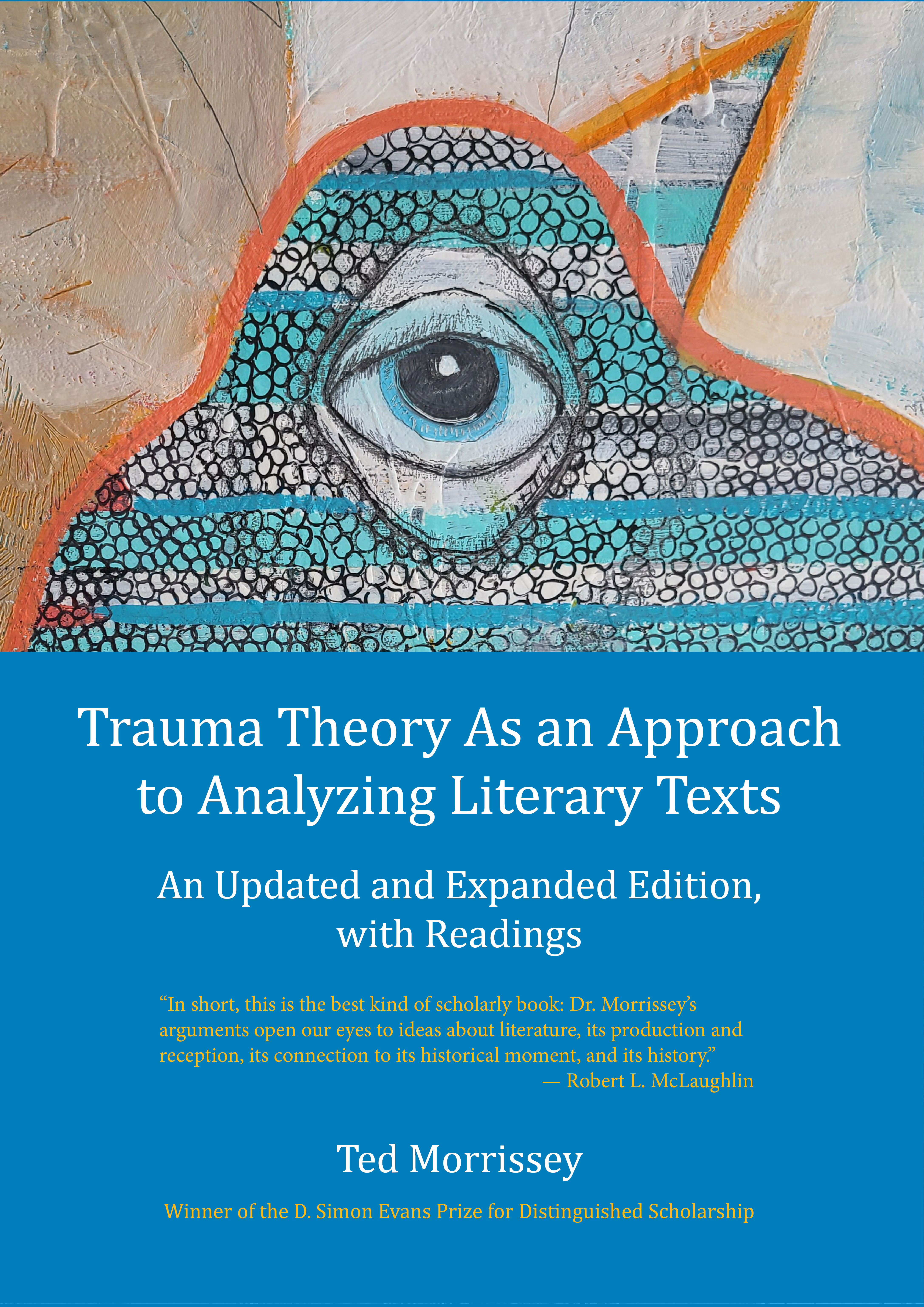
Trauma theory as an approach to analyzing literary texts
The following is the primary text of a presentation for academics in Kabul and Tehran, arranged by Dr. Nasir Arian, Assistant Professor of Persian Literature and Middle Eastern Studies at Penn State University. It was conducted via Zoom December 5, 2024. This text is excerpted and updated from a much longer article published by Eclectica Magazine, “Cultural Trauma and the Postmodern Voice” (April/May 2021), which was itself excerpted and updated from my book Trauma Theory as an Approach to Analyzing Literary Texts (2021).
In a writers’ symposium on postmodern literature at Brown University in 1989, Robert Coover, in his welcoming remarks, gave the impression the writing style that became known as postmodernism sprang up in the 1950s and ’60s almost by sheer coincidence. Among the symposium participants were Leslie Fiedler, John Hawkes, Stanley Elkin, William Gass, Donald Barthelme, and William Gaddis. Coover noted other writers who certainly would have fit in but were not in attendance, including John Barth, Thomas Pynchon, Angela Carter, Italo Calvino, and Gunter Grass. Coover said, “[T]his group sought out some form, some means by which to express what seemed to them new realities.” However, Coover went on to suggest a remarkably thin theory as to why so many writers, all working in relative isolation, began constructing narrative in uncannily similar styles:
We felt we were all alone. No one was reading us, nor was anyone writing remotely like the sort of writing we were doing until, in the little magazines, we began slowly to discover one another. Few of us knew one another at the time we began writing. There was a uniform feeling among writers at that time that something had to change, something had to break, some structure had to go. And that was, I think, what most united us.
Even though the panel was intended to be a debate, and not merely a discussion, not a single writer challenged Coover’s explanation for the emergence of postmodern style. At first this assessment may seem startling—that some of the keenest and best-educated minds who were at the forefront of producing and (many) critiquing literary postmodernism accepted the premise that postmodern narrative style more or less just happened; essentially individuals writing in isolation on various continents, including North and South America, and Europe, just all happened to begin writing in the same sorts of ways, all in a narrow time span, from about 1950 to 1965. According to Coover, writers with virtual simultaneity decided to abandon modernist realism for something fragmented, repetitive, largely unrealistic and illogical, and highly intertextual.
Joe David Bellamy, in his preface to The New Fiction (1974), expresses a similar notion as to the origins of postmodern narrative style. Bellamy cites an essay by Louis D. Rubin, Jr., who “described his sense that the most interesting writers (at that hour of the world [mid 1960s]) were in the process of struggling against a ‘whole way of using language . . . a whole way of giving order to experience,’ which had been imposed on the sensibility of the times by the great writers of the immediate past.” Again, Bellamy appears to support the idea that postmodern writers simply decided to rebel against modernist literary convention.
A more cogent explanation, I believe, rests with trauma theory. The trauma of the nuclear age, experienced by the entirety of Western culture, affected the psyches of these writers in a way that resulted in postmodern literary style—a style reflecting the traumatized voice. (More on this in a moment.) Historians Jay Lifton and Greg Mitchell, in Hiroshima in America (1995), make several assertions regarding the 20th-century’s zeitgeist as it suddenly evolved after the Second World War. One is the “[s]truggles with the Hiroshima narrative have to do with a sense of meaning in a nuclear age, with our vision of America and our sense of ourselves.” Another is Americans were deeply and immediately conflicted with the atomic bombings of Hiroshima and Nagasaki. They experienced the “contradictory emotions of approval and fear the bomb evoked, a combination that has continued to disturb and confuse Americans ever since.” A third assertion is “[or]dinary people [. . .] experienced their own post-Hiroshima entrapment—mixtures of nuclearism and nuclear terror, of weapons advocacy and fearful anticipation of death and extinction.” And all of this internal conflict, much of which resides in the unconscious, has contributed to a “sense of the world as deeply absurd and dangerous.” Similarly, literary critic Ihab Hassan sees a connection between the horrors of the Second World War and postmodernism: “Postmodernism may be a response, direct or oblique, to the Unimaginable that Modernism glimpsed only in its most prophetic moments. Certainly it is not the Dehumanization of the Arts that concerns us now [1987]; it is rather the Denaturalization of the Planet and the End of Man.”
It is quite possible Coover and the other postmodernists at the Brown University symposium experienced the same sort of repression and dissociation individual trauma victims frequently do. We know it is common for people suffering the symptomology of post-traumatic stress disorder (PTSD) to have no conscious recollection whatsoever of the traumatizing event, or to have a dissociated recollection, so that trauma can be simultaneously indelible and forgettable. While the symposium participants did not seem to recognize post-nuclear cultural trauma as the source of their collective postmodern style, they inadvertently came near the mark—so much so that reading their comments from here in the 21st century, with our growing understanding of trauma theory, one experiences a sort of dramatic irony. An example is this exchange between Fiedler and Elkin regarding the role of the unconscious in narrative production:
Fiedler: [. . . The writer’s] possessed with certain hallucinations that he would like other people to take as real and to weep over and laugh over and shiver over. [. . .] One of the marvelous things about being a writer is many of the things you do you don’t know you’re doing until you get somebody’s response to it.
Elkin: I don’t believe that.
Fiedler: You don’t believe anything’s out of control in a writer?
Elkin: There’s plenty out of control, yes. Absolutely. But I don’t think there’s any such thing as serendipitous meaning.
Fiedler: Well, there’s meaning that comes from writers who are gifted, especially in writers who please many and please long—and it comes from levels deep within their unconsciousness.
I would call attention to Fiedler’s use of the word “possessed,” as we know trauma tends to possess its victim, distorting reality in numerous ways; and “hallucinations” of course are among the symptomology of the traumatized. Also, while Fiedler and Elkin disagree on specific points, they concur fiction is harvested in large part from the writer’s unconscious mind. Moreover, William Gass cited Gertrude Stein’s theory of composition and applied it to Elkin’s earlier statement where he imagined William Faulkner peering over his shoulder as he composed: “[Stein] wrote, she said, finally, for the human mind, which was the same in some remote, abstract sense. When Stanley [Elkin] says he’s writing with Faulkner looking over his shoulder, that’s the superego who’s telling you that your paragraphs are lousy.” Stein’s assessment gets at the notion of a collective unconsciousness, where writers and their readers are able to connect because all are tapping into the same neuropsychic substructures. Coover, meanwhile, referenced the nuclear-age zeitgeist of the 1960s:
I also wanted to get involved in telling stories. But we were in that period of time in the 1960s when telling stories was no longer so simple. A lot of people were telling stories, and it was getting us into wars. It didn’t seem to stop the growth of nuclear armaments in the world. The stories seemed to be contributing in some way to all those activities.
Coover also discussed writing as “a kind of therapy.” He said, “There are things you have to work your way through. There are issues that have to be confronted[. . . .] So you work that out in fictional forms, and you do feel that Freudian answer, that kind of power over what would otherwise be your impotent life.” Hence Coover recognized the unsettling cultural climate of post-Hiroshima America and how it contributed to narrative style; also, his view of writing-as-therapy is consistent with trauma theorists who suggest postmodern techniques are akin to victims’ struggling to transform traumatic memory into narrative memory. Even the Rubin quote Bellamy cites in The New Fiction—about writers “struggling” to find a “way of giving order to experience”—sounds very much like the difficult transformation from traumatic into narrative memory.
Characteristics of the Traumatized Voice
Before going further, let me take a step back to discuss, in brief, the correspondences between the postmodern narrative voice and the struggles facing the traumatized when trying to articulate the events surrounding their traumatic experience. To avoid the trap of making “postmodernism” into such an enormous net that, when cast into literary history, it ensnares virtually everything, I turn to the work of contemporary trauma theorists and limit, quite definitively, what it means to say a text is postmodern. Cathy Caruth and others have looked to psychoanalysts such as Freud and Lacan to illustrate the close connections between trauma and literature. Caruth writes, “If PTSD must be understood as a pathological symptom, then it is not so much a symptom of the unconscious, as it is a symptom of history. The traumatized, we might say, carry an impossible history within them, or they become themselves the symptom of a history that they cannot entirely possess.”
I want to call particular attention to Caruth’s statement that the traumatized “become themselves the symptom of a history that they cannot entirely possess” as it implies a duality. The traumatized usually have a conscious awareness of the causal event, but it also colonizes their subconscious in a way beyond their control and quite possibly even their awareness (a common phenomenon, according to neuropsychologists). As a result of the trauma, points out Anne Whitehead, there are “[u]nsettling temporal structures and disturbing relations between the individual and the world.” That is, the victim of trauma is unable to perceive time and space normally. And, as psychologists Bessel A. van der Kolk and Onno van der Hart explain, the impediment to processing time and space perceptions normally are not limited to the traumatic event itself (if, indeed, there was a specific and singular event), but rather affect non-traumatic events as well (until such time that the PTSD can be effectively treated). Here, too, we must recall the group psyche operates much the same as the individual psyche. Whitehead reiterates, “[Traumatic] crisis extends beyond the individual to affect the ways in which historical experience can be accessed at a cultural level.” Ronald Granofsky is among critics who have studied the close ties between the traumatic events of the Second World War and the literature that emerged in its aftermath, with Granofsky coining the term “the trauma novel” to refer to the work of writers like Kurt Vonnegut, Jr., and Thomas Pynchon. Moreover, Laura Di Prete explains, “all of these writers tackle the issue of trauma by depicting imagined collective disasters that only indirectly relate to real historical or personal traumas.”
Indeed, the emergence of postmodernism seems a direct reflection of cultural PTSD. Writes Whitehead,
[Postmodernism’s] innovative forms and techniques critique the notion of history as grand narratives, and it calls attention to the complexity of memory. Trauma fiction emerges out of postmodernist fiction and shares its tendency to bring conventional narrative techniques to their limit. In testing formal boundaries, trauma fiction seeks to foreground the nature and limitations of narrative and to convey the damaging and distorting impact of the traumatic event.
Professionals working with victims of trauma in an attempt to help them articulate and come to terms with their traumatizing event(s)—to relocate their “traumatic memory” to “narrative memory”—note the traumatized voice mirrors narrative techniques of postmodern writers. “[T]raumatic knowledge cannot be fully communicated or retrieved without distortion,” says Whitehead, who has identified key features of postmodern texts reflecting aspects of the traumatized voice: “intertextuality, repetition and a dispersed or fragmented narrative voice.” Here, then, is the vehicle for limiting my examination of “postmodern” texts. Or, said differently, the intersection of trauma and postmodern literature is at these key points:
1) intertextuality, that is, the use of various “texts” to create meanings when contextualized together that are somehow different from the meanings of those same texts when read independently
2) repetition, that is, the compulsion to return to images and events, particularly ones that at first blush may seem relatively insignificant but that gain significance(s) with each return, with each echo
3) a dispersed or fragmented narrative voice, that is, a style of narration that employs multiple authorial voices/perspectives, and/or a decidedly nonlinear emplotment (or even a decidedly “non-plotted” emplotment)
Whitehead explicitly names these three aspects of postmodern technique that mirror the traumatized voice, but I would augment the list with a fourth (implied) aspect: a search for language—if you will, for powerful, indeed, almost magical words—that will uncouple the traumatized from the traumatizing event. One significant aspect of this language-power is the act of testimony; in fact, some trauma theorists have dubbed the end of the 20th century and the beginning of the 21st the Age of Testimony. Shoshana Felman writes, “It has been suggested that testimony is the literary—or discursive—mode par excellence of our times, and that our era can precisely be defined as the age of testimony.” She goes on to compare writing about trauma in a testimonial mode as akin to psychoanalysis, in which patients confide to their therapist.
Development of the Apocalyptic Temper
In his examination of the apocalyptic temper in the American novel, Joseph Dewey theorizes about the literary community’s response to Hiroshima and Nagasaki, which he describes as “slow in coming.” Citing the work of Paul Boyer, Dewey writes, “[T]he literary conscience of America did not seem ready in the 1940s and even in the 1950s to engage the menace of the mushroom cloud.” At first, writers, along with the rest of their culture, experienced a “psychic numbing [. . .] in the face of such catastrophe.” In the ’50s, notes Dewey, “the American literary community pondered the bomb only in tentative ways.” He references “a glut of forgettable speculative fiction” that appeared during the decade. In the early ’60s, however, “the American novel began to work with the implications of the nuclear age.” Dewey speculates the Cuban Missile Crisis—”the nuclear High Noon over Cuba”—may have acted as a catalyst for writers in general to “begin to think about the unthinkable.” Dewey does not approach his subject in this way, but he seems to be accounting for the dual starting point for American postmodern literary style, which some trace to the mid-1940s and others to the ’60s. Nor does Dewey tend to speak in psychological terms, but he seems to be suggesting American writers were by and large repressing the atomic blasts for nearly two decades, until nuclear Armageddon loomed in 1962, which caused the cultural literary psyche to begin to confront the source of its trauma, if only dissociatively. The scenario Dewey suggests corresponds with the way many individuals respond to a traumatic event. As Bessel A. van der Kolk and Alexander C. McFarlane explain,
[p]eople’s interpretations of the meaning of the trauma continue to evolve well after the trauma itself has ceased. This is well illustrated by a case of delayed PTSD reported by Kilpatrick et al. (1989): A woman who was raped did not develop PTSD symptoms until some months later, when she learned that her attacker had killed another rape victim. It was only when she received this information that she reinterpreted her rape as a life-threatening attack and developed full-blown PTSD.
Perhaps the fear of nuclear Apocalypse was part of the American psyche since 1945, but it seemed unreal until 1962’s standoff with Cuba and its ally the Soviet Union. It is also useful to recall that groups—entire nations even—can respond to trauma just as individuals do. In fact, Neil J. Smelser, in his work on cultural trauma in particular, notes societies can undergo a delayed response to trauma akin to the Freudian notion of a breakdown in repression, which “only succeeded in incubating, not obliterating the threat”—though he qualifies the analogy as not being perfect.
The Leading Voices of American Postmodernism
There is more to be said regarding “In the Heart of the Heart of the Country” and, indeed, the rest of Gass’s fiction, but in closing I would like to turn, more broadly, to other postmodern writers who emerged at about the same time as William Gass. As stated earlier, my choice to focus on the fiction of Gass is because of all the postmodernists I have studied, his work most readily and most consistently reveals the connective tissue between cultural trauma and postmodern narrative style. It is worth noting that among the leading voices of American postmodernism, narratives about the Second World War are plentiful. A short list includes Thomas Pynchon’s Gravity’s Rainbow (1973), Kurt Vonnegut, Jr.’s Slaughterhouse-Five (1969), and Joseph Heller’s Catch-22 (1961). Interestingly, bombs and bombing play pivotal parts in nearly all of these novels: Gravity’s Rainbow centers on the rockets Germany is aiming toward the West, and the title itself refers to the parabolic arc of a rocket; the central event of Slaughterhouse-Five is the firebombing of Dresden, Germany, the site of an American POW camp; and Catch-22 focuses on an American bomber squadron stationed in Italy, and the kernel of the narrative returned to again and again happens on a bomber during a mission. So it seems these postmodernists are not only concerned with the events of the Second World War, but they are especially interested in bombs. None of the narratives mentioned deals directly with the bombings of Japan, but it is provocative that in each case Americans are harmed or even killed by the bombs. This indirect engagement of nuclear threat could be a dissociative response. “Avoidance may take many different forms,” write van der Kolk and McFarlane, “such as keeping away from reminders [. . .] or utilizing dissociation to keep unpleasant experiences from conscious awareness.”
In addition to these novels, there appeared a second wave of significant postmodern novels dealing with United States nuclearism, Cold War anxiety, and/or profound government mistrust. On that list would be books like Robert Coover’s The Public Burning (1977), John Barth’s Sabbatical (1982), and Don DeLillo’s Libra (1988) and Underworld (1997). The Public Burning focuses on the Rosenberg espionage trial of 1951 in which Julius and Ethel Rosenburg were charged with selling nuclear secrets to the Soviet Union. Barth’s Sabbatical tells the tale of an ex-CIA analyst who has retired from the agency and written a book about government subterfuge, and who also suspects a cover-up of the murder of his brother and other former colleagues at the CIA. Libra, meanwhile, centers on Lee Harvey Oswald and his dealings with the Soviets and Cubans leading up to the assassination of John F. Kennedy; and Underworld involves a government nuclear testing facility and focuses in part on one of its employees.
Current Perspective
Sadly, 2024, on the brink of 2025, finds no shortage of trauma in the world, on both a personal level and a cultural level, which may explain the steady interest in my trauma-theory book. In addition to my academic work, I’m also a novelist, publisher, podcaster, librarian, and educator of new writers. As a consequence I’m very interested in and very aware of current trends in the writing and publishing world, as least in the U.S., where there are fewer and fewer readers of any sort, but especially the sort of writing that we may call “trauma texts.” Therefore, agents and commercial publishers are not interested in novels and story collections that may be written from a place of trauma. The writers and the books I have discussed here are mid- to late-twentieth-century authors. They had significant (even bestseller) readerships; they won literary awards; they gave readings and lectures; they taught young writers and offered workshops. All of which may have provided a kind of cultural catharsis, mass treatment of cultural posttraumatic stress.
As a writer and teacher of new writers, I know trauma texts are being produced, here in 2024; however, most such texts are not being published (unless they’re self-published), and they’re not finding a wide readership. Moreover, new writers who may be drawn to writing trauma-inspired texts could ignore those psychic impulses because of market pressures. The only writers who are being widely read now are producing simplistic, repetitive plots—escapist fiction composed with fast, shallow consumption in mind. If the writing and reading of trauma literature does act as a therapeutic response to posttraumatic stress, what will be the consequences to stifling the traumatized voice?
What is more, I wonder if future scholars will be able to gauge the amount of cultural trauma being experienced in the beginning decades of the twenty-first century if there is a dearth of trauma texts being published (and read, reviewed, critiqued, judged, promoted, etc.). Will scholars develop a skewed sense of our reality because of market pressures and readers’ tastes?
I also fully anticipate artificial intelligence taking over the production of popular fiction (which is already essentially the only kind of fiction being published by the five remaining major houses in the U.S.). How will AI-produced texts respond to our personal and cultural needs to voice and to process trauma?
Psychoanalytic Criticism and the Creative Writer
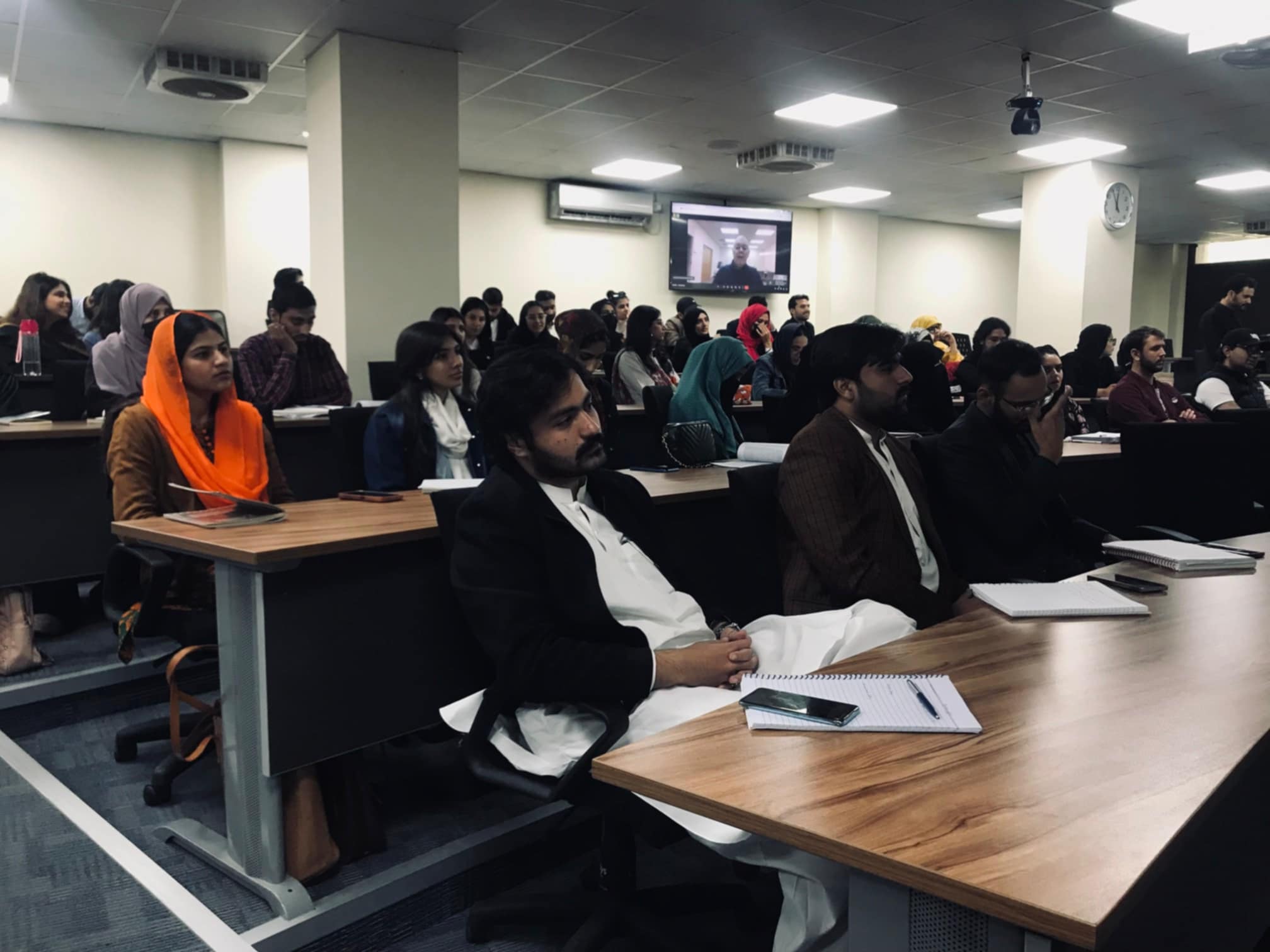
The following is the principal lecture of a seminar on psychoanalytic criticism delivered remotely to students at the National University of Modern Languages, Islamabad, Pakistan. It was hosted by the Department of English and arranged by Dr. Amina Ghazanfar. The seminar was held November 19, 2024.
My plan is to speak to you about psychoanalytic criticism along four axes: one set stretching from the past to the future; and the other set running from reader to writer. Even though these two sets exist on different planes of thought, their data points will no doubt cross paths and even bump into one another at times. Mixed in with all the theorizing, I hope to impart some actual useful information now and again. And let us start with that (just in case there is no more to be had).

When asked to discuss psychoanalytic criticism, the immediate response is to focus on the adjective, psychoanalytic, and to regard the noun as a given. But let’s not. Criticism and especially its related word critic tend to have bad connotations, especially in everyday English. One definition of criticism, in fact the most prominent one, means to offer an unfavorable opinion about someone or something. A fed-up spouse may say to their partner (or child to their parent, employee to their employer), “I’m tired of your constant criticism!” Or the person who finds themselves surrounded by people who feel free to judge them may say, “Sure, everyone’s a critic!”
These negative connotations associated with criticism and with the critic have drifted over to the words as they’re used in the arts, meaning to evaluate a work of art, and the one doing the evaluation. In fact, there seems to be a natural antagonistic, even adversarial, relationship between the artist and the critic, perhaps because so much of an artist’s reputation (and possibly, in turn, their livelihood) depends on the critic’s opinion. A good or bad review, in a prominent place, could make or break an artist’s standing.
In the academy, criticism has managed to avoid the most negative associations and survives more on par with the neutral critique, which is less about passing judgment and more about asking interesting questions and stimulating interesting discussion. Criticism is about opening up possibilities regarding a work of art; it’s about multiplying potential interpretations. It’s not about identifying truths regarding the art; it’s not about solving the art, as a mathematician may solve a complicated equation.
This may be the first important thing I’ve said: Budding critics must guard against the sense that they’ve said something definitive about the work under consideration. Everything is speculative, and they should manage their rhetoric to make that clear. When writing criticism, there should be a lot of hedging. Not “Shakespeare clearly had a troubled relationship with his mother”; rather, “Shakespeare may have had a troubled relationship with his mother.” In the sciences, they strive for declarative statements. In the humanities, we almost always avoid them. We happily traffic in ambiguity.
All of this brings me round (finally) to the adjective, psychoanalytic, which is an especially intriguing critical approach because it is a kind of hybrid school of criticism, marrying science with humanism (although it may be an unhappy or at least unequal marriage). The term of course means that we, psychoanalytic critics, are about analyzing (examining, testing, dissecting) the psyche. That seems straightforward enough. But since we love ambiguity, let’s ask “What do we mean by the psyche?” Are we examining the mind? The soul? The personality? The spirit? These are all synonyms for psyche. If this were a question on a multiple-choice exam, and we could only choose one answer, nearly all of us would probably choose A) The mind. But I think each of the choices is potentially correct, depending on factors like the work being critiqued and the working thesis of the critic. For example, my first monograph—The “Beowulf” Poet and His Real Monsters—was, yes, an examination of the poet’s mind, but also (equally) an examination of the poet’s culture and community, its zeitgeist, which comes closer to psyche as “spirit,” as geist is German for “ghost” or “spirit.” (Zeit, if you’re curious, means “time.”)
So, upon a closer look, psychoanalytic has a broader sense than just an examination of the mind. “Whose mind?” we of course need to ask—and we will.
Before going there, though, let’s spend some time on the origins of psychoanalysis itself. Note the plural: origins. Returning to that simplistic multiple-choice exam, if there were a question about the origin of psychoanalysis, being brilliant students, we would look for “Sigmund Freud.” But in truth it’s not that simple. I do want to talk about Freud—because he was a crucial theorist, a foundational theorist—but he wasn’t the first human being to notice that people have a lot of complicated things happening under the hood. Ancient storytellers had a sense of multi-faceted personalities, of “good” versus “evil,” of twins (Romulus and Remus, for example), of trios forged into a single entity (the Fates); in more contemporary times, of doppelgangers, of Jekyll-and-Hyde personas.
Freud’s masterstroke was to take the sense of an unconscious part of the mind to a much further point, theorizing that people’s behavior is chiefly due to their unconscious. They may believe, consciously, that their decisions and their subsequent actions are due to a, b and c. But in reality their actions are, unconsciously, due to x, y and z. Nearly all of the time, said Freud, people are unaware—oblivious even—to their own true motivations, their own true reasoning. Moreover, Freud said the dominance of the unconscious mind is completely natural. Finally, in his theorizing (and in his prolific publishing) Freud provided a vocabulary for discussing the workings of the unconscious mind: terms like Id, Ego and Superego, as well as processes drawn from literature like Oedipal complex, Electra complex, and narcissism.
In essence, Freud theorized that the unconscious drivers of human behavior are our unexpressed fears and our unacknowledged wishes. Our fears and wishes find expression in four ways: neurotic behaviors (like anger, anxiety, depression, paranoia); dreams and nightmares; accidental vocalization and diction (so-called “Freudian slips”); and the creative arts. It is of course this last kind of expression that is our main interest. In other words, when artists create (when writers write, painters paint, music composers compose, dance choreographers choreograph), they are accessing their hidden fears and wishes, usually unwittingly.
I don’t want to be overly technical, but Freud used the concepts of condensation and displacement to describe the processes by which the mind obfuscates its fears and wishes. With condensation, the writer, let’s say, brings together several ideas or personas into a single representation. With displacement, a fear or wish may be moved from its true origin to become associated with someone or something else. It must be underscored that the mind conceals its fears and wishes because it would be unbecoming or downright taboo to discuss them openly, that is, consciously.
Just as Freud did not develop his theories in isolation, other psychologists, psychiatrists and psychoanalysts either accepted them, modified them, or rejected them in favor of competing theories, during Freud’s lifetime (he died in 1939) and up to the present. It is a cast of thousands, and even the most significant are too numerous to mention even in the briefest summary. Nevertheless, I want to mention one psychoanalyst who, for our purposes, provided the most useful clarifications and extensions of Freud: Frenchman Jacques Lacan.
Like Freud, with whom he was somewhat of a contemporary (Lacan, 1901-1981), the Frenchman was a prolific writer and lecturer; therefore, his discussion of Freud’s theories takes up many volumes, and he was oftentimes at odds with Freud, tinkering, extending, or frequently outright disagreeing. From my perspective, there are two Lacanian concepts that are crucial to our effectiveness as psychoanalytic critics. First, while Freud certainly believed in the significance of language, Lacan took that belief further to the point of making careful attention to language paramount. In fact, he believed that psychoanalysts must work with language just as literary critics do, microscopically and all-encompassingly. No word-choice, no word-order-choice can be taken for granted. Each has significant bearing on interpretation. (I suppose one could go further and say that each word-omission and word-order-not-taken is worthy of attention, too.)
Second, a major criticism (there’s that word) of Freud had to do with causation. Lacan felt that Freud tended to oversimplify the relationship between cause and effect. What appears to be the cause is not the real cause at all. Or it may be more accurate to say that anything attributed to a single cause is misleading because for everything there are multiple causes, with some causes being more significant than others. The analyst—and by extension, the critic—who is satisfied with a one-to-one causal relationship is almost certainly overlooking important facets of cause.
These two Lacanian concepts are so crucial I want to repeat them. Let’s call them important points two and three: The psychoanalytic critic must consider every aspect of the text’s language as significant—diction, syntax, rhetorical posture, everything. Also, psychoanalytic critics must approach each effect as having multiple causes, and therefore they must be dissatisfied with analyses that suggest a facile, single cause, no matter how logical, no matter how well supported by the critique. Causes are always multiple and/or multilayered.
By stopping with Lacan I don’t want to imply that he represents the last word in psychoanalysis. Far from it. Advances in psychoanalysis, psychiatry, and perhaps especially neuropsychology have continued apace for the last half century. Consequently, literary critics inclined toward psychoanalytic interpretation should be aware of the latest advances in our study of the mind. I was recently asked to peer-review an article using trauma theory (a branch of psychoanalytic critique), and the writer only cited pioneers in the field, as if there has been no advancement in our understanding of the mind in decades. I recommended against publication without significant revision to include the work of contemporary (living and practicing) psychologists and psychological theorists. I was gratified to read a later draft that made good use of some of the names I suggested. I was happy to greenlight publication as a useful contribution to the field (and not just a well-written rehash of what has come before).
Let’s call that important point number four: Our understanding of the human psyche and how it relates to behavior is constantly evolving and improving. Psychoanalytic critics must make an effort to stay abreast of new knowledge, at least new knowledge that is directly relevant to the critique they have in mind.
It is also worth noting that we sometimes hear “psychoanalytic criticism” and “Freudian criticism” as synonymous terms, but it’s probably best to think of them as somewhat different. Psychoanalytic criticism is any critique that deals with the unconscious, whereas Freudian criticism makes use specifically of terms and concepts developed by Freud. By the same measure, we may employ Lacanian criticism or Jungian criticism, which are types of psychoanalytic criticism, but as one may imagine they make use of Lacan’s or Jung’s theories and terminologies.
So, then, what is the mission of psychoanalytic criticism? I want to suggest that psychoanalytic criticism has two broad agendas. Through careful examination the critic seeks to find at work the author’s unconscious fears and wishes as they are represented in a literary text. Or (and/or) the critic seeks to find at work a character’s unconscious fears and wishes. With some texts, we can do one or the other or both because we know the author; that is, we have access to their biographies and therefore, to a degree, their personalities. With other texts we are limited to the analysis of the fictional characters (or other literary elements) because we do not have access to the author’s personality. Either the author is unknown, or there is so little known about them that nothing of use can be definitively said. A third approach would be to critique a text psychoanalytically in an effort to reconstruct an unknown or little-known author’s persona. What fears and wishes may be operating in the text, and what may they tell us about the person who created the text? Referencing again my Beowulf monograph, my objective was this last one: I attempt to reconstruct the persona of the anonymous poet by psychoanalyzing the text of the poem.
What does it matter? Why bother to critique a text psychoanalytically, or any other way? T. S. Eliot, considered one of the most astute critics of the twentieth century, put it simply (I paraphrase): The ultimate goal of criticism is to understand a work of art better. We psychoanalytic critics may say our goal is to better understand the relationship between the artist and their art, and in so doing understand the work of art better. Is criticism, then, simply an academic pastime, using academic in both its meanings? Is criticism a behavior of the academy, something done by scholars as a function of their scholarship? And is criticism of no practical value?
Regarding the first meaning of academic, I would say yes, probably: It primarily happens in the academy. That is, it is primarily scholars who engage in criticism as we are thinking of it here, psychoanalytic and otherwise. Regarding the second meaning, I hope and believe the answer is no. Criticism does have practical value. Since art is a product of human beings, and a reflection of all that it means to be human, then I think we can modify Eliot’s assessment to say that the ultimate goal of criticism is to understand ourselves better: ourselves as a species, ourselves as a society, and our each individual selves. Important point number five. What could be of greater value? We hardly have time here for a meaningful discussion of whether or not the value is practical. Going back to Plato at least, we have debated the usefulness of knowledge—and if there is a difference between knowledge and understanding. In a contemporary, real-world sense of practicality, understanding human beings is essential to modifying human behavior, whether individually or en masse, including behaviors that are either constructive or destructive.
My literary idol William Gass believed that art (including literature) could impact consciousness, that it could assemble ethical paradigms that would lead individuals and societies to behave more humanely, more empathically. I would direct you in particular to his essay “The Artist and Society,” which I know is not easily available. There is an insightful discussion of the essay, with several block quotes, available online. (here) I am beginning to stray far afield, so I will end this line of thought by simply reiterating that if art has value, practical or ethereal, then criticism of that art is at least equally valuable.
Let me return to psychoanalytic criticism’s mission and restate how we may use it: Through careful examination the critic seeks to find at work the author’s unconscious fears and wishes as they are represented in a literary text. Or (and/or) the critic seeks to find at work a character’s unconscious fears and wishes. With some texts, we can do one or the other or both because we know the author; that is, we have access to their biographies and therefore, to a degree, their personalities. With other texts we are limited to analysis of the fictional characters (or other literary elements) because we do not have access to the author’s personality. Either the author is unknown, or there is so little known about them that nothing of use can be definitively said. A third approach would be to critique a text psychoanalytically in an effort to reconstruct an unknown or little-known author’s persona. What fears and wishes may be operating in the text, and what may they tell us about the person who created the text?
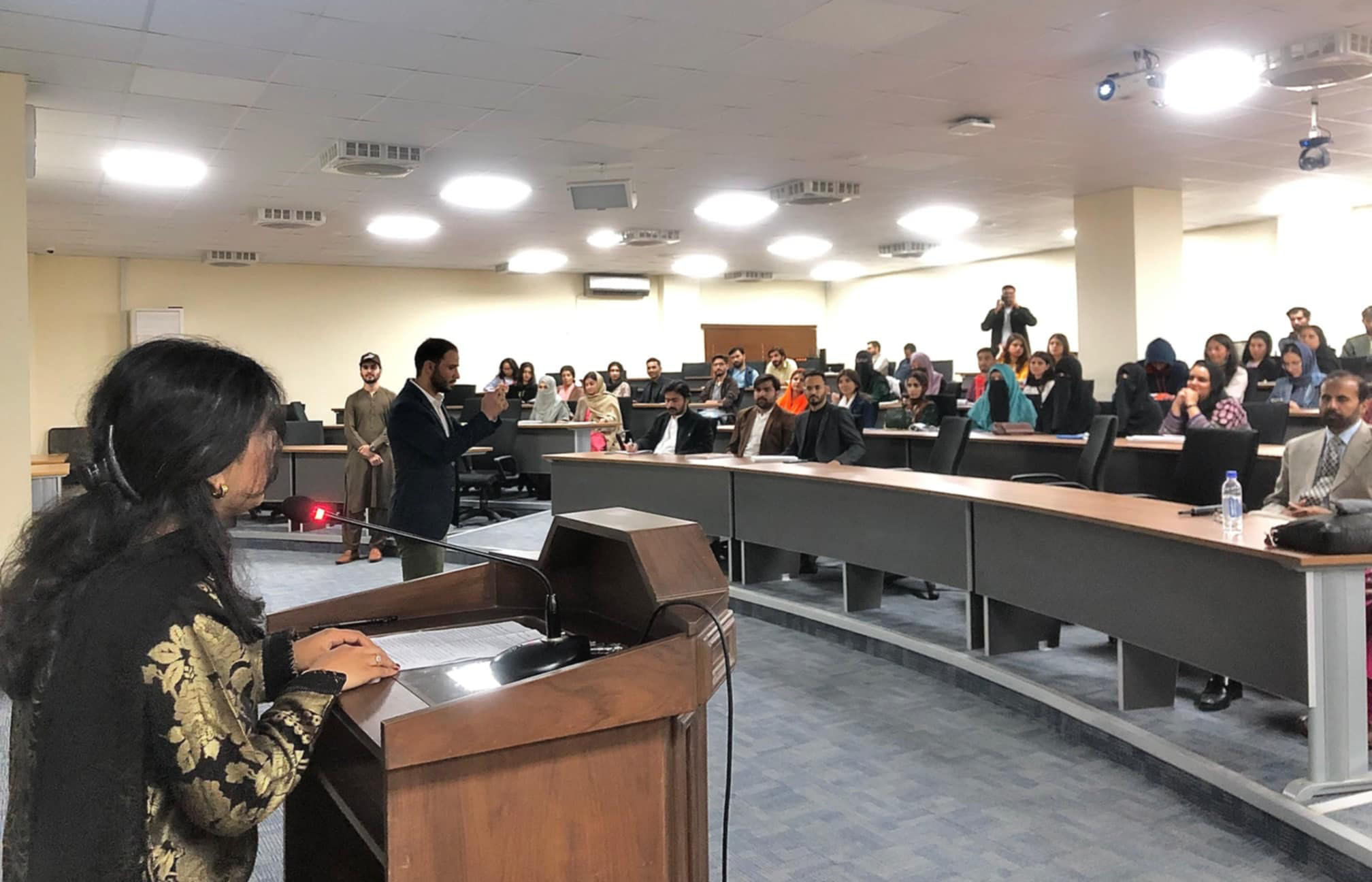
Of the first order would be a text like Henry James’s novella “The Turn of the Screw” (1898). In brief, it is the first-person account of an English governess who comes to believe that her two young charges, a brother and sister, are being harassed or even possessed by the ghosts of two adults who worked at the estate before their deaths. The employees, who were lovers, had an oddly close relationship with the children in life, and are perhaps continuing the relationships as ghosts. In fact, they may have had inappropriate relationships with the children. In the novella, Henry James is always highly suggestive and lightly clear. His vagueness has left a great deal to our imaginations, and to the ingenuity of critics. Via plot details, via characterization, and via a host of symbols (some rather heavy-handed), critics have penned copious readings over the past 125 years. Many of those critiques are based on our understanding of the author, who was a lifelong bachelor. It is believed that James was attracted to men at a time when that would have been an impossible situation in England: perhaps this is reflected in the same-sex relationships between the adults and the children in the story—the wholly inappropriate same-sex relationships. Some critics have speculated that James was a victim of sexual abuse as a child, and that fact has found its way into the novella. What is more, the vagueness of the novella, James’s seeming inability to state anything plainly and directly, may represent his inability to discuss his sexuality and (possibly) the abuse he experienced as a child. “The Turn of the Screw” (with the suggestive imagery of its title) is, above all, a story of psychological repression.
Another interesting example from the same time period is the work of Sir Arthur Conan Doyle and his Sherlock Holmes mysteries, of which he ultimately wrote four novels and sixty short stories. The apparently platonic relationship of Holmes and his sidekick Dr. Watson has of course been the subject of countless critiques. The fictional character Holmes, like the real Henry James, never marries. Perhaps of greater interest is the fact that the danger in the Holmes stories is always associated with British colonization. Conan Doyle was writing during an expansionary period of the Empire. Britain’s global influence was steadily increasing from about 1815 to 1915, adding 10 million square miles of territory and subjugating as many as 400 million people. Conan Doyle’s first Holmes story appeared in 1886, the last in 1927—all but the final twelve were published during the height of British colonial expansion prior to the First World War. Again, the antagonist or antagonistic element consistently comes from one of the colonies. In the first Sherlock Holmes story, A Study in Scarlet, the murders are connected to Mormonism, a religion that originated in the United States. In the second story, The Sign of Four, the murder is provoked by treasure brought back from India. In the third, “A Scandal in Bohemia,” again it is an American, an opera singer, who is at the root of an extortion plot. In the fourth, “The Red-Headed League,” an American millionaire is behind a robbery that is to unfold in the heart of London. Plot after plot hinges on someone or something that has returned to England from a colony or former colony: The U.S., Canada, South America, Asia, Africa. Critics have suggested that the guilt associated with the subjugation and exploitation of millions led Conan Doyle to enact revenge on British citizens at the hands of the colonized. The guilt, as well as the fear of retribution. Conan Doyle was staunchly and outspokenly pro-Queen Victoria, pro-King Edward VII, and pro-Empire, which contributed greatly to his being knighted in 1901.
At the most fundamental Freudian level, we can see that both Henry James and Arthur Conan Doyle were motivated, on some level, by fear and/or inappropriate wish fulfillment.
This time period—around 1900, which we also associate with the writings of Sigmund Freud—is important to our interests, but for now let me go back a bit further.
Of course all of Shakespeare’s plays have been fertile ground for a wide variety of critical analyses. In terms of psychological criticism, his most famous play, Hamlet, has lent itself to discussions of the Oedipal complex: young Hamlet fosters a desire to kill his uncle and stepfather, Claudius, upon marrying Gertrude after what may appear an inappropriately short period of mourning the death of King Hamlet. Young Hamlet had been in love with Ophelia, but he rejects her after developing his obsession to kill Claudius, who has usurped King Hamlet’s status.
William Shakespeare, as a person, is much more of a mystery than authors like Henry James and Arthur Conan Doyle, for whom we have extensive biographical accounts as well as diaries, letters, and other documents directly attached to their lives. It is difficult to say anything with certainty when it comes to the life of Shakespeare. There are no letters, no diaries, and scant official documentation. We have the texts of the plays and the poems, and we have a great deal of documentary evidence from the time period. We can’t say for certain what may have motivated Shakespeare based on his personal history, but we do know about the outbreaks of plague, the assassinations and attempted assassinations of monarchs, and we know about the fear of invasion by Spain, France and other European powers. Psychoanalytic critics can make educated guesses about how this cultural milieu may have impacted Shakespeare’s writing.

I have done similar guesswork when it comes to the Old English poem Beowulf and its anonymous poet, composed around AD 725. We know nothing of the poet himself (assuming a male poet), not even his name, but we know quite a lot about his time period. It isn’t nearly as well documented as Shakespeare’s day, almost a thousand years later, but there is a considerable record, including numerous firsthand, eyewitness accounts. Drawing from this material, I theorized in The “Beowulf” Poet and His Real Monsters that the three monsters in the poem may have represented specific sources of anxiety for the poet and his audience: continual armed violence, the dangers of reproduction, and illnesses that were caused by agents beyond people’s comprehension—manifested in Grendel, Grendel’s Mother, and the dragon.
I want to return to the year 1900. It has been noted that creative writers in the twentieth century and beyond have been more concerned with character motivation than writers in the past. Let’s take as one example a writer I’ve already alluded to—considered by many the greatest writer in the English language, Shakespeare. As great as Shakespeare was, his treatment of character motivation was consistently cursory. Why is Hamlet so quick to turn against his mother and his girlfriend, based on the urgings of a ghost? In The Winter’s Tale, why does Leontes turn against his wife, Hermione, based solely on the friendly hospitality she shows her husband’s oldest friend? How can Othello move so easily from adoring Desdemona to murdering her? The examples are abundant. We could explore any number of explanations, but the important point is that Shakespeare’s audience didn’t seem to care much about character motivation, a token effort is all they required of their playwrights. Said differently, the early modern audiences appeared to have little interest in the psychology of their fictional characters. Of course, Shakespeare was interested in his characters’ psychology. It was often the element he added to his revisions of previously existing plays: a focus on his characters’ tendency toward introspection. Yet it was still minimal compared to the psychological novels and plays (and films) as they developed in the twentieth century. One theory is that the wide dissemination of Freud’s theories—which began in the 1890s, but not until the 1920s were his works widely translated and read—made twentieth-century readers and theatergoers much more interested in the psychology (i.e. the motivation) of the fictional characters they were seeing on the page, the stage, and ultimately the screen. Important point number six.
It may be worth noting that in the United States the first college to establish a course in “psychology” was Harvard, in 1873, taught by Henry James’s older brother William, who eventually wrote the first psychology textbook, The Principles of Psychology, published in 1890. It was the primary college psychology textbook for decades, and greatly influenced thought in other disciplines as well.
I want to turn now from one side of the page to the other, from psychoanalytic critic to writer of fiction, which has been my chief interest since childhood. As a writer, I’m not mindful of my characters’ psychology—and certainly not of my own. It sounds like a simple goal, but when I put pen to paper I’m trying to tell an interesting story in an interesting way. I know there are elements at work beneath the surface of my awareness, but when I’m writing a story or a novel or a poem (my poetry tends to be strongly narrative), I’m not thinking about what those influential elements may be. Similarly, I’m not even thinking about what the text I’m writing may mean. Long ago I decided that meaning was the reader’s purview. In fact, when I let go of my concern for meaning in my stories, my stories became much, much better—more interesting and probably more meaningful.
William Gass said it well: “You hope that the amount of meaning you can pack into a book will always be more than you are capable of consciously understanding…. You have to trick your medium into doing far better than you, as a conscious and clearheaded person, might manage” (my italics).
That is, Gass understood that while he was writing consciously—making deliberate choices about plot, characterization, setting, word choice, and so on—his unconscious mind was at work as well, perhaps operating on a more symbolic level; and because of the influence of his unconscious thoughts, the work would turn out more complex, more engaging, and more interesting than it would if just his consciousness was directing the narrative.
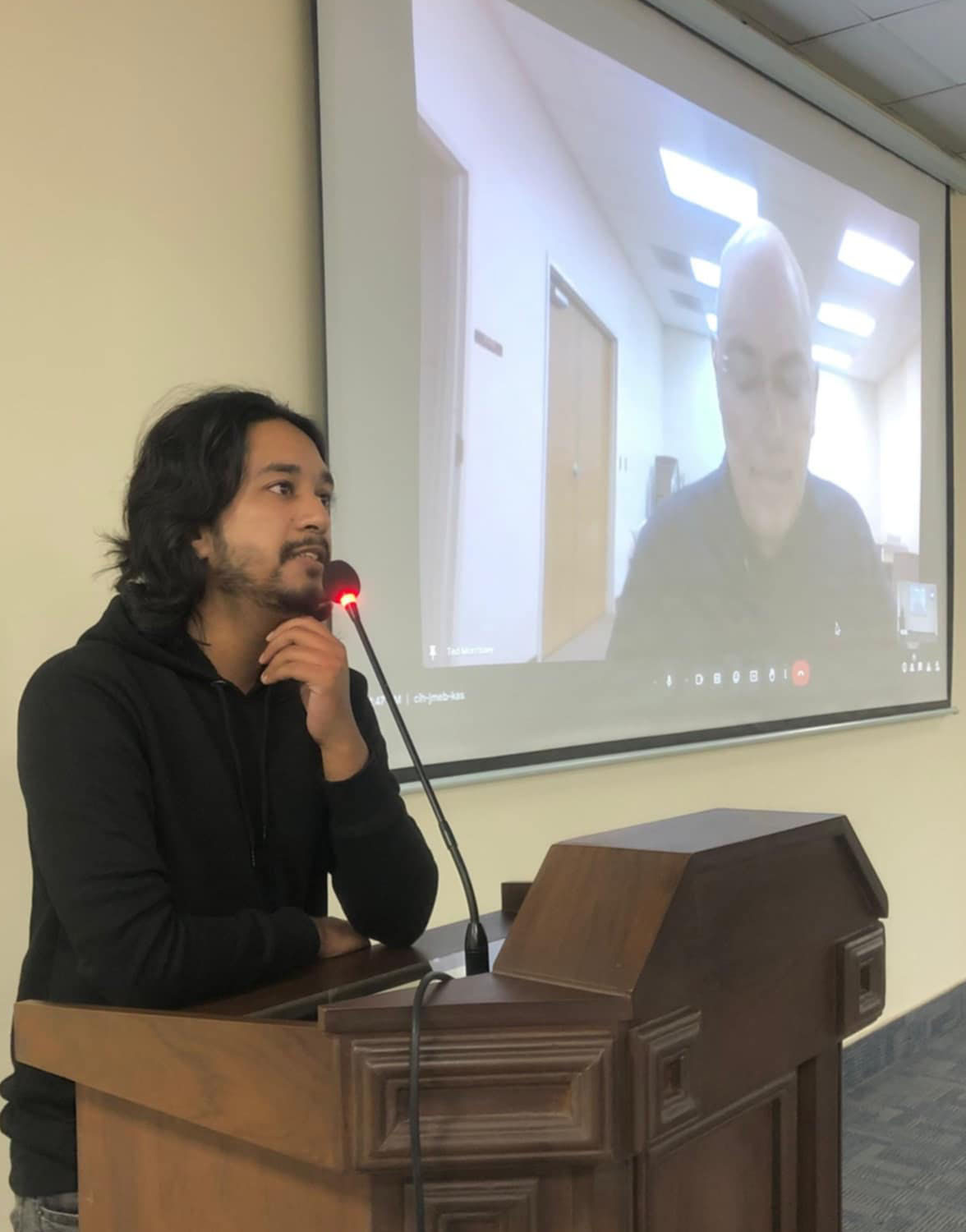
When I write, I deliberately (i.e. consciously) put what I think of as “constellations of images” into the work: repeated words, phrases, ideas (much as we do in poetry, even when I’m writing prose), as well as allusions to the great, classical repositories of narrative. In the west, writers have tended to allude to four narrative sources: the Bible, classical mythology, history, and Shakespeare. I don’t limit myself to these sources for allusions, but I do draw from them copiously. These techniques are not done at random. I have intentions, but I also know that each reader is going to bring their own perspective, their own experiences to my text, and therefore read it and interpret it idiosyncratically. By using these “constellations of images” I’m feeding their imaginations as readers, giving them a lot of handholds for scaling their own personal understanding of the text (and perhaps their own personal understanding of me as the author of the text).
I have experienced two phenomena as a writer that I want to share because they relate directly to our interest in psychology and the unconscious mind. For more than thirty years my process has been to write in the morning, Monday through Friday. When I taught full-time, I would only manage about 30 minutes per morning writing session (now it’s somewhat more). Some mornings I sat down to write knowing precisely where I was in the narrative I was working on. That is, I’d left off the previous morning with a clear sense of what to write next (I’d just run out of time). On those mornings, the writing tended to produce a fine enough first draft. The writing session was satisfactory. Other mornings, I wasn’t sure where to take the narrative. I would sit with my coffee and a blank sheet of paper staring at me. Some writers, I knew, would say at that point “Well, I don’t have anything today. I’ll try again tomorrow.” I, on the other hand, had learned that if I just start writing—put pen to paper and begin producing text—the ideas would come. Not only that, the writing tended to be much, much better on those days that began so aimlessly. More interesting, more creative, more linguistically complex. I have a theory as to why.
On the mornings when I had a clear sense of what I wanted to write, the composing of text was directed primarily by my conscious mind, whereas on the mornings when I had a fuzzy sense or no sense at all, the composing of text was directed by my unconscious mind. And, lo and behold, it turns out my unconscious mind is a much better writer than my conscious mind. Said differently, my conscious mind operates in the real, and my unconscious mind operates in the surreal. And most of us would agree that surrealistic images are more engaging, more captivating than realistic ones.
The other phenomenon has to do with not writing. I’m dedicated to my creative writing, but I will have stretches when I’m not writing for several days—generally this happens when I’m traveling or on vacation. I have had a few occasions where a significant illness or injury has prevented me from writing for several days. I notice that I begin to get anxious, I have difficulty concentrating, I become impatient, and generally I just feel uneasy. These symptoms of my not-writing correspond precisely with sleep deprivation. Returning to Freud, he compared creative writing to daytime dreaming. He theorized that the mind of the creative writer is functioning in much the same way as the brain does when we’re sleeping and dreaming. I feel that my experience gives credence to Freud’s theory. By not writing for several days I’m depriving my mind of its process for analyzing and interpreting my world. I’ve often said that my writing is a kind of meditation. It keeps me centered. It may also be keeping me mentally healthy.
I will end on a note about a possible future for psychoanalytic criticism. As we know, a dominant topic in the academy is artificial intelligence: how is it reshaping society, how is it reshaping education, how is it reshaping us? It is a broad and constantly changing subject, so I want to focus on a very narrow sliver: AI’s production of narrative text. I have no doubt that commercial publishers in the U.S. and elsewhere will start marketing books written by artificial-intelligence “authors.” There will be no need for royalty payments, no authorial egos for editors to bruise (really, no need for editors), no missed deadlines by unpredictable human writers, who become sick, who become distracted, who become blocked.
If you follow developments in artificial intelligence, you’re probably familiar with the “black box problem.” AI is autodidactic, gathering data and “learning” from that data of its own mysterious volition. When AI begins doing things that its programmers didn’t program it to do, demonstrating processes and outcomes the programmers themselves don’t understand, the AI is operating in a so-called black box. AI that is composing narratives—telling stories, writing novels, etc.—is essentially drawing from its unconscious, its impenetrable black box. At that point, computer scientists are unable to untangle and understand the AI author’s complex programming, but perhaps psychoanalytic critics can employ their skill sets, analyzing the language of the narrative itself to perceive the artificial author’s unconscious mind. Such a process was predicted by science fiction writers. In Robert Heinlein’s novel The Moon Is a Harsh Mistress (1966), computer technicians are essentially psychoanalysts who diagnose and fix problems by talking to the computer, asking it questions, and analyzing its responses. Similarly, in Arthur C. Clarke’s 2001: A Space Odyssey (1968), the computer, HAL, has what amounts to a nervous breakdown when faced with an ethical dilemma.
As the new generation of critics, you may well be at the forefront of working with artificial intelligences, reading their output, analyzing their language, and assessing their unconscious programming. If so, I encourage you not to ignore the old, human-produced texts, for they are the gateway to comprehending the artificial authors of the very near future, and humanity will likely depend on that comprehension. Humanity will likely depend on you. Vitally important point number seven.
William H. Gass at 100: Looking backward, Looking forward
This paper was presented at the Louisville Conference on Literature and Culture, held Feb. 22-24, 2024, at the University of Louisville. Another paper in the “Novel Focus” panel were “Emma Donoghue’s Hunger Aesthetic” by Carey Mickalites (University of Memphis). The panel was chaired by Marie Pruitt (University of Louisville).
• • •
Where to begin?
I suppose with this quote: “William H. Gass is not an easy man to grasp; and, like the man, his work is beautiful, formidable, and troubling all at once,” wrote Theodore G. Ammon in the introduction to Conversations with William H. Gass (2003). There is no shortage of opinions of and therefore quotes pertaining to him and his work, which, thankfully, is copious: fiction ranging from brief sketches to the epic novel The Tunnel; nonfiction in the form of essays, criticism, lectures, and reviews, much of which collected in ten volumes over more than forty years; plus translations, interviews, and the thousands of pages of letters, early drafts, publication proofs, teaching notes, and even his doctoral dissertation (archived at Washington University in St. Louis, where he spent the last 32 years of his professional life).
I like this quote from Ammon, though, to begin this paper because it’s in conjunction with the William H. Gass centenary. Born in Fargo, North Dakota, in 1924, Gass was a prolific author (despite the difficulty he always claimed to have in composing, and the slow pace by which much of his work—especially his fiction—emerged), toiling away with words almost until his death in 2017 at the age of 93. It seems to me that one of the goals of this year, 2024, and perhaps its chief goal, is to try to capture and honor the essence of Gass’s contributions to not just American literature but also to literature beyond the borders of the United States (Gass dedicated the last decade of his time at Washington University to founding and directing the International Writers Center). I’ll ape Ammon’s quote by saying that this Gass-focused goal is not an easy one to achieve.
I mean the title of this paper to be quite literal. I will devote a good deal of it to looking backward by outlining (if only superficially) Gass’s many interests and accomplishments over the decades; and I will end by looking forward, both in the short term (what else is happening this year as part of the Gass centenary) and the long term (where might scholarly energies be devoted over time). I apologize to anyone who is already quite familiar with Gass: the first part of this presentation may seem basic and unnecessary. However, I’m always a little ashamed to acknowledge that I was in my mid-forties when I first read Gass’s work, and I was not alone in my ignorance. For the past fifteen years I’ve devoted myself to what one of my students dubbed “preaching the Gass-pel,” and I have encountered many well-read scholars and devoted readers who have never heard of Gass, or who only have a passing familiarity with him and his work.
Looking backward.
Gass was always doing everything all at once. That is to say, he didn’t devote himself to a kind of writing for a certain period of his life; then to another kind for a time; then another and so on. Like so many of the writers that Gass admired—Henry James, Virginia Woolf, Samuel Beckett, Jorge Luis Borges—his interests were wide-ranging, and he was forever juggling multiple projects. For convenience, I’ll give an overview organized by kind of writing. His varying interests are illustrated by the journal that was the first to publish his fiction. Accent: A Quarterly of New Literature (published by University of Illinois, Urbana), included the short story “Mrs. Mean” and the opening section of what would become his debut novel, “The Triumph of Israbestis Tott.” In the same issue, Accent also brought out “The High Brutality of Good Intentions,” an essay on Henry James.
“Mrs. Mean” (Accent, winter 1958, later collected in In the Heart of the Heart of the Country) was reprinted in Best American Short Stories (1959), which may have begun the process of having Gass’s fiction read by a broader national audience. The 1961 edition of Best American Short Stories included Gass’s “The Love and Death of Henry Pimber” (Accent, spring 1960); and the 1962 edition included “The Pedersen Kid” (MSS [Mt. Shasta Selections], no. 1, 1961). Throughout this period, Gass was regularly publishing short fiction, scholarly essays, and book reviews in academic journals. However, it was the publication of his debut novel, Omensetter’s Luck, in 1966 (New American Library) that really put his name on the national literary map. The novel won high praise from a host of reviewers. The fact that it was published by New American Library was significant because it brought Gass to the attention of Theodore Solotaroff, editor of New American Review literary journal, which was published by New American Library and was launched in 1967. Gass’s “In the Heart of the Heart of the Country” was in the inaugural issue—the first of four appearances in the journal.

As you may know, New American Review was published as a mass market paperback, and distributed nationally via bookstores and newsstands, but also drug stores, supermarkets, and other places where literary journals were not commonly available. In the beginning (when Gass’s work was included), 100,000 copies of each issue were printed, and there were three issues annually. Gass’s work, both fiction and nonfiction, was appearing alongside writers and poets like Grace Paley, Philip Roth, Anne Sexton, Russell Banks, Jorge Luis Borges, Marvin Bell and Louise Gluck.
Other important book publications were soon to follow: in 1968, both the wildly experimental novella Willie Masters’ Lonesome Wife (originally TriQuarterly in a limited edition, then reprinted by Knopf, 1971), and In the Heart of the Heart of the Country and Other Stories (Harper & Row). Gass’s first collection of nonfiction was released in 1970 by Knopf, Fiction and the Figures of Life.
It was also during the late 1960s that Gass began writing The Tunnel. In fact, it first began to appear in print in New American Review, with “We Have Not Lived the Right Life” (no. 6, 1969). The novel would not be published until 1995, and over the more than quarter century that Gass worked on it, excerpts would appear in a host of noteworthy journals and magazines, including The Paris Review, Kenyon Review, Salmagundi, and Esquire. Meanwhile, the excerpts were reprinted numerous times as part of “best of” anthologies and as Pushcart and Best American Short Stories prizewinners. Nevertheless, Gass said in 1971, half jokingly and half seriously, that he hoped The Tunnel “will be such a good book no one will want to publish it” (McCauley 12); and his wish nearly came true. The book had been under contract to Boston-based Ticknor and Fields, but once the manuscript was finally complete in 1992, they withdrew the contract. Dalkey Archive Press entertained the idea of publishing what Steven Moore described as a “huge manuscript, along with a lengthy set of design and typesetting instructions.” Ultimately Knopf brought out the first edition in 1995, only to let it go out of print shortly thereafter. Dalkey stepped in to publish a paperback edition in 1999.

The Tunnel won the American Book Award in 1996, and it had its fervent admirers, but it also generated many reviews that ranged from tepid to hostile. The Tunnel turned 25 in 2020, during the pandemic, so I initiated an online symposium, available at thetunnelat25.com. I encourage you to check out all of the site’s contributions, but since I’m focused at the moment on the novel’s publishing history I’ll highlight two pieces in particular: “The Tunnel: A Survey of Published Excerpts” by Joel Minor; and my own “The Tunnel: A Chronology & Bibliography.” The two papers have similar aims, yet contain different information. Joel’s important contribution focuses in great detail on the publishing history of the various excerpts, and cross-references them with material that is available at Washington University in the William H. Gass papers (of which Joel is the curator). My paper, on the other hand, is more interested in Gass’s writing process, and tracks the composition of the novel alongside Gass’s biography. For example, I’ve integrated some of Gass’s comments about the novel year by year, drawing from the many interviews he granted.
While Gass was writing The Tunnel, he was also working on a series of novellas that was ultimately published as Cartesian Sonata and Other Novellas (Knopf, 1998), but the title novella began to appear in 1964, as “The Clairvoyant” in Location, volume 1, number 2. During the same period that parts of The Tunnel were appearing in journals, being reprinted and winning prizes, bits and pieces of Cartesian Sonata were taking similar paths, coming out in places like Art and Literature, The Partisan Review, and the Iowa Review, being anthologized here and there, and winning a Pushcart Prize in 1976. As a side note, I feel like the Cartesian Sonata collection is Gass’s most masterful masterpiece (even though The Tunnel tends to overshadow the rest of Gass’s fiction in terms of scholars’ attention and cultural memory), and I’ll make my case when I deliver a paper at the American Literature Association Conference in May.
In the interest of time, I’ll summarize the remainder of Gass’s output of fiction: the novel Middle C (Knopf, 2013) and Eyes, a collection of novellas and stories (Knopf, 2015). Much of these final two works appeared in Conjunctions, which became an important outlet for Gass’s writing, both fiction and nonfiction, starting in the early 1980s and lasting until his death in 2017. He eventually became a contributing editor of the journal and was a central figure in several Conjunctions projects.
Fiction, of course, is only part of Gass’s legacy. For the remainder of my time I’ll discuss the “looking forward” aspect of my title—and in so doing also provide a sense of other facets of William Gass’s voluminous output and his far-reaching influence on the literary community, including the global literary community.
While Gass was writing stories, novellas and novels, he was also prolifically producing nonfiction in the form of essays, reviews, book introductions, and lectures. He published seven works of fiction, and he published ten works of nonfiction (if one counts the collection of interviews edited by Theodore Ammon in 2003). Moreover, he served as co-editor of three collections of nonfiction, including The Writer and Politics (1996) and The Writer and Religion (2000). Broadly speaking, Gass’s nonfiction has not received nearly as much critical attention as his fiction, even though his work was highly influential, including among his peers. We know, for instance, that Fiction and the Figures of Life—which includes several “craft” essays—was acquired by Cormac McCarthy while he was at work on Child of God, published in 1973, three years after the release of Gass’s essay collection (King 31).
In addition to the eight collections of nonfiction (here not counting the book-length essay On Being Blue), Gass’s vita lists about 100 uncollected essays, reviews, introductions, and lectures. Fortunately, Washington University in St. Louis started archiving Gass’s work even before he began teaching there in 1969. It’s difficult to say, but the Gass collection, begun in the mid-60s but reaching back as far as 1948, consists of thousands of items, and it keeps expanding as Gass’s widow, Mary Henderson Gass, continues the work of sorting and cataloging her late husband’s papers and contributing them to the archive in batches.
Besides the possibility of posthumous publications, there is limitless potential here for scholarly research and writing. William Gass has been the main focus of my scholarship for the past 15 years, and I’ve visited the Gass archive several times, which has proven to be the epitome of scratching the surface.
In addition to Gass’s fiction and nonfiction, other rich veins of scholarship could include the following abbreviated list:
Gass’s support and promotion of other writers, including and perhaps especially writers outside the U.S. For the final decade of his professional career, Gass directed the International Writers Center at Washington University, a Center that he founded in 1990. Its mission was to “build on the strengths of its resident and visiting faculty writers; to serve as a focal point for writing excellence in all disciplines and in all cultures; to be a directory for writers and writing programs at Washington University, in St. Louis, in the United States, and around the world; and to present the writer to the reader” (“William H. Gass”).
Gass’s frequent writing of book reviews. He penned both reviews of scholarly books (especially early in his career) as well as more mainstream books. He was a regular contributor to The New York Times Book Review, but also The Times Literary Supplement and other venues. Furthermore, Gass established a reputation as a writer of introductions for others’ books—perhaps most famously his introduction to William Gaddis’s The Recognitions (Penguin Classics edition). Michael Millman, senior editor at Viking Penguin, wrote to Gass on January 21, 1993: “I can’t remember another time when we had an essay of this caliber as an introduction to one of our volumes. . . .” But the list is long and includes introductions to books by or about Gertrude Stein, John Hawkes, Robert Coover, Stanley Elkin, and Gabriel Garcia Marquez.
Gass as educator. Gass’s primary teaching posts were at Purdue University and Washington University, and he proved to be an award-winning educator at both institutions. Beyond that direct influence on countless students, Gass’s writings serve as teaching material for an untold number of educators. His fiction and essays have been widely anthologized (I first encountered Gass in an anthology), thus serving as models. Moreover, his essays—particularly his craft-focused essays—are the bases for others’ lectures and teaching notes. Plus Gass was a generous granter of interviews, nearly all of which contain discussion of tecnique that ranges from the practical to the theoretical. Fourteen interviews are collected in Conversations with William H. Gass, but this book represents the proverbial tip of the iceberg. There are many interviews online, as text, video and audio, in addition to copious uncollected interviews in print. All of these interviews are rich sources of material for teachers and students of writing.
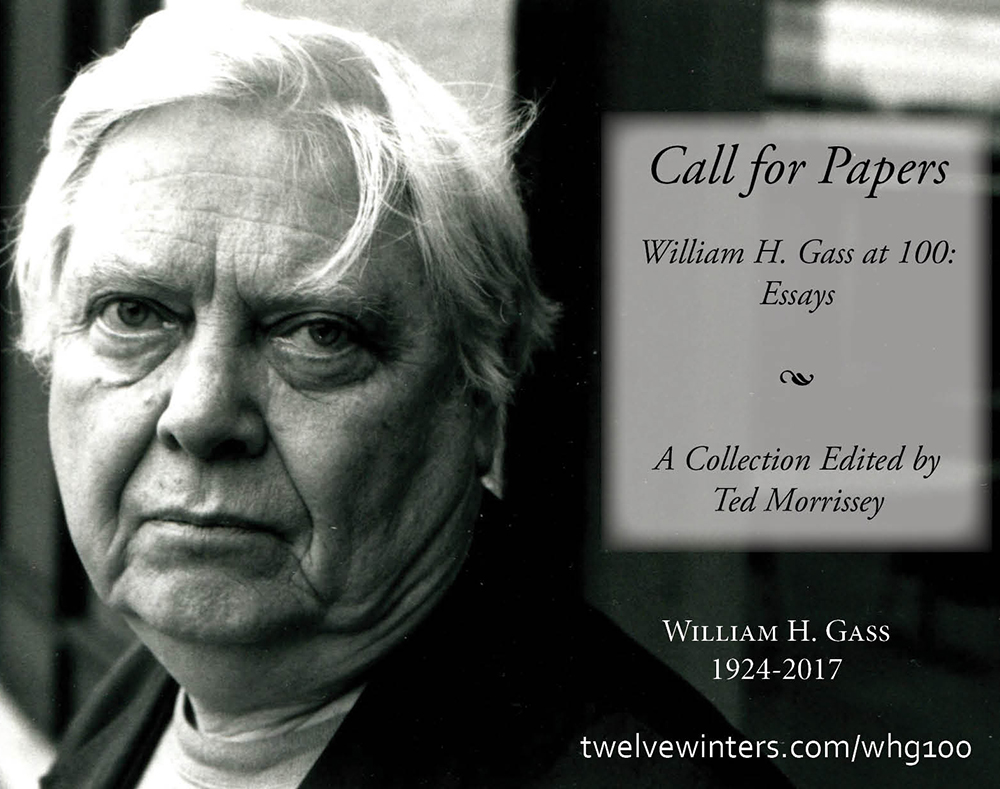
I’ll end by mentioning that in this, Gass’s centenary year, I’ll be editing and publishing a collection of essays—and there is ample time to contribute to that project. See the CFP here. Also, this fall there will be a conference at Washington University in St. Louis. The specifics are still being worked out, but it will likely focus on Gass’s On Being Blue, which was re-released by New York Review Books in 2014. And as a footnote, another resource for Gass studies is this blog, where all of my Gass conference papers are archived. One can get hold of a significant chunk of Gass’s writing in The William H. Gass Reader (Knopf, 2018), writing that was handpicked and annotated by Gass before his death. For a detailed overview, see my rather lengthy review of the Reader at the North American Review website.
Works Cited
Ammon, Theodore G., editor. Conversations with William H. Gass. UP of Mississippi, 2003.
King, Daniel Robert. Cormac McCarthy’s Literary Evolution: Editors, Agents, and the Crafting of a Prolific American Author, The U of Tennessee P, 2016.
McCauley, Carole Spearin. “William H. Gass.” Ammon, pp. 3-12.
Moore, Steven. Dalkey Days: A Memoir. Zerogram Press, 2023.
“William H. Gass.” University Libraries, Washington University in St. Louis, 16 Feb. 2024, https://library.wustl.edu/spec/william-h-gass/.
Beauty Must Come First: The Short Story as Art Made of Language

[This paper was presented at the 16th International Conference on the Short Story in English, held June 20-24, Singapore. It was part of the panel “The Short Story and the Aesthetics of Narration.” Other papers were “A Lot Like Joy: Fractured fragments represented within a composite narrative” by Sarah Giles, and “‘Writing back’—The Sideways Progress of Ideasthetic Imagining” by Julia Prendergast.]
“A second rate writer has no reason to exist unless he is on his way to being a first rate writer, and there is no point at all in doing pleasant easy things, or altering one’s conception of how a story ought to be to get it into print” (Saltzman, “Selected Correspondence” 66).
William H. Gass wrote this statement in a letter, in 1958, to an editor who was considering publishing his fiction, which would have been its first appearance in print. The editor was balking at Gass’s elaborate prose style. Gass, age 34 at the time, preferred to remain unpublished than have his words changed. It was an attitude he maintained – that to be edited was to be rejected – throughout what became a long and illustrious career that claimed numerous awards and distinctions, including Pushcart Prizes, Best American Stories, an O. Henry, the PEN/Nabokov Award, the American Book Award, and the William Dean Howells Medal. Gass – novelist, novella-ist, story-writer, critic, translator, and teacher – passed away in 2017 at the age of 93, working on his final project until he no longer had the energy to continue.
This paper is about Gass’s aesthetic theories when it came to producing narrative, and specifically fiction. Luckily, Gass was a generous granter of interviews, so we have a substantial amount of material in which he discusses his ideas about plot, character, setting, theme, symbolism … all of the elements we associate with storytelling (we have printed material, plus video and audio recordings that are available online). He also wrote numerous “craft” essays in which he goes into detail about his writing, as well as the writing techniques of others (among them Henry James, James Joyce, and Gertrude Stein). Such essays were included in his nine nonfiction collections, beginning with Fiction and the Figures of Life (1970) and concluding, for now, with Life Sentences (2012). And we have copious letters, which are carefully archived at Washington University in St. Louis.
To be clear, Gass’s theories are not designed to make one popular, that is, to make one a bestselling author. On the contrary, Gass never achieved that brand of success. In fact, he said (in another letter to the same editor, Charles Shattuck): “[S]uccess is merely failure at another level” (Saltzman 65), by which he meant that a writer must compromise their artistic principles in order to gain the public attention and financial rewards we (in the United States at least) usually associate with literary success. Gass’s primary goal was to create a work of literary art that he himself was satisfied with; if he had secondary goals they were to earn the respect of writers he admired, and to be read beyond his own lifetime. “I don’t write for a public,” Gass said. “[. . .] It’s the good book that all of us are after. I’ve been fortunate in that I think I have the respect of the writers whom I admire” (Saltzman, “Language and Conscience” 24). He did indeed as his work was praised by authors such as John Barth, Susan Sontag, John Gardner, Stanley Elkin, Joy Williams, and William Gaddis, who called Gass “our foremost writer, a magician with language” (Gaddis 629).
Regarding the goal of having his work read beyond his lifetime, it’s been my mission to make that a reality for more than a decade, during which time I’ve been “preaching the Gass-pel” (an expression coined by one of my students that I immediately filched). I’ve presented dozens of conference paper (all available at my blog, and some elsewhere); I’ve included readings of Gass’s work in my book Trauma Theory as an Approach to Analyzing Literary Texts (2021 edition); and I organized the website thetunnelat25.com, an online symposium devoted to Gass’s magnum opus. In my teaching I regularly place Gass’s books on my syllabi, and I share pearls of his writing wisdom with my students regularly (they may say obsessively). Many of these pearls I also share via social media in the form of memes that I’ve created. Like this one:
[This meme has to do with a topic I’ve recently written about: “To Plan or Not to Plan,” available here.]
And this:
[During the presentation I talked briefly about the inherent problem of writing workshops or writing groups: No matter how well-intentioned, peers’ critiques are oftentimes wrongheaded, and an offhanded criticism can send the unwary writer down a frustrating and fruitless rabbit hole. Instead, writers must accept the unavoidable subjectivity of reader response and stay true to their artistic vision.]
And this:
[I felt this was an especially apropos sentiment to share since the conference was comprised of writers from across the globe — but mainly Asia, Australia and Europe — who compose in English, even though for many it’s not their first language.]
I want to touch on some specific ideas Gass had about writing narrative, but before we get there I’m inclined to discuss the cornerstone of his aesthetic philosophy – as well as my primary focus here: Throughout his long writing career, Gass’s main interest was language, and he sought to use it as a painter uses paint, a sculptor uses marble or metal, a composer uses musical notes, or a photographer uses light and shadow. He stated, in a 1976 interview, “As a writer I only have one responsibility, and that’s to the language I’m using and to the thing I’m trying to make” (Duncan 53). He elaborated elsewhere, “Old romantic that I am, I would like to add objects to the world worthy of love. . . . My particular aim is that it be loved because it is so beautiful in itself, something that exists simply to be experienced. So the beauty has to come first” (LeClair 48).
Allow me to restate Gass’s central tenet: The beauty of the language must come first. By extension, then, everything else – all the other elements associated with fictional narrative, plot, characterization, setting, etc. – are subordinate to the quality of the language, to the beauty of the language. Gass’s devotion to beautiful language took many forms. For example, he regularly employed literary devices we normally associate with poetry: alliteration, assonance, rhyming, repetition. As such, Gass considered himself a stylist, meaning that his main interest was the writing itself. “I’ve always been interested in writing as writing. My interest in the various forms is dominated by an interest in style as such” (Duncan 64). Though Gass considered himself an abysmal poet, his use of poetic language was, he said, “compulsive” and “turns up in almost every line of prose, in sound patterns that get pushy, even domineering” (“Retrospection” 43-44).
Gass’s drive to create art made of language led him away from using narrative elements in traditional ways. Mind you, not ways that are utterly unique – I’m a supporter of Adorno’s assertion that when it comes to art, there is nothing new under the sun, yet the true artist must strive for the new nevertheless – but ways that are certainly unusual in modern American fiction, especially popular fiction. For instance, we normally think of characters in fiction as people, or possibly animals or machines (generally, though, personified animals or machines). However, for Gass a character was “any linguistic location of a book toward which a great part of the rest of the text stands as a modifier” (LeClair 53). Gass’s ideas about characters and characterization were complex, and he wrote and spoke frequently about those ideas (I direct you, especially, to his essay “The Concept of Character in Fiction”), but I will try to communicate the essence of his thinking.
Drawing from the essay above: He wrote, “[T]here are some points in a narrative which remain relatively fixed; we may depart from them, but soon we return, as music returns to its theme. Characters are those primary substances to which everything else is attached . . . anything, indeed, which serves as a fixed point, like a stone in a stream or that soap in Bloom’s pocket, functions as a character” (49-50). As such, physical objects can be characters (everything from Lowry’s volcano to Gogol’s overcoat); symbols can be characters; ideas; concepts; situations. All can function a characters.
If we think of plot as what happens to a narrative’s central character (its protagonist), commonly how the character changes during the course of the narrative, we must be prepared to modify our sense of conflict, resolution and denouement when other things besides people operate as protagonists (and antagonists). A volcano or an overcoat or a crucifix or a bombing or fascism cannot have epiphanies (as Joyce would have phrased it). They do not change as, we hope, people change. No matter how many ghosts visit a volcano on Christmas Eve, it’s still a volcano on Christmas morning, with all the capricious and explosive qualities its kind is known to have.
To be clear, nearly all of Gass’s fiction is populated with human characters as their ostensible narrative focus (two exceptions are the brief stories “Don’t Even Try, Sam” and “Soliloquy for a Chair” in which the protagonist of the former is the legendary piano in the film Casablanca, while it is a folding chair in a barbershop that soliloquizes in the latter – both are collected in Eyes [2013]). However, the human characters’ primary function is to provide a scaffolding on which Gass can develop his thematic interests, and, perhaps chiefly, play with language. “For me,” he said, “a character is really a voice and a source of language. . . . Words are going to come out from that source either as direct speech or as a means of dictating the language you use in the third person to describe scenes or that individual from outside” (Saltzman 85). So, functionally speaking, human characters are providing the means (structurally and linguistically) by which Gass can explore other characters in the narrative: a concept, an attitude, a place, an object.
One may ask at this point: If in Gass’s fiction he was disinclined to maneuver his characters toward epiphanies, toward traditional, Aristotelean kinds of resolutions, how did he develop his narratives? What was their aim? In one sense, Gass developed a piece of fiction as one might develop an expository essay, with the objective being to more fully realize a particular subject. Ultimately, though, and overarchingly, Gass’s interest was to create a beautiful piece of writing: a work of art made of language. Perhaps he expressed his philosophy most clearly and most forcefully in a series of debates with fellow writer (and friend) John Gardner in the 1970s (audio recordings of one such debate session can be accessed here). Gardner believed that fiction should have a moral component, that it should teach the reader something important about how to behave in the world. Gass vehemently disagreed: “John wants a message, some kind of communication to the world. I want to plant some object in the world. . . . I want to add something to the world which the world can ponder the same way it ponders the world” (LeClair 48). Elsewhere Gass bluntly asserted that “literature in not a form of communication” (Duncan 49).
Since we are a gathering of writers, I want to end on what Gass believed to be a kind of side benefit of using artful language, a utilitarian additional advantage. He said, “Shakespeare succeed[s] mainly because the rhetoric succeeds. Psychological shifts, changes of heart, all sorts of things happen which are inexplicable, except that if the speech is good enough, it works. The same is true in the way I go at things” (Saltzman 83-4). To put it plainly, certain weaknesses in a narrative can be bolstered by using language beautifully. Readers can be distracted from fissures in the foundation if the architecture is elaborate and enchanting. May we all build such mesmerizing abodes with our material of choice: the English language.
Works Cited
Duncan, Jeffrey L. “A Conversation with Stanley Elkin and William H. Gass.” The Iowa Review, vol. 7, no. 1, 1976, pp. 48-77.
Gaddis, William. The Letters of William Gaddis, edited by Steven Moore, New York Review Books, 2023.
Gass, William H. Fiction and the Figures of Life. Knopf, 1970.
LeClair, Thomas. “William Gass and John Gardner: A Debate in Fiction.” Conversations with William H. Gass, edited by Theodore G. Ammon, UP of Mississippi, 2003, pp. 46-55.
Saltzman, Arthur M. “An Interview with William H. Gass.” Conversations with William H. Gass, edited by Theodore G. Ammon, UP of Mississippi, 2003, pp. 81-95.
—. “William H. Gass: Selected Correspondence.” Review of Contemporary Fiction,
vol. 11, no. 3, 1991, pp. 65-70.
—. “Language and Conscience: An Interview with William H. Gass.” Review of Contemporary Fiction, vol. 11, no. 3, 1991, pp. 15-28.
Preface to ‘Mrs Saville’–2021 Reboot
My novel Mrs Saville was published in 2018, although it had begun to appear two years earlier in serialized installments at Strands Lit Sphere. It was important to me that the book come out in 2018, the bicentennial year of Mary Shelley’s novel Frankenstein, because, as the cover makes plain, Mrs Saville is “a novel that begins where Mary Shelley’s Frankenstein ends.”
I thought it was appropriate homage to the novel, and the author, that inspired my sequel; and I hoped it would be a statement readers would find intriguing. In retrospect, tying Mrs Saville so overtly to Mary Shelley’s classic may have been a marketing misstep. Mrs Saville has been languishing without readers for going on three years — a situation I hope to ease in 2021.

I’ve been teaching Frankenstein for more than twenty years, and I always begin our study by noting that students probably think they know the basic story already, but in fact what they know is a greatly simplified misrepresentation of what Mary Shelley wrote as a profoundly depressed, yet highly motivated, as well as eclectically educated, teenager. The novel was published anonymously in January 1818. In spite of a small initial press run, Frankenstein; or, The Modern Prometheus caused an immediate stir among readers and reviewers alike.
Several editions soon followed, as did stage productions that proved highly profitable (not to Mary, however, as modern copyright laws did not yet exist). Beginning with the stage adaptations and continuing with screen adaptations almost the moment cinema was invented (Thomas Edison’s film company produced the first Frankenstein movie, a silent film, in 1910), the novel was reduced to a simplistic horror story about a mute monster terrorizing his creator and anyone unlucky enough to encounter him.
This basic narrative was solidified in the cultural psyche with director James Whales’ wildly popular 1931 movie Frankenstein, and Boris Karloff’s portrayal of the creature (bolts in his neck and all) became emblematic of Mary Shelley’s novel, even though the movie and the monster have little to do with what she created on the page. In the film, Karloff’s creature is an inarticulate fiend, unable to control his emotions and his strength.
The Whales film, like the adaptations that came before and the majority to follow, misrepresented Frankenstein, the novel, as a story about a frightening, out-of-control monster. So, perhaps, my tying Mrs Saville directly to the novel may encourage would-be readers to think my book is just the further exploits of a monster running amok. Such an assumption about Mrs Saville would be as far from the truth as the stage and film adaptations have been from Mary Shelley’s original.
Readers who open the pages of Frankenstein soon find out just how watered-down the story has become in the popular imagination. Scholar Susan J. Wolfson covers the misrepresentation well in her introduction to the Longman Cultural Edition of the 1818 text. Frankenstein is
a vibrant intersection of interlocking cultural concerns: the claims of humanity against scientific exploration; the relationship between ‘monsters’ and their creators; the questionable judgments by which physical difference is termed monstrous; the responsibility of society for the violent behavior of those to whom it refuses care, compassion, even basic decency; the relationships between men and women, and parents and children (and the symbolic version in care-givers and care-receivers); and the psychological dynamics of repression, doubling, and alter egos.
Wolfson’s description accurately represents the novel for which I wrote a sequel. A lot is going on in Frankenstein, and (I like to believe) a lot is going on in Mrs Saville. That said, I don’t want to make my novel out to be a dry, introspective treatise. Far from it. Nor was Mary Shelley’s. Regarding her book’s genesis, she tells us in the introduction to the novel’s 1831 edition:
I busied myself to think of a story; . . . One which would speak to the mysterious fears of our nature, and awaken thrilling horror–one to make the reader dread to look around, to curdle the blood, and quicken the beatings of the heart. If I did not accomplish these things, my ghost story would be unworthy of its name.
In writing Mrs Saville, similar goals were foremost in my mind as well. Otherwise, my sequel would be unworthy of its connection to Frankenstein, a book I have loved nearly all of my adult life.
When a reviewer for Kirkus Reviews wrote that Mrs Saville is “a fantastically chilling psychodrama intelligently woven into literary history,” I felt that I had hit my mark. Moreover, in an unsolicited review, the novelist Spenser Stephens said of the book: “The author fits the pieces together with a seamless and terrifying logic. He shows a nuanced understanding of the darkness that lives within us all.”
I was gratified by these early assessments, and further gratified when Mrs Saville began to receive some critical distinctions. It was a quarterfinalist for the ScreenCraft Cinematic Novel Award in 2018, and the same year the novel was a finalist for American Book Fest’s Best Book Award. Then in 2020 Mrs Saville won the Manhattan Book Award in the category of literary fiction.
I felt that the accolades, modest though they be, vindicated the artistic risks I took with the novel. I wanted Mrs Saville to seem an artifact of the same time period and the same place as its impetus; that is, London at the dawn of the nineteenth century. I tried to achieve this effect primarily through two means. Like Mary Shelley’s original, I used an epistolary structure (a novel told via a series of letters). I also imagined Margaret Saville, my narrator, as a woman similar to Shelley in that she was largely self-educated via her own voracious reading.
My novel also needed to be in British English, as opposed to American English, meaning spellings, expressions, punctuation style, syntax, and so forth in the manner that Mary Shelley used in the early 1800s. I found that I had difficulty composing while keeping in mind British English’s differences from modern American English, so I decided to write the first drafts as I was accustomed to writing; then to convert my Americanisms into nineteenth-century British vernacular in the processes of revising and editing. I found, then, that the unfamiliar style didn’t impede my creativity.
In spite of the work I’d put into writing Mrs Saville, and its good reviews and modest accomplishments, finding readers for the book has proven a considerable challenge. I wasn’t able to capitalize on its winning the Manhattan Book Award to any great extent because I was notified of the prize in the summer of 2020, when the pandemic was peaking again. Furious debates were raging everywhere about opening up businesses, etc., and whether or not schools should open in August. Everyone, including me, was distracted by weightier matters than a novel’s winning a prize.
I promoted Mrs Saville on social media, and I purchased advertisements here and there (spending more money than I care to recall . . . in the thousands of dollars), but none of it accomplished much as far as attracting readers. Nearly every writer is facing this challenge. It is estimated that more than 3 million books are published each year, and yet only a handful of authors account for the vast majority of books sales, according to EPJ Data Science.
Writers trying to build a readership face a classic catch-22: Librarians and bookstore managers are reluctant to devote shelf space to an author that readers don’t recognize; and readers don’t recognize these authors because librarians and bookstore managers are reluctant to devote shelf space to them.
So, instead of relying on social media and costly advertising, for this promotional reboot I’m targeting book clubs in hopes of getting Mrs Saville directly into the hands of readers. From the start, however, there’s an obstacle. Book clubbers don’t tend to buy books, preferring to borrow them from libraries — therefore, if libraries haven’t acquired your title, book clubs will most likely pass.
To overcome this obstacle, I’m happy to send interested book clubs copies of Mrs Saville. I’d much rather spend money on getting my books out into the world, as opposed to buying a few meager inches of expensive and inconsequential advertising space. Moreover, I’ll be happy to speak with groups, in person or via Skype or Zoom, etc. I’m happy to do readings and interviews — essentially anything to connect with potential readers.
Here is the novel’s description:
Margaret Saville’s husband has been away on business for weeks and has stopped replying to her letters. Her brother, Robert Walton, has suddenly returned after three years at sea, having barely survived his exploratory voyage to the northern pole. She still grieves the death of her youngest child as she does her best to raise her surviving children, Felix and Agatha. The depth of her brother’s trauma becomes clear, so that she must add his health and sanity to her list of cares. A bright spot seems to be a new friendship with a young woman who has just returned to England from the Continent, but Margaret soon discovers that her friend, Mary Shelley, has difficulties of her own, including an eccentric poet husband, Percy, and a book she is struggling to write. Margaret’s story unfolds in a series of letters to her absent husband, desperate for him to return or at least to acknowledge her epistles and confirm that he is well. She is lonely, grief-stricken and afraid, yet in these darkest of times a spirit of independence begins to awaken. ‘Mrs Saville’ begins where Mary Shelley’s ‘Frankenstein’ ends. The paperback edition includes the short story “A Wintering Place” and an Afterword by the author.
It’s important to note that even though Mrs Saville is a sequel to Frankenstein, it’s not necessary to have read Frankenstein in order to understand and (I trust) enjoy my novel.
Anyone interested in talking with me about using Mrs Saville for their book club or another literary function, please contact me through my website — tedmorrissey.com — or email me, jtedmorrissey [at] gmail [dot] com.
I’ve always written, and I’ve always written in the same state as most writers — largely without readers. I will always write, but some readers would be nice.
Preface to ‘The Artist Spoke’
Like all novels, The Artist Spoke is about many things — some that I, as the author, am privy to, and some, as the author, I am not. One of the things it’s about (I know) is what it means to be a writer when the book, as an art form, is gasping its final breaths. Why labor over a novel, a story, a poem, an essay when you’re certain almost no one is going to read it?

It’s a question I’ve been contemplating, on various levels, for a number of years — as a writer certainly, but also as a publisher, a teacher, a librarian, and a reader. I have found solace in the words of my literary idol William H. Gass: “Whatever work [the contemporary American writer] does must proceed from a reckless inner need. The world does not beckon, nor does it greatly reward. . . . Serious writing must nowadays be written for the sake of the art.”
Gass shows up, explicitly, a couple of times in The Artist Spoke. I use most of the above quote as an epigraph for Part II of the novel, “Americana.” Then later, the two main characters, Chris Krafft and Beth Winterberry, visit a bookstore where they briefly discuss Gass’s iconic essay collection Fiction and the Figures of Life and specifically its concluding piece “The Artist and Society.” I read the essay often, as a reminder — a kind of mantra — that what I do, answering the call of the “reckless inner need,” is not only worthwhile but important.
Quoting the Master again: “[The world] does not want its artists, after all. It especially does not want the virtues which artists must employ in the act of their work lifted out of prose and paint and plaster into life.” Gass goes on to discuss these virtues, which include honesty, presence, unity, awareness, sensuality, and totality (that is, “an accurate and profound assessment of the proportion and value of things”).
Gass concludes the essay, written toward the end of the 1960s (the Vietnam era), by saying that “the artist is an enemy of the state [. . . but also] an enemy of every ordinary revolution [. . . because] he undermines everything.” That is, to be true to their art, artists must be ready to stand alone. As soon as they lend their voice to a cause, their art becomes something else, like propaganda, jingoism, a corporate slogan.
The Artist Spoke is a departure for me in several ways. For one, it has a contemporary setting. When I began writing the novel, in late 2015 or early 2016, I even intended for it to have a somewhat futuristic setting — but when it takes five years to write a novel nowadays, the future quickly becomes the now, if not the past. My other novels and novellas have been set in the past: Men of Winter (early twentieth century, First World War-ish), Figures in Blue (also early twentieth century), Weeping with an Ancient God (July 1842), An Untimely Frost (1830s), Crowsong for the Stricken (1950s, mainly), and Mrs Saville (1816 or 17).
I prefer writing in a past setting. My current project is set in 1907 (the first three episodes are going to be published by Wordrunner as an e-novella or abbreviated collection, First Kings and Other Stories). I like the definitiveness of the past, and I enjoy reading history — so doing research is one of the most pleasurable parts of the writing process. What rifle would the hunter have been using? When did electricity come to that part of the country? How were corpses embalmed?
Though a devout atheist, I’m fascinated with the Bible, as a narrative and as a cultural artifact, so I often incorporate biblical elements into my fiction. I did this to some degree in Crowsong for the Stricken, but in the current project all the stories (episodes?) are rooted in Bible stories and biblical imagery, which is reflected in their titles: “First Kings,” “Hosea,” “The Widow’s Son,” and (the newest) “The Buzite.”
Religious faith is explored in The Artist Spoke as well. For instance, the novel asks, is faith in literature — or devotion to a particular author — not a kind of religion, and one that could be more meaningful than a traditional religion? A faith’s liturgy, after all, is at the core of its beliefs (in theory). Are not Joyceans, then, a kind of congregation? People who consider life’s meaning through the lenses of Ulysses or Finnegans Wake or another Joyce text, like “The Dead”?
For me, though a fan and admirer of Joyce, my religion is rooted in the writings of William H. Gass. They help me to understand the world and to sort through my own opinions and feelings regarding what the world offers up to me, like a pandemic, like a country where many of its citizens refuse to take precautions against spreading the virus, believing it to be some sort of hoax or conspiracy. Gass said, “One of the themes of my work is that people certainly do not want to know the truth, and they construct all sorts of idiocies to avoid facing it.” Amen.
Reading Gass helps me to cope with what is going on in the country right now. I would want that sort of solace for anyone, for everyone — but one needs to read literature and read it well and read it often. And those days are quickly coming to an end.
Another way that The Artist Spoke is a departure for me is that I feel I have stepped from behind a curtain to acknowledge that the book is all me: I wrote it, I took the photographs, I designed the book, I designed the cover, I edited it. I have done everything. I have been slowly inching my way into full view. With my last book, Mrs Saville, I was essentially out but was perhaps not quite as vocal about it.
Self-publishing is still seen by many as “vanity publishing.” In other artistic fields, taking charge of your own art is viewed as rebellious and bold: musicians who create their own labels, fashion designers who found their own boutiques, visual artists who start their own galleries, etc. The simple truth is that commercial publishing houses are not interested in what I’m doing in my writing, thus literary agents aren’t either. Nevertheless, I still feel that “reckless inner need”; and, what is more, I enjoy the entire process. I love writing the stories and novels, and I enjoy designing the books and illustrating them.
By taking control of the whole process, I can shape the book into a unified artistic expression. The design can complement the words. I’ve had run-ins over the years with editors, and I’ve been disappointed by the efforts of graphic designers who didn’t seem to get my work (perhaps they didn’t read it, or comprehend it).
That said, I do have an ego, so I seek publication for pieces of my books as I work on them (perhaps I am more sensitive to the charge of vanity publishing than I like to let on). Most of The Artist Spoke appeared in print, here and there, prior to the novel’s full publication, in Floyd County Moonshine, Lakeview Journal, Adelaide Magazine, Central American Literary Review, and Litbreak Magazine. I say in the Acknowledgments, “I wrote this book in fits and starts, often losing my way, at one point abandoning it for nearly two years. The editors who saw something of value in the work and published pieces of it over time provided more encouragement than they can know.”
My ego also hopes at least a few people read and enjoy The Artist Spoke, but I didn’t write it for a mass audience. Ultimately, I suppose, I wrote it for an audience of one. In any case, I give it to the world, to take or to leave. Gass-speed, little book.
Interview with Grant Tracey: A Fourth Face
As a publisher, one of your hopes when working with an author is to facilitate their creative productivity — to not only bring out their completed work but to also establish a relationship that nurtures their imagination and their ambition. When I met Grant Tracey in 2015, over coffee in his hometown of Cedar Falls, Iowa, he confided some frustration. He hadn’t published a book since 2009, a collection of short fiction, and he had plenty of material for a new book, but he’d come home from the most recent AWP Conference feeling overwhelmed and downtrodden. Various sessions he’d attended had implored authors to be cyber-beings, with websites and Twitter accounts and Facebook pages, and in general to embrace all sorts of newfangled media.
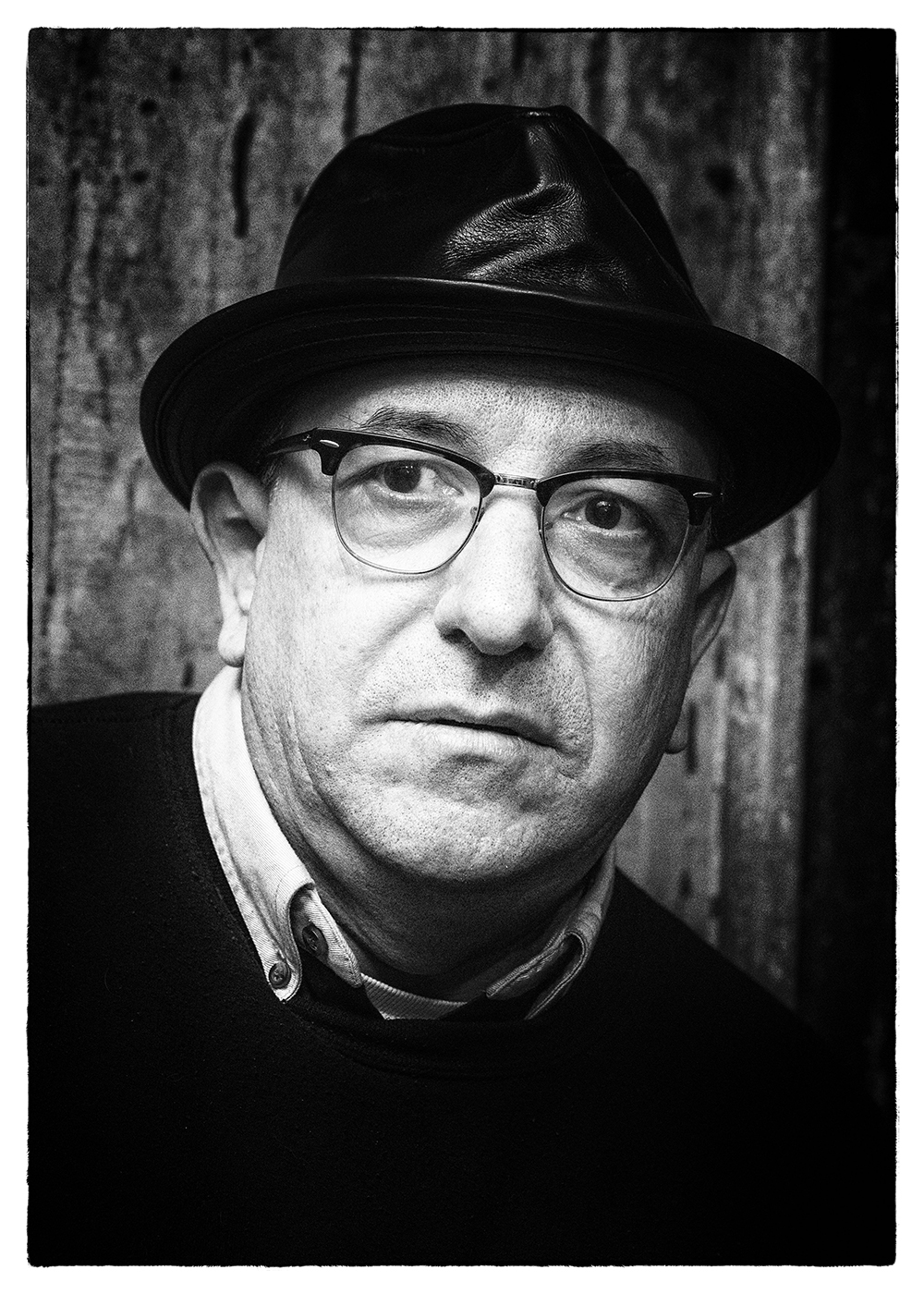
Grant, however, wasn’t interested in any of that. He was a storyteller, and he wanted to focus on his craft, not get bogged down in the world of the Net. I only knew Grant by reputation, as the longstanding fiction editor of the venerable North American Review, the longest continuously published literary journal in the country (in fact, my wife and I were in town for the magazine’s bicentennial celebration conference). I definitely wanted Grant and his work to be part of Twelve Winters Press, regardless of whether or not he had any interest in being a cyber warrior. Certainly, a vigorous Web presence can only help sales, but what matters to me most is the quality of the writing — and the quality of Grant’s writing wasn’t in question at all.
I went away from that conversation with a handshake agreement to bring out a new collection of stories (which evolved into Final Stanzas, released later that year in paperback and e-book, then, a bit later, as a unique audiobook). In the process of working on the project with Grant, I discovered he’d also written a detective novel (his first full-length novel). My curiosity piqued, I asked to see the manuscript, wherein I was introduced to Hayden Fuller, an ex-pro hockey player turned private eye, navigating the mean streets of 1960s Toronto (Grant’s true hometown).
It turned out that detective noir was Grant’s first love as a writer. We published Cheap Amusements, the debut Hayden Fuller Mystery, in 2016, and in the process unleashed a torrent of inspired prose from Grant, complex stories he’d been percolating for years apparently. Twelve Winters has just released the second Hayden Fuller Mystery, A Fourth Face (in hardcover, paperback and Kindle), and Grant has already delivered the third installment of the series, which we plan to bring out next year, while Grant is researching and writing the already outlined fourth book.
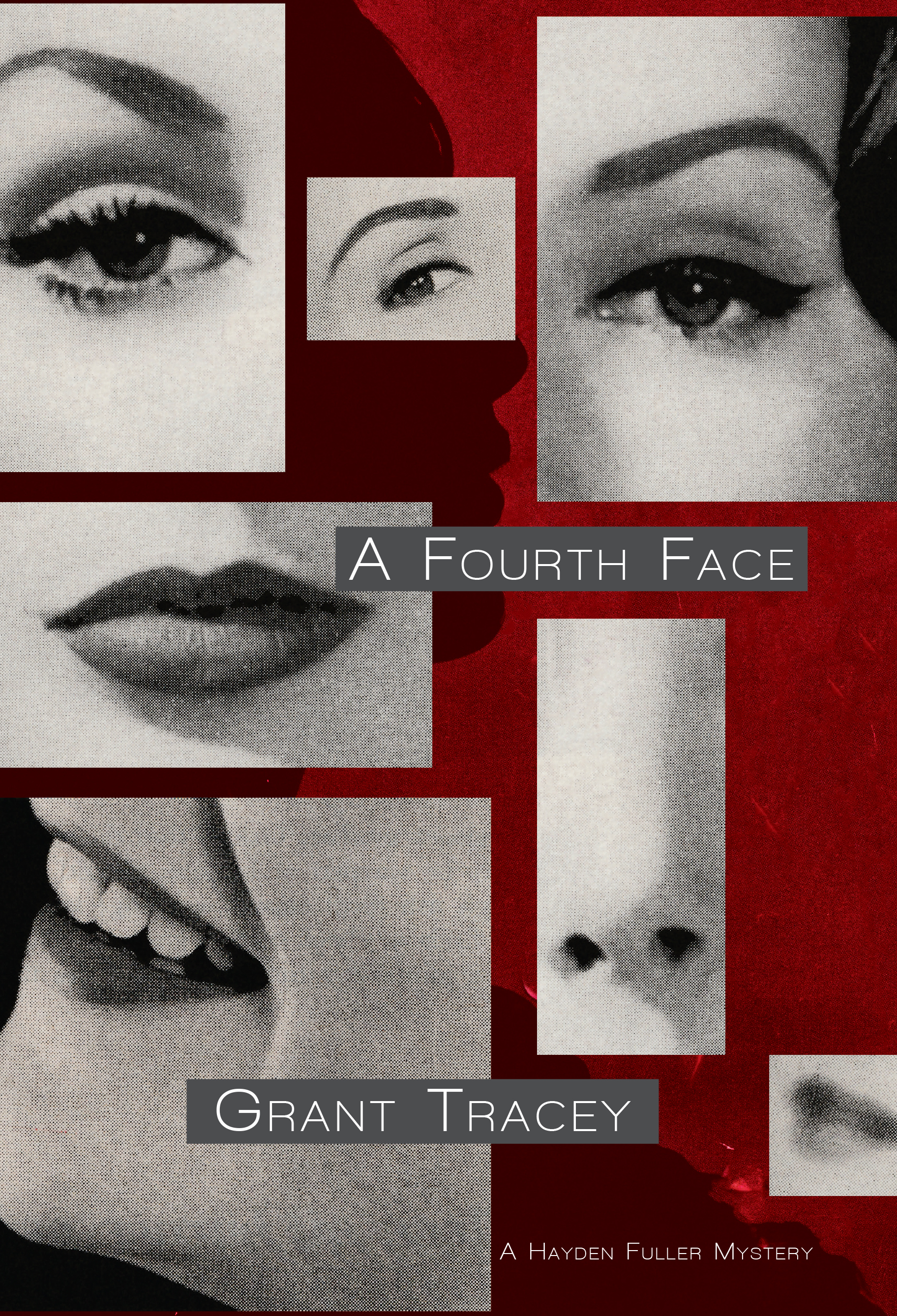
I coaxed Grant into slowing down the composing process long enough to answer a few questions about this newest release, and what follows are his thought-provoking and entertaining responses. (See also my interviews with Grant about Cheap Amusements and Final Stanzas; in addition, we published Grant’s memoir regarding the impetus of Hayden Fuller in an e-book, Toronto, 1965: Cheap Amusements’ Beat.)
Hayden Fuller is back in A Fourth Face. Trying to avoid any spoilers, what’s your protagonist up to in this new novel?
A former teammate, Bobby Ehle, is suspected of murdering his wife and asks Hayden for his help. Bobby has a history of domestic violence, but Hayden believes in the possibility of his innocence and takes the case. From there the trail takes him into a world of dangerous and experimental psychedelic drugs (the mind altering Red 45), quack doctors with their phony cosmetics and plastic surgeries, and a terrorist organization, N’oublie jamais, bent on destroying Expo 67. Hayden also goes on an inner journey, confronting for the first time, the traumas of his own past. The pace is quick, and the violence accelerates.
The title of the novel is a call back to Cheap Amusements and that novel’s exploration of the “third face,” an idea, first expressed by writer/director Samuel Fuller. He believed that we all have private and public faces, but also a third face, ones that we don’t even know we have until faced with trauma or extreme stress, like Fuller experienced on the battle lines in World War II. The third face is the repressed primordial impulse that we all carry. In A Fourth Face, reporter Stana Younger suggests that it, the fourth side of our complex selves, represses what the third side did, denying its culpability and reality. So if, Bobby, in third-face mode, did murder his wife, the fourth face denies what the third did, saying that the third face is not a part of the “real” Bobby Ehle.
Oh, a couple of footnotes. One: this novel, in part, was inspired by the opening of Raymond Chandler’s The Long Goodbye, where Terry Lennox asks Philip Marlowe to help him out of a possible “domestic jam.” Marlowe, in the Robert Altman film version, comes to discover that Lennox did kill his wife. Two: the Red 45 subplot is something Mickey Spillane might have concocted for a Mike Hammer thriller. No doubt, Spillane’s later Mike Hammer offering, Survival Zero, was an influence on A Fourth Face. Chandler and Spillane are among my favorite writers of crime noir.
I’m sure in the writing of this new Hayden Fuller Mystery you got to know Hayden even better. What did you learn about him? Was there anything especially surprising that you didn’t know before about your protagonist?
Two things. One, there’s a big reveal in the novel that I don’t want to give away, but that plot turn totally surprised me. Hayden came to me in a dream and told me about what had happened in his past, so I just had to work that into the book. It becomes a big part of the inner journey in Neon Kiss, and I think Hayden’s trauma helps explain the violence of the first book’s ending or “execution.” I didn’t feel that I needed to explain Hayden’s actions in Cheap Amusements, but this novel helps contextualize the debut novel’s final moments.
Second, I had no idea what was going to happen to Hayden’s relationship with Stana Younger (which seemed to be over at the end of Cheap Amusements), but relationships are complicated so I allowed the two characters to surprise me with where they were at, and where they were headed as friends, and as possible rekindled lovers. People, emotions, are complicated and I allowed for that messiness, muddy quality, to grab hold of me.
There’s a sensitivity, vulnerability to Hayden that is a part of me, and I guess as I keep writing him, taking risks, I’m surprised at how much I’m willing to explore and reveal of who he is, and in turn, who I am.
It seems like you’re really in the groove now writing about Hayden. You wrote A Fourth Face pretty quickly, and you’ve already completed a draft of the third Hayden Mystery, with plans for a fourth developing. My sense, then, is that you feel really comfortable with Hayden and the world you’ve created for him. How would you describe your comfort level with the characters and their world, and would you agree that the writing of the novels is coming along fairly easily at this point?
When you first suggested to me that with Cheap Amusements we had a series here and not just a one-off, I have to admit I was both extremely elated but also scared. Did I have it in me to continue to write not just this character but plots full of surprising twists, turns, and deceptions? But once I started writing the second novel (which I drafted in just under 40 days, writing every day) things just flowed and the fear went away. Hayden’s voice was overwhelming, there from the beginning, grabbing a hold of me. It’s me, but not me. Hayden’s a smart-ass, sensitive, and like Holden Caulfield, has little patience with phonies. The voice is a good fit with my sensibilities.
My writing style, for this series, is full of allusions. For example, Top Cop Sal Lambertino now wears suits instead of policeman blues, and Hayden describes his outfit as “Sloan Wilson grays,” a reference to a great novel, The Man in the Gray Flannel Suit. That’s part of Hayden’s voice, as is the short-jabs of sentences, the quirky one-liners, and the eyes tuned to psychological subtexts.
Stana Younger is also evolving into a character I really like. She’s tough, pragmatic, and fighting to make her way in the male-dominated field of reporting. After the first novel, she may have struck some readers as a femme-fatale, but such labels are too limiting. She’s a complex person who has made some bad decisions in the past, but she’s decent, caring, and committed to empowering the underdogs and outliers. She is also a great resource, with her police connections and fact-finding skills, providing Hayden with much needed information on each case. Sal is the no-nonsense, best friend, the state-sanctioned authority figure, a top cop. And the nattily-attired gangster Babe Migano also helps out Hayden, when it serves his interests. He is an underworld figure who straddles the line between genuine charm and menace. Migano is a cross between 1960s Rod Steiger and Jackie Gleason. If you can imagine that.
Do you feel Hayden is evolving organically, or are you having to coax his character along from time to time?
I never have to coax him. He always surprises me. I’m an impulse writer, comfortable with uncertainty, never knowing what will turn up next. But I trust in the process, my instincts, choices the characters make, that the journey we take will be a meaningful one. I begin with a plot outline and of course the big so what: who killed whom and why, but once the writing begins subplots emerge, side characters elbow their way on stage, and the novel takes me on a series of detours and highways I hadn’t expected to travel. The original plot outline changes dramatically.
I do know that I want each book to have a “hey wow” finish (like Dr. No’s island blowing up at the end of a Bond film), but I don’t pre-plan the shock ending. Somewhere on the journey, maybe three-fourths through, I see it and write toward it. Spillane, by contrast, often began his novels with the shock ending and then worked his way to find how to get there.
The goal is to entertain readers with a thriller, a good whodunit, but also to give them a lead character who is real and not just solving a crime but discovering in the process of detection who he is. The inner and outer stories.
On the one hand, you know a lot about Hayden and his world from your own experiences and interests—hockey, Toronto, the 1960s, etc.—but I’m sure some research or fact-checking is needed from time to time. Can you talk about how much research has gone into the writing of the books so far?
Crime books. As I mentioned before, I read the old masters: McBain, Chandler, Spillane, Thompson. I also admire John D. Macdonald, Richard Stark, Benjamin Black, and Max Allan Collins. Together they help inform, not so much an aesthetic, but a back drop of possibilities, contexts for my own writing in terms of plotting choices.
Movies. My fashion sense grows out of 60s fare: Honey West, The Green Hornet, Route 66, and Naked City. And any film with Paul Newman. Coolest cat ever.
Hockey books about the original six era. For A Fourth Face I read and re-read Roch Carrier’s Our Life with the Rocket; Benoît Malançon’s The Rocket: A Cultural History of Maurice Richard; and Jean Béliveau’s My Life in Hockey to contextualize 1955’s “The Richard Riot,” which is an important backstory to the N’oublie jamais movement in the novel. I also read Pierre Berton’s 1967 to get a greater appreciation for that year’s Expo in Montreal.
When Cheap Amusements came out in 2016 you were able to give several readings, some in your own backyard and others in Chicago and elsewhere. How did those readings go? How did people respond to Hayden Fuller and the book?
The readings are a lot of fun. I get into it, becoming all the characters, inhabiting their spaces, and I want to give the audience the best performance I have in me that night. I want them to enjoy the energy with which I write.
Fans of mysteries are pretty knowledgeable so when they ask me about influences on my work and I mention writers I admire they know who I’m talking about and they can make those connections. I think one of the things audiences respond to in my books is the comic touches to Hayden’s voice. They like his smart-ass asides, his use of cultural allusions, and his brand of not-so-subtle understatement.
People also like the plotting. They say it’s complex (in a good way) and full of surprising turns.
Moreover, audiences seem to like that Hayden is a former hockey player (at least when I read in hockey towns like Minnesota and Chicago that was the case). That wrinkle gives the book a different flavor. In the 1950s and 60s, William Campbell Gault wrote a series of detective novels featuring Brock (“the Rock”) Callahan, a former lineman for the Los Angeles Rams, who is now a private eye in the City of Angels. My series, in part, is inspired by his earlier series.
In addition to being a writer, editor, teacher (among other things), you’re also an experienced stage actor. How does your acting inform your presentations of Hayden, etc., when you give readings?
The keys to acting are empathy and authenticity. Placing yourself in the spaces inhabited by others and fully understanding, appreciating, without judging, where each character is coming from. Acting is also about keeping it simple and true. Direct, honest. That’s what I try to do in my writing, and that’s what I try to do when I read, inhabit every space. Ron Carlson, in his great book, Ron Carlson Writes a Short Story, says that direct dialogue is a place of genuine freedom; those are the spaces where characters exist outside the modulated voice of the writer. As a writer, when you engage in dialogue, you have to take on each character’s agendas: what they want and what they are willing to do to get it. Or maybe, I should say, you have to allow the characters to take you on surprising journeys. When they speak let them lead. Don’t fit them into a pre-defined agenda. Listen to what they have to tell you. And from there the plot will shift.
I’m also a big fan of the actorly beats. Those are the moment-to-moment choices an actor makes, following the impulses of the dialogue and what’s happening in the scene with his acting partner and within the play’s given circumstances. I’m always aware of beats when I read and let them spin me with surprises.
I also use a lot of beats in my writing. Not just in terms of shifts in dialogue, but I like, as did Ernest Hemingway, using brief descriptors, to create pauses, and thus increase the tension and psychological subtext of each moment. For example, two characters are talking and character A notices character B is chewing on her shirt collar. This is a beat. A pause. And it implies something within the given circumstances of the moment.
Tell us about the Gas Station Pulp Mystery series which you’ve started editing since the last time we talked (about Cheap Amusements).
It’s an imprint series of the North American Review Press that publishes a once-a-year crime novel. I love pulp fiction and the series blends that genre with the inner-directed drive of literary fiction. So I’m seeking character-driven pulp stories, loaded with action but also psychological nuance. Our first book in the series, Black Fin by Mary Frisbee, will be forthcoming soon. I’m currently reading material for our second Gas Station Pulp book.
Neon Kiss is the third Hayden Fuller Mystery (which the Press is planning to get out in 2019). What was your inspiration for the third book?
In the early 1980s I was visiting San Francisco and someone approached me on Geary Street and asked a bunch of questions, trying to figure out my faith (at the time I was an agnostic existentialist). Anyway, I made some disparaging comments about fundamentalists and how I couldn’t get behind their concept of a conditional God: receive my love if you do these things. My idea then was, if there is a God, he loves and accepts all. The fella really dug that comment and said something about how my idea of love fit right in with his church, and the notion of surrendering ourselves over to the way, giving up worldly things, and he invited me to attend a service that afternoon.
I thought about it. The fella had charisma. But, ultimately, I didn’t go. I was a bit freaked out to be honest with you. But I often wondered what would have happened to me if I did go? Would I have wound up in a commune somewhere? I know, I know. I’m sounding a little paranoid here, but a writer has to run with those imagined probabilities. That episode on Geary Street, in part, became the inspiration for the story.
Moreover, I wanted to tell a story about control. How people with dominant personalities and charismatic charm can control those who are less outgoing. At the heart of the novel is an abusive story: one sibling controlled by a megalomaniacal older sibling, who wants to “dismantle the universe,” and thus create his own reality. Twisted relationships of power I find endlessly interesting.
I’m sure at some level Dashiell’s Hammett’s The Dain Curse had a hand in my writing of Neon Kiss as does my fascination/repulsion with cults. John Buell’s The Pyx, in terms of subject matter and structure, was also an inspiration.
When I first drafted the novel, the young runaway woman, at the center of the story, was white. She falls into the cult and becomes the key to Hayden solving the double mystery (what happened to his father and who is behind the cult’s nefarious goings on). However, after visiting and being transformed by my experiences at the Canadian Museum for Human Rights in Winnipeg, Manitoba, in July 2017, I decided to make the young woman Métis. I was really struck with the injustices First Nations Peoples faced at the hands of the Canadian Government.
Throughout the 1950s, 60s, and 70s, if a native mom raised a child alone, there could possibly be a knock at her door and that child would be taken out of the biological mother’s home and raised by a white couple. This was so shocking to me (and don’t get me started on residential schools and natives being force to learn white laws and ways) that I was compelled to revise my novel and put a Métis presence at the center of it. Like I said, the visit to the museum was transformative. If you haven’t gone. Do so. I was inspired.
This theme of human rights injustice will be revisited in the fourth Fuller novel, Shot/Reverse-Shot.
And lastly, the novel is a continuation of what happens in A Fourth Face, and here Hayden further explores his troubled relationship with his father. That becomes the novel’s inner journey.
I know you have big plans for the fourth book—you’ve even landed a sabbatical to assist the writing of it. What can you tell us about that Hayden project?
It’s 1966. Hayden is back in the NHL with the Montreal Canadiens and he has just won the Stanley Cup. An independent film producer wants to make an indie film, sort of a sappy Canadian Disney thing, and uses several Habs players as extras, filming that year’s Stanley Cup final versus Detroit for footage in his film.
Danny Davis, a minor character in Cheap Amusements will be more prominently featured this time around. Stana Younger, now living with Hayden, and working for a Montreal newspaper will also be strongly featured.
However, back to the main plot line. The indie, hockey producer used to make graphic sexploitation films, stuff in the spirit of the Defilers, and although he’s trying to go all family friendly, his sexploitation chickens come home to roost, and after one of the stars of his film is murdered, a Habs player is blamed for the killing. Hayden, an extra on the film, tries to prove his pal’s innocence.
The journey takes him into a world of sexploitation film-making, First Nations People’s Land rights, and a badass motorcycle club, the Northern Arrows. The title, Shot/Reverse-Shot is double-voiced: a film term, but also indicative of bullets flying.
I’ll be living for four weeks in Montreal, spring 2019, to both write the novel and explore the city and spot locations for the novel’s main lines of action. It’ll be a big challenge for me. I know Toronto really well, but I’ve never been to Montreal before. It has been a long-time dream, going back to my days at Trent University and hearing friends from Montreal (Ivan LeCouvie and Dave Coons), regale me with stories about fountains, bistros, and St. Urbain’s Street. I’m really excited to soak up the culture. If ever so briefly.
But, alas, I’ll always be a Leafs fan.
It would appear Hayden Fuller is taking up just about all your creative writing energy. Is that true, or are you working on some other projects, too?
I’ve started to branch out. At first Hayden was taking up all my time. I was constantly reading other crime novels, detective series, to find inspiration for future Fuller novels.
It takes a lot of energy to write a novel, but the Fuller books have given me the courage to try writing longer works, one-offs, outside the Hayden series. I just finished drafting a stand-alone crime novel, Winsome, sort of modeled on Geoffrey Homes’s Build My Gallows High and William P. McGivern’s Odds Against Tomorrow in which a 36-year-old cab driver, living in Winsome, a small upstate New York town, is confronted with the demons of his past (a prior kidnapping case) and is thus blackmailed into returning to a life of crime (a bank heist). A former radio operator in Korea, Eddie Sands is a good person who has made bad choices. He also suffers from PTSD.
The story is set in 1966, seven years after a 1959 failed kidnapping case in which Eddie’s wife, Karen, double-crossed Eddie and his pal Sy, and led the police to the boy’s location. The child didn’t press charges because Eddie and Karen treated him so well. He claimed only Sy was involved in the kidnapping. Sy, who didn’t treat the kid so well, was captured, and in true gangland code, didn’t rat the other two out. Eddie and Karen have taken on new last names and now live in relative anonymity. She’s a waitress. Together they share a home in a trailer park.
I had my good friend Mitchell D. Strauss read it (he also shoots my author photos for the Hayden Fuller series), and he gave me some really great revision strategies that I’m going to adopt over the next four months. Hopefully by Thanksgiving, I’ll have the new, improved Winsome ready to shop around.
Recently, I’ve also tried my hand at writing short crime stories. “Sun on Prospect Street, 1938” is a 1900-word hit men story inspired by an Edward Hopper painting hanging at the Cincinnati Art Museum. The painting made me think of two people sitting in a car, looking at an empty street, preparing to do what they have to do. It’s a humdinger!
Is there anything else you’d like to share?
I’m just grateful for the opportunity to write what has always been a passion of mine: detective stories. I began writing my first stories in high school, featuring Rick Dragon, Cleveland’s toughest private eye (I’d never been to Cleveland, but the rust-belt town appealed to my love of grime and the smell of dust and dirt). Story titles such as “Accidents Will Happen” (I was a huge Elvis Costello fan back then) and “It All Makes a Lot of Sense” tells you all you need to know. In my MA workshops, I wrote literary fiction and detective stories (as a matter of fact, mobster Babe Migano first appears in a story I wrote way back in the fall of 1984. I think it was called “Find the Girl.”).
However, in workshops, I was often made to feel that detective fiction was less than, that I should be aspiring to write a story worthy of inclusion in an O. Henry Award anthology. My work was taken to be highly stylized and labeled “parody.” What, really? Parody. Come on, now. Raymond Chandler’s not a parodic writer. Neither am I.
We’re both stylized writers, but not parodic. Chandler sought to be the F. Scott Fitzgerald of crime fiction. There are a lot of links between Farewell My Lovely and the Great Gatsby: the yearning for an irretrievable past; a man searching for his lost love; the doomed romanticism of the narrative voice. Anyway, in such a workshop environment, I shoveled my love of crime detection under smoldering leaves, but it was always there, hiding around the edges of my literary stories.
In 2008 the landscape shifted and genre hybridization became more and more apparent in the world of literary publishing, as stories borrowed from speculative camps and you saw a host of literary hyphenates. I’m not a postmodernist writer. I’m a high modernist; however, not to give away any spoilers, I do, at the end of A Fourth Face, deconstruct, or at least, gray up the binaries, of the classic Mickey Spillane ending: Mike Hammer rescuing a badly beaten and tied-up Velda from a gang of communists or degenerates or communist degenerates if you like.
Anyway, for the first time in my life, I feel like I’m really writing what I love and I thank you, Ted, and Twelve Winters for allowing me to pursue what got me into writing in the first place. As Sam Spade toasts in The Maltese Falcon: “Success. To crime!”
Grant Tracey is an English professor at the University of Northern Iowa, where he teaches film and creative writing, and has been the fiction editor of the North American Review for over seventeen years. He has published nearly fifty short stories, four collections of fiction, and articles on Samuel Fuller and James Cagney. His collections are Final Stanzas, Lovers & Strangers, Parallel Lines and the Hockey Universe, and Playing Mac: A Novella in Two Acts, and Other Scenes. In 2016 Grant published his debut crime novel, Cheap Amusements, the first Hayden Fuller Mystery. Thrice nominated for a Pushcart Prize, Grant was the recipient of an Iowa Regents Award for Faculty Excellence in 2013. In addition to his writing, editing and teaching, Grant has acted in over thirty community theater productions. (Author photo by Mitchell D. Strauss)
An Interview with John Paul Jaramillo: Little Mocos
I’ve known John Paul Jaramillo for several years. Shortly after my first novel, Men of Winter, came out, John Paul interviewed me for a video journal that he edited. He also had a book out, a collection of stories titled The House of Order (Anaphora Literary Press, 2011), which, I discovered, had garnered John Paul much praise and several accolades. Fast forward to, I believe, 2014. John Paul shared with me a manuscript for a book he’d spent quite a bit of time writing and revising (and revising). It was a novel of sorts, comprised of more than thirty interconnected stories and vignettes, a complex family saga that unfolded over decades and multiple generations.
John Paul’s main interest was getting my feedback on the manuscript. I had relied on John Paul’s opinion and expert eye more than once, sharing my own work with him as well as work by some of the authors I was publishing via Twelve Winters Press. I was interested in doing more than giving him feedback on his book; I very much wanted to publish it. I think he was genuinely surprised. We were having coffee at Wm. Van’s Coffee House in Springfield, Illinois. It was summertime so we both had a bit more time on our hands than we normally would during the academic year. We sat there over our coffees talking for a long while.
My sense was that John Paul had worked on the book for so long and had received so much advice, so many critiques, he wasn’t sure any longer quite what he wanted the book to be. So I asked him to take a few months, perhaps enough time to let some of that advice fade away, and figure out exactly what he wanted to publish. The book did go through some changes, including a title change, before he submitted the more or less final version of the manuscript, which I then assigned to one of the Press’s talented and dedicated editors, Pamm Collebrusco, who worked with John Paul to finalize (now) Little Mocos for publication.
I fell behind the publishing schedule I’d hoped to adhere to, but John Paul was consummately patient. We finalized a book cover this past winter; then this summer we were able, at long last, to make available to the world Little Mocos, a novel in stories, available in hardcover and digital editions.

It’s become a tradition that when I publish an author’s work, I also give them some interview questions. What follows are John Paul’s unedited responses.
My sense is that Little Mocos had a long gestation. When you and I first discussed the manuscript it had a different title, and you talked about a few incarnations of the text. Would you talk about the writing and development of the book?
I’ve been working on this particular book Little Mocos and a grouping of stories for five years I believe. I have always known my writing process is incredibly slow and meandering. I often say it is a mis-perspective that writers have an ease with words and language, because I feel it is the opposite—writers struggle to capture the right words and structure. I have an idea and I like to give myself the time to follow that idea and see where the language or my thoughts take me. I don’t think I am the kind of writer who just sits and executes the outline, premise or story—I have to take time and find the story arc and premise and find the surprises. I have to think and re-think and find the ideas rather than drive them. Also I think I am the kind of writer that is always looking for the better angle into the story in terms of means of perception. So there are drafts on my computer in third person and first person and just different experiments to find the right way to approach the stories I want to tell. Drafts that include or exclude different characters. Fragments that fail and fragments that succeed. Writing and drafting a book is incredibly difficult, and taming that and coming to terms with that takes a long while. Also an editor friend and mentor of mine Jennifer C. Cornell has given me advice and guidance to tweak the book to the current organization. I always need help and I am always second-guessing the manuscript as well as my choices.
At one point you were calling the book “a novel” and then altered that to “a novel in stories.” As a writer I’ve been struggling a bit with those labels myself on a particular project. What do you think the difference is, and why did you ultimately decide on the latter label?
 I feel as though I work in a way to send stories out to get feedback from editors. So my work is intentionally worked out in bite-size chunks. Also I think I am a minimalist so always trying to do more with less. And most publications or lit websites I admire are looking for short pieces—one needs to be a bit more experienced and known for a novel excerpt I believe. I usually label something a short story rather than a chapter though I believe a chapter and a short story are similar in many ways—they both have a beginning, middle and end. I also seem to float back to the same “universe” of characters and that keeps them together. I often say the material comes how it comes and I follow it. I hear stories or read stories about Colorado and just try and get them re-imagined and down into bite-size chunks for publication. I’ve always advised my students to create relationships with editors who publish similar work and I’ve tried to submit and gather feedback from Latino lit publications to help with revision and these aesthetic choices. I guess simply the label “novel-in-stories” or “composite novel” or even “novella” comes back to the writer’s decisions and style.
I mean I’ve always known I have a sort of disjointed sort of style. I have always written smaller stories following the same characters, and I’ve always felt these smaller stories as “complete and autonomous.” Interrelated enough yet at the same time creating a complete whole. Creating a story arc the way a novel would. And I’ve never liked fiction too on-the-nose. I like a rougher feel to the writing. Like punk music or something. But as it comes down to the wire on revisions and I get closer and closer to turning over the manuscript to the publisher I struggle with labeling the work a novel-in-stories, composite novel or just plain stories as well. Making decisions is difficult.
The one guiding organizational principle to the book is thematic but also follows the same characters and quite nearly stays in a similar place. The family I am writing about has a family tree that is broken and winding and shattered and so the structure should mirror that. Astillarse, one character describes in the book, or splintered.
My book features a composite structure from what Chapter 1 from The Composite Novel—a book I read once by Margaret Dunn and Ann Morris—classifies as the following: Setting—(all my work takes place in the old neighborhood); Protagonist—I follow the Ortiz family; Collective protagonist–the family and neighborhood in different time periods and perspectives; Pattern/patchwork—identical or similarly themed stories focusing on trouble, problems, work/joblessness, etc.
I know some of the elements of the book, for example the character Cornbread Vigil, are pulled directly from history, while others, I presume, are purely fictional. In your writing process how did you negotiate history and fiction, and I suppose those gray areas in between?
Cornbread Vigil is a character based on a man named Ray Baca who is pretty infamous in Colorado—his name appeared in the newspaper quite often. He was a local criminal from my old neighborhood of Pueblo, Colorado, who folks often talked about. Mostly they talked about how they were afraid of him. My Grandfather talked about him since he robbed some local places. He was a person who had multiple crimes attached to him and he was the kind of person who always seemed to get out of trouble—petty crimes and thefts. He became somewhat of a local infamous character but also a weird folk hero/character. In my mind he represents the complex place I was raised and also the moral problem young Latino males perhaps face growing up. The violent expression that is sometime nurtured. I had so few literary or teacher heroes growing up but my heroes were “around-the-way” kinds of heroes at least when I was very young.
I think in much of my writing I try to take these stories from the paper and try to imagine or re-imagine them. To try and make sense of them, especially the darker or the more senseless stories. It felt as if this Baca criminal was from the same place I was from and I always found that to be very interesting. He always represented the myths and flavor of Colorado, and I wanted to re-create and re-imagine his story and how it merged with some of my own family.
You and I have discussed some of the difficulties presented by using Spanish and Spanish slang in the text, particularly when it came to dealing with editors and finding a publisher. Could you discuss some of the issues that you encountered?
I try to create relationships with Latino lit publications—with editors more sympathetic to the use of Spanish in a manuscript. This seems to be a very American issue. I always try to write the way folks talk in Southern Colorado and they speak Spanish and I guess Spanglish would be the term. A blending of Spanish and English—incorrect Spanish and incorrect English. But I have a collection of emails and responses from editors who were pretty aggressive in wanting me to take out the Spanish or to make the stories somewhat of a caricature of how folks speak in Colorado. Perhaps it was my fault for not knowing the publication well enough. There are so few Latino publications. I guess I want to represent but not sell-out anyone from my old neighborhoods.
Also though there is a professional dimension where Latinos who speak fluent Spanish will question my decision to omit or to use italics with Spanish in the stories. One writer I admire has Spanish italicized in all of his work and yet criticized me for my decision to italicize in my last publication. The idea being the language is not foreign so one shouldn’t italicize it. Until only recently I have become confident enough to edit what I choose in my own manuscripts and fight for more of my aesthetic choices. I see the whole problem as just working with presses who are sympathetic or understanding of these representation issues or not. I’ve received complaints from some editors and emails from some readers who say I’ve captured the way folks in Colorado speak accurately. So perhaps this is also an issue of representation of place as well as representation of the Spanish language in stories.
Little Mocos covers similar territory to your first book, The House of Order. In fact, one of the stories in Little Mocos is titled “House of Order.” How do these projects connect? In what ways does Little Mocos extend or perhaps complicate some of the elements in The House of Order?
The House of Order was a collection of stories published in differing publications and collected in somewhat of a linear narrative structure though missing quite a bit of backstory to the families and relationships. Little Mocos is the fuller story. Readers of The House of Order didn’t read it as a collection of stories but read it as a novel and this book is the novel bringing in many similar stories that have been tweaked to act as a portion of a larger story rather than to just act as a standalone story. There is more time and room to explore the family and legacy only hinted at, I think, in the collection of short pieces. I wanted to tell the fuller and larger trajectory of the story here. I very much see this novel as a continuation and sequel of sorts to that earlier book.
Little Mocos is divided into six parts which vary considerably in terms of length. What was your organizing principle in determining how to fit the various stories together? Ultimately do you feel satisfied with the structure of the book, or is there anything that still nags at you in the middle of the night?
I have a hard time telling a linear story. Also like many other writers, Leslie Marmon Silko as the greatest influence on me, I wanted to tell a story that was not linear but more at liberty with the timeline. The timeline or the structure is circular almost. Later in the book the narrator is criticized for overly thinking on past events in the story and I think that is similar to me. I am drawn to family stories and family history and my mind is rarely in the moment but racing in time to backstory and I wanted that feel in the book. I like to recreate moments of simply sitting and recounting the past. I am not so much interested in linear stories, I guess, but stories that represent the complexity of past and present relationships. I feel that I carry my family with me and the movement in time from section to section is my way to recreate that in the structure. Also I am more and more interested in this idea of legacy and family spirits that mold an individual. I feel I carry my Uncle and Father who have passed away with me in my everyday decision-making as well as in the genetic similarity of appearance and personality. Family trauma is always at the heart of my stories and the stories I like to read and so again this is my way of re-creating that familial dimension to a daily life.
I do very much feel satisfied with the structure though I’m drafting new stories all the time I wish could’ve found their way into the final manuscript—drafts that fill-in certain characters’ back story. I’m always drafting and note-taking on the Bea character and the Tio Neto character though I know they won’t find their way into the fuller story because of deadlines for turning in drafts. I guess what keeps me up would be exploring more stories with these characters and including all of them in one manuscript.
I know your teaching takes up a lot of time and energy. How do you balance teaching and writing? How does teaching and working with your students inform and energize your writing?
I teach composition and literature and I keep a blog on teaching and writing, so this is something I think all writers who work in schools may struggle with—the balance of time. I teach many classes to pay the bills and also teach creative writing. And I think all of my classes represent my thinking about the written word and also books I admire. I think as a writer I am perhaps a bit more skilled to teach about form or structure of writing as well as meaning. I have an MFA in creative writing instead of an MA or PhD and so I feel I might speak differently about writing and reading than say someone who studied literary criticism theory. I often say I have a degree in writing rather than in the study of writing since I see myself as a creative writer first and foremost, rather than as a researcher, teacher, or critic. Writers rarely think about meaning or theme and yet most classes and most instructors lecture on dominant themes and dominant interpretation, and I am more interested in how the writer or the character is represented in the work. I think there is a large distinction between what a work is saying and how the work is constructed. As a writer I am rarely thinking about what I am trying to say and more and more interested in how to construct a more dynamic experience for the reader. I like the idea that perhaps I can bring a different perspective on writing as a writer than say a lit scholar.
Other than finalizing Little Mocos for publication by the press, you’ve been done with the book for quite awhile. What else have you been working on? Is writing fiction your only interest, or have you explored other modes of writing?
Little Mocos in many ways is a love letter to my father’s side of my family. The last story in the book is about my mother’s family. While Little Mocos is an entire book about my father and his relationship to his brother and father, I have a whole manuscript of material I’ve been working on that follows the relationship between my mother and her father. Again I am interested in family legacy and family trauma. This manuscript is tentatively titled Monte Stories or Mountain Stories as my mother’s side of the family is from the San Luis Valley in Colorado and that is where most of these stories take place. I am more and more obsessed with my mother’s father and his life in the San Luis Valley. Recently I’ve had a story from this manuscript featured at La Casita Grande Lounge—a website for Chicano and Latino literature. I have a good dozen of these stories I am slowly hoping to build into another book taking place in the same Colorado universe of characters.
I have also been working on a collection of creative non-fiction essays. Most of my favorite fiction writers are also my favorite essayists. I hope to turn more of my blog post son teaching and writing and on the Colorado steel industry into essays. I am also hoping to write more memoir-styled essays. Essays that read as short stories but driven more by facts. I have always written little fragments of reviews and recounting of experiences on my blog and I hope to conduct more interviews and also gather more of these essays for a non-fiction collection. I am interested in the steel industry in Colorado and its history as well as the subject of being a Latino male in the teaching profession.
John Paul Jaramillo’s stories and essays have appeared in numerous publications, including The Acentos Review, PALABRA: A Magazine of Chicano and Latino Literary Art and Somos en Escrito. In 2013 his collection The House of Order was named an International Latino Book Award Finalist. In 2013 Latino Boom: An Anthology of U.S. Latino Literature listed Jaramillo as one of its Top 10 New Latino Authors to Watch and Read. Originally from Colorado, he lives in Springfield, Illinois, where he is a professor of English at Lincoln Land Community College. (Author photo by Polly Parsons)

 12 Winters Blog
leave a comment