The Loss of Intellect by Ted Morrissey
I appreciate NAR’s invitation to contribute to its blog.


My review of William H. Gass’s novel Middle C for NAR was a warm-up for a longer critical paper that I’ll present at the Louisville Conference on Literature and Culture Since 1900, and in preparing to write that paper I re-read several of Gass’s essays and interviews, including an interview from 1995 that was published in the Hungarian Journal of English and American Studies 3.1 (1997), and reprinted in Conversations with William H. Gass (2003), edited by Theodore G. Ammon.
The interviewer, Idiko Kaposi, asked Gass his view on emerging (mid-90s) technologies and how they would affect writing, reading, and ultimately, thinking. As a teacher, mainly of eighteen-year-olds, looking back at Gass’s remarks from nearly two decades ago, I find his insights disturbingly accurate. Gass, besides being an award-winning novelist and literary critic, was also a professor of philosophy at Washington University in St. Louis, since retired.
Gass suspected that the…
View original post 487 more words
Anthology released by Twelve Winters Press
I’m pleased to report that [Ex]tinguished & [Ex]tinct: An Anthology of Things That No Longer [Ex]ist was released last week by Twelve Winters Press, which I founded in 2012. The anthology is a collection of poems, prose poems and flash fiction all dealing with the theme of extinguished and extinct, from animals to plants to languages to eras, and much, much more. The anthology was edited, and in fact the project was directed, by John McCarthy, with much support from the Press’s associate editor Pamm Collebrusco.

John and Pamm received thousands of submissions last fall and eventually narrowed it down to work by 37 writers and poets from the US, Canada, United Kingdom, Australia and Singapore: Elmaz Abinader, Majnun Ben-David, Lauren Camp, Jennifer Clark, Rebecca Clever, Susan Cohen, Meg Eden, Frances Gapper, Damyanti Ghosh, John Gosslee, Laura Hartenberger, Parul Kapur Hinzen, Daniel Hudon, Douglas Jackson, Zeke Jarvis, Amanda Larson, Christina Lovin, Mark McKain, Sarah Fawn Montgomery, Elizabeth Deanna Morris, Travis Mossotti, Ezra Olson, Lynn Pedersen, Cindy Rinne, Matt Rotman, Freya Sachs, Susan Sailer, Danielle Sellers, Mary Senger, M.E. Silverman, Judith Skillman, Darren Stein, Ursula Villarreal-Moura, J. Weintraub, Lenore Weiss, Laurelyn Whitt, and Lee Tyler Williams.
I had nothing to do with selecting the work and in fact didn’t read the pieces until they were already laid out in the proof of the anthology. Perhaps I’m biased, but I was pleasantly surprised at just how exceptional the work is. It’s literary and accessible, and provides incredible variety in both focus and form. The link above is to the anthology on Amazon; however, it’s available from a growing list of global sellers, including Barnes & Noble and Espresso Book Machine. Check the Poetry Titles page at the Twelve Winters Press site for a complete list (which will be expanding daily for a while).
Currently only the print edition of the anthology is available. We’re working on digital editions (complexly structured poetry and e-readers are not always happy bedfellows, so it’s taking longer to get the digital editions out than we’d hoped — but we want them to be as readable as possible and to do justice to the original work).
My thanks to John and Pamm, and also to my partner in all things, Melissa Sievers, for her support and assistance, especially with mailing out the anthology copies to contributors.
Keep an eye on Twelve Winters Press as we have several exciting things in the works, including J.D. Schraffenberger’s forthcoming poetry collection, The Waxen Poor, with a tentative release date in August. Follow the Press @twelvewinters.
Not speaking about Danielson Framework per se, but
Sir Ken Robinson has several TED Talks regarding education, and his “How to Escape Education’s Death Valley” is an especially appropriate follow-up to my last post about the Danielson Group’s Framework for Teaching Evaluation Instrument. Robinson, who is very funny and engaging, doesn’t reference Charlotte Danielson and her group per se, but he may as well. The Danielson Group’s Framework, which has been adopted as a teacher evaluation instrument in numerous states, including Illinois, is emblematic — in fact, the veritable flagship — of everything that’s wrong with education in America, according to Robinson.
Treat yourself to twenty minutes of Robinson’s wit and wisdom:
Fatal flaws of the Danielson Framework
The Danielson Group’s “Framework for Teaching Evaluation Instrument” has been sweeping the nation, including my home state of Illinois, in spite of the fact that the problems with the Group, the Framework, the Instrument, and even Ms. Danielson herself are as obvious as a Cardinals fan in the Wrigley Field bleachers. There have already been some thorough critiques of the Danielson Group, its figurehead, the Framework, and how it’s being used destructively rather than constructively. For example, Alan Singer’s article at the Huffington Post details some of the most glaring problems. I encourage you to read the article, but here are some of the highlights:
[N]obody … [has] demonstrated any positive correlation between teacher assessments based on the Danielson rubrics, good teaching, and the implementation of new higher academic standards for students under Common Core. A case demonstrating the relationship could have been made, if it actually exists.
[I]n a pretty comprehensive search on the Internet, I have had difficulty discovering who Charlotte Danielson really is and what her qualifications are for developing a teacher evaluation system … I can find no formal academic resume online … I am still not convinced she really exists as more than a front for the Danielson Group that is selling its teacher evaluation product. [In an article archived at the Danielson Group site, it describes the “crooked road” of her career, and I have little doubt that she’d be an interesting person with whom to have lunch — but in terms of practical classroom experience as a teacher, her CV, like most educational reformers’, is scant of information.]
The group’s services come at a cost, which is not a surprise, although you have to apply for their services to get an actual price quote. [Prices appear to range from $599 per person to attend a three-day workshop, $1,809 per person to participate in a companion four-week online class. For a Danielson Group consultant, the fee appears to be $4,000 per consultant/per day when three or more days are scheduled, and $4,500 per consultant/per day for one- to two-day consultations (plus travel, food and lodging costs). There are fees for keynote addresses, and several books are available for purchase.]
As I’ve stated, you should read Mr. Singer’s article in its entirety, and look into the Danielson Group and Charlotte Danielson yourself. The snake-oil core of their lucrative operation quickly becomes apparent. One of the chief purposes of the Danielson Framework, which allegedly works in conjunction with Common Core State Standards, is to turn students into critical readers who are able to dissect text, comprehending both its explicit and implicit meanings. What follows is my own dissection of the “Framework for Teaching Evaluation Instrument” (2013 edition). For now, I’m limiting my analysis to the not quite four-page Introduction, which, sadly, is the least problematic part of the Framework. The difficulties only increase as one reads farther and farther into the four Domains. (My citations refer to the PDF that is available at DanielsonGroup.org.)
First of all, the wrongheadedness of teacher evaluation
Before beginning my dissection in earnest, I should say that, rubrics aside, the basic idea of teacher evaluation is ludicrous — that sporadic observations, very often by superiors who aren’t themselves qualified to teach your subject, result in nothing especially accurate nor useful. As I’ve blogged before, other professionals — physicians, attorneys, business professionals, and so on — would never allow themselves to be assessed as teachers are. For one thing, and this is a good lead-in to my analysis, there are as many styles of teaching as there are of learning. There is no “best way” to teach, just as there is no “best way” to learn. Teachers have individual styles, just as tennis players do, and effective ones know how to adjust their style depending on their students’ needs.
But let us not sell learners short: adjusting to a teacher’s method of delivery is a human attribute — the one that allowed us to do things like wander away from the Savanna, learn to catch and eat meat, and survive the advance of glaciers — and it is well worth fine tuning before graduating from high school. I didn’t attend any college classes nor hold any jobs where the professor or the employer adjusted to fit me, at least not in any significant ways. Being successful in life (no matter how one chooses to define success) depends almost always on one’s ability to adjust to changing circumstances.
In essence, forcing teachers to adopt a very particular method of teaching tends to inhibit their natural pedagogical talents, and it’s also biased toward students who do, in fact, like the Danielsonesque approach, which places much of the responsibility for learning in the students’ lap. Worse than that, however, a homogenous approach — of any sort — gives students a very skewed sense of the world in which they’re expected to excel beyond graduation.
In fairness, “The Framework for Teaching Evaluation Instrument” begins with a quiet little disclaimer, saying in the second sentence, “While the Framework is not the only possible description of practice, these responsibilities seek to define what teachers should know and be able to do in the exercise of their profession” (3). That is, there are other ways to skin the pedagogical cat. It’s also worth noting that the Danielson Group is seek[ing] to define — it doesn’t claim to have found The Way, at least not explicitly. Nevertheless, that is how untold numbers of legislators, reformers, consultants and administrators have chosen to interpret the Framework. As the Introduction goes on to say, “The Framework quickly found wide acceptance by teachers, administrators, policymakers, and academics as a comprehensive description of good teaching …” (3).
Teachers, well, maybe … though I know very, very few who didn’t recognize it as bologna from the start. Administrators, well, maybe a few more of these, but I didn’t hear any that were loudly singing its praises once it appeared on the Prairie’s horizon. Academics … that’s pretty hard to imagine, too. I’ve been teaching high-school English for 31 years, and I’ve been an adjunct at both private and public universities for 18 years — and I can’t think of very many college folk who would embrace the Danielson Framework tactics. Policymakers (and the privateer consultants and the techno-industrialists who follow remora-like in their wake) … yes, the Framework fits snugly into their worldview.
Thus, the Group doesn’t claim the Framework is comprehensive, but they seem to be all right with others’ deluding themselves into believing it is.
The Framework in the beginning
The Introduction begins by explaining each incarnation of the Framework, starting with its 1996 inception as “an observation-based evaluation of first-year teachers used for the purpose of licensing” (3). The original 1996 edition, based on research compiled by Educational Testing Service (ETS), coined the performance-level labels of “unsatisfactory,” “basic,” “proficient,” and “distinguished” — labels which have clung tenaciously to the Framework through successive editions and adoptions by numerous state legislatures. In Illinois, the Danielson Group Framework of Teaching is the default evaluation instrument if school districts don’t modify it. Mine has … a little. The state mandates a four-part labeling structure, and evaluators have been trained (brainwashed?) to believe that “distinguished” teachers are as rare as four-leaf clovers … that have been hand-plucked and delivered to your doorstep by leprechauns.
In my school, it is virtually (if not literally) impossible to receive a “distinguished” rating, which leads to comments from evaluators like “I think you’re one of the best teachers in the state, but according to the rubric I can only give you a ‘proficient.'” It is the equivalent of teachers telling their students that they’re using the standard A-B-C-D scale, and they want them to do A-quality work and to strive for an A in the course, but, alas, virtually none of them are going to be found worthy and will have to settle for the B (“proficient”): Better luck next time, kids. Given the original purpose of the Framework — to evaluate first-year teachers — it made perfect sense to cast the top level of “distinguished” as all but unattainable, but it makes no sense to place that level beyond reach for high-performing, experienced educators. Quite honestly, it’s demeaning and demoralizing — it erodes morale as well as respect for the legitimacy of both the evaluator and the evaluation process.
Then came (some) differentiation
The 2007 edition of the Framework, according to the Introduction, was improved by providing modified evaluation instruments for “non-classroom specialist positions, such as school librarians, nurses, and counselors,” that is, people who “have very different responsibilities from those of classroom teachers”; and, as such, “they need their own frameworks, tailored to the details of their work” (3). There is no question that the differentiation is important. However, the problem is that it implies “classroom teacher” is a monolithic position, and nothing could be further from the truth. Thus, having one instrument that is to be used across grade levels, ability levels, not to mention for vocational, academic and fine arts courses is, simply, wrongheaded.
As any experienced teacher will tell you, each class (each gathering of students) has a personality of its own. On paper, you may have three sections of a given course, all with the same sort of students as far as age and ability; yet, in reality, each group is unique, and the lesson that works wonderfully for your 8 a.m. group may be doomed to fail with your 11 a.m. class, right before lunch, or your 1 p.m. after-lunch bunch — and on and on and on. So the Danielson-style approach, which is heavily student directed, may be quite workable for your early group, whereas something more teacher directed may be necessary at 11:00.
Therefore, according to the Danielson Group, I may be “distinguished” in the morning, but merely “proficient” by the middle of the day (and let us not speak of the last period). The evaluator can easily become like the blindman feeling the elephant: Depending on which piece he experiences, he can have very different impressions about what sort of thing, what sort of teacher, he has before him. Throw into the mix that evaluators, due to their training, have taken “distinguished” off the table from the start, and we have a very wobbly Framework indeed.
Enter Bill and Melinda Gates
The 2011 edition reflected revisions based on the Group’s 2009 encounter with the Bill and Melinda Gates Foundation and its Measures of Effective Teaching (MET) research project, which attempted “to determine which aspects of a teacher’s practice were most highly correlated with high levels of student progress” (4). Accordingly, the Danielson Group added more “[p]ossible examples for each level of performance for each component.” They make it clear, though, that “they should be regarded for what they are: possible examples. They are not intended to describe all the possible ways in which a certain level of performance might be demonstrated in the classroom.” Indeed, the “examples simply serve to illustrate what practice might look like in a range of settings” (4).
I would applaud this caveat if not for the fact that it’s embedded within an instrument whose overarching purpose is to make evaluation of a teacher appear easy. Regarding the 2011 revisions, the Group writes, “Practitioners found that the enhancements not only made it easier to determine the level of performance reflected in a classroom … but also contributed to judgments that are more accurate and more worthy of confidence” (4-5). Moreover, the Group says that changes in the rubric’s language helped to simplify the process: “While providing less detail, the component-level rubrics capture all the essential information from those at the element level and are far easier to use in evaluation than are those at the element level” (4).
I suspect it’s this ease-of-use selling point that has made the Framework so popular among policymakers, who are clueless as to the complexities of teaching and who want a nice, tidy way to assess teachers (especially one designed to find fault with educators and rate them as average to slightly above average). But it is disingenuous, on the part of Charlotte Danielson and the Group, to maintain that a highly complex and difficult activity can be easily evaluated and quantified. In a 2012 interview, Ms. Danielson said that her assessment techniques are “not like rocket science,” whereas “[t]eaching is rocket science. Teaching is really hard work. But doing that [describing what teaching “looks like in words”] isn’t that big a deal. Honestly, it’s not. But nobody had done it.”
It’s downright naive — or patently deceptive — to say that a highly complex process (and highly complex is a gross understatement) can be easily and simply evaluated — well, it can be done, but not with any accuracy or legitimacy.
Classic fallacy of begging the question
I want to touch on one other inherent flaw (or facet of deception) in the Danielson Framework and that is its bias toward “active, rather than passive, learning by students” (5). Speaking of the Framework’s alignment with the Common Core, the Group writes, “In all areas, they [CCSS] place a premium on deep conceptual understanding, thinking and reasoning, and the skill of argumentation (students taking a position and supporting it with logic and evidence).” On the one hand, I concur that these are worthy goals — ones I’ve had as an educator for more than three decades — but I don’t concur that they can be observed by someone popping into your classroom every so often, perhaps skimming through some bits of documentary evidence (so-called artifacts), and I certainly don’t concur that it can be done easily.
The Group’s reference to active learning, if one goes by the Domains themselves, seems to be the equivalent of students simply being active in an observable way (via small-group work, for example, or leading a class discussion), but learning happens in the brain and signs of it are rarely visible. Not to get too far afield here, but the Framework is intersecting at this point with introverted versus extroverted learning behaviors. Evaluators, perhaps reflecting a cultural bias, prefer extroverted learners because they can see them doing things, whereas introverted learners may very well be engaged in far deeper thinking, far deeper comprehension and analysis — which is, in fact, facilitated by their physical inactivity.
And speaking of “evidence,” the Introduction refers to “empirical research and theoretical research” (3), “analyses” and “stud[ies]” (4) and to “educational research” that “was fully described” in the appendix of the 2007 edition (3), but beyond this vague allusion (to data which must be getting close to a decade old) there are no citations whatsoever, so, in other words, the Danielson Group is making all sorts of fantastic claims void of any evidence, which I find the very definition of “unsatisfactory.” This tactic, of saying practices and policies are based on research (“Research shows …”), is common in education; yet citations, even vague ones, rarely follow — and when they do, the sources and/or methodologies are dubious, to put it politely.
I plan to look at the Danielson Framework Domains in subsequent posts, and I’m also planning a book about what’s really wrong in education, from a classroom teacher’s perspective.
’Tis the season–to traumatize young teachers
Illinois has many seasons–bow season, shotgun season … and every March is “traumatizing young teachers” season as school administrators across the state dismiss nontenured teachers, and they’re not even required to give a reason for the dismissal, hence, oftentimes they don’t. Teachers are left devastated, humiliated, and profoundly confused about whether they’ve chosen the right professional path after all.
A few years ago the Illinois legislature, in one of the opening salvos in its campaign to destroy and demoralize educators, expanded the length of time that teachers could be let go without cause to four years, which means that young professionals (or older ones entering the profession later in life) can be dedicated, hard-working teachers who are establishing themselves in their communities and developing collegial relationships for one, two, three and even four years when they’re blindsided by the administrator’s news that they won’t be coming back the following year.
Sometimes, of course, there have been issues raised, and the teacher has not corrected them to the administrator’s satisfaction; and sometimes the school district’s desperate financial situation has led to the dismissal. Too often, though, the young and developing educators are sacked without any warning whatsoever–they’ve fallen prey to the caprices of an administration that has no one to answer to, excerpt perhaps school board members, who tend to know only what administrators tell them since they rarely have direct contact with the teaching staff.
The situation has been exacerbated in the past year by the state’s mandate of a new model for evaluating teachers. It is more complicated and more labor intensive than the tools most district’s had been using. The increased complications and time commitments have not led to a better approach to evaluation, however. They’ve only opened the door for even more nebulous assessments of a teacher’s performance. Teacher evaluation is a rich subject in itself, too rich of a subject to discuss here–but the bottom line is that teaching is far too complex an endeavor to be reasonably evaluated by a single rubric that is used across grade levels, disciplines, and teaching assignments. In fact, it’s insulting to the profession that so many people believe such a model can be devised and successfully implemented. Physicians, attorneys, engineers, business professionals–and politicians!–would never allow themselves to be evaluated the way that a teacher’s worth is determined.
But no matter how simple or how complex the evaluation process is, its usefulness and fairness depend on the sagacity and integrity of the evaluating body. Unfortunately, sagacity and integrity are not prerequisites for becoming an administrator or a school board member. There are good administrators out there, of course, and well-meaning board members; but administrators and board members come in all stripes, just like the human population as a whole. Yet there is no check-and-balance built into the process. Young teachers who are dismissed unfairly, and the professional associations who represent their interests, have no recourse. No recourse at all.
In other words, there is no evaluation of the evaluator, whose sagacity and integrity, apparently, are assumed by the Illinois General Assembly … in all of its sagacity and integrity.
When there is an unfair and unwarranted dismissal, a shockwave goes through the faculty and the student body almost as palpable as an accidental death. Other nontenured teachers become like deer in hunting season and worry that they’ll be next–if not this spring maybe the next, or the next, or the next, or the next. Tenured teachers are angered, saddened and frustrated by the loss of a valuable colleague and trusted friend. It greatly diminishes their respect for their superiors and their good will in working with them. It disrupts students’ focus, and it teaches them a hard lesson about the perils of choosing a career in education. And once a district becomes known as one that mistreats young professionals, word spreads virulently and the best and brightest don’t bother to apply.
Who, in their right mind, would want to work for an administration and board that will dismiss them without reason after a year, or two, or three, or four of hard work and dedication? Who, in their right mind, would chance subjecting their spouse and possibly children to the trauma of a lost job beyond their control?
Young teachers have mainly debt (nowadays from colossal student loans) and very little savings. It’s frightening to be jobless, especially when it’s due to no fault of their own–at least, no fault they’ve been made aware of. Yet teachers must continue to teach for the remainder of the school year, while also looking for new employment. They are often–magnanimously–given the option of resigning instead of being dismissed, but it’s likely a thin disguise that fools no one in their search for another teaching job. They find themselves in very difficult situations when interviewing elsewhere because the question must come up “Why did you leave such-and-such school?” What, then, do they say that won’t compromise either their honesty or their chances of landing another job?
The fact that we as a society allow this devastating unfairness to be visited on our young teachers every spring is just another indication of how little we value education, educators and–for that matter–the children they’ve dedicated themselves to educating.
Theory into Praxis: William H. Gass’s Middle C
My paper, “Theory into Praxis: William H. Gass’s Middle C,” was presented Feb. 20, 2014, at the Louisville Conference on Literature Culture Since 1900 as part of the panel “The New Adventures of Old Debates: Postmodernism and the New Sincerity,” chaired by Nick Curry, University of Louisville. Other papers presented were “‘Everything is ending but not yet’: Post-Modern Irony and the New Sincerity in Jennifer Egan’s A Visit from the Goon Squad” by Katherine Leake Weese, Hampden-Sydney College; and “Liminality and Dialogism: Dreamscape Narratives in Donald Barthelme’s Postmodern Paradise” by Nicholas Sloboda, University of Wisconsin-Superior. (A much abridged version of this paper appeared as a review in North American Review, 298.4. Search this blog for other Gass papers.)

Theory into Praxis: William H. Gass’s Middle C
by Ted Morrissey, University of Illinois Springfield
A long and complex novel, or series of novels . . . may present us with a world complete through every principle and consequence, rivaling in its comprehensiveness the most grandiose philosophical systems. (Gass, “Philosophy and the Form of Fiction” 9)
With the release of Middle C in 2013, William H. Gass’s third novel, one imagines that Gass has attempted to do just that: present us with a world complete. For the past half century, William Gass has been one of America’s most prolific essayists and literary critics, as well as one of its most receptive interviewees. Consequently, his ideas about writing, especially about writing the novel and what makes a great one, are well documented, and they’ve remained amazingly consistent decade after decade. Middle C, even more so than his previous two novels, is a praxis of his most heartfelt theories—which makes it a deliberately challenging read, deliberately aimed at a rapidly disappearing readership. What is more, given Gass’s age, Middle C may prove to be the final argument in his legendary debate with John Gardner in which aesthetics was pitted against morality as the rubric for assessing great literature.
Gass, who was born in Fargo, North Dakota, in 1924, is a self-acknowledged slow writer of his own fiction. Therefore, his novels have appeared with great gaps of time in between: Omensetter’s Luck (1966), The Tunnel (1995), and now Middle C—with an iconic collection of stories, In the Heart of the Heart of the Country (1968), a highly experimental novella (?), Willie Masters’ Lonesome Wife (1968), and a collection of novellas, Cartesian Sonata (1998), rounding out his books of fiction. Meanwhile, the professor of philosophy, retired from Washington University in St. Louis, has published ten collections of essays and criticism between 1970 and 2012. Conversations with William H. Gass, a compendium of just some of his copious interviews, was released by University Press of Mississippi in 2003.
This paper will deal with Gass’s concept of narrative structure that he refers to as layering, his views on characterization, and his sense of morality’s proper place in fiction.
In Middle C, via the novel’s singular focus, music professor Joseph Skizzen, Gass demonstrates the narrative elements he believes to be essential to great fiction, but also the ones that have prevented him from being a best-selling author—though they have garnered him numerous honors and accolades, including the American Book Award for The Tunnel, a ponderous novel twenty-six years in the writing, and a Guggenheim Fellowship.
Though not a musician himself, Gass has long been fascinated with musical composition and has tried to structure his novels as if they were orchestral arrangements. More important, Gass’s nonlinear structural technique that he refers to as layering mimics musical composition, he believes, because the goal of a great novel is to affect the reader as a whole creation: “[T]he linear element in fiction is inescapable and must be dealt with, used just as it is in music, but there are other elements too, equally important. So I have a kind of view of a work as being layered: certain layers, or certain aspects of it, are nonlinear and certain aspects are linear. Then what becomes interesting is the tension, the contrasts, contradictions between the layers” (Janssens 60-61).
The result of layering is a narrative that shifts relentlessly between Skizzen’s childhood, adolescence, young adulthood and beyond to nearing retirement age, forcing readers to acquire their temporal bearings with each new section. It is useful that each phase of Skizzen’s life tends to take place in a distinct setting with different casts of characters (except for the professor’s mother, Miriam, as she is a constant throughout). Gass also provides some assistance in how he references Skizzen as either Joey or Joseph, but ultimately the two names appear side by side in the novel as if the young and old versions of his character become conjoined twins and experience the world through dual perceptions.
The merciless shifting in time is due to the thematic elements in the book. Gass writes in “The Concept of Character in Fiction,” “But there are some points in a narrative which remain relatively fixed; we may depart from them, but soon we return, as music returns to its theme” (49). In The Tunnel, Gass employed a twelve-part structure suggestive of Schoenberg’s twelve-tone pattern. “That is how I began working out the way for the various themes to come in and out,” said Gass. “It’s layered that way too” (Kaposi 135). In Middle C, Gass has returned to the concept of Schoenberg’s twelve-tone system but even more overtly. For one thing, Arnold Schoenberg and his disciples, like Alan Berg and Anton Webern, are discussed at various points in the novel via Professor Skizzen’s lectures; and Skizzen himself effects the aura of a Viennese intellectual, reflective of Schoenberg’s Second Viennese School of musical composers. Also, throughout the novel Skizzen wrestles with a sentence, or series of sentences, having to do with the destructive nature of the human race, as he continually composes the thought, critiques it, and revises it. Skizzen believes he is on the right track when he writes the sentence in twelve beats, and near the end of the novel he feels he has the sentence perfect:
First Skizzen felt mankind must perish
then he feared it might survive
The Professor sums up his perfect creation: “Twelve tones, twelve words, twelve hours from twilight to dawn” (352). Gass, through his narrator, does not discuss the sentence’s direct correlation to the Second Viennese School’s twelve-tone system, but it does match it exactly. The twelve-tone system has four parts, described as Prime—Retrograde—Inverse—Retrograde Inverse. As such, the primacy of “First Skizzen felt” is represented literally with the word First, while “mankind must perish” suggests the retrograde movement of the species from existence to extinction. “Then he feared” marks the inverse of Skizzen’s initial impression, and “it might survive” is the retrograde inverse because it reverses his belief that mankind will become extinct and concludes that it will actually persist.
In a microcosmic sense, Skizzen’s capturing of the perfect expression of his fears about the human race reflect Gass’s overarching strategy of novel composition, which he expressed in a 2012 Tin House interview: “You want to organize and make sense out of it on a conceptual level as well as a physical, or musical, level. And indeed, a spatial level. Like a parking garage, there are a bunch of levels” (Gerke 41). On the page, Gass, as he often has, uses typographical features to suggest the multilayered nature of Skizzen’s expression, by indenting, tabbing and boldfacing the words, so that visually they draw attention to their deeper meanings and associations. This evolving thought about humanity is associated with another reoccurring element in the novel, Skizzen’s Inhumanity Museum, which is a collection of newspaper and magazine clippings, and handwritten notecards that detail horrific human actions:
The gothic house he and his mother shared had several attic rooms, and Joseph Skizzen had decided to devote one of them to the books and clippings that composed his other hobby: the Inhumanity Museum. . . . Sometimes he changed the [name] placard to an announcement that called it the Apocalypse Museum. . . . Daily, he would escape his sentence to enter yesterday’s clippings into the scrapbooks that constituted the continuing record. (55)
And just as Gass returns to the evolving sentence throughout the novel, he also references the Inhumanity Museum and its growing record of atrocities. Hence, the motif of humans’ inhumanity to other humans demonstrates one of Gass’s other important theories about fictional narrative: that anything can be a character and people don’t make for the most interesting ones. He writes, “Characters are those primary substances to which everything else is attached. [. . . A]nything, indeed, which serves as a fixed point like a stone in a stream or that soap in Bloom’s pocket, functions as a character” (“The Concept of Character” 49, 50). Perhaps Gass’s interest in developing ideas as characters and not people stems from his most fundamental affections. In the Tin House interview, he acknowledged that he “hate[s] the species” and aligns himself with Spinoza’s advocacy of “lov[ing] ideas” (Gerke 33, 36). People, he says, are less trustworthy than objects, and the singular focus of Middle C, Joseph Skizzen, reflects that lack of trustworthiness in that the music professor is a complete fraud who constructs his career, and his very life, from forged documents and fabricated CVs.
Gass said that Skizzen was based on a real history professor at Wooster College in Ohio who was living under a false identity and on the run from both the English and Canadian authorities. Gass remarked, “I want to talk about—or deal with—somebody who’s a counterfeit of that sort. Professor Skizzen obtains his position with false CVs [. . .] but he gradually expands his dreamland to include the classes he starts to teach” (Gerke 37-8). Skizzen’s falseness even extends to his supposed admiration of Schoenberg, whom he chose as a pet topic because no one knew much about him. Perhaps Skizzen’s irreverent strategy reflects to some degree Gass’s own choice of Schoenberg’s twelve-part system to use as a controlling structure for his fiction. In writing criticism, Gass had to stay within the boundaries of expectation, he said, but for his fiction, which has been more important to him, “there are no expectations, there is no job to fulfill,” allowing him “to be more outrageous, or daring” (32).
Gass’s emphases in Middle C on inhumane behavior and on Skizzen’s profound falseness represent another of his theories about artistic, versus popular, writing. On the one hand, Gass has said that significant novels need to be about significant themes. In the essay “Fiction and the Figures of Life,” Gass writes, “[T]he form and method of metaphor are very much like the form and method of the novel. . . . [T]he artist is able to organize whole areas of human thought and feeling, and to organize them concretely, giving to his model the quality of sensuous display.” He goes on,
[T]hen imagine the Oriental deviousness, the rich rearrangement, the endless complications of the novel conceived as I suggest it should be, as a monumental metaphor, a metaphor we move at length through, the construction of a mountain with its views, a different, figured history to stretch beside our own, a brand-new ordering both of the world and our understanding. (68-9)
Yet this world-altering effect must be executed via mundane plot details. Gass said, “. . . I want to avoid as much as possible situations, extreme situations whose reality is strong because then the reader is reading it like a newspaper or something. If you’re going to write aesthetically about it, you have to defuse its power in order to get anybody to pay any attention to the nature of the prose” (Gerke 42-3). He said that “ninety percent of bad literature” was due to writers focusing on the sensational act itself, the part of real life that is “quite shattering, or pornographic, or whatever. And it isn’t art” (43). As such, Professor Skizzen’s achievement of the perfect twelve-part sentence about humans’ inhumanity acts as a kind of climax for Middle C, and Skizzen’s feared defrocking, which occupies the final pages of the novel, is a sort of anticlimax juxtaposed against the truly climactic narrative event.
This avoidance of the extreme situation has been practiced by Gass ever since his very first written narrative, from about 1951, the novella “The Pedersen Kid,” which carefully sidesteps descriptions of child abuse, molestation, kidnapping, rape and murder, leaving them merely implied on the fringes of the plot. And in The Tunnel, Gass’s most ambitious work, the Holocaust remains in the background while the novel’s protagonist secretly digs a hole to nowhere in his basement.
Gass is in his ninetieth year, and it’s all but certain that he will not write any other novels. He’s said that more novellas, stories, essays and literary criticism could be forthcoming, so Middle C may well be his closing argument in his famous debate with John Gardner, who died in 1982. Gass and Gardner’s debate regarding the chief aim of fiction was often carried out in private, but it also became very public, being transcribed in various interviews and even fictionalized by Larry McCaffery in The Literary Review as a Point-Counterpoint-style “confrontation” (135). At the risk of oversimplifying their positions … Gardner believed that literature’s highest calling was to put forward a moral, life-affirming message, while Gass believed that literature’s highest calling was to be something beautiful, a work of linguistic art. Gass said in a 1978 interview, “There is a fundamental divergence about what literature is. I don’t want to subordinate beauty to truth and goodness. John and others have values which they think are important. Beauty, after all, is not very vital for people. I think it is very important . . .” (LeClair 55). Gardner’s view was that “you create in the reader’s mind a vivid and continuous dream . . . living a virtual life, making moral judgments in a virtual state” (49-50).
More than a decade after Gardner’s death, with the publication of The Tunnel, whose narrator, history professor Frederick Kohler, seems to sympathize with the Nazis, Gass was still clarifying his position on morality versus art in literature. He said that his “position [had] been frequently misunderstood, almost invariably” (Kaposi 122). He went on,
Ethical, political, and social concerns will be present in every writer’s work at every point. The question is not that; the question is how you write about them. . . . My view is that you don’t judge a work to be beautiful because it’s morally uplifting or tells the truth about things. And it’s perfectly possible for a work to be beautiful and not tell the truth, and in fact to be morally not a very nice thing. Ideally of course it would be all these things at once. (122)
Unlike Kohler, Joseph Skizzen is clearly appalled by human behavior, like the Holocaust. In his lectures on Schoenberg’s Moses und Aaron, Skizzen contemplates how Jews were able to reconcile “the Almighty’s malevolence . . . a punishment long in coming and therefore most deserved” (209). Thus, in the context of a novel in which nothing much happens, certainly nothing earthshattering, Gass interjects significant moral issues, especially involving humakind’s inhumane treatment of itself. In The Tunnel, Gass created a character and a book who were “morally not a very nice thing,” and it seemed to distract many readers from its artfulness, its literary beauty. In a 1998 interview, Gass responded to critic Robert Atler’s assertion that The Tunnel was an immoral book because of the way it treated the Holocaust by saying that it must be “to some sorts of reader an immoral book. I want it to be for them. I want it misread in a certain way by certain people. It’s for me the proof in the pudding” (Abowitz 144). Gass said that he considers Middle C “a much lighter” book (Gerke 38), even though he deals with many of the same issues as in The Tunnel. What makes it seem lighter, perhaps, is the first-person narrator’s posture toward atrocities like the Holocaust.
In the end, then, Gass has found a way to create a work of literary art while also taking the higher moral ground that his friend John Gardner advocated. Gardner said in 1978 that his “ambition in life is to outlive Bill Gass and change all of his books” (LeClair 55)—maybe he managed to change Gass’s final novel from beyond the grave.
Gass is adamant that he’s written his last novel as a matter of practicality—after all, eighteen years elapsed between The Tunnel and Middle C (“I can’t live forever,” he told the St. Louis Post-Dispatch)—but he’s working on a collection of essays, a collection short stories (alluded to in the mid-1990s and still not complete apparently), and he’s planning another novella or two.
Let me end on a personal and professional note: I’m planning to edit a series of books on Gass’s work through Twelve Winters Press, and about a week ago I put out a call for submissions (of abstracts) for the first anthology, titled Critical Perspectives on William H. Gass: The Novellas. Please visit TwelveWinters.com/submissions for details and to access the submissions portal. You can also follow my 12 Winters Blog and ReadingGass.org for updates on the project.
Works Cited
Abowitz, Richard. “Still Digging: A William Gass Interview.” 1998. Ammon 142-48.
Ammon, Theodore G., ed. Conversations with William H. Gass. Jackson: UP of Mississippi, 2003. Print.
Gass, William H. “The Concept of Character in Fiction.” Fiction and the Figures of Life. Boston, MA: Nonpareil, 2000. 34-54. Print.
—. “In Terms of the Toenail: Fiction and the Figures of Life.” Fiction and the Figures of Life. Boston, MA: Nonpareil, 2000. 55-76. Print.
—. Middle C. New York: Knopf, 2013. Print.
—. “Philosophy and the Form of Fiction.” Fiction and the Figures of Life. Boston, MA: Nonpareil, 2000. 3-26. Print.
Gerke, Greg. “Many-Layered Anger: A Conversation with William Gass.” Tin House 14.2 (Dec. 2012): 30-45. Print.
Janssens, G. A. M. “An Interview with William Gass.” 1979. Ammon 56-70.
Kaposi, Idiko. “A Talk with William H. Gass.” 1995. Ammon 120-37.
LeClair, Thomas. “William Gass and John Gardner: A Debate on Fiction.” 1978. Ammon 46-55.
McCaffery, Larry. “The Gass-Gardner Debate: Showdown on Main Street.” The Literary Review 23.1 (fall 1979): 134-144. Print.
Chapter One of An Untimely Frost
Below is the first chapter of my new novel An Untimely Frost, published by Twelve Winters Press earlier this month. The story was inspired by Washington Irving’s rumored courtship of Mary Shelley, author of Frankenstein. Listen to an interview by WUIS’s Rachel Otwell.
from An Untimely Frost copyright © 2014 Ted Morrissey. All rights reserved.

Chapter One
The London streets confounded me. I had the address of her residence, obtained via my London publisher—how difficult could it be to find, 261½ Wicker’s Lane? How difficult indeed! The cut of my suit was like a giant flame for the moth-like streetpeople, hawking their wares directly in my face, so that I smelled their rotting teeth and breakfasts of spoiled turnips and onions. And solicitous women . . . at ten in the morning? Even Old New Yorkers waited until after a proper luncheon for such engagements, I would think.
In spite of the distractions I found the inauspicious house on Wicker’s Lane. I stood across from it and gazed somewhat in awe: here was the residence of Margaret T. Haeley, authoress of so many of my fretful nights. For months after reading Dunkelraum, before I could settle into sleep, I would check under my bed and in the wardrobe for Mrs. Haeley’s monster—ridiculous, I knew even then, for a giant to be lurking in such small places. But if it were possible at all for her monster to exist, my still childish mind must have reasoned, then it was equally possible for him to break the physical laws of space.
My wonder at Mrs. Haeley’s monster contributed in no mean part to my wanting to take up the pen myself. (Which reminded me, I still needed to finish the proof-sheets for Andersen’s Romance; Murry—that was Mr. A. B. C. Murry of Claxton House—was, I imagined, growing impatient as he wanted to capitalize on the renewed interest in America in Sunnydale, my second book and first full-length novel; there was a stage play in the works, rumored to be starring none other than Mr. Junius Booth. Murry had had the proof-sheets delivered to the hotel and the stack was waiting in my room upon my arrival. No rest for the weary, they say.)
The thought of the house’s occupant quickened my pulse but the narrow-shouldered structure itself was remarkably unremarkable: brown-stained boards (in need of fresh stain) which led one’s eye to black-shuttered windows that were too small for the house’s two and a half storeys; the windows gave the impression the old house was squinting. I recalled the boyhood trick of squinting at an object until the act of only partial seeing—of shutting out more and more light—transformed the object into something altogether of another world. I was tempted to narrow my eyes at the old structure. . . .
Church-bells’ pealing in the neighborhood broke my reverie. I was readying myself to cross the lane and call on Mrs. Haeley when I noticed a slightly built black fellow approach the house with a leather tote of wood—wood, yes, I realized, but not split logs or kindling as such—rather broken pieces of furniture: a severed table leg protruded conspicuously from the tote, which the fellow balanced quite easily on his narrow shoulder. He bypassed Mrs. Haeley’s front steps and instead went to an alternate door to the side, below street level, that I had not observed at all. A moment to fiddle with the lock and the black fellow with his sticks of furniture disappeared from view.
I waited for a dray to pass; the malnourished beast pulling it deposited a fresh dollop of manure in the lane. Then, dodging the droppings, I went to Mrs. Haeley’s front door. There was a bell-key positioned beneath a pane of stained glass, glass which was too smudged and greasy for me to make out its figures. I turned the key and heard the rattling chime within. I imagined its echoing in the empty foyer of a haunted and abandoned house. . . . Thinking of Mrs. Haeley’s monster had worked its old spell on my fancy.
I waited, listening to the noises of the streetpeople behind me. I did not want to appear rude but I turned the bell-key again. After all, I knew someone was inside. Another long period elapsed. I took my card from my vest pocket (beforehand I had added the name of my hotel, The Saint Georges) and I was intending to slip the card through the postman’s slot when I heard footsteps inside, then the bolt . . . bolts (four!) were moved aside, and the door slowly and creakily receded but only about a hand’s length. “Yes?” came a man’s voice, English but not a Londoner it seemed. It was gloomy inside Mrs. Haeley’s house but with the little daylight leaking into the narrow space I realized the gatekeeper (I thought of Macbeth’s jocular one) was the slightly built black fellow.
“Hello there; I’ve come to pay my regards to Mrs. Haeley—a mutual friend recommends me.” Friend was a bit strong as I wasn’t certain that any true ones existed in the book business but I hoped the innocent embellishment would gain me admittance.
“Mrs. Haeley is not receiving callers today, sir. Thank you . . .” and he began to close the door.
“Wait—please—I’ve come such a long way—” It was true, and my feet were starting to pain me again. “Will you at least present her my card?” I held it in the narrow opening and felt the foyer’s draft on my fingers. The fellow’s hand came up, perhaps reluctantly, to take it. The realization struck me that there was no proper servant in Mrs. Haeley’s house, just this taciturn handyman or whatever he was, who completed the task and shut the door without further word. The bolts were slid back into place.
I stood a moment at Mrs. Haeley’s door, nonplussed at being turned away so unceremoniously; then I began my descent of the five steps but halted when I heard the bolts again. The door opened more fully this time and the black fellow stood in its frame. “Jefferson Wheelwright—author of Sunnydale and the Old New Yorker stories?”
I had turned and was looking up from the second step. “That’s correct, my good fellow—at your service.” I put a finger to my hat brim (a high, round-crown affair I was informed was the epitome of London vogue, though I had not seen a one since stepping from the Chaos, an old packet whose crew made certain she was aptly named).
“Mrs. Haeley is not taking callers but she would not wish me to turn away a man of letters without some refreshment. Won’t you step indoors, sir?”
“Most kind; thank you.” I was still disappointed at not meeting Mrs. Haeley, but I was feeling most fagged and some tea and a taste of biscuit sounded quite glorious. I went in and removed my allegedly fashionable hat (it was chocolate brown velveteen made from the same bolt as my coat lapels, vest and cuffs—I was sparing no expense for my tour of England and the Continent). When Mrs. Haeley’s man closed the door the foyer was plunged into a profound gloom for which my eyes were ill prepared.
“This way, Mr. Wheelwright.”
“Your name, sir?”
“Mrs. Haeley has always called me ‘Thursday.’”
“Like Crusoe’s Friday.”
“Yes—but one better, she says.” The pride in Thursday’s voice was evident. From the foyer we went into a long narrow hall. The irregularity of the walls made me think they were in sad disrepair; then my adjusting eyes discovered the appearance of irregularity was due to the fact the walls were lined with books, stacks and stacks of books, each reaching close to the fourteen-foot ceiling. Actually it was my nose that helped my eyes to interpret clearly: the wonderful smell of old books permeated Mrs. Haeley’s house. There were hundreds of books just in the hall—perhaps thousands!
Thursday paused for a moment and deftly removed a book from the middle of a stack, about eye height, and handed it to me before turning a corner into a room I soon discovered was the parlor. Daylight filtered in through slightly ajar shutters and sheer curtains—enough light to allow me to read the spine of the book: Sketches of the Old New Yorkers. The volume, I was happy to see, was well thumbed.
Thursday took my hat. “It’s very nice—I’ve not seen one quite like it.”
“So I’m beginning to suspect.”
He placed the hat on a coat rack in the corner from which a long woolen scarf and a dark jacket already hung. The room was of good proportions with several couches and armchairs and low seats of the Ottoman style. A large oval table occupied the more or less center of the room. It all gave the impression, however, that though it was a place to welcome guests, none had been welcomed there for some time.
Thursday invited me to sit while he fetched “a nuncheon of tea and crackers.” I took a couch opposite one of the room’s three windows. I smelled the dust that was unsettled by my sitting. There were no pictures on the walls, though there were darkened rectangular spaces where ones had been hanging for years. The motif of the book continued as there were stacks here and there in the parlor, none as prodigious, though, as those that stood in the hall.
My eyes had adapted totally and I perused the volume of Sketches Thursday had handed me. I opened the cover and there was the India-ink portrait of me rendered by young Melissa Blackwood, my neighbor’s daughter during my Albany days (the Blackwoods had moved to Brussels and I planned to visit them on my tour). Little Miss had done a remarkable job on the portrait for such a youthful artist but the likeness was not perfect. Her affection for her “Uncle Jeff” had caused her to widen the space between my eyes and to thin my lips and to tuck in my ears (the ears which had acquired for me the grammar-school nickname of “Chimp”). I realized that the inclusion of my portrait rendered by such a juvenile hand was apropos in so much as the sketches themselves were unpracticed in their way, too—though at the time I considered them the masterpieces of the age. Only two years elapsed between Sketches and Sunnydale, yet they were worlds apart in craft. I trusted that my new work demonstrated a similar advancement in my technique, but I wasn’t so certain: I’d often felt in something of an artistic rut.
The musing reminded me of one of my chief reasons for calling upon Mrs. Haeley. Like the rest of the literary world, I wondered if the authoress was at work on something new. Other than the posthumous volume of her husband’s verse that she had edited and for which had written a touching introduction, nothing had come from her pen, save, I supposed, for letters to family and friends (I held out hope of becoming one of the latter).
Thursday returned with a silver tray and pot, both slightly tarnished, two delicate-looking cups, and a plate of crackers. I wondered then if Mrs. Haeley would be receiving me after all. But Thursday, after pouring my tea and adding a spot of cream at my request, fixed himself a cup and sat in a chair adjacent to my couch. I was not used to such behavior from a domestic, and it occurred to me that maybe Thursday was more than that to Mrs. Haeley. When did Haeley drown? It’d been more than ten years. Sipping at my tea, I tried to examine Thursday’s features more acutely in the parlor’s poor light: his nose was somewhat broad and his lips thick, but his hair, which was brushed straight back, was more Italian in appearance than African; so he seemed of mixed parentage.
“The tea is very good. Thank you for it.” I took a cracker from the plate. It proved stale but was tolerable (and welcome) with the tea. “When might Mrs. Haeley be receiving?”
Thursday lowered the cup from his lips. “It is difficult to say. She does not see many visitors so there is no regularity to it.”
I would imagine journalists were a constant bother to the household. She had been, after all, notorious in her youth, before Haeley’s yachting accident. I recalled the headline in the Post: Celebrated English Poet Dead! / Stephen Hæley’s Yacht Capsizes During Storm. A romantic teenager at the time, I immediately fantasized courting and wooing Haeley’s young widow, of taking his place at her side, a new King with the Queen of English literati. I had not thought of all that for years but perhaps the notion lay on the underside of my mind when I made my plans for the tour.
We sat in silence for a time with our tea and crackers. I was trying to think of something to say when there was a creaking overhead as if someone were walking about upstairs. I looked to Thursday, perhaps to confirm it was the lady herself.
“Old houses and their rheumatic joints.” Thursday smiled, his teeth as white as alabaster in the gloomy parlor.
“Indeed.” Then I had the crazy thought that Mrs. Haeley was not there at all . . . that Thursday was an invader of her home, had murdered the famous (infamous?) authoress and buried her in the yard. There were instances of actresses and opera dancers having overzealous supporters who would not leave them be and who sometimes broke into their rooms—even a case or two wherein the worshipper did harm to their chosen idol because of their twisted devotion. To my knowledge, authoresses did not generate such a following (nor authors for that matter), but there is always a first case. “How is Mrs. Haeley?”
“Oh Mrs. Haeley is fine. I make certain she gets her meals and her rest.” There was more of that pride in Thursday’s voice, though it sounded as if he were referring to a prized equine and not the lady of the house. On the one hand, I had no reason to doubt Thursday’s assertion but on the other my first impression of Mrs. Haeley’s house was not of its being a place of sound health. It seemed like a home from her fiction, a birthplace for a monster. Perhaps her upstairs apartment was all light and cheerfulness, a place she could revel in the sort of vitality Thursday implied. After all, Mrs. Haeley was still a young woman, only some eight years my senior. It was just that she achieved literary fame at such a young age, her novel the buzz of New York City, London, Paris, Brussels, all coinciding with her twentieth birthday. Quite remarkable really.
I finished my tea and crackers, feeling somewhat refreshed, which was good as I would likely have to hike up to Fullham Road on aching feet to find a cab. I had been dropped there, wishing to walk the remaining blocks, to take in the sights and sounds of the OldCity. My head was filled with London stories—of the strolling gentlemen and ladies, of the fancy carriages, of the gay chimneysweeps. This idealized tableau was not the London I found. Perhaps it was somewhere else, in another district. I wondered at the impression of Old New York my book created and whether visitors were taken aback by the genuine thing. I was no doubt giving myself and my pen too much credit.
“Well,” I said, placing my cup upon the tray, “thank you, Thursday, for the refreshment; it worked wonderfully and I feel quite able to return to the hotel.”
“I’m sorry, sir, you did not see Mrs. Haeley, but I will tell her of your visit and present your card.” We both had risen and Thursday was crossing the room to retrieve my hat.
I appreciated Thursday’s politeness but it wasn’t the same thing as insuring me a future audience with Mrs. Haeley.
He handed me my hat. “One thing more, sir, if you would.” He went to a small writing desk in the corner of the parlor and returned with a pen and ink-bottle. I understood, and sat on the edge of the couch to autograph the volume of Sketches. It took me a moment to decide what to write but after turning to the cover page I inscribed: “To Mrs. Haeley and her ‘inmates,’ Best Regards, J. Wheelwright.” The “inmates” remark, of course, was meant as an allusion to her novel, where the childhood Hans mistakes the word intimates for inmates, and it proves ominous foreshadowing. I wondered though if my cleverness—my wanting to illustrate my level of familiarity with Mrs. Haeley’s work—would be grasped . . . and appreciated. It was done now. I used the ink-bottle to hold open the front cover and first pages until my inscription would dry, and I lay the pen besides.
A moment later I was on the stoop listening to Thursday quadruple bolt the door. And the sounds and smells of Wicker’s Lane were instantly upon me. I began making my way—sore feet and all—toward the hotel, resolving to hail the first cab I saw. I felt the old melancholia beginning to stir. I hadn’t a clue what a visit to Mrs. Haeley’s home would yield, but my experience was a disappointment of the first order.
The novel is available from Amazon (print and Kindle), Barnes & Noble (print and Nook), Espresso Book Machine, and a host of global booksellers. See the Twelve Winters Press Fiction Titles page for a complete list.
The Psychic Origins of Creativity by Ted Morrissey
Thanks for posting, NAR.

For quite some time now, I’ve been interested in what I’ve come to call “the psychic origins of creativity.” That is, where do the guiding inspirations for a creative work come from? I’m mainly interested in writing, especially fiction, but I think the question pertains to any creative endeavor. In an earlier draft of this post I wrote the above question as “where does the guiding inspiration,” but I think making the question singular is rooted in the well-established romantic notion that a piece of writing grows from a single inspirational event, person or object—and that’s a gross oversimplification of the process. Many things, most of them mostly unconscious, contribute to shaping a novel, short story, poem, musical composition, work of art, and so on.
View original post 591 more words
TWP taking submissions and Beowulf book makes its way in the world
I’m happy to announce that Twelve Winters Press, which I founded last year, began taking submissions today for its first anthology: [Ex]tinguished and [Ex]tinct: An Anthology of Things That No Longer [Ex]ist, slated for a spring 2014 release. I’m also happy to acknowledge that I’ve been joined on the Press’s masthead by two of my oldest Benedictine University and Quiddity friends and colleagues, John McCarthy and Pamm Collebrusco. In fact, John will be serving as editor of the anthology, while Pamm will be a reader and ultimately do what she does as well as anyone I know: edit and proofread the book before it goes to press. Pamm has generously edited and proofread my last three books, and is at work on the galleys of my latest novel, An Untimely Frost, probably even as I write this blog post. (Her work on my monograph, The Beowulf Poet and His Real Monsters, with all of its technical terminology drawn from a host of disciplines, copious citations, and its Old English, was nothing short of herculean — more on the Beowulf book in a moment.)
The anthology will consist of poems, prose poems and flash fiction (up to 1,000 words in length), and John is accepting submissions through November 30. Please check out and share the submission guidelines.
My monograph, The Beowulf Poet and His Real Monsters: A Trauma-Theory Reading of the Anglo-Saxon Poem, came out in March, but with the advent of the new academic year university libraries have started to add it to their collections (nearly every day a new library or two pops up on WorldCat — and, yes, I’m checking its progress, just like you would a child who’s beginning to make his way in the world). To date, libraries that have added either the print edition or ebook edition to their collection include Notre Dame, Duke, Purdue, Pepperdine, Nebraska, South Dakota, Maryland, Illinois, Wisconsin, Loyola Notre Dame, Lewis and Clark, Smith College, and Australian National University.
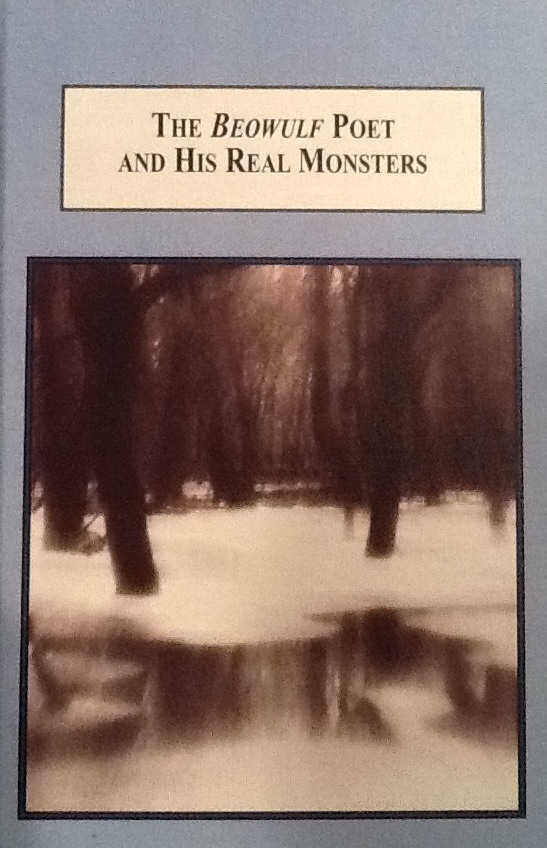
The book actually grew out of my doctoral dissertation, which I completed in 2009 (Zeitgeist and the Zone: The Psychic Correlation between Cultural Trauma and “Postmodern” Literature). My primary focus was American postmodernism, but I included quite a bit of research on Anglo-Saxon history and culture, and the poem Beowulf in way of support for my thesis. As almost an appendix to my dissertation I also wrote a trauma-theory reading of Beowulf; however, the Anglo-Saxon scholar on my committee wouldn’t accept my theory about the poem, so I ended up cutting that chapter. Anglo-Saxonists are notoriously uncomfortable with post-structural criticism (they tend to prefer analysis of a more traditional philological nature), so it wasn’t a big surprise that she didn’t care for my reading. Nevertheless, I’d put a lot of time and effort into it, and I felt it was valid (even revolutionary — hey, sometimes you have to toot your own horn).
Even as I was cutting the chapter, I had vague plans of bringing my theory out somehow or another (perhaps in an article). After successfully defending my dissertation, my mind switched gears back into creative writing, and I spent the next three years working on the novel that would become An Untimely Frost. I teach Beowulf every fall, so I continued meditating on the poem and my analysis of it. Then in late winter 2012 I met with an editor from Edwin Mellen Press who encouraged me to pursue writing a monograph about Beowulf and my trauma-theory reading. I accepted a contract, and in May of 2012 I began work on the project in earnest. I transported home from my classroom three copy-paper boxes of books and articles, transforming my bedroom into a Beowulf and postmodern critical theory library (it was a mess, and it was a good thing I was living alone because if I hadn’t been, I soon would’ve been).
I thought I could knock out the project in three to five months; I was wrong. I pulled quite a lot from my dissertation, but it was now three years old. An important book or article on Beowulf appears once a week or so, according to the University of Toronto, which is the epicenter of Beowulf scholarship, and to say I’d been keeping up only at my leisure would be putting it rather kindly. So I had a lot of reading to do. Also, I’d done a little translating of Old English for my dissertation, but for this monograph I felt that I needed to analyze the original language of the poem, so I set about translating numerous key sections. Much of the summer of 2012 was spent with my nose in the poem, various Old English dictionaries, and translations that I admired. I was often at my kitchen table entombed in stacks of books.
The project that I thought I could finish by September (2012) dragged on into the fall … and winter. In the meantime, two of my three adult sons had moved back home for various reasons, and it became a running joke as nearly every day they’d ask me what I was doing, and I’d say that I was finishing my Beowulf book (or I’d ask them, “Guess what I’m doing today?” to solicit their groans of skepticism), as I was in the process of finishing it for about six months. There were a thousand details to attend to to get it right. I was not a known Beowulf scholar, at all, so I was determined to make it as solid a piece of scholarship as I was able to produce. When I needed to procure supporting reviews before sending it to the press, I sought opinions from the most respected Beowulf scholars in the world, and I was grateful that James W. Earl and Robert E. Bjork, both of whose work I’d admired for years, agreed to review my manuscript. I waited, a little anxiously, for their reviews — and was considerably relieved when they were returned so favorably. (See my Beowulf book’s page to read blurbs of their reactions.)
It ended up taking ten months for me to complete the project. Shortly after its publication, Edwin Mellen’s editor-in-chief awarded it the press’s D. Simon Evans Prize for distinguished scholarship. Considering I had to cut from my dissertation the chapter on which the monograph was based, I was especially pleased with Earl’s and Bjork’s good opinions, and then the Prize. In fairness to the Beowulf scholar on my committee, my chapter paid little attention to the poem’s original language, and my analysis of the Geatland/dragon section of the poem, I knew, was undercooked (in writing the monograph, that was the section that received the most new material and most extensive revision — by the time I wrote the book, I had a clearer idea what I’d been wanting to say all along). Also, her reaction inspired me to make my scholarship as airtight as possible as it represented what the mainstream of the discipline was likely to say about my rather wild reading of the poem. I thank her in the book’s acknowledgements, and my thanks is sincere.
The press is just beginning to solicit reviews of my Beowulf book in scholarly journals, and I don’t know of any that have appeared so far. As I said, I’m gratified that universities are adding it to their collections, so hopefully some Anglo-Saxonists will begin to pay attention to it (as well as scholars and doctors in psychoanalysis and neuropsychology, which are also important aspects of my trauma-theory reading).

 12 Winters Blog

leave a comment