Interview with Melissa Morrissey: Shawna’s Sparkle
When I founded Twelve Winters Press in 2012, I didn’t anticipate establishing an imprint for children’s literature — nor did I anticipate meeting my (now) wife, Melissa. Besides our both being educators, Melissa and I are bibliophiles (if not -maniacs). She’d always written and had in mind that she’d like to publish books (like her father, Larry D. Underwood, who wrote and published several history books and even an historical novel). In particular, she had some ideas for children’s books, but she wasn’t sure how to go about getting them published. I told her I’d be happy to show her the ropes — how to look for an agent … and wait and wait and wait … or submit directly to a publisher … and wait and wait and wait … Or, instead, we could direct our time and creative energies to establishing our own children’s literature imprint, and bring out her books ourselves.
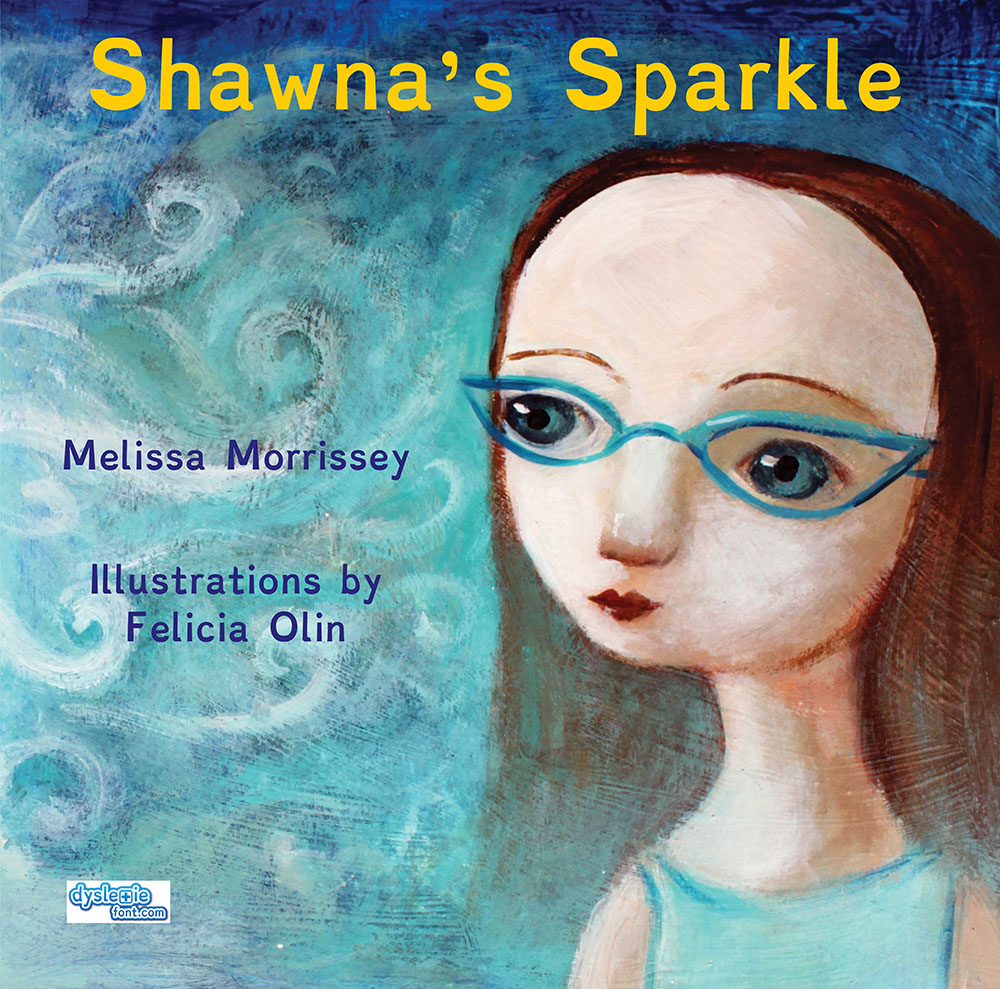
So that’s what we’ve done. This past year we established Shining Hall, and our first project was to publish Melissa’s book Shawna’s Sparkle. As Melissa was writing the book, she had characters in mind in the style of one of our favorite local artists, Felicia Olin. When the story was completed, we crossed our fingers and contacted Felicia about possibly doing the illustrations. She agreed, in spite of her busy schedule getting her paintings ready for upcoming exhibits and various art shows. Earlier in the summer of 2015, Felicia sent us the illustrations that she’d created. We were blown away. We’d only had a brief meeting with Felicia over coffee at Wm. Van’s in Springfield, and gave her very little in the way of direction, trusting her artistic instincts — and our trust was well placed.
I went to work designing the book (my first children’s book), and on July 10 Shawna’s Sparkle was released in hardcover, paperback and Kindle editions. So far response to the book has been overwhelmingly positive, to both the story itself and to Felicia’s wonderful illustrations. It’s become something of a tradition that I interview the authors I’m publishing about their books, and even though I of course already know a lot about Melissa’s book, I didn’t see any reason to suspend the tradition on account of our being married. I gave Melissa some questions about the book and her writing of it, and what follows are her unedited responses. We have other books by Melissa in the works, and Shining Hall will begin publishing books by other children’s authors in the near future. We’re also planning a children’s book contest for early 2016.

What made you want to write a book for children?
I am a teacher, so I feel I can easily relate to children. They are so open. They love to read and people love to read to them.
For most authors, their characters are composites of different people they’ve known, maybe mixed with a healthy dose of self. Who is Shawna, would you say?
She is a part of me, of course. Anytime you write, a part of you comes out. I have changed some details, such as only having a brother. However, as a child, I felt very much like Shawna and sometimes still do.
You’ve said that you want the book to teach children to love themselves and appreciate their special gifts. Why do you think that’s so important for kids?
Children are born with a connection and lots of sparkle. Put a child in a room and every eye in the room is transfixed. They have such light. Life, and unfortunately sometimes school and adults, makes their sparkle dim. They can forget that connection. Kids that struggle in school have it especially hard because they have to go to school all day and practice things they are not good at or comfortable doing. What torture! As adults, we mostly do things to reinforce talents. School doesn’t always work that way. We all have gifts, however, and capitalizing on them makes us sparkle in all areas of our life. Any child who learns this early, has a leg up on life so to speak.
In what ways does Shawna’s Sparkle reflect your interests in meditation and mindfulness?
My interests in meditation and mindfulness come out in Shawna’s dream, especially. The book is simplistic in that a simple dream changes everything; however, it can be that easy. One moment can change your whole life. Reconnecting with your “sparkle” occurs naturally when you meditate or become more mindful of your gifts. I am passionate about people becoming more mindful because as we all increase our sparkle, the whole world is filled with more light. There are a lot of children hurting right now. I believe learning mindfulness would equip them with tools that would serve them their entire lives.
Shawna seems to be something of a throw-back to an earlier time in that she loves books and reading, and there’s no mention in your book of modern technology — no iPad, not even any TV. Why do you think reading, and maybe especially reading old-fashioned books, is so important for children?
There is so much to be learned about life, humans, and empathy through the characters in literature. There is currently a push to read more nonfiction, and indeed nonfiction has its place in education, but purely reading nonfiction makes your brain lazy. I think that is why struggling readers and kids on the spectrum can be drawn to nonfiction. When you read literature there are all kinds of characters and emotions to keep straight in your brain. It is a real workout but so rewarding! We can see through a character’s eyes and experience a side of life and a point of view that we may not have otherwise considered. I like to think that if we knew how others were feeling we would all be gentler and kinder.
What about artist Felicia Olin’s work made you think she’d be the perfect illustrator for Shawna’s Sparkle? How did you feel about the illustrations she created?
When writing Shawna’s Sparkle, I pictured the characters as if created by Felicia. I actually mentioned the book to one person who suggested I contact her. He was amazed when I told him I already had her in mind. People that know me know I don’t believe in coincidences. I was very thankful that she agreed to do this project. Felicia brought the book to life in a way I certainly could never have done. I am eternally grateful and continually wowed by her work.
How much do you think your father’s example of being an author impacted your desire to write and publish?
My earliest childhood memories were of sitting on my father, author Larry D. Underwood’s, lap and stating that “when I grow up I’m going to be a teacher and a writer just like you!” He inspired me to challenge myself in both my reading and writing. I wrote a teen novel for a contest in high school. It wasn’t chosen, so I stuck it in a drawer. However, I continued writing various articles and editorials including one in Springhouse magazine. I always planned to get back to writing more seriously. Since my dad has been “in spirit” I feel the urge to write more strongly, which can no longer be ignored.
You spent two decades teaching special education students. How did that experience influence your writing of the book?
My father encouraged me to go into special education and the career has served me well. I am perfectly suited to smaller groups and children who respond to love, attention, and my gentle nature. My administrators and supervisors always commented that I had a calming effect on students. I was grateful that they recognized and appreciated that in me because I do not believe in yelling at children to motivate them. I am now in special education administration and miss that classroom connection immensely. This book, I feel, is allowing me to reach a larger audience than my single classroom, including all the people I never had the honor to teach.
Why is it important to you that your book was published in Dyslexie font, which is designed to be easier to read for learners with dyslexia?
I was always bothered by my inability to “fix” dyslexia, which was really the wrong way to approach it because students with dyslexia have so many other gifts, like their ability to see the world in a different way. However, I feel that the font will help students access print more readily. I also intend to release the book in an audio format soon.
What other writing projects are you working on?
I am working on a teacher’s guide for Shawna’s Sparkle that will align with Common Core. I have other books written that teach social emotional skills. We are working on getting illustrators for them. Also, I am working on a new series of books that center around our rescue dog, Einstein, and will help teach the Next Generation Science Standards. We are hoping to release the first one soon, if we get an illustrator on board.
Melissa Morrissey, an Illinois Teacher of the Year Finalist, has been a special education teacher and administrator for over twenty years. She holds degrees from Eastern Illinois University, Southern Illinois University Edwardsville, and University of Illinois Springfield. Shawna’s Sparkle is her first book. (Author photo by Polly Parsons)
Interview with Lynette D’Amico: Road Trip
Twelve Winters Press doesn’t solicit submissions as a general rule. Sometimes we’ll have a call for submissions for a special project, but otherwise, as a publisher, I see myself as more of a hunter-gatherer. That is, I keep my eyes and ears open for interesting projects, and when I pick up a scent, I track it down to see if it pans out. I believe it was in the summer of 2014 that I received the Quarterly West newsletter which included an announcement of the winner and finalists of its annual novella contest. One of the finalists was “Road Trip” by Lynette D’Amico. There were several finalists, and I’m not sure why that one stood out to me. I’m a big fan of the road trip motif — I’ve taught Homer’s Odyssey many, many times, as I have tales from Chaucer’s Canterbury Tales, and I’m a fan of Kerouac’s On the Road, and McCarthy’s The Road . . . and so on. So maybe it’s as simple as that.

I went about tracking down this Lynette D’Amico person on the Web (which took a little doing), and introduced myself and Twelve Winters via email. She responded, and come to find out, her novella had been three times a bridesmaid. Prior to the Quarterly West finalist finish, her little book also had been a finalist for the Paris Literary Prize and, as part of a collection, for the 2014 Flannery O’Connor Award for Short Fiction. She had some other impressive writing credentials, including placing a piece with The Gettysburg Review, “Ashes, Ashes,” that had been nominated for a Pushcart Prize. She said in her email that being contacted by a publisher took some of the sting out of her third close-but-not-quite finish, and she agreed to send me the manuscript.
I was blown away by her novella — its complexity, its intricate structure, its mixing of genres, its main characters who are thoroughly lovable in spite of their glaring flaws, and its offbeat humor. I very much wanted to bring this strange little book into the world. We began our negotiations. I entertained the idea of bringing “Road Trip” out as part of a collection, but ultimately we agreed that it should stand on its own as a novella. The story is highly intertextual, so I liked the idea of perhaps mixing in yet another mode of communication in the form of illustrations of some sort (at least, I think it was my idea — maybe Lynette suggested it first . . . I could easily be persuaded she did). Ultimately, Lynette found some photographs from the Wisconsin Historical Society and from a book titled Death of the Dream that she wanted to include in the book. The odd and often haunting photographs definitely added another layer to her already multi-layered novella.
I enlisted the aid of a couple of the Press’s loyal editors to read the manuscript and work with Lynette to finalize it for publication; then beginning in about March of this year I re-entered the process, and Lynette and I went about creating Road Trip in its final form, in print and digital editions. (Lynette is at work on an audio version of Road Trip as well.) On June 22, 2015, the novella entered the world. I sent Lynette some interview questions about her book and her process, and what follows are her unedited responses. SPOILER ALERT: At times the interview drifts into details of the novella you may not want to know before reading it (I wouldn’t have).

The travel narrative obviously has a rich history. The Bible is filled with travel stories. There’s Homer’s Odyssey, Chaucer’s Canterbury Tales, Gulliver’s Travels, with your own book perhaps being more closely related to Kerouac’s On the Road. Why do you think the travel narrative has been so attractive to storytellers, and what specifically attracted you to it for Road Trip?
Isn’t it a version of the travel narrative that we all see ourselves as coming from somewhere on our way to somewhere else? Well, maybe that’s a version of the travel narrative written by white men of a particular social class. When I was 21 or 22, I tried to wrangle a posse of girlfriends to drive from a first-ring suburb of St. Louis to the Pacific Ocean. My friends wanted to bake on a beach, so I wrote to chambers of commerce, collected maps, a sleeping bag, and hit the road alone. I made it as far as Taos before I exhausted my credit limit and my own capacity for adventure—sleeping and not sleeping in my car with all the doors locked at state parks.
The notion of the road trip immediately inspires a sense of the unknown; it has its own engine—we’re heading out from Point A to Point B, or to points unknown. I needed a trajectory for Road Trip, something that would propel the story forward, and place the characters of Myra and Pinkie in time and space, and a literal road trip does the trick.
There’s a line in a story by Paul Yoon, “So That They Do Not Hear Us,” that I get caught on, “. . . there was a time she had departed and was now wishing to return to.” This nostalgia for returning is also a part of the mythology of a road trip: we want to go back to where we started, and the inherent sadness of the road trip for Myra and Pinkie is that even if they get back to where they started, even if they return, nothing will ever be the same again.
Some of the travel narratives I mentioned have a significant supernatural element in them—as does your novella. What do you think the connection is between travel and the supernatural?
Travel removes us from the familiar. In Rebecca Solnit’s A Field Guide to Getting Lost, she says that “to be lost is to be fully present, and to be fully present is to be capable of being in uncertainty and mystery.” The expectation of the travel narrative is exploration of the unknown; to turn a corner or come into a clearing, where “I have never seen this place before” and the unexpected becomes possible.
Flimic references that inform Road Trip include David Lynch’s Wild At Heart, the Cohen brothers’ O Brother Where Art Thou?, The Wizard of Oz, and Wim Wenders’ Paris, Texas. And by “inform,” I mean I paid attention that if you’re on a road trip, something’s gotta happen along the way, and I like it when the something that happens along the way is a little weird, or incorporates unreal elements.
A few years back my spouse and I were staying in a cabin in the Adirondacks. We woke up early the morning we were due to leave and rather than go back to sleep, we packed the car and got on the road before dawn. There were no cars on the road, no lights; it was foggy and misty, and all of a sudden we saw a one-armed figure in the middle of the road. Polly was driving. We both screamed and Polly, who has the reflexes of an athlete, swerved and braked hard. We looked around and there was no one on the road. We kept driving. Did we really see a one-armed man on a foggy road? And where did he go? In writing, and perhaps in life, anything is possible on the road—one-armed hitchhikers, or red-headed hitchhikers in one-piece bathing suits and flip-flops pulling doughnuts and mini-bottles of vodka out of a bottomless purse.
The structure of Road Trip is decidedly nonlinear. You have several characters embarking on various storylines, and the reader constantly shifts between these storylines, as well as back and forth temporally. How did this rather frenetic structure come about? Was it planned early on in the composition, or did it develop more organically while you were writing Road Trip?
Nothing was planned! I so rarely work with any kind of intentionality unless I’m writing an essay, but even then I leave plenty of space for discovery. Road Trip started as one straight-line short story called “No Brakes”—the story of Myra and Pinkie—more or less. It was a big sprawling mess, but from the one draft I had the last words, “no brakes,” and in subsequent drafts I wrote towards that line. It was always fragmented, but I had sections in it about Ed Gein, the Plainfield, Wisconsin, killer who is the model for Norman Bates in Psycho and Buffalo Bill in Silence of the Lambs, which didn’t make the cut and sections called “What Does My Mother Have to Do with This” that were kind of funny stories about my mother talking about death, but their destiny was foretold by their heading. Then my first semester in grad school I worked with the brilliant Kevin (Mc) McIlvoy, who taught me one simple thing about braiding story chords (I don’t mean that he told me one thing; he told me a million things, but I actually managed to hold onto this one right thing): He referred to the turns in the long version of “Layla” by Derek and the Dominos: “You thought we were entering a pond? No. You thought we were entering a lake? No. Here: the ocean. The ocean: hear.” His comment translated into some kind of circular, touch-and-go movement in the story. Mc encouraged me to think about fragmentation—breaking blocks of text into small islands to introduce a rhythmic discontinuity and dynamic disjunction into the narrative. To my surprise, as I broke the main narrative down and split the secondary narrative into discrete modules, I was able to see the shape of the story. In pulling everything apart, the story came together for me.
Myra Stark (the narrator) and Pinkie have a complex relationship. What do you think is at the core of their friendship? Are you basing this complex friendship on any real-life models?
In all the conversations and discussions I’ve had about this book, I’ve never tried to explain the relationship between Myra and Pinkie, except maybe to myself. Early feedback I got on the story was that Myra was so mean to Pinkie wasn’t I worried that readers wouldn’t like her? I also heard that Pinkie was beyond believable infuriating. Beyond believable in a story with ghosts and an animated butter and cheese doll? Well, it doesn’t hurt my feelings if readers don’t like Myra or Pinkie. My interest is in creating complex, difficult characters that readers want to argue with or talk to on a long road trip. My interest is that readers keep reading.
I had in mind a complicated relationship between two women, a relationship if not as clear-cut as lovers, then maybe a friendship betrayed, or a friendship of history and habit and conflicted feelings. In my own life, I’ve had friendships that blew up, I’ve disappointed and been disappointed by friends. I wrote pages and pages, which is my way of thinking, trying to discover a relationship that existed beyond estrangement and death. What I discovered in the process was that I wasn’t really interested in Myra and Pinkie making peace. Theirs was a relationship that would extend in its contentiousness beyond death. One of my models for Myra and Pinkie’s relationship was Sula Peace and Nel Wright from Toni Morrison’s Sula. Sula is a devastating novel about the relationship between two black women from the fictional town of Medallion, Ohio. The story follows Sula and Nel from the 1920s as young girls, then young women; their falling apart, and through the death of the title character, which corresponds with the slow decline of the black community they come from. When Sula is ill and alone, Nel visits her and asks her a question she had been struggling with since the friends had ceased being friends after Sula slept with Nel’s husband:
“I was good to you, Sula, why don’t that matter?” Sula turned her head away from the boarded window. . . . “It matters, Nel, but only to you. Not to anybody else. Being good to somebody is just like being mean to somebody. Risky. You don’t get nothing for it.”
“Being good to somebody is just like being mean to something. Risky. You don’t get nothing for it.” That line is at the heart of the relationship between Myra and Pinkie.
Road Trip was originally part of a collection (which was a finalist for the Flannery O’Connor Award for Short Fiction in 2012). How is Road Trip similar to and different from other pieces in that collection?
Other stories in the collection, although not all the stories, use similar nonreal elements as appear in Road Trip, such as ghosts, and a couple of the stories try to be funny. I think a problem with the collection is that Road Trip was in it. The other stories are about families: mothers and daughters, sisters, and the relationships you are born into versus the relationships you choose. Road Trip might have been too much of its own animal to work with the collection.
For a long time the novella, as a form, was “persona non grata” in the publishing world—too long to be published as a story, and too short to be taken as seriously as a novel. But the novella’s status seems to have improved in recent years. Major houses are publishing them, and some have even fared well in national contests competing right alongside full-length novels. How do you personally feel about the novella form, compared to story and novel writing?
I love the novella form. I went around for a while pitching a book that was going to be comprised of three novellas! That plan fell by the wayside due to lack of interest—not on my part but on the part of every publishing venue that I approached—but I like to keep a novella percolating on the back burner, something to dip into from time to time. I’m still new to novel writing. I’m writing a novel, but I am a little shy about saying that I’ve written a novel yet. Time will tell. The only form that I feel sure about before I write it is the short story. Sure, in that I usually know if a short story is going to be a short story when I start writing, although I’m open to surprises too.
The most obvious way to differentiate novellas from stories and novels is, of course, by word count, which is typically in the 20,000 to 40,000 word range—but word count is only one indicator of what a novella is and it doesn’t address form. Author Debra Spark, who I had the great fortune to work with at Warren Wilson, has an essay about the novella in her book on the craft of writing called Strange Attractions. She refers to Howard Nemerov’s essay “Composition and Fate in the Short Novel,” and says that novellas “must represent not simply a compression but a corresponding rhythmic intensification, and not just for plot—which we expect from most fiction—but for design.” Rhythmic intensification to me means exerting pressure on every element: language, sentences, paragraphs, which is compounded by and propelled by tone. It’s a process of distillation. The best way I can think of to illustrate what I’m talking about is with these few novellas and short novels that are particularly important to me:
The Body Artist, Don DeLillo.
I am a freak for DeLillo and then I go through periods where I can’t read another word of his. The Body Artist is a drifty, dreamy book with the thinnest of plots and the first fifty pages or so is this excruciating chapter of a domestic scene that is written kind of like in real time. The book is like a dream. I love The Falling Man by DeLillo too.
The Great Gatsby, F. Scott Fitzgerald
I reread or listen to Gatsby two or three times a year. I would like to write a collection of essays from lines from Gatsby. Every line opens a world.
Tinkers, Paul Harding
Another drifty, dreamy novella, and the first chapter in which the main character tells his own death in the context of the house he built falling down around him is brilliant.
Train Dreams, Denis Johnson
The main character of Train Dreams is opaque and unreflective, but Johnson evokes a whole way of life and period of history through the character Grainier—of logging and the woods and labor and heartbreak in Idaho in the early part of the twentieth century. I love this book as an example of how to tell a story through characterization.
So Long, See You Tomorrow, William Maxwell
I like my fiction a little slapdash and hard-edged, language-driven or image-driven or just voice-y—funny, snappy voice-y. So Long, See You Tomorrow isn’t that kind of book. It’s such a quiet, meditative book, but I read it, then listened to the audio file of the author William Maxwell reading it, which is an extraordinary experience, then I read it again. And maybe a few more times. I’ve heard the book referred to as a nonfiction novel because the first half of the book is written like a memoir in which the author William Maxwell is the central character. He tells an account of a murder on a tenant farm outside of Lincoln, Illinois, the small Midwestern town where Maxwell was born and lived until he started high school. The second half of the book is a fictionalized account of the murder from a third-person omniscient perspective. I love that this book tells the same story many different ways.
Coming Through Slaughter, Michael Ondaatje
The subject of the novella is a fictionalized account of the life of New Orleans jazz trumpet player Buddy Bolden. The novel incorporates point of view jump cuts, lists, lyrics, descriptions of photographs, and invented and historical interviews in an attempt to enter the character and historical figure of Buddy Bolden. The presentation is disjointed and imagistic and opens up whole worlds.
Why Did I Ever, Mary Robison
Funny as hell. And sad. Written in 536 little sections. Not an extra word.
Road Trip must have had a fairly long and adventurous trip of its own before being published. Could you talk about your efforts to get it into print, and what kind of a journey that was for you as a writer, including emotionally.
Over the past several years, Road Trip was a finalist in a few well-considered contests—always a bridesmaid, as they say. Every time I got on one of those close-but-no-cigar lists, an agent or two would contact me and ask “what else you got?” Nobody was interested in a novella, or in the novella as part of a collection of short fiction. I think Road Trip didn’t really work in a collection. If the collection had won some prize, that might have made a difference, but generally, what I heard from agents was that they wanted a novel, and there’s nothing like the attention of a few publishing professionals to completely derail my writing practice and sidetrack me from the work, which is ultimately what matters. So, I tried to keep my head down and just keep focused on the page.
I had stopped submitting Road Trip to journals—the few that are open to considering novella-length work—but I’d gear up and send it around to the couple of novella contests that come around every year. After an appearance on the finalist list for the 2014 Quarterly West Novella contest (which I lost to Nathan Poole, a fellow Warren Wilson alum, which by the way, if you’re a fan of the novella or just gorgeous writing, read his winning novella Pathkiller as the Holy Ghost or his collection of short fiction from Sarabande, Father, Brother, Keeper), you contacted me. As I think I said to you in my initial response, nothing takes the sting out of losing like a query from a publisher. I was impressed with Twelve Winters’ dedication to independent publishing, your commitment to publishing literary titles that might be a little off the beaten track, as well as your plans to expand the press’s fiction list. Let me just say, too, that I have a lot of writer friends who operate like literary hoarders. Playwrights who are holding out and holding out—they don’t want their work to be produced at a small local theater in case Steppenwolf or The Public wants to consider their play, writers who have their marketing plans in place before they finish a first draft. The upshot is an unproduced play (or an unpublished book) sitting in a drawer or on a computer file. I started writing later in life, and besides feeling the pressure of age in a youthful field, I want my work to be in the world. I liked that Twelve Winters is an entrepreneurial endeavor. I liked that you are a reasonable guy who is interested in working with his authors to make the best books possible. I liked that you were willing to take a chance on my weird, sad-funny novella. I think it’s worked out.
How did a Midwesterner with “a prairie eye” end up in Boston? Does your writing tend to focus on the Midwest, or do you sometimes find your East Coast environment an appropriate setting for your fiction?
I lived a lifetime in Minnesota and Wisconsin. Then my spouse, who works in theatre, got a job offer in Chicago. While she was in Chicago interviewing, my mother died. We sold our house, I quit my job, and we moved three months later.
After kicking me around for a year or so, Chicago became my best friend. I came to think of Chicago as my place. And then we moved again. To Boston, following Polly’s career again. We’ve been here now for three years. Boston has been a culture shock, more so even than the traffic in Chicago, where I drove for three years without ever making a left turn. There’s the cost of housing in Boston and the contrast with all the hardscrabble Massachusetts hill towns and then all these tiny, tight New England states. I can drive for twenty minutes and cross three state lines. I miss having an uninterrupted view. I miss driving for hours and hours and the unchanging landscape. I miss parking. To find my place here, I’m considering the ocean, which is right across the street from where we live in South Boston. I’ve lived with Lake Superior and Lake Michigan, both beloved to me, but the ocean requires a different relationship. I haven’t written anything yet about the East Coast, beyond ranting emails, but I likely will.
Could you talk about your writing process? Are you someone who consistently follows a routine, or do you write more in fits and starts as ideas and inspiration come to you?
I try to write everyday, which some days is more aspirational than realistic.
I think of it as exercise—another aspirational pursuit. If I don’t have a couple hours to write during the day, then I at least try to engage my current project in some way—through research, which can include reading, watching movies, listening to podcasts, music, eating whole boxes of dry cereal and bags of chips—I’ll use anything. Of course having an open-ended definition of research sometimes means that I lose days on the internet reading about how to frame a door, or birds of the prairie, or just googling writer bios in publications that have rejected me and comparing their lives to my own.
What are your current writing/creative projects?
I’m presently finishing a novel called The Third Twin, which is about renditions of home, how to make a home, homesickness, homelessness. It might be a reaction to moving around so much. Myra Stark appears in The Third Twin too. I also have a collection of short fiction called Below the Surface.
You’re a graduate of the MFA Program for Writers at Warren Wilson College. There’s been a lot of discussion of late about the escalating number of MFA programs, and whether or not they actually help someone to become a better writer and establish a career as a writer, etc. What are your thoughts on the “MFA question”? How did Warren Wilson and its instructors nurture (or hinder) you as a writer?
I spent years trying to write over weekends, or in one-week or two-week increments—my allotted vacation time—or early in the morning or late at night, between working full-time. When I met Polly, I was introduced to the work of some of the best theater artists in the country—Lisa D’Amour, Deborah Stein, Kirk Lynn, Dominic Orlando, Sherry Kramer. My proximity to the world of theater and playwriting allowed me a fuller understanding of what it means to be an artist and the odds against gaining any kind of recognition or audience for your work. It was the example of many of these theater artists that pushed me to consider what I was doing with my own writing and what it meant to pursue a career as a writer. I saw the value of formal training in my chosen field, the necessity of credentials, and the importance of being connected to an academic institution or a professional organization. I decided to pursue an MFA. Writer friends, who had gone back to school later in life, recommended low-residency MFA programs.
My MFA program was a great gift to myself. Since I had been making my living as a writer in advertising and marketing communications, I came into the program thinking that I really didn’t have much to learn. It took one residency to disabuse me of that particular delusion. I listened to James Longenbach deliver a lecture on the excess of poetry to show how excess can be used to heighten a poem’s meaning, citing examples from Ezra Pound’s Canto 74, Emily Dickinson’s “The vastest earthly day,” John Keats’s “Ode to a Nightingale,” and my head blew off. I realized I didn’t know anything. But I knew the difference between inspiration, a first draft, and material that was ready for an audience. I didn’t take rejection personally. I trusted my skills and I was prepared to start over every day. With the help of brilliant mentors and an intentionality that considers the arc of a student’s development as a writer throughout the program, I cultivated a craft lens to consider what I’m doing in my work and how to look at the work of other writers. I came out of the program a better writer, reader, and editor, and I’d also say, a better cultural citizen as part of a community of Warren Wilson alumni that extends after graduation.
So to get back to the question, earning an MFA changed me as a writer and a person, and it allowed me entrance to a supportive and far-reaching community of faculty and alumni.
I don’t pay much attention to the pervasive rhetoric that circles around every season or so, calling out that MFA programs in creative writing are mass producing mediocre writers who support the uninspired and uninspiring literary journals and elite publishing venues that publish work by the same crew of insiders from insider MFA programs. I am mostly indifferent to the ongoing MFA controversy. Where I’d shed blood is over the line that creative writing can’t be taught. Teaching is complicated, writing students are varied, and my life is forever changed by the dedication and generosity of my teachers.
Who are some writers or works of literature that have been especially important to you? What have you learned from them, either about writing or about living?
In addition to the list of books above, I’ll add a few others: Lewis Nordan, author of (among other titles) Wolf Whistle, Music of the Swamp, and Lightning Song. Some time ago, I heard Lewis Nordan read in Minneapolis with Dorothy Allison. I was at the reading for Dorothy Allison, but what I remember was Lewis Nordan reading an extended scene from Wolf Whistle, which is a fictional account of the murder of Emmett Till. The scene Nordan read was from the point of view of Bobo’s—the murdered child’s—“demon eye,” the eye that is knocked out by the killer’s bullet. Nordan gives Bobo a voice in death that was not available to him in life. Not only does the dead boy’s vision expand to see past his own death into the lives of characters he hadn’t encountered previously, he also sees into the future and the significance of his murder, “worlds invisible to him before death.” The scene is devastating and out of place and so audacious. I read Nordan to model how to tell a sad story funny. Ditto with Lorrie Moore, Mary Robison, Sherman Alexie, and—Samuel Beckett? I saw a production of Endgame at Steppenwolf Theatre when we lived in Chicago. There was an Eastern European woman sitting next to me with her grandson, I presumed, who looked to be about 11 or 12. Before the show started, she leaned over to her young companion and said, “To understand everything, you must first understand the Nothingness. This is the Nothingness.” I think the Nothingness is pretty funny.
It wasn’t until I traveled to Asheville, North Carolina, for grad school that I was anywhere south, but I read so many Southern writers, like Harry Crews, Larry Brown, Barry Hannah, Tennessee Williams to understand the use of voice, language, tone, velocity, and relationship to place.
An author that I turn to often is Marilynne Robinson. Housekeeping is my version of a perfect book. I like imperfection in novels, sideroads, an authorial breakdown or two. If a work is shorter, I have higher expectations. Perfection is realized in Housekeeping. It’s just a book that I love so much. I love those sad sisters, I love the elegant, image-dense sentences, I love the lake, I love the name of the town—Fingerbone! When I was writing many of the stories in my collection Below the Surface, I looked at Housekeeping for a view of another version of family, and on the first page of my novel, The Third Twin I have this quote from Housekeeping, “Memory is the sense of loss, and loss pulls us after it.”
Books that I’m living with at the moment, and by living with, I mean literally, the books I have piled on every surface in my apartment:
Snow Hunters, Paul Yoon. This is a beautiful novel where the pressure on the language drives the story. Not much happens. Almost no dialogue. Close third POV. A North Korean war refugee is relocated to Brazil. On a sentence by sentence level, an exquisite book.
Citizen, Claudia Rankine. My particular interest is in how Rankine incorporates visual art into her poetry. She and her husband, the videographer John Lucas, made a series of video “Situations” that are referred to in Citizen. The book is a living document, or art installation.
The Argonauts, Maggie Nelson. I’m not a theory head. I like to read bits and pieces of theory to sort of launch off of, but mostly it’s not my thing. My thing is story. I write creative nonfiction too, so when I’m reading The Argonauts, I’m considering the story first, then form and structure, POV, language, and then somewhere down the line, if I get around to it, I’ll think about the ideas. Nelson’s subjects—falling in love, making family, motherhood, change and transition inherent in any relationship and the queering of those constructs—are reflected in the form of the text which are short little paragraphs.
What compelled you to use historic photos in the novella? What do you hope they add to the novella as part of the reading experience? How’d you go about finding them?
For me, the photos are all about entering the story. I visited the Wisconsin Historical Society in Madison, Wisconsin, this past spring to do photo research.
A book of photographs by William G. Gabler of abandoned Midwestern farmplaces was one of the inspirations for Road Trip. The book is The Death of the Dream and two of the photographs from that book appear in Road Trip. When I came across Gabler’s book I was living in Western Wisconsin on 20 acres in an L-shaped farmhouse. I had grown up living in new houses, built to order. Living in a rural area in a house that was built at the turn of the century, on land that had been cleared and cultivated and then gone back to woods, excited my imagination. From Gaston Bachelard’s The Poetics of Space, “…the house shelters day-dreaming, the house protects the dreamer, the house allows one to dream in peace.”
In that farmhouse I dreamed and those dreams enter everything I write.
I came across another book, Wisconsin Death Trip by Michael Lesy, which is a collection of photographs by the nineteenth century photographer Charles Van Schaik taken in the city of Black River Falls, Wisconsin. The photographs are paired with news reports of suicides and murder, infant death, crime, mental illness, and business failure. The images cast a spell. The first time I looked at Wisconsin Death Trip, I kept the book in my car. I didn’t want the book in the house, I didn’t want it in the place where I ate breakfast and slept; the book is at odds with the idea of shelter.
When I started thinking of Road Trip, I used Death of the Dream and Wisconsin Death Trip to set the scene, so to speak, for the story. Then I became fixated on a photo of threshing from the Wisconsin Historical Society. This photo evoked Road Trip for me, which is kind of funny because it’s not an image of a wagon train or any other kind of a road trip—it’s a photo of threshing with horse-drawn wagons in the early 20th century. The photo ultimately didn’t make it into the book, but it was an early contender for the cover image and it was my screen saver while I was writing Road Trip. Then I saw the image of the mannequin in the window of a hat shop in Black River Falls. I wrote the scene of Carmella shaping a butterhead girl/man with a mustache based on this image. The photos in the book are not necessarily specific to the time period of the Starks’ story line, but I was more interested in conveying atmosphere rather than hyperrealism. So in some instances, the photos informed the story and in others, the story is enhanced I hope by the photos.
Lynette D’Amico worked in publishing and advertising for a decade. Today, she is a former ad writer and graduate of the Warren Wilson MFA Program for Writers. Her work has appeared in The Gettysburg Review, The Ocean State Review and at Brevity and Slag Glass City. She is the content editor for the online performance journal HowlRound. Born in Buffalo, New York, she has lived in St. Louis, Minneapolis and Chicago. She makes her home in Boston with her love Polly Carl.
(Author photo by Meg Taintor)
Fictionalizing the Life and Voice of Washington Irving
The following paper — “Fictionalizing the Life and Voice of Washington Irving” — was presented at the North American Review Bicentennial Conference at the University of Northern Iowa, in Cedar Falls, which ran from June 11 to 13, 2015. This paper was part of the “Voice and Point of View” panel on June 13. Other papers presented were “Expanding the Powers of First-Person Narration” by Buzz Mauro and “The Art of Narrative Telling: Transforming Cheever’s Voice” by Grant Tracey. In addition to presenting, I also moderated the panel.

Portrait of Washington Irving by John Wesley Jarvis, 1809
I’m here today to talk about writing my novel An Untimely Frost, which I worked on between about 2006 (I think) and 2011, eventually publishing it via my own press, Twelve Winters, in 2014—Twelve Winters Press, by the way, has a table at the conference. The inspiration for the novel was Washington Irving’s rumored courtship of Mary Shelley. It seemed to me that a romantic relationship between the author of “The Legend of Sleepy Hollow” and the author of Frankenstein could make for an intriguing chemistry. I didn’t know where or when I’d learned of that rumor, and I wasn’t especially interested in verifying its accuracy because I decided very early on that I wasn’t going to write a fictionalized biography of Irving and Shelley and their time together. Rather, I was going to use them as sources of inspiration and an armory of period details as needed. [As noted, I didn’t research the actual relationship between Irving and Shelley when writing the novel; however, in preparing this talk I came across this rare book—The Romance of Mary W. Shelley, John Howard Payne and Washington Irving (1907)–which would be of interest to anyone who wanted to know more about the famous authors’ “romance.”]
For an earlier project, which resulted in the novella Weeping with an Ancient God, I wrote a fictionalized biography of author Herman Melville’s real-life experiences among cannibals in 1842. I was dedicated to staying true to the established details of Melville’s life and times, which made for a challenging artistic endeavor. I like to believe that the novella turned out pretty well, but oftentimes I did feel hemmed in by reality and by Melville’s biography. Not to mention, real life rarely provides us with a satisfying narrative arc, which tends to handicap a novelist. It’s a bit like running in a three-legged race. It’s an experience all its own, but there’s no helping that the entire time one is keenly aware of how much easier it would be to race the usual two-legged way.

Thus, when I began writing about Irving and Shelley, I had no intention of shackling my creativity to their real lives. I began by concocting fictional names for them, eventually ending up with “Jefferson Wheelwright” and “Margaret Haeley.” I also decided early on that Jefferson Wheelwright would be my first-person narrator. I obviously had some familiarity with Washington Irving—and I’d taught “Sleepy Hollow” a couple of times in a college course—but I didn’t feel that I knew him and, more importantly, his voice well enough to create my Jefferson Wheelwright persona. To prepare, I did read several biographical sketches of Irving and more of his fictional stories. However, what I really wanted to steep my brain in was his real-life speaking voice, and the closest I could come to that, given that he lived in the early and mid nineteenth century, was to study his published letters.
I got hold of two collections in particular, both edited by Stanley T. Williams. One collection, brought out by Harvard University Press, concerns Irving’s letters “from England and the Continent, 1821-1828,” and the other, brought out by Yale University Press, consists of his letters “from Sunnyside and Spain,” spanning the years 1840-1845. I made use of both collections, and in fact one of the epigraphs for the novel comes from a Madrid 1842 letter. However, I found the letters from the earlier period to be more helpful since they correspond more closely to the time frame and the geography of my novel’s setting.
I culled the letters, along with biographical information, for two sorts of material. First, while I wasn’t writing a fictionalized biography based on Irving’s life, I was open to transferring and transforming real-life details from Irving to my creation, Wheelwright. Second, and more vital, I wanted to capture as nearly as possible Irving’s narrative style.
Without reading through the biographical notes and letters in their entirety again, it’s difficult for me to recall all that I borrowed in terms of real-life details and events. I did skim through the letters in preparation for this presentation, and I was surprised in a couple of instances regarding details that in my recollection I had wholly made up, but in actuality stemmed from my research.
One of the character details that I know I extracted from Irving’s letters had to do with a skin condition of his legs and feet that plagued him in the 1821-28 period. For instance, he writes from Germany on August 20, 1822: “I grew very lame in trudging about the dutch [sic] towns, and unluckily applied a recipe given me by old Lady Liston (may god bless her, and preserve her from her own prescriptions!)—it played the vengeance with me [. . .] I could scarcely put my feet to the ground & bear my weight upon them [. . .]” (“Wi[e]sbaden” 19). Elsewhere Irving talks about seeking treatment from various physicians. I decided early on in the writing process that some sort of foot condition would be part of my Jefferson Wheelwright’s situation. I guess I vaguely thought it might have some metaphorical value, connecting to his fear that he was not evolving, not moving forward, as a writer and artist. In An Untimely Frost, Wheelwright requests the aid of a London physician, Dr. Carter. In Chapter 2, I write,
On the first morning, he listened to my complaint while touching and gently kneading my feet and toes, which were blotchy red, except around the toenails where the skin was a vibrant purple. Spots on my feet were pained to the touch while my toes were dead numb. [. . .] The good doctor said it was a circulation problem; he said that even though exercise irritated my feet, rest was counterproductive, that we must increase the blood flow to nourish the nerve fibers.” (11)
In reality, Irving was laid up for days and even weeks with bouts of his “cutaneous condition,” but I didn’t think that would make for an especially exciting narrative, to have Jefferson Wheelwright lying around his hotel room for days on end nursing his feet, so I had Dr. Carter prescribe exercise. Carter becomes an important character in the novel—although when I first introduced him in the second chapter I had no idea whether it would be a cameo appearance or lead to a larger role.
In addition to physical details I also borrowed one of Washington Irving’s personality traits, namely his lack of interest and acumen when it came to business affairs. He let his elder brothers manage the family’s business interests, while he focused on his literary aspirations. In my novel, I write:
So far I was having a splendid time lounging in the gigantic bed at The Saint Georges [hotel], drinking the black-black Italian coffee, and scribbling my tale. I even felt a brief—brief, mind you—pang of guilt at the idea that this is what I did to earn my keep in the world. Like many of the Wheelwright men, I’d tried my hand at business, but to dismal results. I simply do not have a head for numbers and inventories and so on—I can conjure whole worlds with my pen, yet adding a column of numbers and arriving at the correct result seemed beyond me (I believe because midway I would lose interest and begin daydreaming of haunted castles on lonely, wind-swept cliffs). (10)
There were numerous details from Irving’s life, especially his writing life, that I commandeered for my purposes, but even more important was capturing Irving’s narrative style—and in particular the style he used in his letters to friends and family, which was somewhat different, on the whole, than his published authorial voice, such as in The Sketch Book and Bracebridge Hall stories.
I wrote a brief essay about trying to capture Irving’s voice for Glimmer Train Press’s Writers Ask series (it appeared in number 54 and I reprinted it in An Untimely Frost). Since it is brief and to the point at hand, I would like to insert it here in its entirety:
Like the vast majority of writers who have come out of a university creative writing program, I was taught to write contemporary literary fiction. However, for over a decade now, I’ve been mainly attracted to historically based narrative, both as a reader and as a writer. When we think of writers tackling a story or novel set in another time and another place, we imagine them doing extensive research on things like people, on the chronology of events, on various aspects of the material world they are attempting to fabricate—and we tend to imagine rightly. For me, though, there is another sort of research that must go on as well, the results of which are not as easy to spot in a story as, say, an infamous assassination or an obsolete gadget; and that is researching the structure of language itself. It can be a nebulous term, but what I’m most interested in is a setting’s voice.
Voice should contribute to the ring of authenticity, to be sure, but, more than that, voice can actually compel the movement of the narrative; voice can shape its structure. William H. Gass spoke to this phenomenon in a 1976 interview for The Paris Review, saying that “word resemblance leads you on [as a writer], not form. So you’ve really got a musical problem, certain paragraphs you are arranging, and you imagine you are orchestrating the flow of feelings from one thing to another.” Gass summed up by saying, “Once you get your key signature, the theme inherent in the notes begins to emerge: the relationship between art and life and all that.” Gass, author of some of the most admired books in the English language, suggests that the physical structure of the words on the page—and the meanings, feelings, moods that they convey—help guide the writer to, essentially, everything else in the narrative: plot development, characterization, theme, setting. . . .
The importance of this sort of research in historically based fiction is nicely illustrated in Charles Frazier’s highly acclaimed novel Cold Mountain, which is set in Civil War-era Appalachia. In an interview available online, Frazier said, “I wanted the language of the book to create a sense of otherness, of another world, one that the reader doesn’t entirely know.” Frazier did library research regarding the material world he was creating, finding “words for tools and processes and kitchen implements that are almost lost words.” Beyond that, however, he was interested in “getting a sense of the particular use of language in that region, the rhythm of it.” Frazier culled period letters and diaries for much of his information, but he also had the benefit of having actually heard “that authentic Appalachian accent” when he was a child.
For my own writing I’ve been attracted to more distant times and places, and as such have not had the benefit of hearing period speakers so printed examples of voice have been my guideposts. Nevertheless, the feel and rhythm of the language can filter into one’s writing by paying attention to the linguistic structures. For my current project I’ve been creating a first-person narrator based on the American author Washington Irving. It isn’t a fictionalized biography. It’s more that Irving’s persona has been the primary inspiration for my protagonist. When I first became interested in the project, I tracked down an obscure collection of Irving’s letters that he wrote between 1821 and 1828. The book has been invaluable to me in my effort to develop an effective narrative voice.
Simply put, in Irving’s day a well-read New Englander structured the language in ways that sound quite foreign—quite exotic even—to us now. Take, for example, this letter written at “Beycheville,” France, October 17, 1825:
I have had something of a dull bilious affection of the system which has clung to me for more than two weeks past. . . . The greater part of Mrs Guestiers household, who have lately removed here, are unwell—I have tried to shake off my own morbid fit by exercise—I have been out repeatedly hunting, as there were two packs of hounds in the neighborhood, but though I have taken violent exercise I do not feel yet reinstated by it. (50)
The terms are spectacular, yes—heaven help anyone who contracts “a dull bilious affection” and Irving’s reference to “violent exercise” makes me think of junior high P.E. class—but even more meaningful to my eye and ear are the syntactic rhythms. Today one might say, “I’ve been feeling sick for a couple of weeks,” but for Irving the “affection of the system” has “clung” to him “for more than two weeks past.” The structure implies that his sense of unwell-being is a sort pernicious companion of whom he can’t quite rid himself, in spite of his taking “violent exercise”—giving the act of exercise a physicality, as if it were an item from the apothecary’s pantry.
Yet I have no particular interest in my protagonist’s contracting a bilious affection or partaking of violent exercise. Rather I want the structure of the language. I want to tell my own tale, but I want to form the sentences as Irving might have had he written of the same events nearly two centuries ago. I normally keep the book of Irving’s letters on my nightstand, and every so often I open to a random page and read awhile, perhaps a few pages but often as little as a sentence or two, because I’m not searching for information: I want to keep retracing the sentence rhythms in my brain, like wagon wheels along a worn track, so that when I sit down to write, the words flow as naturally in the direction of his prose style as if he (or someone like him) were composing them himself. (I must go now—I feel the onset of a bilious affection.)
There haven’t been a lot of reivews of the novel, and the ones that have appeared are somewhat mixed—but the reviewers seem to appreciate the narrative voice that I was able to create. For example, Anne Drolet writes in the North American Review: “Morrissey styles Wheelwright’s voice after the patterns and idioms of 19th-century British speech, and that choice lulls the reader into the historical setting” (47). I presume being lulled into a setting is better than being jarred into one. Cécile Sune says in her blog Book Obsessed: “The writing is beautiful and elaborate, and is a testament to the research Ted Morrissey conducted for this book . . . As a result, it feels like a Victorian novel”—ultimately, though, she only gave it three out of five stars on Amazon (damn it). And most recently William Wright writes for the Chicago Book Review: “There are moments of true brilliance in An Untimely Frost. It reads like it was written by a post-modernist emulating Henry James [I like that line], which proves to be an intriguing combination”—but Wright concludes with “Perhaps with more ruthless editing, the novel could have been a triumph. As it stands, it was a wonderful idea that wasn’t quite pulled off.”
I’ll tell you what, critics are hard to please.
My five years floating around in the fictional consciousness of Washington Irving was an interesting artistic experiment, and it really stretched me as a writer. When I finished with the novel, I began writing a series of interconnected short stories—each in third-person, with shifting points of view, and set for the most part in an unnamed Midwestern village in the 1950s. I finished the twelfth and final story just a few weeks ago, and eventually I’ll be bringing them out in a collection titled Crowsong for the Stricken. I’m considering other long-term writing projects at the moment, and one idea is to return to nineteenth-century London, but not Jefferson Wheelwright. Never say never, but I believe I’ve said all I care to say in the voice and persona of Mr. Wheelwright.
Works Cited
Drolet, Anne. Rev. of An Untimely Frost, by Ted Morrissey. North American Review Fall 2014 (299.4): 47. Print.
“An Interview with Charles Frazier.” BookBrowse [c. 1997]. Web. 9 June 2015.
Morrissey, Ted. An Untimely Frost. Sherman, Ill.: Twelve Winters Press, 2014. Print.
—-. “Researching the Rhythms of Voice.” Writers Ask #54. Portland, Ore.: Glimmer Train Press. Print.
Sune, Cécile. Rev. of An Untimely Frost, by Ted Morrissey. Book Obsessed 10 Oct. 2014. Web.
Williams, Stanley T., ed. Letters from Sunnyside and Spain by Washington Irving. New Haven, Conn.: Yale University Press, 1928. Print.
—-. Washington Irving and the Storrows: Letters from England and the Continent, 1821-1828. Cambridge, Mass.: Harvard University Press, 1933. Print.
Wright, William. “A Hot and Cold ‘Frost.’” Rev. of An Untimely Frost, by Ted Morrissey. Chicago Book Review 18 May 2015. Web.
(Note that the portrait of Washington Irving was obtained via Wikipedia at this link.)
A Hot and Cold ‘Frost’
A mixed review, but appreciated nevertheless. (I intended the novel to be a bit of a challenge.)

 An Untimely Frost (or, The Authoress)
A Novel
by Ted Morrissey
An Untimely Frost is prefaced by two quotes on loneliness, one from Washington Irving, the other Mary Shelley. These quotes serve both to set up one of the major themes of the novel and to nod toward its inspiration: the rumored hint of romance between the aforementioned authors.
Written by Illinois author Ted Morrissey, An Untimely Frost concerns Jefferson Wheelwright, an American author hailing from a family of industrial wealth, traveling Europe to promote the impending publication of his latest work, and on Margret Healey, a mysterious, reclusive British author whose only published novel to date, Dunkelraum, regards a German scientist who built a man from the body parts of dead people and reanimated him. The two authors’ lives of solitude intertwine when Wheelwright visits Healey’s house in an attempt to meet her, having been a fan of…
View original post 595 more words
When Not to Edit
I’ve been writing for publication since high school (I graduated, ahem, in 1980), and I’ve been editing publications since then, including scholastic publications and the literary journals A Summer’s Reading and Quiddity. In 2012 I founded Twelve Winters Press, and I’ve had a hand in editing each of the books we’ve published (we’ll be releasing our ninth title next month). Editing a book is different, of course, from editing a piece for a journal — but no matter the context, I’ve come to believe that there’s a right time to edit someone’s work, and there’s most definitely a wrong time.
It’s the latter that has prompted me to write this post, and in particular an encounter with the editor-in-chief of a well-respected literary journal which ended in her withdrawing my piece due to “Author unwilling to cooperate with editorial process.” About two years earlier I had a similar encounter with a literary press — but in that case I had signed a contract allowing the press editorial control of the piece, never imagining how far its editor-in-chief would take liberties.
I’m not going to identify the publications and their editors. Even though I disagree with their approaches, I respect that they’re doing important and largely thankless work. I have no interest in blackening their eyes, but there are a lot of editors at work — what with online journals and print-on-demand publishers springing up daily — so I think it’s worth discussing when the right and wrong times to edit are.
I had very similar experiences with the journal and the publisher, so I’m going to focus on the more recent experience with the journal. Last week I received in the mail the issue that my short story “Erebus” was supposed to appear in (I generally try to support the journals that publish my work by buying subscriptions). It’s an attractive little journal, which no doubt contains some very good pieces. It would have been a nice feather in my CV cap.
The problem, as I see it, is one of timing. The story was accepted for publication with no caveats whatsoever on November 29, 2014. Months went by, during which time I supported the journal by including the forthcoming publication on my website and in my bio to other journals — some free publicity if you will. Then I received the following email with my edited story attached:
[March 21 — 7:16 p.m.]
Dear Ted,
I’m sending out copy edits for the upcoming issue, and have attached yours to this message.
My edits are made using the track changes feature, and comments/questions/suggestions are included in comment balloons in the document. Please make any changes within the document with track changes turned on. Please do not accept any of my changes or delete comments, as I will need those to remain in place as references. If everything looks okay to you, please let me know by e-mail (no need to send the document back unless you have made changes).
Thank you and I look forward to including your work in the upcoming issue! Just let me know if you have any questions.
It was obviously a generic email sent to all contributors (which is understandable) because when I opened the document I found there were numerous changes and requests for changes — so “[i]f everything looks okay to you, please let me know by email (no need to send the document back unless you have made changes)” didn’t even apply because there were places here and there where the editor (or another editor) wanted me to replace a word or revise a section to make some other aspect of the story plainer — things to that effect. Also, someone must have read Stephen King’s On Writing and really taken his disdain for adverbs to heart because every adverb in the 3,300-word story was deleted, regardless of how it impacted the meaning of the sentence. Moreover, I’ve developed a style for my literary work that uses punctuation (or doesn’t use it) in nonstandard ways; and the editor had standardized my punctuation throughout.
I was flummoxed. Here are our verbatim exchanges over the next few weeks:
[March 21 — 8:31 p.m.]
Hi, [Editor]. While I can see some improvements here and there, in general the editing is too heavy-handed, for example, the addition of quotation marks and tinkering with italics. I’m well aware of conventional rules, and I’m breaking them. I’m not sure why journal editors accept pieces for publication, then find so much fault with them before publication. I’m ok with considering a wording change or two, but I’m not comfortable with this amount of editing.
If you didn’t care for the story in its original form, you should have rejected it. I’m not sure where that leaves us. Thank you for the time and thought you’ve put into my story, but I disagree with much of what is suggested here. Not angry, just disappointed and a little frustrated.
Ted
* * *
[April 1 — 12:09 p.m.]
Hi Ted,
While I’m aware that you were intentionally breaking stylistic conventions, I added things like quotation marks because they were needed for clarity, i.e., to separate narrative from dialogue. There were some sections where the distinction wasn’t clear without them. Many of the other changes I implemented were for our house style. However, those edits are minor in light of many of the other edits that are suggested, notably in the comments. I edit every piece before publication…that’s what editors do. So, that is to say that the edits aren’t personal, and in my experience, that is the reaction of many new writers, to take edits personally somehow. So the bottom line is that if you’re not comfortable making any changes to your work, then I’ll withdraw it from the issue and you’re free to shop it elsewhere.
Let me know.
* * *
[April 1 — 1:42 p.m.]
Edit “Erebus” however you see fit, [Editor]. Thank you for including it in the journal.
* * *
[April 1 — 1:50 p.m.]
There are editorial suggestions in the comments that require your feedback. I have attached the piece again. Below are the instructions for editing in track changes:
Edits are made using the Track Changes feature in Word. Please look over the edits and changes I have made, and let me know if you accept these or have any questions. Of course, if there is anything you disagree with, please let me know and we can discuss it to try to reach a mutually agreeable solution. If you make any further changes, please make sure that you do so with Track Changes toggled on, so that I can be sure that your work makes it into the final copy; otherwise, I may not see it.
Please have edits back to me by 4/5, if possible
* * *
[April 1 — 2:09 p.m.]
Gosh, [Editor]. You guys seem to be making this as difficult as you can. I don’t agree with any of the editorial suggestions/questions, so it’s difficult for me to find a better way of saying things. I did all that work before I sent it to you, so now we’re into potay-to/potah-to, and I don’t know how to say things the way you want to hear them. I looked at your comments again to see if I could get into the spirit of things. I’ve been publishing my writing (fiction, poetry, academic writing, essays, reviews) for thirty-five years, and I’ve been editing and publishing other people’s work for nearly that length of time, and I’ve never experienced a process like this one before. I disagree with your comments on the story, but I’ve given you free rein to edit it however you like. If you feel like you can make the story better, please do so. I’m generously putting my faith in your editorial skills. I don’t know what more I can do than that.
* * *
[April 1 — 2:10 p.m.]
You can consider “Erebus” withdrawn from the issue.
* * *
[April 1 — 2:40 p.m.]
Thank you. That’s been my inclination too.
All the best,
t
In offering her carte blanche, I wasn’t trying to be a smart-ass (ok, maybe a tiny bit). After all, her original email said I didn’t need to return the edited document. But, truly, I didn’t see the point of attempting to guess what wording would make her happy, like trying to sell shoes to someone — “Something with a heel perhaps? No, a loafer? Maybe a half-boot?” There were two aspects of the exchange that I found particularly baffling (and they parallel the experience I had with the literary publisher a couple of years earlier).
One thing I’m baffled by is her surprise (and irritation, I think) that I would take the edits personally. She characterizes it as a shortcoming of “many new writers” (rather condescendingly, I feel). Well, I ain’t no new writer, so that’s not the problem. I think all writers and poets of literary work take their diction, syntax, and punctuation choices seriously, so why wouldn’t they be emotionally invested in those choices? And having those choices edited to conform to “house style” is especially irksome, which brings me to the second thing I’m baffled by: house style?!?
Why in the world would a literary journal have a house style that applies to the actual content of its stories and poems? Of course they would have a style when it comes to things like the font they use for titles and authors’ names, and they should be consistent in placing a translator’s name at the head or foot of a published piece — things like that. But a style for the content of the literary work itself? It’s, well, ridiculous. “Dear Mr. McCarthy, please insert quotation marks in your dialogue … and Mr. Joyce, no more dashes in your dialogue … and Mr. Shakespeare, stop making up words! — if it’s not in the dictionary, we won’t publish it … Sorry, our hands are tied, house style and all.”
The publisher I had a run-in with two years ago insisted on editing my literary book according to the Chicago Manual of Style. The CMS, really?
All right, so I disagree with editors imposing arbitrary styles on literary work, but that’s their prerogative, I suppose. What I find downright unethical is accepting a piece for publication without any reservations, waiting several months, then making significant edits that the author is supposed to accept or else (the publisher flexed her contract language and forced CMS on my work, while the lit journal editor-in-chief withdrew my story, in something of a snit I think).
A better approach, I believe, is the one we use at Twelve Winters Press. Our editors and readers offer authors feedback — food for thought, as I call it — but the decisions when it comes to the final presentation of the work rest with the writers and poets. If there are reservations about some aspect of the work, those should be ironed out before it’s formally accepted. There should be no surprises and heavy-handed editing months and months later. When our contributing editor John McCarthy was reading submissions for his Extinguished & Extinct anthology, he had some suggestions for authors in a few instances, but they were made up front, before offering publication. Obviously there are many editors and publishers who operate this way, and as a writer I’ve had the good fortune to work with several of them.
What is more, in the case of the literary journal editor, she took my story out of circulation during the peak reading months of the year, from November to April. Most lit journals, due to their being affiliated with universities, follow an academic calendar and many begin folding their tents for the year in April or May. It seems odd to me, also, that the editor felt I was over-reacting to changes that were, in her view, minor — yet she couldn’t see fit to letting the story run in its original form when I expressed my strong preference to leave the story be. Pulling the story after five months due to a disagreement over minor edits could be seen as an over-reaction too.
It’s my impression that with both the literary publisher and the editor-in-chief, the problem arose in part because another editor had acquired or accepted the work; then someone else took charge of it before it was published. If so, then the problem is in-house. If the readers and editors acquiring and accepting work have different artistic sensibilities from the top-dogs on the masthead, it’s going to create problems for the authors they’re publishing. Ultimately, though, I’d like to see all editors respect their authors and their authors’ work enough to give them the benefit of artistic doubt. In the commercial, mass market world of publishing, I can see where publishers and editors may feel the need to pull rank since capitalism drives their decisions. They may well know better than the author what phrasing, what title or what cover image may enhance sales.
But literary publishing isn’t about sales — and don’t I know it! It’s about being true to the work and respecting the author’s artistic vision . . . or at least it ought to be.
A Sensory Feast
A concise and thoughtful review of my novella “Weeping with an Ancient God” from Chicago Book Review.
 Weeping with an Ancient God
A Novella
by Ted Morrissey
Ted Morrissey’s Weeping with an Ancient God is a fictional revision of Herman Melville’s own telling of his time spent amongst cannibals. The story begins with Melville and his friend Toby trapped on an island, unable to speak the native language, and unaware of what exactly the cannibals want from them. They over time try to devise a plan to escape.
Morrissey does a great job at the beginning with establishing the isolation of the main character. Immediately the reader is introduced to heavy sensory detail as Melville awakens to darkness and heat, pain throbbing in his leg, remembering whom he now lives among. This tone of darkness is carried throughout, with only small dollops of light. The darkness is found not just amongst Melville’s relationships with the cannibals, or his entrapment on the island, but within his own mind…
View original post 404 more words
Destroying Public Education for Dummies
“I’m as mad as hell, and I’m not gonna take this anymore!”
It’s the iconic line from the 1976 film Network in which news anchor Howard Beale (Peter Finch) is pushed beyond the breaking point and implores his viewers to get mad, go to their windows, open them and shout: “I’m as mad as hell, and I’m not gonna take this anymore!” — and people do . . . by the thousands.
This is essentially the message of Williamsville (Illinois) school superintendent David Root in the District Dispatch he sent out yesterday in which he writes: “So, want to destroy public education and prevent people from wanting to teach? Not a problem. It’s actually pretty simple.”

Superintendent David Root
Root uses the metaphor of the how-to books “for Dummies” to say that the dummies in charge of state government — recently elected governor Bruce Rauner and the General Assembly as a whole — have managed, without breaking a sweat, to destroy public education and the morale of educators by slashing funds, mandating a litany of pointless tests, and demonizing and demoralizing teachers. One of the points I especially appreciate alludes to the Danielson Framework for Teacher Evaluation and how its adoption by the state is part of a scheme to make teachers in Illinois look ineffective (and thus, I say, pave the way for the lucrative privatization of schools) — an argument I’ve been making for months, especially in my August 17, 2014, post “Principals unwitting soldiers in Campbell Brown’s army.”
Please read superintendent Root’s superb jeremiad in its entirety here. (Or you can also access it via the district’s webpage here.).
Some people were surprised at Root’s vitriol, even though it’s been building for some time, and suggested that perhaps Mr. Root should have held off sending it out until he’d calmed down a bit. But I unequivocally disagree: I say we are long past the point of civility. We need more — all! — administrators, teachers, school board members, parents and students to raise their windows and shout: I’m mad as hell and I’m not going to take it anymore!
And we shouldn’t stop our raging against the “education reform” machine until public schools and public educators receive the support and the respect they deserve. Because, ultimately, our students deserve no less.
Bravo, superintendent Root! I too am as mad as hell!
“Professor Tolkien’s Rebel Readings of Beowulf” by Ted Morrissey
An addendum to my review of J.R.R. Tolkien’s translation of “Beowulf” which ran in NAR 300.2.

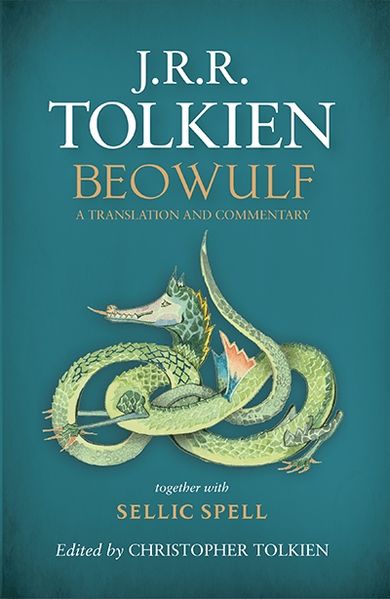
In my review (issue 300.2) of J.R.R. Tolkien’stranslation of the Old English poem Beowulf, I allude to the Oxford professor’s radical interpretations of certain sections of the poem; however, space limitations in the print magazine didn’t allow me to elaborate on those interpretations, so I spoke with NAR editors about using their blog to further discuss Tolkien’s rebel readings.
The word rebel is not used merely for dramatic effect. Scholarship devoted to Beowulf has been a thriving subculture in the academic world for more than 150 years. Opinions are often held passionately, and challenges to those opinions can be contentiously and even bitterly met. Tolkien held the post of Professor of Anglo-Saxon at Oxford University from 1925 to 1959. It was an esteemed professorship, of course, and brought with it respect, but also a host of jealous rivals. Tolkien seems to have been keenly aware of his colleagues…
View original post 1,458 more words
Big Questions in Small Doses
A smart and insightful review of Twelve Winters Press’s “Extinguished and Extinct: An Anthology of Things That No Longer Exist,” edited by John McCarthy. Thanks much, Melissa Wiley and the Chicago Review of Books.
 Extinguished & Extinct:
An Anthology of Things That No Longer Exist
Edited by John McCarthy
Extinction is a sad business, and poets have as much to say about it as scientists. Don’t mistake Extinguished & Extinct: An Anthology of Things That No Longer Exist for an elegy, however, because most readers will encounter more life forms here than they likely knew existed. The volume beckons readers to embark and reflect on a meditation regarding what it means to pass through this world and then pass out of it. The longevity of any given species is the least of the matter.
 Within these pages, everything these writers turn their attention to—from airships to nomadic tribes to lovers who have left to love someone else—feels more alive for being gone or its absence only imagined. A free-verse speculation of being the last surviving Jew follows upon a conjuring of the ghosts of…
View original post 761 more words
The Celibacy of Joseph Skizzen and the Principles of “On Being Blue”
The following paper was presented at the Louisville Conference on Literature and Culture Since 1900, Feb. 26-28, 2015, as part of the panel “Sexual Manners,” chaired by Mariah Douglas, University of Louisville. Other papers presented were “‘A world of bottle-glass colours’: Defining Sexual Manners in Subversive Spaces,” by Bonnie McLean, Marquette University; and “Sex as Border Crossing in Anglophone Labanese Fiction,” by Syrine Hout, American University in Beruit. For other Gass papers at this blog, search “gass.”
The Celibacy of Joseph Skizzen and the Principles of On Being Blue
One of William H. Gass’s first publications was the highly experimental novella (?) Willie Masters’ Lonesome Wife, which appeared as a special supplement in TriQuarterly literary journal in 1968 and was republished in book form by Dalkey Archive in 1989. The experiment revolves around the titular character Babs Masters, whose sexual history and growing sexual arousal are represented via a variety of signifiers, including bawdy and explicit diction, typographical features and nude pictures. In fact, the book’s cover features a neck-to-navel photograph of the nude model portraying Babs with the title and author’s name projected onto her pale chest: the word “Wife” is distorted in the cleavage between her breasts, and “BY WILLIAM H. GASS” runs in a straight line beneath them. Appropriately the back cover features a close-up of Babs’ nude backside above a paragraph-length synopsis of the book which reads in part: “Disappointed by her inattentive husband/reader, Babs engages in an exuberant display of the physical charms of language to entice both her new lover and the reader.” Every page of the book features either an erotic photograph of Babs and/or sexually charged language, both explicit and implicit. (As an aside, earlier I called Babs the titular character. I don’t find that funny, but I wanted to point it out for those of you who are less evolved than I am.)

By Gass’s own reckoning, Willie Masters’ was for the most part a failure. “I was trying out some things,” Gass said in a 1976 interview. “Didn’t work. Most of them didn’t work. . . . Too many of my ideas turned out to be only ideas. . . . I don’t give a shit for ideas—which in fiction represent inadequately embodied projects” (LeClair 22). It so happens that 1976 was also the year that he published his novella-like essay (or essay-like novella) On Being Blue, subtitled “A Philosophical Inquiry,” in which he discusses at length various manifestations of the word and concept of blue, especially so-called blue language. It seems that one of the chief lessons he learned from writing Willie Masters’ Lonesome Wife was that writers should avoid at all cost writing about sex:
Art, like light, needs distance, and anyone who attempts to render sexual experience directly must face the fact that the writhings which comprise it are ludicrous without their subjective content, that the intensity of that content quickly outruns its apparent cause, that the full experience becomes finally inarticulate, and that there is no major art that works close in. (19)
He concludes the section by saying “a stroke by stroke story of a copulation is exactly as absurd as a chew by chew account of the consumption of a chicken’s wing” (20). What is more, “the sexual, in most works, disrupts the form; there is an almost immediate dishevelment, the proportion of events is lost” (16-17). In sum, according to Gass, an explicit description of sex is inherently unartful, and the insertion (sorry) of an actual sexual climax in a story counterbalances and therefore diminishes the plot’s narrative climax. (Since the Louisville Conference is devoted to literature and culture, I will make the rather low-brow observation that Gass’s analysis may be borne out by the number of television series that quickly fizzle after the flirtatious main characters finally have sex, dubbed “the Moonlighting curse.” Recent examples include Bones, Castle and New Girl.)
Allow me to raise my brow again to critic H.L. Hix, who has suggested Gass’s fiction writing since Willie Masters’ “can be read as an attempt to restore events to proper proportion” (72). Writing in 2002, Hix cites Gass’s mammoth novel The Tunnel in particular. I agree with Hix’s assessment. The purpose of this paper is to suggest that Gass’s most recent—and presumably his final—novel, Middle C, is an even more overt representation of the principles that the author delineated in On Being Blue. In 2013’s Middle C, the protagonist Joseph Skizzen has several opportunities to pursue romantic relationships with female characters, but in each case he retreats into his safely insulated academic life as a professor of music theory. What is more, Gass frequently alludes to the Genesis story of Adam and Eve, and the sin-bearing serpent could be seen as sex attempting to slither its way into Gass’s narrative and corrupt the pristine text. Indeed, in On Being Blue Gass discusses the “five common methods by which sex gains entrance into literature . . . as through French doors and jimmied windows”; and the “commonest, of course” is “the direct depiction of sexual material—thoughts, acts, wishes” (10).
Middle C keeps its focus on Joseph Skizzen from his birth to retirement age, and twice in Joey’s youth older women attempt to seduce him. Joey’s reaction in both cases suggests perhaps the level of alarm serious writers ought to exhibit when their narratives begin to flirt with describing sexual scenes. The first such episode in the novel involves Joey’s college French teacher Madame Mieux, whose “laughter preceded her like a warning siren” (100). In the word siren, of course, Gass describes Madame Mieux as both a temptress and a warning. Joey’s grades are mediocre, but Madame Mieux invites him to her house on the pretense of listening to music, promising him a “trombone concerto,” and Gass writes, “He made a mistake. He accepted her invitation” (103). Madame Mieux beckons him into a room filled with pillows, where she is lying at its center smoking a joint. She invites him to make himself “comfy,” but instead he flees from her. Outside, “[h]e realized already that he was not embarrassed or repulsed, he was terrified, and that terror was not the appropriate response: amusement maybe, disdain perhaps, a sense of superiority or a feeling of pity” (104). Metaphorically, Joey is akin to the writer who is tempted to narrate a sexual scene but saves himself from the absurd—what Gass calls “Madame Mieux’s pillow party.”
Later, Joseph lands a job as a librarian at a public library run by Miss Marjorie Bruss, a middle-aged woman who also has a room to rent next to her house, so she becomes both Joey’s boss and his landlady. Marjorie gets in the habit of leaving milk and cookies for Joey in his room. One night, Marjorie comes to him wearing only a robe. Gass writes, “She seemed zipped into a towel, her wild hair terrible to behold, and sat upon the bed with the familiarity of one who has made it” (286). Joseph stares at her, “transfixed.” She rises from the bed, telling him that he is a “[g]ood boy . . . [who] deserve[s] a nice surprise.” She then bends over Joseph and puts her hands on his face. Joseph says, “Unhand me, Madame, you forget yourself, . . . frightened from the world into a novel; and Marjorie recoiled as though struck by the book from which he had unconsciously taken the phrase” (286-87). The comically melodramatic scene continues to unfold, becoming more and more ridiculous. Joey’s milk is knocked over when Marjorie is repulsed, and she begins screaming the cliché phrase “Unhand me” louder and louder. She goes outside in her robe and scuffs and removes the blocks from beneath the wheels of Joey’s beat-up car so that it rolls down the drive into a utility pole. At which point the humiliated woman orders him to leave, both his rented residence and his job.
Again, Joseph Skizzen’s extreme reaction to a woman’s attempt to seduce him reflects how authors might best respond when their characters try to seduce them into writing a sexual scene. In the case of Madame Mieux, Joey was invited into her pillow-filled boudoir, whereas Marjorie Bruss invited herself into Joey’s room. In both cases they are women who have power over him, his teacher and his employer/landlady, suggestive at some level perhaps of the strong draw toward the sexual in fiction. In On Being Blue, Gass points out that other extreme acts which are often the stuff of fiction can be controlled by the author—but not so with sex once that path is chosen. He writes, “As writers we don’t hesitate to interrupt murders, stand time on its tail, put back to front, and otherwise arrange events in our chosen aesthetic order, but how many instances of such coitus interruptus are there in the books which speak to us so frankly of the life we never frankly lead?” (20). The comedic nature of the scenes that result from Madame Mieux’s and Miss Bruss’s attempted seductions are deliberate on Gass’s part, but perhaps no more comedic than if he had attempted to render serious sexual scenes—or maybe it would be more accurate to say Gass would find such scenes tragic as far as his success at fashioning them into literary art.
Combining the sexual with the comic has been typical for Gass since the writing of Willie Masters’ Lonesome Wife. In particular, he’s interested in the writing of bawdy limericks. His ponderous novel The Tunnel is filled with limericks of the bluest sort. For example,
A nun went to bed with a sailor
Who said he had come from a whaler.
It was like Moby’s dick—
His blubberous prick—
with which he promptly assailed her. (172)
There’s a second verse to this particular limerick, but I imagine you’re trusting me on this point. Gass has said that he writes limericks because he’s unable to write longer poems. He told LeClair in the 1976 interview, “I can get away with a limerick because it is a very short form. I can turn out couplets, too, but not enough of them to make a whole poem” (31). More significantly, the limerick encapsulates Gass’s attitudes toward writing that involves sexual language. In another interview, Gass said that he’s not interested in writing about sex, but he’s very interested in “the language of sex”: “[T]here’s very little sexuality in my work, but there are a lot of sexual words. I have very few steamy sexual scenes, if any. The metaphor is fundamental, sure. But my interest in the subject and my use of a character’s sexuality are almost invariably either symptomatic or metaphorical, whereas for a great number of writers sex is the direct object” (Brans 107-8). By symptomatic he means that the sexual references represent “some larger quality in the character that isn’t directly sexual at all—dominance, power, or what might be called the verbal sexualization of the mind” (108). These statements were made nearly thirty years prior to the publication of Middle C, but his approach is clearly represented by Joseph Skizzen, who finds himself the locus of female domination throughout the novel: Madame Mieux, Marjorie Bruss, his sister Debbie, his mother Miriam, among several other female characters. In fact, Joey dreams of a pre-Eve Eden, an Eden before the Fall. Gass writes, “He did dream of strolling naked as Adam through a garden [. . .] No . . . rethink that . . . he would be more naked than Adam, leafless as a winter tree, untroubled by any companion, Eve or angel. [. . . H]e’d be free to do whatever he chose to do, to his blame or to his credit [. . .]” (254). Joey’s Edenic daydream ends, and he returns to the real world in which every woman in his life is the cause of some sort of anxiety. He ticks off a list of them and the troubles they cause him.
The prelapsarian world that Skizzen fantasizes about would be one free of the absurdity of sexual situations, and he creates the closest thing he can manage, eventually living with his mother in a rambling and poorly maintained house on the college campus where he teaches. Here, free of any opportunity for a romantic encounter, Professor Skizzen pursues two of his favorite hobbies: collecting newspaper clippings and making notecards that record the daily atrocities of humankind, and writing and revising a sentence regarding the human race. Gass, via his main character, returns to the sentence he is composing and reworking repeatedly throughout the novel, which he finally perfects near the end: “First Skizzen felt mankind must perish, then he feared it might survive” (352). The evolving sentence is in fact a sort of central character in Middle C, which reflects one of Gass’s unusual theories regarding writing fiction: that anything can be a character and people don’t make for the most interesting ones. In his essay “The Concept of Character,” he writes, “Characters are those primary substances to which everything else is attached. [. . . A]nything, indeed, which serves as a fixed point like a stone in a stream or that soap in Bloom’s pocket, functions as a character” (49, 50). Skizzen’s finally perfecting his sentence about the inhumanity of man serves as a kind of climax for the novel. It is obviously an understated sort of climax compared to most works of fiction, and one can see that scenes of sexual climax would certainly tend to eclipse a music professor’s perfectly worded, perfectly balanced sentence—thus bearing out H.L. Hix’s observation that since Willie Masters’ Gass has been working to “restore events to proper proportion.”
Given the subject of my paper and its timing—with all the hubbub in recent weeks about the release of the movie Fifty Shades of Grey—it seems appropriate to refer to E.L. James’s mega bestseller, which has a sexual scene on virtually every page. Last fall, I read through most of Fifty Shades in about an hour in anticipation of teaching a workshop on writing about sex—or rather on not writing about sex—and based on that experience I was loathe to return to the book for this paper, so I’ll rely on Anthony Lane’s review of the movie in the February 23 issue of The New Yorker. In comparing the film to the novel, Lane writes,
Above all, we are denied James’s personifications, which are so much livelier than her characters. . . . No new reader, however charitable, could open “Fifty Shades of Grey,” browse a few paragraphs, and reasonably conclude that the author was writing in her first language, or even her fourth. There are poignant moments when the plainest of physical actions is left dangling beyond the reach of [James’s] prose.
Beyond the vapid prose, James’s problem, according to Gass’s theory, is that it is impossible to create an effective narrative climax when there is a sexual climax described in detail on every other page. As Gass said in one of his most recent interviews, “[T]hat’s what ninety percent of bad literature is. It’s just referring to these scenes in so-called real life that would be quite shattering, or pornographic, or whatever. And it isn’t art” (Gerke 43). Sadly, more than a hundred million people have bought copies of Fifty Shades of Grey (Andrew Lane’s figure)—which helps to explain why it’s so difficult to publish a literary novel in the United States, and if one does, it’s a challenge to get a hundred people to read it, let alone buy a copy.
Middle C will almost certainly be William Gass’s final novel, but the ninety-year-old author has a new collection of novellas and stories coming out in October, titled Eyes, which will no doubt include material that he said he was working on in the mid-1990s. In fact, Middle C was titled that in part because it was supposed to be the second of a trio of novellas, all with titles beginning with “C,” but the story of Joseph Skizzen kept expanding until Gass had a complete novel on his hands. Presumably the novellas included in Eyes will be the companion pieces to Middle C. Very little of that work has seen the light of publication, so not much is known about it. One can rest fairly certain, however, that it will feature sexual language but no sexual scenes—unless they are absurdly comedic ones.
Works Cited
Ammon, Theodore G., ed. Conversations with William H. Gass. Jackson: UP of Mississippi, 2003. Print.
Brans, Jo. “Games of the Extremes: An Interview with William Gass.” Ammon 96-110.
Gass, William H. “The Concept of Character in Fiction.” Fiction and the Figures of Life. Boston, MA: Nonpareil, 2000. 34-54. Print.
—-. Middle C. New York: Knopf, 2013. Print.
—-. On Being Blue: A Philosophical Inquiry. 1976. Boston, MA: David R. Godine, 2007. Print.
—-. The Tunnel. 1995. Champaign, IL: Dalkey Archive, 2007. Print.
—-. Willie Masters’ Lonesome Wife. 1968. Champaign, IL: Dalkey Archive, 1998. Print.
Gerke, Greg. “Many-Layered Anger: A Conversation with William Gass.” Tin House 14.2 (Dec. 2012): 30-45. Print.
Hix, H.L. Understanding William H. Gass. Columbia: U of South Carolina P, 2002. Print.
Lane, Anthony. “No Pain, No Gain: Fifty Shades of Grey.” The New Yorker. 23 Feb. 2015. Web. 15 Feb. 2015. [link]
LeClair, Thomas. “William Gass: The Art of Fiction LXV.” 1976. Ammon 17-38. [link]
Note: I would like to thank Craig Saper, who sent me a pdf of his art book On Being Read, published in a limited edition by Diane Fine in 1985, as it was inspired by Gass’s On Being Blue.

 12 Winters Blog
1 comment